
Poker rules are the standard procedures that govern how cards are dealt, how players bet, and how the pot is awarded. Every game follows the same core: forced bets start the pot, players act in clockwise order, each can fold, check, call, bet or raise, and the best five-card hand at showdown wins.
The rules in brief
- Action always moves clockwise, and you act only when it’s your turn.
- A raise must be at least as large as the previous bet or raise in the same round.
- You can only bet the chips in front of you when the hand began (table stakes).
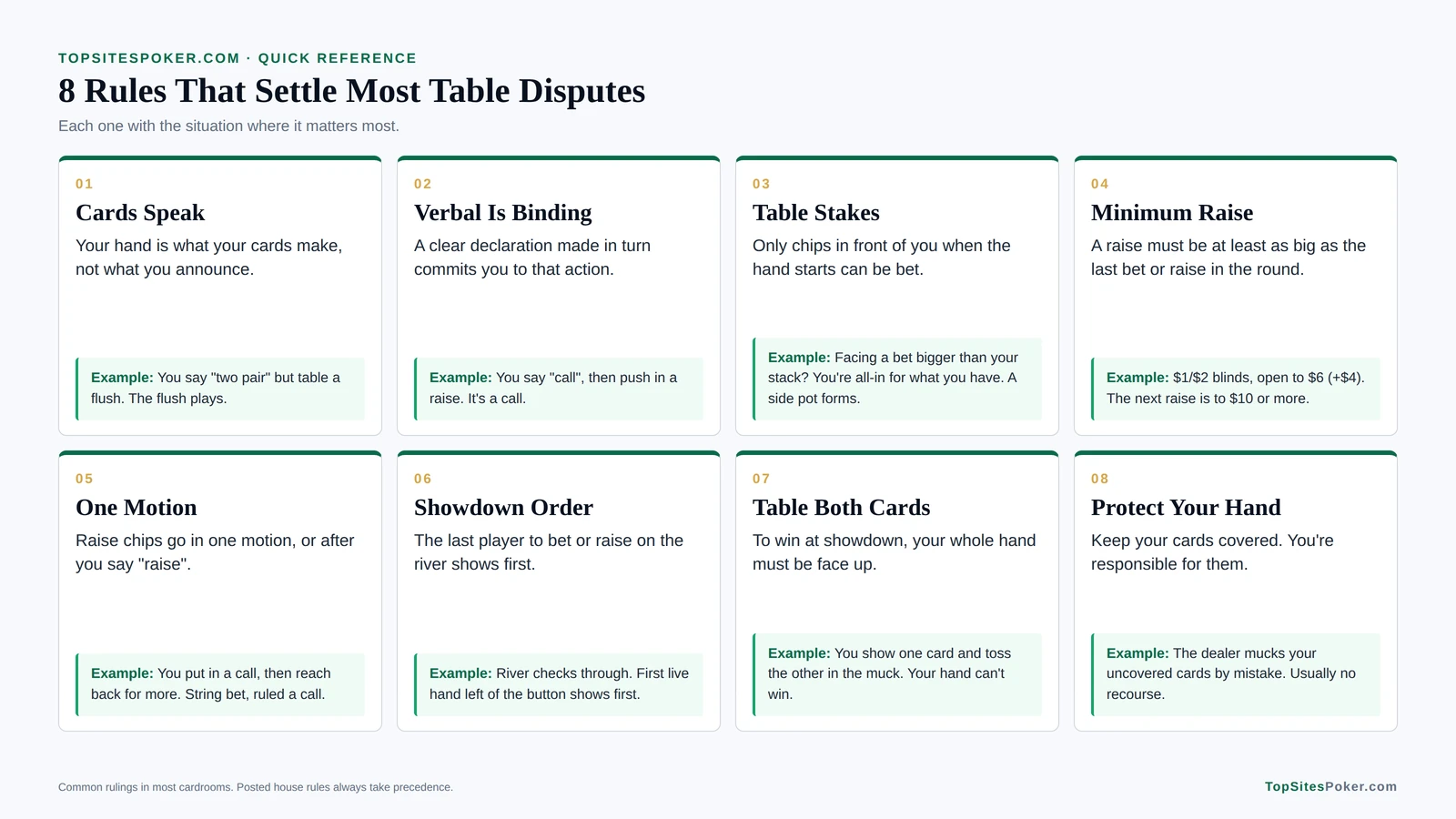
- Your cards speak for themselves, but you must table both of them to win at showdown.
- Verbal declarations made in turn are binding.
- Ties split the pot; suits never break a tie in standard poker.
- The house’s posted rules and the floor’s ruling are final.
Most people learn poker by watching a few hands and picking up the flow. That works until the first real dispute: a raise that wasn’t big enough, a player who went all-in for less, a card flashed during the deal, or two hands that look identical at showdown. Poker’s rules exist for exactly those moments. They decide who wins money when something unusual happens, and at a real table the person who knows them is the one who doesn’t get a bad ruling.
This guide is the complete rulebook for a beginner, organized the way a floor manager thinks about rules. It covers the setup of a game (the deck, the button, the blinds), the betting rules (order of action, minimum raises, how a raise must be made), all-in and side-pot rules, showdown procedure, hand rankings and tie-breakers, dealer errors and irregularities, player conduct, and the rules that differ between cash games, tournaments, online rooms, home games and other poker variants. Texas Hold’em is used for most examples because it’s the game you’re most likely to play, but nearly every rule here applies to all common forms of poker.
Where a rule varies from room to room, this guide says so. Where a widely adopted standard exists, it follows the conventions published by the Tournament Directors Association (TDA), the body whose rules most tournament rooms and many cash-game rooms use as their reference. Your local cardroom’s posted house rules always come first.
Key takeaways
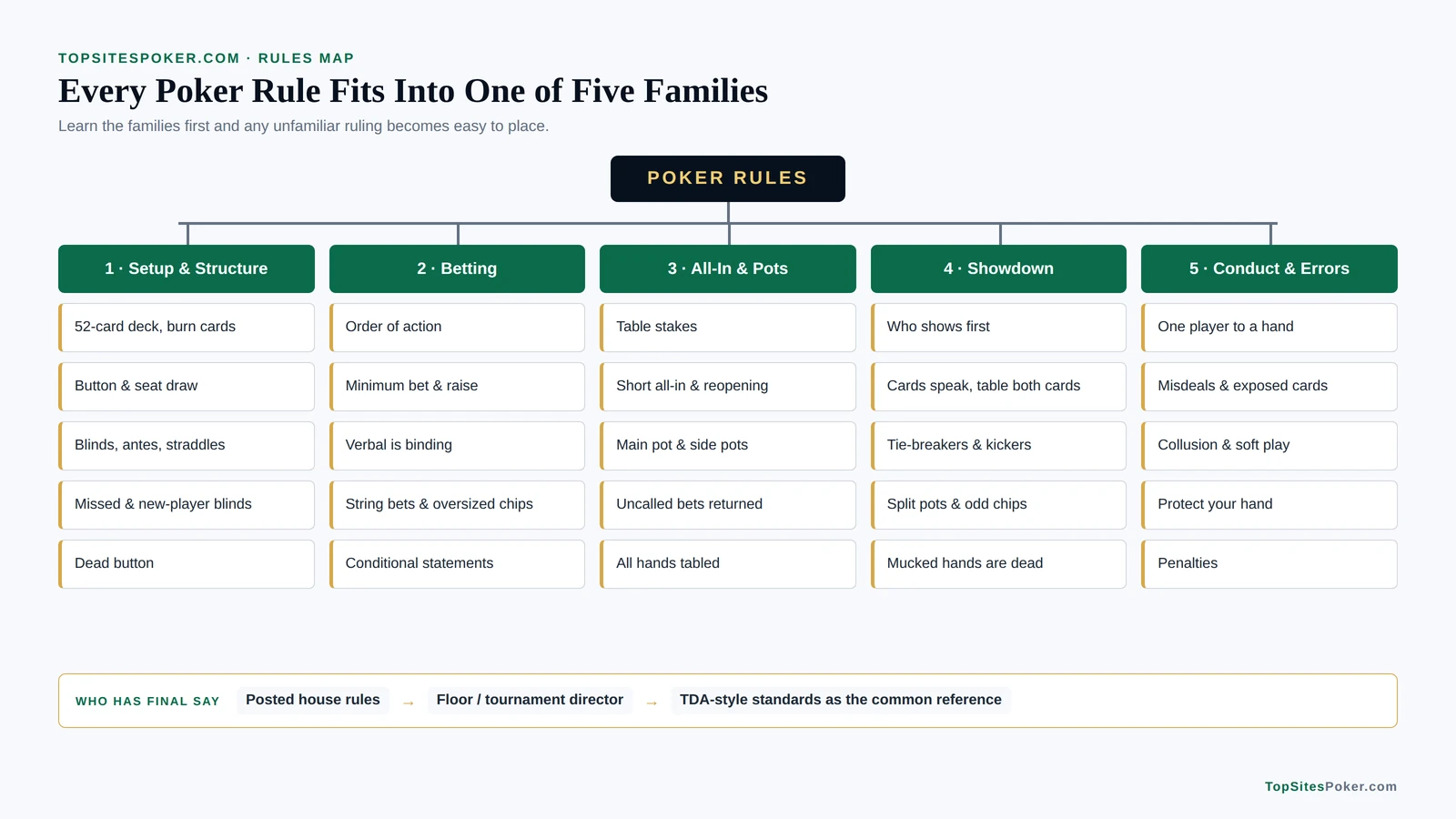
- Nearly every poker rule belongs to one of five families: setup, betting, all-in and pots, showdown, or conduct and errors.
- The minimum raise rule and the “short all-in doesn’t reopen betting” rule cause more beginner confusion than any others. Both are explained with worked numbers below.
- How you put chips in the pot matters as much as how many. Say “raise” before you move chips, or put the full amount in with one motion.
- Side pots follow simple arithmetic: each player can win only as much from each opponent as they put in themselves.
- Dealer errors have set procedures. Speak up immediately, calmly, and let the floor rule.
How Poker Rules Are Organized
Poker has no single world governing body and no single official rulebook. What it has instead is a strong shared core, followed almost everywhere, and a layer of house rules that fill in the details. Once you know the core, most house rules are small variations you can learn in a minute by reading the sign on the wall or asking the dealer.
Where the rules come from
Three sources shape the rules you’ll actually play under:
- House rules. Every licensed cardroom and online site publishes its own rules. They govern buy-ins, straddles, how missed blinds are made up, whether you can use your phone at the table, and dozens of other details. When a house rule conflicts with anything else, the house rule applies.
- The floor’s decision. Rules can’t anticipate every situation. Written rulebooks, including the TDA’s, give the floor manager or tournament director authority to decide disputes in the interest of fairness, even if that means departing from a strict reading of a rule. That decision is final.
- Common standards. The TDA publishes a tournament rulebook that has become the default reference for tournament play worldwide, and many cash-game rooms borrow from it. Older cardrooms and many home games use rules derived from Robert’s Rules of Poker, a widely circulated free rulebook. The two agree on nearly everything a beginner will encounter.
Rules, etiquette and strategy are different things
Beginners often mix up three layers of “how to behave” at a poker table. Keeping them separate saves a lot of confusion:
- Rules are enforceable. Break one and the dealer or floor will make a ruling, which can cost you chips or, in serious cases, get you removed. String betting, acting out of turn and showing your cards to another player during a hand are rule questions.
- Etiquette is expected behavior that keeps the game pleasant: not slow-rolling a winning hand, not criticizing other players’ decisions, tipping dealers in live rooms where that’s customary. Repeated etiquette problems can become rule problems.
- Strategy is anything legal you do to win. Bluffing, check-raising and slow-playing a strong hand are strategy, not rule violations, and complaining about them isn’t a basis for a ruling.
Setup and Structure Rules
Before a single chip goes in the pot, a set of rules decides the deck, the seats, the button and the forced bets. These rarely cause disputes once a game is running, but they explain why the game works the way it does.
The deck
Standard poker uses a single 52-card deck with no jokers: four suits (spades, hearts, diamonds, clubs) of thirteen ranks each, from 2 up to the ace. The ace plays both high (above the king) and low (below the 2) for making straights, so A-K-Q-J-10 and 5-4-3-2-A are both straights, but a straight can’t “wrap around” the ace (Q-K-A-2-3 is not a straight). Short Deck poker removes the 2s through 5s for a 36-card deck, and some home games add wild cards, but neither is standard.
In a cardroom, the deck is shuffled thoroughly before each hand. Dealers typically scramble the cards face down, riffle several times, and cut the deck, usually onto a plastic cut card so the bottom card is never exposed. Automatic shufflers do the same job at many tables. Players don’t touch the deck in a casino game. In home games, the player to the dealer’s right traditionally cuts.
Seats and the dealer button
In a casino, a small disc called the dealer button marks the player who acts as the nominal dealer for that hand, while a house dealer does the actual dealing. The button moves one seat clockwise after every hand, which rotates the blinds and the order of action fairly around the table.
At the start of a game or tournament, the initial button position is usually decided by dealing one card face up to each player. The highest card gets the button. If two players tie on rank, suit breaks the tie, using the order spades (highest), hearts, diamonds, clubs (lowest). This is one of the few situations in poker where suits matter at all.
The deal
In flop games such as Hold’em and Omaha, cards are dealt one at a time, clockwise, starting with the player immediately to the left of the button (the small blind), until each player has the full number of hole cards: two in Hold’em, four in Omaha. The button receives the last card of each round of dealing.
Before each round of community cards, the dealer burns the top card of the deck face down: one burn before the flop, one before the turn and one before the river. The burn protects against anyone who has glimpsed the top card of the deck, and it’s part of the standard procedure for fixing certain dealing errors, as you’ll see in the irregularities section.
The dead button
When a player leaves or is eliminated, the button can’t always move one simple step. Most tournaments and many cash games use the dead button rule, where the big blind always moves forward exactly one player, and the small blind and button fall into place behind it. Sometimes that means the button sits in front of an empty seat, or no one posts a small blind that hand, or the same player ends up acting last two hands in a row. It looks odd, but it guarantees that no one skips the big blind and no one pays it twice in a row because a player busted.
Some cash games use a “moving button” instead, where the button always advances to the next occupied seat and the blinds adjust around it. Either way, the dealer handles it. Your only job is to notice whether you’re due to post.
Blinds, Antes and Posting Rules
Poker needs money in the pot before cards are dealt, or every player could simply wait for a great hand at no cost. Blinds and antes are the forced bets that solve this problem, and a small cluster of rules governs who posts what, and when.
Small blind and big blind
The player to the left of the button posts the small blind, and the next player posts the big blind. The big blind usually equals the minimum bet, and the small blind is usually half of it (a $1/$2 game has a $1 small blind and $2 big blind), though some structures use other ratios, such as $1/$3. Blinds are live bets: they count toward what that player needs to call. If no one raises, the big blind has “the option” to raise when the action reaches them, even though everyone has only called.
Heads-up (two players) changes the arrangement. The button posts the small blind and acts first before the flop, then acts last on every later street. This is one of the most frequently misapplied rules in home games, and it’s standard in every cardroom and online site.
Antes and the big blind ante
An ante is a small forced bet from every player, added to the pot before the deal. Antes are standard in the later levels of most tournaments and in stud games. Unlike blinds, a traditional ante is dead money: it doesn’t count toward calling a bet.
Collecting an ante from nine players every hand is slow, so most modern tournaments use a big blind ante, where the player in the big blind pays the ante for the entire table in one amount, typically equal to the big blind itself. The total paid over a full orbit is similar, and hands move faster. Some cash games use a button ante, where the button pays a single ante for everyone.
Straddles
A straddle is an optional blind, usually twice the big blind, posted before the cards are dealt. The standard straddle is posted by the player under the gun (immediately left of the big blind), who then acts last before the flop and, like the big blind, has the option to raise if everyone just calls. Some rooms allow a “button straddle” or “Mississippi straddle” from other seats, and some allow re-straddles. Others forbid straddles entirely. Straddles are a cash-game feature and generally aren’t permitted in tournaments. Check the house rules before posting one.
New players and missed blinds
In a cash game, you can’t sit down and play a few free hands before your blinds come around. A new player joining a game typically has two choices: post an amount equal to the big blind to be dealt in immediately, or wait until the big blind reaches their seat. Many rooms don’t let a new player post from the small blind or the button position; you wait until the button has passed.
If you step away from a cash game and miss your blinds, you’ll usually have to make them up when you return, either by posting what you missed or by waiting for the big blind. A common convention is that the missed big blind is posted as a live bet and the missed small blind is dead money that goes straight into the pot. Rooms differ, so ask the dealer when you come back.
Tournaments have no such choice. Your blinds and antes are posted whether you’re at the table or not, and an absent player’s stack is “blinded off” until they return or run out of chips. To have a live hand, a tournament player must be at their seat, meaning within reach of their chair, by the time the last card of the initial deal has been dealt. Otherwise, their hand is dead even though their blinds are in the pot.
| Forced bet | Who posts it | Counts toward a call? | Where you’ll see it |
|---|---|---|---|
| Small blind | First player left of the button | Yes | All flop games (Hold’em, Omaha) |
| Big blind | Second player left of the button | Yes, plus the option to raise | All flop games |
| Traditional ante | Every player dealt in | No, it’s dead money | Stud games, some tournaments |
| Big blind ante | The big blind, for the whole table | No, the ante portion is dead | Most modern tournaments |
| Button ante | The button, for the whole table | No | Some cash games |
| Straddle | Usually under the gun, voluntarily | Yes, plus the option to raise | Cash games, where allowed |
| Bring-in | Lowest upcard (highest in Razz) | Yes | Seven Card Stud and Razz |
Betting Rules
Betting is where almost every rules dispute happens, because betting is where the money moves. The rules below cover when you can act, what you’re allowed to do, how much you can bet or raise, and, just as important, how you have to physically do it for your action to count.
Order of action
Action always moves clockwise, one player at a time. Before the flop, the first player to act is the one to the left of the big blind (or to the left of the straddle, if there is one), and the big blind acts last. On the flop, turn and river, the first active player to the left of the button acts first, and the button acts last. Heads-up is the exception covered above: the button acts first preflop and last afterward.
You act only when the action reaches you. Folding, checking or betting before your turn isn’t a harmless shortcut. It gives information to players who haven’t acted yet and can change the hand, which is why it’s governed by its own rule (see “Acting out of turn” below).
The five actions and when each is available
- Check: pass the action without betting. Only possible if no one has bet in the current round. The big blind can check preflop if no one has raised.
- Bet: put the first chips into the pot in a betting round.
- Call: match the current bet.
- Raise: increase the current bet. The other players must then call the new amount, raise again, or fold.
- Fold: give up your hand and any claim to the pot. Folding when you could check is a binding fold. Cash games allow it, but it gives away information, so tournaments can penalize it and some online sites ask you to confirm it.
A betting round ends when every remaining player has either put in the same amount of money or is all-in, and everyone has had at least one chance to act. You can’t raise your own bet: if the action returns to you and no one has raised, you can’t re-raise. The one exception is the big blind’s (or straddler’s) option before the flop.
Check-raising, meaning checking and then raising after someone else bets, is legal in virtually every casino and online room (a few lowball games are traditional exceptions). Some private home games ban it by agreement, but that’s a house rule, not a standard poker rule.
Minimum bets and the minimum raise rule
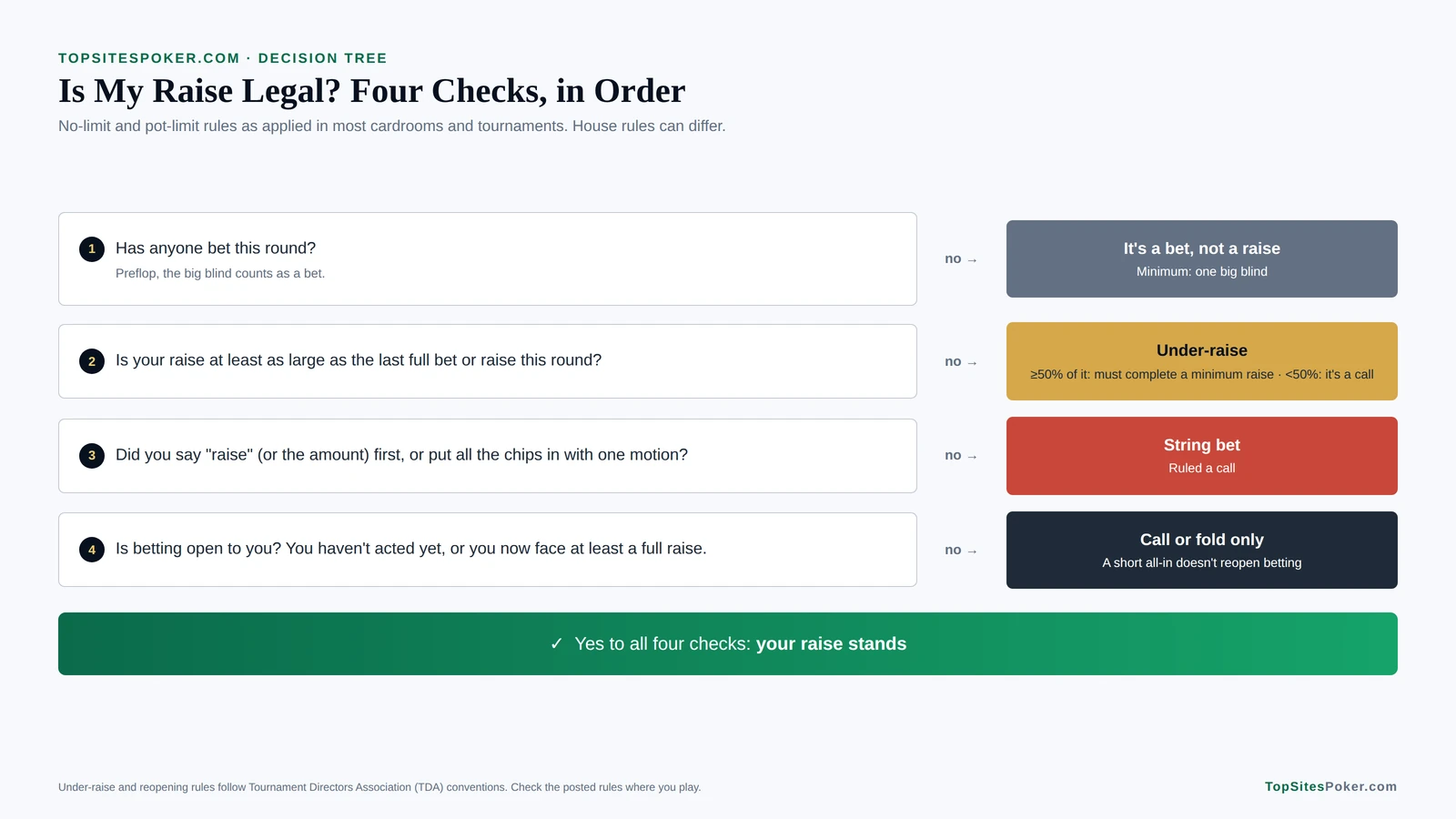
In no-limit and pot-limit games, the smallest bet allowed is one big blind. The smallest raise is governed by the most important betting rule in poker:
Beginners often read that as “double the last bet,” which is right for the first raise but wrong after that. The rule is about the increment, not the total. Preflop, the big blind counts as the opening bet, so in a $1/$2 game the minimum raise is to $4 (an increment of $2). If someone raises to $6 (an increment of $4), the next raise must be at least another $4, to $10. It’s not $12.
| Situation ($1/$2 no-limit) | Last full increment | Minimum legal raise |
|---|---|---|
| Preflop, no one has raised yet (the $2 big blind is the bet) | $2 | To $4 |
| Preflop, a player has raised to $6 | $4 ($2 to $6) | To $10 |
| Preflop, raised to $6, then re-raised to $20 | $14 ($6 to $20) | To $34 |
| Flop, first bet of $10 | $10 | To $20 |
| Flop, bet $10, raised to $35 | $25 ($10 to $35) | To $60 |
| Flop, bet $10, a player goes all-in for $14 | Still $10 (the $4 all-in wasn’t a full raise) | To $24, for a player who hasn’t acted yet |
The last row matters. An all-in that falls short of a full raise doesn’t change the minimum raise for anyone else, and, as the all-in section explains, it may not let players who have already acted raise at all.
In no-limit, there’s no maximum: you can bet or raise any amount up to all the chips in front of you. Pot-limit and fixed-limit games cap the amount, as covered below.
No-limit, pot-limit and fixed-limit betting
The betting structure is part of the game’s name (“$1/$2 No-Limit Hold’em,” “Pot-Limit Omaha,” “$4/$8 Limit Hold’em”), and it changes how much you can bet, not how the hand is played.
- No-limit: minimum bet of one big blind, minimum raise per the rule above, no maximum beyond your stack.
- Pot-limit: the same minimums, but the maximum bet is the size of the pot. The maximum raise is the amount you’d need to call plus the size of the pot after your call. In pot-limit games you can ask the dealer to count the pot for you; in no-limit and fixed-limit games, dealers generally don’t count the pot on request.
- Fixed-limit: every bet and raise is a set amount. In $4/$8 Limit Hold’em, bets and raises are $4 preflop and on the flop (the “small bet”) and $8 on the turn and river (the “big bet”). Most rooms cap the number of raises per round, commonly at one bet and three raises, sometimes four raises. Many cash games lift the cap when only two players remain in the hand; under TDA tournament rules, the cap stays in place until the tournament itself is down to two players.
Pot-limit worked example. The pot is $30 on the flop. Your opponent bets $10, so there’s $40 in the middle. To raise the maximum, you first “call” $10 (the pot becomes $50), then raise by the size of that pot, $50. Your total bet is $60. A useful shortcut: the maximum raise-to amount is three times the bet you’re facing plus whatever was in the pot before it (3 × $10 + $30 = $60).
How to make a bet or raise so it counts
This is the part of the rules that costs beginners real money, because the way you put chips in can override what you meant to do. In a live game, a raise is only a raise if you make it one of these ways:
- Say “raise” (or state the full amount, such as “raise to 60”) before or as you put chips forward, or
- Put the full raise amount into the pot in a single forward motion.
Some cardrooms also accept a third method as a house rule: say “raise,” put in the amount to call, and then add the extra chips in one more motion. Current TDA tournament rules recognize only the first two methods, so in a tournament, stick to them. What you can’t do is push in a call, see how the table reacts, and then go back to your stack for more chips without having said “raise.” That’s a string bet, and it’s ruled a call. Dealers are expected to call string bets themselves, and other players can point one out.
The reason is fairness. Without the rule, a player could put in a call, watch an opponent’s face, and decide whether to turn it into a raise. The “declare it or do it in one motion” requirement removes that angle entirely.
Oversized chips and multiple chips
Two more physical-betting rules follow the same logic:
- A single oversized chip put in without a word is a call if you’re facing a bet. Tossing a $100 chip into a $25 bet silently means you’ve called $25 and get $75 in change. To raise with a large chip, say “raise” before the chip hits the table. If you’re not facing a bet, a single chip put in silently is a bet of that chip’s full value.
- Multiple chips put in without a declaration are a call if every chip is needed to make the call. Under the TDA standard, if you could remove any one chip and still have at least the call amount, the bet is treated as a raise attempt, and the 50% rule below decides whether it becomes a full raise or stays a call. Facing a 1,200 bet in a tournament, silently putting in two 1,000 chips is a call, because removing one chip would leave only 1,000. Facing a 1,000 bet, the same two chips are a raise to 2,000.
The 50% rule for short raises
Sometimes a player puts in more than a call but less than a legal minimum raise. The widely used TDA standard handles it simply: if the extra amount is at least 50% of the minimum raise increment, the player must complete a full minimum raise; if it’s less than 50%, it’s treated as a call and the extra chips are returned.
In a $1/$2 game, facing an opening bet of $20 after the flop (so the minimum raise is to $40), a player who silently puts in $30 has added $10, exactly 50% of the $20 increment, so they must make it $40. A player who puts in $28 has added $8, less than 50%, so it’s a call of $20 and $8 goes back to them. Declaring “raise” and putting in a short amount has the same effect: you’ll be required to make at least the minimum raise.
Verbal declarations are binding
What you say in turn counts. If you say “call,” you’ve called, even if you then push in a raise. If you say “raise to 50,” you must put in 50. If you say “all-in,” you’re all-in. When your words and your chips don’t match, whichever comes first generally defines the action. That’s why the safest habit is to speak before you move any chips.
Use standard, unambiguous words: check, bet, call, raise, fold, all-in, and state amounts clearly. Non-standard terms (“I’ll play,” “let’s go,” a tap on the table that could mean check or could just be a nervous gesture) can be ruled differently from what you meant. Knocking or tapping the table is a widely accepted way to check, but saying “check” removes all doubt.
Conditional statements
Statements about future action, such as “if you bet, I’ll raise” or “I’m calling whatever you do,” are called conditional statements. Rulebooks strongly discourage them, and the TDA’s rules allow the floor to treat them as binding, to penalize them, or both. The safe rule is simple: say nothing about what you’re going to do until it’s your turn, and then just do it.
Acting out of turn
If you act before it’s your turn, the action may be binding. Under the TDA standard, an out-of-turn action stands if the action to you hasn’t changed by the time it’s really your turn. A check, call or fold by the players in between doesn’t change the action; a bet or raise does. So if you say “call” out of turn and the players between you then check or fold, you’re held to your call. If someone in between bets or raises, your out-of-turn action no longer binds you and you can reconsider, with one exception: an out-of-turn fold always stands. Either way, acting out of turn can draw a warning or a penalty, because it hands information to the players who should have acted first.
Undercalls
An undercall is putting in less than the amount needed to call without declaring anything. Under TDA rules, an undercall is treated as a full call when facing an opening bet in a multi-way pot on any round, or when facing any bet heads-up. In other situations, the floor decides. The practical rule: confirm the amount before you act, and ask the dealer (“how much to call?”) if you’re not sure.
Chip visibility, counts and cash on the table
Your chips need to be visible and stacked in a way that lets opponents estimate your stack. Large-denomination chips must stay in view, not hidden behind smaller stacks. Opponents are entitled to a reasonable estimate of your chips at any time. In tournaments following TDA rules, a player can ask for a precise count only when facing an all-in bet and it’s their turn to act. In cash games, some rooms allow cash to play on the table alongside chips, but it must be visible, and the house rules decide whether it plays for the full amount.
Taking too long: calling the clock
Players are entitled to a reasonable amount of time to decide. When someone takes much longer than that, any player can ask the dealer to “call the clock.” A floor manager then gives the player a fixed amount of time, often a minute or less with a short final countdown. Under TDA tournament rules, that’s 25 seconds plus a five-second countdown. If time runs out, the hand is dead if the player is facing a bet, or checked if they aren’t. Online rooms enforce the same idea automatically with a turn timer and a separate time bank.
All-In Rules and Side Pots
Going all-in is the most dramatic moment in poker, and it comes with the most arithmetic. The good news is that every all-in situation follows from two simple principles: you can only bet what’s in front of you, and you can only win from each opponent as much as you put in yourself.
Table stakes
Poker is played table stakes. Only the chips (and, where allowed, cash) you have on the table at the start of a hand can be used during that hand. You can’t reach into your wallet mid-hand, and you can’t be forced out of a pot because an opponent bets more than you have. If you face a bet larger than your stack, you can call all-in for whatever you have left. Between hands, in a cash game, you can add chips up to the table maximum. In a tournament, you can add chips only through a rebuy or add-on, if the event offers them.
What an all-in player can win
An all-in player competes only for the part of the pot they matched. If you’re all-in for $40 and two opponents keep betting, you can win at most $40 from each of them, plus your own $40 and any dead money that was already in the pot. Everything they bet beyond that goes into a side pot that you have no claim to. You don’t need to calculate this at the table, because the dealer does it, but knowing how it works lets you check the dealer’s math and understand the ruling if something goes wrong.
Uncalled bets are returned
If you bet more than any opponent can call, the unmatched part of your bet goes back to you. Bet $300 into a player who has only $180 left, and if they call all-in, $120 comes back to you. You’re only ever at risk for as much as the largest opposing stack still in the hand.
Short all-ins and reopening the betting
This is the rule that confuses even experienced home-game players. In no-limit and pot-limit games:
Example. On the flop, Player A bets $100. Player B calls $100. Player C goes all-in for $140, which is a raise of only $40, less than the $100 needed for a full raise. The action returns to A and B. Neither is facing a full raise, and both have already acted, so each can only call the extra $40 or fold. Neither can re-raise. If instead a Player D, who hadn’t yet acted, were still to act after C, D could raise, and the minimum would be to $240 (C’s $140 plus the last full increment of $100).
Two refinements come up in tournament rules. First, several short all-ins can add up: under the TDA rules, if multiple short all-ins together amount to a full raise, the betting reopens for a player who faces that full raise. Second, fixed-limit games use a different threshold: an all-in of at least half a full bet or raise reopens the betting.
All hands are tabled in an all-in showdown
In tournaments, once a player is all-in and all betting action is complete, every hand still in the pot is turned face up immediately, before the remaining board cards are dealt. This protects against collusion, where two players could otherwise check a hand down to help eliminate a third. Many cash games follow the same procedure; others only require it at showdown. In tournaments, you can’t muck a hand that’s part of an all-in showdown before the pot has been awarded; cash-game rooms vary.
Side pots: a worked example
Four players are in a hand. To keep the numbers clean, ignore the blinds. Before the flop, Player A goes all-in for $40. Player B goes all-in for $100. Players C and D, both with deep stacks, each call $100. On the flop, C bets $150 and D calls. Here’s how the dealer builds the pots:
| Pot | How it’s built | Amount | Eligible players |
|---|---|---|---|
| Main pot | $40 from each of A, B, C and D | $160 | A, B, C, D |
| Side pot 1 | The next $60 from each of B, C and D ($100 − $40) | $180 | B, C, D |
| Side pot 2 | $150 each from C and D on the flop | $300 | C, D |
| Total | $40 + $100 + $250 + $250 | $640 |
Now suppose the showdown ranks the hands A (best), then B, then C, then D (worst). The dealer usually awards the side pots first and works back to the main pot. Side pot 2 goes to C, the better of the two players eligible for it: $300. Side pot 1 goes to B, the best hand among B, C and D: $180. The main pot goes to A: $160. A turned $40 into $160, B turned $100 into $180, C put in $250 and won $300, and D lost $250. The net results (+$120, +$80, +$50, −$250) add up to zero, which is a quick way to check any side-pot calculation.
Notice that A, with the best hand, won the smallest pot. That’s the whole point of table stakes: A risked only $40, so A can only win $40 from each opponent.
Showdown Rules
If more than one player remains after the final betting round, the hand goes to showdown. If everyone else has folded, the last remaining player wins without showing anything. Showdown has its own set of rules about who shows first, what you need to show, and when a hand is dead.
Who shows first
- If there was a bet on the river: the last player to bet or raise on the final betting round shows first. The player who called then either shows a better hand or can muck without showing.
- If the river was checked through: the player who would act first in a betting round shows first. In Hold’em, that’s the first remaining player to the left of the button, then the others in clockwise order.
- In an all-in situation: all hands are already face up, as described above.
Losing players who see they’re beaten don’t have to show. They can muck their cards and give up their claim to the pot. In practice, showdowns often move quickly this way. The rules on order matter when no one wants to go first, which is why they’re written down.
Cards speak, but you have to table them
“Cards speak” means your hand is whatever your cards actually make, not what you announce. If you say “I have two pair” and turn over a flush, the flush plays. If you say “flush” and turn over a hand that doesn’t make a flush, your announcement doesn’t help you. The dealer reads the hand.
The flip side is that your cards can only speak if they’re visible. To win a pot at showdown, you must table your hand: turn both hole cards face up on the table (all four in Omaha). Showing one card, or holding your cards up for a neighbor to see, isn’t tabling. Once a hand is properly tabled and clearly the winner, the dealer can’t kill it, and players are generally expected to point out an obvious misread before the pot is pushed.
Deliberately announcing a hand you don’t have to trick an opponent into mucking is a different matter. It’s considered angle shooting, and in many rooms a player who misrepresents their hand can be penalized, or their hand can be ruled dead, even if the cards turn out to be good.
Mucked hands are dead
Once your cards touch the muck (the pile of discarded cards) or are thrown face down in a way that signals a fold, your hand is normally dead and can’t be retrieved, even if it would have won. Floor staff can sometimes retrieve a tabled hand that was mucked by dealer error if it’s clearly identifiable, but you shouldn’t count on it. The practical rule is to never release your cards until the dealer has pushed the pot.
Protect your hand
Players are responsible for their own cards. Keep them on the table in front of you and place a chip or card protector on top. If your unprotected cards are mucked by the dealer or fouled when another player’s discard hits them, you usually have no recourse, and the chips you’ve put in the pot stay there.
Asking to see a hand
If you called a river bet, you have the right to see the hand of the player you called, as long as you’ve tabled your own hand or still hold it. Beyond that, requests to see mucked hands are up to house rules and the floor. Many cash games let any player who was dealt in ask to see a called hand at showdown, a privilege meant to help detect collusion. Using it repeatedly just to gather information about opponents is frowned upon, and rooms can withdraw it from players who abuse it.
Show one, show all
If you show your cards to one player, whether during the hand or after it ends, most rooms entitle every player at the table to see them too. Showing a hand to one player during a live hand also violates the one-player-to-a-hand rule covered below.
Hand Rankings: What Beats What
Showdown depends on one fixed ranking of five-card hands, used in every standard form of high-hand poker. Only the best five cards count. In Hold’em, those can come from any combination of your two hole cards and the five community cards, including using both, one, or neither of your hole cards.
| Rank | Hand | Example | What it is |
|---|---|---|---|
| 1 | Royal flush | A♠ K♠ Q♠ J♠ 10♠ | Ace-high straight, all one suit |
| 2 | Straight flush | 9♥ 8♥ 7♥ 6♥ 5♥ | Five consecutive cards, all one suit |
| 3 | Four of a kind | Q♣ Q♦ Q♥ Q♠ 7♦ | Four cards of one rank |
| 4 | Full house | J♠ J♥ J♦ 4♣ 4♠ | Three of one rank plus a pair |
| 5 | Flush | K♦ 10♦ 8♦ 5♦ 2♦ | Five cards of one suit, not consecutive |
| 6 | Straight | 8♣ 7♦ 6♠ 5♥ 4♣ | Five consecutive ranks, mixed suits |
| 7 | Three of a kind | 7♠ 7♥ 7♣ K♦ 2♠ | Three cards of one rank |
| 8 | Two pair | A♥ A♣ 9♠ 9♦ 3♥ | Two different pairs |
| 9 | One pair | 10♠ 10♥ A♦ 6♣ 4♠ | Two cards of one rank |
| 10 | High card | A♣ J♦ 8♠ 6♥ 3♦ | None of the above; highest card plays |
The ordering follows probability: the rarer the hand, the higher it ranks. That’s why a flush beats a straight, and why a full house beats a flush in standard poker. Short Deck, with its 36-card deck, reverses the flush and full house because removing the low cards makes flushes rarer there.
Tie-breakers and kickers
When two players have the same type of hand, the rules compare the cards inside the hand first, then the leftover cards (the kickers) from highest to lowest, until one hand is ahead. Only five cards ever count, so a sixth card can never break a tie. Suits never break ties in standard poker.
| Hand type | Compare first | Then | Example of a decided tie |
|---|---|---|---|
| Straight flush / straight | The highest card of the straight | Nothing else; equal straights split | 9-high straight beats 8-high straight. A-2-3-4-5 is the lowest straight (5-high). |
| Four of a kind | Rank of the four | The kicker | Board 8-8-8-8-3: player holding a king beats player holding a queen. |
| Full house | Rank of the three | Rank of the pair | K-K-K-2-2 beats Q-Q-Q-A-A. |
| Flush | Highest card | Next highest, down through all five | A-J-9-6-3 beats A-J-9-5-4 on the fourth card. |
| Three of a kind | Rank of the three | Two kickers, in order | 7-7-7-A-4 beats 7-7-7-K-Q. |
| Two pair | Higher pair | Lower pair, then the kicker | A-A-3-3-5 beats K-K-Q-Q-J. Q-Q-8-8-A beats Q-Q-8-8-K. |
| One pair | Rank of the pair | Three kickers, in order | K-K-Q-9-4 beats K-K-J-10-9. |
| High card | Highest card | Each remaining card, in order | A-Q-8-6-2 beats A-Q-8-5-4. |
Split pots and odd chips
If two or more players’ best five-card hands are identical in rank, the pot is divided equally among them. This happens more often in Hold’em than beginners expect, mostly because the board is shared. If the five community cards make a better hand than anyone can improve on, such as a board of A♠ K♦ Q♣ J♥ 10♠, every remaining player “plays the board” and splits the pot. In a live game, you still table your cards to claim your share.
When a pot can’t be split evenly, the leftover chip goes to a specific player by rule. In flop games, the TDA standard gives the odd chip to the first winning player to the left of the button. In high-low split games, the odd chip goes to the high half of the pot. In stud games, it usually goes to the winning hand with the highest card by suit. Online rooms apply equivalent rules automatically.
Irregularities: When the Dealer or a Player Makes a Mistake
Dealers are human, decks get dropped, and cards get flashed. Poker’s rulebooks have set procedures for these moments, so the fix doesn’t depend on who argues loudest. The details below follow the TDA’s published procedures and the conventions most cardrooms use. House rules can differ, and the floor’s ruling is final.
Misdeals and “substantial action”
A misdeal means the hand is cancelled: all cards are gathered, the deck is reshuffled, and the hand is dealt again with the button and blinds in the same place. Typical misdeal triggers in flop games include:
- Two or more cards found face up (boxed) in the deck during the initial deal.
- The first card dealt to the wrong seat.
- Cards dealt to a seat that isn’t entitled to a hand, or a seat that is entitled to a hand being skipped.
- In many rooms, the first or second card of the deal exposed by the dealer, or two or more hole cards exposed through dealer error.
There’s a time limit. Once substantial action has occurred, a misdeal can no longer be declared and the hand continues as well as it can. The TDA defines substantial action as either two actions in turn where at least one puts chips in the pot (any two actions other than two checks or two folds), or any three actions in turn. Posting blinds doesn’t count. That’s why you should point out a dealing error the moment you notice it, not after you’ve seen how the hand develops.
Premature and extra board cards
If the dealer puts out community cards before the betting round has finished, or deals too many, the board has to be repaired so no one gains an advantage from cards they shouldn’t have seen yet. Common procedures:
- Premature flop: the flop cards are returned to the deck, the deck is reshuffled and cut, and a new flop is dealt. The original burn card stays where it is.
- Four-card flop: under the TDA procedure, the dealer scrambles the four cards face down, a floor person randomly picks one to become the next burn card, and the other three become the flop. Some rooms instead redeal the flop entirely.
- Premature turn: the card is set aside. Betting on the flop is completed, then the dealer burns and deals a new turn card. After the turn betting, the set-aside card is shuffled back into the remaining deck before the river is dealt.
- Premature river: the card is shuffled back into the remaining deck after the turn betting is complete, and a new river is dealt.
Exposed cards
What happens depends on who exposed the card and when:
- Exposed by the dealer during the deal (and not enough for a misdeal): the usual fix is that the exposed card is replaced with the next card from the deck and then used as the burn card for the flop.
- Exposed by the player who holds it: not a misdeal. Your hand stays live, but you’ve given away information, and that’s your problem. Deliberately exposing cards during a hand can be penalized in tournaments.
- Exposed while folding: the hand is still folded. Some rooms show a flashed card to the whole table so every player has the same information.
Wrong number of cards and fouled hands
If a player receives too many or too few hole cards and it’s discovered before substantial action, it’s normally a misdeal. After substantial action, a hand with the wrong number of cards is usually declared dead (fouled), and that player loses any claim to the pot. A hand can also be fouled by being mixed with the muck or with another player’s cards. Protecting your cards prevents most of these situations.
Pot awarded to the wrong player
If the dealer misreads a tabled hand and pushes the pot to the wrong player, the mistake can usually be corrected as long as it’s raised promptly, typically before the next hand has started being dealt. This is one more reason to keep your winning hand face up until you actually have the chips.
| Situation | Typical ruling | What you should do |
|---|---|---|
| Two cards boxed in the deck on the initial deal | Misdeal; reshuffle and redeal | Wait for the redeal; don’t act on your cards |
| Dealer skips a player entitled to a hand | Misdeal if caught before substantial action | Speak up immediately |
| Flop dealt before preflop betting finished | Flop reshuffled into the deck; new flop | Finish the preflop action as if you hadn’t seen it |
| Four cards come out on the flop | One chosen at random as the next burn; three remain as the flop (TDA) | Call the floor; don’t argue about which card “should” be there |
| Player acts before their turn | Binding if the action to them doesn’t change; possible penalty | Wait until the action is clearly on you |
| Player shows cards to a neighbor mid-hand | Penalty in tournaments; show-one-show-all in many cash games | Keep your cards to yourself until showdown |
| Hand is mucked before being tabled | Hand is dead, even if it would have won | Table both cards and wait for the pot |
| Dealer pushes pot to the wrong player | Corrected if raised before the next hand starts | Keep your hand face up and speak up at once |
| Player at the table but not in the seat when the deal finishes (tournament) | Hand is dead; blinds and antes stay in the pot | Be within reach of your chair when cards go out |
The common thread: say something immediately, say it calmly, and ask for the floor if needed. “Floor, please” is the standard request. A prompt objection is far more likely to be upheld than a complaint three actions later, and a player who argues with a ruling instead of accepting it can be penalized for that too.
Conduct and Integrity Rules
Poker is a game where every player is trying to win money from every other player, so the rules protect the game’s integrity as much as its mechanics. These rules apply everywhere, live and online, cash and tournament.
One player to a hand
Each hand is played by one person, alone. You can’t ask a friend what to do, a spectator can’t advise you, and you can’t discuss the hand with someone who is still in it. Players who have folded are also expected to stay silent about the hand in progress. Saying “I folded a king” while two players are still betting changes the odds for both of them, and it’s a rules violation, not just bad manners.
No collusion, soft play or chip dumping
- Collusion is any agreement between players to share information or coordinate actions against others at the table. It’s cheating, and it can lead to disqualification, confiscation of winnings and bans.
- Soft play is deliberately not betting or raising against a friend when you normally would. In tournaments, it’s penalized because it harms every other player in the field.
- Chip dumping is intentionally losing chips to another player, for example to help a friend build a tournament stack. It’s treated as collusion.
Phones, devices and assistance
House rules on phones vary, but the direction everywhere is the same. You generally can’t talk on the phone at the table, and devices must be silent. Current TDA rules go further: strategy apps and charts aren’t allowed at the table at all, and a player with a live hand can’t use an electronic device. Online, real-time assistance software that advises you during a hand is prohibited by major poker sites, and using it can get an account closed and its balance withheld.
Language and behavior
Many tournaments require table talk during a hand to be in a single language, often English in U.S. events, so everyone can understand what’s being said. Abusive language, throwing cards or chips, and repeatedly criticizing other players’ play can all draw penalties. The TDA’s penalty options run from a verbal warning, through chip penalties and “missed hand” or “missed round” penalties where the player sits away from the table while their blinds and antes are still posted, to disqualification for serious or repeated offenses.
Angle shooting
Angle shooting means using technically ambiguous actions to gain an unfair edge: making a motion that looks like a call to see how an opponent reacts, hiding high-value chips, misrepresenting your hand at showdown, or pretending not to understand a rule. Rulebooks give the floor wide discretion to penalize conduct that is within the letter of the rules but clearly against their spirit.
Cash Game Rules
Cash games (also called ring games) use the same betting and showdown rules as tournaments, but a handful of rules only make sense when chips represent real money you can take home.
- Buy-ins: every cash game has a minimum and maximum buy-in, often expressed in big blinds, such as 40 to 100 big blinds for a common no-limit game. You can add chips (top up) between hands, up to the maximum.
- No “going south” or ratholing: you can’t remove chips from the table while you stay in the game. You can take them all when you leave. If you leave and return to the same game within a set period, many rooms require you to buy in for at least the amount you left with, so no one can “win and run” and come back short.
- Rake and time charges: the house earns money either by taking a small percentage of each pot, usually capped, or by charging a fixed fee per player every half hour. The rate should be posted.
- Seat and table changes: you can usually request a seat change within your game or a move to another table of the same game. The floor manages a list.
- Must-move games: when a game is popular, rooms run a main game and a “must-move” feeder game. Players in the feeder are moved into the main game in order as seats open.
- Playing over: some rooms let a waiting player sit in an absent player’s seat and play, with the absent player’s chips moved aside.
- Rabbit hunting and running it twice: dealing out the remaining cards after a hand is over just to see them (“rabbit hunting”) is forbidden in most cardrooms. Running an all-in board more than once is allowed in some cash games when all involved players agree, but it isn’t part of standard tournament play.
Tournament Rules
Tournaments add a clock and an elimination format, and with them come rules that don’t exist in cash games.
- Chips have no cash value. Everyone starts with the same number of tournament chips, and you’re paid based on your finishing position, not your chip count. You can’t leave with chips or cash them out.
- Blind levels increase on a schedule. Blinds and antes rise at fixed intervals, and the structure sheet posted by the tournament lists every level, break and late-registration cutoff.
- Rebuys, re-entries and add-ons are only available if the event offers them and only within the stated period.
- Chip race (color-up): when the smallest chips are no longer needed, they’re removed. Whole amounts are exchanged for larger chips, and leftover small chips are “raced off”: each player gets one card per leftover chip, and the highest cards win the larger chips. Under TDA rules, a player can’t be eliminated by a chip race; if a player would lose their last chip, they get one chip of the lowest denomination still in play.
- Hand-for-hand: near the money bubble, all tables play one hand at a time and wait for each other, so no one can stall to move up the payouts.
- Simultaneous eliminations: if two or more players bust on the same hand, the player who started that hand with more chips finishes higher. If they started with equal stacks, many events have them share the combined prize money for those places, so check the tournament’s rules.
- Balancing and breaking tables: as players are eliminated, the tournament moves players between tables to keep them balanced. You’ll take your chips to your new seat when asked.
- Deals: players at a final table sometimes agree to divide the remaining prize money. Tournaments typically allow this only with the tournament director’s approval, and any player can decline a deal without penalty.
| Rule area | Cash games | Tournaments |
|---|---|---|
| Chip value | Chips equal real money | Chips have no cash value |
| Blinds | Fixed for the life of the game | Increase on a posted schedule |
| Leaving | Leave any time with your chips | Play until eliminated or the event ends |
| Missing hands | Sit out; make up missed blinds on return | Blinds and antes are posted in your absence |
| Adding chips | Top up between hands, up to the maximum | Only via rebuy or add-on, if offered |
| Straddles | Allowed in many rooms | Generally not allowed |
| Running it twice | Sometimes, by agreement | Not part of standard tournament play |
| All-in hands | Tabled at showdown (earlier in many rooms) | Tabled as soon as betting is complete |
| Penalties | Warnings, removal from game | Warnings, missed hands or rounds, disqualification |
Online Poker Rules
Online, the software enforces the betting rules automatically. You can’t string bet, act out of turn, under-raise or expose a card by accident. Buttons only offer legal actions, and the minimum raise is calculated for you. That makes online play a comfortable place to learn, but it also means the rules that matter online are different ones.
- Time to act: each decision has a timer, usually backed by a time bank you can dip into for difficult spots. If both run out, your hand is checked if possible and folded if not.
- Disconnections: policies vary by site. Some treat a disconnected player like a timed-out one; others offer limited disconnection protection. Read your site’s policy before playing for meaningful stakes.
- Sitting out: in cash games you can sit out, but you’ll be asked to post missed blinds when you return, and you may be removed after a set number of missed hands. In tournaments, your blinds are posted automatically and your hand is folded.
- One account per person: multi-accounting, account sharing and letting someone else play for you (“ghosting”) are prohibited everywhere.
- No collusion or assistance software: sites run security teams and analysis tools that look for collusion, chip dumping, bots and real-time assistance. Accounts found breaking these rules are closed, and winnings can be confiscated.
- Eligibility: regulated sites verify your identity and, in U.S. states that license online poker, confirm your location is inside the state. The minimum age is 21 in the U.S. states that license online poker, including Nevada, New Jersey, Pennsylvania and Michigan, and 18 in many other jurisdictions.
How the Rules Change Between Poker Variants
Everything above applies across poker, but each variant changes a few specific rules: how many cards you get, which cards you’re allowed to use, who acts first, and sometimes what counts as the best hand. These are the differences that trip up Hold’em players when they try another game.
| Game | Cards | Key rule difference from Hold’em | Usual betting |
|---|---|---|---|
| Texas Hold’em | 2 hole cards + 5 community | Use any five of your seven cards: both hole cards, one, or none | No-limit (limit also common) |
| Omaha (PLO) | 4 hole cards + 5 community | You must use exactly two hole cards and exactly three board cards | Pot-limit |
| Omaha Hi-Lo (8 or better) | 4 hole cards + 5 community | Pot splits between the best high hand and the best low of five different ranks, 8 or lower; if no low qualifies, the high hand wins it all | Pot-limit or fixed-limit |
| Seven Card Stud | 7 cards each (3 down, 4 up), no community cards | Antes plus a bring-in from the lowest upcard; from fourth street, the highest showing hand acts first | Fixed-limit |
| Razz | 7 cards each, as in Stud | Lowest hand wins; straights and flushes don’t count against you; aces are low; the highest upcard brings it in | Fixed-limit |
| 2-7 Triple Draw | 5 cards, three draws | Lowest hand wins; aces are high; straights and flushes count against you, so the best hand is 7-5-4-3-2 | Fixed-limit |
| Short Deck (6+) | 2 hole cards, 36-card deck | 2s through 5s removed; a flush beats a full house; A-6-7-8-9 is the lowest straight | No-limit, often with a button ante |
The single most common variant mistake is the Omaha “two and three” rule. In Omaha, holding A♥ K♥ 7♣ 2♦ on a board with four hearts doesn’t give you a flush unless two of your hole cards are hearts. Here they are (A♥ K♥), so you have an ace-high flush. But if the A♥ were your only heart, you’d have no flush at all, even with four hearts on the board, because you can’t combine one hole card with four board cards. The same logic means a board of four to a straight doesn’t give you the straight unless two of your own cards complete it.
In stud games, ties for the bring-in are broken by suit. The usual order for this purpose is clubs lowest, then diamonds, hearts and spades highest. It’s one of the rare places, along with the button draw and odd chips in stud, where suit ever matters.
Home Game Rules
A home game can run on any rules the players agree to, which is both its charm and its biggest source of arguments. Most disputes in home games come from rules nobody discussed beforehand. Settling these points before the first hand prevents nearly all of them:
- Game and structure: which variant, which betting structure, and whether “dealer’s choice” rotates the game.
- Stakes and buy-ins: the blinds, the buy-in, whether rebuys are allowed, and when rebuys stop.
- Blind increases: for a home tournament, the level length and blind schedule, written down where everyone can see it.
- Which casino rules apply: are string bets enforced? Is check-raising allowed? Does a folded hand exposed by accident get shown to everyone?
- Dealing: who deals, who cuts, how misdeals are handled, and whether the dealer rotates with the button.
- Money: who holds the bank, how chips are cashed out, and, if you want to avoid awkward moments, no playing on credit.
- Ending time: a fixed finish time or a last orbit, so no one feels trapped at the table.
A simple approach is to adopt standard cardroom rules for everything and agree only on the exceptions. That way, anyone who has played in a casino already knows the rules, and a new player can learn rules that will serve them anywhere.
One legal note: whether a private poker game is legal depends on where you live. In many places, a social game is only lawful if the host takes no cut of the pots and charges no fee to play. Check your local law before hosting a regular game, especially one with significant stakes.
The Most Common Rule Mistakes
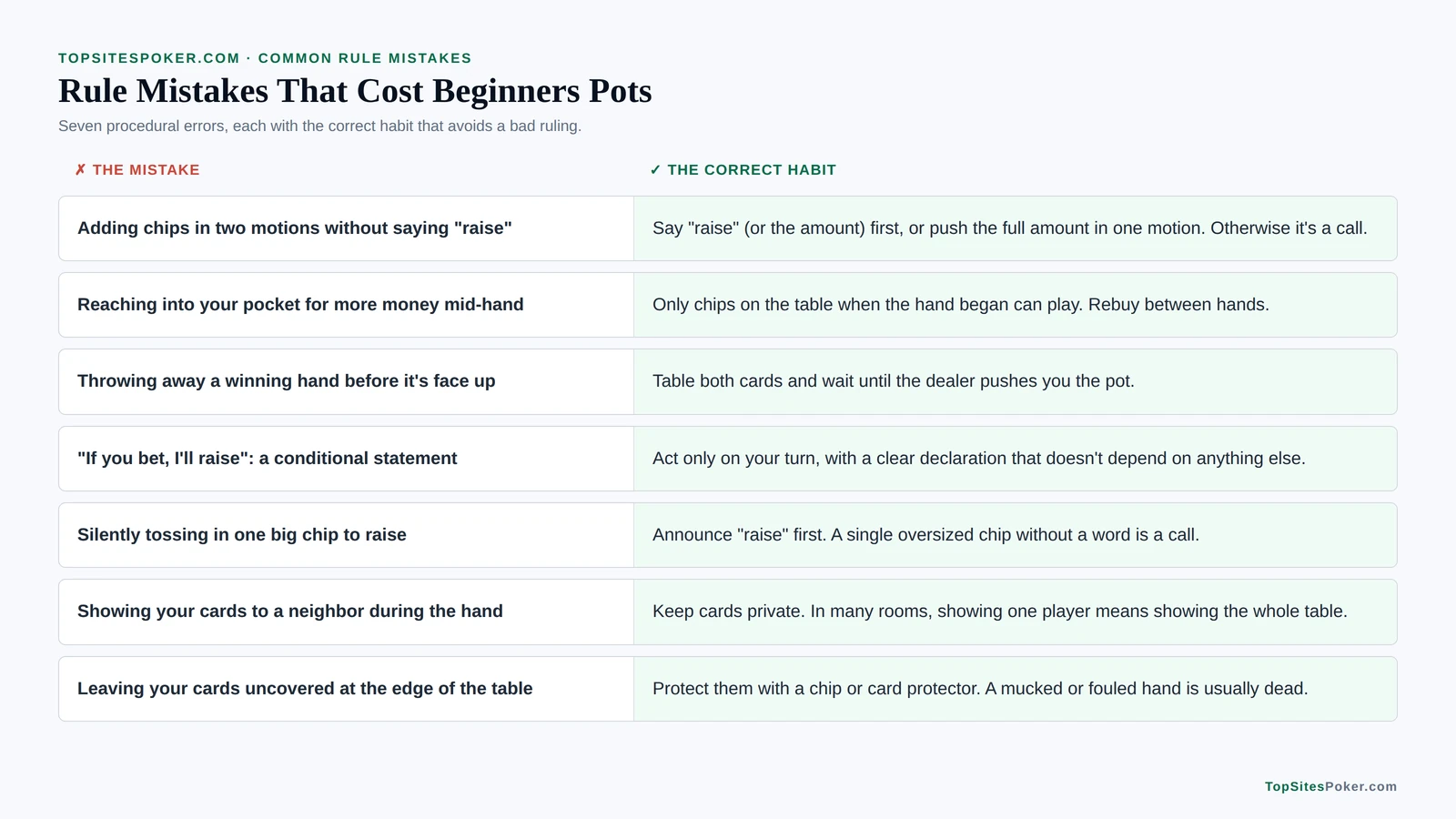
Most rules problems at a real table come from the same short list of habits. None of them are about strategy. Each one is a procedural slip that leads to a ruling you didn’t intend.
| Mistake | Rule it breaks | Typical consequence | Correct habit |
|---|---|---|---|
| Putting in a call, then going back for more chips | String bet | Ruled a call; the raise doesn’t count | Say “raise” first, or move all the chips at once |
| Silently tossing in one large chip to raise | Oversized chip | Ruled a call | Say “raise” before the chip lands |
| Raising less than the last raise increment | Minimum raise | Required to make a full raise, or ruled a call | Count the increment, not the total |
| Re-raising after a short all-in when you’ve already acted | Short all-in doesn’t reopen betting | Raise not allowed; you can only call or fold | Ask the dealer whether action is open to you |
| Acting before your turn | Acting out of turn | Action may be binding; possible penalty | Wait for the dealer to indicate your action |
| Mucking a winner before tabling it | Hands must be tabled to win | Hand is dead; pot goes to the other player | Turn both cards up and wait for the pot |
| Telling a neighbor what you folded | One player to a hand | Warning or penalty | Stay silent about any hand in progress |
| Adding chips from your pocket mid-hand | Table stakes | Chips don’t play; you’re all-in for what was on the table | Top up between hands |
| Leaving cards unprotected | Protect your hand | Hand mucked or fouled with no recourse | Use a chip or card protector |
| Posting the big blind on the button heads-up | Heads-up blind rule | Blinds and action order are wrong for the whole hand | Button posts the small blind and acts first preflop |
You Make the Call: Eight Rulings to Test Yourself
Read each situation and decide the ruling before you read the answer. Every scenario uses standard cardroom and TDA-style rules.
1. The silent big chip. In a $2/$5 no-limit game, a player raises to $15 before the flop. You put a single $100 chip in the pot without saying anything.
Ruling: it’s a call of $15. A single oversized chip without a verbal declaration is a call when you’re facing a bet. You get $85 in change.
2. The short all-in. On the flop, Player A bets $50, you call $50, and Player C goes all-in for $80. The action returns to A, who wants to re-raise.
Ruling: A can only call the extra $30 or fold. C’s all-in raised by $30, less than the full $50 increment, so the betting isn’t reopened for players who have already acted. The same applies to you.
3. Words versus chips. Facing a $60 bet, you say “call” and push forward $200 in chips.
Ruling: it’s a call of $60. Your verbal declaration was made in turn and is binding. The extra $140 goes back to you.
4. Nobody wants to show. The river is checked by everyone. Three players remain: the small blind, the cutoff and the button.
Ruling: the small blind shows first, as the first remaining player to the left of the button, followed by the others in clockwise order. Anyone who’s beaten can muck instead of showing.
5. The board plays. The board is A♠ A♦ K♣ K♥ Q♠. Player 1 holds J♣ J♦. Player 2 holds 10♥ 9♥.
Ruling: split pot. Both players’ best five-card hand is A-A-K-K-Q, taken entirely from the board. Player 1’s pair of jacks can’t be used, because only five cards count and two pair with a queen kicker is already the best available hand.
6. Late back to the table. In a tournament, you’re walking back from the restroom and reach your chair just after the dealer has finished dealing the hole cards.
Ruling: your hand is dead. You must be within reach of your chair when the last card of the initial deal is dealt. Your blinds or antes, if you owed them, stay in the pot.
7. The early flop. Before the last player has acted preflop, the dealer burns and deals the flop.
Ruling: the preflop betting is completed first. Then the three flop cards are shuffled back into the deck, which is cut, and a new flop is dealt. The original burn card stays out of play.
8. The helpful friend. Your friend, who folded, leans over during the turn betting and whispers that you should call.
Ruling: a violation of the one-player-to-a-hand rule. Expect at least a warning for your friend, and in a tournament possibly for both of you. Your decision must be your own.
Frequently Asked Questions
What are the basic rules of poker?
Players receive cards, forced bets (blinds or antes) create a starting pot, and players take turns clockwise to check, bet, call, raise or fold over several betting rounds. If more than one player remains at the end, the best five-card hand wins the pot. If everyone else folds, the last player remaining wins without showing their cards.
What is the minimum raise in no-limit poker?
A raise must increase the bet by at least the size of the largest previous bet or raise in that betting round. If the blinds are $1/$2 and a player raises to $6, the next raise must be to at least $10, because the previous increment was $4.
Is a string bet allowed?
No, not in casinos or online. If you put in a call and then add more chips in a separate motion without having said “raise,” the action is ruled a call. Home games can choose not to enforce the rule, but most players are used to it.
Can you check-raise in poker?
Yes. Checking and then raising after an opponent bets is legal in virtually every cardroom and online site. A few home games ban it by agreement, which is a house rule, not a standard poker rule.
Do you have to show your cards if you win?
If everyone else folds, no. At showdown, you must table your whole hand to be awarded the pot. If you bet on the river and got called, you’re required to show first, and the caller has the right to see your hand.
What happens if two players have the same hand?
The pot is split equally. Before declaring a tie, compare all five cards: the cards making the hand first, then the kickers in order. Suits never break a tie in standard poker. If the pot can’t be divided evenly, the odd chip goes to the first winning player to the left of the button in flop games.
Can someone bet more than I have?
Yes, but you can always call all-in with whatever you have in front of you. You’re only competing for the part of the pot you matched, and any extra betting between other players goes into a side pot you can’t win.
Does a flush beat a straight?
Yes. A flush beats a straight, and a full house beats a flush. The ranking follows probability, so rarer hands rank higher. The one common exception is Short Deck poker, where a flush beats a full house.
What should I do if the dealer makes a mistake?
Point it out immediately and calmly, and ask for the floor if the dealer doesn’t correct it. Don’t take any action on a hand that may be a misdeal. Rulings are much more likely to go your way when the error is raised before further action.
Are poker rules the same everywhere?
The core rules are the same in nearly every cardroom and online site: hand rankings, the order of action, the minimum raise, table stakes and showdown procedure. Details such as straddles, missed-blind procedures, phone policies and some irregularity procedures vary, so read the posted house rules wherever you play.
Can I leave a cash game with my chips at any time?
Yes, between hands. What you can’t do is take chips off the table and keep playing. If you leave and come back to the same game shortly afterward, many rooms require you to buy back in for at least the amount you left with.
What does “the floor’s decision is final” mean?
The floor manager (in tournaments, the tournament director) has authority to resolve any dispute, including situations the written rules don’t cover, and can depart from a strict reading of a rule in the interest of fairness. You can ask for an explanation, but once the ruling is made, it stands.
Quick-Reference Summary Table
| Rule | What it says |
|---|---|
| Order of action | Clockwise. Preflop starts left of the big blind; later streets start left of the button. Heads-up, the button is the small blind. |
| Minimum bet | One big blind in no-limit and pot-limit games |
| Minimum raise | At least the largest previous bet or raise increment in the round |
| Maximum bet | No-limit: your stack. Pot-limit: the pot. Fixed-limit: the set amount. |
| Making a raise | Say “raise” first, or put the full amount in with one motion |
| Verbal declarations | Binding when made in turn |
| Table stakes | Only chips on the table at the start of the hand can play |
| Short all-in | Doesn’t reopen betting for players who’ve already acted (no-limit and pot-limit) |
| Side pots | Each player wins at most what they matched from each opponent |
| Showdown order | Last river aggressor first; if checked through, first player left of the button |
| Winning at showdown | Table your whole hand; cards speak |
| Ties | Compare all five cards; split if identical; suits don’t count |
| Irregularities | Raise them immediately; misdeals can’t be called after substantial action |
| Conduct | One player to a hand; no collusion, soft play or outside assistance |
| Final authority | Posted house rules, then the floor’s decision |
About This Guide
This guide reflects standard cardroom procedure and the rules published by the Tournament Directors Association, with differences between cash games, tournaments, online rooms and home games noted where they apply. Worked examples and rulings were checked against those standards, and side-pot and raise arithmetic was verified step by step. Poker’s core rules change rarely, but individual rooms update their house rules, and the TDA revises its rulebook periodically, so this guide is reviewed every 6 to 12 months. Always read the posted rules where you play, especially for straddles, missed blinds, device policies and irregularity procedures.
Poker involves real financial risk. Play only with money you can afford to lose, set a budget before you sit down, and take a break if the game stops being fun. If gambling is causing problems for you or someone close to you, support is available: in the U.S., the national problem gambling helpline is 1-800-MY-RESET (1-800-697-3738), available by phone, text or chat.
The Bottom Line
Poker’s rules are more consistent than they first appear. Five families of rules (setup, betting, all-in and pots, showdown, conduct and errors) cover almost every situation you’ll meet, and a handful of them decide most disputes: act in turn, declare your raises, respect the minimum raise, remember that you can only bet what’s on the table, table your whole hand, and protect your cards. Learn those, read the house rules wherever you sit down, and the rules will stop being something that happens to you and become something you use.