
How to play poker (Texas Hold’em) in seven steps:
- Two players post forced bets, the small blind and big blind, to the left of the dealer button.
- Every player gets two private cards, called hole cards.
- Players bet in turn, starting left of the big blind: fold, call or raise.
- The flop: three shared cards are dealt face up, then a betting round.
- The turn: a fourth shared card, then a betting round.
- The river: a fifth shared card, then the last betting round.
- Showdown: the best five-card hand from each player’s two cards and the five shared cards wins the pot.
Poker is easier to learn than it looks. A hand of Texas Hold’em, the game you’ll find in almost every casino, home game and online poker room, follows the same fixed sequence every time: forced bets, two private cards, up to four rounds of betting while five shared cards appear, and a showdown if more than one player is left. Once you know that sequence and the five things you can do when it’s your turn, you can sit down and play.
This guide teaches the whole game from zero. It starts with the table, the seats and the forced bets, walks through a hand street by street, and then plays out complete hands, including an all-in with side pots. After that it covers the three betting structures, cash games and tournaments, which hands to play as a beginner, and the first pieces of poker math you’ll actually use at the table, all calculated by our team rather than repeated from memory. It ends with etiquette, the mistakes new players make most often, a practice plan and a quiz.
Key takeaways
- Every hand of Hold’em has up to four betting rounds: preflop, flop, turn and river.
- On your turn you can only ever check, bet, call, raise or fold, and which ones are available depends on whether someone has bet.
- Your seat relative to the dealer button decides when you act. Acting last is a real advantage: from under the gun at a nine-handed table, eight players still act after you.
- You’ll be dealt a pocket pair about once in 17 hands and pocket aces once in 221, so most hands should be folded.
- Two numbers run most beginner decisions: your outs (about 35% to hit a flush draw from the flop to the river) and the pot odds (a pot-sized bet requires you to win 33.3% of the time to call).
What You Need to Play
A game of Texas Hold’em needs very little equipment, and online everything is handled for you. At a home game or in a cardroom, this is the full list:
| Item | What it is | Detail |
|---|---|---|
| Deck | A standard 52-card deck | No jokers or wild cards. Cardrooms replace decks regularly; home games should use two decks and alternate them |
| Players | 2 to 10 players | Nine or ten is a “full ring,” six is “six-max,” two is “heads-up” |
| Chips | Tokens that represent money or tournament chips | Different colors for different values, which vary by cardroom |
| Dealer button | A disc that marks the nominal dealer | Moves one seat clockwise after every hand, even when a house dealer deals every hand |
| Hole cards | Two private cards per player | Dealt face down; only you see them |
| Community cards | Five shared cards in the middle | Dealt face up in three stages: the flop (3), the turn (1) and the river (1) |
| The pot | All the chips bet in the current hand | Goes to the winner, or is split between tied hands |
Chips and what they’re worth
In a cash game, chips represent real money: a red chip might be worth $5 and a green chip $25, though colors vary between cardrooms. In a tournament, chips have no cash value at all. Everyone buys in for the same amount and receives the same starting stack, and prizes are paid according to finishing position. Online, chip amounts are simply shown as numbers.
Who deals
In a casino or online, a house dealer or the software deals every hand, and the dealer button only marks whose turn it is to be the nominal dealer. That seat matters because it sets the blinds and the order of action. In a home game without a dealer, the player on the button usually shuffles and deals, then passes the deck to the left for the next hand.
Hand rankings come first
You win a showdown with the best five-card poker hand, so it helps to know the ten hand ranks before your first real hand. From best to worst: royal flush, straight flush, four of a kind, full house, flush, straight, three of a kind, two pair, one pair and high card. This guide assumes you know them or have a chart nearby, and it focuses on how a hand is played.
The Table: Seats, the Button and Position
Before any cards are dealt, you need to know where you sit relative to the dealer button, because that decides when you act for the whole hand. Players call this your position. Everything in poker moves clockwise: the deal, the betting and the button itself, which moves one seat to the left after every hand. Over a full lap of the table, called an orbit, every player sits in every position once.
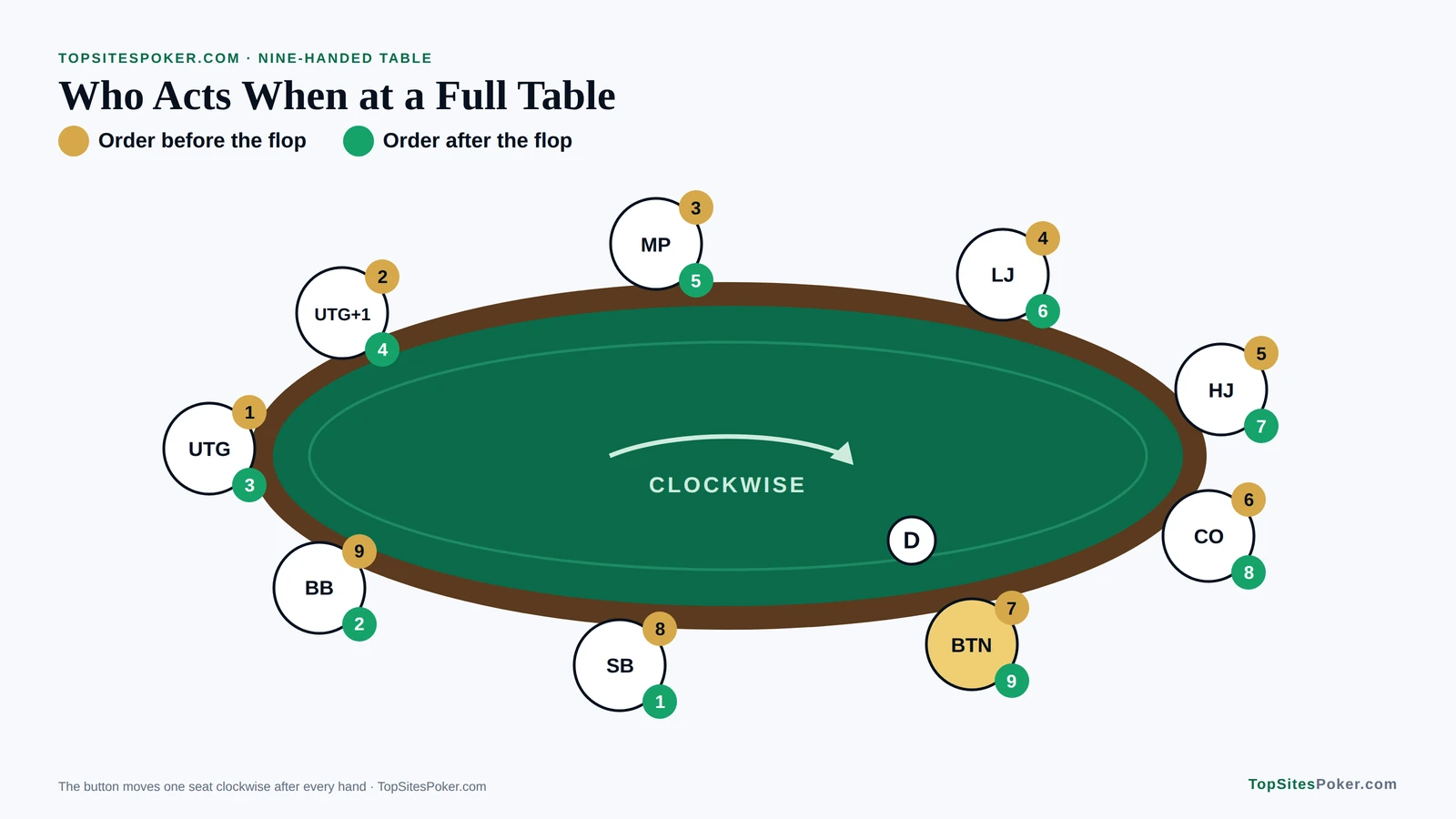
Before the flop, under the gun acts first and the big blind last. After it, the small blind acts first and the button last.
The positions at a nine-handed table
Positions are named relative to the button. At a full nine-handed table they are:
| Position | Short name | Acts preflop | Players still to act after you preflop | Acts after the flop |
|---|---|---|---|---|
| Under the gun | UTG | 1st | 8 | 3rd |
| Under the gun +1 | UTG+1 | 2nd | 7 | 4th |
| Middle position | MP | 3rd | 6 | 5th |
| Lojack | LJ | 4th | 5 | 6th |
| Hijack | HJ | 5th | 4 | 7th |
| Cutoff | CO | 6th | 3 | 8th |
| Button | BTN | 7th | 2 | 9th (last) |
| Small blind | SB | 8th | 1 | 1st |
| Big blind | BB | 9th (last) | 0 | 2nd |
“Acts after the flop” assumes every player is still in the hand. Players who fold are skipped, but the order never changes.
Two things stand out in the table. First, the order changes between preflop and the later streets. Preflop, the blinds act last, because their forced bets count as the opening bet. From the flop on, the small blind acts first and the button acts last. Second, the button is the only seat that acts last on every street after the flop, which is why it’s the most valuable seat at the table.
Six-max and heads-up tables
Online, six-handed tables (“six-max”) are the most common cash-game format. They simply drop the early seats: the six positions are usually called UTG (sometimes lojack), hijack, cutoff, button, small blind and big blind. The logic is identical, but with fewer players behind you, more hands are worth playing from every seat.
Heads-up play, with just two players, has one special rule that surprises many beginners: the button posts the small blind. The button acts first before the flop and last after it, and the other player posts the big blind. The same rule applies when a bigger game gets down to two players.
Why position matters: the players behind you
Acting later means you see what other players do before you decide, and it means fewer players can act after you. The second point is easy to underestimate, so we measured it. We dealt 200,000 random deals for each number of opponents still to act and counted how often at least one of them held a strong hand, with your own cards removed from the deck. Here your hand is A-J offsuit, a hand beginners often overplay:
| Your seat (nine-handed) | Players left to act | At least one has J-J+ or A-K | At least one has 9-9+, A-Q+, A-J suited or K-Q suited |
|---|---|---|---|
| Under the gun | 8 | 18.2% | 33.8% |
| UTG+1 | 7 | 16.3% | 30.5% |
| Middle position | 6 | 14.0% | 26.5% |
| Lojack | 5 | 11.8% | 22.5% |
| Hijack | 4 | 9.5% | 18.4% |
| Cutoff | 3 | 7.1% | 14.0% |
| Button | 2 | 4.8% | 9.5% |
| Small blind | 1 | 2.5% | 4.9% |
TopSitesPoker.com simulation: 200,000 deals per row, hero holding A-J offsuit, opponents dealt at random from the remaining 50 cards.
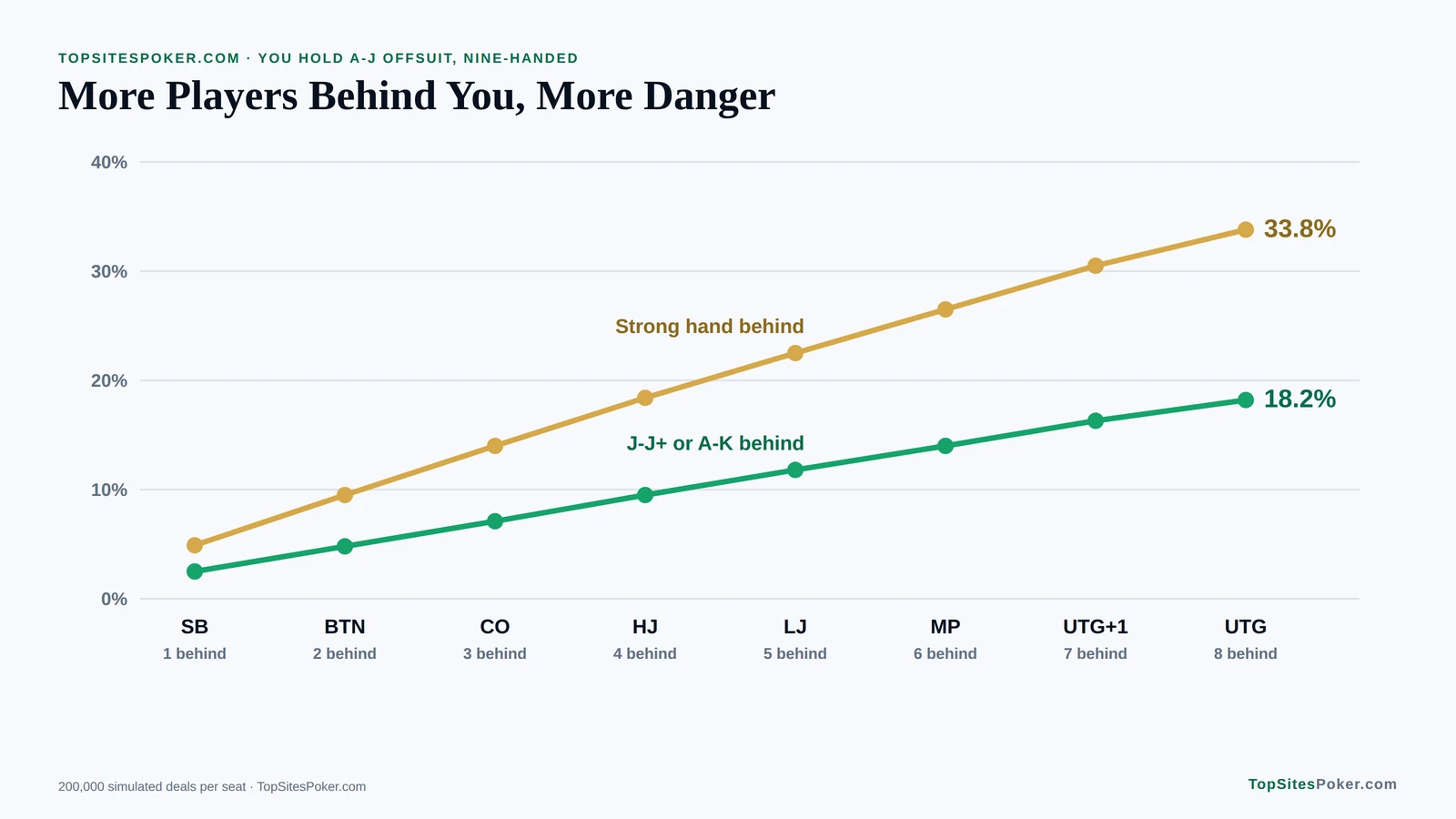
The same A-J faces more than three times as much danger under the gun as on the button.
From under the gun, one time in three somebody behind you holds one of these strong hands, most of which are ahead of A-J. From the button, it’s fewer than one time in ten. Your cards are the same in both seats; only the number of players left to act has changed. That’s the whole logic behind the most repeated beginner rule in poker: play fewer hands in early position and more hands in late position.
The effect is even stronger with small pairs. Holding 7-7 under the gun, we found at least one of the eight players behind held 9-9 or better, A-Q or better, A-J suited or K-Q suited 41.2% of the time. Small pairs don’t block any of those hands, so they’re more likely to be out there.
Position after the flop
Position keeps paying after the flop. When you act last, you know whether your opponents checked or bet before you decide. You can check behind to see a free card, bet when they show weakness, or fold cheaply when they show strength. The player out of position has to act first on every street, often guessing. Over thousands of hands, that information difference is worth a lot of money, and it’s why experienced players fight hard to play pots from the button and the cutoff.
Blinds and Antes: The Forced Bets
If nobody had to put money in the pot, everyone could wait for pocket aces and the game would grind to a halt. Forced bets fix that by giving every hand something to win. Hold’em uses two of them, the blinds, and many games add a third, the ante.
- Small blind: posted by the player directly to the left of the button, usually half the big blind.
- Big blind: posted by the next player to the left. It’s the size of the minimum bet.
- Ante: a small extra forced bet. In most modern tournaments it’s a single “big blind ante” that the big blind posts for the whole table, usually equal to the big blind. Older structures, and some cash games, have every player post a smaller ante.
The blinds name the stakes. A “$1/$2” game has a $1 small blind and a $2 big blind. Blinds are “live” bets: they count toward what the blind has to call, and if nobody raises, the big blind can check and see the flop for free, or raise. That privilege is called the big blind’s option.
What the blinds cost you
Every orbit, you pay one small blind and one big blind, 1.5 big blinds in total. How much that costs per hand depends on how many players share the blinds. Per 100 hands dealt, it works out as follows:
| Table size | Hands per orbit | Blinds you post per orbit | Blinds you post per 100 hands |
|---|---|---|---|
| Heads-up (2 players) | 2 | 1.5 big blinds | 75 big blinds |
| Six-max (6 players) | 6 | 1.5 big blinds | 25 big blinds |
| Full ring (9 players) | 9 | 1.5 big blinds | 16.7 big blinds |
| Full ring (10 players) | 10 | 1.5 big blinds | 15 big blinds |
Simple arithmetic: 1.5 big blinds per orbit multiplied by the number of orbits in 100 hands. Straddles and antes add to these figures.
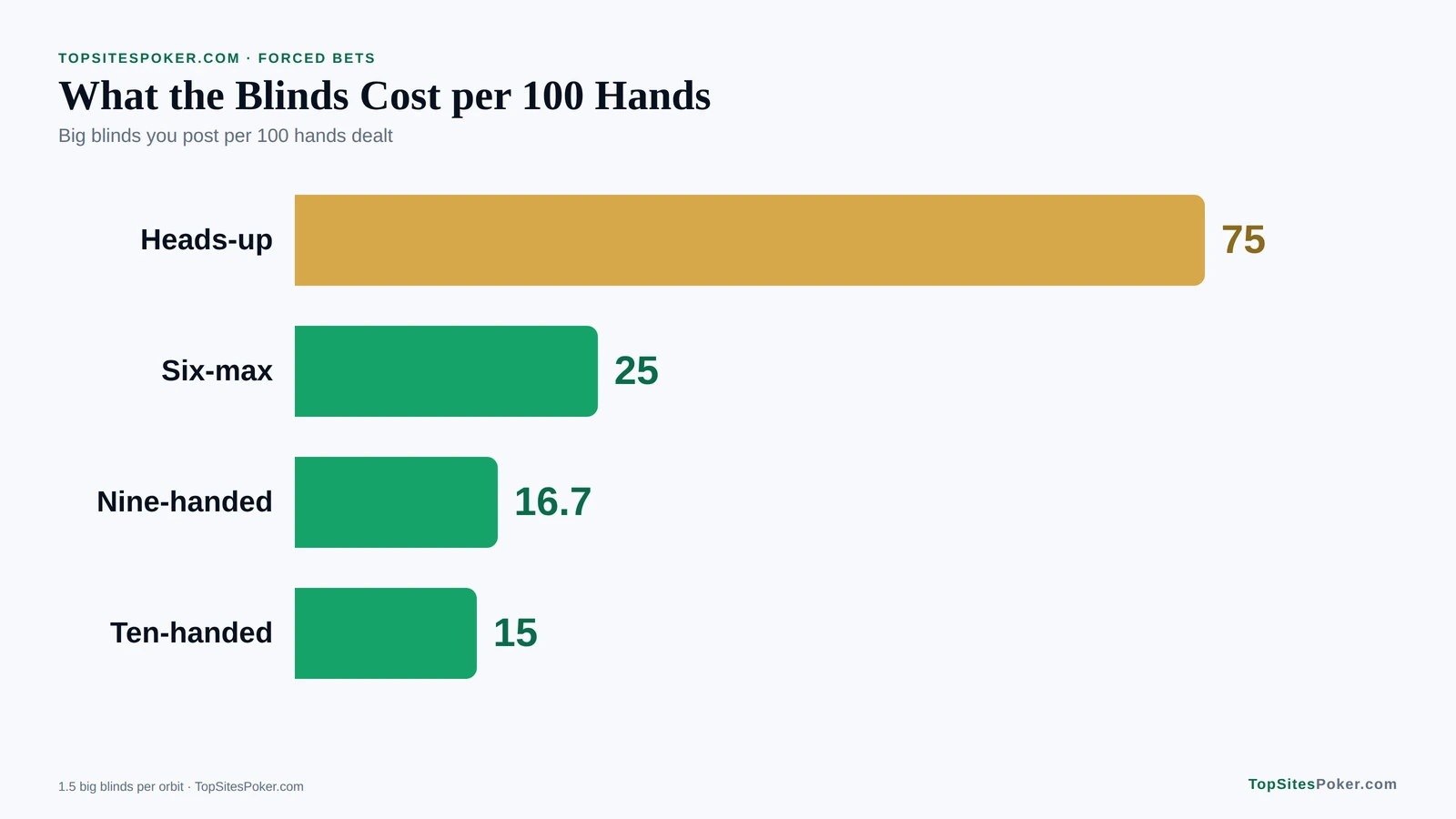
The fewer players at the table, the more often you pay the blinds.
This is why shorter tables play more aggressively. At a six-max table, you’re paying the blinds 50% more often than at a nine-handed table, so waiting only for premium hands gets expensive. Heads-up, you’re in a blind every single hand. It’s also why folding every hand is never a free strategy: at a nine-handed table, a player who folds everything loses about 16.7 big blinds per 100 hands.
Straddles and other optional blinds
Some cash games allow a straddle: a voluntary extra blind, normally twice the big blind, posted by the player to the left of the big blind before the cards are dealt. It doubles the effective stakes for that hand, and the straddler gets the last option to act preflop. Straddles are a house-rule feature, common in live games and rarer online. If you’re new, you never have to post one.
Joining a game and missed blinds
When you sit down in a cash game, most rooms ask you to either post a big blind to get a hand straight away or wait until the big blind reaches you. If you step away and miss your blinds, you’ll usually have to post them when you come back. The exact procedure varies by cardroom, so ask the dealer the first time. Online rooms handle this automatically with a “wait for big blind” box.
Stack size is measured in big blinds
Experienced players describe their stacks in big blinds, not dollars, because the number of big blinds decides how much room there is to play. A $200 stack is 100 big blinds in a $1/$2 game but only 20 big blinds at $5/$10. Many cash games set a buy-in range of roughly 40 to 100 big blinds, though some allow shorter or deeper stacks, and 100 big blinds is the standard “full” stack that most strategy advice assumes.
In tournaments, stacks shrink in big blinds even when your chip count stays the same, because the blinds rise at fixed intervals. This example structure shows what happens to a 20,000-chip starting stack that doesn’t grow:
| Level | Blinds | Big blind ante | Your 20,000 chips in big blinds |
|---|---|---|---|
| 1 | 100/200 | 200 | 100 |
| 2 | 200/400 | 400 | 50 |
| 3 | 300/600 | 600 | 33.3 |
| 4 | 400/800 | 800 | 25 |
| 5 | 500/1,000 | 1,000 | 20 |
| 6 | 600/1,200 | 1,200 | 16.7 |
| 7 | 800/1,600 | 1,600 | 12.5 |
| 8 | 1,000/2,000 | 2,000 | 10 |
An illustrative structure, not a specific tournament’s. Real structures differ in level length and increments.
A stack that starts deep becomes short in a few hours unless it wins pots. That’s the single biggest difference between tournaments and cash games, and it’s why tournament play gets more aggressive as the blinds climb.
Your Turn: The Five Actions
Every decision in poker comes down to five actions. Which ones you can choose depends on a single question: has anyone bet in this round yet?
| Action | What it means | Available when |
|---|---|---|
| Check | Pass without putting in chips, and stay in the hand | No one has bet in this round |
| Bet | Put in the first chips of the round | No one has bet in this round |
| Call | Match the current bet | Someone has bet or raised |
| Raise | Match the current bet and increase it | Someone has bet or raised |
| Fold | Give up your hand and any chips you’ve already put in | Any time it’s your turn |
So if nobody has bet, your choices are check or bet. If somebody has bet, they’re fold, call or raise. Preflop, the big blind counts as a bet, so every player except the big blind starts with fold, call or raise. If nobody raises, the big blind can check or raise when the action reaches them.
One more term completes the list: all-in. Going all-in means betting or calling with every chip you have in front of you. You can never be forced out of a hand because you can’t match a bet. If you call all-in for less, you can only win the part of the pot you matched, and any extra betting between other players goes into a side pot. The worked example later in this guide shows exactly how that works.
Checking isn’t folding
New players sometimes fold when they could have checked. Never do it: if nobody has bet, checking keeps you in the hand for free. Online software often has a “check/fold” button for this reason. It checks if it can and folds only if someone bets.
When a betting round ends
A betting round ends when every player still in the hand has put in the same amount, or has folded, and everyone has had a chance to act. A raise reopens the action: every player who acted before it gets another turn to call, raise again or fold. That’s why a round can go around the table more than once. If everyone checks, the round ends as soon as the last player checks.
If everyone but one player folds at any point, the hand ends immediately. The remaining player wins the pot without showing their cards, and no further cards are dealt.
How much you can bet and raise in no-limit
In No-Limit Hold’em, the most common game, you can bet any amount up to all your chips. The limits are at the bottom end:
- Minimum bet: the size of the big blind.
- Minimum raise: the raise must be at least as big as the largest full bet or raise so far in the same round. You match the current bet and add at least that increment.
| Situation ($1/$2 no-limit) | Current bet | Size of the last bet or raise | Minimum raise to |
|---|---|---|---|
| Preflop, nobody has raised | $2 (the big blind) | $2 | $4 |
| Preflop, a player has raised to $10 | $10 | $8 | $18 |
| Flop, a player bets $10 | $10 | $10 | $20 |
| Flop, bet $10 and raised to $30 | $30 | $20 | $50 |
A player who goes all-in for less than a full raise doesn’t always reopen the betting for players who’ve already acted, one of several finer points in the official rules. For your first sessions, the practical advice is simple: when you raise, say the total amount out loud (“raise to twenty”).
Making your action count at a live table
Online, you click a button and there’s no ambiguity. At a live table, a few habits keep you out of trouble. Many cardrooms base their procedures on the Poker TDA rules, which were written for tournaments, and cash-game house rules are usually similar:
- Act in turn. Wait until the player before you has acted. Acting out of turn gives information away and can be held against you: in many rooms, an out-of-turn action is binding if the action to you hasn’t changed.
- Say what you’re doing. A verbal declaration in turn, such as “call” or “raise to 40,” is binding. It’s the clearest way to act.
- Put your chips out in one motion. Going back to your stack for more chips without having announced a raise is a “string bet,” and the dealer can rule it a call.
- Be careful with a single big chip. When you’re facing a bet, putting one oversized chip into the pot without saying anything is usually treated as a call, not a raise.
- Fold by pushing your cards face down toward the dealer. Don’t show them to other players while the hand is still being played.
A Hand of Hold’em, Street by Street
Each stage of a hand where new cards appear is called a street. Hold’em has four: preflop, the flop, the turn and the river. Each one is followed by a betting round, and if two or more players are still in after the river, the hand ends with a showdown.
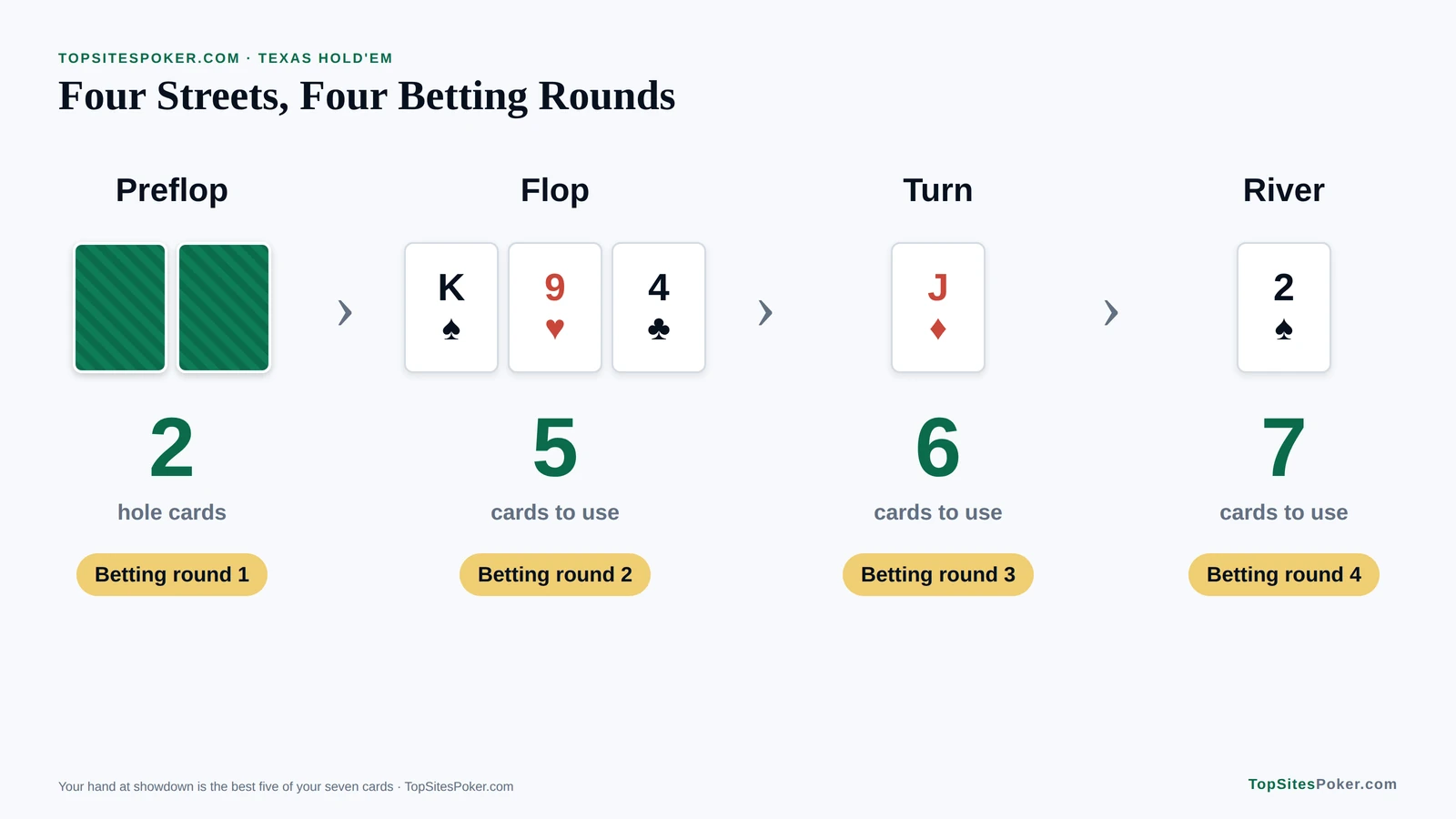
By the river you have seven cards to choose from, and your hand is the best five.
| Street | New cards | Community cards showing | Cards you can use | First to act |
|---|---|---|---|---|
| Preflop | 2 hole cards to each player | 0 | 2 | The player left of the big blind (UTG) |
| Flop | 3 community cards | 3 | 5 | The first active player left of the button |
| Turn | 1 community card | 4 | 6 | The first active player left of the button |
| River | 1 community card | 5 | 7 | The first active player left of the button |
| Showdown | None | 5 | Best 5 of 7 | The last player to bet or raise on the river shows first |
1. Preflop
The blinds are posted, and the dealer deals two cards face down to every player, one at a time, starting with the small blind and going clockwise (heads-up, the big blind gets the first card). The first betting round starts with the player to the left of the big blind, who is “under the gun.” Each player folds, calls the big blind or raises, and the action moves clockwise until everyone has either matched the highest bet or folded. The big blind acts last and, if nobody raised, can check or raise.
2. The flop
The dealer “burns” the top card, placing it face down to one side, and deals three community cards face up. Burning a card protects the game if the top card was accidentally exposed or marked. Everyone can now use these three cards along with their own two, so each player has a five-card hand for the first time. The betting starts with the first player still in the hand to the left of the button, usually the small blind, and continues clockwise.
3. The turn
The dealer burns another card and deals a fourth community card. Another betting round follows, in the same order as on the flop. In fixed-limit games, the bet size doubles on this street.
4. The river
The dealer burns a third card and deals the fifth and final community card. The last betting round follows. No more cards are coming, so on the river you’re no longer drawing: your hand is what it is, and the only question is whether it’s better than your opponents’ hands.
5. The showdown
If two or more players are still in after the river betting, they show their cards and the best hand wins. The order is set by the rules, not by who wants to go first:
- If there was a bet or raise on the river, the last player to bet or raise shows first.
- If everyone checked on the river, the first player to the left of the button shows first, and the others follow clockwise.
- In tournaments, when a player is all-in and no more betting is possible, all hands are turned face up right away, before the remaining cards are dealt. Cash games vary.
Each player’s hand is the best five cards from their two hole cards and the five community cards. You can use both of your cards, one of them, or neither (that’s called “playing the board”). A losing player may throw their cards away face down (“muck”) instead of showing, but to win the pot at a live table you must turn both of your cards face up. The dealer reads the hands: cards speak, so your hand is whatever your cards make, even if you described it wrongly.
When two hands are exactly equal, the pot is split. Kickers, the side cards in your best five, often decide hands that look tied, and suits never do.
How most hands actually end
Most hands never reach a showdown. Somebody bets and everyone else folds, or a raise before the flop takes the blinds. That’s normal and healthy: poker’s structure lets you get out cheaply with weak cards. A good first habit is to count how many hands at your table reach the river. You’ll see that the player who folds most weak hands before the flop rarely has to make difficult decisions later.
Reading Your Hand: The Best Five of Seven
By the river you have seven cards to choose from, and your hand is the best five of them. New players often misread their hand in one of two directions: they miss a flush or straight hiding in the seven cards, or they count a card that doesn’t actually play. A short routine avoids both mistakes. Check for the hands from the top of the ranking down, and stop at the first one you find:
- A paired board: if the board has a pair, check for four of a kind and a full house first.
- Suits: are there five cards of one suit among the seven? If so, you have a flush, and if they’re also in sequence, a straight flush.
- Sequences: are there five cards in a row, counting the ace as high or low?
- Matches: three of a kind, two pair or one pair.
- Kickers: fill the rest of your five with the highest cards left.
| Your cards | Board | Your best five | What to notice |
|---|---|---|---|
| A♥ K♦ | Q♠ J♣ 5♥ 5♦ 2♠ | 5-5-A-K-Q: a pair of fives | The board’s pair is your pair too; your ace and king are kickers |
| A♥ K♦ | 10♠ 9♣ 8♥ 7♦ 6♠ | 10-9-8-7-6: a straight | The board plays. Your cards don’t improve it, so anyone with a jack beats you |
| J♥ 10♠ | 9♠ 8♣ 7♥ 2♦ K♦ | J-10-9-8-7: a jack-high straight | You use both of your cards |
| 7♥ 7♣ | A♠ A♦ 7♠ K♣ 2♥ | 7-7-7-A-A: sevens full of aces | Your set plus the board’s pair makes a full house |
| A♥ 5♥ | K♥ 9♥ 3♥ Q♣ 2♦ | A-K-9-5-3 of hearts: an ace-high flush | Five hearts among seven cards; the best possible flush on this board |
| Q♣ Q♦ | K♠ K♦ 9♥ 9♣ 4♠ | K-K-Q-Q-9: two pair, kings and queens | Three pairs in seven cards; only the top two count |
Every best-five hand checked with a hand evaluator.
Three rules that settle most confusion
- You can use any combination of your cards and the board. Two hole cards, one or none. In Hold’em there’s no requirement to use both (that rule belongs to Omaha).
- Only five cards count. There’s no such thing as “three pair” or a six-card straight. A sixth card never breaks a tie.
- A kicker only counts if it’s in your best five. If the board supplies a higher card, your kicker doesn’t play, and two players with the same pair can split the pot even though their second cards differ.
At the table, you never have to announce your hand correctly: cards speak, and the dealer reads them. But reading your own hand quickly and correctly is how you make good decisions before the showdown, so practice it until it’s automatic. Dealing out seven cards at home and naming the best five is the fastest drill there is.
Three Complete Hands, Played Out
Rules make more sense when you watch them work. These three hands cover the situations you’ll meet most: a hand that goes to showdown, a hand that ends without one, and an all-in with side pots. All three use a $1/$2 no-limit cash game, and every result was checked with a hand evaluator.
Hand 1: to the showdown
Nine players. You’re on the button with A♥ Q♣.
- Preflop. The small blind posts $1 and the big blind $2. Everyone folds to the cutoff, who raises to $6. You call $6. The small blind folds, and the big blind calls $4 more. The pot is $19: three players’ $6 each plus the small blind’s $1.
- Flop: Q♦ 8♠ 3♣. You’ve made top pair, queens, with an ace kicker. The big blind acts first and checks. The cutoff bets $10. You call. The big blind folds. The pot is $39.
- Turn: 5♥. The cutoff checks. You bet $20, and the cutoff calls. The pot is $79.
- River: K♠. The cutoff checks. A bet here would mostly be called by hands that beat you, such as a king or a set, so you check too.
- Showdown. Nobody bet on the river, so the first player to the left of the button still in the hand shows first: that’s the cutoff. The cutoff shows J♠ J♦: a pair of jacks, J-J-K-Q-8. You show a pair of queens, Q-Q-A-K-8. Queens beat jacks, and you win the $79 pot.
Notice what decided the hand. Both players had one pair, so the rank of the pair settled it before any kicker mattered. Notice too that you checked the river rather than betting: when a bet would mostly be called by hands that beat you, checking is usually the better play.
Hand 2: won without a showdown
Nine players. You’re in the cutoff with K♣ J♣.
- Preflop. Everyone folds to you. You raise to $6. The button and small blind fold. The big blind calls. The pot is $13.
- Flop: A♦ 7♠ 2♥. You missed. The big blind checks. You bet $5, a little over a third of the pot. The big blind folds.
- Result. You win the $13 pot. The hand ends immediately: no turn or river is dealt, and nobody shows their cards.
Pots like this, won without a showdown, are extremely common. A bet on the flop by the player who raised before the flop is called a continuation bet. It works often on boards like this, which rarely help the big blind’s calling range. You don’t need the best hand to win a pot; you need to be the last player left.
Hand 3: an all-in with two side pots
Four players go all-in before the flop. Player A has $30, Player B $80, Player C $150 and Player D $150. Once all the betting is done, the chips are split into pots according to how much each player could match:
| Pot | How it’s built | Amount | Who can win it |
|---|---|---|---|
| Main pot | $30 from each of the four players | $120 | A, B, C and D |
| Side pot 1 | The next $50 from B, C and D | $150 | B, C and D |
| Side pot 2 | The last $70 from C and D | $140 | C and D |
| Total | $410 |
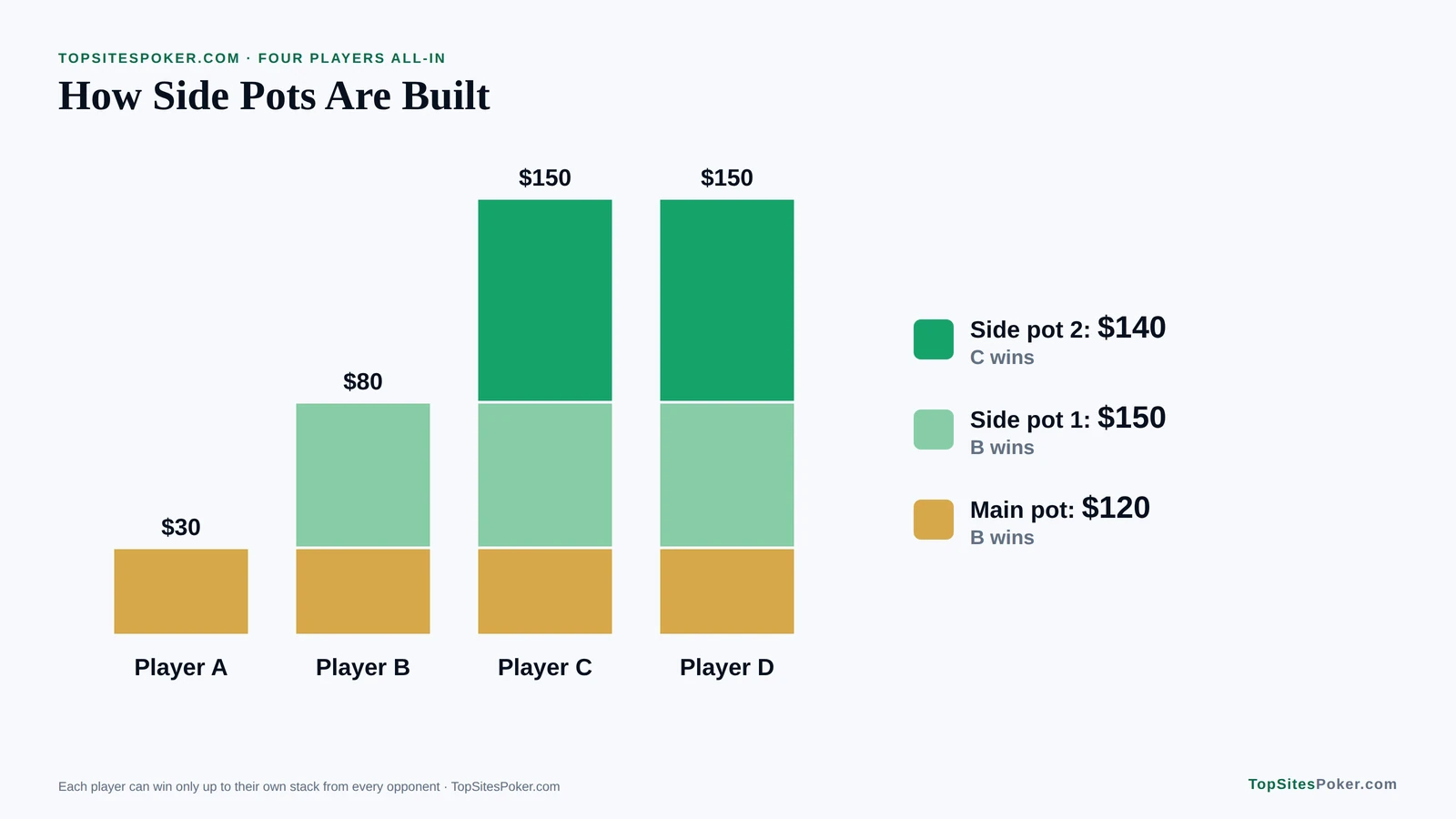
Each layer is a separate pot, and only players who contributed to it can win it.
The players show their hands: A has A♣ A♦, B has K♠ K♣, C has 9♥ 9♦ and D has A♠ Q♠. The board runs out 9♠ 7♣ 2♦ K♦ 4♠.
- B has three kings, the best hand at the table.
- C has three nines, the second-best hand.
- A has a pair of aces, and D has only ace-high.
The pots are awarded from the last side pot back to the main pot, each to the best hand among the players eligible for it:
- Side pot 2 ($140) is between C and D only. C’s three nines win it.
- Side pot 1 ($150) is between B, C and D. B’s three kings win it.
- The main pot ($120) is between everyone. B’s three kings win that too.
B collects $270 from an $80 stack, C collects $140, and A and D win nothing. C had only the second-best hand, but won the side pot that B couldn’t compete for. That’s the principle behind every side pot: you can only win from each opponent as much as you put in yourself.
The Three Betting Structures: No-Limit, Pot-Limit and Fixed-Limit
The order of play is the same in every Hold’em game. What changes is how much you’re allowed to bet, and that changes the feel of the game completely. The structure is always in the game’s name: “No-Limit Hold’em,” “Pot-Limit Omaha,” “$4/$8 Limit Hold’em.”
| No-limit | Pot-limit | Fixed-limit | |
|---|---|---|---|
| Smallest bet | The big blind | The big blind | Fixed: the small bet (preflop, flop) or big bet (turn, river) |
| Largest bet | All your chips | The size of the pot | Fixed: the same as the smallest |
| Smallest raise | The size of the last bet or raise | The size of the last bet or raise | One bet |
| Largest raise | All your chips | Raise by the size of the pot after your call | One bet |
| Number of raises | Unlimited | Unlimited | Usually capped, often at one bet and three raises per round |
| Where you’ll see it | Most Hold’em cash games and nearly all tournaments | Most Omaha games | Limit Hold’em, mixed games, stud games |
No-limit: any amount, any time
In no-limit, you can bet any amount from the big blind up to your whole stack, at any point. That makes every decision potentially a decision about all your chips, which is what makes no-limit exciting on television and dangerous for beginners. The minimum-raise rules explained above still apply.
Pot-limit: the pot sets the ceiling
In pot-limit, the most you can bet is the size of the pot. The most you can raise is a little trickier: you first imagine calling the bet in front of you, then raise by the size of the pot after that call. Dealers work it out for you if you say “raise pot,” but it’s easy to calculate:
- Start with the pot, including all bets already made in this round.
- Add the amount you need to call.
- Raise by that total.
Example: the pot is $20 and your opponent bets $10. The pot is now $30. Your call of $10 would make it $40. You can raise by $40, so the maximum is a raise to $50.
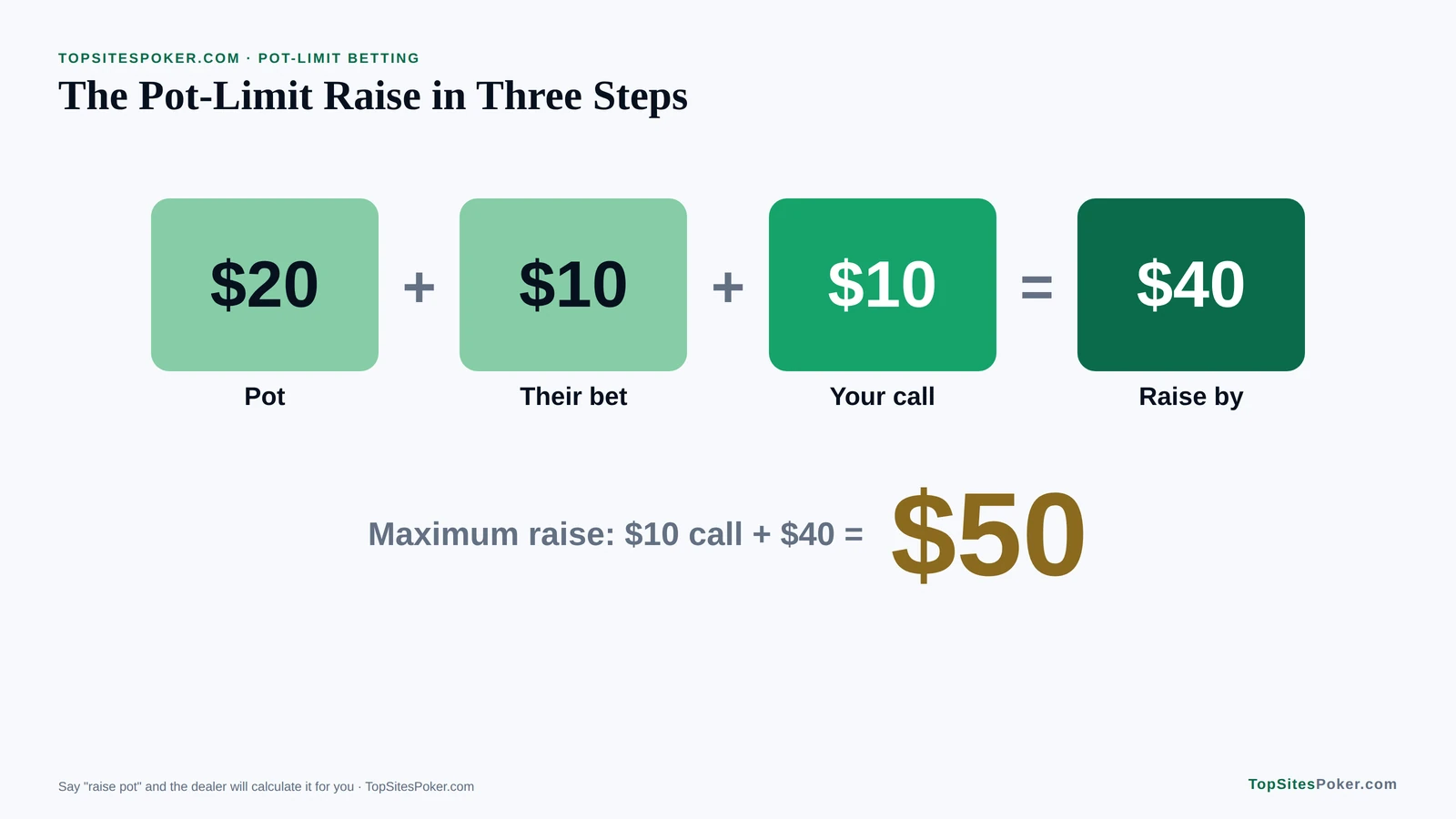
Imagine calling first, then raise by the size of the pot after your call.
Before the flop in a $1/$2 pot-limit game, the first player in can raise to at most $7. The pot is $3 (the blinds), the call is $2, so the pot after calling is $5, and the raise can be $5 more: $2 plus $5 makes $7. That’s why “raise to three and a half big blinds” is the standard maximum opening raise in pot-limit games.
Fixed-limit: fixed steps
In fixed-limit (usually just called “limit”), every bet and raise is a set size. A $4/$8 limit game uses $4 bets and raises before the flop and on the flop, and $8 bets and raises on the turn and river. The blinds are usually $2 and $4. Most rooms cap each betting round at one bet and three raises when three or more players are in the hand, though some allow four raises, and many cash games remove the cap when only two players are left.
Limit is a good game for learning, because no single decision can cost you your whole stack. It rewards discipline and hand reading more than bold bluffing, since a bluff can’t be large enough to force anyone out of a big pot.
A fixed-limit hand, bet by bet
Limit betting is easiest to understand by watching the amounts. Here’s a hand in a $4/$8 limit game with $2/$4 blinds, in which three players see the flop:
| Street | Bet size | Action | Pot after the round |
|---|---|---|---|
| Preflop | $4 (small bet) | The cutoff raises to $8. The button calls $8. The small blind folds. The big blind calls $4 more | $26 |
| Flop | $4 (small bet) | The big blind checks, the cutoff bets $4, the button raises to $8, the big blind folds, the cutoff calls | $42 |
| Turn | $8 (big bet) | The cutoff checks, the button bets $8, the cutoff calls | $58 |
| River | $8 (big bet) | The cutoff checks, the button bets $8, the cutoff calls | $74 |
Every bet and raise is exactly one unit: $4 before and on the flop, $8 on the turn and river. Nobody ever has to decide how much to bet, only whether to bet. The pot grows steadily rather than in sudden jumps, which is why a single mistake in limit costs much less than in no-limit, and why good limit players win by making many small correct decisions.
Which one should you start with?
No-Limit Hold’em is by far the easiest game to find, online and live, so most new players start there. If you do, start at the lowest stakes available and buy in for a stack you’re completely comfortable losing. If your local room or site spreads fixed-limit Hold’em, it’s a gentler way to learn the flow of a hand. Pot-limit is mostly a feature of Omaha, which is best learned after Hold’em.
Cash Games and Tournaments
Every hand of Hold’em plays the same way whether you’re in a cash game or a tournament. The formats differ in what the chips mean, how the blinds behave and when you can leave.
| Cash game | Tournament | |
|---|---|---|
| Chips | Worth real money, at face value | Tournament chips with no cash value |
| Buying in | Any amount within the table’s minimum and maximum | A fixed buy-in, usually plus an entry fee, for a fixed starting stack |
| Blinds | Stay the same all session | Rise at scheduled intervals |
| Running out of chips | Buy more chips (rebuy) whenever you like | You’re eliminated, unless the event allows re-entry during a set period |
| Leaving | Any time, taking your chips as cash | Only when you’re eliminated or the tournament ends |
| How you win money | Every pot you win is real money | Prizes are paid by finishing position, usually to the top 10–20% of the field |
| How the house earns | A small percentage of each pot (the rake), or a time charge | The entry fee added to the buy-in |
Cash games
A cash game (also called a “ring game”) is the simplest format. You sit down, buy chips and play hands until you decide to stop. The blinds never change, so strategy stays consistent, and you can take a break or leave whenever you want. For most people learning the game, low-stakes cash games are the best classroom: every decision matters, but no single session decides much.
The house takes its share through the rake: a percentage of each pot, from a few percent at many online sites to around 10% in many live rooms, up to a fixed maximum per hand. Many rooms don’t rake pots that end before the flop (“no flop, no drop”). Some live rooms charge players a fee per half hour instead. At the lowest stakes, the rake is a large cost relative to the pots, which is one more reason to avoid calling off chips with weak hands.
Tournaments
In a tournament, everyone starts with the same stack and plays until one player has all the chips. The blinds rise at set intervals, which forces action and eventually eliminates players. Prizes go to the top finishers, with the biggest share for first place. A “$100 + $10” tournament means $100 goes into the prize pool and $10 is the fee.
Tournaments come in many shapes:
- Multi-table tournaments (MTTs) start on many tables and consolidate as players bust. They can last from a few hours to several days.
- Sit-and-gos start as soon as a set number of players register, often a single table of six or nine.
- Freerolls cost nothing to enter and pay small prizes, a useful way to practice tournament play.
- Satellites award entries into bigger tournaments instead of cash.
- Bounty or knockout tournaments pay a cash prize every time you eliminate a player.
- Turbo and hyper-turbo events have shorter blind levels, so they’re faster and more luck-dependent.
Tournament strategy has one twist cash games don’t: because prizes are paid by finishing position, chips you lose are worth more than chips you win. Surviving to the payouts matters, especially near the “bubble,” the point where the next player to bust finishes just outside the money. That’s an advanced topic, but it explains why experienced players tighten up in some tournament spots where they’d happily gamble in a cash game.
Which format to start with
- If you want to learn fastest, play low-stakes cash games. You’ll play many hands at a steady structure and can stop whenever you want.
- If you want the most fun for a fixed cost, play small tournaments or sit-and-gos. You know your maximum loss in advance, and a small buy-in can last hours.
- If you want to practice without money, use free play-money tables or freerolls, but remember that play-money games are much looser than real games, so don’t take their habits to the real tables.
Playing Your First Tournament
Tournaments use exactly the same hands and betting as cash games, but the rising blinds and the payout structure change how you should play at each stage. You don’t need advanced tournament theory to play a sensible first event, just a feel for stack depth and one important idea about what chips are worth.
Let your stack size guide you
The most useful single number in a tournament is your stack measured in big blinds. It tells you how much room you have to maneuver:
| Your stack | What it means | A simple approach |
|---|---|---|
| 50+ big blinds | Deep; plenty of room to play after the flop | Play much like a cash game, with a solid starting-hand plan |
| 25–50 big blinds | Comfortable, but every big pot matters | Raise to about 2 to 2.5 big blinds; avoid calling large raises with speculative hands |
| 15–25 big blinds | Getting short | Mostly raise or fold before the flop; re-raising all-in becomes a real option |
| Under 15 big blinds | Short | “Push or fold”: when you play a hand first in, move all-in rather than making a small raise |
| Under 8 big blinds | Critical | Move all-in with a wide range of hands before the blinds eat your stack |
Rough guidance for beginners. Stronger players adjust these thresholds for antes, table size and opponents.
Short stacks push all-in rather than raising small because there’s no room left to play after the flop. A raise to 2.5 big blinds with 10 big blinds behind commits a quarter of your stack, and folding to a re-raise would cripple you. Moving all-in keeps the pressure on the other players and gives you two ways to win: they fold, or you win the showdown.
Why chips you lose are worth more than chips you win
In a cash game, every chip is worth its face value. In a tournament, your share of the prize money doesn’t grow in proportion to your chips, because you can never win more than first prize, and every player who outlasts others locks in a bigger payout. The standard way to measure this is the Independent Chip Model (ICM). Here’s an example we calculated with it.
Three players are left in a tournament paying $500, $300 and $200. Their stacks are 5,000, 3,000 and 2,000 chips:
| Player | Chips | Share of chips | Prize equity (ICM) | Share of the $1,000 prize pool |
|---|---|---|---|---|
| A | 5,000 | 50% | $383.93 | 38.4% |
| B | 3,000 | 30% | $327.50 | 32.8% |
| C | 2,000 | 20% | $288.57 | 28.9% |
Calculated by TopSitesPoker.com with the Independent Chip Model, which estimates each player’s chance of finishing in each place from their share of the chips.
The chip leader holds half the chips but only 38.4% of the prize money, while the short stack, with a fifth of the chips, already owns 28.9% of it, because $200 is guaranteed to everyone. Now suppose Player A calls an all-in from Player C for 2,000 chips:
- If A wins, C is out in third, and A’s prize equity rises to $440.00: a gain of about $56.
- If A loses, the stacks become 3,000, 3,000 and 4,000, and A’s equity falls to $322.86: a loss of about $61.
The same 2,000 chips are worth about $56 when won but about $61 when lost. That’s why tournament players need a better hand to call an all-in than they would in a cash game, especially near the payouts, and why short stacks can push aggressively: the bigger stacks can’t afford to call them lightly.
The stages of a tournament
- Early levels: stacks are deep. Play solid, patient poker and avoid risking your tournament on marginal hands.
- Middle levels: in many structures antes start or grow, and stacks get shorter relative to the blinds. Stealing the blinds from late position becomes important.
- The bubble: the last few eliminations before the prizes start. Many players tighten up to make the money, which gives bigger stacks a chance to raise more often.
- In the money and the final table: every elimination raises everyone’s payout, and the ICM effect grows. Pay attention to stack sizes around the table, not just your own.
Which Hands to Play: A Beginner’s Starting Plan
The biggest difference between new players and winning players isn’t bluffing or reading tells. It’s which hands they play. New players play too many, hoping to hit something on the flop. The math of how often good hands arrive explains why folding most of your hands is correct.
How often you’re dealt each kind of hand
There are 1,326 possible two-card starting hands. Counting them exactly:
| Starting hand | Combinations | How often | About once every |
|---|---|---|---|
| Any pocket pair | 78 | 5.88% | 17 hands |
| Any two suited cards (not a pair) | 312 | 23.5% | 4.3 hands |
| Two unpaired offsuit cards | 936 | 70.6% | 1.4 hands |
| At least one ace | 198 | 14.9% | 6.7 hands |
| Pocket aces | 6 | 0.45% | 221 hands |
| Ace-king, suited or offsuit | 16 | 1.21% | 83 hands |
| J-J, Q-Q, K-K, A-A or A-K | 40 | 3.02% | 33 hands |
Exact counts out of 1,326 two-card combinations.
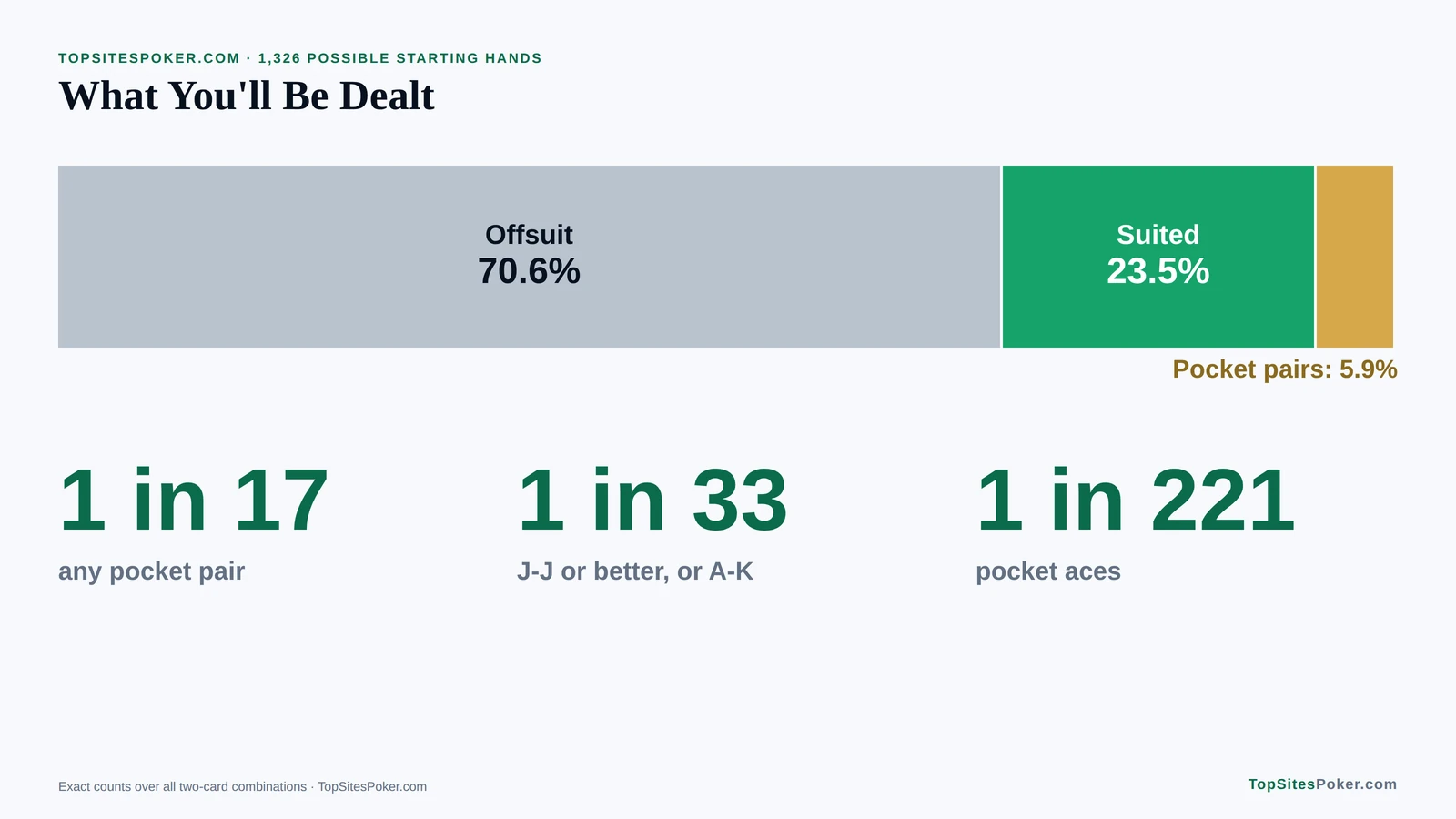
Most starting hands are unpaired offsuit cards; premium hands are rare.
Seven hands in ten are unpaired, offsuit cards. The premium hands everybody hopes for, J-J or better and A-K, arrive about once every 33 hands, which at a live table is roughly once an hour. If you play every hand that “might” win, you’ll mostly be playing weak cards.
Waiting for aces
Pocket aces are the best starting hand, and you’ll be dealt them once in 221 hands on average. Averages hide how streaky the wait feels. This is the chance of seeing aces at least once within a given number of hands:
| Hands dealt | At least one pocket aces | At least one pocket pair | At least one J-J+ or A-K |
|---|---|---|---|
| 10 | 4.4% | 45.5% | 26.4% |
| 50 | 20.3% | 95.2% | 78.4% |
| 100 | 36.5% | 99.8% | 95.3% |
| 221 | 63.3% | more than 99.9% | 99.9% |
| 500 | 89.6% | more than 99.9% | more than 99.9% |
| 1,000 | 98.9% | more than 99.9% | more than 99.9% |
Exact: 1 minus the chance of missing in every hand, for example 1 − (220/221)100 for aces in 100 hands.
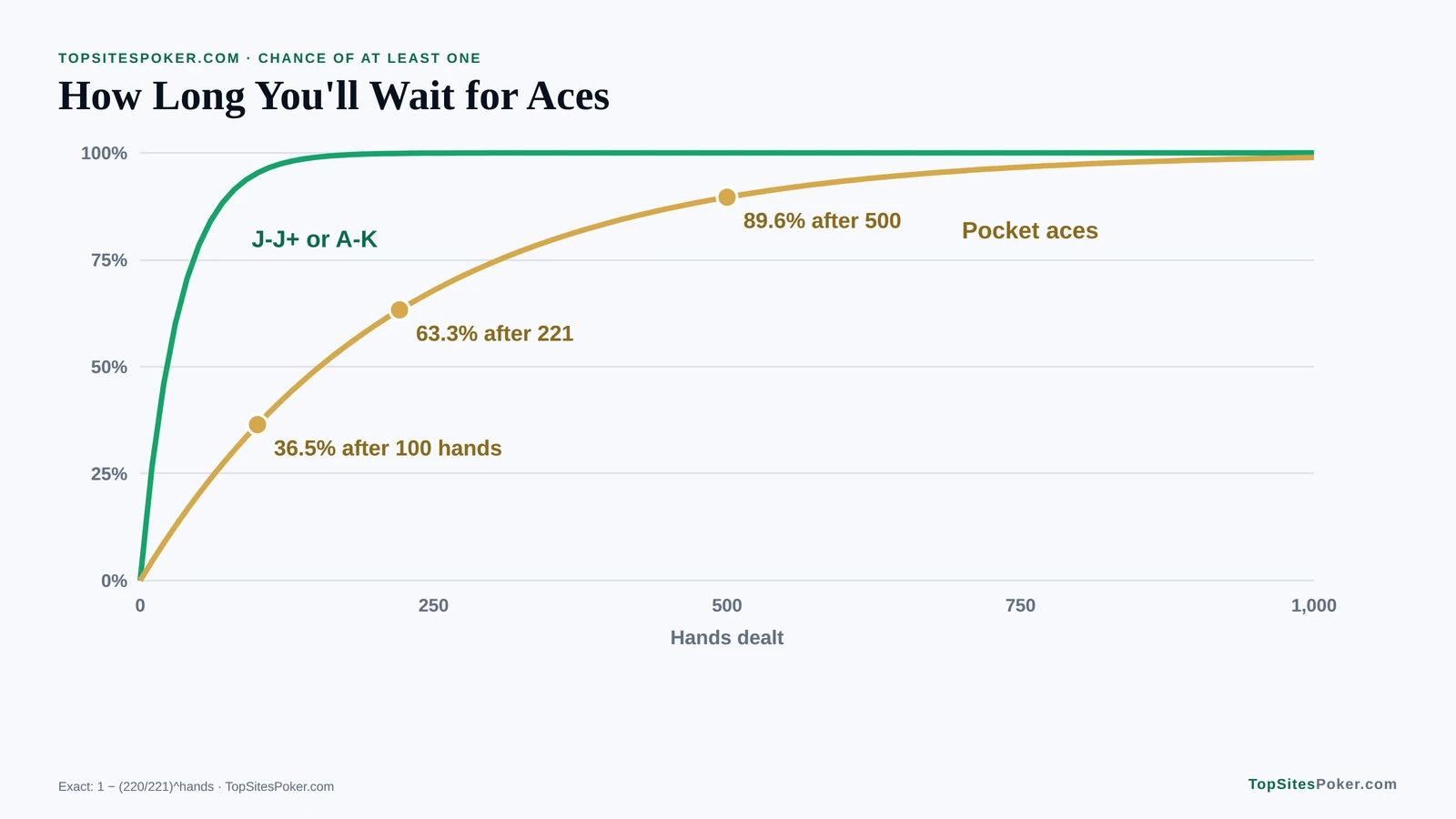
Premium hands arrive steadily; pocket aces can take hundreds of hands.
Half the time you’ll wait more than 150 hands for pocket aces, which is about five hours or more at a typical live table. In 221 hands, the “average” wait, more than a third of the time (36.7%) you won’t see them at all. Patience isn’t a personality trait in poker; it’s a requirement built into the deck.
A simple starting plan by position
Here is a deliberately simple set of hands to raise with when nobody has entered the pot before you. It’s tighter than what strong players use, which is the point: it keeps you out of the difficult spots that cost beginners most of their money. “Suited” means both cards are the same suit, and “A-J+” means A-J and better aces, like A-Q and A-K.
| Position | Raise with | Share of all hands |
|---|---|---|
| Early (UTG, UTG+1, middle) | 8-8 or better; A-J suited, A-Q suited, A-K suited; K-Q suited; A-Q and A-K offsuit | 6.2% |
| Middle (lojack, hijack) | 6-6 or better; A-10 suited or better; K-J and K-Q suited; Q-J suited; J-10 suited; A-J offsuit or better; K-Q offsuit | 10.1% |
| Late (cutoff, button) | Any pair; any suited ace; K-9 suited or better; Q-9 suited or better; J-9 suited or better; 10-9, 9-8, 8-7 and 7-6 suited; A-10 offsuit or better; K-10 offsuit or better; Q-10 and Q-J offsuit; J-10 offsuit | 22.5% |
Share of all hands counted exactly from the 1,326 starting combinations. A starting guide for full-ring cash games, not a solver-derived strategy.
Some practical notes for using the plan:
- Raise, don’t limp. If a hand is good enough to play and nobody has entered the pot, raise rather than just calling the big blind. Raising gives you two ways to win: everyone folds, or you have the better hand. A common raise size is about 2.5 to 3 big blinds online and 3 to 5 big blinds in live games, plus one big blind for each player who has already limped in.
- Tighten up when someone has already raised. A player who raised before you usually has a good hand. Against a raise, play only the top of your range, roughly the early-position hands, and re-raise with the very best (Q-Q, K-K, A-A and A-K).
- The small blind is a bad seat. You’ll act first on every later street. Play a little tighter than you would on the button.
- The big blind gets a discount. You’ve already paid a full bet, so you can call a small raise with more hands than you’d play from other seats, especially suited and connected hands.
- Six-max is looser. At a six-handed table, use the middle-position list from under the gun and widen from there.
Why suited and connected hands are overrated
Suited cards look pretty, but being suited only improves a hand’s chance of winning at showdown by a few percentage points. Two suited cards will make a flush by the river only about 6.4% of the time. Connected cards such as 8-7 make straights, but they rarely make the best hand when they flop a pair. They’re worth playing from late position, when a pot is cheap and you’ll act last. From early position, they cost more than they earn.
Short-Handed and Heads-Up Play
Fewer players at the table doesn’t change the rules, but it changes which hands are worth playing. With fewer opponents, a hand only has to beat a few other hands rather than eight, and you’re in the blinds much more often, so waiting for premium cards costs more.
Our starting-hand simulations show how much the number of opponents matters. Against one random hand, 89 of the 169 distinct starting hands are favorites, covering 654 of the 1,326 possible combinations (49.3%). Weak-looking hands become playable:
| Hand | Wins against 1 random hand | Wins against 4 random hands | Fair share against 4 opponents |
|---|---|---|---|
| K-2 offsuit | 50.6% | 17.0% | 20% |
| Q-7 offsuit | 51.8% | 18.3% | 20% |
| 10-9 offsuit | 51.5% | 22.5% | 20% |
| A-2 offsuit | 55.0% | 19.8% | 20% |
| K-7 offsuit | 55.2% | 20.4% | 20% |
TopSitesPoker.com simulation: 200,000 deals per hand against one random hand and 60,000 deals per hand against four, all five board cards dealt, split pots counted as fractional wins. “Fair share” is the win rate each player would have if all hands were equal: 1 in 5 with five players.
K-2 offsuit wins more often than it loses against a single random hand, but falls below its fair share against four opponents. Connected hands like 10-9 offsuit hold up better in multiway pots because they make straights. That’s the logic behind playing looser short-handed and tighter at a full table.
Heads-up in practice
- The button is the small blind and acts first before the flop, then last on every later street.
- You’re in a blind every hand, paying 75 big blinds per 100 hands. Folding too often loses quickly.
- Hand values shift. High cards and any pair go up in value; small suited connectors go down, because big pots with several players are rare.
- Aggression matters more. Most flops miss both players, so the player who bets first often takes the pot.
Heads-up play is a great way to practice reading a single opponent, but it’s also the fastest-moving and most demanding format. Get comfortable at six-max or full-ring tables first.
Your First Poker Math: Outs and Pot Odds
You don’t need to be good at math to play poker, but two calculations come up in almost every hand where you’re drawing to a better hand. Together they answer one question: is this call worth it?
Step 1: count your outs
An out is a card that improves your hand to one you expect to win with. If you hold two hearts and the flop brings two more, any of the nine remaining hearts gives you a flush, so you have nine outs. These are the draws you’ll see most often, with exact chances of hitting:
| Your draw | Example | Outs | Hit on the next card (flop to turn) | Hit by the river (from the flop, seeing both cards) | Hit on the river (from the turn) |
|---|---|---|---|---|---|
| Flush draw plus open-ended straight draw | 9♥ 8♥ on 10♥ 7♣ 2♥ | 15 | 31.9% | 54.1% | 32.6% |
| Flush draw plus gutshot | K♠ 9♠ on Q♠ J♦ 4♠ (a 10 makes a straight) | 12 | 25.5% | 45.0% | 26.1% |
| Flush draw | A♥ 6♥ on K♥ 9♥ 2♣ | 9 | 19.1% | 35.0% | 19.6% |
| Open-ended straight draw | 9♣ 8♦ on 10♠ 7♥ 2♣ | 8 | 17.0% | 31.5% | 17.4% |
| Two overcards | A♣ K♦ on 9♠ 6♥ 2♣ | 6 | 12.8% | 24.1% | 13.0% |
| One pair to two pair or trips | K♣ 9♦ on K♥ 7♠ 3♦ | 5 | 10.6% | 20.4% | 10.9% |
| Gutshot straight draw | 9♣ 8♦ on J♠ 7♥ 2♣ (only a 10 helps) | 4 | 8.5% | 16.5% | 8.7% |
| Pocket pair to a set | 6♠ 6♦ on A♣ J♥ 9♠ | 2 | 4.3% | 8.4% | 4.3% |
Exact: outs divided by the 47 unseen cards on the flop or the 46 unseen cards on the turn; “by the river” is 1 minus the chance of missing twice. Unseen cards include your opponents’ hole cards, which you can’t see, so they’re treated as unknown.
Two cautions about outs. First, not every out is clean: if you’re drawing to a flush on a paired board, the same card that gives you the flush might give an opponent a full house. Second, overcard outs assume your opponent has one pair. If they already have two pair or better, pairing your ace doesn’t help. When in doubt, count your outs conservatively.
Discounting outs: an example
Suppose you hold 9♣ 8♣ and the flop is 10♥ 7♥ 2♠. You have an open-ended straight draw: any 6 or jack gives you a straight, 8 outs in all. But two of those cards, the 6♥ and J♥, also put a third heart on the board. If your opponent has two hearts, those cards give them a flush that beats your straight. Against an opponent you suspect is on a flush draw, it’s safer to count 6 clean outs rather than 8, which lowers your chance of hitting by the river from 31.5% to 24.1%. Counting outs isn’t just counting cards; it’s counting the cards that actually win.
The rule of 2 and 4
You won’t calculate exact percentages at the table, so players use a shortcut:
- With one card to come, multiply your outs by 2.
- With two cards to come (on the flop, if you’ll see both the turn and river), multiply your outs by 4.
How good is the shortcut? We compared it with the exact figures for every number of outs from 1 to 20:
| Outs | Rule of 4 (two cards) | Exact (two cards) | Rule of 2 (one card) | Exact (river, from the turn) |
|---|---|---|---|---|
| 2 | 8% | 8.4% | 4% | 4.3% |
| 4 | 16% | 16.5% | 8% | 8.7% |
| 6 | 24% | 24.1% | 12% | 13.0% |
| 8 | 32% | 31.5% | 16% | 17.4% |
| 9 | 36% | 35.0% | 18% | 19.6% |
| 10 | 40% | 38.4% | 20% | 21.7% |
| 12 | 48% | 45.0% | 24% | 26.1% |
| 15 | 60% | 54.1% | 30% | 32.6% |
| 20 | 80% | 67.5% | 40% | 43.5% |
Exact figures calculated by TopSitesPoker.com from 47 unseen cards on the flop and 46 on the turn.
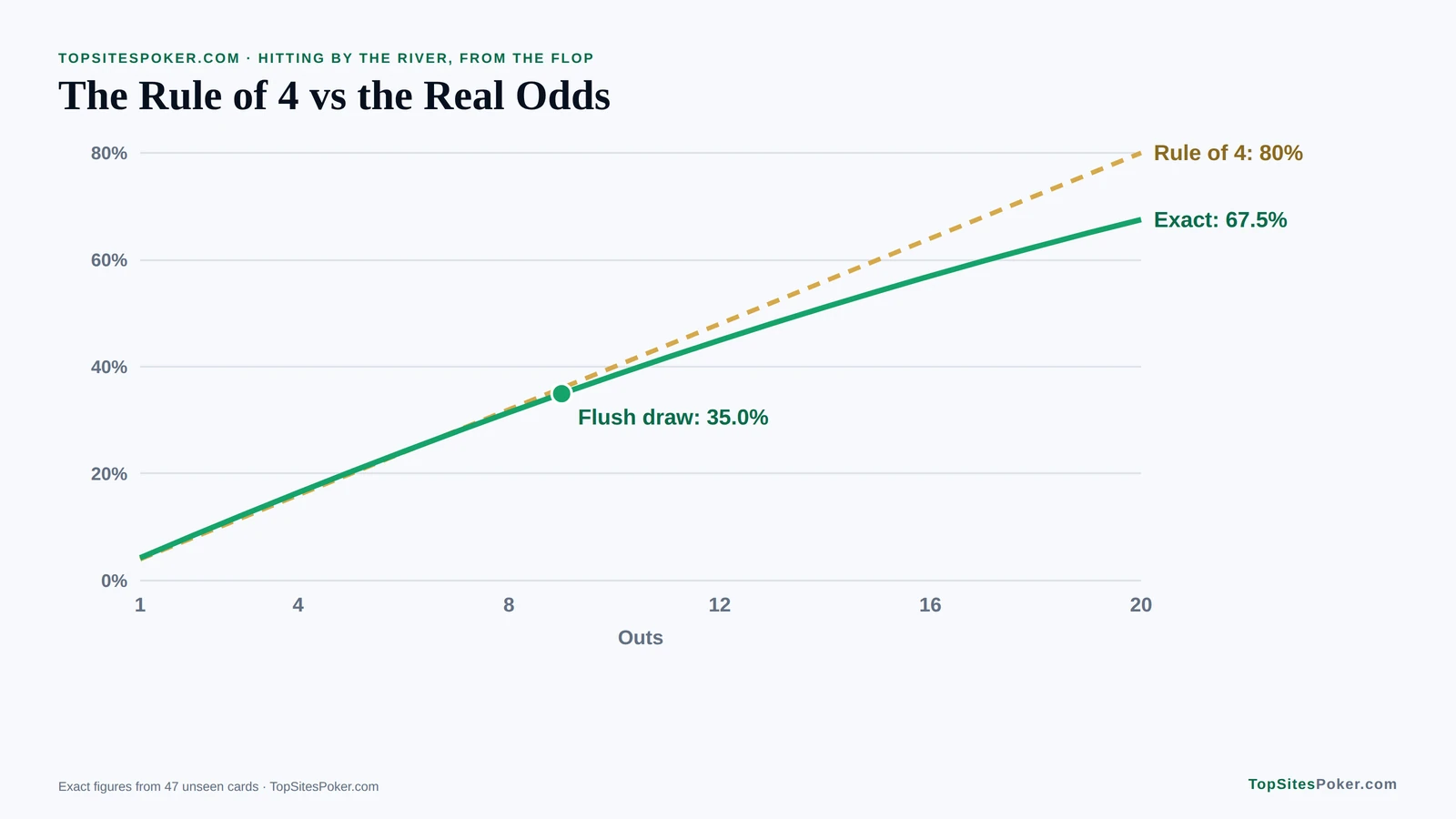
The shortcut is accurate up to about 9 outs and too optimistic for big draws.
Up to about 9 outs, the rule of 4 is within one percentage point. Beyond that it overstates your chances, by about 6 points with 15 outs and about 12 points with 20. A simple fix for big draws: multiply by 4 and then subtract the number of outs above 8. With 15 outs that gives 60 − 7 = 53%, close to the exact 54.1%. The rule of 2, meanwhile, slightly understates your chances, so it errs on the safe side.
Step 2: compare your chances with the pot odds
Pot odds tell you how often a call has to win to break even. The formula is simple: divide the amount you have to call by the total pot after your call. If the pot is $60 after your opponent’s bet and you have to call $20, the pot will be $80 and you need to win 20 ÷ 80 = 25% of the time.
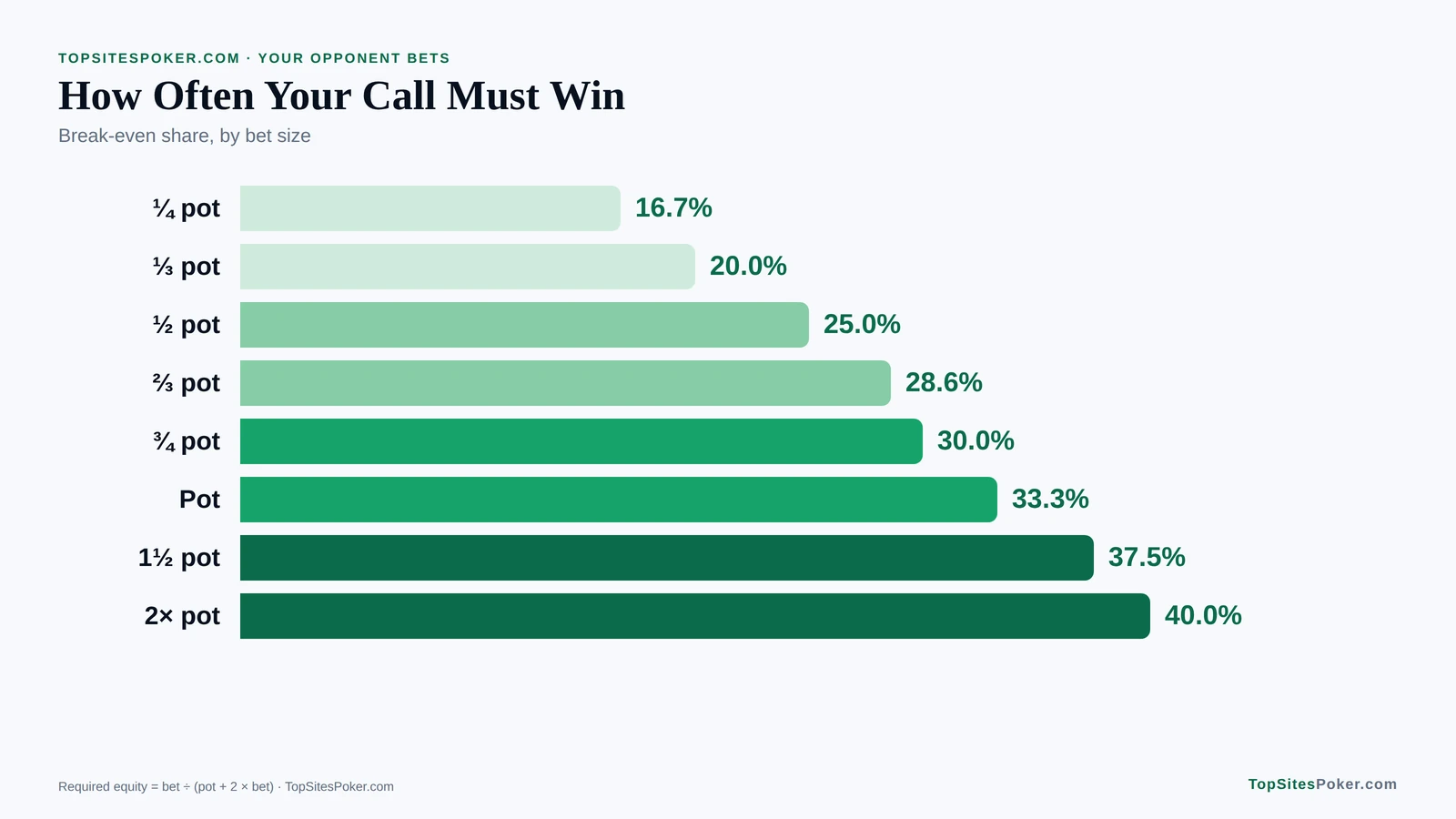
Because opponents usually bet a fraction of the pot, it helps to know the break-even percentage for common bet sizes:
| Opponent’s bet | Example (pot $100) | You must win at least | Pot odds |
|---|---|---|---|
| A quarter of the pot | Bet $25; you call $25 into a final pot of $150 | 16.7% | 5 to 1 |
| A third of the pot | Bet $33 | 20.0% | 4 to 1 |
| Half the pot | Bet $50 | 25.0% | 3 to 1 |
| Two-thirds of the pot | Bet $67 | 28.6% | 2.5 to 1 |
| Three-quarters of the pot | Bet $75 | 30.0% | 2.3 to 1 |
| The size of the pot | Bet $100 | 33.3% | 2 to 1 |
| One and a half times the pot | Bet $150 | 37.5% | 1.7 to 1 |
| Twice the pot | Bet $200 | 40.0% | 1.5 to 1 |
Required equity = bet ÷ (pot + 2 × bet). Exact.

The bigger the bet relative to the pot, the more often your call needs to win.
Putting it together: two examples
Example 1: a flush draw on the flop. You hold A♥ 6♥ and the flop is K♥ 9♥ 2♣. The pot is $40 and your opponent bets $20. You need to call $20 into a pot that will be $80, so you need 25%. If you call, you’re only guaranteed to see the turn, where you’ll hit 19.1% of the time. By pot odds alone, that’s a fold. But if you hit, you’ll probably win more money on later streets, which players call implied odds, and your ace might win even if you miss. That’s why most players call here with a nut flush draw.
Example 2: the same draw against an all-in. Now your opponent moves all-in for $20 into the same $40 pot. There’s no more betting, so you’ll see both the turn and river, and you’ll make your flush 35.0% of the time. You need 25%, so calling is clearly profitable, even before counting the times your ace wins.
The lesson: the “by the river” figure only applies when you’re sure to see both cards, usually because someone is all-in. When more betting can follow on the turn, use the one-card figure.
What pot odds don’t tell you
- Whether your outs are live. Pot odds assume your draw wins when it hits. Against a bigger draw or a set, it may not.
- What happens after you hit. Implied odds reward draws that are hidden and that can win a big pot. Reverse implied odds punish draws that make a second-best hand.
- Whether a raise is better. With a strong draw, raising can win the pot immediately or build a bigger pot for when you hit. That’s a more advanced decision, but it’s worth knowing calling isn’t the only option.
Expected Value: How Good Players Judge a Decision
Pot odds are one example of a broader idea that runs through all of poker: expected value, or EV. The expected value of a decision is the amount it wins or loses on average if you made it many times. A decision with positive EV makes money in the long run, whatever happens this time.
The EV of a call
Say the pot is $100, your opponent bets $50, and you estimate you’ll win 30% of the time. If you call:
- 30% of the time you win the $150 that’s already in the pot (the $100 plus the $50 bet).
- 70% of the time you lose your $50 call.
EV = 0.30 × $150 − 0.70 × $50 = $45 − $35 = +$10. The call makes $10 on average, even though it loses more often than it wins. That’s the same answer pot odds give: you needed 25% to break even and you have 30%.
The EV of a bluff
A bluff works the other way around. It doesn’t need to win at showdown; it needs your opponent to fold often enough. The break-even point depends only on your bet size compared with the pot:
| Your bluff | Example (pot $100) | Opponent must fold at least |
|---|---|---|
| A third of the pot | Bet $33 | 25% |
| Half the pot | Bet $50 | 33.3% |
| Two-thirds of the pot | Bet $67 | 40% |
| Three-quarters of the pot | Bet $75 | 42.9% |
| The size of the pot | Bet $100 | 50% |
| Twice the pot | Bet $200 | 66.7% |
Break-even fold frequency = bet ÷ (pot + bet). Exact, assuming the bluff never wins when called.
This explains why small continuation bets are so popular. A bet of a third of the pot only has to work one time in four to show a profit, and on dry boards that most players miss, it often does. A pot-sized bluff has to work half the time, which is a much bigger ask, especially against players who don’t like to fold.
Thinking in EV instead of results
The biggest shift in a new player’s thinking is moving from “did I win the hand?” to “was it a good decision?” You can make a +$10 call and lose the pot, or a −$20 call and win it. Over hundreds of hands, the decisions decide your results; in a single hand, luck does. When you review a hand, ask whether the decision was right given what you knew, not whether it worked.
Two practical consequences:
- Don’t change a good strategy after one bad result. If you folded correctly and would have won, you still made the right decision.
- Don’t copy a bad play because it worked. A lucky call that hit a two-outer is still a losing play every time you repeat it.
After the Flop: Playing Your First Postflop Hands
Preflop decisions are the easy part: you can follow a chart. After the flop, every hand is different, and that’s where poker really starts. You don’t need advanced theory to avoid the big mistakes, just a way to judge how strong your hand is and a plan for each type of hand.
Most flops miss you
The first thing to accept is that the flop usually doesn’t help. We counted every possible flop for a few typical starting hands:
| Your hand | What you’re hoping for | How often the flop gives it to you |
|---|---|---|
| Two unpaired cards, such as K-Q | A flop that pairs at least one of your cards | 32.4% (about 1 flop in 3) |
| A pocket pair, such as 7-7 | A third card of your rank (a set) or better | 11.8% (about 1 flop in 8.5) |
| Two suited cards, such as 9♥ 8♥ | A made flush | 0.84% (about 1 flop in 119) |
| Two suited cards | A flush draw (exactly two more of your suit) | 10.9% |
| Connected cards, such as 9-8 | A made straight | 1.3% |
Exact counts over all 19,600 possible flops for each hand. Calculated by TopSitesPoker.com.
Two flops in three, an unpaired hand doesn’t pair either of its cards. That has two consequences. When you miss, you should usually be ready to give up the hand. And because your opponents miss just as often, a well-timed bet can win many pots that nobody has much of a hand in.
Sort your hand into a category
Instead of trying to work out exactly what you have against every possible holding, sort your hand into one of five rough categories. Each comes with a simple default plan:
| Category | Examples on a K♠ 8♦ 3♣ flop (unless noted) | Default plan |
|---|---|---|
| Very strong | A set (8-8, 3-3, K-K), two pair (K-8) | Bet to build the pot; you want to be called |
| Strong | An overpair (A-A), top pair with a good kicker (A-K, K-Q) | Bet for value on the flop and usually the turn; be more careful if the betting gets heavy |
| Medium | Top pair with a weak kicker (K-5), middle pair (9-8, Q-8), pocket pairs below the top card (Q-Q, 10-10) | Keep the pot small: check, call reasonable bets, avoid big pots |
| Drawing | On K♥ 10♥ 4♣: Q-J (an open-ended straight draw) or any two hearts (a flush draw). This rainbow K-8-3 board allows almost no draws | Check-call if the price is right, or bet as a semi-bluff; use pot odds |
| Nothing | No pair and no draw, such as A-Q, which has only ace-high | Check and give up, or make one small bet if you raised before the flop and your opponent seems weak |
The categories aren’t fixed. A flush arriving on the turn can move your top pair from strong to medium, and a player who has called all the way and suddenly raises the river probably has something better than your one pair. Re-sort your hand on every street.
Read the board: dry or wet
The same hand plays very differently on different flops. Players describe boards as dry or wet:
- Dry boards have unconnected cards of different suits, such as K♠ 7♦ 2♣. Few draws are possible, so the best hand on the flop is likely to still be best on the river. Small bets work well.
- Wet boards have connected cards and suits, such as J♥ 10♥ 8♣. Many straight and flush draws are possible, so hands change a lot on later streets. Bigger bets make drawing more expensive for your opponents.
- Paired boards, such as 9♠ 9♦ 4♣, make full houses and three of a kind possible, and they tend to miss most starting hands.
Bet sizes that make sense
Beginners often bet too big with weak hands and too small with strong ones, which tells observant opponents exactly what they have. A simpler approach is to size your bets by the board, not by your hand:
- On dry boards, bet about a third to half of the pot.
- On wet boards, bet about half to three-quarters of the pot.
- On the turn and river with a strong hand, bet about half to three-quarters of the pot, or more against players who call too much.
Using the same sizes with your strong hands and your bluffs makes you much harder to read.
The continuation bet
If you raised before the flop and got one caller, a small bet on the flop, called a continuation bet or “c-bet,” wins the pot a lot of the time, because your opponent will often have missed. It works best on dry boards, against one opponent, and when you’re in position. It works poorly against several opponents, because the chance that somebody hit the flop grows with each extra player. Against two or more callers, bet mainly when you have a real hand or a strong draw.
When to slow down
A few signals should make you re-think a one-pair hand:
- A passive player raises. Players who mostly check and call rarely raise without a strong hand.
- Large bets on the turn and river. At low stakes, big bets on later streets usually mean a strong hand.
- The board completes a draw. If a third heart arrives and your opponent suddenly bets big, your top pair is probably beaten.
Folding one pair in these spots feels bad, but it’s usually right. One pair is a good hand in many small pots and a losing hand in most big ones.
Eight Situations Every New Player Meets
Some spots come up again and again in your first sessions. Here’s how to think about each, with the numbers behind the advice where they help. Equities for specific hands were calculated exactly over every possible board.
1. Everyone limps and you’re in the big blind
Three players call the $2 big blind and it’s your turn. You can check for free and see a flop. With a strong hand, such as A-K or a big pair, raise to about 5 times the big blind plus 1 big blind per limper, so the limpers pay to see the flop. With anything else, check and play carefully: you’ll be out of position against several opponents.
2. Someone raises and you hold a small pocket pair
Small pairs make money mostly by flopping a set, which happens 11.8% of the time, roughly 7.5 to 1 against. Because you’ll miss so often, you need to win a lot when you hit. A common rule of thumb is to call a raise with a small pair only if both you and the raiser have at least 15 to 20 times the size of the call left in your stacks. If the stacks are shorter, fold, or re-raise all-in in a tournament.
3. A pair against two higher cards: the “coin flip”
A pocket pair against two higher unpaired cards is close to even. With these exact cards, 7♠ 7♥ wins 55.2% of the time against A♣ K♦ (and ties 0.3%), and Q♠ Q♥ wins 57.0% of the time against A♣ K♦ (and ties 0.3%). That’s why players call these all-ins “coin flips.” Being slightly ahead is fine, but it’s never a big edge. Don’t risk your whole tournament on a flip early on if you can avoid it.
4. Your ace-king meets ace-queen
When two hands share a card, the one with the higher second card is said to dominate the other. A♣ K♦ against A♠ Q♥ wins 74.0% of the time, counting splits as half. The weaker hand mostly needs to pair its queen without the king pairing too. This is why A-Q, A-J and K-Q are dangerous hands to call big raises with: the hands that raise big often dominate them.
5. You flop top pair and get raised
You raised with A-J, and the flop comes J♣ 8♦ 4♠. You bet, and a player who called before the flop raises you. At low stakes, a flop raise from a player who has only called so far usually means two pair or a set, sometimes a strong draw. Top pair with a top kicker is a fine hand to call once, but if the raises continue on the turn, give serious thought to folding.
6. Pocket aces, and someone re-raises
Pocket aces are the best starting hand, and against a single re-raise you should almost always re-raise again or go all-in before the flop. Even against pocket kings, the next-best hand, A♠ A♥ wins 82.4% of the time against K♠ K♥, with another 0.5% ending in a split. The mistake with aces isn’t losing with them; it’s slow-playing them before the flop and letting several players in cheaply.
7. You missed the flop in a three-way pot
You raised with K-Q, two players called, and the flop is 9-6-3. You have nothing. With two opponents, the chance that at least one of them connected with the flop is much higher than against one, so a continuation bet works less often. Checking and giving up is usually fine. Save your bluffs for heads-up pots.
8. Your draw faces a big bet
You have a flush draw on the turn, and your opponent bets the size of the pot. You need 33.3% to call and you have 19.6% (9 outs from 46 cards). Unless you’re very likely to win a large extra bet when you hit, fold. Drawing is profitable against small bets, not large ones.
Thinking in Ranges: What Could Your Opponent Have?
Beginners try to guess their opponent’s exact hand. Experienced players think about the whole set of hands the opponent could have, called a range, and how their own hand does against it. It sounds advanced, but the basic version needs nothing more than counting.
Counting combinations
Every two-card hand comes in a fixed number of suit combinations, or “combos”:
| Hand type | Example | Combos |
|---|---|---|
| A pocket pair | K-K | 6 |
| A specific suited hand | A-K suited | 4 |
| A specific offsuit hand | A-K offsuit | 12 |
| Any unpaired hand, suited or not | A-K | 16 |
Cards you can see remove combos. This effect, called blocking, changes the numbers a lot:
| What you can see | Combos of A-K left | Combos of K-K left |
|---|---|---|
| Nothing relevant | 16 | 6 |
| You hold one ace | 12 | 6 |
| One king on the board | 12 | 3 |
| You hold an ace, and a king is on the board | 9 | 3 |
Exact counts. Each visible card of a rank removes the combos that would need that card.
A single king on the board halves the ways an opponent can hold pocket kings, from 6 to 3. That’s why a set of kings on a king-high board is less likely than it feels, and why holding an ace makes it less likely that your opponent has pocket aces or A-K.
A worked example: top pair against an early raise
A player raises from under the gun, and you call on the button with K♥ J♥. The flop is K♠ 7♦ 2♣. You have top pair. How good is it?
Suppose the raiser follows the early-position list from our starting plan: 8-8 or better, A-J suited or better, K-Q suited, and A-Q or A-K offsuit. After removing the combos blocked by your cards and the board, 63 combinations remain. Comparing each with your hand on this flop:
| Opponent’s holding | Combos | Against your K-J |
|---|---|---|
| A-A | 6 | Ahead of you (overpair) |
| K-K | 1 | Ahead of you (a set) |
| A-K | 8 | Ahead of you (top pair, better kicker) |
| K-Q suited | 2 | Ahead of you (top pair, better kicker) |
| Q-Q, J-J, 10-10, 9-9, 8-8 | 27 | Behind you (a lower pair) |
| A-Q, A-J suited | 19 | Behind you (no pair) |
| Total | 63 | You’re ahead of 46, behind 17 |
Exact combination count by TopSitesPoker.com, with each hand’s result on the flop.
On the flop, you’re ahead of 46 of the 63 combos, about 73%. That’s a good spot to call a bet or bet yourself if it’s checked to you. But look at what happens if the raiser bets big on the turn and river. The 46 hands you beat are mostly pairs below a king and ace-high hands, which rarely want to put in a lot of money on this board. The hands that do want to build a big pot are the 17 that beat you. As the betting grows, the part of the range you beat folds, and the part that beats you stays.
That’s the most important lesson about ranges for a new player: your hand’s strength isn’t fixed; it depends on which hands your opponent would continue with. Top pair with a mediocre kicker is ahead of a range, but behind the part of it that raises.
Using ranges at the table
- Start with the preflop action. A raise from under the gun means a narrower, stronger range than a raise from the button.
- Narrow it on each street. Each call, bet or raise removes some hands and keeps others.
- Ask what they’d do with the hands you beat. If those hands would fold or check, a big bet from your opponent comes mostly from the hands that beat you.
- Count combos in big decisions. Knowing that there are 3 combos of a set and 12 of a bluffing hand can turn a guess into a clear decision.
Reading Your Opponents Without Guessing
Movies make poker look like a contest of spotting nervous twitches. In practice, the most reliable information about an opponent comes from how they bet, and it’s available online and live alike. Start by sorting each player at your table along two simple lines:
- Tight or loose: does this player enter many pots or few? A player who plays almost every hand has weaker cards on average than one who plays one hand in six.
- Passive or aggressive: when they play, do they mostly check and call, or bet and raise? Passive players’ bets and raises mean more, because they make them less often.
That gives four basic player types, and a simple adjustment for each:
| Player type | What you’ll see | How to adjust |
|---|---|---|
| Loose and passive (“calling station”) | Plays many hands, calls a lot, rarely raises | Don’t bluff. Bet your good hands for value, and bet bigger |
| Tight and passive (“rock”) | Plays few hands, rarely bets without a strong hand | Steal their blinds; fold when they suddenly bet big |
| Loose and aggressive | Plays many hands and bets and raises often | Call down more with good hands; let them bet into you |
| Tight and aggressive | Plays few hands but plays them hard | Respect their raises; avoid big pots without a strong hand |
Most low-stakes games have plenty of loose, passive players, which is good news for disciplined beginners. The single most profitable adjustment against them is to stop bluffing and bet your good hands.
What bet patterns tell you
- A sudden raise from a passive player is usually a strong hand.
- A small bet on a scary board often means a medium hand that wants to see the next card cheaply.
- A check, then a big bet on the next street can mean a draw that hit.
- An instant call often means a hand that didn’t need to think: a draw, or a medium hand that was never folding. An instant raise is more often strong.
None of these is a rule. They’re tendencies, and good players vary their play precisely so they can’t be read this way. But at low stakes, bet patterns are usually more reliable than trying to spot a shaky hand.
Physical tells, briefly
Live, some players do give away information: reaching for chips before it’s their turn, relaxing after seeing a card they like, or acting very strong to look weak. Treat any single tell as weak evidence that only adds to what the betting already says. And keep your own behavior consistent: take about the same time for every decision and put your chips in the same way whether you’re strong or bluffing.
Money Management: Stakes, Bankroll and Swings
Poker is a game of skill in the long run and a game of luck in the short run. Even a player who makes better decisions than everyone at the table can lose for weeks. Managing your money well is what lets you survive those stretches, and it matters more than any single strategy tip in this guide.
How big the swings are
To show how much short-term results can vary, we modeled a solid winning cash-game player: someone who wins 5 big blinds per 100 hands on average, with a standard deviation of 80 big blinds per 100 hands, a realistic level of variance for no-limit Hold’em cash games. These are illustrative assumptions, not a promise of any win rate. Using the standard normal approximation, this is how often that winning player would still be behind after a given number of hands:
| Hands played | Expected result | Chance of being behind | Range of results, 95% of the time |
|---|---|---|---|
| 1,000 | +50 big blinds | 42% | −446 to +546 big blinds |
| 5,000 | +250 big blinds | 33% | −859 to +1,359 big blinds |
| 10,000 | +500 big blinds | 27% | −1,068 to +2,068 big blinds |
| 25,000 | +1,250 big blinds | 16% | −1,229 to +3,729 big blinds |
| 50,000 | +2,500 big blinds | 8% | −1,006 to +6,006 big blinds |
| 100,000 | +5,000 big blinds | 2.4% | +42 to +9,958 big blinds |
TopSitesPoker.com calculation: normal approximation with a win rate of 5 big blinds and a standard deviation of 80 big blinds per 100 hands. Illustrative assumptions.
Short-term results say little about skill; it takes tens of thousands of hands for a winning player to be reliably ahead.
Read that again: a winning player is still behind after 1,000 hands more than four times in ten. At a live table, that’s roughly 30 to 40 hours of play. Short-term results tell you almost nothing about how well you’re playing, which is why good players judge their decisions, not their results, and why nobody should play with money they can’t afford to lose.
How big a bankroll you need
A bankroll is money set aside only for poker, separate from money you need for anything else. The question is how many buy-ins to keep so that a bad run doesn’t wipe it out. For the same illustrative winning player, a standard risk-of-ruin formula gives these chances of ever losing the whole bankroll while playing at one stake (a buy-in here is 100 big blinds):
| Bankroll | Risk of ruin, winning 5 big blinds per 100 hands | Risk of ruin, winning 2.5 big blinds per 100 hands |
|---|---|---|
| 10 buy-ins | 21% | 46% |
| 20 buy-ins | 4.4% | 21% |
| 30 buy-ins | 0.9% | 9.6% |
| 50 buy-ins | 0.04% | 2.0% |
Risk of ruin = e−2 × win rate × bankroll ÷ variance, using a standard deviation of 80 big blinds per 100 hands. It assumes the player never moves down in stakes. A losing player’s risk of ruin is 100% at any bankroll size.
That’s why common guidance for cash games is somewhere around 20 to 40 buy-ins for the stakes you play, and more for tournaments, where results swing much harder because most entries finish without a prize. Many players keep 50 to 100 tournament buy-ins or more. If you’re new, the simplest rule is even stricter: play at stakes so low that the money doesn’t matter to you, and move up only when you have both the results and the bankroll to support it.
Practical money rules for beginners
- Set your limit before you sit down. Decide how much you’re willing to lose in a session, and stop when you reach it.
- Buy in for a full stack at a small game rather than a short stack at a bigger game. Short stacks at high stakes make every mistake more expensive.
- Move down when you lose a set share of your bankroll, for example a quarter of it. Moving down is normal; even professionals do it.
- Keep records. Write down the date, game, stakes, hours and result of every session. Results you don’t track are easy to overestimate.
- Stop when you’re tilted. “Tilt” means playing worse because you’re upset, usually after a bad beat. Taking a break is a skill, not a weakness.
Poker should be entertainment you can afford. If it stops feeling that way, the helpline listed at the end of this guide can be reached by phone, text or chat.
Live Poker vs Online Poker
The rules of a hand are the same in a casino and on your phone, but the experience is very different. Knowing the differences helps you choose where to start and avoid feeling lost the first time you try the other.
| Live (casino or cardroom) | Online | |
|---|---|---|
| Speed | Roughly 25–35 hands per hour with a dealer | Often 60–100 hands per hour at one table, more with several tables |
| Dealing and chip counts | A dealer shuffles, deals and counts the pot | Software does it instantly and without errors |
| How you act | Say your action, or move chips in one motion | Click a button; bet sizes are typed or chosen with a slider |
| Time to act | No fixed limit, but anyone can “call the clock” on a slow player | A countdown timer, often with an extra time bank |
| Lowest stakes | Usually $1/$2 or $1/$3 no-limit | Blinds of a few cents, and free play-money tables |
| Reading opponents | Betting patterns plus physical behavior | Betting patterns, timing and statistics |
| Tipping | Customary in the U.S. to tip the dealer when you win a pot | None |
| Legality | Licensed cardrooms and casinos | Legal only in some U.S. states and many other countries; use licensed, regulated sites |
Hand rates are typical ranges, not fixed figures. They vary with the dealer, the players and the site.
Online is the fastest way to gain experience: at 60 or more hands an hour, you’ll see as many hands in an evening as a live player sees in two or three sessions. It also removes the fear of making a procedural mistake in front of a table of strangers. Live poker is slower but more social, and many players find it the more enjoyable way to play. Whichever you choose, the important thing is that the game is legal where you are and the operator is licensed.
Poker Etiquette: How to Behave at the Table
Etiquette isn’t just politeness. Most of it exists to keep the game fair and moving, and breaking it can cost you a hand or a warning from the floor. These are the habits that mark an experienced player:
- Act in turn. Don’t fold, bet or even reach for your chips before it’s your turn. Out-of-turn actions give information away and can be binding.
- Pay attention. Know when it’s your turn and how much the bet is. Asking “what’s the bet?” every hand slows everyone down.
- Protect your cards. Keep them on the table in view and place a chip or card protector on them. A dealer can accidentally muck unprotected cards, and a mucked hand is dead.
- Don’t splash the pot. Place your bet in front of you rather than throwing chips into the middle, so the dealer can check the amount.
- Keep your chips visible. Large-value chips should be in front of your stack where other players can see them. You can’t hide chips or remove them from the table in a cash game.
- One player to a hand. Don’t discuss a hand while it’s being played, even if you’ve folded, and never show your cards to another player while the hand is still live.
- Don’t slow-roll. If you know you have the winning hand at showdown, show it promptly. Deliberately making an opponent wait before revealing a winner is one of the rudest things you can do at a poker table.
- Be a good winner and a good loser. Don’t criticize other players’ decisions, even when they beat you with a bad call. Weaker players are the reason the game is profitable, and nobody plays better after being lectured.
- Follow the room’s phone rules. Many cardrooms don’t allow phone calls at the table, and tournament rules restrict phones and other devices at the table.
Your first live session, step by step
- Go to the poker desk and ask for the lowest no-limit game. You’ll be added to a waiting list if the tables are full.
- When your name is called, buy chips from the dealer or a chip runner. In many rooms cash on the table doesn’t play, so convert it to chips.
- Tell the dealer it’s your first time in the room if you like. Dealers are used to new players and will help with procedure.
- Wait for the big blind, or post one to get dealt in straight away, as the dealer directs.
- Watch a few orbits before playing a hand. You’ll learn the table’s pace and which players are aggressive.
- When you leave, carry your chips to the cashier (the “cage”) to exchange them for cash.
Hosting Your First Home Game
A home game is the friendliest place to learn, and it’s easy to run one well. The keys are a sensible chip setup, a blind schedule that ends the night on time, and house rules everyone agrees to before the first hand.
A home tournament for eight players
A tournament is the easiest format for a home game: everyone pays the same, plays until they’re out, and the prize money is set in advance. This setup gives each player 10,000 in chips using four chip values:
| Chip value | Chips per player | Value per player | Chips needed for 8 players |
|---|---|---|---|
| 25 | 8 | 200 | 64 |
| 100 | 8 | 800 | 64 |
| 500 | 6 | 3,000 | 48 |
| 1,000 | 6 | 6,000 | 48 |
| Total | 28 | 10,000 | 224 |
You need at least 64 chips in each of two colors and 48 in each of two more, so a 500-chip set with four or more colors is the safe choice; many 300-chip sets don’t have enough of each color. Assign the values to colors before anyone arrives and write them on a card in the middle of the table.
A blind schedule with 20-minute levels suits most evenings:
| Level | Blinds | Level | Blinds |
|---|---|---|---|
| 1 | 25/50 | 7 | 300/600 |
| 2 | 50/100 | 8 | 400/800 |
| 3 | 75/150 | 9 | 500/1,000 |
| 4 | 100/200 | 10 | 700/1,400 |
| 5 | 150/300 | 11 | 1,000/2,000 |
| 6 | 200/400 | 12 | 1,500/3,000 |
There are 80,000 chips in play. By level 12, even if only two players remain, the average stack is 40,000, or about 13 big blinds, so the game will very likely finish within about four hours, plus breaks. Once the blinds reach 200/400 at level 6, every blind is a multiple of 100, so the 25 chips are no longer needed. Exchange them for 100 chips, and settle any leftovers with a quick “chip race”: deal each player one card per leftover 25 chip, and award the new 100 chips to the highest cards, no more than one per player.
For payouts with eight players, paying the top two or three places works well. A common split is 65% and 35% for two places, or 50%, 30% and 20% for three.
A home cash game
If your group prefers cash games, pick blinds that make a normal buy-in about 100 big blinds. With a $50 buy-in, that means $0.25/$0.50 blinds. Keep a bank: one person sells chips for cash at the start, records every buy-in, and cashes everyone out at the end. The bank should balance to the dollar.
Dealing a hand correctly
Without a house dealer, the player on the button deals. A clean deal keeps everyone confident the game is fair:
- Shuffle thoroughly. Several riffle shuffles, then have the player to the dealer’s right cut the deck.
- Deal one card at a time, clockwise, starting with the small blind and ending with the button, until everyone has two cards. Heads-up, the big blind gets the first card and the button the last.
- Burn one card face down before the flop, the turn and the river.
- Deal the flop face up in the middle, then the turn and the river, each after its betting round is complete.
- Pull in the bets at the end of each round, not during it, so everyone can see what’s been bet.
Cardrooms and house rules differ on when an exposed card during the deal means a misdeal. For a home game, agree a simple rule in advance: for example, a misdeal if either of the first two cards dealt is exposed, and otherwise the exposed card is replaced after the deal.
House rules to agree on first
- The game and limits: No-Limit Hold’em unless everyone agrees otherwise, and no wild cards.
- Cards speak: a hand is what the cards make, and players must show both cards to win at showdown.
- All-ins: when a player is all-in and betting is over, all hands are turned face up.
- Rebuys: whether players who bust can buy back in, and until which level.
- Odd chips: in a split pot, the odd chip goes to the first tied player to the left of the button.
- Disputes: who decides when there’s a disagreement. Usually the host.
One legal point: rules for social home games differ by state and country. In many places a home game is only lawful if the host takes no cut of the pots or entry fees. Check the rules where you live before you organize a game for money.
Beyond Hold’em: Other Poker Games
Once you can play Hold’em, most other poker games take an hour to learn, because they share the same actions, the same betting structures and nearly the same hand rankings. What changes is how many cards you get and how you’re allowed to use them.
| Game | Cards | The key difference from Hold’em |
|---|---|---|
| Pot-Limit Omaha | 4 hole cards, 5 community cards | You must use exactly two hole cards and three board cards. Hands run much stronger |
| Omaha Hi-Lo | 4 hole cards, 5 community cards | The pot is split between the best high hand and the best qualifying low hand (8 or lower); if no low qualifies, the high hand takes it all |
| Seven Card Stud | 7 cards per player, 3 face down and 4 face up; no community cards | No blinds or button: antes and a “bring-in” start the betting, and the best visible hand acts first on later streets |
| Razz | As Seven Card Stud | The lowest hand wins; straights and flushes don’t count |
| Five Card Draw | 5 private cards | One round of discarding and drawing replacement cards; no community cards |
| 2-7 Triple Draw | 5 private cards | Three draws, and the lowest hand wins, with straights and flushes counting against you |
| Short Deck (Six Plus Hold’em) | 2 hole cards, 36-card deck | The 2s through 5s are removed, and a flush beats a full house |
The most common next step is Pot-Limit Omaha. It feels familiar, but the exactly-two rule catches out almost every Hold’em player at first: with four hearts on the board and one heart in your hand, you don’t have a flush. Because every player has six possible two-card combinations, the winning hand is usually much stronger than in Hold’em. Treat one pair and even two pair as weak hands until you’ve played a few sessions.
Mixed games, such as HORSE (Hold’em, Omaha Hi-Lo, Razz, Stud and Stud Hi-Lo), rotate through several of these games. They’re a fun challenge once you’re comfortable, and they reward the most versatile players.
The Mistakes New Players Make Most
Almost every new player makes the same handful of mistakes. None of them is about complicated strategy, which is good news: they’re easy to fix once you know them.
| Mistake | Why it costs money | The fix |
|---|---|---|
| Playing too many hands | Weak starting hands make second-best hands, which lose big pots | Follow a starting plan; fold most hands, especially from early position |
| Limping in | Calling the big blind gives up the chance to win the pot preflop and invites more players in | Raise or fold when you’re first in |
| Ignoring position | Playing out of position means guessing on every street | Play more hands from the cutoff and button, fewer from the early seats |
| Calling too much | Calling can’t win the pot unless you have the best hand at showdown | Ask “what can my opponent have that I beat?” before calling a big bet |
| Chasing draws at any price | Paying more than your chances of hitting justify loses money in the long run | Count outs, compare with the pot odds, and use the one-card figure when more betting is possible |
| Overvaluing one pair | One pair wins small pots but loses most big ones | Keep pots small with medium hands; fold to heavy aggression from passive players |
| Bluffing the wrong players | Loose, passive players call bluffs | Bluff rarely at low stakes; value-bet more |
| Folding when you could check | Throws away a free look at the next card | If nobody has bet, check |
| Acting out of turn or string betting | Can make your action binding or change your bet into a call | Wait your turn and announce your action |
| Playing on tilt | Frustration leads to loose calls and wild bluffs | Set a stop-loss and take a break after a bad beat |
| Playing above your bankroll | Normal swings can wipe you out | Keep 20 or more buy-ins for your cash-game stakes, or play for amounts you’re happy to lose |
The two that matter most
Playing too many hands is the root of most beginner losses. The problem isn’t just the weak hands themselves; it’s the difficult, expensive decisions they lead to later. A player holding K-8 who flops top pair against a tight raiser is in trouble before the first bet, because the hands that call or raise are mostly better. Folding K-8 before the flop avoids the whole problem.
Calling too much is the other big one. Calling feels safe, because it’s cheaper than raising and doesn’t risk being re-raised. But a call can only win at showdown, while a bet or raise can also win when everyone folds. Players who call a lot give their opponents a free choice every street. A simple test before any big call: name two or three realistic hands your opponent could have that you beat. If you can’t, fold.
A Practice Plan for Your First Ten Sessions
You’ll learn faster with a goal for each session than by simply playing a lot of hands. This plan works for online or live play. Each step adds one skill while the earlier ones become habits.
| Session | Focus | How to practice it |
|---|---|---|
| 1 | The flow of a hand | Play free or very low stakes. Before every action, say to yourself what street it is and which actions you have |
| 2 | Position | Before each hand, name your position. Fold everything under the gun except the early-position list |
| 3 | Starting hands | Follow the starting plan strictly. Count how many hands you play when first in; at a full table the plan works out to roughly one hand in eight |
| 4 | Raising first in | Never limp. Every hand you play when first in gets a raise of a consistent size |
| 5 | Reading your hand | At every showdown you see, name each player’s best five cards before the cards are read |
| 6 | Hand categories | On every flop you play, sort your hand: very strong, strong, medium, drawing or nothing |
| 7 | Outs and pot odds | Whenever you have a draw, count outs and work out the pot odds before acting |
| 8 | Continuation bets | After raising preflop, bet small on dry flops against one opponent; check more against several |
| 9 | Opponent types | Label each player tight or loose, passive or aggressive. Pay most attention to the players on your left, who act after you |
| 10 | Review | Write down your three most expensive hands and decide, without looking at the result, whether each decision was right |
After ten sessions, you’ll know the mechanics well enough that they no longer need thinking about, which frees your attention for your opponents. That’s the point where poker starts to become the game experienced players describe: less about your cards and more about the people holding the other ones.
Test Yourself: What’s the Right Call?
Twelve quick questions on rules, procedure and first-step strategy. Unless a question says otherwise, the game is $1/$2 No-Limit Hold’em.
- You’re in the small blind. Everyone folds to you. How much do you need to call to see the flop?
$1. You’ve already posted $1, and the bet is the $2 big blind. - It’s your turn on the flop, nobody has bet, and you missed completely. Should you fold?
No. With no bet to call, checking is free. Folding here only gives up your chance to win. - A player raises to $8 before the flop. What’s the minimum re-raise?
To $14. The raise was $6 on top of the $2 big blind, so the next raise must add at least $6. - In a pot-limit game, the pot is $30 and your opponent bets $15. What’s the maximum you can raise to?
$75. The pot becomes $45 with the bet, $60 once you call, and you can raise by $60 on top of your $15 call. - Everyone checks the river. Who shows their hand first?
The first player still in the hand to the left of the button. - The board is A♠ K♠ Q♠ J♠ 10♠. You hold 2♥ 2♦. What happens at showdown?
Everyone still in the hand has the same royal flush on the board, so the pot is split between all of them. - You hold 8♥ 7♥ on a flop of 9♥ 6♣ 2♥. How many outs do you have, and roughly what’s your chance of hitting by the river if you see both cards?
15 outs: nine hearts plus the three non-heart tens and three non-heart fives. About 54%. - The pot is $60. Your opponent bets $30. What share of the time must your call win to break even?
25%. You call $30 to play for a final pot of $120. - The board is K♣ K♦ 7♠ 7♥ 2♣. You hold A♠ 3♦ and your opponent holds Q♠ J♦. Who wins?
You do. Both hands have kings and sevens, and your ace beats the opponent’s queen as the fifth card. - You’re under the gun at a full table with K-J offsuit. What does the beginner starting plan say?
Fold. K-J offsuit isn’t on the early-position list; eight players still act after you. - At a heads-up table, who posts the small blind?
The button. It acts first before the flop and last after it. - In a tournament, the blinds are 1,000/2,000 and you have 24,000 chips. How deep are you?
12 big blinds, a short stack. At this depth, most decisions before the flop are about going all-in or folding.
If you answered at least ten correctly, you know enough to sit down at a low-stakes table. If the math questions (7 and 8) tripped you up, go back over the outs and pot odds section; those two numbers will come up in almost every session you play.
Before your first real-money game: a checklist
- I can name the ten hand rankings in order without looking.
- I know where the blinds are and who acts first on every street.
- I know which actions I have when nobody has bet, and when somebody has.
- I have a starting-hand plan for early, middle and late position.
- I can count outs for a flush draw and a straight draw, and I know the pot odds for a half-pot and a pot-sized bet.
- I’ve set aside a bankroll I can afford to lose and decided on a session limit.
- I’ve chosen a licensed room or site, and I’ve set a deposit limit if I’m playing online.
If you can tick every box, you’re ready. Start at the smallest stakes available, and give yourself permission to fold a lot.
Choosing Where to Play Safely
Once you’re ready to play for real money, where you play matters as much as how. The safest option is always a licensed and regulated operator, whether that’s a casino cardroom or an online site.
What to check before playing online
- A license where you live. In the U.S., real-money online poker is legal only in a small number of states, and each licensed site is regulated by that state’s gaming authority. Outside the U.S., look for a license from your country’s regulator. Unlicensed sites offer you no protection if something goes wrong.
- Age and location checks. Licensed sites verify your identity and age and, in the U.S., your physical location during play. That can feel like a hassle, but it’s a sign the site follows the rules.
- Responsible gambling tools. Good sites let you set deposit limits, loss limits and session reminders, take a cooling-off break, or exclude yourself entirely. Set a deposit limit before your first deposit.
- Low stakes and beginner options. Look for micro-stakes cash games, low buy-in tournaments and play-money tables where you can practice the software first.
- Clear rules and fees. The rake, tournament fees, disconnection rules and withdrawal terms should all be easy to find.
Using the software well
Online software has features that help new players. Most sites show a hand history you can review after each session, let you pre-select actions such as “check/fold,” and display the pot size and your stack at all times. Many let you take notes on other players. Turn off distractions, play one table at a time until you’re comfortable, and use the time-bank sparingly on big decisions rather than letting it run out on routine ones.
Whatever you choose, keep poker in its place: an enjoyable game played with money set aside for it. Stop if it stops being fun.
Where Texas Hold’em Came From
Poker itself developed in the United States in the 19th century, but Texas Hold’em is a 20th-century game. The Texas Legislature officially recognizes the town of Robstown, Texas, as its birthplace, dating the game to the early 1900s. It spread through Texas card games for decades before anyone outside the state paid much attention.
Hold’em reached Las Vegas in the 1960s. It was introduced at the California Club in 1963, and by 1967 a group of Texas road gamblers, including Doyle Brunson and Amarillo Slim, were playing it in the city. The game’s big break came in 1970, when Benny and Jack Binion launched the World Series of Poker at their Binion’s Horseshoe casino. From the second year on, the main event was played as No-Limit Hold’em, and it still is today.
Two later events turned a regional game into a global one. In 1978, Doyle Brunson published the book that became known as Super/System, one of the first serious strategy books, which changed how the game was studied. Then television cameras that showed players’ hole cards, first used in the late 1990s, made poker watchable in the early 2000s, and in 2003 an amateur named Chris Moneymaker won the World Series of Poker main event after qualifying online. The “poker boom” that followed brought millions of new players to the game, most of them learning exactly what this guide covers.
The reasons for Hold’em’s popularity are the same ones that make it a good first game: it’s easy to learn, with only two private cards; the shared cards give everyone something to read; and no-limit betting means any hand can become a big one.
Poker Terms Every Beginner Should Know
- Action
- A player’s turn to act, or the betting activity in a hand. “The action is on you” means it’s your turn.
- All-in
- Betting or calling with all the chips you have on the table.
- Ante
- A small forced bet added to the pot before the deal, common in tournaments.
- Bad beat
- Losing a hand you were a big favorite to win when the money went in.
- Big blind / small blind
- The two forced bets posted by the players to the left of the button.
- Board
- The community cards in the middle of the table.
- Burn card
- The card the dealer discards face down before dealing the flop, turn and river.
- Button
- The disc that marks the dealer position, and the player in that seat.
- Buy-in
- The amount you pay to sit in a cash game or enter a tournament.
- Check-raise
- Checking, then raising after an opponent bets in the same round. It’s legal in almost every game.
- Continuation bet (c-bet)
- A bet on the flop by the player who raised before the flop.
- Cutoff
- The seat to the right of the button.
- Draw
- A hand that needs more cards to become strong, such as four cards to a flush.
- Equity
- Your share of the pot based on your chances of winning from this point.
- Heads-up
- A hand or game with only two players.
- Hole cards
- Your private cards. In Hold’em, you get two.
- Implied odds
- The extra money you expect to win on later streets if your draw hits.
- Kicker
- A side card that breaks ties between hands of the same rank, such as the second card when two players have the same pair.
- Limp
- To enter the pot before the flop by just calling the big blind instead of raising.
- Muck
- The pile of folded cards, or to throw your cards away without showing them.
- The nuts
- The best possible hand at that moment, given the board.
- Orbit
- One full lap of the button around the table.
- Outs
- The cards that will improve your hand to a likely winner.
- Pot odds
- The price of a call compared with the size of the pot you’d win.
- Position
- Where you sit relative to the button, which decides when you act. “In position” means acting after your opponent.
- Rake
- The house’s fee, taken as a small share of each pot in cash games.
- Semi-bluff
- A bet with a drawing hand that can win either by making opponents fold or by improving.
- Set
- Three of a kind made with a pocket pair and one matching board card.
- Showdown
- The end of a hand, when the remaining players reveal their cards and the best hand wins.
- Side pot
- A separate pot for chips bet after a player is all-in. The all-in player can’t win it.
- Stack
- The chips a player has on the table, often measured in big blinds.
- Straddle
- An optional extra blind, usually twice the big blind, posted before the deal in some cash games.
- Street
- A stage of the hand: preflop, flop, turn or river.
- Tilt
- Playing worse because of frustration or anger.
- Under the gun (UTG)
- The first player to act before the flop, to the left of the big blind.
- Value bet
- A bet made with a strong hand, hoping to be called by a worse one.
Phrases you’ll hear at the table
| You hear | What it means |
|---|---|
| “The action is on you.” | It’s your turn to act |
| “Check to the raiser.” | Everyone checks to the player who raised before the flop |
| “Pot’s right.” | All bets are matched and the next card can be dealt |
| “Time!” | A player asks for the action to stop while they think, or a player calls the clock on a slow opponent |
| “Chop” or “split” | Divide the pot, usually because hands tie |
| “Nice hand.” | A polite comment after a hand; it’s never a reason to show your folded cards |
| “Show one, show all.” | A common rule: if you show your cards to one player after the hand, anyone at the table can ask to see them |
| “Seat open.” | A seat is free for a new player from the waiting list |
| “Color up.” | Exchange small chips for larger ones, usually when leaving or in a tournament when small chips are removed |
| “Run it twice.” | An option some cash games allow after an all-in: the remaining cards are dealt twice and the pot is split between the results |
Frequently Asked Questions
What’s the easiest way to learn how to play poker?
Learn the hand rankings first, then the order of a hand (blinds, two cards, four betting rounds, showdown) and the five actions. Then play a few sessions of free or very low-stakes Texas Hold’em online, where the software handles the procedure and shows you whose turn it is. Most people can play a correct hand within an hour and play reasonably within a few sessions.
How many cards does each player get in Texas Hold’em?
Two private cards, called hole cards. Five community cards are then dealt face up in the middle over three stages: three on the flop, one on the turn and one on the river. Each player makes the best five-card hand from those seven cards.
Do I have to use both of my hole cards?
No. In Hold’em you can use both, one or neither. If the best hand you can make is the five community cards, you’re “playing the board.” The rule that you must use exactly two hole cards applies to Omaha, not Hold’em.
What happens if everyone checks on every street?
The dealer keeps dealing the flop, turn and river, and the remaining players show their hands at the end. The best hand wins the blinds and any other chips in the pot. Hands where everybody checks down are common in low-stakes games.
Can I fold when I could check?
You can, but you shouldn’t. If nobody has bet, checking costs nothing and keeps you in the hand. Under tournament rules, folding when you could check, or folding out of turn, is still a binding fold and can draw a penalty. Online software usually warns you before letting you do it.
What’s the minimum bet and raise in No-Limit Hold’em?
The minimum bet is the size of the big blind. A raise must be at least as large as the largest full bet or raise so far in the same round. In a $1/$2 game, the smallest opening raise before the flop is to $4. If someone raises to $10, the next raise must be to at least $18.
Can I lose more money than I have on the table?
No. Poker is played “table stakes”: you can only bet the chips in front of you when the hand starts. If a bet is bigger than your stack, you can call all-in for what you have. You can then only win that amount from each other player, and any extra betting goes into a side pot you can’t win.
How many players can play Texas Hold’em?
From two to ten at a standard table. Nine or ten players is a full ring, six is common online, and two is heads-up. The rules are the same at every table size, apart from the heads-up rule that the button posts the small blind.
Who deals the cards?
In a casino or online, a house dealer or the software deals every hand, and the dealer button simply rotates to mark the nominal dealer. In a home game, the player with the button usually deals.
Why does the big blind act last before the flop?
The blinds are forced bets posted before the cards are dealt, so the first voluntary action belongs to the player to the left of the big blind. Action moves clockwise and the big blind is the last player to respond. From the flop onward, the small blind acts first and the button acts last.
Is poker a game of skill or luck?
Both. Luck decides individual hands and short sessions: even a clearly winning player can be behind after a thousand hands. Over many thousands of hands, skill decides results, because better players make better decisions in the same situations. That’s why the same players tend to win consistently over time, and why you should judge yourself by your decisions rather than your results.
How long does a hand take?
At a live table, a hand takes about two minutes on average, which means roughly 25 to 35 hands an hour. Online, a hand often takes well under a minute, and one table can deal 60 to 100 hands an hour. Tournaments run from about an hour for a fast single-table event to several days for major events.
Do I need to memorize a starting-hand chart?
Not before your first hand, but it helps to follow a simple plan, like the one in this guide, from your first real session. The most important habit isn’t memorizing a chart; it’s folding most of your hands, especially from early position.
What’s the difference between a cash game and a tournament?
In a cash game, chips are real money, the blinds never change, and you can leave whenever you like. In a tournament, everyone pays the same entry for the same stack, the blinds rise on a schedule, and you play until you’re eliminated or win, with prizes paid by finishing position.
How much money do I need to start?
Very little. Online micro-stakes games have blinds of a few cents, and many sites offer tournaments for a dollar or two and free play-money tables. Live, the smallest games are usually $1/$2 or $1/$3 no-limit with buy-ins of about $100 to $300. Only ever play with money you can comfortably afford to lose.
Can I play poker online legally?
It depends on where you live. In the U.S., real-money online poker is licensed only in some states; elsewhere, many countries license and regulate it. Always choose a site licensed where you are, and check the minimum age: 21 in the U.S. states that license online poker, and usually 18 or older elsewhere.
Is bluffing allowed? Is it rude?
Bluffing is a normal, legitimate part of poker, not a breach of etiquette. What’s not allowed is cheating: sharing information with other players, playing more than one hand or seat in the same game, or colluding. What is rude is gloating, slow-rolling or criticizing other players.
What happens if I act out of turn?
At a live table, the dealer will usually stop you and return the action to the correct player. Depending on the room’s rules, your out-of-turn action may be binding if the action to you doesn’t change, for example if the players before you check. It’s an easy mistake to avoid by waiting until the player on your right has clearly acted.
Can two players split the pot?
Yes. If two or more players have exactly the same five-card hand at showdown, the pot is divided equally between them. Suits never break a tie. If the chips can’t be split evenly, the odd chip usually goes to the first tied player to the left of the button.
How do I know whether I’m improving?
Not from a few sessions’ results, which are mostly luck. Track your decisions instead: are you folding more hands from early position, raising instead of limping, and counting outs before calling? Over tens of thousands of hands, your results will start to reflect your skill. Until then, reviewing your biggest hands critically is the best measure you have.
Should I play one table or several online?
One. Playing several tables at once multiplies your hands per hour, but it also multiplies your mistakes and stops you from watching your opponents. Add a second table only when your play at one feels automatic.
What should I learn after the basics?
Three things, in this order: a solid starting-hand plan by position, the habit of counting outs and pot odds, and how to adjust to different types of opponents. After that, study bet sizing and hand reading, and review your own hands. Learning another game, such as Pot-Limit Omaha, is also a good way to sharpen your understanding of Hold’em.
How to Play Poker: Quick-Reference Summary
| Topic | What to remember |
|---|---|
| The goal | Win chips by having the best five-card hand at showdown, or by making everyone else fold |
| Forced bets | Small blind and big blind to the left of the button; the button moves one seat clockwise every hand |
| Cards | Two hole cards each; five community cards (flop 3, turn 1, river 1); best five of seven |
| Betting rounds | Four: preflop, flop, turn, river |
| Your options | No bet yet: check or bet. Facing a bet: fold, call or raise |
| Who acts first | Preflop: left of the big blind. Flop onward: first active player left of the button |
| Showdown order | Last river bettor or raiser shows first; if the river was checked, first player left of the button |
| No-limit raises | At least the size of the largest full bet or raise so far in the round; at most your whole stack |
| Position | From under the gun, 8 players act after you at a full table; from the button, 2. Play fewer hands early, more late |
| Starting hands | Pocket pair 1 in 17; pocket aces 1 in 221; J-J+ or A-K 1 in 33. Fold most hands |
| Outs | Flush draw 9 outs: 35.0% by the river from the flop, 19.6% on the river from the turn |
| Pot odds | Half-pot bet: need 25%. Pot-sized bet: need 33.3% |
| Bankroll | Around 20 to 40 buy-ins for cash games, more for tournaments; or only money you can afford to lose |
About This Guide
This guide was written for complete beginners and checked against the current Poker Tournament Directors Association (TDA) rules and common cardroom practice. Where cardrooms differ, it says so, and the posted rules of the room or site you play at always apply.
Every probability and odds figure was calculated by the TopSitesPoker.com editorial team rather than copied from other sources:
- Exact calculations: starting-hand frequencies and range counts over all 1,326 combinations, flop frequencies over all 19,600 flops for each hand, outs and draw percentages, pot odds, bluff break-even points, the chance of being dealt a hand within a number of deals, head-to-head equities over all 1,712,304 possible boards, and the tournament prize equities from the Independent Chip Model.
- Simulations: the “players behind you” figures come from 200,000 random deals per row, with your own cards removed from the deck. The win rates against one and four random hands, and the count of hands that are favorites heads-up, come from 200,000 and 60,000 simulated deals per starting hand.
- Models: the variance figures use a normal approximation, and the risk-of-ruin figures a standard exponential risk-of-ruin formula, both with an assumed win rate and standard deviation. They illustrate how large normal swings are, not what any individual player will win.
The starting-hand plan and bet-sizing suggestions are deliberately simple guidelines for new players at low stakes. Stronger players use wider and more flexible strategies.
The Bottom Line
Poker takes minutes to learn because every hand follows the same pattern: blinds, two cards, four betting rounds and a showdown, with only five possible actions on your turn. What takes longer is learning which hands to play and when to let them go.
If you remember only a few things from this guide, make them these. Fold most of your hands, especially from early position, because good hands are rare: J-J or better and A-K arrive about once every 33 hands. Play more hands from the cutoff and button, where fewer players act after you. Raise rather than limp when you enter a pot. Before calling a bet with a draw, compare your outs with the pot odds. And play at stakes small enough that a bad night doesn’t matter, because even winning players lose often in the short run. Do those things consistently and you’ll avoid the mistakes that cost most new players their money, before you’ve learned any advanced strategy at all.
About the Author and Legal Notes
Written and fact-checked by the TopSitesPoker.com Editorial Team. Our editors write, test and review every guide on the site. Poker odds in our guides are calculated with exact enumeration or large-scale simulation, never copied, and rules are checked against current Poker Tournament Directors Association (TDA) standards and published cardroom rules.
Last updated: September 23, 2026
- For information only. This guide is for educational and informational purposes. It isn’t legal, financial or professional gambling advice, and nothing in it guarantees a result at the table.
- Laws and age limits. Gambling laws differ by country, state and province. Play real-money poker only where it’s legal and licensed, and only if you meet the minimum age: 21 in the U.S. states that license online poker, and 18 or older in many other jurisdictions. Check the rules where you live before you play.
- Accuracy. We check every rule, figure and example carefully, but cardroom and site rules differ and can change. Where they differ from this guide, the posted rules of the room or site you play at apply. If you spot an error, please let us know through the site’s contact page.
- Affiliate disclosure. TopSitesPoker.com may earn a commission when readers sign up with poker sites we review. Commissions never influence the rules, odds or rankings we publish, and this guide contains no promotional links.
- Responsible gambling. Poker involves real financial risk. Set a budget, play only with money you can afford to lose, and take a break if the game stops being fun. In the U.S., the national problem gambling helpline is 1-800-MY-RESET (1-800-697-3738), available by phone, text or chat.
- Trademarks. Names of games, events and organizations mentioned in this guide, such as the World Series of Poker and the Poker Tournament Directors Association (TDA), are trademarks of their respective owners and are used for identification only. TopSitesPoker.com isn’t affiliated with or endorsed by them.
- Copyright. © 2026 TopSitesPoker.com. All rights reserved. The original data, tables and infographics in this guide may not be reproduced without permission.