
Poker hands rank in a fixed order from best to worst: royal flush, straight flush, four of a kind, full house, flush, straight, three of a kind, two pair, one pair and high card. A higher-ranked hand always beats a lower one. When two hands have the same rank, the higher cards win, and a pot is split only when all five cards tie.
What beats what, in brief
- A flush beats a straight. A full house beats a flush.
- Three of a kind beats two pair. Two pair beats one pair.
- Only your best five cards count. A sixth card never breaks a tie.
- Suits never rank. Two identical hands in different suits split the pot.
- The ace plays high or low in a straight (A-K-Q-J-10 or 5-4-3-2-A), but a straight can’t wrap around.
Every poker game, from a kitchen-table home game to a televised final table, is settled by the same list of ten hands. Learn that list and you can play almost any version of poker, because Texas Hold’em, Omaha, Seven Card Stud and five-card draw all score their hands the same way. What changes from game to game is how you get your five cards, not what they’re worth.
This guide is the complete reference. It starts with the full ranking chart, then walks through every hand one at a time: what it looks like, how many versions of it exist, how often you’ll make it in Hold’em, what beats it, and how often it actually wins at showdown. After that come the tools for real decisions: a step-by-step method for comparing any two hands, quick answers to the “does X beat Y?” questions players ask most, the rules for ties and kickers, and how the rankings change in other poker variants.
Every number in this guide is either an exact count over all possible hands or the result of our own simulations, which range from hundreds of thousands to millions of deals. Where a figure came from a simulation, the guide says so and gives the sample size.
Key takeaways
- There are 2,598,960 possible five-card hands, but only 7,462 distinct hand strengths. Every hand in poker falls into one of those 7,462 steps.
- In Hold’em, your best five cards use both hole cards about 47% of the time and one hole card about 48% of the time. The board alone plays only about 5% of the time.
- Heads-up at showdown, one pair wins about 41% of the time and two pair about 64%. Against five opponents, those numbers fall to about 6% and 20%.
- A straight wins about 81% of heads-up showdowns, but it ties 12% of the time, more than any other hand, because straights are so often shared with the board.
- Most disputes come from three misunderstandings: counting more than five cards, thinking suits break ties, and forgetting that the trips in a full house are compared first.
The Complete Poker Hand Ranking Chart
Here’s every poker hand from best to worst. The chart shows two sets of odds, because “how rare is this hand?” depends on the game. The five-card column is the chance of being dealt the hand in exactly five cards, as in five-card draw before the draw. The seven-card column is the chance of finishing with it when you choose the best five from seven cards, as in Texas Hold’em when you see the river or in Seven Card Stud.
| Rank | Hand | Example | Ways to make it (5 cards) | Chance in 5 cards | Chance in 7 cards (Hold’em) |
|---|---|---|---|---|---|
| 1 | Royal flush | A♠ K♠ Q♠ J♠ 10♠ | 4 | 1 in 649,740 | 1 in 30,940 |
| 2 | Straight flush | 9♥ 8♥ 7♥ 6♥ 5♥ | 36 | 1 in 72,193 | 1 in 3,590 |
| 3 | Four of a kind | J♣ J♦ J♥ J♠ 4♦ | 624 | 1 in 4,165 | 1 in 595 |
| 4 | Full house | 10♠ 10♥ 10♦ 6♣ 6♠ | 3,744 | 1 in 694 | 1 in 38.5 |
| 5 | Flush | K♦ Q♦ 9♦ 5♦ 3♦ | 5,108 | 1 in 509 | 1 in 33 |
| 6 | Straight | 8♠ 7♣ 6♥ 5♦ 4♠ | 10,200 | 1 in 255 | 1 in 21.6 |
| 7 | Three of a kind | 5♥ 5♣ 5♠ K♦ 9♣ | 54,912 | 1 in 47 | 1 in 20.7 |
| 8 | Two pair | Q♠ Q♥ 7♦ 7♣ A♠ | 123,552 | 1 in 21 | 1 in 4.3 |
| 9 | One pair | A♥ A♦ 10♣ 8♠ 2♥ | 1,098,240 | 1 in 2.4 | 1 in 2.3 |
| 10 | High card | K♣ J♦ 8♥ 5♠ 3♣ | 1,302,540 | 1 in 2.0 | 1 in 5.7 |
Five-card counts are exact over all 2,598,960 possible hands, verified by TopSitesPoker.com with a full enumeration. Seven-card odds are exact over all 133,784,560 seven-card combinations. “Straight flush” here excludes the four royal flushes.
Read the chart from the top: any hand beats every hand below it, regardless of the individual cards. The lowest possible full house (2-2-2-3-3) beats the highest possible flush (A-K-Q-J-9 of one suit). The lowest possible straight (5-4-3-2-A) beats the best possible three of a kind (A-A-A-K-Q). Only when two hands share the same rank do the individual cards matter.
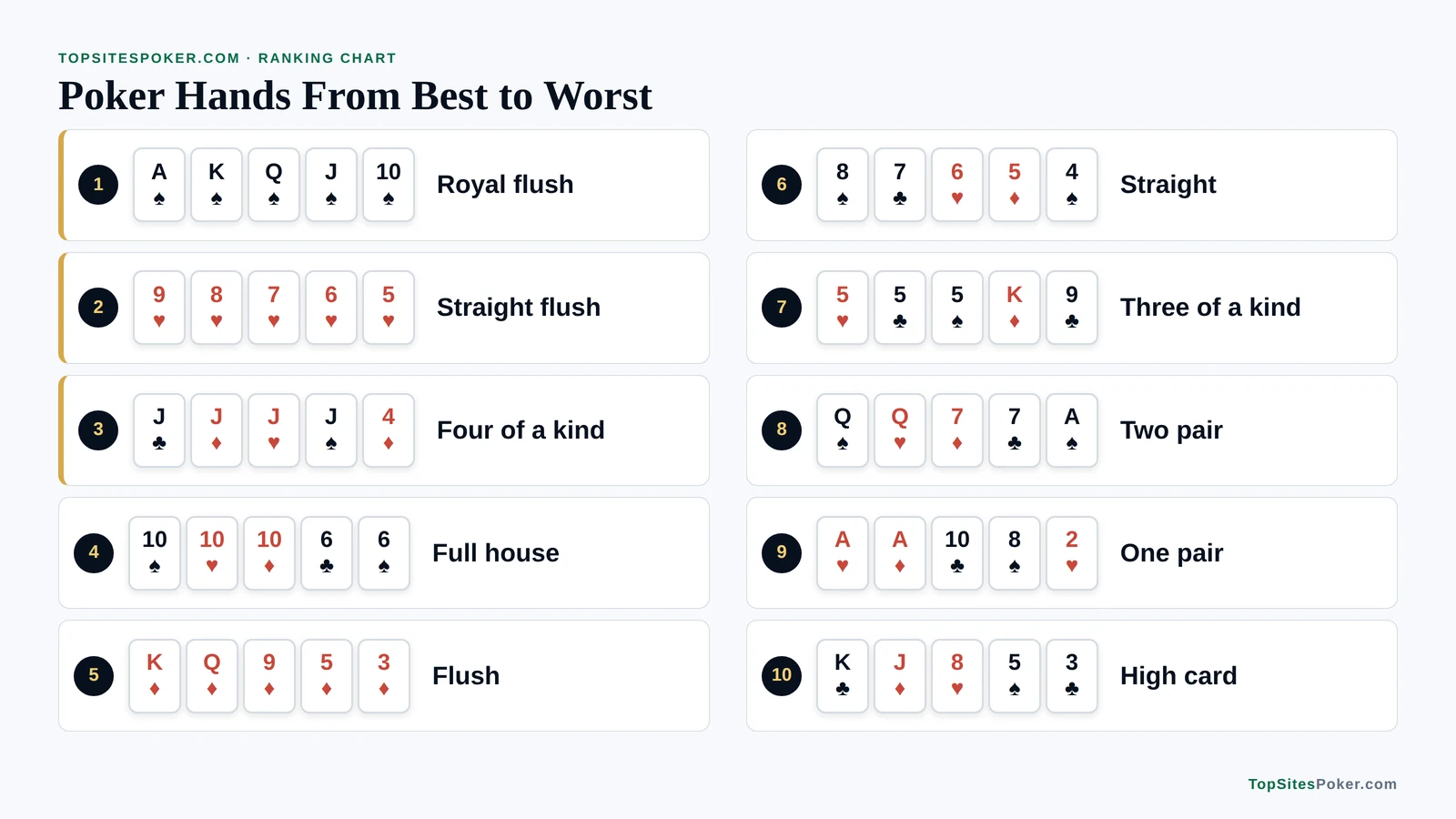
All ten poker hands in order. Any hand beats every hand below it.
Why the order is what it is
The ranking follows how rare each hand is in five cards: the fewer ways a hand can be made, the higher it ranks. The five-card column shows the order holding perfectly. There are only 4 royal flushes, 36 other straight flushes, 624 ways to make four of a kind, and so on, up to 1,302,540 hands with no pair at all.
Seven-card games strain that tidy pattern in two places. First, the gap between three of a kind and a straight almost disappears: with seven cards, three of a kind (4.83%) is only slightly more common than a straight (4.62%), so the ranking still matches rarity, but only just. The bigger surprise is at the bottom: with seven cards, you finish with one pair or two pair far more often than with no pair. High card drops from the most common five-card hand (50%) to only 17.4% of seven-card hands. The ranking wasn’t changed for Hold’em, and it doesn’t need to be, because the order of the hands above one pair still matches their rarity.
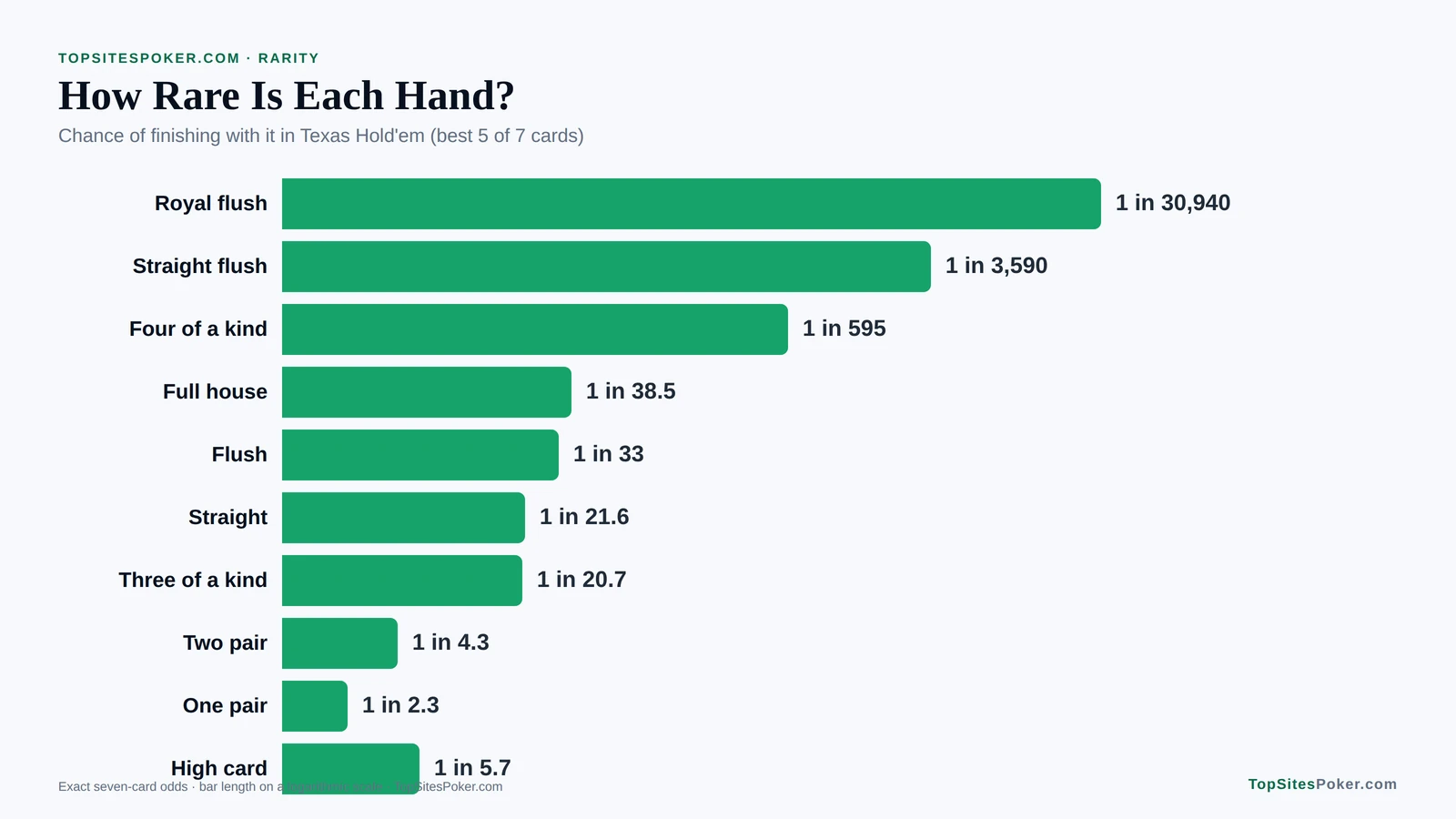
The rarer the hand, the higher it ranks. Bar lengths use a logarithmic scale.
How to use the chart at the table
You don’t need to memorize the odds. You need to know three things cold:
- The order of the ten hands. Say it out loud until it’s automatic: royal flush, straight flush, quads, full house, flush, straight, trips, two pair, pair, high card.
- The two most commonly confused pairs. A flush beats a straight, and a full house beats a flush. Almost every beginner mistake about rankings involves one of those two comparisons.
- How ties break. Same hand type? Compare the cards that make the hand first, then the leftover cards (kickers), highest first. All five equal? Split the pot. Suits never matter.
Everything else in this guide builds on those three.
Every Poker Hand Explained, From Best to Worst
This section takes the ten hands one at a time. For each one you’ll find what it looks like, how many versions exist, how it’s usually made in Texas Hold’em, what beats it and what it beats, how often it actually wins at showdown, and the mistake players most often make with it.
The showdown figures come from our simulation of 4,000,000 heads-up deals and 2,000,000 six-player deals, in which every hand was dealt to the river with no folding. They show how strong each hand is against random opposition. Real opponents fold weak hands, so in practice the hands you face at showdown are stronger than random, but the order and the size of the gaps are what matter.
1. Royal flush
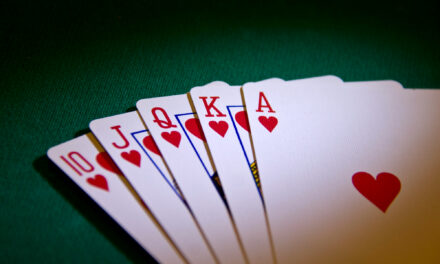
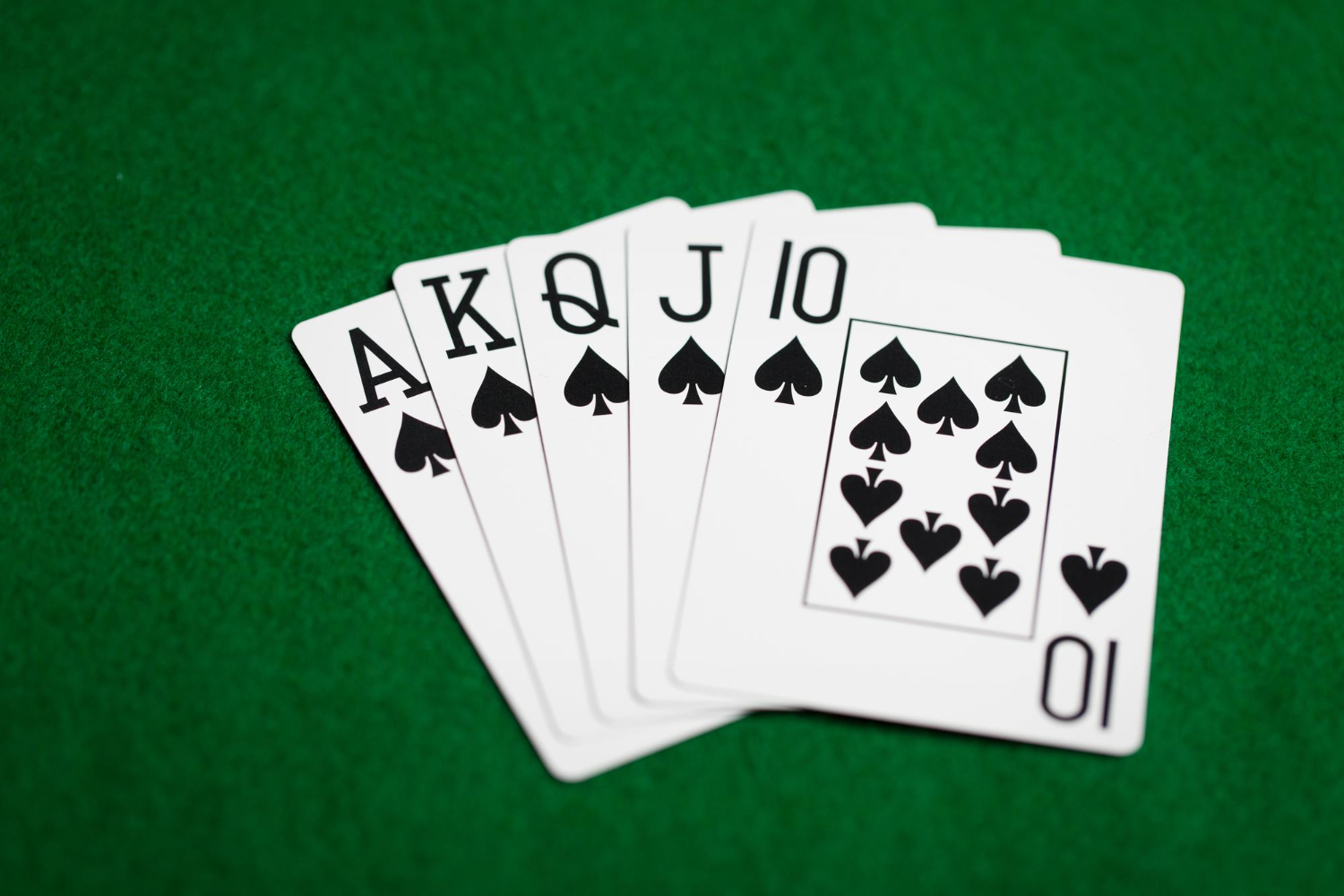
What it is: A-K-Q-J-10, all of the same suit. It’s the ace-high straight flush, the single best hand in standard poker.
Example: A♥ K♥ Q♥ J♥ 10♥.
How many exist: exactly four, one per suit. In five cards, the odds are 1 in 649,740. With seven cards, as in Hold’em, they improve to about 1 in 30,940, because you have many more five-card combinations to choose from. Even so, a player who sees 30,000 hands to the river, which is years of regular play for most people, might make only one.
How it’s made in Hold’em: almost always with two suited broadway hole cards and three matching cards on the board. If you hold A♠ K♠, the chance that the board brings Q♠ J♠ 10♠ by the river is exactly 1 in 1,960. A royal flush can also appear entirely on the board, which happens on 1 in 649,740 boards. In that case, every player still in the hand plays the board and the pot is split.
What beats it: nothing. A royal flush can only tie, and in Hold’em a tie is only possible when the whole royal flush is on the board.
The common mistake: treating a royal flush as a separate hand category with special rules. It isn’t. It’s simply the highest straight flush, and it’s ranked as one. Some casinos pay a bonus or jackpot for it, but that’s a promotion, not a rule of the game.
Hold’em spotlight: with A♠ K♠, exactly one of the 19,600 possible flops (Q♠ J♠ 10♠) gives you a flopped royal flush. Waiting for the turn and river improves the odds tenfold, to the 1 in 1,960 above, because the three cards you need can then arrive on any of the five board cards.
2. Straight flush
What it is: five cards in sequence, all of the same suit, below ace-high.
Example: 9♥ 8♥ 7♥ 6♥ 5♥ (a nine-high straight flush).
How many exist: 36 in five-card poker, or 40 if you include the four royal flushes. There are only nine distinct strengths, from the five-high “steel wheel” (5-4-3-2-A of one suit) up to the king-high straight flush (K-Q-J-10-9). Your chance of finishing with one in seven cards is about 1 in 3,590.
How ties break: by the highest card. A queen-high straight flush beats a jack-high straight flush. The ace counts low only in the steel wheel, so 5-4-3-2-A suited is the lowest straight flush.
What beats it: only a higher straight flush, including the royal flush. It beats four of a kind and everything below.
At showdown: in our simulation, straight flushes (including royals) won 95.2% of heads-up showdowns outright and tied another 4.1%. Against five opponents, they won 92.9%. The rare losses come from an opponent holding a higher straight flush in the same suit.
The common mistake: overlooking a straight flush possibility when you hold four of a kind or a full house. On a board with three suited cards close together, such as 7♠ 8♠ 9♠, a straight flush is possible, and that sits above any quads or full house you might hold. It’s rare, but it’s the reason the “find the nuts” check always looks for straight flushes first.
Hold’em spotlight: suited connectors such as J♠ 10♠ flop a straight flush on 4 of the 19,600 possible flops (7-8-9, 8-9-Q, 9-Q-K or Q-K-A of spades, the last one a royal flush), about 1 in 4,900. It’s rare enough that most players can count their flopped straight flushes on one hand.
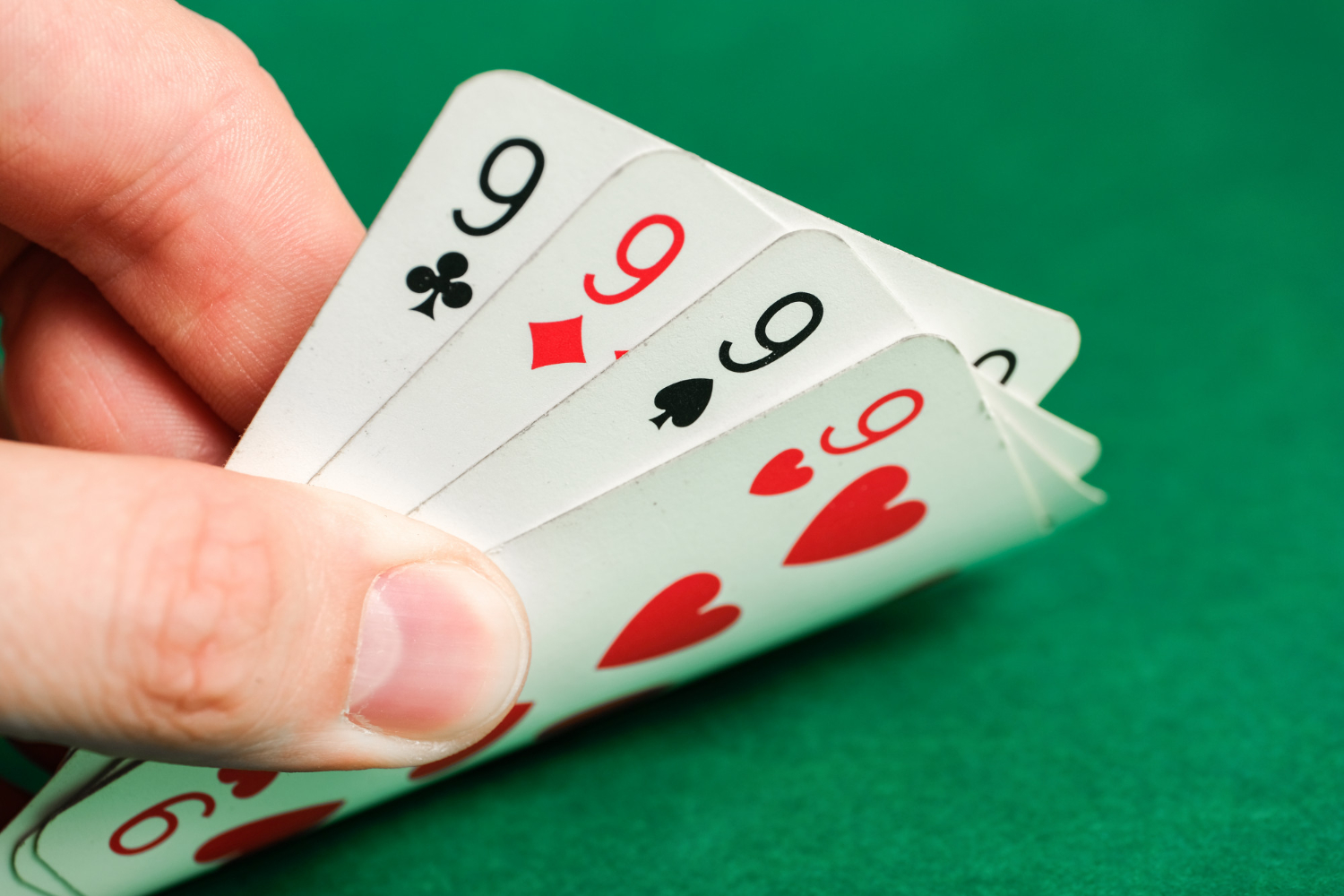
3. Four of a kind (quads)
What it is: four cards of the same rank plus any fifth card, called the kicker.
Example: J♣ J♦ J♥ J♠ 4♦.
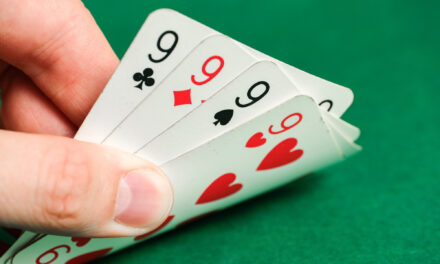
How many exist: 624 five-card hands (13 ranks times 48 possible kickers), with 156 distinct strengths. In seven cards, you’ll make quads about once every 595 hands you see to the river.
How it’s made in Hold’em: usually with a pocket pair and the other two cards of that rank on the board. If you hold a pocket pair, the chance that both remaining cards of your rank appear by the river is about 0.82%, or 1 in 122.5. Quads can also be made with one hole card and three of a kind on the board, or can appear entirely on the board. Quads on the board means every player has four of a kind, and the fifth card decides the pot.
How ties break: by the rank of the four, then by the kicker. Four kings beat four queens regardless of the kickers. Two players can only share the same four of a kind when the four are on the board, and then the highest fifth card among the players’ hands and the board wins.
What beats it: a straight flush or royal flush. Quads beat a full house and everything below.
At showdown: quads won 90.2% of heads-up showdowns outright and tied 4.4% in our simulation. The losses are almost all cases where the quads were on the board and the opponent held a better kicker.
A useful rule: in Hold’em, four of a kind is only possible when the board is paired. If no two board cards share a rank, nobody can have quads. The same is true of full houses, which makes the board’s pairing the first thing to check when you hold a big hand.
Hold’em spotlight: a pocket pair flops four of a kind on 48 of the 19,600 possible flops, about 1 in 408. When you flop quads, you’re almost never behind, and the question becomes how to win a pot from opponents who are unlikely to have much.
4. Full house (a “boat”)
What it is: three cards of one rank plus two cards of another rank. It’s described by its three of a kind first: 10-10-10-6-6 is “tens full of sixes.”
Example: 10♠ 10♥ 10♦ 6♣ 6♠.
How many exist: 3,744 five-card hands and 156 distinct strengths, from aces full of kings at the top to twos full of threes at the bottom. You’ll finish with a full house in about 2.6% of seven-card hands, roughly 1 in 38.5.
How it’s made in Hold’em: most often from a set (a pocket pair plus one matching board card) when the board pairs, or from two pair when the board brings a third card to one of them. Like quads, a full house is only possible when the board is paired. Once you flop a set, you’ll improve to a full house or better by the river 33.4% of the time.
How ties break: by the three of a kind first, then by the pair. That’s the rule players get wrong most often: 3-3-3-A-A (threes full of aces) loses to 4-4-4-2-2 (fours full of twos), because the fours outrank the threes. The pair is only compared when the three of a kind is identical, which in Hold’em means the board supplies at least two of the three cards.
What beats it: four of a kind and straight flushes. A full house beats every flush, straight and lower hand.
At showdown: full houses won 87.1% of heads-up showdowns outright and tied 7.1%. Against five opponents, they won 65.3% and tied 11.7%. That drop is the most important fact about full houses in multiway pots: on a paired board, several players can hold full houses at once, and the higher one takes everything.
The common mistake: assuming any full house is the nuts. On a board like Q-Q-7-7-2, anyone holding a queen has queens full of sevens, which beats your sevens full of queens if you hold a seven. On paired boards, the size of your full house matters as much as the fact that you have one.
Hold’em spotlight: a pocket pair flops a full house (or better) about 1.2% of the time. On the river, a full house is the best possible hand only about 2.5% of the time in our simulation, because the paired board it needs almost always makes four of a kind possible for someone. It’s usually a winner, just rarely an unbeatable one.
5. Flush
What it is: any five cards of the same suit that aren’t in sequence.
Example: K♦ Q♦ 9♦ 5♦ 3♦ (a king-high flush).
How many exist: 5,108 five-card flushes, with 1,277 distinct strengths. The best is A-K-Q-J-9 of one suit (A-K-Q-J-10 would be a royal flush); the worst is 7-5-4-3-2 of one suit (6-5-4-3-2 would be a straight flush). You’ll finish with a flush in about 3.0% of seven-card hands, roughly 1 in 33.
How it’s made in Hold’em: you need at least three cards of one suit on the board. With two suited hole cards, you complete a flush by the river about 6.4% of the time, and a flush draw on the flop (four to a flush) gets there by the river 35.0% of the time. When four cards of a suit are on the board, any single card of that suit in your hand makes a flush, and the highest such card usually decides the pot.
How ties break: by the highest card, then the second-highest, and so on through all five. A-J-9-6-3 beats A-J-9-5-4, because the fourth card (6 against 5) decides it. Suits don’t matter: a spade flush and a heart flush with the same ranks split the pot. In Hold’em, two players can only both have flushes in the same suit, since the board must supply at least three cards of it.
What beats it: a full house, four of a kind and straight flushes. A flush beats every straight, three of a kind and below.
At showdown: flushes won 84.9% of heads-up showdowns outright in our simulation, and 59.4% against five opponents. Flushes tie rarely (3.4% heads-up, 0.9% six-handed), because two flushes are seldom identical in all five cards.
The nut flush: the best possible flush on a board is the one containing the highest missing card of the suit, usually the ace. If the ace of the suit is on the board, the king-high flush becomes the nut flush, and so on. Holding the ace of the flush suit is so valuable that many players prefer suited aces over other suited hands for exactly this reason.
The common mistake: overvaluing small flushes. On a board with three or four cards of one suit, a low flush often loses to a higher one, and on a paired board it can lose to a full house. Always ask what the nut flush is, and how many higher flushes your opponent could hold.
Hold’em spotlight: two suited hole cards flop a flush (or straight flush) about 0.84% of the time, roughly 1 in 119 flops. By the river, a flush is the best possible hand only about 6.2% of the time in our simulation: paired boards, higher flushes and possible straight flushes usually leave something above it.
6. Straight
What it is: five cards in sequence, in at least two different suits.
Example: 8♠ 7♣ 6♥ 5♦ 4♠ (an eight-high straight).
How many exist: 10,200 five-card straights, but only 10 distinct strengths. The highest is A-K-Q-J-10, called “Broadway.” The lowest is 5-4-3-2-A, called “the wheel,” where the ace plays low. You’ll finish with a straight in about 4.6% of seven-card hands, about 1 in 21.6.
The ace rule: the ace can be high (A-K-Q-J-10) or low (5-4-3-2-A), but not both at once. Straights don’t wrap around the corner, so Q-K-A-2-3 is not a straight. It’s just ace-high.
How it’s made in Hold’em: you need at least three board cards that fit inside a five-rank window. An open-ended straight draw on the flop (four in a row, open at both ends) completes by the river 31.5% of the time. A gutshot (four cards missing one inside card) completes about 16.5% of the time.
How ties break: only by the highest card. A jack-high straight beats a ten-high straight, and two straights with the same top card split the pot. There are no kickers in a straight, because all five cards are part of the hand.
What beats it: a flush, full house, four of a kind and straight flushes. A straight beats three of a kind and everything below.
At showdown: straights won 80.7% of heads-up showdowns outright, but they also tied 12.1% of the time, far more than any other hand. Against five opponents, the tie rate doubles to 23.8%. The reason is the board: when four or five cards of a straight are on the board, several players often make the same straight. Straights are the hand most likely to end in a split pot.
The common mistake: missing that someone can make a higher straight with the same board. On 9-8-7 with a 6 or 10 on the turn, several different straights are possible. Holding the low end of a straight (for example, 5-6 on a 7-8-9 board) is sometimes called “the idiot end,” because a player holding J-10 or 10-6 has a higher straight using the same board cards.
Hold’em spotlight: connected cards such as J-10 flop a straight about 1.3% of the time. On the river, a straight is the nuts only about 12.7% of the time, because by then most boards allow a flush, a full house or a higher straight. That doesn’t make straights weak, but it’s the reason experienced players slow down with the low end of a straight on a coordinated board.
7. Three of a kind (a set or trips)
What it is: three cards of the same rank plus two unrelated cards.
Example: 5♥ 5♣ 5♠ K♦ 9♣.
How many exist: 54,912 five-card hands, with 858 distinct strengths (13 ranks for the three, times 66 possible kicker combinations). You’ll finish with three of a kind in about 4.8% of seven-card hands, about 1 in 20.7.
Set or trips? Hold’em players use two names for the same hand, because the two versions play very differently:
- A set is a pocket pair plus one matching board card, such as 8-8 on a K-8-3 flop. It’s well hidden, because the board shows only one 8.
- Trips are one hole card plus a pair on the board, such as K-8 on an 8-8-3 flop. Everyone can see the pair on the board, and anyone else holding an 8 has trips too, so the kicker matters.
A pocket pair flops a set about 10.8% of the time, and a set or better (including the rare flopped full house or quads) 12.0% of the time.
How ties break: by the rank of the three, then the two kickers in order. 7-7-7-A-4 beats 7-7-7-K-Q. Two players can only share the same three of a kind when a pair on the board supplies two of the cards, or when all three are on the board.
What beats it: a straight, flush, full house, four of a kind and straight flushes. Three of a kind beats two pair and everything below.
At showdown: three of a kind won 72.6% of heads-up showdowns outright in our simulation, and 46.6% against five opponents. It’s the first hand on the list that wins nearly half the time even in a crowded pot.
Room to improve: a set on the flop improves to a full house or better by the river 33.4% of the time, and so do trips. That redraw is what makes a set so strong even against a completed straight or flush.
The common mistake: overplaying weak trips. With K-8 on an 8-8-3 board, you have trips, but so does anyone holding A-8, and their ace kicker beats you. When you hold trips with a weak kicker, remember that the hands most willing to put in a lot of money are often the same trips with a better kicker, or a full house.
Hold’em spotlight: unpaired hole cards flop trips (one hole card plus a pair on the flop) about 1.35% of the time, while a pocket pair flops a set 10.8% of the time. A flopped set or trips goes on to win 87.1% of the time by the river against one random opponent in our simulation.
8. Two pair
What it is: two cards of one rank, two cards of another rank and one unrelated card.
Example: Q♠ Q♥ 7♦ 7♣ A♠ (“queens and sevens with an ace kicker,” or “queens up”).
How many exist: 123,552 five-card hands, with 858 distinct strengths. With seven cards, it’s a very common hand: you’ll finish with two pair about 23.5% of the time, nearly one hand in four.
How ties break: by the higher pair first, then the lower pair, then the kicker. A-A-3-3-5 beats K-K-Q-Q-J, because aces beat kings, even though the second hand’s other cards are all higher. If both pairs match, the fifth card decides it.
How it’s made in Hold’em: in three quite different ways, and the difference matters:
- Both hole cards paired, such as K-8 on a K-8-3 board. This is strong and hidden. It improves to a full house by the river 16.7% of the time.
- One hole card paired plus a pair on the board, such as A-K on a K-7-7 board. You have kings and sevens, but so does anyone holding a king, and anyone holding a seven has trips.
- A pocket pair plus a pair on the board, such as J-J on a 9-9-4 board. Your hand is really one pair (jacks) plus the board’s pair.
What beats it: three of a kind and every hand above. Two pair beats one pair and high card.
At showdown: two pair won 64.3% of heads-up showdowns outright in our simulation, but only 20.0% against five opponents. No other hand loses as much value as the table gets more crowded, because two pair is common enough that several players often hold it, and the board often gives someone a straight, flush or full house.
Counterfeiting: two pair can lose its value without any scary card appearing. If you hold 6-5 on a 6-5-2 board and the turn and river are both jacks, your best hand becomes J-J-6-6-5, and anyone with a six and a better kicker, such as A-6, now beats you with J-J-6-6-A. The board’s pair of jacks has pushed your fives out of your best five cards.
The common mistake: counting three pairs. In Hold’em, seven cards can contain three pairs, but only the two highest pairs count, plus the best remaining card. With Q-Q-8-8-4-4-A, your hand is queens and eights with an ace kicker.
Hold’em spotlight: two unpaired hole cards both pair on the flop about 2.0% of the time. Counting two pair made with the help of a paired flop, unpaired hands flop two pair about 4.0% of the time. A flopped two pair holds up to win by the river 75.6% of the time against one random opponent.
9. One pair
What it is: two cards of the same rank plus three unrelated cards.
Example: A♥ A♦ 10♣ 8♠ 2♥ (a pair of aces).
How many exist: 1,098,240 five-card hands, with 2,860 distinct strengths (13 ranks for the pair times 220 kicker combinations). It’s the most common final hand in Hold’em: about 43.8% of the time, one pair is the best you have after seven cards.
How ties break: by the rank of the pair, then the three kickers from highest to lowest. K-K-Q-9-4 beats K-K-J-10-9, because the first kicker (queen against jack) decides it. This is where most real-world pots are settled, which is why kickers matter so much in Hold’em.
The names of one-pair hands in Hold’em: players describe a single pair by how it relates to the board, because that tells you much more than the pair’s rank alone.
- Overpair: a pocket pair higher than every board card, such as Q-Q on a J-7-3 board.
- Top pair: pairing the highest board card, such as A-K on a K-9-4 board. Top pair with the best possible kicker is called “top pair, top kicker.”
- Middle pair and bottom pair: pairing the second or lowest board card.
- Underpair: a pocket pair lower than the lowest board card, such as 5-5 on a Q-9-7 board.
- A pair on the board: when the only pair is on the board, every player shares it and the kickers from your hand decide the pot.
What beats it: every hand from two pair upward, and any higher pair. A pair beats high card and any lower pair.
At showdown: one pair won 40.8% of heads-up showdowns outright in our simulation, and just 5.8% against five opponents. Those two numbers sum up one pair in Hold’em: a hand worth playing carefully against one opponent and rarely worth a big pot against several.
The common mistake: treating an overpair as unbeatable. Pocket aces on a J-10-9 board with two hearts are still one pair. By the river, many straights, flushes, sets and two-pair hands can beat them. An overpair is the strongest one-pair hand, not a strong hand in every situation.
Hold’em spotlight: unpaired hole cards pair at least one of your cards on the flop about 32.4% of the time. A flopped one-pair hand wins by the river 57.5% of the time against one random opponent in our simulation, a modest edge that shrinks quickly against more players or against opponents who only continue with strong hands.
10. High card
What it is: any hand that doesn’t make one of the nine hands above. It’s named after its highest card: “ace-high,” “king-high.”
Example: K♣ J♦ 8♥ 5♠ 3♣ (king-high).
How many exist: 1,302,540 five-card hands, about half of all five-card deals, with 1,277 distinct strengths. The best is A-K-Q-J-9 in mixed suits; the worst possible hand in poker is 7-5-4-3-2 in mixed suits. With seven cards, you’re left with only high card about 17.4% of the time.
How ties break: highest card first, then each next card in order. A-Q-8-6-2 beats A-Q-8-5-4.
At showdown: high card won 15.9% of heads-up showdowns outright and tied another 2.4% in our simulation, which is why ace-high sometimes wins a pot between two players who both missed. Against five opponents, a high-card hand essentially never wins at showdown: in our simulation, it won less than 0.1% of the time.
The common mistake: giving up on ace-high too quickly heads-up, or holding on to it far too long in a multiway pot. Against one opponent who has also missed, ace-high has real showdown value. Against several opponents, it almost never wins without a bet that makes the others fold.
Hold’em spotlight: ace-king misses the flop completely (no pair using either hole card) 67.6% of the time. A hand that’s still only high card on the flop wins by the river 35.0% of the time against one random opponent, mostly by improving on the turn or river.
Showdown Strength at a Glance
Putting the showdown results side by side shows how much a hand’s real value depends on the number of opponents. These are the outright win rates for the final hand you hold after the river, against one opponent and against five, with every hand dealt to the river:
| Your final hand | Wins vs 1 opponent | Ties vs 1 opponent | Wins vs 5 opponents | Ties vs 5 opponents |
|---|---|---|---|---|
| Straight flush (incl. royal) | 95.2% | 4.1% | 92.9% | 3.5% |
| Four of a kind | 90.2% | 4.4% | 87.4% | 3.4% |
| Full house | 87.1% | 7.1% | 65.3% | 11.7% |
| Flush | 84.9% | 3.4% | 59.4% | 0.9% |
| Straight | 80.7% | 12.1% | 49.5% | 23.8% |
| Three of a kind | 72.6% | 3.4% | 46.6% | 3.2% |
| Two pair | 64.3% | 5.2% | 20.0% | 3.4% |
| One pair | 40.8% | 3.2% | 5.8% | 0.7% |
| High card | 15.9% | 2.4% | under 0.1% | under 0.1% |
TopSitesPoker.com simulation: 4,000,000 heads-up deals and 2,000,000 six-player deals, all hands dealt to the river with no folding. Straight flush and quads figures rest on smaller samples (about 1,200 and 6,600 heads-up occurrences) and can vary by about a point.
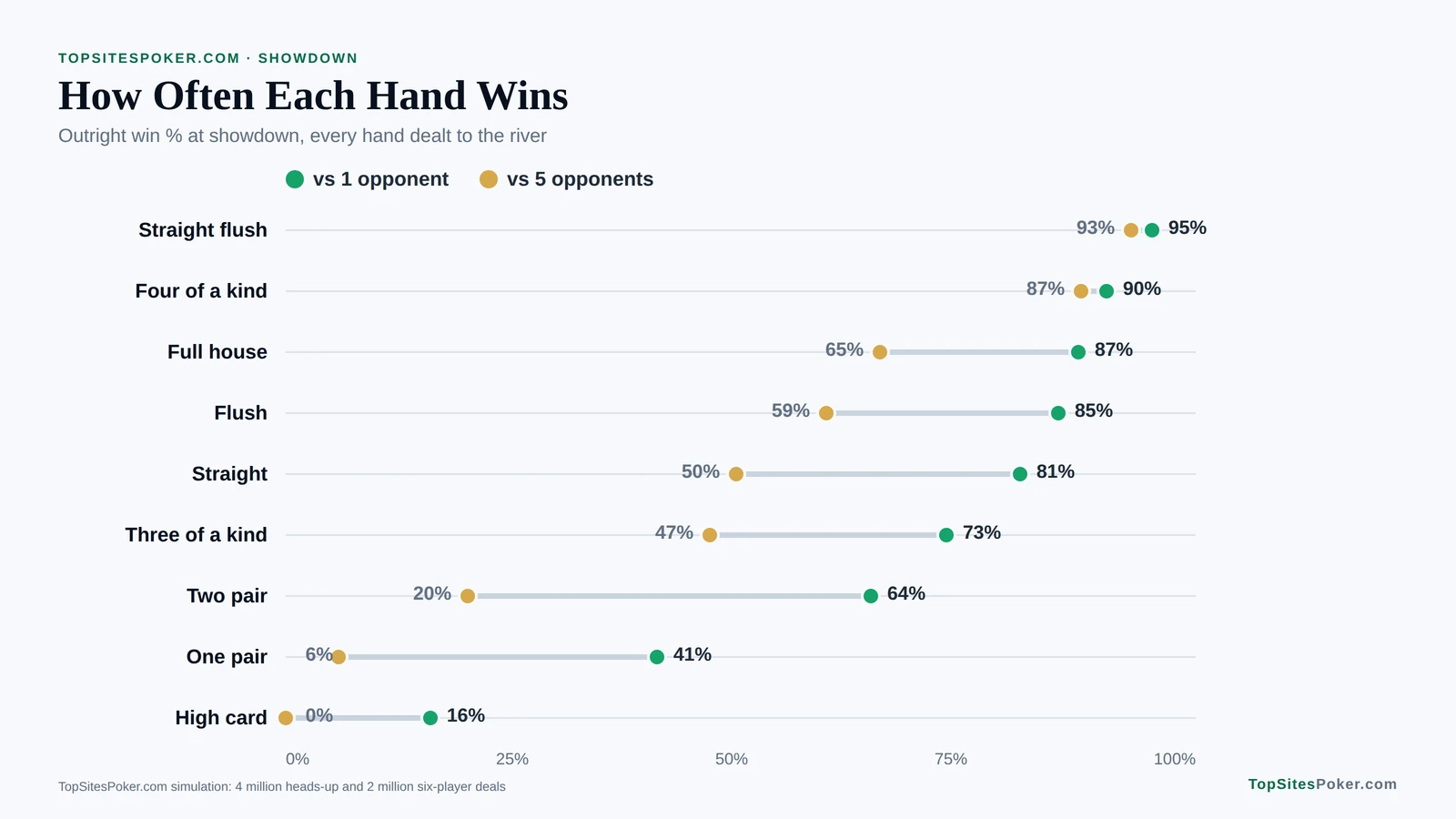
Middle-ranked hands lose the most value when more players reach the river.
Three patterns stand out. First, every hand from a flush upward wins well over 80% of the time heads-up, so the real fight in two-player pots is between one pair, two pair and three of a kind. Second, the drop from one opponent to five is steepest in the middle of the ranking: two pair loses more than two-thirds of its win rate, and one pair almost all of it. Third, straights and full houses tie far more often than other hands, because the board so often supplies most of the hand.
These are win rates against random hands that never fold, so they overstate how often weak hands win in real games, where the hands that reach showdown have usually been through several rounds of betting. Use them for the shape, not as exact odds for a specific hand.
What Beats What: Quick Answers
These are the comparisons players ask about most. Each answer follows directly from the ranking chart, but seeing them spelled out removes any doubt at the table.
Does a flush beat a straight?
Yes. A flush always beats a straight, even the highest straight against the lowest flush. A-K-Q-J-10 in mixed suits loses to 7-5-4-3-2 of one suit. Flushes rank higher because they’re rarer: 5,108 five-card flushes against 10,200 straights.
Does a full house beat a flush?
Yes. Twos full of threes beats an ace-high flush. In Hold’em, this matters whenever the board is paired and three cards of one suit are showing: a player with a full house beats every flush.
Does a straight beat three of a kind?
Yes. The lowest straight (5-4-3-2-A) beats three aces.
Does three of a kind beat two pair?
Yes. Three twos beat aces and kings.
Does two pair beat one pair?
Yes, whatever the ranks: threes and twos beat a pair of aces. In Hold’em, check that your second pair isn’t just the board’s pair shared with everyone, because then your opponent may have two pair as well.
Does four of a kind beat a straight flush?
No. A straight flush, including a royal flush, beats four of a kind. Quads beat every other hand.
Does a royal flush beat a straight flush?
Yes. A royal flush is the highest straight flush, so it beats every other straight flush.
Do aces beat everything?
Only within the same hand type. A pair of aces beats a pair of kings, and an ace-high flush beats a king-high flush. But any two pair beats a pair of aces, and any three of a kind beats aces up.
Does a higher kicker beat a higher pair?
No. The pair is compared first. A pair of kings with a 2 kicker beats a pair of queens with an ace kicker. The kicker only matters when the pairs are the same rank.
Does a spade flush beat a heart flush?
No. Suits have no rank in standard poker. Two flushes are compared card by card, and if all five ranks match, the pot is split. In Hold’em, two players can’t even hold flushes in different suits on the same board, since the board would need at least three cards of each.
Close Calls: The Comparisons That Cause Arguments
Some comparisons aren’t hard, just easy to get wrong in the moment. This table collects the ones that most often lead to a mistaken claim at showdown.
| Hand A | Hand B | Winner | Why |
|---|---|---|---|
| 3-3-3-A-A (threes full of aces) | 4-4-4-2-2 (fours full of twos) | B | A full house is ranked by its three of a kind first |
| A-A-3-3-5 | K-K-Q-Q-J | A | Two pair is ranked by its higher pair first |
| K-K-2-4-7 | Q-Q-A-J-10 | A | The pair outranks any kicker |
| 5-4-3-2-A (wheel) | A-A-A-K-Q | A | Any straight beats any three of a kind |
| 5-4-3-2-A (wheel) | 6-5-4-3-2 | B | In a straight, the ace plays as a one: the wheel is the lowest straight |
| Q-K-A-2-3 (mixed suits) | 2-2-7-9-J | B | Straights can’t wrap around, so Q-K-A-2-3 is only ace-high |
| A♠-J♠-9♠-6♠-3♠ | A♥-J♥-9♥-5♥-4♥ | A | Flushes compare card by card; the fourth card (6 against 5) decides |
| A♠-K♠-Q♠-J♠-9♠ | A♥-K♥-Q♥-J♥-9♥ | Split | Identical ranks; suits never break a tie |
| J-J-J-J-2 | 9-9-9-9-A | A | Quads are ranked by the four; the kicker only matters for identical quads |
| 7-7-5-5-K | 7-7-5-5-Q | A | Identical two pair: the fifth card decides |
How to Compare Any Two Poker Hands
Every showdown, however complicated it looks, can be settled with the same four steps. Dealers use this exact order, and so should you.
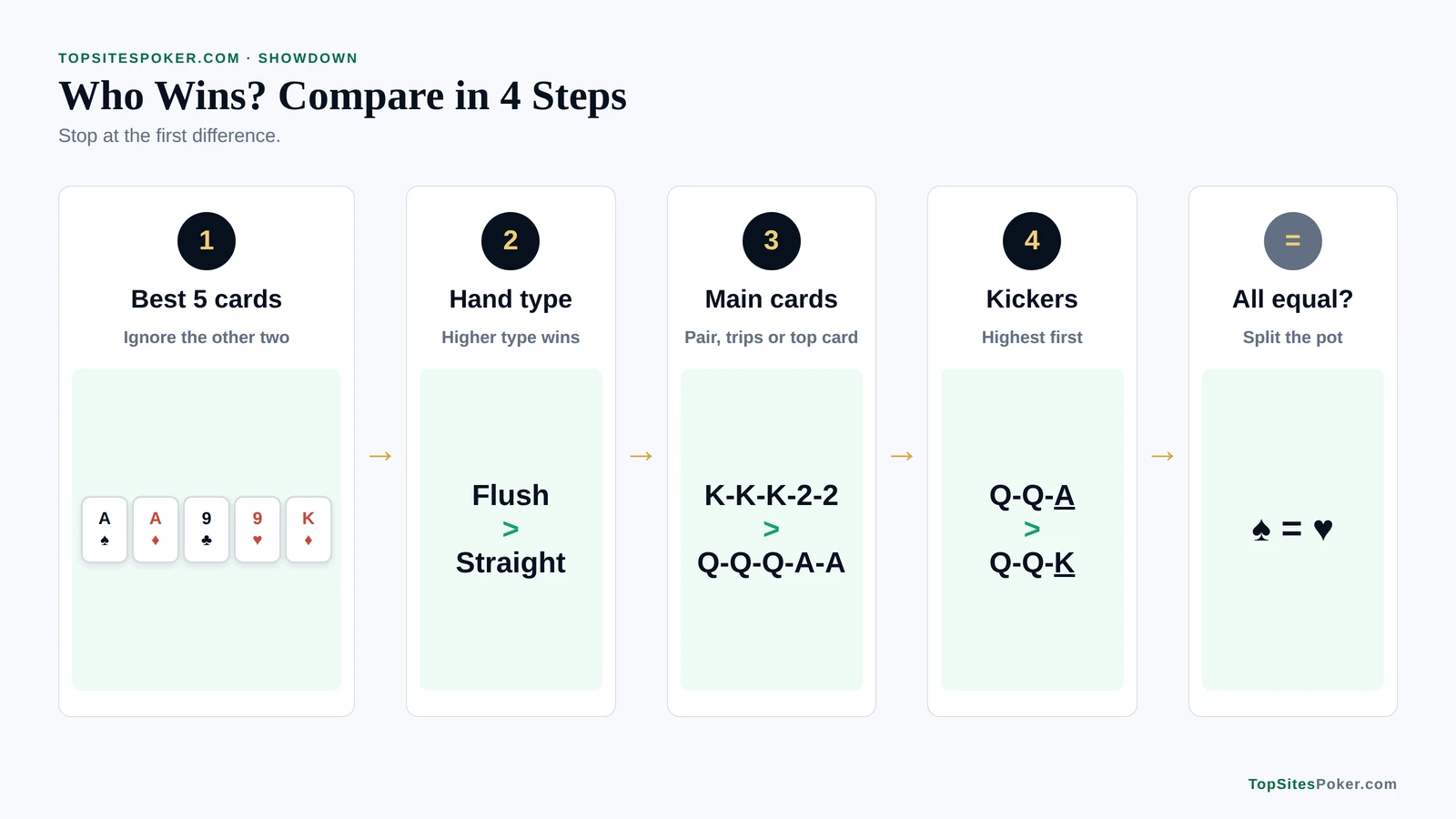
Settle any showdown in four steps, stopping at the first difference.
- Build each player’s best five cards. In Hold’em, choose the best five from the player’s two hole cards and the five community cards. Ignore the other two cards completely.
- Compare the hand types. If one hand is higher on the ranking chart, it wins. Stop here.
- If the types match, compare the cards that make the hand. The order depends on the hand type:
- Straights and straight flushes: the highest card.
- Four of a kind: the rank of the four.
- Full house: the three of a kind, then the pair.
- Three of a kind: the rank of the three.
- Two pair: the higher pair, then the lower pair.
- One pair: the rank of the pair.
- Flush and high card: every card, from highest to lowest.
- If those match, compare the kickers, highest first. Still equal after all five cards? The pot is split equally.
Tie-breakers for every hand type
| Hand type | Compare first | Then | Kickers used | Example of a decided tie |
|---|---|---|---|---|
| Straight flush | Highest card | — | None | Q-high beats J-high |
| Four of a kind | Rank of the four | Kicker | 1 | Board 6-6-6-6-2: A-x beats K-x |
| Full house | Rank of the three | Rank of the pair | None | Board K-K-K-5-2: 9-9 (kings full of nines) beats 5-x (kings full of fives) |
| Flush | Highest card | Each next card | All five cards compared | K-Q-7-5-2 beats K-J-10-9-8 |
| Straight | Highest card | — | None | 10-high beats 9-high |
| Three of a kind | Rank of the three | Kickers | 2 | Q-Q-Q-A-3 beats Q-Q-Q-K-J |
| Two pair | Higher pair | Lower pair, then kicker | 1 | J-J-4-4-A beats J-J-4-4-K |
| One pair | Rank of the pair | Kickers | 3 | 8-8-A-10-3 beats 8-8-A-9-7 |
| High card | Highest card | Each next card | All five cards compared | A-J-9-4-2 beats A-J-8-7-6 |
Kickers: when they count and when they don’t
A kicker is any card among your best five that isn’t part of the hand’s main combination. Kickers only matter when the main combination is tied, and they only count if they’re among your best five cards. That second condition causes most kicker disputes in Hold’em. Consider a board of A♠ K♦ 9♣ 9♥ 4♠, with Player A holding A♦ 7♣ and Player B holding A♣ Q♦. Both players make aces and nines. For the fifth card, both use the king on the board, which is higher than either the queen or the seven. The pot is split, even though Player B’s queen looks like a better kicker.
The same thing happens with one pair. On a board of J♥ J♣ 8♦ 7♠ 5♥, a player holding A-2 beats a player holding K-Q, because the pair of jacks is shared and the first kicker (ace against king) decides it. But on a board of J♥ J♣ A♦ K♠ 9♥, a player holding 8-7 and a player holding 6-5 both have J-J-A-K-9 from the board alone and split the pot. A player holding Q-2 would beat them both, because the queen replaces the nine as the third kicker.
Split pots and odd chips
When two or more hands tie exactly, the pot is divided equally. If a pot can’t be split evenly, the leftover chip goes to a specific player according to house rules. In flop games like Hold’em, the widely used standard gives it to the first tied player to the left of the button. In games with a high hand and a low hand, the odd chip goes to the high half.
How Many Different Poker Hands Are There?
There are 2,598,960 ways to deal five cards from a 52-card deck. But most of those hands are equivalent in strength: K♠ K♥ 9♦ 6♣ 2♠ and K♦ K♣ 9♠ 6♥ 2♦ are different sets of cards with exactly the same value. If you group every hand by its strength, there are only 7,462 distinct poker hands, and every possible deal falls into one of those 7,462 steps from the royal flush down to 7-5-4-3-2 offsuit.
| Hand type | Five-card deals | Distinct strengths | Why that many |
|---|---|---|---|
| Straight flush (incl. royal) | 40 | 10 | One per top card, 5-high to ace-high |
| Four of a kind | 624 | 156 | 13 ranks for the four × 12 kicker ranks |
| Full house | 3,744 | 156 | 13 ranks for the three × 12 ranks for the pair |
| Flush | 5,108 | 1,277 | 1,287 five-rank combinations minus the 10 that form straights |
| Straight | 10,200 | 10 | One per top card, 5-high to ace-high |
| Three of a kind | 54,912 | 858 | 13 ranks × 66 pairs of different kicker ranks |
| Two pair | 123,552 | 858 | 78 pairs of pair ranks × 11 kicker ranks |
| One pair | 1,098,240 | 2,860 | 13 ranks × 220 combinations of three kicker ranks |
| High card | 1,302,540 | 1,277 | The same 1,277 rank patterns as flushes, in mixed suits |
| Total | 2,598,960 | 7,462 |
Verified by TopSitesPoker.com with a full enumeration of every five-card hand.
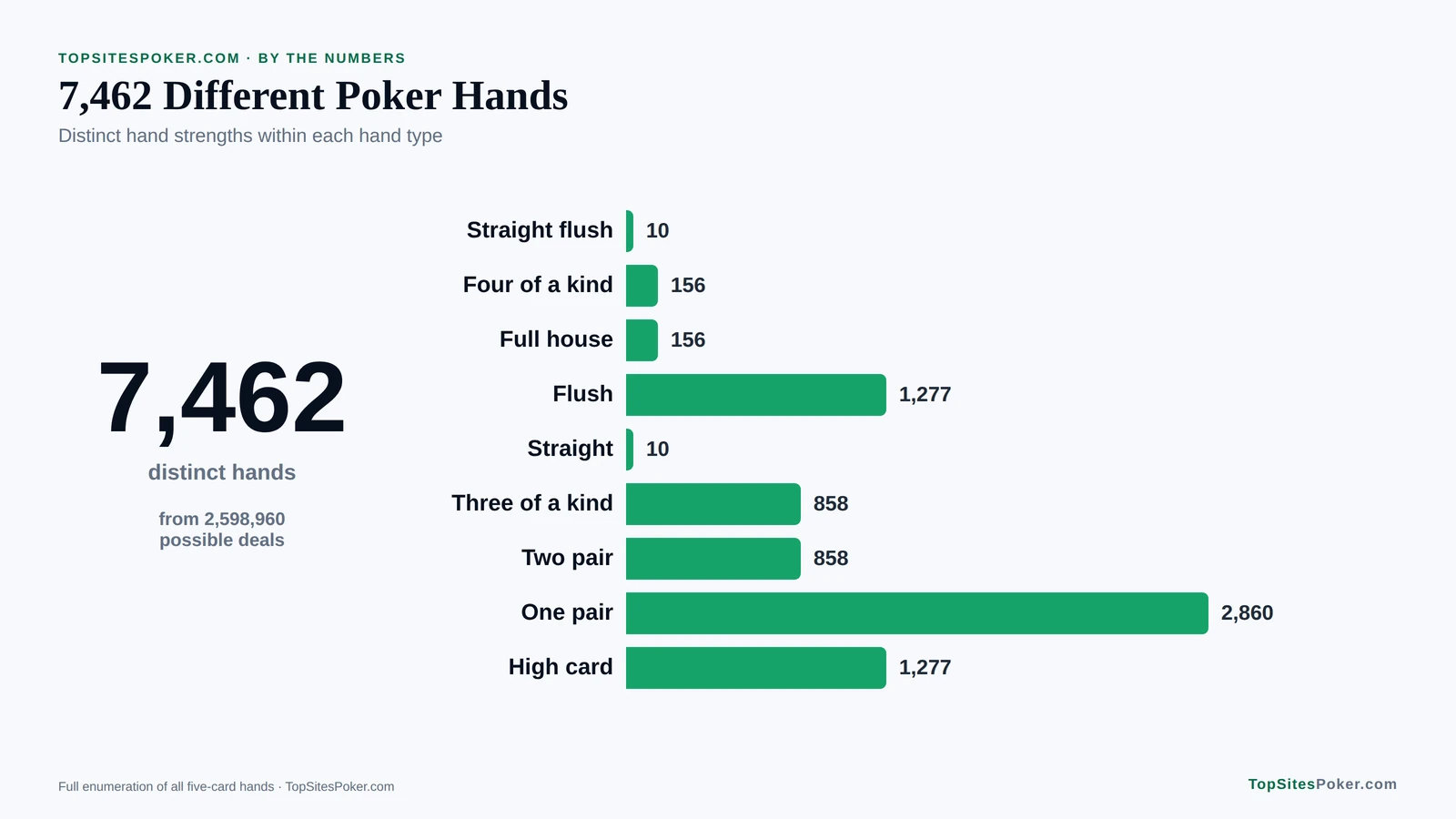
Every one of the 2,598,960 possible deals falls into one of 7,462 strength classes.
The table explains several things that confuse players:
- Why straights tie so often. There are only 10 distinct straights. Two players with straights have a high chance of holding the same one, especially when the board supplies most of it.
- Why flushes almost never tie. There are 1,277 distinct flushes. Two flushes are only equal if all five ranks match.
- Why kickers matter so much. One pair has 2,860 distinct versions, more than any other hand type. Most of that variety is in the kickers, and one-pair hands are the most common hands at showdown, so the kicker decides a large share of real pots.
- Why suits never rank. The four suits multiply the number of deals, but not the number of strengths. That’s the formal version of “suits don’t break ties.”
How Often Your Best Hand Uses Your Hole Cards
In Texas Hold’em, your best five cards can use both of your hole cards, just one, or none at all (in which case you “play the board”). How often each happens tells you a lot about what your hand really is. We dealt 200,000 random seven-card hands (two hole cards and five board cards) and checked which cards each best hand needed:
- Both hole cards: 47.2% of the time.
- Exactly one hole card: 47.9% of the time.
- No hole cards (the board plays): 4.9% of the time.
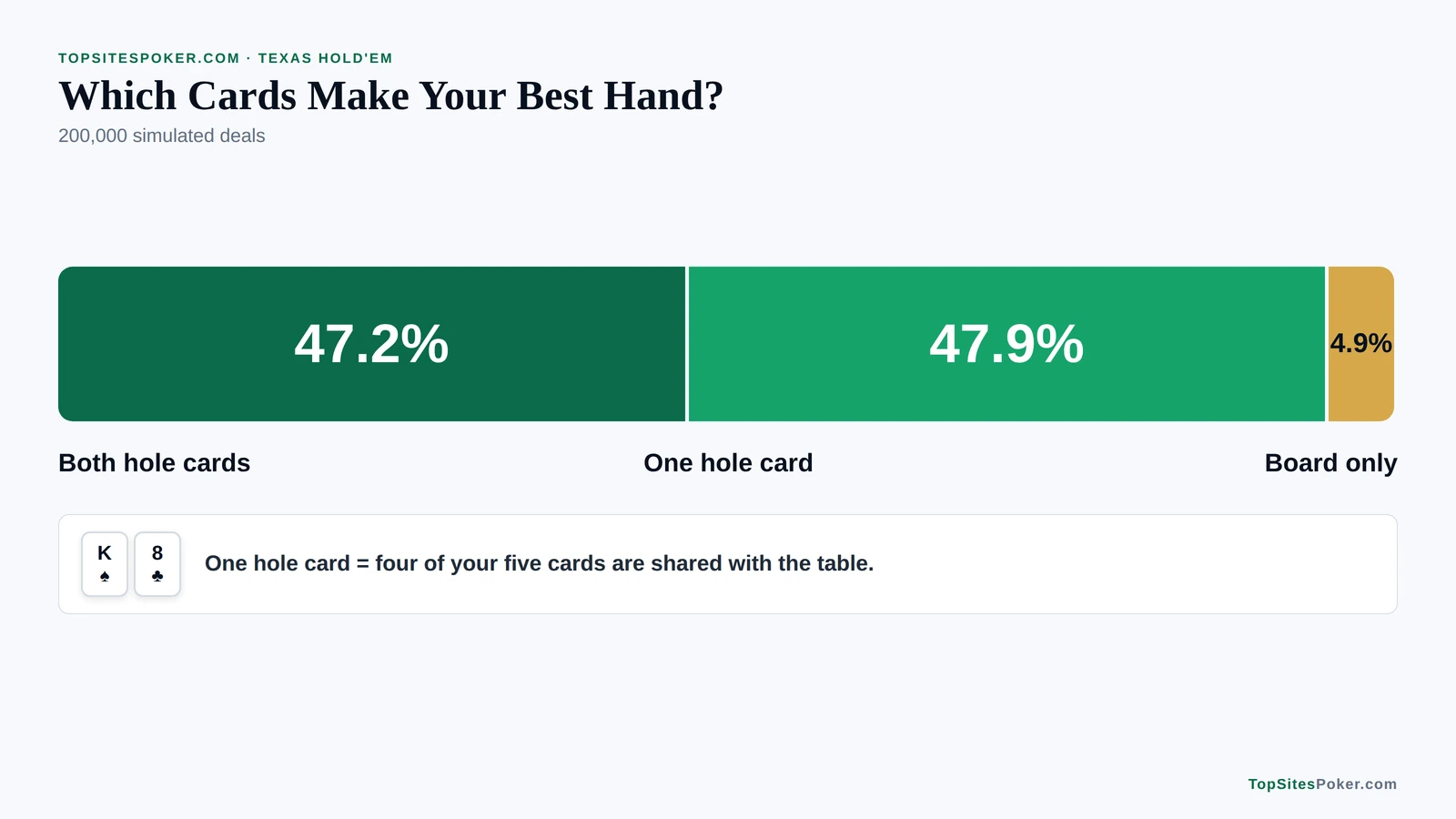
Your best hand is almost as likely to use one hole card as two.
That near-even split between one and two hole cards matters more than it seems. When your hand uses only one hole card, everyone else at the table shares four of your five cards. Any opponent holding the same card, or a better one for that spot, has a hand at least as good. When your hand uses both hole cards, it’s more individual and harder for others to match. Hands that use both of your cards, such as a set, two pair from both hole cards or a flush with two suited cards, are generally stronger than their rank alone suggests. Hands that use one hole card, such as trips with a pair on the board or a flush from four board cards, are generally weaker.
The board plays about one hand in twenty. When it does, everyone still in the hand has at least that five-card hand, and the only way to win outright is to hold a card that improves on it. That’s why a player who can see that the board plays will often just check and call rather than bet: the most likely result is a split pot.
How Made Hands Improve by the River
A hand on the flop isn’t finished. Two more cards are coming, and many hands have a real chance to improve. These are the exact chances of improving by the river when you see both the turn and the river, calculated over all 1,081 possible turn-and-river combinations for each example:
| Your hand on the flop | Example | Improves to | Chance by the river |
|---|---|---|---|
| Set | 8♠ 8♣ on K♥ 8♥ 3♦ | Full house or better | 33.4% |
| Trips (one hole card) | A♠ 8♣ on 8♥ 8♦ 3♣ | Full house or better | 33.4% |
| Two pair (both hole cards) | K♠ 8♣ on K♥ 8♥ 3♦ | Full house or better | 16.7% |
| Flush draw | A♠ J♠ on K♠ 7♠ 2♦ | Flush or better | 35.0% |
| Open-ended straight draw | 9♣ 8♦ on 7♥ 6♠ 2♣ | Straight or better | 31.5% |
| Gutshot straight draw | 9♣ 8♦ on J♥ 7♠ 2♣ | Straight or better | 17.9% (16.5% from a ten alone; the rest from two-card runner-runner straights) |
| Two overcards | A♣ K♦ on 9♥ 6♠ 2♣ | Pair of aces or kings | 24.1% |
| Overpair | Q♠ Q♣ on 9♥ 6♦ 2♣ | Set or better | 9.3% |
Exact enumeration by TopSitesPoker.com over every possible turn and river card for each example hand. Chances assume you see both cards; if you’re paying for one card at a time, roughly halve them.
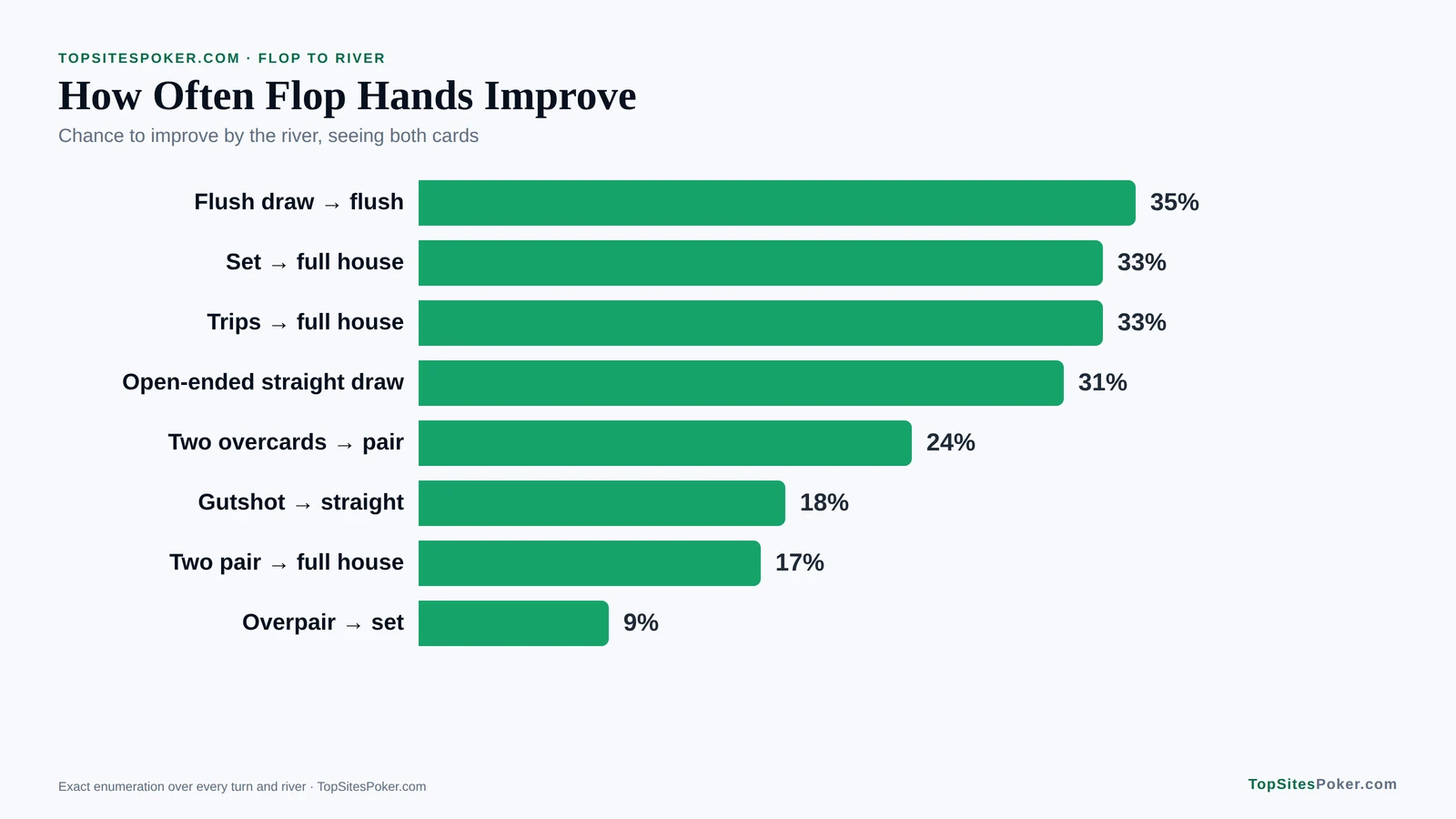
The most common draws and a flopped set all improve about one time in three.
Two numbers are worth remembering. A set, the strongest common hand on the flop, becomes a full house or better one time in three. And the two most common draws, a flush draw and an open-ended straight draw, get there roughly one time in three as well. That’s why a completed straight or flush on the flop is often less of a lock than it feels against a set: the set has a one-in-three chance to overtake it.
Reading Your Hand in Texas Hold’em
Knowing the rankings is one skill. Finding your best five cards out of seven, quickly and correctly, is another. Most showdown mistakes happen here: a player misses a straight, counts a sixth card, or doesn’t notice that the board has given everyone the same hand. This routine avoids all of them.
A five-step routine for finding your best hand
- Check for flushes. Count the suits on the board. Three or more of one suit means a flush is possible. Add any of your hole cards in that suit.
- Check for straights. Put the board ranks in order and look for three within a five-rank window. See whether your hole cards fill the gaps. Remember the ace can play low (A-2-3-4-5).
- Check for pairs and sets. Look for any rank that appears more than once across all seven cards. Two of a rank is a pair, three is a set or trips, four is quads. Three of one rank plus two of another is a full house.
- Pick the highest hand type you found. Use the ranking chart. A flush beats a straight; a full house beats both.
- Fill the remaining spots with your highest cards. For one pair, two pair, trips and high card, add the highest unused cards until you have exactly five. Those are your kickers.
Always stop at five. If you find yourself describing a hand with six cards, such as “three pair” or “a six-card straight,” you’ve counted too many.
Worked examples
Each example gives your hole cards and the full board. Try to name the best hand before reading the answer.
Example 1. You hold A♣ 7♣. The board is K♣ 9♣ 4♦ 2♣ Q♥.
Answer: an ace-high flush, A♣ K♣ 9♣ 7♣ 2♣. The board’s three clubs plus your two make five. Because the A♣ is in your hand, you hold the nut flush. No straight flush is possible, since no three of the clubs (A, K, 9, 7, 2) fall within five ranks of each other.
Example 2. You hold 6♥ 5♥. The board is 7♣ 8♦ 9♠ K♥ 2♣.
Answer: a nine-high straight, 9-8-7-6-5. Both hole cards play. It’s the low end of what’s possible, though: anyone holding 10-6 or J-10 has a higher straight.
Example 3. You hold K♠ Q♦. The board is K♥ K♣ Q♠ 7♦ 7♥.
Answer: a full house, kings full of queens (K-K-K-Q-Q). The board’s pair of sevens doesn’t count, because only your best five cards matter. Very few hands can challenge you: a player holding the last king with a queen ties you, and only a player holding the last two sevens (four of a kind) beats you. Nobody else can have four kings, because you hold one of the four.
Example 4. You hold A♦ 4♣. The board is 5♠ 3♥ 2♦ K♣ 9♠.
Answer: a five-high straight (the wheel), 5-4-3-2-A. Your ace plays low. It’s the lowest straight, so anyone holding 6-4 has a six-high straight and beats you.
Example 5. You hold J♠ J♦. The board is Q♣ Q♥ 8♠ 8♦ 3♣.
Answer: two pair, queens and jacks, with an 8 kicker (Q-Q-J-J-8). You have three pairs across seven cards (queens, jacks, eights), but only the two highest count. Your pocket jacks are the second pair; without them, the board’s queens and eights would play.
Example 6. You hold 10♠ 9♠. The board is A♥ A♦ A♣ A♠ 3♦.
Answer: four aces with a 10 kicker. Every player has four aces, so the kicker decides. A player holding a king, queen or jack beats you. A player whose highest card is also a 10 ties you, and anyone with lower cards loses.
Example 7. You hold 8♥ 8♣. The board is 8♦ 5♠ 5♥ 5♣ K♦.
Answer: a full house, eights full of fives (8-8-8-5-5). You might first read it as “fives full of eights,” but the three eights are higher than the three fives, so your best full house uses the eights as the three of a kind. Anyone holding the last five has quads and beats you, and so does anyone holding pocket kings (kings full of fives).
Example 8. You hold Q♦ 2♣. The board is J♣ 10♥ 9♦ 8♠ 7♣.
Answer: a queen-high straight, Q-J-10-9-8. The board already makes a jack-high straight (J-10-9-8-7) for everyone, and your queen extends it by one card, so you beat every player who is only playing the board. Any other player holding a queen ties you, and a player holding K-Q beats you with a king-high straight.
What Beats What Depends on the Board
The ranking chart never changes, but in Hold’em the board decides which hands on the chart are even possible. On some boards, three of a kind is the best hand anyone can hold. On others, a straight flush is possible and a flush is nowhere near the top. Knowing which hands the board allows is the fastest way to judge whether your hand is strong or merely good.
The table below shows seven boards. For each one, we checked every possible pair of hole cards to find the best hand anyone could hold (the nuts), the second-best possible hand, and which hand types can appear at all.
| Board | Best possible hand | Second best | Hand types possible | What it means for top pair |
|---|---|---|---|---|
| K♠ 8♦ 3♣ 9♥ 2♠ | Three kings (K-K) | Three nines (9-9) | Trips, two pair, pair, high card | Top pair is strong: only sets and two pair beat it |
| Q♥ J♥ 10♣ 4♦ 2♠ | Ace-high straight (A-K) | King-high straight (K-9) | Straight and below | Several straights beat any pair |
| 9♠ 9♦ 5♣ K♥ 2♠ | Four nines (9-9) | Kings full of nines (K-K) | Quads, full house, trips, two pair, pair | Anyone with a nine has trips; top pair is really two pair shared with the board |
| A♥ 7♥ 4♥ K♣ 2♦ | Ace-high flush (K♥ Q♥, with the board’s A♥) | Ace-high flush (K♥ J♥) | Flush, straight and below | Any two hearts beat top pair |
| 8♣ 7♣ 6♣ 2♦ 2♥ | Straight flush (10♣ 9♣) | Straight flush (9♣ 5♣) | Every type from straight flush to pair | Top pair is weak: flushes, straights, trips and full houses all beat it |
| 5♠ 4♦ 3♥ K♣ 9♣ | Seven-high straight (7-6) | Six-high straight (6-2) | Straight and below | Straights (7-6, 6-2, A-2), sets and two pair all beat top pair |
| K♦ 10♦ 7♦ 3♦ 8♠ | Ace-high flush (A♦ Q♦) | Ace-high flush (A♦ J♦) | Flush, straight and below | A single diamond beats top pair |
Calculated by TopSitesPoker.com by checking every possible two-card holding on each board.
The pattern is worth internalizing. Unpaired, rainbow boards without connected cards cap the best hand at three of a kind, so top pair is close to the top. Boards with three cards of one suit, three connected cards, or a pair open up flushes, straights and full houses, and top pair drops several rungs. The ranking chart tells you the order of the hands. The board tells you how many of them are in play.
Five Cards vs Seven Cards: How the Odds Change
Most ranking charts quote five-card odds, but most poker today is played with seven cards to choose from: Texas Hold’em (two hole cards and five community cards) and Seven Card Stud. More cards mean more combinations, and every hand type becomes more likely except high card. Here are the exact seven-card counts:
| Hand | Seven-card combinations | Chance | About 1 in | Five-card chance, for comparison |
|---|---|---|---|---|
| Royal flush | 4,324 | 0.0032% | 30,940 | 0.00015% |
| Straight flush | 37,260 | 0.028% | 3,590 | 0.0014% |
| Four of a kind | 224,848 | 0.17% | 595 | 0.024% |
| Full house | 3,473,184 | 2.60% | 38.5 | 0.14% |
| Flush | 4,047,644 | 3.03% | 33 | 0.20% |
| Straight | 6,180,020 | 4.62% | 21.6 | 0.39% |
| Three of a kind | 6,461,620 | 4.83% | 20.7 | 2.11% |
| Two pair | 31,433,400 | 23.5% | 4.3 | 4.75% |
| One pair | 58,627,800 | 43.8% | 2.3 | 42.3% |
| High card | 23,294,460 | 17.4% | 5.7 | 50.1% |
| Total | 133,784,560 | 100% |
Three things change when you go from five cards to seven:
- Everything strong becomes much more common. A full house is about 18 times more likely with seven cards than with five, and a flush about 15 times more likely. That’s why hands that feel rare in five-card draw show up regularly in Hold’em.
- High card nearly disappears. Half of all five-card hands are high card, but with seven cards only about one in six are. With seven cards to combine, most hands pair something.
- The ranking survives, just barely. Three of a kind (4.83%) is only slightly more common than a straight (4.62%) with seven cards. The ranking order still matches the odds, which is one reason it has never needed changing for Hold’em.
A useful way to remember the seven-card numbers: about one hand in four finishes as two pair, a little under half as one pair, and about one in six and a half (15.3%) as three of a kind or better. A flush or better comes about one time in seventeen (5.8%).
How Many Hands Beat Yours? Eleven Real Situations
“What beats what” becomes practical when you count. On the river, with your two cards and the five board cards known, there are exactly 990 two-card hands an opponent could hold. For each situation below, we checked all 990 and counted how many beat you. The results show how much the same hand type can vary in strength.
| Situation | Your hand | Board | Opponent hands that beat you (of 990) | What beats you |
|---|---|---|---|---|
| Top pair, top kicker, dry board | A♠ K♦ | K♣ 8♥ 3♦ 9♠ 2♣ | 94 (9.5%) | Two pair, sets, pocket aces |
| Top pair, top kicker, wet board | A♠ K♦ | K♣ Q♣ J♥ 7♣ 2♦ | 164 (16.6%) | Flushes, straights, two pair, sets, pocket aces |
| Overpair, dry board | Q♠ Q♦ | J♣ 7♥ 3♦ 2♠ 8♣ | 133 (13.4%) | Two pair, sets, straights, higher pairs |
| Two pair, four to a straight on board | J♠ 9♦ | J♥ 9♣ Q♦ 10♠ 3♥ | 371 (37.5%) | Mostly straights (324 hands): any king or eight |
| Set on a three-flush board | 8♠ 8♦ | 8♥ K♥ 3♥ 10♣ 5♠ | 51 (5.2%) | Any two hearts (45 hands), higher sets |
| Low end of a straight | 6♣ 5♦ | 7♥ 8♠ 9♣ 2♦ K♥ | 28 (2.8%) | Higher straights with a 10 |
| Nut flush, paired board | A♥ 5♥ | K♥ 9♥ 9♣ 4♥ 2♠ | 28 (2.8%) | Full houses (27 hands) and four nines (1) |
| Small flush, four-flush board | 4♦ 2♣ | K♦ 10♦ 7♦ 3♦ 8♠ | 287 (29.0%) | Every higher diamond: any hand with the A, Q, J, 9, 8, 6 or 5 of diamonds |
| Trips with a weak kicker | K♠ 8♣ | 8♥ 8♦ 3♣ Q♠ 5♥ | 22 (2.2%) | Full houses (18) and A-8 (4) |
| Bottom set, three-flush board | 3♥ 3♣ | K♠ 7♠ 3♠ J♦ 2♥ | 54 (5.5%) | Any two spades (45 hands), higher sets |
| Pocket aces, four to a straight | A♠ A♦ | 9♣ 10♣ J♥ Q♠ 4♦ | 429 (43.3%) | Straights (324 hands), two pair, sets |
Exact counts by TopSitesPoker.com over every possible opponent holding. These are counts of all possible hands, not a prediction of what a particular opponent holds.
A few lessons stand out. The weakest two situations on the list are “strong” hands: pocket aces are beaten by 43.3% of all possible holdings once four cards to a straight are on the board, and a small flush on a four-flush board is beaten by any higher card of the suit. The same hand, ace-king with top pair, is beaten by 94 possible holdings on a dry board and 164 on a wet one, almost twice as many. Two pair, a “strong” hand on the ranking chart, is beaten by more than a third of all possible holdings when the board has four cards to a straight, because any king or eight completes one. Meanwhile, the nut flush on a paired board is beaten by only 28 hands, all of them full houses or quads.
Trips with a weak kicker are an instructive case. Only 22 of the 990 possible holdings beat K-8 on that 8-8-3-Q-5 board. On paper, that’s a very strong hand. But the few hands that beat it, A-8 and the full houses, are exactly the hands most likely to bet and raise, while most of the 968 hands you beat will fold to a bet. That’s why raw counts are only the first step: the question is always which of the possible hands your opponent would play the way they’re playing.
The counts are the starting point for reading an opponent. They tell you how many hands could beat you; the betting tells you whether your opponent is likely to hold one of them. A player who calls a big river bet on that four-to-a-straight board holds a straight much more often than 37.5% of the time, because the hands that would pay off a large bet are exactly the ones that beat you.
How the Odds Grow Street by Street
In Hold’em, your hand has five cards to choose from on the flop, six on the turn and seven on the river. Here’s how the chance of holding each hand type grows as the board is dealt, calculated exactly over every possible five-, six- and seven-card combination:
| Hand type | On the flop (5 cards) | On the turn (6 cards) | On the river (7 cards) |
|---|---|---|---|
| Straight flush (incl. royal) | 0.0015% | 0.009% | 0.031% |
| Four of a kind | 0.024% | 0.072% | 0.17% |
| Full house | 0.14% | 0.82% | 2.60% |
| Flush | 0.20% | 1.01% | 3.03% |
| Straight | 0.39% | 1.78% | 4.62% |
| Three of a kind | 2.11% | 3.60% | 4.83% |
| Two pair | 4.75% | 12.4% | 23.5% |
| One pair | 42.3% | 47.8% | 43.8% |
| High card | 50.1% | 32.5% | 17.4% |
Exact counts over all 2,598,960 five-card, 20,358,520 six-card and 133,784,560 seven-card combinations, from a full enumeration by TopSitesPoker.com for five and six cards.
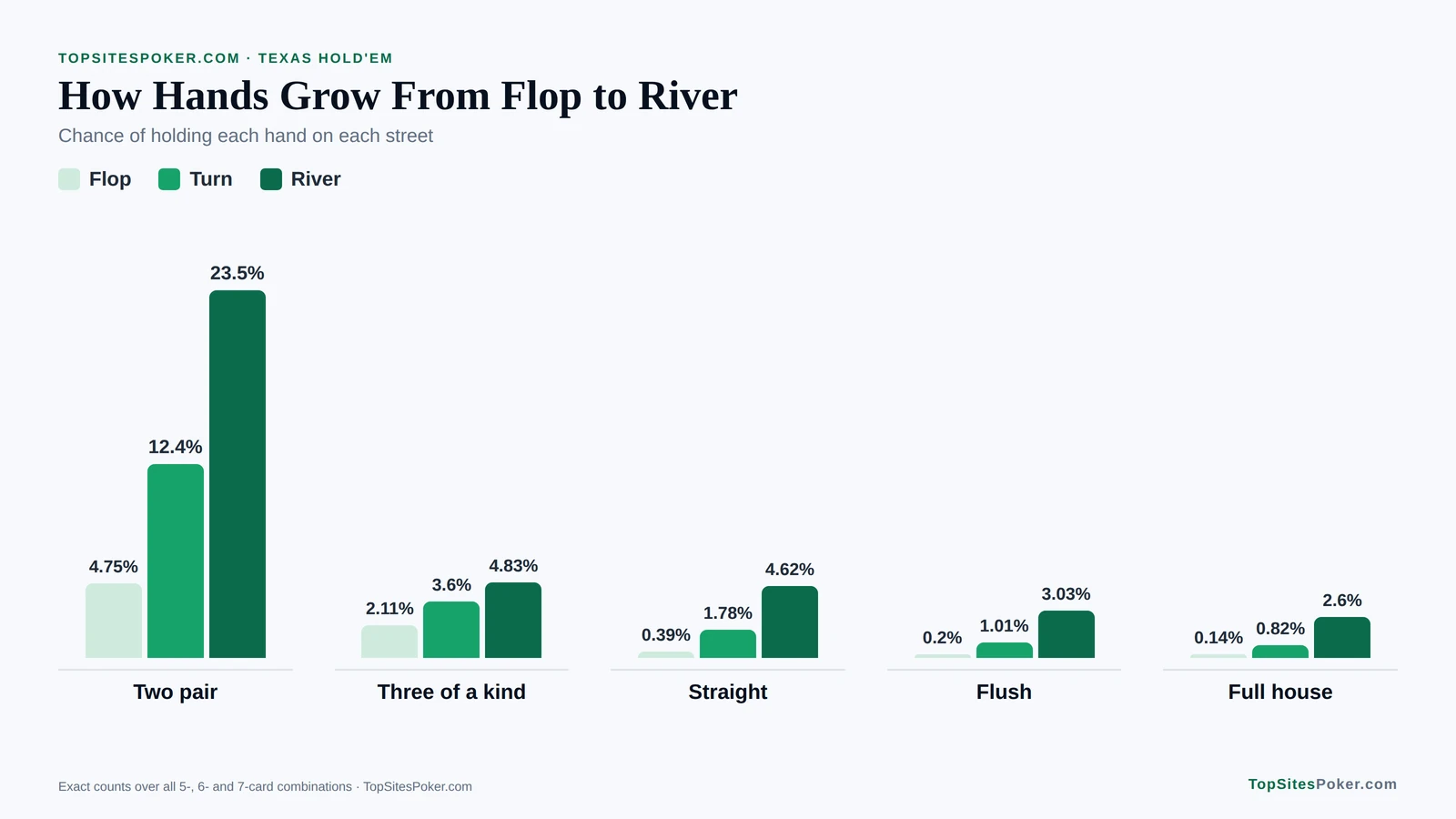
Big hands become many times more likely between the flop and the river.
The big hands grow fastest. A flush is about 15 times more likely by the river than on the flop, and a full house about 18 times more likely. One pair behaves differently: it peaks on the turn (47.8%) and then falls on the river (43.8%), because the seventh card turns many one-pair hands into two pair or better. High card shrinks steadily, from half of all flops to about one river in six.
In practice, that means your read of the board has to be updated every street. A flush that isn’t possible on the flop may be possible on the turn, and a hand that was probably best on the flop faces a much stronger field of possible hands by the river.
What Your Starting Hand Usually Becomes
Your two hole cards shape which final hands you’re likely to make. We dealt 200,000 boards to each of seven typical starting hands and recorded the final hand type after the river. Each row adds to 100% (small differences are rounding).
| Starting hand | High card | One pair | Two pair | Trips | Straight | Flush | Full house or better |
|---|---|---|---|---|---|---|---|
| A-A (any pocket pair behaves similarly) | — | 35.9% | 39.6% | 11.8% | 1.2% | 2.0% | 9.4% |
| 7-7 | — | 35.1% | 39.4% | 11.7% | 2.3% | 2.0% | 9.5% |
| A-K suited | 18.3% | 43.4% | 22.1% | 4.3% | 3.1% | 6.5% | 2.4% |
| A-K offsuit | 19.6% | 45.5% | 22.7% | 4.4% | 3.4% | 2.0% | 2.3% |
| J-10 suited | 15.8% | 40.6% | 21.8% | 4.3% | 8.5% | 6.3% | 2.6% |
| 7-6 suited | 16.1% | 40.7% | 21.7% | 4.2% | 8.4% | 6.3% | 2.5% |
| 7-2 offsuit | 19.6% | 46.1% | 22.8% | 4.4% | 2.7% | 2.0% | 2.3% |
TopSitesPoker.com simulation, 200,000 deals per starting hand. Hand types include hands made entirely or mostly by the board.
The table shows why hands are valued for what they can become, not just what they are:
- Pocket pairs never finish with high card. They end with three of a kind about 12% of the time and with a full house or better about 9% of the time, roughly three to four times as often as unpaired hands (about 4% and 2.5%).
- Suited cards triple the flush rate. A-K suited finishes with a flush 6.5% of the time against 2.0% for A-K offsuit. The 2.0% offsuit hands still show are flushes made mostly with the board.
- Connected cards triple the straight rate. J-10 suited and 7-6 suited make a straight about 8.5% of the time, compared with 2.7% for 7-2 offsuit.
- The type of hand isn’t the same as its value. A-A and 7-7 finish with almost identical hand-type frequencies, but aces make much higher pairs, sets and full houses. That’s where most of the difference in their value comes from.
How Often a Flopped Hand Holds Up
If you have a hand on the flop, how often is it still the winner by the river? We dealt 1,500,000 heads-up hands and grouped them by the type of hand the player held on the flop, then recorded how often that player won at the river against one random opponent, with no folding.
| Your hand on the flop | Wins by the river | Ties |
|---|---|---|
| Full house | 95.9% | 1.0% |
| Flush | 94.0% | 0.0% |
| Straight | 88.2% | 4.8% |
| Three of a kind | 87.1% | 2.7% |
| Two pair | 75.6% | 2.8% |
| One pair | 57.5% | 4.2% |
| High card | 35.0% | 4.2% |
TopSitesPoker.com simulation, 1,500,000 heads-up deals. Flopped quads and straight flushes (a few hundred cases) won virtually every time in the sample.
Two lessons come out of these numbers. First, a flopped pair is only a modest favorite against a single random hand: it wins 57.5% of the time, because the opponent has two more cards to pair up or make something better. Against real opponents who stay in with stronger-than-random hands, a flopped pair holds up less often still. Second, even a flopped straight or set fails to win outright about one time in eight against a random hand, because of the board pairing, flushes arriving and other late improvements. A strong hand on the flop is a strong favorite, not a finished result.
How Often Your Hand Is the Nuts
The nuts is the best possible hand on the board. How often is your made hand the nuts by the river? We generated 3,000 random river hands of each type and checked each one against every possible opponent holding:
- Straight: the nuts (or tied for it) only 12.7% of the time.
- Flush: the nuts only 6.2% of the time.
- Full house: the nuts only 2.5% of the time.
- Three of a kind: the nuts about 0.1% of the time.
- Two pair and one pair: never the nuts in our sample.
These numbers look shocking until you remember what the nuts require. A straight is only the nuts when no flush, full house or higher straight is possible, and by the river most boards allow at least one of those. A full house is almost never the nuts, because a full house needs a paired board, and a paired board makes four of a kind possible.
That doesn’t mean a straight or full house is usually beaten. The possible better hands are usually rare combinations your opponent probably doesn’t hold. But it does mean that “I have a strong hand” and “I have the best possible hand” are very different statements, and the gap between them is where the biggest pots are won and lost.
What You’ll Flop With Each Type of Starting Hand
The flop is where most hands take shape. Here’s the exact distribution of hand types on the flop for four typical starting hands, calculated over all 19,600 possible flops for each:
| Hand on the flop | Pocket pair (8-8) | Two high cards (A-K offsuit) | Suited connectors (J-10 suited) | Unconnected, unsuited (7-2 offsuit) |
|---|---|---|---|---|
| High card | — | 53.6% | 51.8% | 53.9% |
| One pair | 71.8% | 40.4% | 40.4% | 40.4% |
| Two pair | 16.2% | 4.0% | 4.0% | 4.0% |
| Three of a kind | 10.8% | 1.6% | 1.6% | 1.6% |
| Straight | — | 0.33% | 1.29% | — |
| Flush | — | — | 0.82% | — |
| Full house | 0.98% | 0.09% | 0.09% | 0.09% |
| Four of a kind | 0.24% | 0.01% | 0.01% | 0.01% |
| Straight flush | — | — | 0.02% | — |
Exact enumeration by TopSitesPoker.com. “One pair” and “two pair” include pairs made by the flop itself; for example, a pocket pair on a paired flop counts as two pair.
Look at the three unpaired hands and you’ll see nearly identical numbers for pairs, two pair and trips. On the flop, the difference between A-K, J-10 suited and 7-2 isn’t how often they connect. It’s what they connect into. A-K makes top pair with the best kicker, J-10 suited adds straight and flush chances, and 7-2 makes low pairs with weak kickers and can’t flop a straight at all. The ranking of hands is the same for everyone. The quality of the hands within each rank is what separates good starting hands from bad ones.
Some specific flop odds worth knowing:
- A pocket pair flops a set 10.8% of the time, and a full house or quads another 1.2%.
- Two unpaired cards both pair on the flop (two pair using both hole cards) about 2.0% of the time.
- Two suited cards flop a flush 0.82% of the time, and a flush draw 10.9% of the time.
- Connected cards such as J-10 flop a straight about 1.3% of the time.
- Two unpaired cards miss the flop completely (high card only) a little more than half the time.
What the Board Makes Possible
By the river, the five community cards set the ceiling for every hand at the table. These are the exact frequencies of the board features that matter most, calculated over all 2,598,960 possible five-card boards:
| Board feature (after the river) | How often | What it makes possible |
|---|---|---|
| At least one pair on the board | 49.3% | Full houses and four of a kind |
| Three or more cards of one suit | 37.1% | Flushes (for players holding two of that suit) |
| Four or more cards of one suit | 4.5% | Flushes with just one card of that suit |
| Three cards within a five-rank window | 74.7% | Straights |
| Four cards within a five-rank window | 13.7% | Straights with just one matching card |
| No pair, no three-flush, no straight possible | 1.8% | Nothing above three of a kind |
Those numbers explain why river decisions are so often uncomfortable. About three river boards in four make a straight possible, about half are paired, and more than a third allow a flush. Only 1.8% of boards cap the best possible hand at three of a kind. Whatever you hold, there’s usually some combination of two cards that beats it. The practical question is never “can I be beaten?” but “how likely is it that this opponent, playing this way, has one of the hands that beats me?”
From Rankings to Decisions: How Players Group Hand Strength
The ranking chart has ten rungs, but at the table, players usually think in five broader groups. The groups depend on the board and the opponents, not just the hand type, and they’re the bridge between knowing what beats what and deciding what to do.
- The nuts and near-nuts. Hands that can’t be beaten, or can be beaten only by a handful of rare combinations: the nut flush on an unpaired board, top set on a dry board, the highest possible straight with no flush possible. Players usually try to build the biggest possible pot with these.
- Strong made hands. Hands that beat most of what an opponent could have but lose to a real share of strong hands: a non-nut flush, a set on a wet board, two pair using both hole cards. These are usually bet for value, with some caution when the betting gets heavy.
- Medium-strength hands. Hands that win against weaker hands and bluffs but lose to most hands that are willing to put in a lot of money: top pair with a weak kicker, a small overpair on a coordinated board, middle pair. These are often played to keep the pot manageable.
- Draws. Hands that are behind now but have a real chance to improve: flush draws, straight draws, and combinations of both. Their value depends on how many cards improve them and on the price of continuing.
- Weak hands and air. Hands that rarely win at showdown: bottom pair, ace-high in a multiway pot, missed draws. These are usually folded, or used as bluffs in the right spots.
The same hand type can fall into different groups. On K♠ 8♦ 3♣, top pair with an ace kicker is near the top of the medium group, or even strong, because only sets, two pair and pocket aces beat it. On K♣ Q♣ J♥ 7♣, the same top pair is barely medium, because flushes, straights, sets and two pair all beat it. The earlier table of “how many hands beat yours” puts numbers on exactly this shift: 94 beating holdings on the dry board against 164 on the wet one.
That’s why experienced players rarely describe a hand just by its type. “I had a flush” says very little. “I had the second-nut flush on an unpaired board against a player who only calls with strong hands” says almost everything that matters. The ranking chart is where every decision starts, but the board and the betting decide which group your hand belongs to.
Poker Hands in Other Games
The ten-hand ranking in this guide is the standard for every “high” poker game, meaning any game where the best hand wins. What changes between games is how many cards you get, which of them you’re allowed to use, and in some games whether the best hand is the highest or the lowest. This section covers the variants you’re most likely to meet.
| Game | Cards you get | How you make your hand | Rankings used | Best possible hand |
|---|---|---|---|---|
| Texas Hold’em | 2 hole cards + 5 shared | Best five of seven, any combination | Standard high | Royal flush |
| Omaha | 4 hole cards + 5 shared | Exactly 2 hole cards + exactly 3 board cards | Standard high | Royal flush |
| Omaha Hi-Lo (8 or better) | 4 hole cards + 5 shared | Exactly 2 + 3, separately for high and for low | High, plus A-5 low with an 8-or-better qualifier | Can win both halves with one set of cards |
| Seven Card Stud | 7 cards (3 face down, 4 face up), no shared cards | Best five of your seven | Standard high | Royal flush |
| Razz | 7 cards, as in Stud | Lowest five of your seven | A-5 low (aces low; straights and flushes ignored) | 5-4-3-2-A |
| 2-7 Triple Draw | 5 cards, three draws | Your five cards after the draws | 2-7 low (aces high; straights and flushes count against you) | 7-5-4-3-2, not all one suit |
| Five-card draw | 5 cards, one draw | Your five cards after the draw | Standard high | Royal flush |
| Short Deck (6+) | 2 hole cards + 5 shared, 36-card deck | Best five of seven | Modified: a flush beats a full house | Royal flush |
| Pineapple and Crazy Pineapple | 3 hole cards, one discarded | As Hold’em, after the discard | Standard high | Royal flush |
Omaha: the “exactly two” rule
In Omaha, you get four hole cards, and your hand must use exactly two of them together with exactly three of the five board cards. The rankings are identical to Hold’em, but the two-and-three rule changes what you can make:
- Flushes need two of your own cards. If the board shows four hearts and you hold only the A♥, you don’t have a flush. You’d need a second heart in your hand.
- Straights need two of your own cards. A board of 9-8-7-6 doesn’t give you a straight with a single 10 in your hand.
- Holding four of a kind isn’t four of a kind. If you’re dealt A-A-A-A, you can only use two of them, so you start with a pair of aces.
- A board full house doesn’t play for you. If the board shows K-K-K-7-7, a player holding A-Q-J-10 does not have a full house. They must use two hole cards and three board cards, so their best hand is three kings with an ace-queen kicker (K-K-K-A-Q). In Hold’em, the same player would simply play the board’s full house.
Because every player has six possible two-card combinations from four hole cards, Omaha hands are much stronger on average than Hold’em hands, and the nut hand wins far more often. A flush or straight that would be a big hand in Hold’em is often only medium strength in Omaha.
Hi-lo games and the 8-or-better low
In “hi-lo” or “split” games, such as Omaha Hi-Lo and Seven Card Stud Hi-Lo, the pot is divided between the best high hand and the best low hand. The high hand uses the standard rankings. The low hand is judged separately, and in most split games it must “qualify”:
- A qualifying low is five cards of different ranks, all 8 or lower, with the ace counting as the lowest card. 8-7-6-5-4 qualifies; 9-5-4-3-2 doesn’t.
- Straights and flushes don’t count against a low. 5-4-3-2-A is both a straight (for high) and the best possible low.
- Lows are compared from the top card down. 7-5-4-3-2 beats 7-6-3-2-A, because the second-highest cards differ (5 against 6), and the lower one wins.
- If no low qualifies, the high hand wins the whole pot.
- One player can win both halves (called “scooping”), and the same five cards, or in Omaha a different combination of two hole cards, can be used for high and for low.
Lowball rankings: A-5 and 2-7
In lowball games, the lowest hand wins the whole pot. Two ranking systems are used, and they disagree about aces, straights and flushes:
| Question | A-5 low (Razz, California lowball, hi-lo games) | 2-7 low (Deuce-to-seven, Kansas City lowball) |
|---|---|---|
| Is the ace high or low? | Always low | Always high |
| Do straights and flushes count? | No, they’re ignored | Yes, they count as high hands and ruin a low |
| Best possible hand | 5-4-3-2-A (the wheel) | 7-5-4-3-2, not all one suit |
| How hands are compared | Highest card first; lower is better | Highest card first; lower is better |
| Are pairs bad? | Yes, any pair loses to any no-pair hand | Yes, any pair loses to any no-pair hand |
A-5 low is the more intuitive system: the smallest cards win, and you can ignore straights and flushes completely. 2-7 low is the “purist” system: a hand is low only if it would be a bad high hand, so a straight like 6-5-4-3-2 is not a good low hand at all. It counts as a straight. That’s why 7-5-4-3-2 (which is not a straight) is the best 2-7 hand, and why 7-6-5-4-2 is a much weaker 2-7 hand than it looks.
Short Deck: when a flush beats a full house
Short Deck (also called Six Plus Hold’em) removes the 2s through 5s, leaving 36 cards. With only nine cards per suit, flushes become rarer than full houses, so most Short Deck rule sets rank a flush above a full house. The ace can still play low, which in Short Deck means A-6-7-8-9 is the lowest straight. Some rule sets also rank three of a kind above a straight, because straights become more common with fewer ranks, but this varies between rooms and events, so check the rules before you play.
Seven Card Stud
Stud uses the standard high rankings with no community cards. Each player gets seven cards of their own over several betting rounds, three face down and four face up, and makes the best five-card hand. Because some of each player’s cards are face up, Stud players can see which cards are “dead”: if three of the four aces are showing in other players’ hands, your chance of making aces is tiny. Suits have one extra role in Stud: when two players tie for the lowest face-up card at the start of a hand, suit order (clubs lowest, then diamonds, hearts and spades highest) decides who must make the forced opening bet. Suits never decide a showdown.
Wild cards and five of a kind
Most casino poker doesn’t use wild cards, but many home games do, and wild cards change the ranking chart. A wild card, such as a joker or all the 2s (“deuces wild”), can stand for any card the holder chooses. That makes a new hand possible: five of a kind, such as four kings plus a wild card. In most home-game rules, five of a kind is the highest hand of all, above a royal flush, though some groups rank it just below. Agree on this before the first deal.
A few common house rules are worth settling in advance, too. Does a hand with a wild card beat an otherwise identical “natural” hand? Can a wild card complete a flush in a suit you already hold that card in? The standard rankings don’t answer these questions, so the group has to.
A related casino tradition is the “bug,” a joker used in some forms of draw poker and lowball. In high draw poker, the bug can only be used as an ace or to complete a straight or flush. In A-5 lowball, it counts as the lowest card not already in your hand.
Omaha hand-reading examples
The two-and-three rule trips up almost every new Omaha player, so here are three quick checks:
- You hold A♥ K♣ 8♦ 3♠. The board is Q♥ J♥ 7♥ 4♥ 2♣. You do not have a flush: you hold only one heart, and Omaha requires two of your own cards. Your best hand is ace-high (A-K with Q-J-7).
- You hold 10♠ 9♠ 5♦ 5♣. The board is 8♥ 7♣ 6♦ K♠ 2♥. You have a ten-high straight (10-9 from your hand with 8-7-6 from the board). The pair of fives doesn’t help, because you can use only two hole cards.
- You hold K♦ K♠ 7♣ 2♥. The board is K♥ 9♣ 9♦ 4♠ 2♠. You have a full house, kings full of nines, using K-K from your hand and K-9-9 from the board.
Poker Hands in Casino Table Games and Video Poker
Poker hand rankings also power a family of casino games where you play against the house instead of other players. Most use the standard ranking, but a few change it, and knowing the difference prevents surprises.
| Game | Cards | Ranking used | Key difference from standard poker |
|---|---|---|---|
| Video poker (e.g., Jacks or Better) | 5 cards, one draw | Standard high | Hands pay according to a posted pay table; in Jacks or Better, a pair must be jacks or higher to pay |
| Three Card Poker | 3 cards | Modified three-card ranking | A straight beats a flush, and three of a kind beats a straight |
| Caribbean Stud | 5 cards, no draw | Standard high | The dealer must qualify (usually ace-king or better) for bets to be fully in play |
| Ultimate Texas Hold’em | 2 hole cards + 5 shared | Standard high | You play against the dealer’s Hold’em hand, not other players |
| Pai Gow Poker | 7 cards split into 5 and 2 | Standard high, with a joker | The two-card hand only counts pairs and high cards; in many casinos A-2-3-4-5 is the second-highest straight |
| Chinese poker / Open-Face Chinese | 13 cards in rows of 3, 5 and 5 | Standard high | The three-card front row can only make three of a kind, a pair or high card |
Three Card Poker: why the order changes
With only three cards, the math behind the ranking changes. Out of 22,100 possible three-card hands, 720 are straights and 1,096 are flushes (not counting straight flushes), so a straight is rarer than a flush and ranks higher. Three of a kind (52 hands) is rarer than a straight, so it ranks above it too. The full Three Card Poker order is: straight flush, three of a kind, straight, flush, pair, high card. It’s the same “rarer is better” logic as standard poker, applied to a different number of cards.
Video poker
Video poker uses the standard five-card ranking, but what matters to the player is the pay table, which sets how much each hand pays. In the common Jacks or Better game, the lowest paying hand is a pair of jacks or better, and the royal flush pays by far the most, usually with a large bonus when you play the maximum number of coins. Because the draw lets you replace cards, the odds of finishing with each hand are much better than the five-card figures in the chart above, and correct play depends on which cards you hold. Pay tables vary from machine to machine, and they’re the single biggest factor in the game’s return, so compare them before you play.
Pai Gow Poker
In Pai Gow Poker, you split seven cards into a five-card hand and a two-card hand, and the five-card hand must rank higher than the two-card hand. The five-card hand uses the standard ranking, with one common exception: in many casinos, A-2-3-4-5 ranks as the second-highest straight, just below A-K-Q-J-10. The two-card hand can only be a pair or high card. A joker is usually added to the deck, playing as an ace or to complete a straight or flush. Rules vary by casino, so check the posted rules.
Poker Hands in Five-Card Draw: Improvement Odds
In five-card draw, you’re dealt five cards, then discard some and draw replacements, once. The ranking chart is the standard one, but the draw adds a question Hold’em players rarely face: which cards should you keep, and how often will the draw improve your hand? These are the exact chances, calculated over every possible replacement card combination for each example:
| You keep | Cards drawn | Chance to improve | Breakdown |
|---|---|---|---|
| One pair | 3 | 28.7% | Two pair 16.0%, trips 11.4%, full house 1.0%, quads 0.3% |
| One pair plus an ace kicker | 2 | 25.9% | Two pair 17.2%, trips 7.8%, full house 0.8%, quads 0.1% |
| Two pair | 1 | 8.5% | Full house 8.5% (4 cards of 47) |
| Three of a kind | 2 | 10.4% | Full house 6.1%, quads 4.3% |
| Three of a kind plus a kicker | 1 | 8.5% | Full house 6.4%, quads 2.1% |
| Four to a flush | 1 | 19.1% | Flush (9 cards of 47) |
| Four to an open-ended straight | 1 | 17.0% | Straight (8 cards of 47) |
| Four to an inside straight | 1 | 8.5% | Straight (4 cards of 47) |
| Four to an open-ended straight flush | 1 | 31.9% | Straight flush 4.3%, flush 14.9%, straight 12.8% |
Exact enumeration by TopSitesPoker.com over every possible draw from the 47 unseen cards, with the discarded cards removed from the deck.
A few practical points follow from the table:
- Draw three to a pair. Keeping a kicker with a pair (drawing two instead of three) slightly lowers your chance of improving, from 28.7% to 25.9%. Players sometimes keep an ace kicker anyway, to make their hand harder to read.
- Two pair rarely improves. Only 4 of the 47 unseen cards make a full house. Two pair is usually as good as it’s going to get, so it’s played as a made hand.
- Draw two to three of a kind. Drawing two gives a slightly better chance of improving (10.4%) than keeping a kicker and drawing one (8.5%).
- Four-card draws are underdogs. Even the best single-card draw, four to an open-ended straight flush, completes only about one time in three. A four-flush gets there about one time in five, and an inside straight about one time in twelve.
These odds also explain an old piece of draw-poker advice: never draw to an inside straight. At 8.5%, it completes about once in twelve tries, so it’s only worth chasing when the pot pays more than about 11 times the cost of drawing.
How Software Ranks Poker Hands
Every online poker site, and every hand evaluator used in poker research, has to answer the same question millions of times a second: which of these hands is better? The 7,462 figure from earlier is the key. Because every five-card hand falls into one of exactly 7,462 strength classes, a program can give each class a number, from 1 for a royal flush to 7,462 for 7-5-4-3-2 offsuit, and compare two hands by comparing two numbers. Lower is better, and equal numbers mean a split pot.
A well-known approach, described by programmer Kevin Suffecool and often called “Cactus Kev’s evaluator,” shows how this can be done quickly. Each rank is assigned a prime number (2 for a deuce, 3 for a three, up to 41 for an ace). Multiplying the five primes in a hand gives a product that’s unique to its combination of ranks, which can be looked up in a precomputed table to find the hand’s class. Flushes are detected separately by checking the suits, and straights and high-card hands are handled with small lookup tables. Later evaluators refined the idea with larger lookup tables that evaluate seven-card Hold’em hands directly.
For players, the practical point is simple: online showdowns are virtually never misread. The software finds each player’s best five cards, compares their strength classes and awards the pot, including the odd chip in a split pot, exactly according to the rules in this guide. If an online result ever surprises you, the software is almost certainly right and the hand deserves a second look, usually for a kicker that plays from the board or a straight or flush you missed.
Terms That Are Easy to Confuse
- Straight flush vs royal flush. A royal flush is a straight flush: specifically, the ace-high one. Every royal flush is a straight flush, but only 4 of the 40 straight flushes are royal.
- Set vs trips. Both are three of a kind. A set uses a pocket pair; trips use one hole card plus a board pair.
- Full house vs “full boat.” The same hand. “Boat” and “full boat” are slang for a full house.
- Two pair vs “three pair.” There’s no such hand as three pair. Seven cards can contain three pairs, but only the two highest count.
- Flush vs “flush draw.” A flush is five cards of one suit. A flush draw is four cards of one suit, waiting for a fifth. Only the finished flush is a hand.
- Straight vs “wraparound.” A straight is five consecutive ranks. There’s no wraparound straight: Q-K-A-2-3 is ace-high.
- Wheel vs steel wheel. The wheel is 5-4-3-2-A in mixed suits (a straight). The steel wheel is 5-4-3-2-A of one suit (a straight flush).
- Kicker vs hole card. A kicker is any card in your best five that isn’t part of the main combination. It can come from your hand or from the board.
Settling Hand Disputes in Home Games
Casinos have dealers and floor staff to read hands. Home games usually don’t, so it helps to agree on a few standards before the first deal:
- Cards speak. A hand is whatever the cards make, regardless of what the player says. This is the casino standard and the simplest rule for a home game.
- Table your hand to win. A player who throws their cards away face down gives up the pot, even if the cards would have won. Settle this before a big pot makes it a painful discussion.
- Declare games. Some home hi-lo games use a “declare” rule, where each player announces (often by hiding chips in a closed hand) whether they’re playing for the high half, the low half or both. In a declare game, a player who declares both must usually win both halves outright, or they get nothing. Agree on the exact rule if your group plays declare.
- Wild cards. If you play with wild cards, agree whether five of a kind ranks above a royal flush and whether a natural hand beats an identical hand made with a wild card.
- Write it down. A short list of house rules taped to the table ends most arguments before they start.
Where the Poker Hand Rankings Came From
The ten-hand ranking feels timeless, but it was built up gradually as poker developed in the United States during the 19th century. The details of early poker history are patchy, so the dates below are approximate, but the broad outline is well established.
- Early 1800s: a betting game called poker appears along the Mississippi River and in New Orleans, drawing on older European games in which players bet on the strength of their cards. The earliest descriptions, from the 1830s, describe a game played with a 20-card deck (aces through tens) in which each of four players received five cards. Straights and flushes weren’t counted as hands: the recognized hands were pairs, two pair, three of a kind, full houses and four of a kind.
- Mid-1800s: the full 52-card deck replaces the 20-card deck, allowing more players, and the flush is added to the rankings. Draw poker, with a chance to exchange cards, becomes popular.
- Later 1800s: the straight becomes widely accepted as a hand, and the straight flush takes its place at the top of the ranking. By the end of the century, the ranking is essentially the one used today.
- 20th century: stud poker and then community-card games spread. Texas Hold’em is generally traced to Texas in the early 1900s, reached Las Vegas in the 1960s, and became the main event of the World Series of Poker in the early 1970s. The rankings came along unchanged.
The fact that rarer hands rank higher isn’t an accident. As new hands were recognized, they were slotted into the order according to how hard they are to make in five cards. That’s why the order fits the five-card odds perfectly, and why the one modern game with a different deck, Short Deck, had to swap the flush and the full house to keep the same logic.
Poker Hand Nicknames
Poker players have a nickname for almost everything. You don’t need to use them, but you’ll hear them at the table, on broadcasts and in strategy articles, so it helps to know what they mean.
| Nickname | Cards | Where it comes from, or what it means |
|---|---|---|
| Pocket rockets, bullets | A-A as hole cards | The best starting hand in Hold’em |
| Cowboys | K-K as hole cards | The kings on the cards |
| Ladies | Q-Q as hole cards | The queens on the cards |
| Hooks, fishhooks | J-J as hole cards | The shape of the letter J |
| Big slick | A-K as hole cards | Origin unclear; a strong but unpaired hand that misses the flop about two times in three |
| Snowmen | 8-8 as hole cards | The shape of the number 8 |
| Ducks | 2-2 as hole cards | The shape of the number 2 |
| The hammer | 7-2 offsuit | Often called the worst starting hand in Hold’em |
| Broadway | A-K-Q-J-10 | The highest straight; “broadway cards” are tens through aces |
| Wheel, bicycle | 5-4-3-2-A | The lowest straight and the best A-5 low hand |
| Steel wheel | 5-4-3-2-A of one suit | The lowest straight flush |
| Boat | Any full house | A common slang term, as in “aces full of kings, a big boat” |
| Quads | Four of a kind | Short for “quadruplets” |
| Trips, set | Three of a kind | “Set” when made with a pocket pair; “trips” when made with a board pair |
| Dead man’s hand | Two pair, aces and eights | According to legend, the hand Wild Bill Hickok held when he was shot in 1876 |
| The nuts | The best possible hand on the board | Common slang of uncertain origin |
Glossary of Hand Terms
| Term | Meaning |
|---|---|
| Hole cards | Your private cards (two in Hold’em, four in Omaha) |
| Board, community cards | The shared cards dealt face up in the middle of the table |
| Made hand | A hand that already has value, such as a pair or better, as opposed to a draw |
| Draw | A hand that needs more cards to become strong, such as four cards to a flush |
| Outs | The unseen cards that would improve your hand to the likely winner |
| Kicker | A card in your best five that isn’t part of the main combination; it breaks ties |
| Playing the board | When your best five cards are all community cards |
| Counterfeited | When a board card makes one of your hand’s cards irrelevant, such as a board pair pushing your lower pair out of your best five |
| Overpair | A pocket pair higher than every board card |
| Top pair | A pair made with the highest board card |
| Second nuts | The second-best possible hand on the board |
| Runner-runner | A hand completed by both the turn and the river, such as a flush from two more suited cards |
| Rainbow | A board with no two cards of the same suit (on the flop: three different suits) |
| Suited / offsuit | Hole cards of the same suit / of different suits |
| Connectors | Hole cards of consecutive rank, such as 8-7 |
| Chop, split pot | A pot divided between players with identical hands |
| Scoop | Winning both halves of a split (hi-lo) pot |
| Muck | The discard pile, or to throw your hand away without showing it |
| Table (verb) | To turn your hand face up at showdown |
| Cards speak | The rule that your hand is what your cards make, not what you announce |
Showdown: How Hands Are Shown and Read
The ranking chart only matters if the hands are shown and read correctly. A few showdown rules exist specifically to make sure the right hand wins:
- Cards speak. Your hand is whatever your cards actually make, not what you say it is. If you announce “two pair” and table a flush, the flush plays. If you announce a flush you don’t have, the announcement doesn’t help you, and deliberately misstating your hand to get an opponent to fold can be penalized.
- Table both cards. To win at showdown, you must turn your whole hand face up. A card you keep hidden or toss into the discards can’t be counted.
- Who shows first. If there was a bet on the final round, the last player to bet or raise shows first. If everyone checked, the first remaining player to the left of the button shows first. A player who sees they’re beaten can give up their hand without showing it.
- The dealer reads the hands. In a casino or online, the dealer or software identifies each player’s best five cards and awards the pot. Players at the table are expected to point out an obvious misread before the pot is pushed.
- Protect your cards until the pot is yours. A winning hand that’s thrown away before it’s read is usually dead, even if it would have won.
Online, the software builds every player’s best hand and compares them automatically, which makes online play an easy place to check your hand-reading: note what you think each player has, then compare it with the hand description the site shows at showdown.
Common Mistakes With Poker Hands
Most errors with poker hands aren’t about forgetting the ranking. They come from misapplying it under pressure, when a pot is on the line and there are seven cards to sort through. These are the ones that come up most:
| Mistake | Example | The correct rule |
|---|---|---|
| Thinking a straight beats a flush | “I have a straight to the ace!” against a small flush | Any flush beats any straight |
| Using more than five cards | Claiming “three pair” or counting a sixth kicker | Only your best five cards count |
| Thinking suits break ties | “My spade flush beats your heart flush” | Suits never rank; identical ranks split the pot |
| Ranking a full house by its pair | 3-3-3-A-A against 4-4-4-2-2 | The three of a kind is compared first; fours full wins |
| Wrapping a straight around the ace | Q-K-A-2-3 called a straight | The ace is high or low, never both; that hand is ace-high |
| Letting a kicker override a pair | Q-Q with an ace kicker against K-K with a 2 | Compare the pair first; kings win |
| Counting a kicker that doesn’t play | A-Q against A-8 when the board’s king is the fifth card | A kicker only counts if it’s in your best five |
| Missing that the board plays | Betting a hand that only matches the board’s straight | If your cards don’t improve the board, you can at best split |
| Throwing away a winner | Mucking two pair without noticing the flush | Table your hand and let the dealer read it |
| Applying Hold’em rules to Omaha | Claiming a flush with one suited card in Omaha | Omaha requires exactly two hole cards and three board cards |
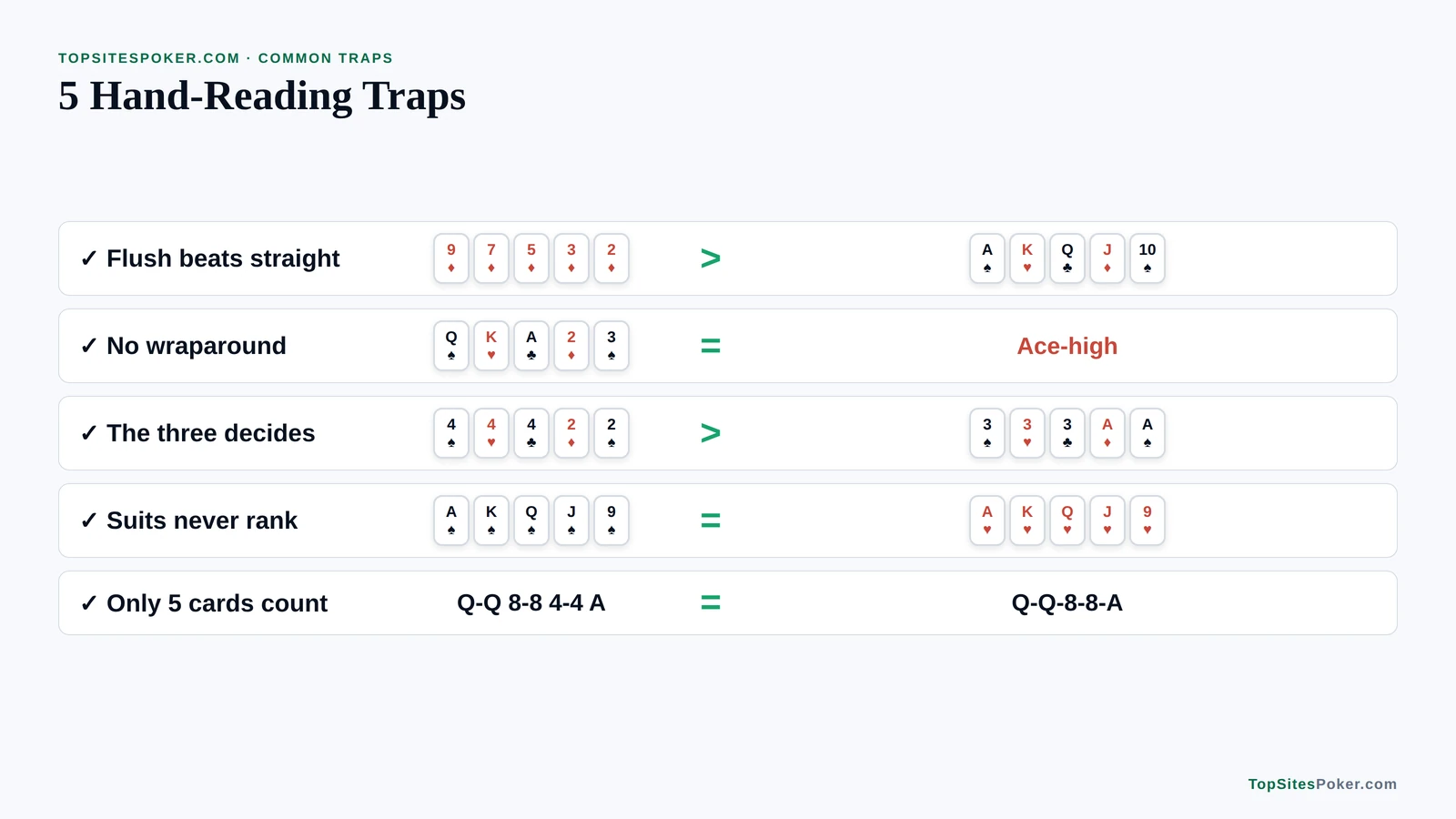
Five rules that settle most showdown arguments.
Two of these deserve a closer look because they cost the most money. The first is throwing away a winning hand. It happens when a player reads their hand as “just two pair” and mucks without tabling, not noticing that their seven cards also contain a flush or a straight. In a live game, the discarded hand is dead, and the pot goes to someone else. The fix is simple: at showdown, turn your cards face up and let the dealer read them. Cards speak.
The second is misreading a shared board. When four or five community cards form a straight or flush, many players hold the same hand. A player who bets heavily with a hand that doesn’t improve on the board can only split the pot at best, and will lose to anyone holding a higher card that extends it. Before you bet big with a straight or flush, check how many of its cards are yours.
How to Learn the Rankings Fast
You can memorize the ten hands in a few minutes. Reading them instantly in real hands takes a little more practice. These methods work well for new players:
Memory aids
- Learn it as five pairs of neighbors. Royal flush and straight flush; four of a kind and full house; flush and straight; three of a kind and two pair; one pair and high card. Five pairs, from top to bottom, and within each pair the first one wins.
- Rarer is better. If you can’t remember which of two hands wins, ask which is harder to make. Four of the same rank is harder than a full house, and five of the same suit is harder than five in a row.
- Count what matches. For the same-rank hands, the more matching cards, the better: four matching beats three plus two, which beats three, which beats two plus two, which beats two.
Practice drills
- The seven-card deal. Shuffle a deck and deal seven cards face up. Name the best five-card hand out loud, then check it with the five-step routine. Twenty deals a day for a week makes hand-reading automatic.
- The two-hand showdown. Deal two hands of two cards and a five-card board. Decide who wins, and why, before checking. This drill trains kickers and shared-board situations.
- The nuts drill. Deal only a five-card board and name the best possible hand anyone could hold. Then name the second-best. This builds the habit of judging your hand relative to what’s possible.
- Watch showdowns online. Most online poker sites display each player’s hand description at showdown. Name each hand before the site does, and compare.
More tricky reads
Two flushes on a four-flush board. The board is K♠ 9♠ 6♠ 3♠ 2♦. You hold Q♠ 4♣; your opponent holds J♠ 10♠. Your best hand is K♠ Q♠ 9♠ 6♠ 3♠. Your opponent’s is K♠ J♠ 10♠ 9♠ 6♠. You win, because your second card (queen) beats theirs (jack). Your opponent’s second spade doesn’t help, because only five cards count and the queen outranks both of theirs.
A straight that isn’t there. The board is A♦ K♣ Q♥ J♠ 3♦. You hold 2♣ 4♥. You might see A-K-Q-J and 2-3-4 and think of a wraparound straight, but Q-K-A-2-3 isn’t a straight. Your best hand is ace-high: A-K-Q-J-4. Anyone holding a 10 has Broadway, the highest straight.
The full house that isn’t. The board is 7♥ 7♣ 4♦ 4♠ K♥. You hold K♦ 2♣. With three pairs across your seven cards (kings, sevens and fours), it can look like a full house. It isn’t: a full house needs three cards of one rank. Your best hand is two pair, kings and sevens with a four (K-K-7-7-4). A player holding a seven has sevens full of fours and beats you.
Four of a kind on the board. The board is 9♠ 9♥ 9♦ 9♣ K♠. You hold A♣ 2♦. Everyone has four nines, and your ace is the highest possible kicker. You can’t lose. The best anyone else can do is tie you with another ace.
Showdowns With Three or More Players
Ties and kickers get more interesting when several hands reach showdown at once. The rules don’t change: every player’s best five cards are compared, the best hand wins, and exactly equal hands split. But with more hands, there are more ways for kickers, shared boards and split pots to decide the result. Each example below was checked with a hand evaluator.
Example 1: Two players split, a strong hand loses. The board is A♠ K♥ Q♦ 7♣ 2♠. Player 1 holds J♣ 10♦, Player 2 holds J♥ 10♠ and Player 3 holds A♥ A♦.
Result: Players 1 and 2 both have Broadway (A-K-Q-J-10) and split the pot. Player 3’s three aces lose to both straights. A set of aces is a powerful hand, but it sits below a straight on the chart.
Example 2: Three kickers in a row. The board is K♠ K♦ 8♣ 5♥ 2♠. Player 1 holds A♣ 9♦, Player 2 holds Q♥ J♣ and Player 3 holds A♦ 3♣.
Result: Everyone has a pair of kings from the board, so the kickers decide. Player 1’s best hand is K-K-A-9-8 and Player 3’s is K-K-A-8-5. Both have an ace, so the second kicker decides: 9 beats 8, and Player 1 wins. Player 2 (K-K-Q-J-8) finishes third. Player 3’s 3 never plays, because the board’s 8 and 5 are higher.
Example 3: A straight flush on the board. The board is 5♥ 6♥ 7♥ 8♥ 9♥. Player 1 holds 10♥ 2♣, Player 2 holds A♠ A♦ and Player 3 holds 4♥ 4♣.
Result: Player 1 wins with a ten-high straight flush (6-7-8-9-10 of hearts). Players 2 and 3 can’t beat the board’s nine-high straight flush. Player 3’s 4♥ would only make a lower straight flush (4-5-6-7-8), so Player 3 also plays the board. If Player 1 had folded, Players 2 and 3 would have split the pot.
Example 4: Four of a kind for everyone. The board is 7♠ 7♥ 7♦ 7♣ A♥. Player 1 holds K♠ Q♠, Player 2 holds 2♣ 3♦ and Player 3 holds A♠ 2♦.
Result: a three-way split. Every player has four sevens with an ace kicker from the board, and no one can improve on the board’s ace. Player 3’s ace doesn’t help, since the board already provides one. If the pot can’t be divided evenly, the odd chip goes to the first tied player to the left of the button.
Example 5: A full house that loses to a bigger one. The board is Q♣ Q♦ 9♠ 9♥ 4♣. Player 1 holds 9♦ 2♠, Player 2 holds Q♠ 3♥ and Player 3 holds A♦ A♣.
Result: Player 2 wins with queens full of nines (Q-Q-Q-9-9). Player 1 has nines full of queens (9-9-9-Q-Q), which ranks below because the three of a kind is compared first. Player 3’s aces make only two pair (A-A-Q-Q-9), and lose to both full houses.
What the multiway examples teach
- A strong hand type isn’t enough. In a pot with several players, the chance that someone holds a higher hand type goes up quickly, as the showdown table earlier showed.
- Kickers are compared one at a time. When the pair is shared, the first kicker is compared, then the second, and so on. Each comparison only happens if the previous one tied.
- Shared boards create split pots. When the board makes a strong hand by itself, the players who can’t improve on it all split, and one card in someone’s hand can take the whole pot.
Poker Hand Odds for the Whole Table
Most odds in this guide describe your own hand. But at a full table, the question that matters is often what someone has. With nine players each holding two cards, hands that are rare for any one player become routine for the table as a whole. We simulated 400,000 nine-handed deals to measure how often at least one player is dealt each type of starting hand:
- Someone holds a pocket pair: 42.0% of hands.
- Someone holds ace-king: 10.6% of hands.
- Someone holds pocket aces or pocket kings: 7.9% of hands.
- Someone holds pocket aces: 4.0% of hands, about once every 25 deals.
The same effect applies to single cards. If you hold K-K at a nine-handed table, the chance that at least one of your eight opponents holds an ace is exactly 79.9%. Most of those aces are folded before the flop, but that figure is why an ace on the flop is so dangerous for pocket kings in a multiway pot: with several callers, someone holding an ace is more likely than not.
The lesson carries over to made hands. A flush is only about a 1-in-33 hand for any one player by the river, but with several players seeing a board that has three cards of one suit, the chance that someone has two of that suit is far higher. That’s the same reason the showdown table earlier showed every hand winning much less often against five opponents than against one: more hands in the pot means more chances for one of them to be strong.
A Checklist Before You Put in a Big Bet
Hand-ranking mistakes are most expensive at the moment a big pot is at stake. Before you bet, raise or call a large amount, run through these questions:
- What exactly is my best five-card hand? Name it precisely, including kickers.
- How many of those five cards come from my hand? If it’s one or none, other players may share most or all of it.
- Is the board paired? If so, full houses and four of a kind are possible.
- Are three or more cards of one suit showing? If so, flushes are possible, and a small flush may not be good.
- Do three board cards fit within five ranks? If so, straights are possible, and I may hold the low end.
- What’s the best possible hand, and how far am I from it? The closer to the nuts, the more confidently I can build a big pot.
- Which of the better hands would this opponent play this way? The ranking tells you what’s possible. The betting tells you what’s likely.
It takes a few seconds, and it prevents the most costly errors in poker: paying off a hand that the board clearly makes possible, and throwing away a winner that you misread.
Test Yourself: What Beats What?
Twenty questions, from easy to tricky. Cover the answers, decide, then check. Unless a question says otherwise, the rules are standard Texas Hold’em.
1. Which wins: a straight or three of a kind?
Answer: the straight. Any straight beats any three of a kind.
2. Which wins: 10-10-10-4-4 or 9-9-9-A-A?
Answer: 10-10-10-4-4. Full houses compare the three of a kind first, and tens beat nines.
3. Which wins: A-A-7-7-2 or K-K-Q-Q-J?
Answer: A-A-7-7-2. The higher pair decides two pair, and aces beat kings.
4. Which wins: a pair of queens with an ace kicker, or a pair of kings with a 3 kicker?
Answer: the kings. The pair is compared before any kicker.
5. Which wins: A♥ K♥ Q♥ J♥ 9♥ or A♠ K♠ Q♠ J♠ 9♠?
Answer: neither. The ranks are identical, suits don’t rank, and the pot is split.
6. Is Q-K-A-2-3 a straight?
Answer: no. Straights don’t wrap around the ace. It’s ace-high.
7. Which wins: 5-4-3-2-A or 6-5-4-3-2?
Answer: 6-5-4-3-2. In the wheel, the ace plays as a one, so it’s the lowest straight.
8. The board is A♠ K♦ 9♣ 9♥ 4♠. Player A holds A♦ 7♣. Player B holds A♣ Q♦. Who wins?
Answer: split pot. Both have A-A-9-9-K; the board’s king is the fifth card for both, so neither the queen nor the seven plays.
9. The board is 8♣ 8♦ 8♥ K♠ 5♦. Player A holds A♣ 2♦. Player B holds Q♠ Q♥. Who wins?
Answer: Player B, with eights full of queens (8-8-8-Q-Q). Player A has only three eights with an ace-king kicker.
10. The board is J♣ 10♥ 9♦ 8♠ 7♣. Player A holds A♠ A♦. Player B holds Q♥ 2♣. Who wins?
Answer: Player B. The board makes a jack-high straight for everyone; Player B’s queen extends it to a queen-high straight. Player A’s aces don’t improve on the board’s straight.
11. The board is K♠ 9♠ 6♠ 3♠ 2♦. Player A holds Q♠ 4♣. Player B holds J♠ 10♠. Who wins?
Answer: Player A, with K-Q-9-6-3 of spades against Player B’s K-J-10-9-6. The second card (queen against jack) decides.
12. Which is higher: four twos with an ace kicker, or a king-high straight flush?
Answer: the straight flush. Any straight flush beats any four of a kind.
13. In Omaha, you hold A♥ K♣ 8♦ 3♠ and the board is Q♥ J♥ 7♥ 4♥ 2♣. Do you have a flush?
Answer: no. Omaha requires exactly two hole cards, and you hold only one heart.
14. In an 8-or-better hi-lo game, does 9-6-4-3-2 qualify for low?
Answer: no. Every card in a qualifying low must be 8 or lower.
15. The board is 7♥ 7♣ 4♦ 4♠ K♥. You hold K♦ 2♣. Your opponent holds 7♠ 3♦. Who wins?
Answer: your opponent, with sevens full of fours (7-7-7-4-4). You have two pair, kings and sevens (K-K-7-7-4).
16. Which wins: K-K-K-2-2 or Q-Q-Q-A-A?
Answer: K-K-K-2-2. The three kings outrank the three queens, and the pair only matters when the three of a kind is identical.
17. In Three Card Poker, which wins: a straight or a flush?
Answer: the straight. With three cards, straights are rarer than flushes (720 against 1,096 possible hands), so the ranking is reversed.
18. The board is 9♠ 9♥ 9♦ 9♣ K♠. Player A holds A♣ 2♦. Player B holds A♦ Q♥. Who wins?
Answer: split pot. Both have four nines with an ace kicker. Player B’s queen can’t play, because only five cards count.
19. Is 5-4-3-2-A of hearts a straight flush?
Answer: yes. It’s the lowest straight flush, called the steel wheel. The ace plays low.
20. The board is 10♥ J♥ Q♥ 3♣ 3♦. Player A holds K♥ 9♥. Player B holds 3♠ 10♣. Who wins?
Answer: Player A, with a king-high straight flush (9-10-J-Q-K of hearts). Player B’s threes full of tens (3-3-3-10-10) is a strong hand, but a straight flush beats every full house.
If you got 17 or more right, you know the rankings well enough to settle any showdown at the table. If you missed questions 8, 10, 15 or 18, spend a little time on the drills above: those are the shared-board situations that decide real pots.

Frequently Asked Questions
What is the order of poker hands from best to worst?
Royal flush, straight flush, four of a kind, full house, flush, straight, three of a kind, two pair, one pair and high card. A hand higher on the list beats every hand below it.
What is the best hand in poker?
A royal flush: A-K-Q-J-10 of one suit. In five cards, you’ll be dealt one about once in 649,740 hands; with seven cards, as in Hold’em, about once in 30,940.
What is the worst hand in poker?
7-5-4-3-2 in mixed suits is the lowest possible five-card hand in standard high poker. It’s the weakest no-pair hand that isn’t a straight. In lowball games, where the lowest hand wins, the best hands are the ones at the bottom of the high ranking.
Does a flush beat a full house?
No. A full house beats a flush in standard poker. The one common exception is Short Deck poker, where a flush beats a full house because flushes are rarer with a 36-card deck.
Does a straight beat a flush?
No. A flush beats a straight. Even the lowest flush beats Broadway, the highest straight.
What beats four of a kind?
Only a straight flush, including a royal flush.
What happens if two players have the same hand?
Compare the cards that make the hand first, then the kickers, from highest to lowest. If all five cards match in rank, the pot is split equally. Suits never break a tie.
How many cards make a poker hand?
Five. In Hold’em you choose the best five of seven, and in Omaha the best five using exactly two of your four hole cards. A sixth card never counts, not even as a tiebreaker.
Can an ace be low in poker?
Yes, in a straight or straight flush, where 5-4-3-2-A is the lowest straight (the wheel). In every other hand, the ace is the highest card. In A-5 lowball games, and for the low half of hi-lo games, the ace always counts low.
Is two pair better than three of a kind?
No. Three of a kind beats two pair. Three twos beat aces and kings.
What is a kicker?
A card that’s part of your best five but not part of the main combination, such as the A in K-K-A-9-4. Kickers break ties between hands of the same type, and they only count if they’re among your best five cards.
How often do you get a royal flush in Texas Hold’em?
If you see every hand to the river, about once in 30,940 hands. If you hold two suited broadway cards such as A♠ K♠, the chance that the board completes a royal flush by the river is exactly 1 in 1,960.
Is the order of poker hands the same in every game?
In every standard high-hand game, yes: Hold’em, Omaha, Seven Card Stud and five-card draw all use the same ranking. Short Deck swaps the flush and full house (and in some rule sets, trips and straights). Lowball games rank hands from the bottom instead, using either the A-5 or 2-7 system.
How many possible poker hands are there?
There are 2,598,960 possible five-card hands and 7,462 distinct hand strengths. With seven cards to choose from, as in Hold’em, there are 133,784,560 combinations.
What does “the board plays” mean?
It means your best five cards are all community cards, so your hole cards don’t improve your hand. In Hold’em, this happens about 5% of the time. When the board plays for you, the best you can do is split the pot with anyone else who is also playing the board.
Can two players have a royal flush at the same time?
In Hold’em, only if the royal flush is entirely on the board, in which case every remaining player shares it and the pot is split. Two different royal flushes would need at least three cards of each suit on the board, which is impossible with five community cards.
What’s the difference between a set and trips?
Both are three of a kind. A set uses a pocket pair plus one matching board card; trips use one hole card plus a pair on the board. Sets are harder for opponents to spot, and with trips, the kicker often decides the pot when another player holds the same card.
Is a straight flush possible without a royal flush being possible?
Yes. A straight flush only needs three suited board cards close enough together to fit a five-card sequence with two more cards of that suit. A royal flush needs those cards to include the ace, king, queen, jack and ten of one suit.
Do I have to use both of my hole cards in Texas Hold’em?
No. In Hold’em, your best five cards can use both hole cards, one or neither. That’s different from Omaha, where you must use exactly two of your four hole cards. In our simulation, Hold’em hands used both hole cards about 47% of the time, one hole card about 48% of the time, and played the board about 5% of the time.
What does “full of” mean in a full house?
It names the full house by its two parts: the three of a kind first, then the pair. “Jacks full of fours” is J-J-J-4-4. Because the three of a kind is compared first, jacks full of fours beats tens full of aces.
Why is a flush ranked above a straight?
Because it’s rarer. In five cards there are 5,108 flushes and 10,200 straights, so a flush is about twice as hard to make. The whole ranking follows the same rule: the fewer ways a hand can be made, the higher it ranks.
What are the odds of flopping a set?
With a pocket pair, you flop exactly three of a kind (a set) about 10.8% of the time, roughly once every nine or ten flops. Including the rare flopped full house or four of a kind, you flop a set or better 12.0% of the time.
What is the wheel in poker?
The wheel, also called the bicycle, is 5-4-3-2-A. It’s the lowest possible straight in high poker, because the ace plays as a one. In A-5 lowball and hi-lo games, the same five cards are the best possible low hand, which is why the wheel is so valuable in split-pot games.
Can a flush ever beat a full house?
Not in standard poker. A full house always beats a flush. The exception is Short Deck, where most rule sets rank a flush above a full house because the smaller deck makes flushes rarer.
Poker Hands Quick-Reference Summary
| Rank | Hand | Short description | Beats | Ties broken by |
|---|---|---|---|---|
| 1 | Royal flush | A-K-Q-J-10, one suit | Everything | Always a split |
| 2 | Straight flush | Five in sequence, one suit | Quads and below | Highest card |
| 3 | Four of a kind | Four of one rank | Full house and below | Rank of the four, then kicker |
| 4 | Full house | Three of one rank + a pair | Flush and below | The three, then the pair |
| 5 | Flush | Five of one suit | Straight and below | Each card, highest first |
| 6 | Straight | Five in sequence, mixed suits | Trips and below | Highest card |
| 7 | Three of a kind | Three of one rank | Two pair and below | The three, then two kickers |
| 8 | Two pair | Two different pairs | One pair and below | Higher pair, lower pair, kicker |
| 9 | One pair | Two of one rank | High card | The pair, then three kickers |
| 10 | High card | No combination | Nothing | Each card, highest first |
About This Guide
Every count and probability in this guide was calculated rather than copied. The five-card counts and the 7,462 distinct hand strengths come from a full enumeration of all 2,598,960 five-card hands. The seven-card figures are exact counts over all 133,784,560 seven-card combinations. Improvement odds and the board examples were calculated exactly over every possible remaining card. The showdown win rates come from TopSitesPoker.com simulations of 4,000,000 heads-up deals and 2,000,000 six-player deals, and the hole-card usage figures from 200,000 simulated deals. All hand evaluations used an open-source poker hand evaluator, and every worked example and quiz answer was checked with it. The rules on ties, kickers and showdown reflect standard casino practice; where games or rooms differ, the guide says so. This guide is reviewed every 6 to 12 months.
The Bottom Line
Poker hands follow one fixed order: royal flush, straight flush, four of a kind, full house, flush, straight, three of a kind, two pair, one pair, high card. Rarer hands rank higher, and any hand beats every hand below it. When two hands share a rank, the cards that make the hand decide it first, then the kickers, and only five cards ever count. Suits never do. Learn that order, practice reading your best five from seven cards, and check what the board makes possible before you put in a big bet. That combination settles nearly every showdown you’ll ever face.
About the Author and Legal Notes
Written and fact-checked by the TopSitesPoker.com Editorial Team. Our editors write, test and review every guide on the site. Poker odds in our guides are calculated with exact enumeration or large-scale simulation, never copied, and rules are checked against current Poker Tournament Directors Association (TDA) standards and published cardroom rules.
Last updated: September 23, 2026
Next scheduled review: March 2027
- For information only. This guide is for educational and informational purposes. It isn’t legal, financial or professional gambling advice, and nothing in it guarantees a result at the table.
- Laws and age limits. Gambling laws differ by country, state and province. Play real-money poker only where it’s legal and licensed, and only if you meet the minimum age: 21 in the U.S. states that license online poker, and 18 or older in many other jurisdictions. Check the rules where you live before you play.
- Accuracy. We check every rule, figure and example carefully, but cardroom and site rules differ and can change. Where they differ from this guide, the posted rules of the room or site you play at apply. If you spot an error, please let us know through the site’s contact page.
- Affiliate disclosure. TopSitesPoker.com may earn a commission when readers sign up with poker sites we review. Commissions never influence the rules, odds or rankings we publish, and this guide contains no promotional links.
- Responsible gambling. Poker involves real financial risk. Set a budget, play only with money you can afford to lose, and take a break if the game stops being fun. In the U.S., the national problem gambling helpline is 1-800-MY-RESET (1-800-697-3738), available by phone, text or chat.
- Trademarks. Names of games, events and organizations mentioned in this guide, such as the World Series of Poker, are trademarks of their respective owners and are used for identification only. TopSitesPoker.com isn’t affiliated with or endorsed by them.
- Copyright. © 2026 TopSitesPoker.com. All rights reserved. The original data, tables and infographics in this guide may not be reproduced without permission.