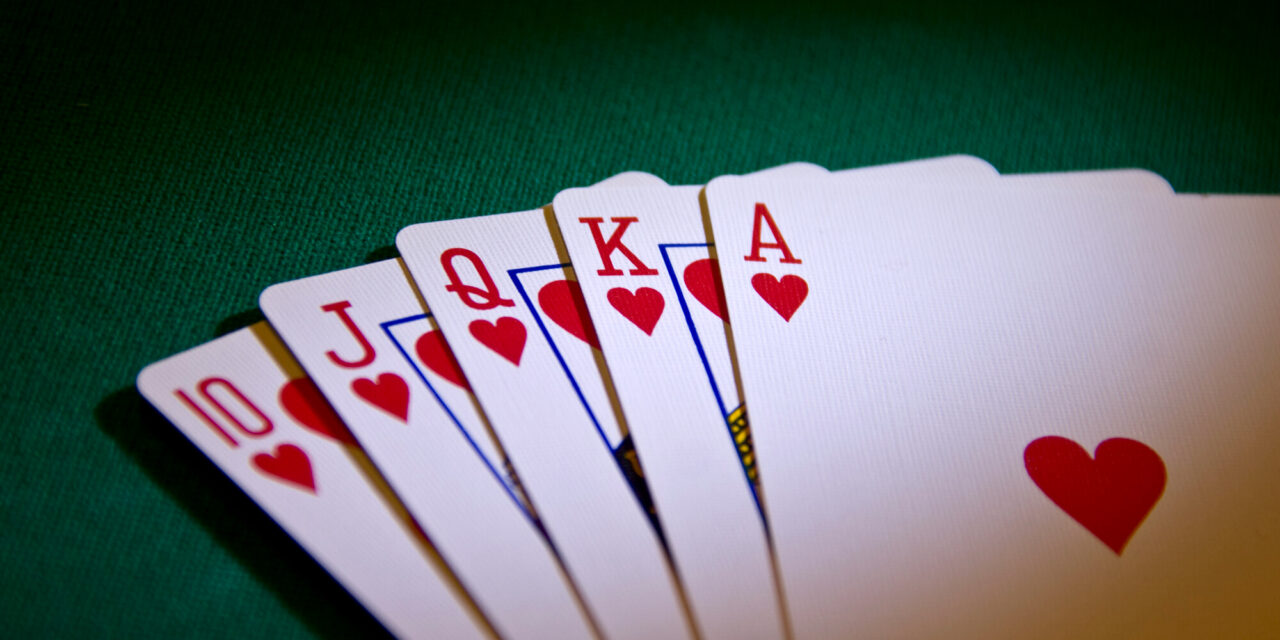
A royal flush poker is A-K-Q-J-10 all of the same suit. It’s the highest possible hand in standard poker: technically the best straight flush, it beats every other hand and can only tie another royal flush. There are just four of them, one per suit.
The royal flush in brief
- Cards: ace, king, queen, jack and ten, all spades, all hearts, all diamonds or all clubs.
- Rank: first of the ten poker hands; nothing beats it.
- Odds in five cards: 1 in 649,740.
- Odds by the river in Texas Hold’em: 1 in 30,940.
- Suits are equal, so two royal flushes split the pot.
- A-K-Q-J-10 in mixed suits is only a straight, not a royal flush.
Every poker player knows the royal flush, and most have never made one. It’s the hand at the top of every ranking chart and the one that video poker machines and cardroom promotions pay the most for. It’s also surrounded by more confusion than its simple definition suggests: players mistake Broadway straights and ace-high flushes for royals, overestimate how often they’ll make one, and chase royal flush draws that are worth far less than they look.
This guide covers the royal flush completely. It starts with the definition and the rules that decide whether a hand counts, then gives the exact odds: in five cards, by each street in Texas Hold’em, for every type of starting hand, at a full table and in Omaha, Short Deck, Seven Card Stud, draw poker and video poker. After that come worked examples, how to play a royal flush and a royal flush draw, what happens at showdown, the most common mistakes, a short quiz and a quick-reference summary.
Every probability was calculated exactly by the TopSitesPoker.com editorial team, by counting every possible combination of cards, and checked with a hand evaluator. The video poker figures we didn’t calculate ourselves, the Jacks or Better royal flush frequency and overall return and the Deuces Wild pay table, are sourced from the Wizard of Odds.
Key takeaways
- Your starting hand decides your chances. With two suited royal cards, such as A♠ K♠, you’ll make a royal flush by the river about once in 1,955 hands; with no royal cards, only when the board itself is a royal flush, about once in 529,690.
- Almost half of all Hold’em royal flushes (47.8%) come from the 3% of starting hands that hold two suited royal cards.
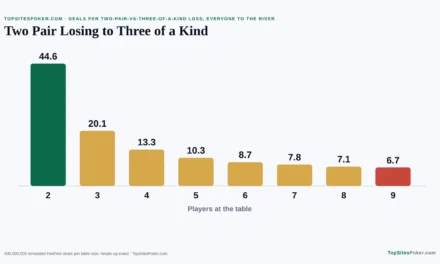
- At a nine-handed table where everyone saw the river, someone would have a royal flush about once in 3,590 deals.
- A royal flush draw on the flop has one royal out: 4.3% by the river. The flush and straight outs that come with it are what make the draw worth playing.
- Two players can never hold royal flushes in different suits in Hold’em. The only way two royals meet is when the royal flush is on the board, and then everyone splits.
What Is a Royal Flush?
A royal flush is five cards in a row, all of the same suit, running from the ten up to the ace: A-K-Q-J-10. It combines the two patterns that define poker’s strongest hands. It’s a straight, because the five ranks are consecutive, and it’s a flush, because all five cards share a suit. And it’s the highest version of that combination, because the ace is the highest card in the deck.
There are exactly four royal flushes, one in each suit:
| Suit | The royal flush | How it’s announced |
|---|---|---|
| Spades | A♠ K♠ Q♠ J♠ 10♠ | “Royal flush in spades” |
| Hearts | A♥ K♥ Q♥ J♥ 10♥ | “Royal flush in hearts” |
| Diamonds | A♦ K♦ Q♦ J♦ 10♦ | “Royal flush in diamonds” |
| Clubs | A♣ K♣ Q♣ J♣ 10♣ | “Royal flush in clubs” |
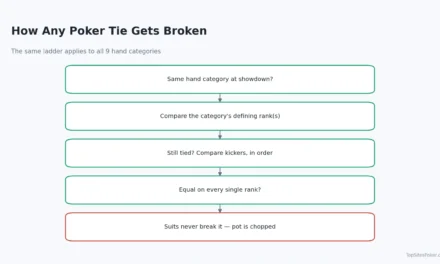
All four are exactly equal. No suit ranks above another in standard poker, so a royal flush in spades doesn’t beat a royal flush in clubs; two royal flushes would split the pot.
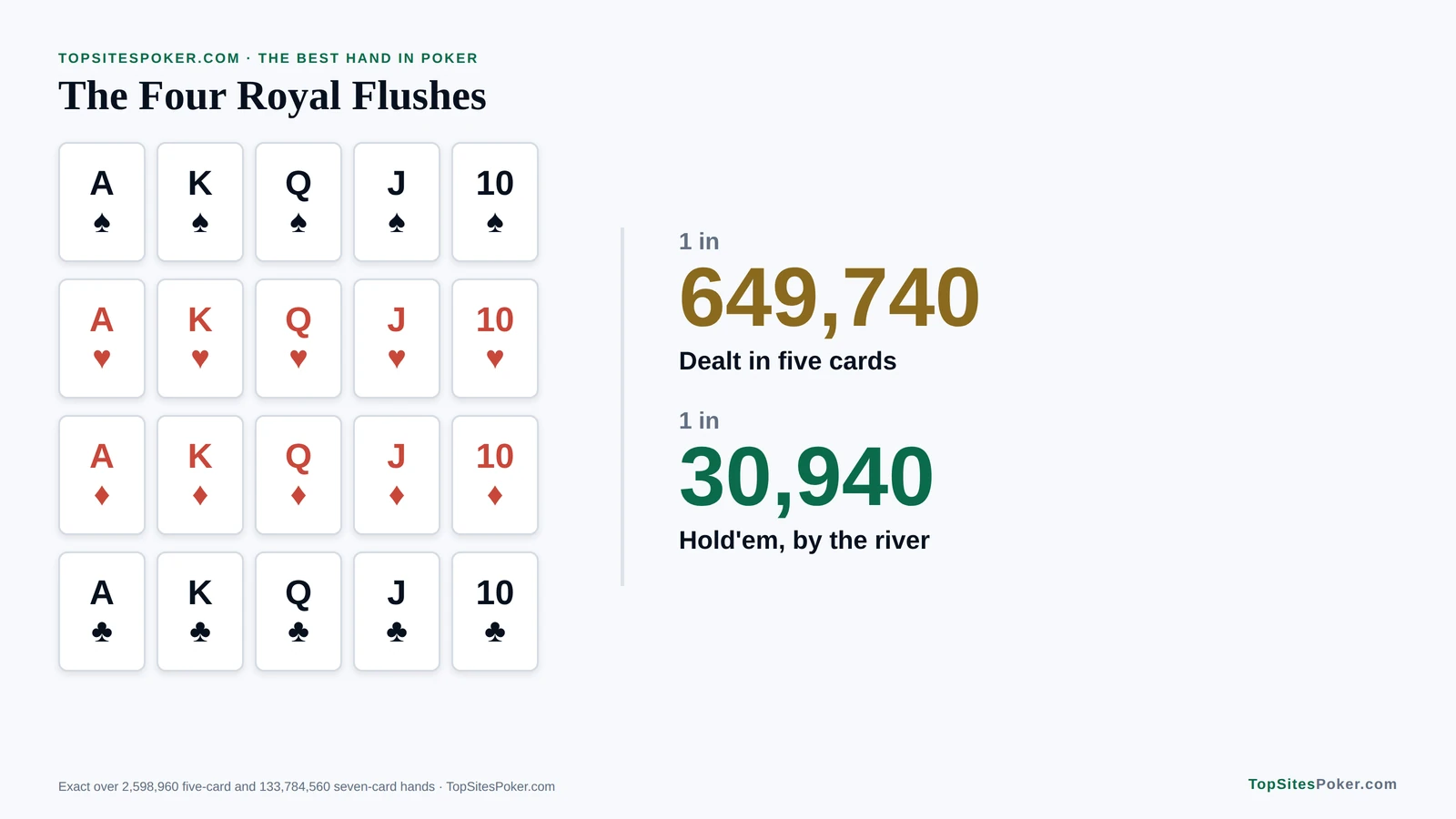
Four royal flushes exist, and all four are equal.
Where it sits in the hand rankings
The royal flush is first of the ten poker hands, above the straight flush, four of a kind, full house, flush, straight, three of a kind, two pair, one pair and high card. Strictly speaking, it isn’t a separate kind of hand at all: it’s the highest possible straight flush. Straight flushes are ranked by their top card, so an ace-high straight flush beats a king-high one, and the ace-high straight flush has its own name. Most charts list it separately because it’s the best hand in the game and a hand players want to talk about.
That has two consequences worth knowing:
- A royal flush can’t be beaten. Whatever your opponents hold, no standard poker hand is higher. In Hold’em, if you make a royal flush with at least one of your hole cards, you have the only one, and you win the whole pot.
- It can only tie. The only way a royal flush doesn’t win outright is if another player has one too, and in Hold’em that can happen only when the royal flush is on the board, shared by everyone still in the hand.
Why “royal”?
The name is usually explained by the cards it contains: the king, queen and jack are the court or “royal” cards, and the royal flush is the only straight flush made up of all three together with the ace. The term means the same thing in every standard form of the game. Players also call it simply “a royal” or “the royal.”
A royal flush is always the nuts
The nuts is the best possible hand on a given board. Because nothing beats a royal flush, holding one means you hold the nuts, with no exceptions and no need to worry about what else the board allows. That’s rare in poker. Even four of a kind can lose to a straight flush, and a straight flush can lose to a higher one. Other hands can be the nuts on a particular board, but a royal flush is the only hand that’s the nuts on every board.
Royal Flush Rules: What Counts and What Doesn’t
A hand is a royal flush only if all of these are true of the five cards that make up your hand:
- They’re all the same suit. One off-suit card turns it into a straight.
- They’re the ace, king, queen, jack and ten. Nothing else, and no card repeated.
- They’re five of your best five cards. In Hold’em, the five can come from your two hole cards and the board in any mix; in Omaha, exactly two must come from your hand and three from the board.
That’s the whole rule. Everything else about the royal flush follows from the general poker rules: only your best five cards count, suits don’t rank, and cards speak at showdown, so a royal flush wins even if you don’t announce it, as long as you turn your cards face up.
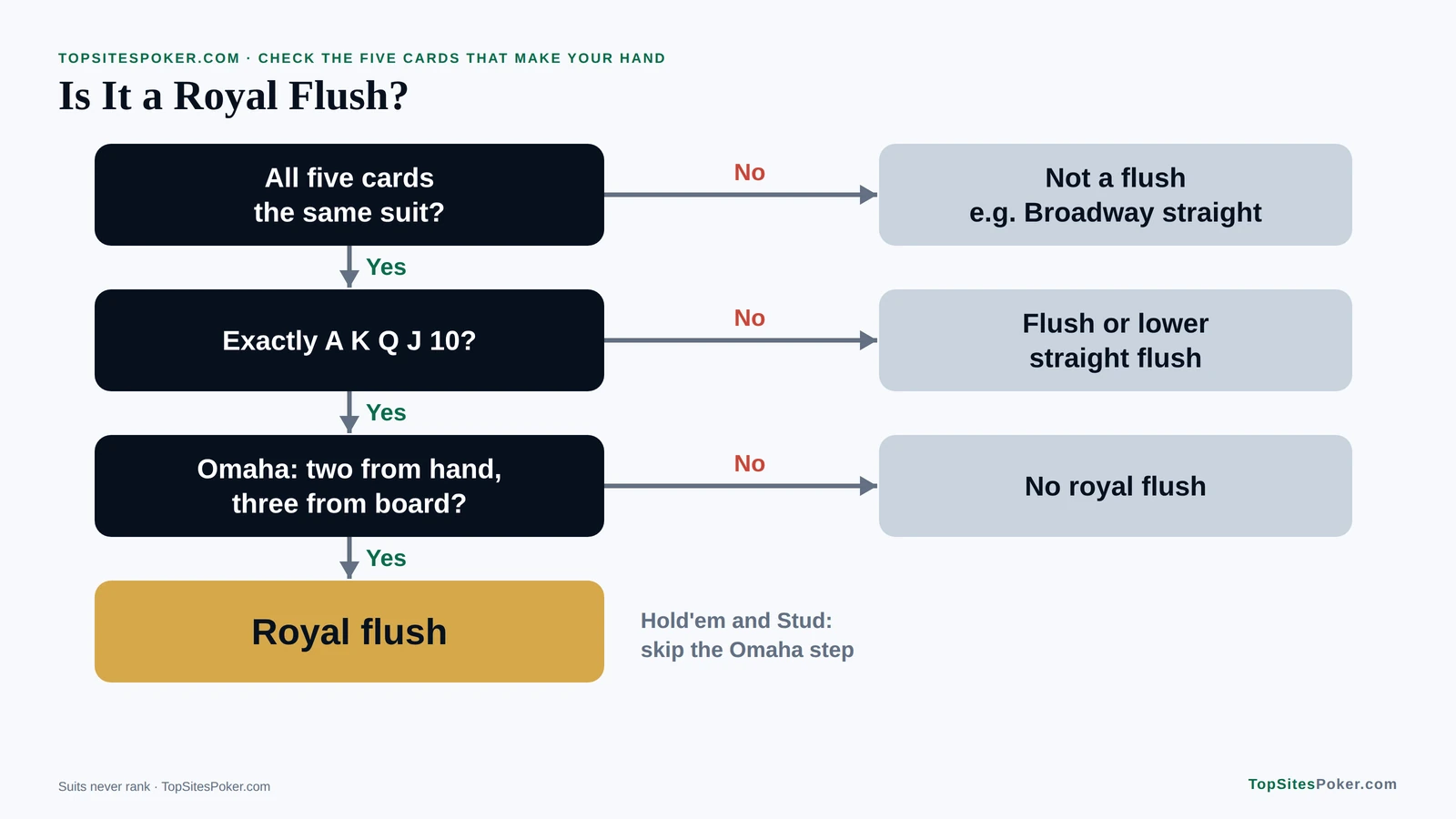
A single card of another suit, or one wrong rank, and it isn’t a royal flush.
Is it a royal flush? Twelve hands that look close
| Cards | Royal flush? | What it actually is |
|---|---|---|
| A♠ K♠ Q♠ J♠ 10♠ | Yes | The royal flush in spades |
| A♠ K♥ Q♠ J♠ 10♠ | No | An ace-high straight (Broadway), because one card is a heart |
| K♠ Q♠ J♠ 10♠ 9♠ | No | A king-high straight flush, the second-best hand in poker |
| A♠ K♠ Q♠ J♠ 9♠ | No | An ace-high flush; the 9 breaks the sequence |
| Q♠ K♠ A♠ 2♠ 3♠ | No | An ace-high flush; a straight can’t wrap around the ace |
| A♠ 2♠ 3♠ 4♠ 5♠ | No | A five-high straight flush, the lowest straight flush |
| Hold’em: A♠ K♠ in hand, Q♠ J♠ 10♠ on the board | Yes | A royal flush using both hole cards |
| Hold’em: 10♥ 4♣ in hand, A♥ K♥ Q♥ J♥ 3♠ on the board | Yes | A royal flush using one hole card |
| Hold’em: A♦ K♦ Q♦ J♦ 10♦ on the board | Yes, for everyone | Every player still in the hand plays the board and splits |
| Omaha: A♥ 9♣ 7♣ 2♦ in hand, K♥ Q♥ J♥ 10♥ 3♣ on the board | No | You must use two hole cards; with only one heart in hand, the best hand is ace-high |
| Wild-card game: A♠ K♠ Q♠ J♠ and a joker | Depends on the rules | Usually counted as a royal flush, but some games and video poker machines treat a “wild royal” as lower than a natural one |
| Deuce-to-seven lowball: A♠ K♠ Q♠ J♠ 10♠ | Irrelevant | In a game where the lowest hand wins and flushes count, it’s the worst possible hand |
Each hand was checked with a hand evaluator by TopSitesPoker.com.
The second, third and fourth rows are the ones that cause real confusion at the table. Broadway in mixed suits looks like a royal flush at a glance, especially when two of the cards are the same color but different suits, such as the A♥ and A♦. A king-high straight flush is a magnificent hand, but it’s one step below. And an ace-high flush with four royal cards is just a flush: strong, but beatable by any full house.
Royal Flush Odds
How rare is a royal flush? It depends on how many cards you get to choose from. The more cards, the more ways to find the five you need. Here are the exact odds for the situations players ask about most:
| Situation | Royal flushes possible | Probability | About once in |
|---|---|---|---|
| Dealt five cards (Five Card Draw before the draw) | 4 of 2,598,960 hands | 0.000154% | 649,740 hands |
| Texas Hold’em, by the flop (your 2 cards + 3) | 4 of 2,598,960 | 0.000154% | 649,740 hands |
| Texas Hold’em, by the turn (6 cards) | 188 of 20,358,520 | 0.000923% | 108,290 hands |
| Texas Hold’em, by the river (7 cards) | 4,324 of 133,784,560 | 0.0032% | 30,940 hands |
| Seven Card Stud (7 cards) | 4,324 of 133,784,560 | 0.0032% | 30,940 hands |
| Omaha, by the river (4 hole cards, exactly 2 used) | 42,807,600 of 463,563,500,400 | 0.0092% | 10,829 hands |
| Short Deck, five cards (36-card deck) | 4 of 376,992 | 0.00106% | 94,248 hands |
| Short Deck Hold’em, by the river (7 cards) | 1,860 of 8,347,680 | 0.0223% | 4,488 hands |
| Jacks or Better video poker, optimal strategy | Sourced figure | about 0.0025% | about 40,000 hands |
All figures are exact counts by TopSitesPoker.com, except video poker, which is the published figure for full-pay 9/6 Jacks or Better with optimal strategy (Wizard of Odds). Hold’em and Stud figures assume the hand is played to the end.
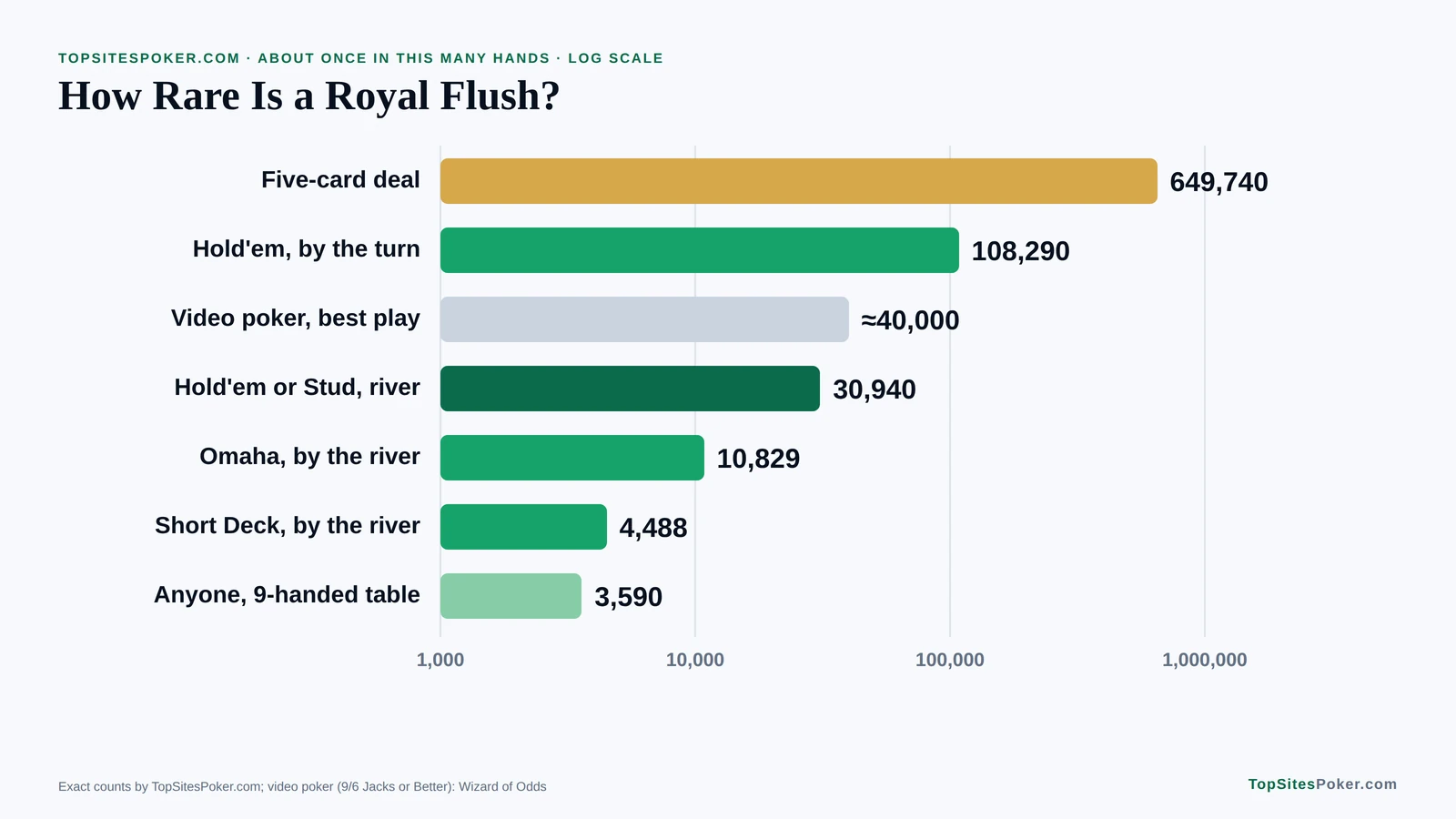
The more cards you choose from, the more often the royal flush appears. Log scale.
Why seven cards help so much (Royal Flush Poker)
With five cards, you need exactly the five royal cards of one suit: four possible hands out of 2,598,960. With seven cards, you need those five plus any two others, and there are 1,081 ways to choose the other two from the remaining 47 cards. So each royal flush can appear in 1,081 different seven-card hands, and there are 4,324 in total. That’s why a royal flush is 21 times more likely by the river in Hold’em than in a five-card deal: 1 in 30,940 against 1 in 649,740.
Omaha gives each player four hole cards, and although only two of them can be used, the extra cards make a royal flush almost three times as likely as in Hold’em: once in about 10,829 hands that reach the river. Short Deck is more generous still. With only nine cards in each suit, the royal cards make up a much larger share of the deck, and a Short Deck Hold’em player makes a royal flush by the river about once in 4,488 hands.
Put in perspective
If you played 30,940 Hold’em hands to the river, you’d expect one royal flush, but “expect” hides a lot of variation. The chance of making at least one royal flush in 30,940 hands is 63.2%, not 100%, and some players will make two or three in that time while others make none. The next sections show how those odds break down street by street, for different starting hands and at a full table.
Royal Flush Odds by Starting Hand
The 1 in 30,940 figure is an average over every possible Hold’em starting hand. In reality, your two hole cards decide almost everything. A royal flush needs five specific cards, and every royal card you already hold is one fewer the board has to deliver. We counted every starting hand against every possible five-card board:
| Your starting hand | Example | Share of all starting hands | Royal flush by the river | Share of all royal flushes |
|---|---|---|---|---|
| Two royal cards of the same suit | A♠ K♠, Q♥ 10♥ | 3.0% (40 combinations) | 1 in 1,955 | 47.8% |
| Two royal cards of different suits, including pairs | A♠ K♥, J♣ J♦ | 11.3% (150) | 1 in 22,540 | 15.5% |
| One royal card | A♠ 7♦, 10♣ 4♣ | 48.3% (640) | 1 in 43,240 | 34.5% |
| No royal cards | 9♠ 8♠, 7♦ 2♣ | 37.4% (496) | 1 in 529,690 | 2.2% |
| All hands | 100% (1,326) | 1 in 30,940 | 100% |
Exact counts over all 2,118,760 boards for each starting hand. “Royal cards” are the ace, king, queen, jack and ten. Each figure includes the rare boards that are a royal flush on their own. Calculated by TopSitesPoker.com.
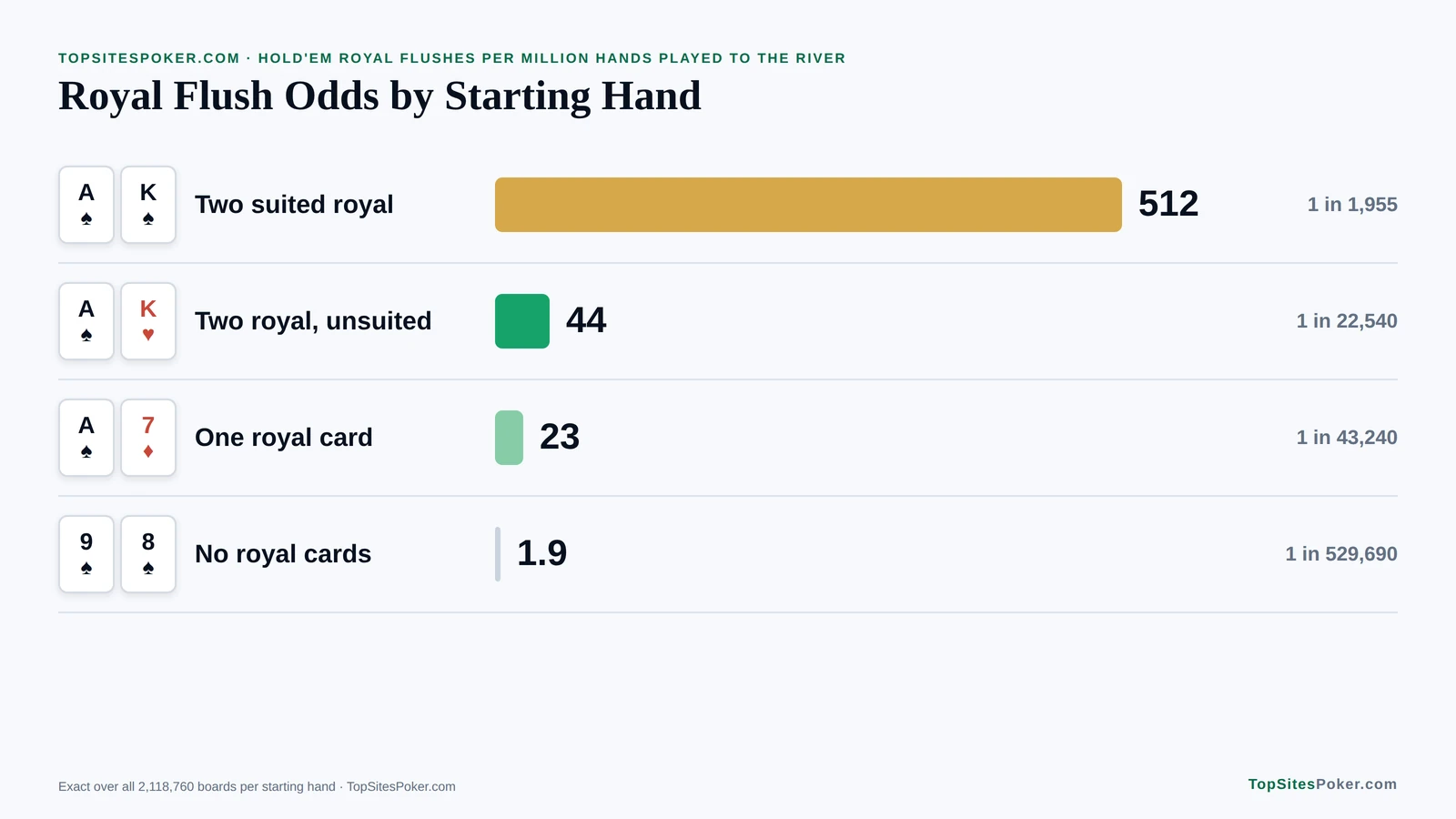
Two suited royal cards make a royal flush more than 11 times as often as any other starting hand type.
The gap is enormous. With two suited royal cards, the board only has to bring three specific cards, and your chance is about 1 in 1,955. With two royal cards of different suits, each suit still needs four specific board cards, so your chance drops more than elevenfold, to 1 in 22,540. With one royal card it halves again, and with no royal cards at all you can only share a royal flush that appears on the board by itself, about once in 529,690 hands.
Notice the pocket pairs in the second row. A♠ A♥ holds two royal cards, but only one of each suit, so it needs four specific board cards for either royal flush. For royal flush purposes, a pair of aces is no better than A♠ K♥, and much worse than A♠ K♠.
Street by street with A♠ K♠
Take the best starting hand for a royal flush, two suited royal cards. Here’s how the odds develop as the board comes out:
| Stage | What you need | Chance | About once in |
|---|---|---|---|
| Flop a royal flush | Q♠ J♠ 10♠ exactly | 0.0051% | 19,600 flops |
| Flop a royal flush draw (four to the royal) | Exactly two of Q♠, J♠, 10♠ | 0.72% | 139 flops |
| Complete it from a flop draw by the river | The one missing card, on the turn or river | 4.26% | 23.5 hands |
| Complete it from a turn draw | The one missing card, on the river | 2.17% | 46 hands |
| Complete it from a flop with one royal card | Both missing cards, on the turn and river | 0.093% | 1,081 hands |
| Royal flush by the river, any route | Q♠ J♠ 10♠ among the five board cards | 0.051% | 1,955 hands |
Exact. The last row also includes the three boards that are a royal flush in another suit. Calculated by TopSitesPoker.com.
The biggest step is the flop. Before it, A♠ K♠ has about a 1 in 1,955 shot. After a flop with two more royal spades, it’s 1 in 23.5 with two cards to come. That’s still a long shot, but it’s a real one, and it’s how most of this hand’s royal flushes arrive: of A♠ K♠’s royal flushes in spades, 60% come from a flop with four to the royal, 30% from a flop with one more royal card followed by a runner-runner turn and river, and only 10% are flopped outright.
Where Royal Flushes Come From
Turn the question around and ask: of all the royal flushes made in Texas Hold’em, how are they made? Counting every combination of two hole cards and five board cards gives a clear answer.
| How the royal flush is made | Share of all Hold’em royal flushes |
|---|---|
| Using both hole cards (three royal cards on the board) | 47.6% |
| Using one hole card (four royal cards on the board) | 47.6% |
| Using no hole cards (the royal flush is on the board) | 4.8% |
Exact counts over all 2,809,475,760 combinations of two hole cards and five board cards; 90,804 of them contain a royal flush. Calculated by TopSitesPoker.com.
The first two rows are exactly equal, and not by chance: per suit, there are 10,810 ways to make a royal flush with two hole cards and exactly 10,810 ways with one, because 10 × 1,081 and 5 × 47 × 46 are the same number. And fewer than one royal flush in 20 is a board royal that every player shares.
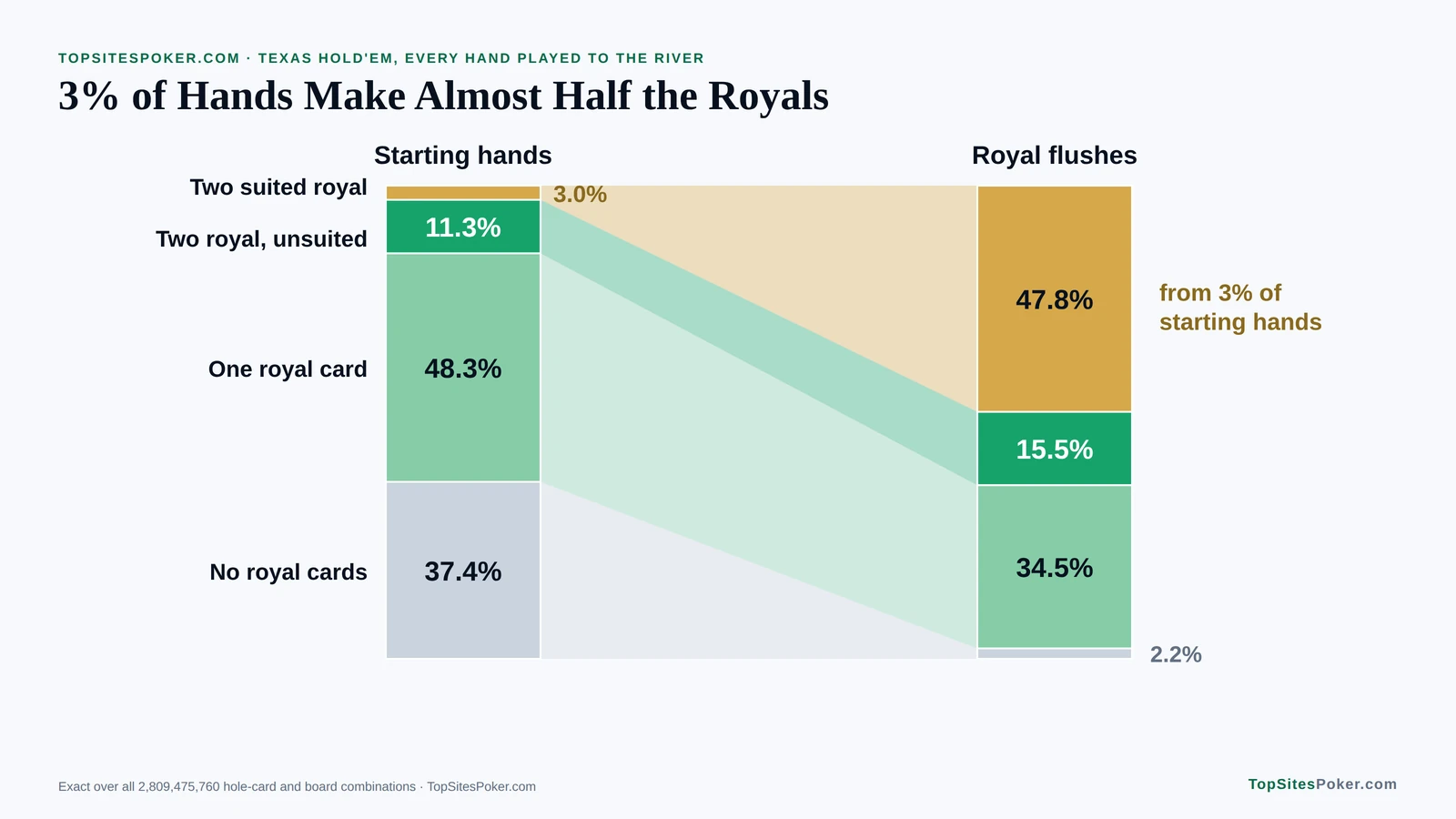
Hands with no royal cards are 37% of starting hands but share only 2.2% of royal flushes, all on the board.
You only make royal flushes with the hands you play
The starting-hand figures in the previous section lead to a practical point. A royal flush can only happen if you’re still in the hand, and good players fold most of their hands before the flop. How much does folding cost you in royal flushes? Suppose you only ever play certain hands, and always see the river with them:
| If you only play | Share of hands played | Share of all royal flushes you can still make | Royal flushes per hand dealt |
|---|---|---|---|
| Two suited royal cards | 3.0% | 47.8% | 1 in 64,794 |
| Any two royal cards | 14.3% | 63.3% | 1 in 48,894 |
| Any hand with at least one royal card | 62.6% | 97.8% | 1 in 31,631 |
| Every hand | 100% | 100% | 1 in 30,940 |
Exact. “Royal flushes per hand dealt” counts every hand you’re dealt, including the ones you fold. Calculated by TopSitesPoker.com.
A player who plays only the 3% of hands with two suited royal cards still has a shot at almost half of all royal flushes. (The 47.8% is a touch higher than the 47.6% of royal flushes that use both hole cards, because it also counts the rare board royal flushes these hands share.) That’s one reason suited broadway hands such as A-K, K-Q and Q-J suited feel “lucky”: they make the biggest hand in poker far more often than their small share of starting hands suggests. It’s also a reminder that you’ll never make the royal flushes you’d have made with 9-3 offsuit, and you shouldn’t want to: with no royal cards, the only royal flush you can have is one on the board, and you’d split it.
Of course, real players don’t see the river with every hand they play. They fold on the flop or turn when they miss, and a hand that would have made a runner-runner royal flush is often folded before the turn. So in practice, royal flushes arrive somewhat more slowly than these figures suggest, which is part of why they feel so rare.
How Long You’ll Wait for a Royal Flush
Averages are misleading for rare events. “One in 30,940” doesn’t mean you’ll make a royal flush after exactly 30,940 hands; each hand is independent, and the royal flush has no memory of how long it’s been. Here’s the chance of making at least one royal flush in Texas Hold’em, if every hand is played to the river:
| Hands played to the river | Chance of at least one royal flush |
|---|---|
| 1,000 | 3.2% |
| 5,000 | 14.9% |
| 10,000 | 27.6% |
| 20,000 | 47.6% |
| 21,446 | 50.0% |
| 30,940 | 63.2% |
| 50,000 | 80.1% |
| 100,000 | 96.1% |
Chance = 1 − (30,939 ÷ 30,940) raised to the number of hands. Calculated by TopSitesPoker.com.
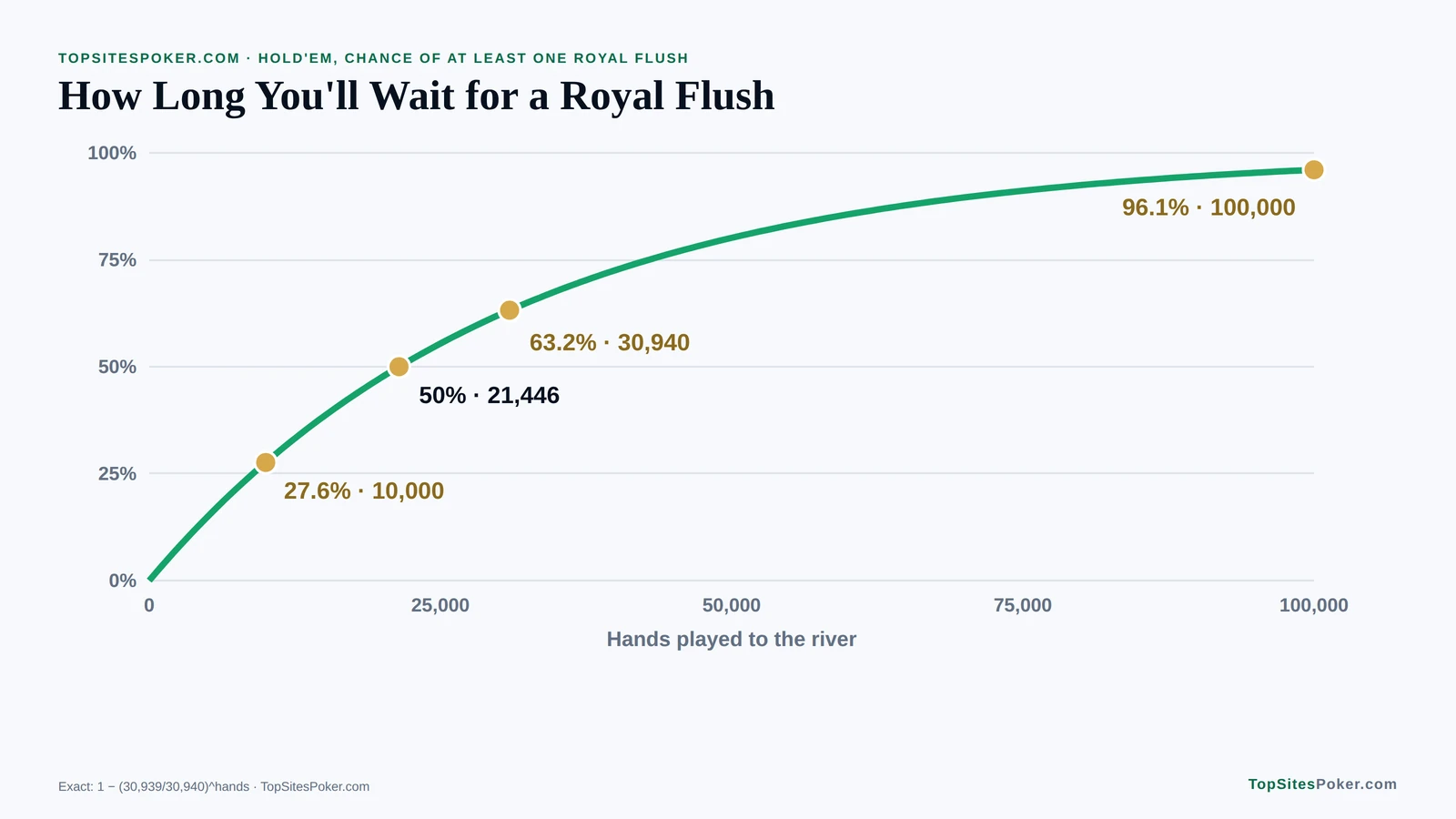
Even after 100,000 hands to the river, about one player in 25 still hasn’t made one.
Three things stand out. First, the halfway point is about 21,446 hands, well short of the 30,940 average, because a few players wait a very long time and pull the average up. Second, even after the average number of hands, more than a third of players (36.8%) still haven’t made one. Third, even 100,000 hands to the river, a huge amount of poker, leaves about one player in 25 without a royal flush.
In real games the wait is longer, because you fold most hands and don’t see the river with the rest. A player who is dealt a few hundred thousand hands over years of regular play may make only a handful of royal flushes, and some serious players go years without one. That’s normal variance, not bad luck in any meaningful sense.
Why royal flushes don’t come in streaks, and do
Because every deal is independent, making a royal flush doesn’t make the next one any less likely. The chance that any two particular hands are both royal flushes is the same whether they’re back to back or a year apart, and the chance of a royal flush on your next hand is always 1 in 30,940. Two royal flushes in one night are rare for any one player, but with so many hands dealt around the world, coincidences like that are bound to happen to someone.
A Royal Flush at the Table: How Often Someone Has One
Your chance of making a royal flush is 1 in 30,940 per hand played to the river. But the chance that someone at the table has one is much higher, because every player has a chance. Counting every possible deal gives a neat formula: with N players all seeing the river, the chance that at least one of them has a royal flush is 4 × (1 + 20N) out of 2,598,960.
| Players seeing the river | Someone has a royal flush, about once in |
|---|---|
| 1 | 30,940 deals |
| 2 (heads-up) | 15,847 deals |
| 3 | 10,651 deals |
| 4 | 8,021 deals |
| 6 | 5,370 deals |
| 8 | 4,036 deals |
| 9 | 3,590 deals |
| 10 | 3,233 deals |
Exact. Includes royal flushes on the board, which count once no matter how many players share them. Calculated by TopSitesPoker.com.
The formula shows where the royal flushes come from. The “1” is the board royal, which is the same no matter how many players there are. The “20N” grows with each player, because each extra player brings another two hole cards that could complete a royal flush with three or four royal cards on the board. At a full nine-handed table where every player saw the river, somebody would make a royal flush about once every 3,590 deals. Real tables see far fewer royal flushes, because most players fold before the river.
Two royal flushes in one hand
Can two players both have a royal flush? In Texas Hold’em, only if it’s the same royal flush on the board. Two royal flushes in different suits would need at least three board cards of each suit, which is six cards, and the board only has five. And two players can’t make the same royal flush with their own cards, because each royal card exists only once. So in Hold’em:
- If you make a royal flush using at least one of your hole cards, nobody else can have one.
- If the royal flush is on the board, everyone still in the hand has it, and the pot is split among them.
In Omaha the same logic holds: each royal flush needs three board cards, so two different royal flushes can’t appear on one board. In games without community cards, such as Seven Card Stud, two players could in principle each hold a royal flush in different suits, since each uses only their own cards, but it’s so unlikely that most players will never see it.
Royal Flush Draws: What They’re Really Worth
A royal flush draw is four cards to a royal flush with a card or two still to come, such as A♠ K♠ on a flop of Q♠ J♠ 4♦. It’s one of the most exciting draws in poker, and one of the most misunderstood. There’s exactly one card in the deck that completes the royal flush. What makes the draw strong isn’t the royal flush; it’s all the other cards that complete a flush or a straight.
| Situation | Example | Royal flush outs | All outs to a straight or better | Royal flush by the river | Straight or better by the river |
|---|---|---|---|---|---|
| Flop: four to the royal, plus a gutshot straight draw | A♠ K♠ on Q♠ J♠ 4♦ | 1 (10♠) | 12 | 4.3% | 45.0% |
| Flop: four to the royal, plus an open-ended straight draw | K♠ Q♠ on J♠ 10♠ 3♦ | 1 (A♠) | 15 | 4.3% | 54.1% |
| Turn: four to the royal, plus a gutshot | A♠ K♠ on Q♠ J♠ 4♦ 7♣ | 1 (10♠) | 12 | 2.2% | 26.1% |
| Flop: three to the royal (backdoor) | A♠ K♠ on Q♠ 8♥ 3♦ | Needs J♠ and 10♠ | — | 0.09% (1 in 1,081) | — |
Exact counts over every possible turn and river, checked with a hand evaluator by TopSitesPoker.com. In the second row, the 9♠ gives a king-high straight flush and the A♠ the royal flush; the other seven spades give a flush and six non-spade aces and nines give a straight.
How to value a royal flush draw
Count the draw for what it is. A♠ K♠ on Q♠ J♠ 4♦ is a flush draw (9 outs, including the 10♠) plus a gutshot to Broadway (three more tens), for 12 clean outs and a 45% chance of making at least a straight by the river. The royal flush is a bonus that arrives 4.3% of the time. Decide whether to call a bet by comparing the 45% (or 26.1% with one card to come) with the pot odds, exactly as you would with any other combination draw. Don’t pay extra because the draw has a royal flush in it.
That doesn’t make these draws weak. With 12 or 15 outs, a royal flush draw is often a favorite, or close to even, against a single pair when there are two cards to come, which is why strong players frequently bet or raise with them rather than just calling. On Q♠ J♠ 4♦, A♠ K♠ has 57.9% equity against Q♥ 10♣ (top pair) with two cards to come, but only 33.8% against a set of fours, which can still improve to a full house. And when the draw comes in, the hand is usually the nuts or close to it, so it can win a big pot.
When someone else has the royal flush draw
If the board shows three or four cards to a royal flush in one suit, think about who could hold the rest. With A♥ K♥ Q♥ on the board, a player holding J♥ 10♥ already has a royal flush; once a fourth heart arrives, anyone holding a single heart has a flush. A board with four royal cards of one suit means a single card, the missing royal card, gives someone the best possible hand. It’s rare, but when that card is the one you’re afraid of, you’re afraid of exactly one card, and the odds that a particular opponent holds it are low.
The Royal Flush in Other Games
The royal flush is the top hand in every standard high-hand poker game, but the odds and a few rules change from game to game.
Omaha
Omaha players get four hole cards and must use exactly two of them with exactly three board cards. For a royal flush, that means you need exactly two royal cards of one suit in your hand and the other three on the board. Counting every combination, an Omaha player makes a royal flush by the river about once in 10,829 hands, almost three times as often as in Hold’em. Two consequences of the two-card rule:
- A royal flush on the board doesn’t play for anyone. With A♦ K♦ Q♦ J♦ 10♦ on the board, you can use only three of those cards, and the two royal diamonds you’d need from your hand are already on the board. Nobody has a royal flush.
- Four royal cards on the board make a royal flush impossible. With K♥ Q♥ J♥ 10♥ on the board, the only royal heart left is the A♥, and one royal card in your hand isn’t enough, because you need exactly two. A player holding the A♥ and any other heart has an ace-high flush at best, unless their other cards make a lower straight flush.
Short Deck (6+ Hold’em)
Short Deck removes the 2s through 5s, leaving 36 cards, but keeps all 20 royal cards. With a larger share of the deck made up of royal cards, the royal flush becomes far more common: 1 in 94,248 five-card hands, and about once in 4,488 hands played to the river, nearly seven times as often as in regular Hold’em. It’s still the best hand in the game.
Seven Card Stud
Each Stud player makes the best five-card hand from seven cards of their own, so the odds are the same as Hold’em by the river: 1 in 30,940 for a player who stays to the end. The difference is what you can see. Four of each opponent’s cards are dealt face up, so a player showing, say, K♣ Q♣ J♣ on board can be read for a possible royal flush, and the cards you can see in other players’ hands tell you whether the cards they need are still live.
Five Card Draw
In draw poker, you’re dealt five cards, then you can exchange some of them. The chance of being dealt a royal flush is 1 in 649,740. Drawing improves it only when you already hold most of it: with four cards to a royal flush, drawing one card completes it 1 time in 47 (2.1%); with three to a royal, drawing two completes it 1 time in 1,081.
Video poker
In video poker, the royal flush is the hand the whole pay table is built around. On a standard full-pay Jacks or Better machine, a royal flush pays 800 for 1 when you bet the maximum five coins, 4,000 coins in all, while most machines pay much less per coin (commonly 250 for 1) if you bet fewer coins, which is why players are advised to bet the maximum. With optimal strategy, a royal flush comes about once in 40,000 hands on that game, and it supplies about 2 percentage points of the game’s 99.5% long-run return.
Wild-card video poker makes the distinction between natural and wild royal flushes explicit. On full-pay Deuces Wild, a natural royal flush, made without any deuces, pays 800 for 1 at maximum coins, while a “wild royal” made with a deuce pays only 25 for 1.
Home games with wild cards
In home games with jokers or deuces wild, a royal flush can be completed with a wild card, and five of a kind becomes possible. Most house rules rank five of a kind above a royal flush, and some rank a natural royal flush above a wild one. There’s no single standard, so agree before the first deal.

Royal Flush Examples
The examples below show the three ways a royal flush is made in Texas Hold’em, three hands that come close without making it, and how the rules change the picture in Omaha, Seven Card Stud and Five Card Draw. Every hand was checked with a hand evaluator.
Example 1: using both hole cards
You hold A♠ K♠. The flop is Q♠ J♠ 4♦, giving you a royal flush draw with a flush draw and a gutshot straight draw behind it. The turn is the 7♣, and the river is the 10♠. Your five cards are A♠ K♠ Q♠ J♠ 10♠: a royal flush, using both hole cards and three board cards.
Your opponent holds Q♥ 10♣. They flopped top pair and made two pair, queens and tens, on the river, a hand strong enough to call a big bet. Because you used both hole cards, nobody else can have a royal flush, and no other hand can tie you. It’s how a hand like A♠ K♠ makes almost all of its royal flushes, and it’s the kind of hand that wins a big pot, because the card that completes your royal flush also improves your opponent’s hand.
Example 2: using one hole card
You hold K♣ 10♥ in the big blind. The board runs out A♥ K♥ Q♥ J♥ 3♠. Your 10♥ completes the royal flush in hearts with the four board hearts; your K♣ plays no part.
This is how almost half of all Hold’em royal flushes are made, and the board is much scarier than in the first example. Four hearts are showing, so any opponent holding a single heart has a flush, and anyone holding a ten has Broadway. An opponent with 5♥ 5♣, for example, has an ace-high flush. That’s good news: when your royal flush uses only one hole card, the board often gives your opponents a big hand too, and they’re likely to pay you off.
Example 3: the royal flush on the board
The board is A♦ K♦ Q♦ J♦ 10♦. Every player still in the hand has a royal flush, whatever they hold, and the pot is split among them. Your hole cards are irrelevant, even the 9♦, because your best five cards are the board. If you’re the only player left, you win the pot, but you’d have won it with any two cards.
Three near misses
| Your cards | Board | What you have | Why it isn’t a royal flush | Can anyone beat it? |
|---|---|---|---|---|
| A♠ K♠ | Q♠ J♠ 10♥ 7♥ 2♦ | Broadway (ace-high straight) | The ten is a heart | No; another A-K ties |
| K♣ 7♦ | Q♣ J♣ 10♣ 9♣ 2♥ | King-high straight flush | The top card is a king, not an ace | No; the only hand that could is the royal flush in clubs, and it needs the K♣ you’re holding |
| A♥ Q♥ | K♥ J♥ 9♥ 4♠ 2♣ | Ace-high flush | The 9♥ breaks the sequence; you need the 10♥ | No; with no pair on the board and no straight flush possible, it’s the nuts |
Each hand checked against every possible opponent holding with a hand evaluator by TopSitesPoker.com.
All three are the best possible hand on their boards, which is the point. You don’t need a royal flush to hold the nuts; you need the best hand the board allows. The king-high straight flush is a neat case: it’s the nuts only because you hold the K♣, which any royal flush in clubs would need along with the A♣. An opponent holding the A♣ has just an ace-high flush.
Omaha: the royal flush and the trap
You hold A♥ K♥ 7♣ 2♦ and the board is Q♥ J♥ 10♥ 5♠ 3♣. You use exactly two hole cards, A♥ K♥, and exactly three board cards, Q♥ J♥ 10♥: a royal flush.
Now change the hand. You hold A♥ 9♣ 7♣ 2♦ and the board is K♥ Q♥ J♥ 10♥ 3♣. A Hold’em player would see a royal flush at once. In Omaha, you have ace-high. You’d have to use four board cards with your ace, and you’re only allowed three. You can’t even make a straight: A-K-Q-J-10 needs four board cards, and K-Q-J-10-9 needs four too. This is one of the most expensive misreads in Omaha, and it’s worth checking every time four cards of a suit hit the board.
Seven Card Stud: live cards decide
You’re dealt A♠ K♠ as your two down cards and the Q♠ face up, three cards to a royal flush. With four cards still to come, you need both the J♠ and the 10♠. Counting only your own three cards as seen, the chance that both arrive in your next four cards is 1 in 196, about 0.5%. If either card is showing in an opponent’s hand, your royal flush chance is zero, though your flush and straight chances are still worth counting. That’s the Stud skill in a nutshell: watch the up cards, because a card you can see in someone else’s hand is a card you can’t get.
Five Card Draw: one card away
You’re dealt A♠ K♠ Q♠ J♠ 7♦. Throw away the 7♦ and draw one card, and 1 of the 47 cards you haven’t seen is the 10♠: a 2.1% chance of a royal flush. Another 8 spades give you a flush and 3 more tens give you a straight, so you’ll make a straight or better with 12 of the 47 cards, about 25.5% of the time.
How to Play a Royal Flush
A royal flush removes the usual worry of poker: you can’t lose the hand. The only question left is how to win the most chips with it, and the answer depends on what your opponents are likely to hold, which depends on the board. There’s no need to bet to protect your hand, because no card can beat you. Every decision is about value.
When you flop a royal flush
Flopping a royal flush is the rarest version of the hand, and the flop itself is a warning sign to your opponents: three suited broadway cards. Here’s what a single opponent could be holding on that flop, counted over every possible two-card hand:
| Opponent’s holding on Q♠ J♠ 10♠ (you hold A♠ K♠) | Combinations | Share |
|---|---|---|
| Straight flush (9♠ 8♠) | 1 | 0.1% |
| Flush (two spades) | 27 | 2.5% |
| Straight (A-K, K-9 or 9-8 without two spades) | 36 | 3.3% |
| A pair, two pair or three of a kind, plus a spade | 96 | 8.9% |
| A pair, two pair or three of a kind, no spade | 336 | 31.1% |
| No pair, but one spade (a flush draw) | 207 | 19.1% |
| No pair and no spade | 378 | 35.0% |
| All holdings | 1,081 | 100% |
Exact count over every two-card hand from the 47 unseen cards. Calculated by TopSitesPoker.com.
About 6% of hands already have a straight or better, and they’ll happily put in a lot of chips. Another 40% have a pair or better. But about a third have nothing, and another fifth have only a flush draw. A big bet folds almost all of those, while a check or a small bet gives them a chance to catch something on the turn: a spade that gives them a flush, a card that makes a pair or two pair. Since no card can hurt you, many players slow down with a flopped royal flush, checking or betting small on the flop and building the pot on the turn and river.
That isn’t a fixed rule. Against an opponent who likes to bet, checking lets them do the betting for you. Against a player who has already shown strength, or in a pot with several players where someone is likely to have a hand, betting straight away is fine. The one mistake is betting so much, so early, that every hand without a strong holding folds before it can improve.
When the royal flush arrives on the turn or river
A royal flush completed on a later street is easier to get paid with, because the card that completes it often improves an opponent too. How much depends on the board. Compare the two Hold’em examples from the previous section, counting every hand one opponent could hold on the river:
| Opponent’s river hand | A♠ K♠ on Q♠ J♠ 4♦ 7♣ 10♠ (both hole cards) | K♣ 10♥ on A♥ K♥ Q♥ J♥ 3♠ (one hole card) |
|---|---|---|
| Straight or better | 6.5% | 43.3% |
| Two pair or three of a kind | 10.5% | 7.9% |
| One pair | 48.5% | 29.7% |
| High card | 34.5% | 19.1% |
Exact count over all 990 possible opponent holdings on each board. Real opponents who call to the river hold stronger hands than a random two cards. Calculated by TopSitesPoker.com.
On the four-heart board, more than four in ten possible hands have a flush or a straight, and many of those players will think their hand is good. That’s the situation for a large bet, an overbet or an all-in: an opponent holding the 9♥ has the second-best hand possible on that board and won’t easily fold. On the first board, a big river bet will mostly be called by two pair or better. A smaller bet that a pair of queens can call may win more, which is the usual trade-off: bet the most the hands you’re likely to be called by will pay.
When the royal flush is on the board
If all five royal cards are on the board, every player still in the hand has the same royal flush and the pot will be split. Betting and raising can’t win you more than your share against players who stay in, so most players just check the hand down. In many cash games the rake grows with the pot, so building a pot that everyone splits can cost everyone money.
Two things matter more than the betting. Never fold a board royal flush: whatever your hole cards, you hold the best possible hand. And turn your cards face up at showdown, because in most cardrooms you need to show your hand to claim your share of the pot.
Playing a royal flush draw: a worked example
You hold A♠ K♠ on Q♠ J♠ 4♦ 7♣. The pot is $100 and your opponent bets $50. To call, you put in $50 to win the $150 already in the pot, so you need to win at least 50 ÷ 200 = 25% of the time for the call to break even.
Count your outs: nine spades (one of them the 10♠ for the royal flush) and three other tens for Broadway, 12 outs from 46 unseen cards, or 26.1%. The call is profitable, just, before you count the chips you’ll win on the river when you hit. Now count only the royal flush: 1 out, 2.2%, and you’d need pot odds of 45 to 1 to call for that card alone. The royal flush is the least valuable part of the draw.
Against some hands, even 12 outs overstates it. If your opponent holds 4♥ 4♣ for a set of fours, the 4♠ gives them four of a kind and the 7♠ gives them a full house, so two of your flush cards lose. The 10♠ is the one card that always wins, which is the royal flush’s real contribution to the draw: an out that no opponent’s hand can take away.
Before the flop: don’t play hands for the royal flush
Every hand with two suited royal cards has the same chance of a royal flush by the river, about 1 in 1,955: J♠ 10♠ exactly as much as A♠ K♠. Yet A♠ K♠ is one of the best starting hands in poker and J♠ 10♠ is a speculative hand that many players fold from early position. The royal flush chance is too small to change that. If every royal flush won you 200 big blinds, that part of the hand would be worth about a tenth of a big blind each time you played it to the river. Choose starting hands for the pairs, straights and flushes they make, and treat the royal flush as a bonus.
Video Poker: When to Break a Hand for a Royal Flush
In video poker, the royal flush’s huge payout changes basic strategy. Players are regularly dealt a paying hand that is also four or three cards to a royal flush, and the right play is often to throw the paying hand away. We worked out the average return of each option for the most common situations on a full-pay 9/6 Jacks or Better game at maximum coins, counting every possible draw:
| Dealt hand | Keep the paying hand or draw | Average return | Go for the royal flush | Average return | Best play |
|---|---|---|---|---|---|
| A♠ K♠ Q♠ J♠ 10♥ | Keep the straight | 4.00 | Hold A♠ K♠ Q♠ J♠ | 18.47 | Break the straight |
| A♠ K♠ Q♠ J♠ 3♠ | Keep the flush | 6.00 | Hold A♠ K♠ Q♠ J♠ | 18.43 | Break the flush |
| A♠ K♠ Q♠ J♠ J♦ | Hold the jacks | 1.54 | Hold A♠ K♠ Q♠ J♠ | 18.53 | Break the pair |
| K♠ Q♠ J♠ 10♠ 9♠ | Keep the straight flush | 50.00 | Hold K♠ Q♠ J♠ 10♠ | 18.62 | Keep the straight flush |
| K♠ Q♠ J♠ K♦ 4♣ | Hold the kings | 1.54 | Hold K♠ Q♠ J♠ | 1.49 | Keep the pair (close) |
| A♠ K♠ Q♠ 7♦ 7♣ | Hold the sevens | 0.82 | Hold A♠ K♠ Q♠ | 1.44 | Go for the royal flush |
| A♠ K♠ Q♠ 5♠ 2♥ | Hold four to a flush | 1.34 | Hold A♠ K♠ Q♠ | 1.39 | Go for the royal flush (close) |
Average coins returned per coin bet, exact over every possible draw from the 47 unseen cards. Pay table per coin at five coins: royal flush 800, straight flush 50, four of a kind 25, full house 9, flush 6, straight 4, three of a kind 3, two pair 2, jacks or better 1. Calculated by TopSitesPoker.com.
Four cards to a royal flush are worth about 18.5 coins per coin bet, more than any paying hand below four of a kind. So you break a made straight, a made flush or a high pair to draw for it. You keep a straight flush, which pays 50 for 1. With three to a royal flush, the decision is closer: holding them beats keeping a low pair or four to a flush, but a high pair is worth slightly more.
Why the maximum bet matters
Most machines pay the royal flush far less per coin when you bet fewer than the maximum coins, commonly 250 for 1 instead of 800. That changes the arithmetic. At 250 for 1, four to a royal flush drop to about 6.8 coins per coin bet, still worth breaking a straight, a flush or a pair for, but the last row flips: holding four to a flush (1.34) becomes better than three to a royal (0.88), and three to a royal is only just ahead of a pair of sevens (0.93 against 0.82). The machine pays the most for the royal flush when you bet the maximum, and optimal strategy assumes you do.
The royal flush also explains why video poker returns are so streaky. On full-pay Jacks or Better, the royal flush comes about once in 40,000 hands and supplies about 2 percentage points of the game’s 99.5% long-run return. Take the royal flush away and the game returns about 97.6%, so between royal flushes a player following perfect strategy loses roughly five times as fast as the headline figure suggests. The royal flush makes up the difference, all at once.

Showing a Royal Flush: Showdown, Etiquette and Promotions
Making a royal flush is the hard part. Getting paid for it still depends on handling the showdown correctly, and in a cardroom with a high-hand promotion, on following the promotion’s rules to the letter.
At showdown
- Table both cards. Cards speak: the dealer reads the hand you show, and a royal flush wins even if you announce “flush” or say nothing at all. Under the TDA rules and in most cardrooms, though, you have to show all your hole cards face up to win any part of the pot. Showing one card isn’t enough.
- Don’t let your cards touch the muck. In most rooms, cards that are pushed into the muck and can’t be identified and retrieved are dead and can’t win, however good they were. Keep your cards in front of you, face up, until the dealer has pushed you the pot.
- Show promptly. Taking your time to reveal a hand you know is best, a slow roll, is one of the worst breaches of poker etiquette, and with a royal flush there’s no doubt to excuse it. When it’s your turn to show, or when you’re sure the pot is yours, table it.
- Don’t miscall your hand to fool anyone. Cards speak, so a wrong announcement won’t cost you the pot, but deliberately miscalling a hand to get an opponent to throw away their cards is unethical and can be penalized under TDA rules and in most cardrooms.
- Be gracious. Your opponent has probably just lost a big pot with a strong hand. A royal flush is worth celebrating; it isn’t worth rubbing in.
High-hand and royal flush promotions
Many cardrooms and some online sites pay a bonus for a royal flush, either as a fixed royal flush bonus or through a high-hand promotion that pays the best hand of the hour or the day. The conditions vary from room to room, and a royal flush that doesn’t meet them earns nothing extra. Common conditions include:
- Both hole cards must play. This is a common Hold’em requirement, and it matters: only about 47.6% of Hold’em royal flushes use both hole cards. A royal flush made with one hole card, which is just as common, or a board royal flush usually doesn’t qualify.
- A minimum pot. Some rooms require the pot to reach a certain size, or require a flop to be seen, before a hand can qualify.
- The hand must be verified before the cards are mixed. The dealer usually has to stop the game and call the floor to record the hand. If you muck your cards, or the dealer scoops them before the floor has seen them, the bonus is normally lost.
- Eligible games and stakes. Promotions are often limited to certain games, stakes or times of day.
If you play in a room with a promotion, read the rules before you sit down. When you make the hand, leave your cards face up, tell the dealer, and wait for the floor.
Bad-beat jackpots
A royal flush can never be the losing hand in a bad-beat jackpot, because nothing beats it. It can be the winning hand, though. If an opponent loses to your royal flush with a hand strong enough to qualify, such as four of a kind or a straight flush where the jackpot allows it, the jackpot may pay out, and under many jackpot rules the winner of the hand receives a share. Qualifying hands and shares are set by each room, so check the posted rules.
Photos and hand histories
Many players want a photo of their first royal flush. Some cardrooms restrict photography at the table, so ask the dealer or the floor before you take out your phone, and wait until the hand is over. Online, the hand history records the royal flush for you, and most sites and poker tools let you save or replay it.
Common Royal Flush Mistakes
Most royal flush mistakes are misreads: seeing a royal flush that isn’t there, or missing one that is. The rest come from overrating the hand’s chances.
| Mistake | Example | What’s actually true |
|---|---|---|
| Calling Broadway a royal flush | A♠ K♥ Q♠ J♠ 10♠ | One card of another suit makes it an ace-high straight |
| Calling any ace-high flush with royal cards a royal flush | A♥ K♥ Q♥ J♥ 9♥ | The cards must run A-K-Q-J-10; this is a flush |
| Thinking a straight can wrap around | Q♠ K♠ A♠ 2♠ 3♠ | A straight can’t go past the ace; it’s an ace-high flush |
| Using four board cards in Omaha | A♥ in hand, K♥ Q♥ J♥ 10♥ on the board | Exactly two hole cards must play; there’s no royal flush |
| Folding a board royal flush | A♦ K♦ Q♦ J♦ 10♦ on the board, facing a bet | Everyone has the royal flush; calling guarantees your share |
| Mucking before the hand is read | Tossing cards away after announcing “royal” | A mucked hand is usually dead; table your cards |
| Thinking suits break ties | “My royal in spades beats your royal in clubs” | All four royal flushes are equal; two of them split |
| Paying for the royal flush out alone | Calling a big bet with A♠ K♠ on Q♠ J♠ 4♦ 7♣ “for the 10♠” | One out is 2.2%; count the flush and straight outs and compare with the pot odds |
| Expecting one every 30,940 hands | “I’ve played 40,000 hands, I’m due” | Every hand is independent; 36.8% of players still have none after 30,940 hands |
| Assuming the bonus is automatic | A royal flush using one hole card in a “both cards must play” promotion | Promotions have conditions; read them before you play |
| Keeping a paying hand in video poker | Holding a flush dealt as A♠ K♠ Q♠ J♠ 3♠ | Four to a royal flush return about three times as much; break the flush |
The first three misreads are easiest to avoid with a simple habit: when you think you have a royal flush, check the suit of every card, then check that the ranks are exactly A, K, Q, J and 10. In a standard two-color deck, hearts and diamonds are both red and spades and clubs are both black, so check each suit symbol, not just the color. A four-color deck, offered by many online sites, makes this easier.
Test Yourself: Royal Flush Quiz
Ten questions on reading, rating and playing the royal flush. Cover the answer column and decide before you look. Every hand was checked with a hand evaluator.
| # | Question | Answer | Why |
|---|---|---|---|
| 1 | Is A♥ K♥ Q♥ J♥ 10♣ a royal flush? | No, it’s a straight | All five cards must be the same suit; this is Broadway |
| 2 | Hold’em: you hold J♦ 4♣ and the board is A♦ K♦ Q♦ 10♦ 2♠. What do you have? | A royal flush | Your J♦ completes it with four board cards; one hole card is enough in Hold’em |
| 3 | Hold’em: you hold A♥ A♦ and the board is A♣ K♣ Q♣ J♣ 10♣. Do your aces matter? | No, the pot is split | The royal flush is on the board, so everyone still in the hand has it |
| 4 | Omaha: you hold A♠ K♠ 8♦ 3♥ and the board is Q♠ J♠ 10♠ 9♠ 2♣. What do you have? | A royal flush | Two hole cards (A♠ K♠) with three board cards (Q♠ J♠ 10♠) |
| 5 | Omaha: you hold 10♣ 9♦ 6♥ 2♠ and the board is A♣ K♣ Q♣ J♣ 5♦. What do you have? | A king-high straight | A royal flush would need four board cards; the best legal hand is 10♣ 9♦ with K♣ Q♣ J♣ |
| 6 | Hold’em: which makes a royal flush by the river more often, A♠ K♠ or J♠ 10♠? | Neither; they’re equal | Any two suited royal cards need three specific board cards: about 1 in 1,955 either way |
| 7 | Seven Card Stud: a royal flush in spades meets a royal flush in hearts. Who wins? | Nobody; they split | Suits don’t rank in standard poker |
| 8 | Hold’em: you hold K♥ Q♥ and the board is J♥ 10♥ 9♥ A♠ 2♦. Can anyone beat your hand? | No | You have a king-high straight flush; a royal flush in hearts would need the A♥, K♥ and Q♥, three hole cards, and you hold two of them anyway |
| 9 | You play 30,940 Hold’em hands to the river. What’s the chance you make at least one royal flush? | About 63.2% | The average wait is 30,940 hands, but 36.8% of players still have none by then |
| 10 | 9/6 Jacks or Better video poker: you’re dealt A♦ K♦ Q♦ J♦ 10♣. Keep the straight or hold the four diamonds? | Hold the four diamonds | About 18.5 coins per coin bet against 4 for the straight |
If you got questions 3, 5 and 8 right, you’re reading boards the way strong players do: checking what the board makes for everyone, what the rules of the game allow, and which cards you hold that nobody else can.
Frequently Asked Questions
What is a royal flush in poker?
A royal flush is the ace, king, queen, jack and ten of the same suit, for example A♠ K♠ Q♠ J♠ 10♠. It’s the highest possible hand in standard poker and the best possible straight flush. There are four royal flushes, one for each suit, and they’re all equal.
What are the odds of getting a royal flush?
It depends on the game. In a five-card deal, the chance is 1 in 649,740. In Texas Hold’em, if you play a hand all the way to the river, it’s 1 in 30,940, because you have seven cards to choose five from. It’s 1 in 30,940 in Seven Card Stud too, about 1 in 10,829 in Omaha, and about 1 in 4,488 in Short Deck Hold’em. Your starting hand matters a lot: in Hold’em, two suited royal cards such as A♠ K♠ make a royal flush about once in 1,955 hands played to the river.
How many royal flushes are there in a deck?
Four: one in spades, one in hearts, one in diamonds and one in clubs. Out of the 2,598,960 possible five-card hands, only those four are royal flushes.
Does a royal flush beat a straight flush?
Yes. A royal flush is itself a straight flush, the highest one, so it beats every other straight flush. A king-high straight flush such as K♠ Q♠ J♠ 10♠ 9♠ is the second-best hand in poker.
Can a royal flush lose?
No. Nothing beats a royal flush in standard poker. It can only tie another royal flush, and in Hold’em that happens only when the royal flush is on the board and every remaining player shares it.
Does a kicker matter with a royal flush?
No. A royal flush uses all five cards of a poker hand, so there’s no kicker. In Hold’em, the other two of your seven cards play no part. If two players share a royal flush on the board, their hole cards don’t break the tie, whatever they are, and the pot is split.
Which suit is the best royal flush?
None. In standard poker, suits have no rank, so a royal flush in spades is exactly as good as a royal flush in clubs. If two players both have one, they split the pot. Some promotions and some special games use a suit order for their own purposes, but the hand rankings don’t.
Can two players both have a royal flush?
In Texas Hold’em, only if the royal flush is on the board, in which case everyone still in the hand has it. Two royal flushes in different suits would need at least six board cards, and there are only five. In Omaha, two different royal flushes are impossible for the same reason. In Seven Card Stud, where each player’s cards are their own, two players could in principle each hold a royal flush in a different suit, but it’s so unlikely that most players will never see it.
Is A-K-Q-J-10 always a royal flush?
No. A-K-Q-J-10 is a royal flush only when all five cards are the same suit. In mixed suits, it’s an ace-high straight, often called Broadway. That’s a strong hand, but it loses to any flush.
What happens when the royal flush is on the board?
In Hold’em, every player still in the hand plays the board and has the royal flush, so the pot is split equally among them. Your hole cards don’t matter. Don’t fold, and show your cards at showdown so you can claim your share. In Omaha, a royal flush on the board doesn’t play for anyone, because each player must use exactly two hole cards.
Can you make a royal flush with one card in Omaha?
No. In Omaha, you must use exactly two of your hole cards and three board cards, so you need exactly two royal cards of the suit in your hand and the other three on the board. With four royal cards of a suit on the board, nobody can make a royal flush, not even the player holding the fifth card.
How often does someone at the table make a royal flush?
If every player at a nine-handed Hold’em table saw the river, someone would have a royal flush about once every 3,590 deals. Heads-up, it’s about once in 15,847 deals. In real games, most players fold before the river, so royal flushes appear at the table much less often than that.
How long does it take to get a royal flush?
There’s no schedule. Each hand is independent, so the chance on the next hand is always the same. In Hold’em, if you play every hand to the river, half of players will have made a royal flush within about 21,446 hands, and 63.2% within 30,940. Because real players fold most hands, many serious players go years between royal flushes.
Is a royal flush with a wild card still a royal flush?
Usually, but it depends on the game. In home games with wild cards, a royal flush made with a joker or a deuce is normally counted as a royal flush, though some house rules rank a natural royal flush above it. In Deuces Wild video poker, a natural royal flush pays 800 for 1 at maximum coins and a wild royal flush only 25 for 1. Agree on the rules before you deal.
What are the odds of a royal flush in video poker?
On full-pay Jacks or Better, a player following optimal strategy makes a royal flush about once in 40,000 hands. That’s more often than being dealt one, because you can hold royal cards and draw to them, and optimal strategy favors royal flush draws, sometimes even over a paying hand. The royal flush pays 800 for 1 at maximum coins, so bet the maximum if you play.
What’s the rarest hand in poker?
In standard poker, the royal flush. It’s the least likely hand in both five-card and seven-card poker. In games with wild cards, five of a kind becomes possible, and most house rules rank it above a royal flush.
What should I do when I make a royal flush in a casino?
Turn both cards face up at showdown and keep them away from the muck until the pot is pushed to you. If the room runs a high-hand or royal flush promotion, tell the dealer so the floor can verify the hand before the cards are mixed, and check the promotion’s conditions, such as a requirement that both hole cards play.
Royal Flush: Quick-Reference Summary
| Question | Answer |
|---|---|
| What it is | A-K-Q-J-10, all the same suit |
| How many exist | Four, one per suit, all equal |
| Rank | The best hand in standard poker; the highest straight flush |
| Can it lose? | No; it can only tie another royal flush |
| Odds in five cards | 1 in 649,740 |
| Odds by the Hold’em river | 1 in 30,940 (1 in 108,290 by the turn) |
| Odds with two suited royal cards | About 1 in 1,955 by the river |
| Odds with no royal cards | About 1 in 529,690 (board royal flushes only) |
| Omaha / Short Deck / Stud | About 1 in 10,829 / 1 in 4,488 / 1 in 30,940 |
| Someone at a nine-handed table (all to the river) | About once in 3,590 deals |
| Royal flush draw on the flop | 1 royal out, 4.3% by the river; count all flush and straight outs |
| Board royal flush | Hold’em: everyone splits. Omaha: plays for nobody |
| Video poker (9/6 Jacks or Better) | About once in 40,000 hands; pays 800 for 1 at maximum coins |
| Promotions | Conditions vary; many require both hole cards to play |
About This Guide
This guide uses the standard poker hand rankings used in casinos, cardrooms and online, and the TDA 2026 rules (version 1.0, September 7, 2026) where showdown procedure is concerned. House rules, especially on wild cards, promotions and jackpots, vary, and the rules of the room or site where you play always apply.
Every probability was produced by the TopSitesPoker.com editorial team rather than copied from other sources:
- Exact counts: five-card odds over all 2,598,960 hands; Hold’em and Stud odds over all 133,784,560 seven-card hands; the starting-hand and royal flush source figures over all 2,809,475,760 combinations of two hole cards and five board cards; Omaha odds over all 463,563,500,400 combinations of four hole cards and five board cards; Short Deck odds over all 376,992 five-card and 8,347,680 seven-card hands; the table-size formula over every possible deal; and the draw, example and opponent-holding figures over every possible remaining card.
- Video poker: the average returns in the strategy table are exact counts over every possible draw, using the standard 9/6 Jacks or Better pay table. The royal flush frequency under optimal strategy (about 1 in 40,000), the game’s 99.5% return and the Deuces Wild payouts are published figures from the Wizard of Odds.
- Evaluator checks: every example, near miss and quiz answer was verified with a hand evaluator.
Hold’em, Omaha and Stud figures assume the hand is played to the end with no folding. Real players fold often, so royal flushes arrive more slowly in real games than these figures suggest.
The Bottom Line
The royal flush is simple to define: A-K-Q-J-10 of one suit, the best hand in poker, beatable by nothing and tied only by another royal flush. What surprises most players is everything around it. The odds swing from about 1 in 1,955 with two suited royal cards to about 1 in 529,690 with none. Almost half of all Hold’em royal flushes come from 3% of starting hands. A royal flush draw is worth playing for its flush and straight outs, not for the one card that completes the royal. And in Omaha, four royal cards on the board make the hand impossible.
When you do make one, the job is to get paid. Think about what your opponents could hold, size your bets for the hands that will call, table both cards, and keep them out of the muck. If there’s a promotion, know its rules before the hand starts. The royal flush is rare enough that you may not see many, so it’s worth playing each one well.
About the Author and Legal Notes
Written and fact-checked by the TopSitesPoker.com Editorial Team. Our editors write, test and review every guide on the site. Poker odds in our guides are calculated with exact enumeration or large-scale simulation, never copied, and rules are checked against current Poker Tournament Directors Association (TDA) standards and published cardroom rules.
Last updated: September 23, 2026
- For information only. This guide is for educational and informational purposes. It isn’t legal, financial or professional gambling advice, and nothing in it guarantees a result at the table.
- Laws and age limits. Gambling laws differ by country, state and province. Play real-money poker only where it’s legal and licensed, and only if you meet the minimum age: 21 in the U.S. states that license online poker, and 18 or older in many other jurisdictions. Check the rules where you live before you play.
- Accuracy. We check every rule, figure and example carefully, but cardroom and site rules differ and can change. Where they differ from this guide, the posted rules of the room or site you play at apply. If you spot an error, please let us know through the site’s contact page.
- Affiliate disclosure. TopSitesPoker.com may earn a commission when readers sign up with poker sites we review. Commissions never influence the rules, odds or rankings we publish, and this guide contains no promotional links.
- Responsible gambling. Poker involves real financial risk. Set a budget, play only with money you can afford to lose, and take a break if the game stops being fun. In the U.S., the national problem gambling helpline is 1-800-MY-RESET (1-800-697-3738), available by phone, text or chat.
- Trademarks. Names of games, events and organizations mentioned on this site are trademarks of their respective owners and are used for identification only.
- Copyright. © 2026 TopSitesPoker.com. All rights reserved. The original data, tables and infographics in this guide may not be reproduced without permission.