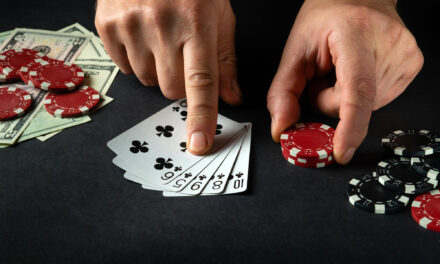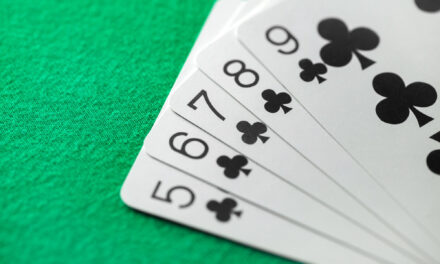
Quick answer: When two or more poker hands are exactly equal, the pot is split (chopped) evenly among them. Ties are broken strictly by comparing card ranks, in a fixed order set by the hand’s category — never by suit. Each of the 9 hand categories has its own comparison order; some stop after one card, others must compare all five. If every rank in that order matches too, the hands are truly identical and the pot is divided.
The Master Tie-Break Table: Every Hand Category at a Glance
This is the one table to bookmark. It lists, for each of the 9 standard poker hand categories, exactly what gets compared and in what order once two or more players share that category at showdown. Suits are not part of this table anywhere — more on that in the next section.
| Hand category | Compared in this order | Do kickers apply? | Can two hands ever be truly equal? |
|---|---|---|---|
| Straight flush | Top card of the run only | No | Yes — any two non-royal straight flushes with the same top card are identical |
| Four of a kind | Rank of the quad, then the 5th (kicker) card | Only in the rare case the quad itself is shared, e.g. on the board | Yes, if quad rank and kicker both match |
| Full house | Rank of the three of a kind, then rank of the pair | No — both cards belong to the defining pattern | Yes — any two full houses with the same trips and pair rank are identical |
| Flush | All 5 cards, highest to lowest | Yes — every card after the first is a kicker | Yes, but only if all 5 ranks match exactly |
| Straight | Top card of the run only | No | Yes — any two straights with the same top card are identical |
| Three of a kind | Rank of the trips, then 2 kickers in order | Yes, 2 kickers | Yes, if the trips rank and both kickers match |
| Two pair | Higher pair, then lower pair, then 1 kicker | Yes, 1 kicker | Yes, if both pairs and the kicker match |
| One pair | Rank of the pair, then 3 kickers in order | Yes, 3 kickers | Yes, if the pair and all 3 kickers match |
| High card | All 5 cards, highest to lowest | Yes — every card after the first is a kicker | Yes, but only if all 5 ranks match exactly |
Notice the pattern: the more of a hand’s five cards are locked into a fixed, defining shape (a straight flush and a straight are pinned down completely by one number; a full house is pinned down by two), the fewer independent ranks are left over to compare — and, as the data further down this page shows, the fewer independent ranks there are to compare, the easier it becomes for two different hands to land on the exact same value.
To use this table at the table: first confirm both hands are actually in the same row (a flush always beats a straight outright, with nothing left to compare, regardless of ranks). Once you’ve confirmed a shared category, read straight down that row’s “compared in this order” column, checking one rank at a time, and stop as soon as one hand is higher on any single rank in that list — that hand wins the pot outright, no matter what the remaining, uncompared ranks happen to be. Only a hand that matches all the way down its category’s full list is genuinely tied. Each category gets its own fully worked example, with real card holdings, in the next two sections.
Where Suits Fit In (and Where They Don’t)
Suits never break a rank-for-rank tie in standard hand comparison. If two hands’ ranks are fully equal under the table above, the pot is chopped — full stop, no tiebreaker card gets consulted, no suit is higher than another. That is a genuine hand-value tie. A suit order (spades, hearts, diamonds, clubs, in the sequence most rooms use) does show up elsewhere in poker — deciding a Stud bring-in, a Razz high card, who gets the odd chip when a pot doesn’t divide evenly, and a handful of other procedural moments — but none of those are hand comparisons, and none of them ever get invoked once two hands are already tied on rank. If you want the full catalog of every place a suit order actually is used procedurally, TopSitesPoker.com’s dedicated article, “Poker Suits Explained: Do Suits Have Rankings?”, walks through each one with sourcing; this article is not that one, so we’ll leave suits there and spend the rest of this page entirely on the rank ladder itself.
The Universal Comparison Ladder: How This Works for Any Hand
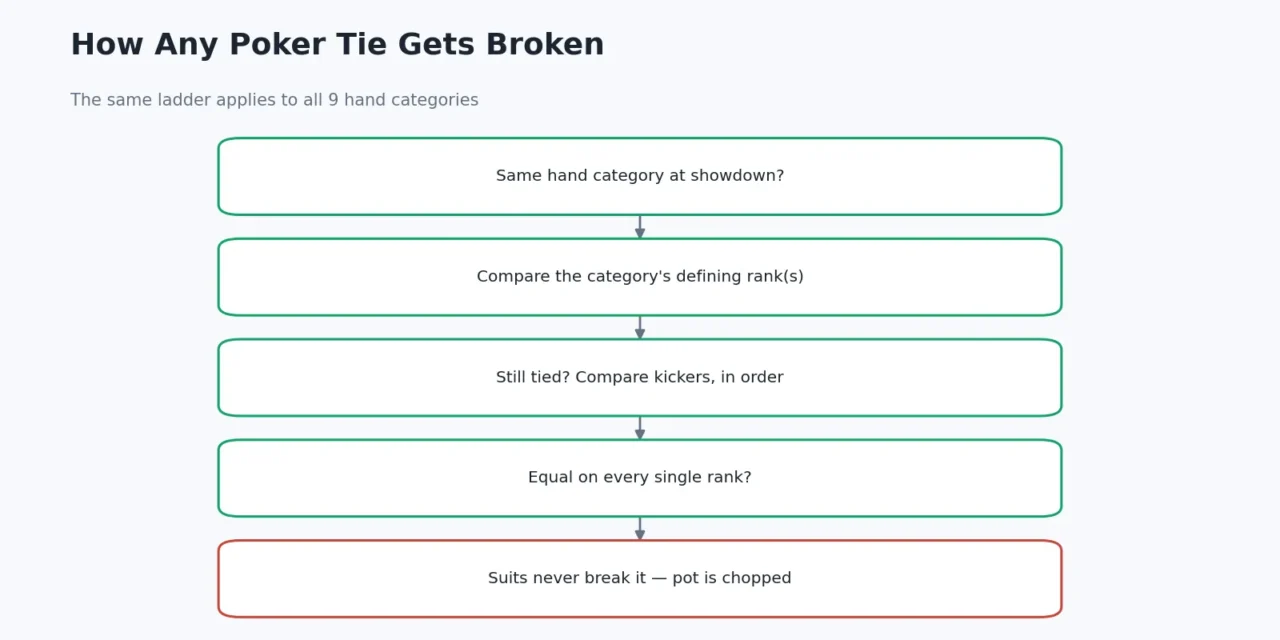
Every showdown comparison, no matter which of the 9 categories is involved, follows the same four-step logic. Only the specific ranks being compared, and how many of them there are, change from category to category.
- Same category? A flush always beats a straight, a full house always beats a flush, and so on down the standard ranking. If the two best hands are in different categories, the higher category wins outright and none of this page’s tie-break machinery ever gets used.
- Compare the category’s defining rank(s) first. Every category has one or two ranks that make it what it is: the top card of a straight, the quad’s rank in four of a kind, the trips-then-pair ranks in a full house, the pair’s rank in one pair, and so on. These are compared first, in the fixed order the category dictates.
- Still tied? Compare kickers, in the same fixed order, if the category has any. Four of the nine categories (straight flush, four of a kind in the ordinary case, full house, and straight) have no independent kickers at all — their defining ranks use up the whole hand. The other five (flush, three of a kind, two pair, one pair, and high card) do have kickers, and those kickers are compared strictly highest-to-lowest until one side is higher or they run out.
- Equal on every single rank the category uses? Then the hands are genuinely, mathematically identical in value. Suits are never consulted. The pot is chopped.
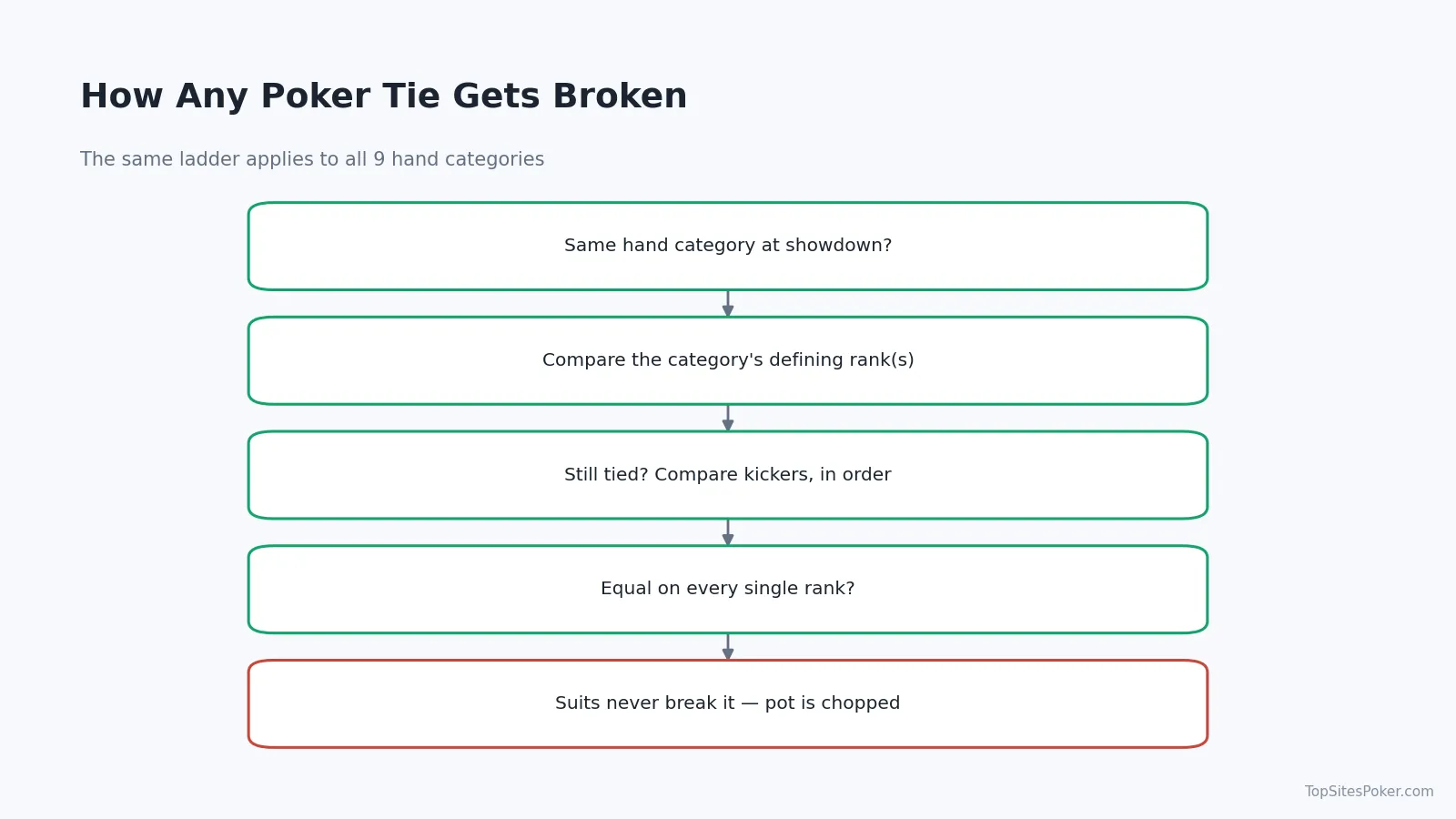
That is the whole system. Everything below this point is that same four-step ladder applied category by category, with worked examples, and then the real numbers on how often each rung of the ladder actually gets used in practice.
Tie-Break Rules for Each of the 9 Hand Categories
Standard poker ranks nine hand categories from strongest to weakest: straight flush, four of a kind, full house, flush, straight, three of a kind, two pair, one pair, and high card. Below, each one gets its own comparison order and a worked example with real card holdings. (Two of these categories — the ace-high case inside high card, and the A-2-3-4-5 “wheel” case inside straight — are common enough and distinctive enough that TopSitesPoker.com covers each in its own dedicated deep-dive article; both get name-checked in their sections below, with the full detail left to those pages.)
1. Straight flush
A straight flush is five consecutive ranks, all one suit. Because both the “consecutive” and the “one suit” conditions are locked in the moment you know the top card, there is exactly one comparison: the top card of the run. Nothing else about the hand can vary independently, so nothing else needs to be checked.
Worked example: Player A shows 9♠-8♠-7♠-6♠-5♠ (a nine-high straight flush). Player B shows 9♥-8♥-7♥-6♥-5♥ (also nine-high, different suit). Both hands compare as identical at the only rank that matters — the 9 — so this is a genuine tie and the pot is chopped, even though the two hands don’t contain a single physically identical card between them.
2. Four of a kind
Four of a kind is compared by the rank of the quad first. In ordinary play, two different players cannot both hold four-of-a-kind of different ranks and tie — the higher rank simply wins. The interesting case is when both players share the exact same quad rank, which in a community-card game happens when all four cards of that rank sit on the board itself. In that specific situation, the fifth card — the kicker — is a genuine tiebreaker, and it is each player’s best remaining card (from their hole cards, since the board is shared) that decides it.
Worked example: The board reads Q♠-Q♥-Q♦-Q♣-9♠ — four queens are sitting in the middle of the table. Player A holds A♥-2♣ and plays the ace as a kicker. Player B holds K♦-3♠ and plays the king. Both players hold “four queens,” but Player A’s ace-kicker beats Player B’s king-kicker, so Player A wins the entire pot outright — this is not a tie, despite the identical quad. Only if both players’ best kicker card were the exact same rank would this one actually chop.
3. Full house
A full house is compared by the rank of the three of a kind first, then the rank of the pair. Unlike four of a kind, there is no free fifth card here at all — a full house’s entire five cards are consumed by its three-plus-two shape, so once the trips rank and the pair rank both match, the hands are unconditionally, completely equal. There is no third comparison waiting in reserve.
Worked example: The board reads T♠-T♥-T♦-6♣-6♠ — tens full of sixes is sitting on the board by itself. Checked directly against the evaluator across every possible two-card hole combination, 992 out of 1,081 leave a player exactly at “tens full of sixes,” unable to improve on it at all. The only two ways to beat the board’s own hand are holding the deck’s one remaining ten (making quad tens, 47 combinations) or a pocket pair ranked higher than six — sevens through aces — which upgrades to a bigger full house, tens full of that pair instead (42 combinations). Any player without one of those two specific holdings is simply playing the board, so every such player at the table splits the pot evenly — a full house tie with zero kickers involved, a live example of Poker TDA Rule 20 (playing the board) combined with Poker TDA Rule 14 (a hand must be tabled to win any part of the pot, board hand included).
4. Flush
A flush is five cards of one suit that don’t run consecutively. Because the “one suit” condition doesn’t pin down any specific ranks the way a straight or a full house does, all five cards are independently meaningful, and all five get compared, highest to lowest, exactly like a high-card hand. A flush tie is correspondingly rare — it needs all five ranks to match, not just one or two.
Worked example: Player A shows A♠-J♠-9♠-6♠-3♠. Player B shows A♥-J♥-9♥-6♥-2♥. The first four cards match rank-for-rank (Ace, Jack, 9, 6), so the comparison drops all the way to the fifth card: Player A’s 3 beats Player B’s 2, and Player A wins the whole pot. Change that final card to a matching 3 in both hands and this becomes a genuine flush tie instead.
5. Straight
A straight is five consecutive ranks of mixed suits. Just like a straight flush, the “five consecutive ranks” condition is entirely determined by the top card — a queen-high straight is always 8-9-10-J-Q, with no other rank combination possible. That means the comparison stops at one card, and it also means that any two straights sharing a top card are not just similar, they are rank-for-rank identical hands.
Worked example: The board reads 8♠-9♥-10♦-J♣-Q♠ — a queen-high straight sits on the board with no flush possible. Every remaining player who can’t beat a queen-high straight (no pair on the board to improve on, no better straight available) is simply playing the board, and the pot splits evenly across all of them. This exact mechanism — a straight tying because the whole hand collapses to one number — is the single biggest reason ties happen at all at a full table, covered in detail further down this page. It’s also the setup behind TopSitesPoker.com’s dedicated deep dive on the A-2-3-4-5 “wheel,” which is simply the lowest of the ten possible straight tops and follows this identical one-card rule.
6. Three of a kind
Three of a kind is compared by the rank of the trips first, then by two kickers, in order. Two players can only share the same trips rank if the board itself provides three of that rank (since no player can hold two hole cards of a rank the board has already tripled, and two different players independently forming a set or trips of the same rank from their own hole cards is what actually creates the tie), which then puts both kickers into play.
Worked example: The board reads 7♠-7♥-7♦-Q♣-4♠ — trip sevens on the board. A three of a kind’s two kickers are simply the two highest cards left over once the trips are set aside, drawn from the board and both hole cards together — a hole card doesn’t automatically outrank a board card just for being in the hole. Player A holds A♥-9♣: the ace is the single highest card in play, but the board’s own queen (12) outranks Player A’s own 9, so Player A’s actual kickers are the ace and the board’s queen, with the 9 never used at all. Player B holds K♦-2♣ and, for the identical reason, ends up playing the king and the board’s queen. Player A’s ace beats Player B’s king at the very first kicker slot, so Player A wins outright — even though both hands are quietly sharing the board’s own queen as their second kicker. If both players instead held a king in the hole (say K♦-9♣ against K♠-2♥), both would land on identical king-queen kickers and the pot would chop.
7. Two pair
Two pair is compared by the higher pair, then the lower pair, then a single kicker. This is the category where “top pair, bottom pair, kicker” language actually maps onto three genuinely independent comparison slots.
Worked example: Player A holds K♠-K♥-8♦-8♣-3♠ (kings and eights, 3 kicker). Player B holds K♦-K♣-8♥-8♠-2♥ (kings and eights, 2 kicker). Both pairs match exactly, so the comparison drops to the kicker: Player A’s 3 beats Player B’s 2, and Player A takes the whole pot. Make both kickers a matching rank and the hands tie completely.
8. One pair
One pair is compared by the rank of the pair first, then by three kickers, in order. This is the category with the most independent ranks besides the two “all five cards” categories — a full four separate values (the pair, plus three kickers) all have to line up for a true tie.
Worked example: Player A holds 9♠-9♥-A♦-K♣-4♠ (pair of nines, A-K-4 kickers). Player B holds 9♦-9♣-A♥-K♠-3♥ (pair of nines, A-K-3 kickers). The pair matches, the first two kickers (Ace, King) match, so the whole hand comes down to the third kicker: Player A’s 4 beats Player B’s 3. Needing all four of those values to land on the same ranks simultaneously is exactly why, as the data below shows, one pair actually chops less often in absolute terms than several higher, rarer-looking categories.
9. High card
High card is what’s left when none of the other eight categories apply. All five cards are independently meaningful, compared highest to lowest exactly like a flush — which is also why a high-card tie needs all five ranks to match, the strictest bar in the entire ladder.
Worked example: Player A holds A♠-J♥-8♦-6♣-3♠. Player B holds A♥-J♣-8♠-6♥-2♦. The top four cards match (Ace, Jack, 8, 6), so it comes down to the fifth card, where Player A’s 3 edges out Player B’s 2. Ace-high hands specifically — the single most common high-card holding — are common enough that TopSitesPoker.com covers exactly how often each kicker slot decides an ace-high-vs-ace-high showdown in its own dedicated article; the short version, reused here only as an example of how fast a kicker chain usually resolves, is that the second card alone settles the overwhelming majority of those matchups, and it is exceedingly rare for the comparison to need to travel all the way to the fifth card.
How Many Cards It Actually Takes to Break Each Tie
The worked examples above all point at the same underlying structure, and it’s worth pinning down exactly, rather than just asserting it. Every hand category, evaluated through poker_lib’s hand-comparison logic, produces a fixed-length tuple of comparison values — the category id, followed by however many ranks that category’s shape leaves independent. Building one example of each category and confirming the tuple shape for 200,000 additional randomly dealt hands per category (to make sure no category’s comparison length ever varies by the specific cards involved) gives the table below.
| Hand category | Defining-rank slots | True kicker slots | Total comparison slots |
|---|---|---|---|
| Straight flush | 1 (top card) | 0 | 1 |
| Straight | 1 (top card) | 0 | 1 |
| Four of a kind | 1 (quad rank) | 1 | 2 |
| Full house | 2 (trips, pair) | 0 | 2 |
| Two pair | 2 (high pair, low pair) | 1 | 3 |
| Three of a kind | 1 (trips rank) | 2 | 3 |
| One pair | 1 (pair rank) | 3 | 4 |
| Flush | 0 | 5 | 5 |
| High card | 0 | 5 | 5 |
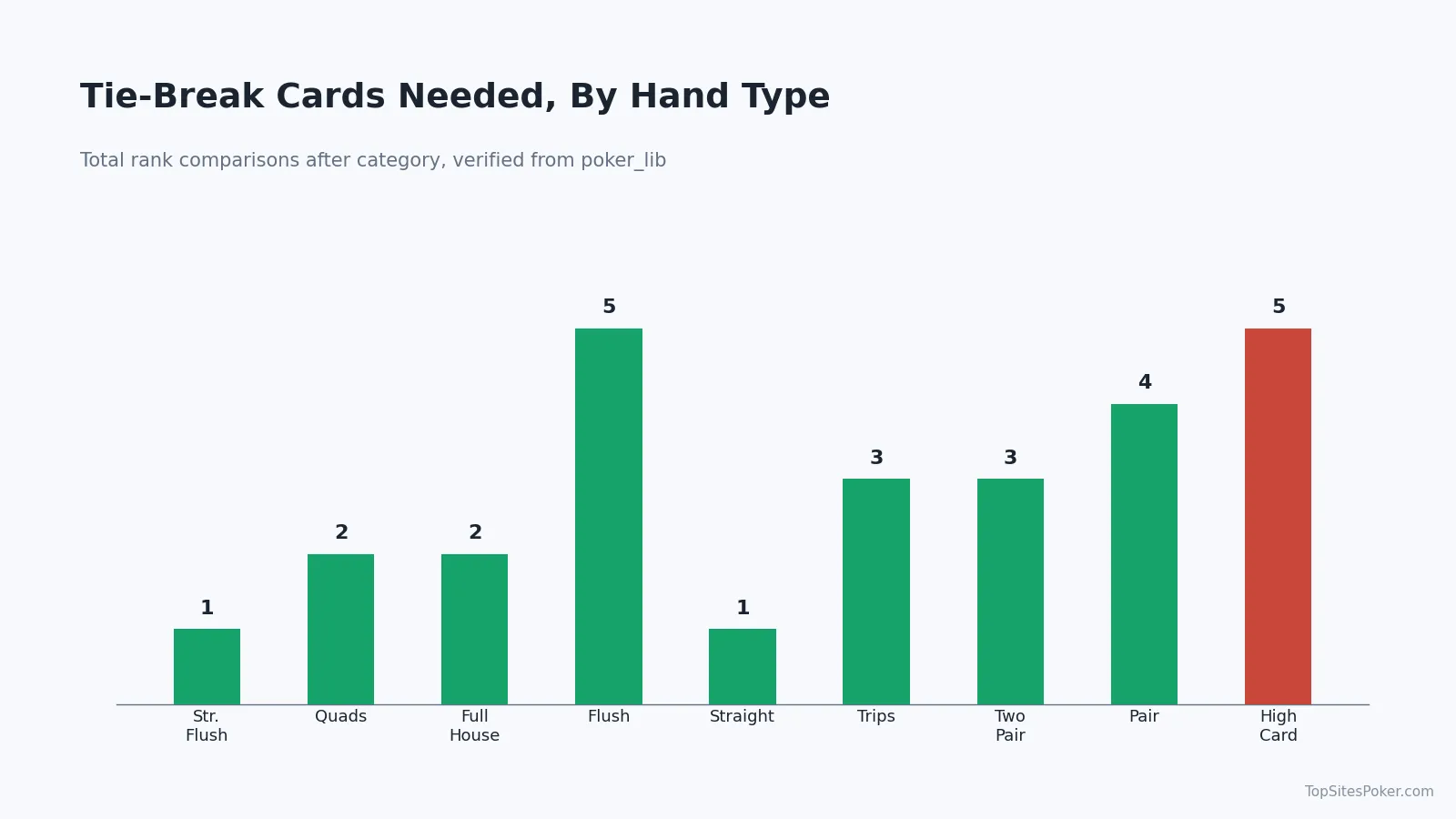
Two results are worth flagging because they run against the simplified version of this rule that gets repeated casually. First, four of a kind is usually described as having “no kickers,” and that’s the right practical answer almost always — but it does have one genuine kicker slot, which only becomes relevant in the specific, real scenario worked through above, where the quad itself sits on a shared board. Second, full house is often lumped in with four of a kind as “no kickers,” and that description is exactly right for full house in every case, with zero exceptions: a full house’s five cards are entirely consumed by its two defining ranks, so there is no free card left over that could ever break a tie between two full houses that already match on trips and pair.
Everything on this page so far has been about the comparison ladder itself, which is identical no matter what game you’re playing — but how often you actually run into that ladder depends heavily on whether the game deals each player an independent hand or has everyone building off a shared board. That distinction is worth pausing on before moving into the real frequency numbers.
In a pure 5-card game like five-card draw, every player’s final hand is made entirely of their own five cards, with zero overlap with anyone else’s. For two hands to tie, five (or however many the category needs) independent card slots, drawn from completely separate parts of the deck, all have to land on matching ranks purely by chance. In a community-card game — Hold’em, Omaha, and the community-board variants of other games — every player instead picks their best 5-card hand from a pool of 7 cards (their own hole cards plus the shared board), which poker_lib’s best_of_7 function implements directly: it simply checks all 21 possible 5-card combinations out of 7 and keeps the best one. That shared board is exactly what makes “playing the board” possible at all, and it’s also exactly what makes ties so much more common in these games than they’d be in a game with no shared cards: when a category like a straight or a full house can be completed entirely from the board’s own five cards, with zero contribution required from any player’s hole cards, every single player at the table who doesn’t happen to hold something better is, by definition, holding the exact same best hand. That single mechanic — a shared board fully determining a category’s value on its own — is the direct cause behind several of the tie examples worked through on this page already, and it’s also the reason multiway ties, including the full nine-way chops covered further down, are a routine occurrence in community-card games in a way they simply couldn’t be in draw poker.
How Often Ties Actually Happen: The Real Numbers
All of the frequency numbers in this section come from a 150,000-trial Monte Carlo simulation of Texas Hold’em showdowns at three table sizes: 2-max (heads-up), 6-max, and 9-max (full ring). Every simulated deal assumes the “no-fold” baseline: all seats at the table are dealt in and see a random 5-card board through to showdown, with nobody folding at any point. That assumption is deliberate — it isolates how often ties occur purely from the raw statistical frequency of hand ranks, without trying to model how real players’ folding decisions would change who actually reaches showdown. Real tables fold far more hands than this before the river, so treat these as “if everyone always saw it through” rates, not as how often a chop happens in an average live session.
| Table size | Trials | Exact ties (chops) | Exact-tie rate |
|---|---|---|---|
| 2-max (heads-up) | 150,000 | 6,211 | 4.14% |
| 6-max | 150,000 | 10,824 | 7.22% |
| 9-max (full ring) | 150,000 | 14,556 | 9.70% |
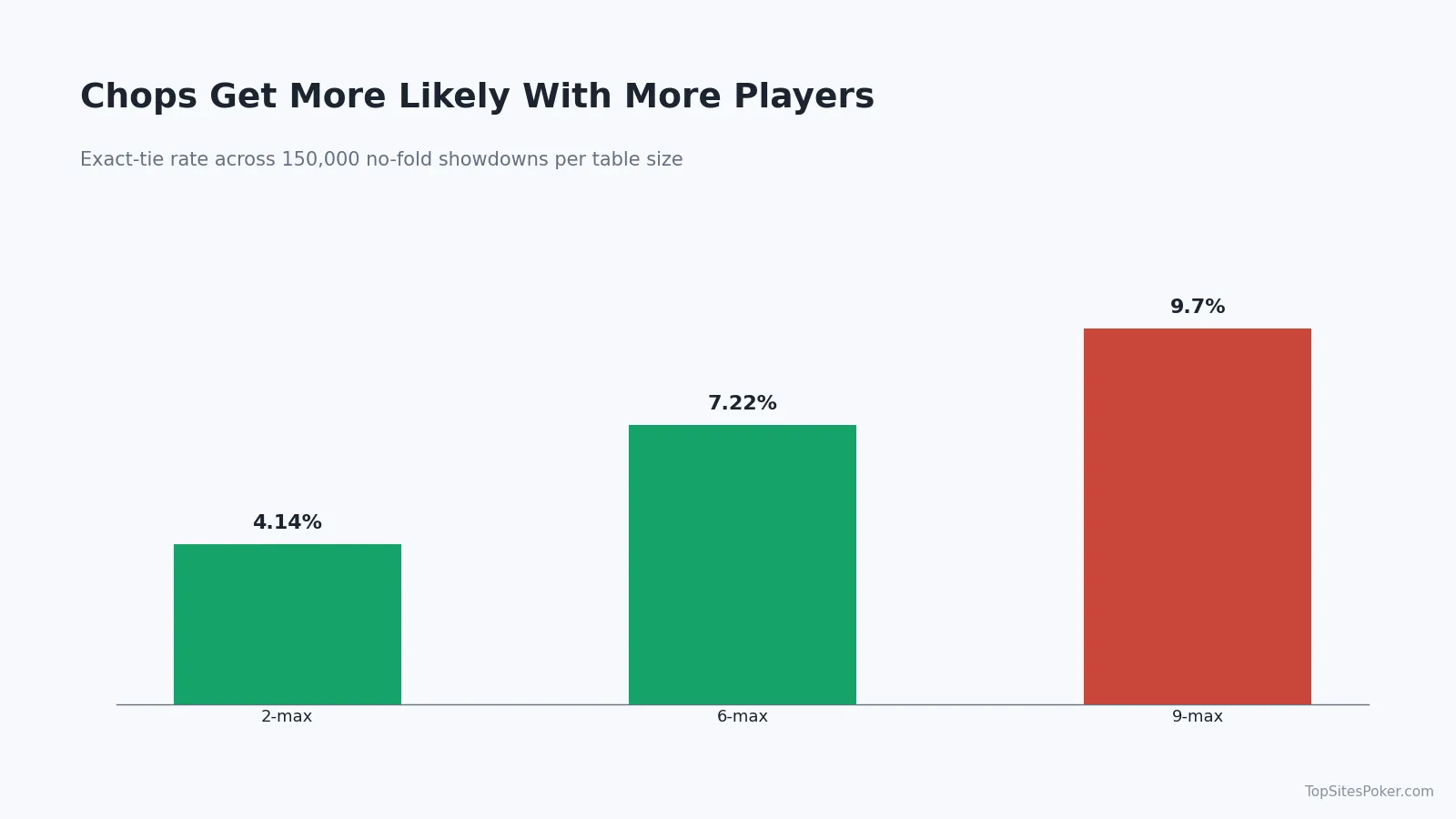
The pattern is straightforward: more live hands at showdown means more chances that two of them land on the exact same rank pattern, so the chop rate climbs steadily with table size — from roughly 1 in 24 heads-up deals, to about 1 in 14 at six-handed, to nearly 1 in 10 at a full nine-handed table, all under the no-fold assumption above.
Which category chops most often shifts as the table fills up
The category responsible for the largest share of ties isn’t the same at every table size, and tracking that shift is itself informative.
| Table size | Leading tie category | Ties in that category | Share of all ties at that size |
|---|---|---|---|
| 2-max | One pair | 2,142 of 6,211 | 34.49% |
| 6-max | Straight | 4,331 of 10,824 | 40.01% |
| 9-max | Straight | 7,252 of 14,556 | 49.82% |
Heads-up, with only two hands ever competing, one pair leads simply because one pair is by far the most common hand at showdown in the first place. As soon as the table grows past a couple of players, though, straight takes over the top spot and never lets go — and by nine-handed play, a single category (straight) is behind essentially half of every chopped pot at the table. That deserves its own closer look.
How these numbers were computed
The exact five-card counts used elsewhere on TopSitesPoker.com (things like “there are exactly 5,108 flushes out of 2,598,960 possible five-card hands”) come from exhaustive enumeration — a program that literally checks every single possible hand, which is fast and completely exact because the space of five-card hands is a fixed, countable 2,598,960 combinations. A full 9-max Hold’em showdown is a different scale of problem entirely: nine 7-card hands drawn against one shared 5-card board produces a number of possible deals far too large to enumerate exhaustively in any reasonable time. That’s exactly the situation Monte Carlo simulation is the standard, correct tool for, not a shortcut around exactness: deal a fresh, fully random hand 150,000 times at each table size, evaluate every player’s best 5-of-7 hand with the same evaluator used throughout this page, record the winning category, whether more than one player shares the winning value, and how many players share it when they do. With 150,000 independent trials behind each table size, a rate like the 9-max exact-tie figure of 9.70% carries a margin of error comfortably under a few tenths of a percentage point — rerunning the same simulation with a different random seed would land within that narrow band, not produce a meaningfully different headline number.
Which Hands Tie Most Often at a Full Table
Restricting to the 9-max simulation, here is the full breakdown of which category was involved every single time the pot chopped:
| Hand category | Ties at 9-max | Share of all 9-max ties |
|---|---|---|
| Straight | 7,252 | 49.82% |
| Two pair | 2,977 | 20.45% |
| Full house | 1,978 | 13.59% |
| Three of a kind | 1,325 | 9.10% |
| One pair | 995 | 6.84% |
| Four of a kind | 17 | 0.12% |
| Flush | 9 | 0.06% |
| Straight flush | 3 | 0.02% |
| High card | 0 | 0.00% |
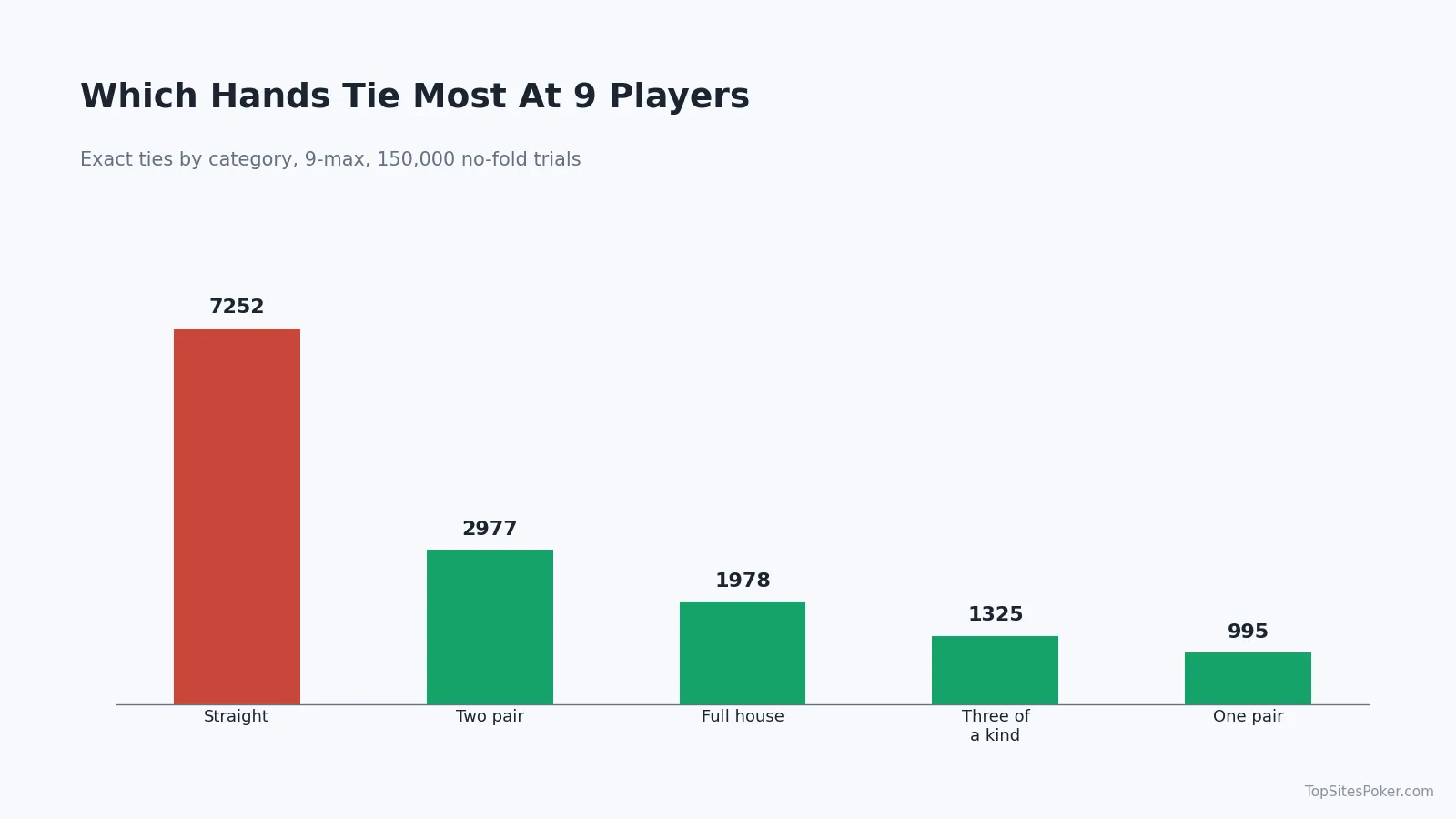
Straight accounts for roughly half of every 9-max chop — despite the fact that straight is not even close to the single most common winning hand overall at that table size (two pair wins the most often outright, at 24.80% of the 150,000 simulated deals, with straight second at 20.02%). So why does the category that isn’t the most frequent winner produce the most ties?
The comparison-slots table above has the answer. A straight’s entire value is pinned down by one number, its top card — every queen-high straight, with no possible flush, is exactly the same five ranks (8-9-10-J-Q), no matter which two cards came from the hole and which came from the board, and no matter what suits are involved. Once you know two players both hold “a straight,” there is only one number left that could possibly separate them. One pair, by contrast, needs four independent ranks — the pair itself, plus three separate kickers — to all land the same way before it can tie. Two pair sits in between, needing three independent ranks to match. That single-number bottleneck is precisely why a straight, structurally, is the single easiest category in the entire game to tie once it’s already the best hand on the table.
The cleanest way to see it: how tie-prone is each category, once it actually wins?
The raw tie counts above mix two different effects together: how often a category wins the pot at all, and how likely it is to tie once it does. Dividing the number of ties in a category by the number of times that category won the pot outright (tie or no tie) isolates the second effect on its own — the probability that, given a category is the best hand on the table, that best hand is shared by more than one player.
| Hand category | 2-max | 6-max | 9-max |
|---|---|---|---|
| Straight | 7.24% | 17.56% | 24.15% |
| Full house | 4.19% | 7.13% | 9.30% |
| Two pair | 3.92% | 7.29% | 8.00% |
| One pair | 3.84% | 4.97% | 7.00% |
| Three of a kind | 2.42% | 3.36% | 5.32% |
This settles the question cleanly. At a full nine-handed table, whenever a straight is the winning hand, it’s actually a multi-way chop roughly 1 time in 4 (24.15%) — more than double the rate of the next category, full house, and consistently the highest of every category at every table size tested. This also resolves a smaller puzzle in the raw numbers: full house structurally needs only 2 matching ranks to tie (fewer than two pair’s 3), yet two pair produces more total ties at 9-max (2,977 versus 1,978). The conditional table shows why — two pair simply wins the pot far more often in absolute terms (24.80% of all 9-max deals versus full house’s 14.18%), so its sheer prevalence outweighs full house’s slightly easier structural path to a tie. Raw tie counts tell you what to expect to see; the conditional rate tells you what’s structurally happening underneath it.
The categories that almost never tie
The flip side of “straight ties constantly” is that a few categories barely tie at all, and the pattern moves in different directions depending on table size:
| Hand category | Ties at 2-max | Ties at 6-max | Ties at 9-max |
|---|---|---|---|
| High card | 657 | 15 | 0 |
| Flush | 139 | 45 | 9 |
| Four of a kind | 9 | 10 | 17 |
| Straight flush | 1 | 0 | 3 |
High card and flush ties get rarer as the table fills up, not more common — the opposite direction from the overall trend. That’s because both categories need all five cards to line up for a tie, and a bare high card or a plain flush is decreasingly likely to even be the best hand at all once eight other random hands are competing for the pot; across the full 150,000-trial 9-max simulation, high card never once won the pot outright, so it had zero opportunities to tie either. Four of a kind and straight flush move the other way, rising slightly with table size, because more live hands at showdown means slightly more chances for these still-rare categories to appear more than once, even as each individual occurrence stays just as unlikely.
How Big Can a Chop Get? Multiway Ties Explained
A chop doesn’t have to be a two-way split. The same 9-max simulation recorded exactly how many players shared the pot every time a tie occurred:
| Players sharing the pot | Occurrences (of 14,556 ties) | Share of all ties | Odds across all 150,000 trials |
|---|---|---|---|
| 2-way | 12,283 | 84.38% | 1 in 12.2 deals |
| 3-way | 1,920 | 13.19% | 1 in 78.1 deals |
| 4-way | 147 | 1.01% | 1 in 1,020 deals |
| 9-way (every seat) | 206 | 1.42% | 1 in 728 deals |
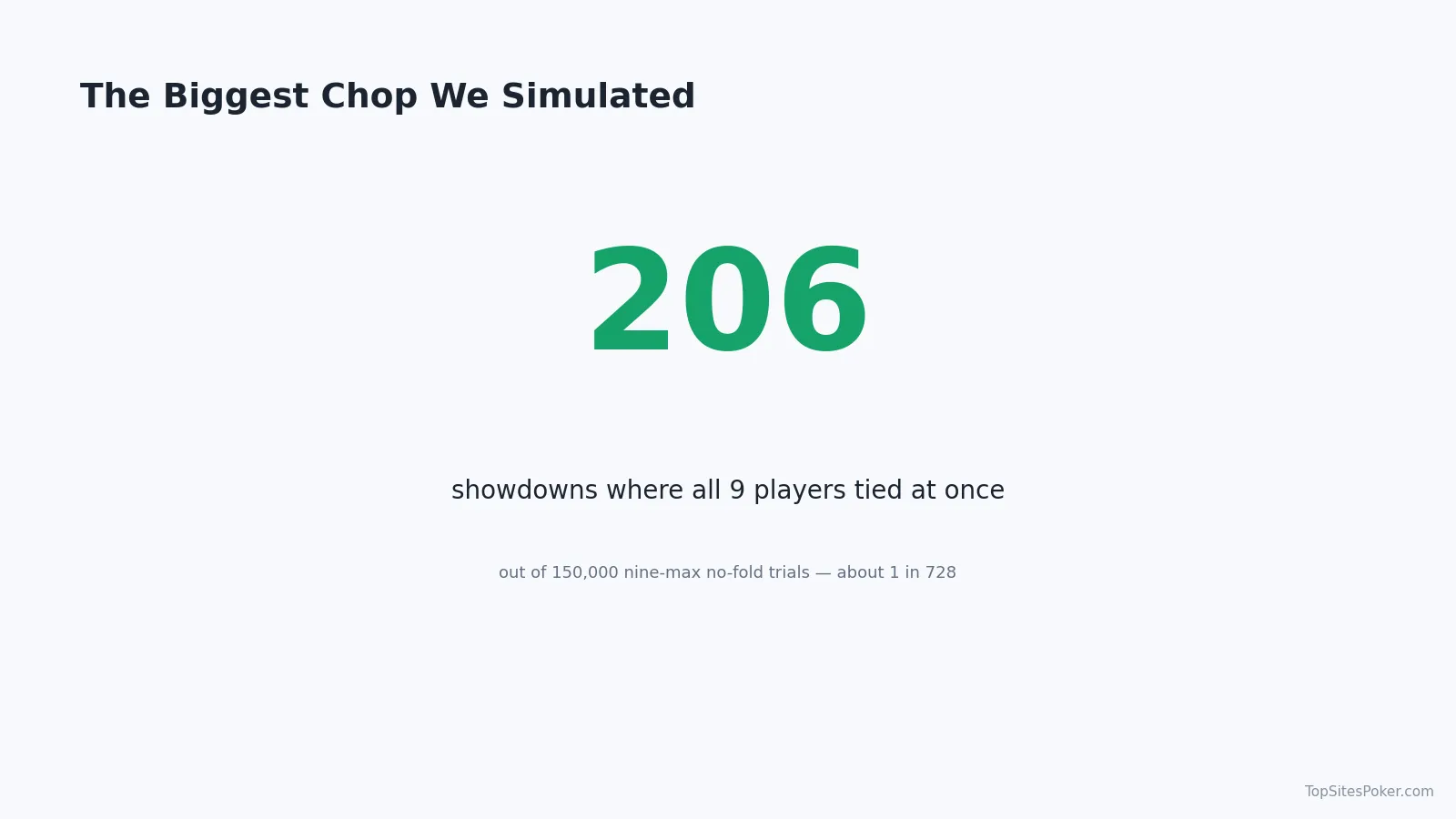
Two-way ties dominate, as you’d expect, but the tail is real: a full nine-way chop, where every single player at a nine-handed table shares the exact same winning hand, happened 206 times out of 150,000 simulated no-fold deals — about once every 728 hands. Every single one of those 9-way chops is, structurally, the board itself simply playing the best hand for the whole table, since it’s the only way all nine hands can be guaranteed to share identical value regardless of what any individual player is holding in the hole. A concrete, verified illustration: board 9♠-9♥-9♦-K♣-Q♥ gives trip nines with king and queen kickers — already the two highest kicker cards left in the deck. Any player at a nine-handed table holding two different ranks, both ten or lower, that aren’t a pocket pair (a pair would improve to a full house instead) and aren’t the specific ten-jack combination (which would complete a king-high straight off the board’s own 9, queen and king), and who holds no 9, King, or Queen — ends up holding that identical value: trip nines, King-Queen kickers, confirmed with zero exceptions across all 448 qualifying hole-card combinations checked directly against the evaluator. Deal nine such hands against that board and, checked the same way, all nine tie exactly — the real-world shape a 9-way chop actually takes. Notice, too, that 4-way ties (147) are actually rarer than the full 9-way tie (206) — a reminder that “more players tied” doesn’t move smoothly with “harder to achieve”; once the board itself is doing all the work, tying 9 players is no harder than tying 4, and considerably more likely once the specific board-play condition is met at all. The mechanics of how a pot actually gets divided once a chop like this is confirmed — who gets the odd chip, how side pots factor in, how an all-in changes the math — is its own subject, covered in full in TopSitesPoker.com’s dedicated split-pot article; this page stops at confirming that the tie exists.
Two Deep-Dive Cases Worth Knowing By Name
Two specific situations inside this ladder come up often enough, and have enough of their own texture, that TopSitesPoker.com covers each in a separate, dedicated article rather than cramming the full detail in here.
Ace-high (inside the high-card category). Ace-high is simply the most common single high-card holding, by a wide margin: exact enumeration of all 2,598,960 possible five-card hands puts the ace-high count at 502,860, or 19.35% of every hand in the deck — roughly one in five hands you could ever be dealt, before any comparison even starts. Ace-high-versus-ace-high showdowns are correspondingly common enough that a focused, 400,000-sample analysis of exactly which kicker slot decides them is worth its own page. As used briefly in the high-card section above, the overwhelming majority of those matchups resolve at the second card; the article covering it by name is where to go for the full kicker-by-kicker breakdown.
The wheel (inside the straight category). The “wheel” — A-2-3-4-5, where the ace plays low — is simply the lowest of the ten possible straight tops, and it follows the exact same one-card comparison rule as every other straight on this page. Exact enumeration confirms all ten straight tops are perfectly evenly represented in a five-card deck: exactly 1,020 non-flush combinations and exactly 4 straight-flush combinations for each of the ten possible top cards, wheel included, so the wheel is neither more nor less likely to occur, or to tie, than any other straight height by that count alone. What makes it worth its own page is everything else around it — the ace’s dual high/low role, how it interacts with flushes and low-hand variants — which this page defers to entirely rather than repeating.
Beyond Hold’em: The Same Ladder in Other Poker Games
This page’s simulation numbers are all drawn from Texas Hold’em, but the comparison ladder itself — category first, then defining ranks, then kickers in order, then chop — is a property of the standard hand-ranking system, not of any one specific game. Here’s how it carries over.
Omaha (Hi). Omaha deals four hole cards instead of two, but the showdown evaluation still selects the best 5-card hand from a combined pool (here, 4 hole plus 5 board, using exactly 2 of the 4 hole cards), and every category’s tie-break order on this page applies completely unchanged. Because every player at an Omaha table shares the same 5-board and is drawing from a larger 4-card hole allotment, board-driven ties (a straight or full house that the board completes on its own) are, if anything, an even more familiar sight to regular Omaha players than to Hold’em players.
Short Deck Hold’em (6-plus). Short Deck removes the 2 through 5 of each suit, leaving a 36-card deck. Some rooms rank a flush above a full house under Short Deck rules, since removing the low cards makes a flush structurally rarer than it is in a full 52-card deck — but that’s a change to the order of categories, not to how a tie is broken within any single category. A flush in Short Deck is still compared card by card, all five ranks, exactly as described above; a full house is still trips-then-pair with no free kicker. The ladder itself never changes, only which category ranks where relative to the others.
Seven-card stud. Stud deals seven cards total (a mix of face-down and face-up, across several betting rounds) and, just like Hold’em, the final hand is the best 5 of those 7. Every comparison rule on this page applies identically. The one procedural wrinkle unique to Stud is the bring-in and, in some tie situations, using suit order to decide an unrelated procedural question — ground that TopSitesPoker.com’s suits article covers, not this one.
Razz and other low-hand games. Razz (and Deuce-to-Seven lowball, in a different rank system) flips the usual ranking so that the worst-looking hand wins, but the underlying comparison mechanic is the same idea, mirrored: instead of comparing high card and its kickers from the top down looking for the biggest match, a low hand is compared from its highest qualifying card down, looking for the smallest one. Two Razz hands with an identical five-card low reading are just as capable of tying, using the exact same rank-for-rank equality logic as anywhere else on this page — the “compare in order until one side wins or you run out of cards” idea doesn’t change, only which end of the deck counts as good.
Hi-Lo split games. In games like Omaha Hi-Lo or Razz-based split formats, the high hand and the low hand are evaluated as two entirely separate comparisons, each with its own tie-break ladder. It’s entirely possible for the high half of the pot to chop while the low half doesn’t, for the low half to chop while the high half doesn’t, for both to chop independently, or for a single hand to “scoop” both halves outright. None of that changes anything about how either individual comparison works — it just means a hi-lo pot can have two separate tie questions running at once. How the actual chips get divided once both halves are settled is exactly the kind of chip-mechanics question the split-pot article handles; this page is only concerned with confirming whether either half is tied in the first place.
Five Full Showdowns to Read Yourself
The single-category examples earlier in this page used isolated 5-card hands to keep each comparison rule clean and simple. These five scenarios do the same thing with full, realistic Hold’em deals — two hole cards plus a shared 5-card board — so you can practice reading a real showdown, not just an abstract rule. Try to work out the winner (or confirm the tie) before reading the answer under each one; every result below has been checked directly against poker_lib’s hand evaluator, not worked out by hand.
Scenario 1. Board: 8♣-9♦-10♠-J♥-4♠. Player A holds Q♦-3♥. Player B holds Q♣-6♦. Who wins?
Answer: It’s a tie. Both players complete the exact same queen-high straight (8-9-10-J-Q) using the board’s four connected cards plus their own queen; their other hole card (the 3 and the 6) never enters the best-5 selection at all, so it’s completely irrelevant to the outcome. Both hands evaluate to an identical value, and the pot is chopped.
Scenario 2. Board: K♦-K♠-7♣-7♥-2♦ (kings and sevens are already paired on the board). Player A holds A♣-9♠. Player B holds Q♥-J♠. Who wins?
Answer: Player A wins outright — this is not a tie. Neither hole card pairs anything or improves the hand’s category, so both players are technically “using the board’s two pair,” but each one’s own best kicker still gets compared: Player A’s Ace beats Player B’s Queen at the very first kicker slot, so Player A takes the entire pot despite both hands sharing the identical two pair.
Scenario 3. Board: 5♠-5♥-5♦-9♣-2♥ (trip fives on the board). Player A holds 9♦-4♠. Player B holds 9♥-8♣. Who wins?
Answer: It’s a tie. Both players pair the board’s own 9 with a 9 in their hand, giving both of them fives-full-of-nines — an identical full house. Their second hole card (the 4 and the 8) is never used, since a full house’s five cards are completely accounted for by the trips-plus-pair shape, with no room for a kicker of any kind.
Scenario 4. Board: A♦-J♦-9♦-4♦-2♠ (four diamonds on the board). Player A holds K♦-7♣. Player B holds 6♦-3♣. Who wins?
Answer: Player A wins — not a tie, even though both players make a flush using the same four board diamonds. Player A’s flush reads Ace-King-Jack-9-4 (their king slots in as the second-highest card of the five); Player B’s flush reads Ace-Jack-9-6-4 (their 6 slots in lower, as the third-highest). Both hands match on the Ace, but Player A’s King beats Player B’s Jack at the second card, deciding it immediately without ever needing to look further down the hand.
Scenario 5. Board: 2♠-2♥-A♦-K♣-Q♥ (a pair of deuces, with the three highest cards in the deck — Ace, King, Queen — sitting right alongside them). Player A holds J♠-9♣. Player B holds 8♥-6♦. Player C holds 4♣-3♥. Who wins?
Answer: A genuine three-way tie. Because the board’s own three non-paired cards are already the Ace, King, and Queen — the highest possible kicker cards in the entire deck — no hole card ranked Jack or lower, held by any player, can ever displace any of them from the kicker slots. All three players end up holding the identical hand: a pair of deuces with Ace-King-Queen kickers, entirely from the board, and the pot splits three ways evenly.
Showdown Mechanics You’ll Still Need
This page is about how a tie is identified — the rank comparison itself. Two closely related questions sit right next to it and deserve a name-check, even though the full answer belongs elsewhere. First: once hands are compared, how does the room actually run the reveal — who has to show first, what “cards speak” really means procedurally, whether a misdeclared hand costs anything? TopSitesPoker.com’s dedicated showdown-procedure article owns that ground start to finish. Second: once a tie is confirmed and the pot needs to be physically divided, how do odd chips, side pots, and all-ins actually get handled? That’s the split-pot article referenced above.
Both of those sibling topics sit downstream of this page: you need to already know whether a tie exists, and exactly which rank it landed on (or failed to land on), before “who shows first” or “how do we split these chips” is even a meaningful question to ask. A few procedural rules from the current Poker TDA rules (2026 edition, Version 1.0, dated September 7, 2026) are directly relevant to how a tie gets confirmed in the first place, and worth stating plainly here even though the fuller procedural detail lives in the sibling articles:
- Cards speak, and deliberate miscalls can be penalized (TDA Rule 13). The actual physical cards determine hand value regardless of what a player says their hand is; a genuine mistake in reading your own hand doesn’t cost you the pot, but knowingly misdeclaring a hand to induce a fold is a different matter and can draw a penalty.
- All hole cards must be tabled to win any part of the pot (TDA Rule 14), including when a player is simply playing the board (TDA Rule 20). A hand that isn’t fully shown, even a hand that’s just riding the board’s own value to a split, isn’t awarded any portion of the pot under tournament procedure.
- The odd chip in a chopped pot goes to the first seat left of the button in flop games, and ties in Stud games are broken by suit for that specific procedural purpose (TDA Rule 21). This is a chip-mechanics rule, not a hand-value rule — it only ever activates after a genuine tie is already confirmed by the ladder on this page, and it’s the split-pot article’s subject, not this one’s.
One more point worth stating clearly because it gets misquoted often: “show one, show all” is a house rule, not a TDA rule. Many rooms adopt a policy that if one player voluntarily shows a card at showdown, any other player involved in the hand can request to see all hands that were in it — but that policy comes from individual room procedure, not from the TDA rulebook itself, and TDA rules in general only bind events and rooms that have formally adopted them. Always check your specific room’s or event’s posted rules, since house procedure varies from card room to card room and from one tournament series to another.
Glossary: Key Terms on This Page
- Defining rank. The rank (or ranks) that a hand category is built around and that gets compared first — the quad’s rank in four of a kind, the top card in a straight, the trips-then-pair ranks in a full house.
- Kicker. A card that isn’t part of a hand’s defining pattern but still counts toward its value and can break a tie between two hands that already match on the defining rank(s).
- Total comparison slots. This page’s term for how many independent ranks, defining plus kicker, a category’s tuple actually contains — 1 for a straight, up to 5 for a flush or high card.
- Chop / split pot. What happens when two or more hands are exactly equal at showdown: the pot is divided evenly (or as evenly as the chip denominations allow) among the tied hands.
- Multiway tie. A chop involving three or more players sharing the winning hand, rather than the more common two-way split.
- Playing the board. Winning (or tying) using some or all of a hand’s value directly from the shared community cards, with little or no help needed from your own hole cards.
- No-fold baseline. The simulation assumption used throughout this page’s frequency numbers: every seat at the table is dealt in and sees a random board all the way to showdown, with nobody folding at any point, which isolates raw hand-rank frequency from real-world folding behavior.
- Best-of-seven. The rule, used in Hold’em, Omaha, and stud, that a player’s final hand is the best possible 5-card combination out of a larger pool (2 hole plus 5 board in Hold’em, for instance) rather than a fixed five specific cards.
- Showdown. The point in a hand where remaining players reveal their cards to determine the winner, after all betting is complete.
- Quads / trips. Common shorthand for four of a kind and three of a kind, respectively.
- Conditional tie rate. This page’s term for the number of times a category tied divided by the number of times it won the pot at all — a way of measuring how tie-prone a category is on its own, separate from how often it shows up as the winning hand in the first place.
- Category (hand category). One of the 9 standard groupings — straight flush, four of a kind, full house, flush, straight, three of a kind, two pair, one pair, or high card — that a 5-card hand always falls into exactly one of, and that always outranks every category below it regardless of the specific ranks involved.
Common Mistakes When Reading a Tie
Most tie-related errors at the table come from applying a rule that’s correct for one hand category to a different category where it doesn’t hold, or from assuming suits do work that they simply don’t do. The table below covers the most common versions of both.
| Mistake | Why it’s wrong | What’s actually true |
|---|---|---|
| “Suits break the tie if the ranks are equal.” | Confuses a hand-value comparison with a separate procedural use of suit order. | Once ranks are fully equal in standard comparison, the pot is chopped. Suit order settles unrelated procedures (bring-ins, odd chips, and similar), never a rank-for-rank hand tie. |
| “A bigger kicker somewhere in my hand always helps.” | Ignores that kickers are compared in a strict, fixed order for each category. | Kickers are checked one at a time, highest first. A strong 5th card is irrelevant if an earlier kicker already lost. |
| “Four of a kind never has a kicker fight.” | True almost always, but not literally always. | If the quad itself is shared (typically because it’s sitting on the board), the 5th card is a real, live kicker. |
| “A full house can come down to the kicker if the trips match.” | Treats the pair rank as an optional tiebreaker rather than a required, structural part of the hand. | A full house has no free card at all. Trips rank, then pair rank — if both match, the hands are unconditionally equal. |
| “Straights basically never tie — they’re too specific.” | Backwards. A straight is the single easiest category in the game to tie, precisely because it’s defined by only one number. | The simulation data above shows straight producing roughly half of every tie at a 9-max table. |
| “Playing the board means you didn’t really win, so you shouldn’t have to show.” | Confuses hand strength with tabling requirements. | TDA Rule 14 and TDA Rule 20 both require a hand to be tabled to claim any part of the pot, board-playing hands included. |
| “If I chop a pot, I automatically get the odd chip back.” | Assumes a specific procedural rule applies everywhere by default. | The odd chip goes to a specific seat by TDA Rule 21 in tournament procedure (or by the room’s house rule in a cash game) — it isn’t handed to whichever player asks. |
| “Whoever has the better-looking hand in general must have the edge on a tie.” | Confuses which hand is more impressive-looking with which specific ranks are actually being compared. | Only the ranks the category’s comparison order actually uses can matter. A flashy-looking kicker that isn’t in the comparison order (for example, a card that isn’t part of a full house’s trips-then-pair check) has no effect on the outcome at all. |
Quick Quiz: Test Your Tie-Break Knowledge
- Which comparison decides a tie between two straight flushes?
- True or false: a full house can come down to a kicker card if the three-of-a-kind ranks match.
- Two players both hold “trip sevens” from a board that shows three sevens. What decides the winner?
- How many independent ranks have to match for two “two pair” hands to be truly equal?
- At a 9-max table in the simulation on this page, which single category was responsible for the largest share of all ties?
- True or false: suits can break a tie once two hands’ ranks are fully, exactly equal.
- Which two categories require comparing all 5 cards, in order, to settle a tie?
- In the 9-max simulation, how many out of 150,000 no-fold deals ended with all 9 players tied at once?
- Under the current Poker TDA rules, which rule requires all hole cards to be tabled to win any part of the pot?
- True or false: “show one, show all” is an official TDA rule.
Answer key
- The top card of the run only — nothing else about a straight flush varies independently once the top card is fixed.
- False. A full house has no free kicker card at all; if the trips rank matches, the pair rank is compared next, and if that matches too, the hands are unconditionally equal.
- Each player’s best remaining kicker cards, compared in order — three of a kind uses two kicker slots after the trips rank itself.
- Three — the higher pair, the lower pair, and the single kicker all have to match.
- Straight, responsible for 49.82% of all ties in the 9-max simulation — essentially half.
- False. Once ranks are fully equal, the pot is chopped; suits are never consulted in that comparison.
- Flush and high card — neither has any defining rank pattern that locks down fewer than all five cards.
- 206 out of 150,000 trials, or about 1 in 728.
- TDA Rule 14, which also applies to a hand that’s simply playing the board under TDA Rule 20.
- False. “Show one, show all” is a house rule adopted by many individual rooms, not a rule in the TDA rulebook itself.
Frequently Asked Questions
Do suits ever break a tie in a standard poker hand comparison?
No. Once two hands’ ranks are fully and exactly equal under the ladder on this page, the pot is chopped. Suits settle a handful of unrelated procedural questions elsewhere in the game (Stud bring-ins, odd chips, and similar), but never a rank-for-rank hand-value comparison.
What’s the very first thing that gets compared when two hands might be tied?
Whether the two hands are even in the same category. A flush beats a straight regardless of ranks, so the tie-break ladder on this page only ever activates once both hands are already confirmed to be in the exact same one of the 9 categories.
Do kickers matter for every hand category?
No. Straight flush, full house, and straight never have a true kicker — their defining ranks use up the hand’s entire value. Four of a kind has one kicker slot that matters only when the quad itself is shared. Flush, three of a kind, two pair, one pair, and high card all have genuine kickers that regularly decide close showdowns.
Why does a straight tie so much more often than a full house, even though a straight sounds more specific?
Because a straight’s entire value collapses to a single number — its top card. Once you know two players both hold “a straight,” there is nothing else left to compare. A full house needs two ranks to match, and one pair needs four, so both are structurally harder for two different hands to land on by chance.
Is a straight really the most common winning hand at a poker table?
Not usually. In the 9-max simulation behind this page, two pair actually won more often outright (24.80% of deals) than straight did (20.02%). Straight simply produces more ties once it does win, because of the one-number bottleneck described above.
Can four of a kind ever tie?
Yes, but only when the quad itself is shared by both players — typically because all four cards of that rank are sitting on the community board. In that case, the fifth card each player plays as a kicker decides it, and if both players’ best kicker is the same rank, the hands genuinely tie.
Can two full houses ever be exactly equal?
Yes, whenever the three-of-a-kind rank and the pair rank both match. Because a full house has no free fifth card, matching on those two ranks is not just similar — it’s a complete, unconditional tie.
How many cards does it take to decide a flush tie?
All five, compared highest to lowest. A flush has no defining rank pattern beyond “one suit,” so every card carries independent tie-break weight, exactly like a high-card hand.
Why doesn’t high card ever seem to tie at a full table?
Because it needs all five cards to match, the strictest bar of any category, and because it’s rarely even the best hand available once eight or more live hands are competing for the pot. In the 9-max simulation used throughout this page, high card never once won a single one of 150,000 no-fold deals outright, so it had zero chances to tie either.
How often does a pot actually get split at a poker table?
Under the no-fold baseline used in this article’s simulation (every seat sees a random board to showdown, nobody folds), roughly 4.14% of heads-up deals, 7.22% of six-handed deals, and 9.70% of nine-handed deals end in an exact tie. Real tables, where most hands end with folds long before the river, will chop far less often in practice than these no-fold figures suggest.
Can more than two players tie at once?
Yes, and it isn’t as rare as it might sound. In the 9-max simulation, 84.38% of ties were a straightforward two-way split, but 13.19% involved three players, 1.01% involved four, and 1.42% — 206 out of 14,556 total ties — involved every single one of the nine players at the table tying at once.
What decides a tie between two of the same three of a kind?
The trips rank first (which, for the tie to exist at all, must already match), then two kicker cards, compared in order, highest first.
What decides a tie between two two-pair hands?
The higher pair first, then the lower pair, then a single kicker — three independent ranks total, all of which have to match for a genuine tie.
What decides a tie between two one-pair hands?
The pair’s rank first, then three kickers in strict order, highest to lowest. That’s four separate values that all need to line up, which is why one pair, despite being an extremely common hand overall, doesn’t chop nearly as often as straight does.
Is the A-2-3-4-5 “wheel” compared any differently from other straights?
No. The wheel is simply the lowest of the ten possible straight tops and follows the identical one-card, top-card-only comparison rule as every other straight. TopSitesPoker.com’s dedicated wheel article covers the extra texture around the ace’s dual role, but the tie-break mechanic itself is unchanged.
What’s the difference between this article and TopSitesPoker.com’s split-pot article?
This page identifies whether a tie exists and exactly which rank decided it (or failed to decide it). The split-pot article picks up from there and covers the money mechanics — odd chips, side pots, all-ins — involved in actually dividing the pot once a tie is confirmed.
What’s the difference between this article and TopSitesPoker.com’s showdown-procedure article?
This page is entirely about the rank comparison. The showdown-procedure article covers the human side of the reveal — who has to show their hand first, what “cards speak” means in practice, and how a room actually runs the moment of comparison.
Is “show one, show all” the same thing as the cards-speak rule?
No. Cards speak (TDA Rule 13) is a rule about hand value being determined by the actual cards, not by what a player claims. “Show one, show all” is a separate, optional house policy about who gets to see hands after one player has already shown — and it is not part of the TDA rulebook, so whether it applies at all depends entirely on the specific room’s or event’s posted rules.
Does an all-in for less than a full bet change how a tie gets read?
No. The rank comparison covered on this page depends only on the five cards each hand plays, never on how many chips any player has at risk. A short all-in can create a side pot that only some players are eligible to win — a chip-mechanics question, and the split-pot article’s territory — but whether the hands eligible for any given pot are tied is decided by the exact same category-then-rank ladder either way.
What’s the fastest way to check, at the table, whether two hands are actually tied?
Confirm both hands are in the same category first (if not, the higher category just wins and there’s nothing left to check). Then read down that category’s row in the master table near the top of this page, comparing one rank at a time in the order listed, and stop the moment one hand is higher on any rank in that order. Only if every rank in that category’s list matches is it a genuine tie.
Does the tie-break ladder work any differently in Omaha or seven-card stud?
No. Both games still evaluate the best 5-card hand out of a larger pool (4 hole plus 5 board in Omaha, 7 total cards in stud), and every category’s comparison order on this page carries over unchanged. What differs between games is which hands are possible to make and how common each category is, not how a tie within a category gets resolved.
In a hi-lo split game, can the high hand tie while the low hand doesn’t, or the other way around?
Yes. The high half and the low half of the pot are two completely independent comparisons, each running its own tie-break ladder. It’s entirely possible for one half to chop and the other to be won outright, for both halves to chop separately, or for one player to scoop both.
Why do multiway ties get more common at bigger tables, but some categories tie less often instead?
Because two separate effects are moving in opposite directions. More players generally means more chances for two hands to match, which is why overall tie rates climb steadily with table size. But a few categories, like high card and flush, also become dramatically less likely to be the best hand at all once eight or more competitors are in the pot — and a category that almost never wins the pot outright has almost no opportunities left to tie, no matter how large the table gets.
Does holding “the nut” version of a hand protect against a tie?
Not by itself. Holding the best possible kicker only matters if your opponent’s kicker is different. Two players can both hold the exact nut version of a hand — the best possible full house on a given board, for instance — and still tie completely, if the board itself is what’s supplying the trips and the pair and neither player’s hole cards change anything.
If two hands are in different categories, is there ever a tie-break comparison at all?
No. Category outranks everything else in standard poker — any flush beats any straight, any full house beats any flush, no matter what specific ranks are involved on either side. The rank-by-rank comparison ladder on this page only ever gets invoked once two hands are already confirmed to be in the exact same one of the 9 categories; a difference in category is settled instantly, with nothing left to check.
The Bottom Line
Every tie in poker, across all 9 hand categories, is broken by the exact same four-step logic: confirm the category matches, compare that category’s defining rank or ranks, compare any kickers the category has left over in strict order, and if every one of those ranks still matches, chop the pot. Suits never enter into that comparison at all — they’re a separate, procedural matter covered in full elsewhere on this site. What changes from category to category is purely how many independent ranks are left to compare, and that single structural fact explains almost everything interesting in the real-world data: straight ties constantly because its whole value rides on one number, while one pair and the two “compare all five cards” categories (flush and high card) need far more to line up and tie correspondingly less. At a full nine-handed table, that one fact alone explains why roughly half of every chopped pot involves a straight. Use the master table near the top of this page as your working reference, use the category-by-category walkthrough when you need a specific worked case, use the five full showdown scenarios when you want to practice reading a real deal rather than an isolated rule, and use the split-pot and showdown-procedure articles referenced above when a tie you’ve correctly identified needs to actually get paid out. None of it depends on memorizing anything beyond the one four-step ladder at the very top of this page — category, defining rank, kickers in order, chop — applied nine different times, once for each hand in the game.
About the Author and Legal Notes
Written and fact-checked by the TopSitesPoker.com Editorial Team. Our editorial team verifies poker hand rankings, tie-breaker mechanics and rules citations against the current Tournament Directors Association (TDA) rules and against hand outcomes computed directly by exhaustive enumeration or large-scale simulation, not recalled from memory.
Last updated: September 28, 2026. Next scheduled review: March 28, 2027.
This article is for informational purposes only and is not legal, financial or professional gambling advice. Nothing here guarantees any result at the poker table.
Play only where poker is legal and licensed. In U.S. states that license online poker, players must be 21 or older; in many other jurisdictions the minimum age is 18. Check your local laws before playing.
Poker room and cardroom rules vary and can change. Where this guide differs from the posted rules at your table or site, the posted rules apply. If you find an error, please let us know through our contact page.
TopSitesPoker.com may earn commissions from some of the poker sites we review. These commissions do not influence the rules, odds or rankings we publish.
If gambling is no longer fun, help is available: call, text or chat 1-800-MY-RESET (1-800-697-3738).
All third-party names, brands and trademarks are used for identification purposes only.
© 2026 TopSitesPoker.com. All rights reserved. Original data, tables and infographics on this page may not be reproduced without permission.