Short answer: yes, but only in one hand and only in one direction. In A-2-3-4-5 — the “wheel” — the Ace plays low, below the 2. It never plays high in that same hand, and there’s no straight that wraps from King through Ace to 2 (K-A-2-3-4 isn’t a straight). Despite holding the deck’s highest card, the wheel is still the lowest-ranked straight, because only its top card — the 5 — gets compared against other straights.
| Question | Answer |
|---|---|
| Can an Ace be low in a straight? | Yes — only in A-2-3-4-5 (the wheel), where it fills the “1” slot below the 2. |
| Can the same hand use the Ace as both high and low? | No. A single five-card hand is never both. There is no wraparound straight. |
| Is K-A-2-3-4 a straight? | No. Verified by direct hand evaluation: it scores as Ace-high, no pair — not a straight of any kind. |
| Where does the wheel rank among the 10 straights? | Lowest. Its top card for comparison purposes is the 5, not the Ace. |
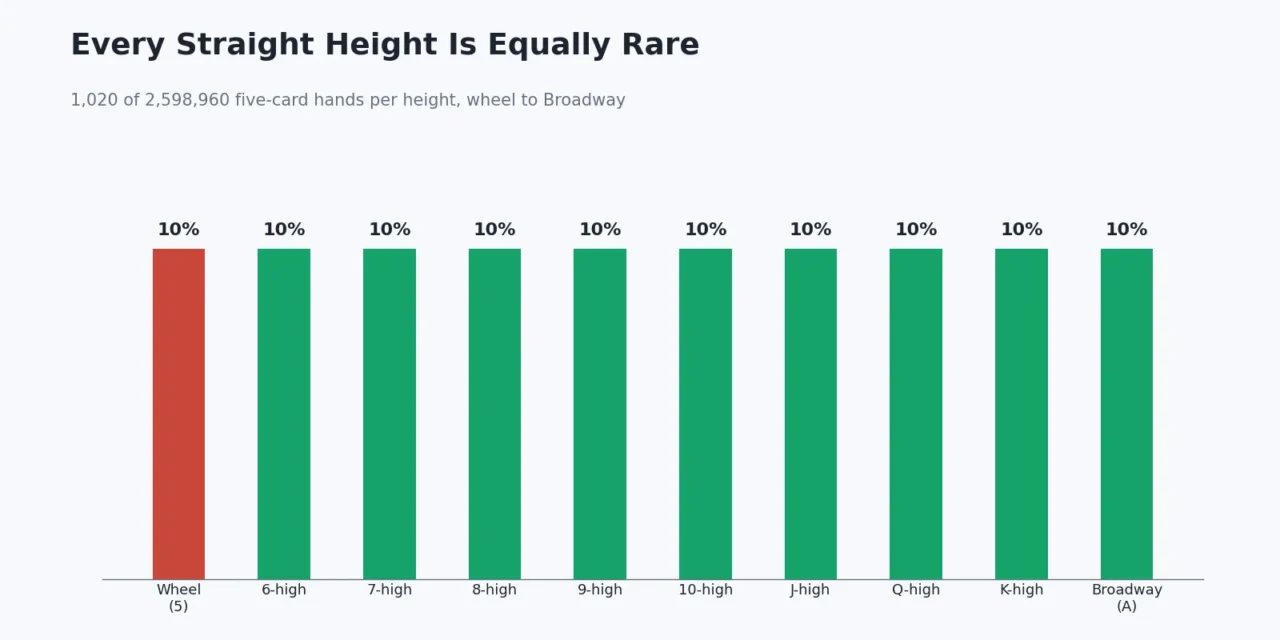
| Is the wheel rare? | No. It is exactly as common as every other straight height: 1,020 of 2,598,960 five-card hands each (0.0392%), an equal 10.0% share of all 10,200 straight combinations, by exact enumeration. |
| Where is the wheel actually the best possible hand? | A-5 (California) lowball, where straights and flushes don’t count against a low hand. |
Meet the Wheel: Poker’s One True Ace-Low Straight
Every straight in poker is five cards of consecutive rank. Nine of the ten possible straights run through the “normal” ranks — 2 through 10, Jack, Queen, King — with the Ace, when it appears, always sitting on top as the highest card (as in Ten-Jack-Queen-King-Ace, “Broadway”). Exactly one straight breaks that pattern: A-2-3-4-5, where the Ace drops all the way to the bottom of the run and plays as if it were a “1.” Poker players have three interchangeable names for this hand:
- The wheel — the most common nickname at the table, especially in lowball and hi-lo games.
- The bicycle (or “bike”) — an older nickname, still used in some rooms and in low-ball literature.
- The ace-low straight — the plain-English, no-nickname description, and the one used in most written rules.
All three names refer to the exact same five cards: one Ace, one 2, one 3, one 4 and one 5, of at least two different suits (if all five are the same suit, the hand becomes a straight flush instead — the “steel wheel,” covered later in this guide).
This article is a focused deep dive on that one hand. TopSitesPoker.com’s companion guide, Straight in Poker, covers all ten straight heights and the general mechanics of making and comparing straights; if you want the full ladder, that is the right page. Everything below is about the wheel specifically: why the Ace behaves the way it does here, why the wheel is simultaneously the most common straight height and the weakest one, where it is actually the best hand in poker, and how to read it correctly when it shows up on the board.
Name Collision Warning: “Ace-High” Is a Different Hand Entirely
Before going further, one clarification that trips up a lot of players searching for this topic: “ace-high” and “the Ace playing low in a straight” are two completely unrelated ideas that happen to share the word “ace.”
Ace-high is the name of the entire no-pair, no-straight, no-flush hand category (category 0 in the standard nine-category ranking) when its best card happens to be an Ace — for example, A-J-8-6-3 of mixed suits. It is the single most common individual holding at a five-card poker showdown, and it has nothing to do with straights at all.
The Ace playing low, which is this article’s whole subject, happens only inside the wheel straight, A-2-3-4-5, where the Ace is part of a made straight (category 4) and is specifically not the hand’s high card for comparison purposes — the 5 is. A wheel is never described as “ace-high” in the hand-category sense, even though it literally contains an Ace.
If you were looking for the no-pair hand instead, that topic is covered in its own dedicated guide on this site. This page is about the wheel straight only.
Rule One: A Single Hand Is Never Both High and Low at Once
This is the single most common misconception about the ace-low straight, so it is worth stating as plainly as possible, before anything else:
In standard poker, a hand’s Ace is either the top of a run or the bottom of a run — never both in the same five cards, and there is no such thing as a straight that “wraps around the corner” from King through Ace to 2.
Concretely: K-A-2-3-4 is not a straight. It doesn’t matter how tempting the “circle” looks on a physical deck, or how the Ace’s dual nature (high in Broadway, low in the wheel) makes it feel flexible enough to bridge King and 2 — it isn’t. A run has to be five truly consecutive ranks with no gap, and going from King (rank 13) to Ace to 2 requires the Ace to simultaneously be rank 14 (to follow the King) and rank 1 (to precede the 2), which the game’s rules simply don’t allow within one hand.
This isn’t a matter of house-rule variation or a “some rooms play it differently” situation — it’s universal across every standard, wild-card-free poker variant played with a 52-card deck. To confirm it beyond any doubt, the table below runs the actual hand-evaluation code used to compute every statistic in this article against K-A-2-3-4 and against the two straights it sits between:
| Five cards (mixed suits) | Evaluator’s verdict | Why |
|---|---|---|
| Q-K-A-2-3 | Not a straight (Ace-high, no pair) | No five consecutive ranks exist; the gap between King and 2 can’t be bridged. |
| K-A-2-3-4 | Not a straight (Ace-high, no pair) | Same reason — this is the exact “wraparound” hand beginners expect to be a straight. It scores as plain Ace-high, with the King as the second-best card. |
| A-2-3-4-5 | Straight (the wheel) — lowest straight | Five truly consecutive ranks, with the Ace correctly filling the “1” slot below the 2. |
| 10-J-Q-K-A | Straight (Broadway) — highest straight | Five truly consecutive ranks, with the Ace correctly filling the “14” slot above the King. |
Two takeaways from that table matter for the rest of this guide. First, K-A-2-3-4 doesn’t downgrade to some lesser straight — it isn’t a straight of any kind. The evaluator reads it as a plain Ace-high hand (no pair, no straight, no flush), because the hand’s five actual ranks are King, Ace, 2, 3 and 4, and there is no way to arrange five consecutive ranks out of that set — jumping from King down to Ace down to 2 skips straight over Queen, which is exactly the gap that breaks the run. Second, the wheel (A-2-3-4-5) and Broadway (10-J-Q-K-A) are the two straights where the Ace does legitimate work — bottom of the run in one, top of the run in the other — and every other straight height (Six-high through King-high) doesn’t involve the Ace at all.
Some home games and informal variants deliberately add “around the corner” or “wraparound” straights as a house-invented twist (sometimes bundled with other novelty rules). If you ever see K-A-2-3-4 accepted as a straight, that is a table-specific house rule being applied on top of the base game, not standard poker, and it should be confirmed with the dealer or posted rules before it costs you a pot.
It’s worth understanding where the misconception comes from, since it’s a genuinely reasonable-looking mistake rather than a careless one. Picture the thirteen ranks laid out in a circle rather than a straight line — the way suits of a physical deck are sometimes shown in teaching diagrams, with the King and the Ace sitting next to each other and the Ace and the 2 sitting next to each other on the other side. On that circular picture, K-A-2-3-4 really does look like five neighbors in a row. Standard poker, though, defines a straight using the ranks’ numeric order, not their physical position on any diagram — 2 through 14 (Ace), laid out in a straight line with exactly one gap-free run of five at the very top (10 through Ace) and one exception at the very bottom (Ace filling in as a “1” ahead of 2 through 5). There’s no rule anywhere that treats King and Ace-then-2 as adjacent for straight-forming purposes, no matter how natural the circular mental picture feels.
Why the Wheel Is the LOWEST Straight Despite Holding the HIGHEST Card
Here is the part that genuinely surprises new players once rule one has sunk in: the wheel contains an Ace, the single highest-ranked card in the deck — and yet it is ranked as the weakest of all ten possible straights, weaker even than a plain 6-high straight (2-3-4-5-6). How can a hand with the best card in the deck in it be the worst version of its own hand category?
The answer comes down to exactly which card gets compared when two straights face off.
Straights compare by their top card only
When two players both hold a straight, the tiebreak isn’t a card-by-card comparison of all five cards (that’s how one pair, two pair, three of a kind and flushes work, and it’s the subject of TopSitesPoker.com’s dedicated tie-breaker guide). A straight’s entire strength for comparison purposes is its single highest card in the run — nothing else about the hand matters once you know it qualifies as a straight at all.
For the wheel, A-2-3-4-5, the top of the run is the 5. The Ace is sitting at the bottom of the run, functionally standing in for a card ranked “1” — a rank that doesn’t otherwise exist in a standard deck. It is present in the hand, but it is not what the hand is compared by.
For Broadway, 10-J-Q-K-A, the top of the run is the Ace, correctly playing at its usual rank of 14.
So the same physical card — an Ace — does two structurally different jobs depending on which straight it’s part of: rank “1” (bottom of the run, irrelevant to comparison) in the wheel, or rank 14 (top of the run, the entire comparison) in Broadway. That is exactly what “the Ace can be high or low” means in practice — one job per hand, never both, and in the wheel’s specific case, the low job leaves the Ace out of the comparison picture entirely.
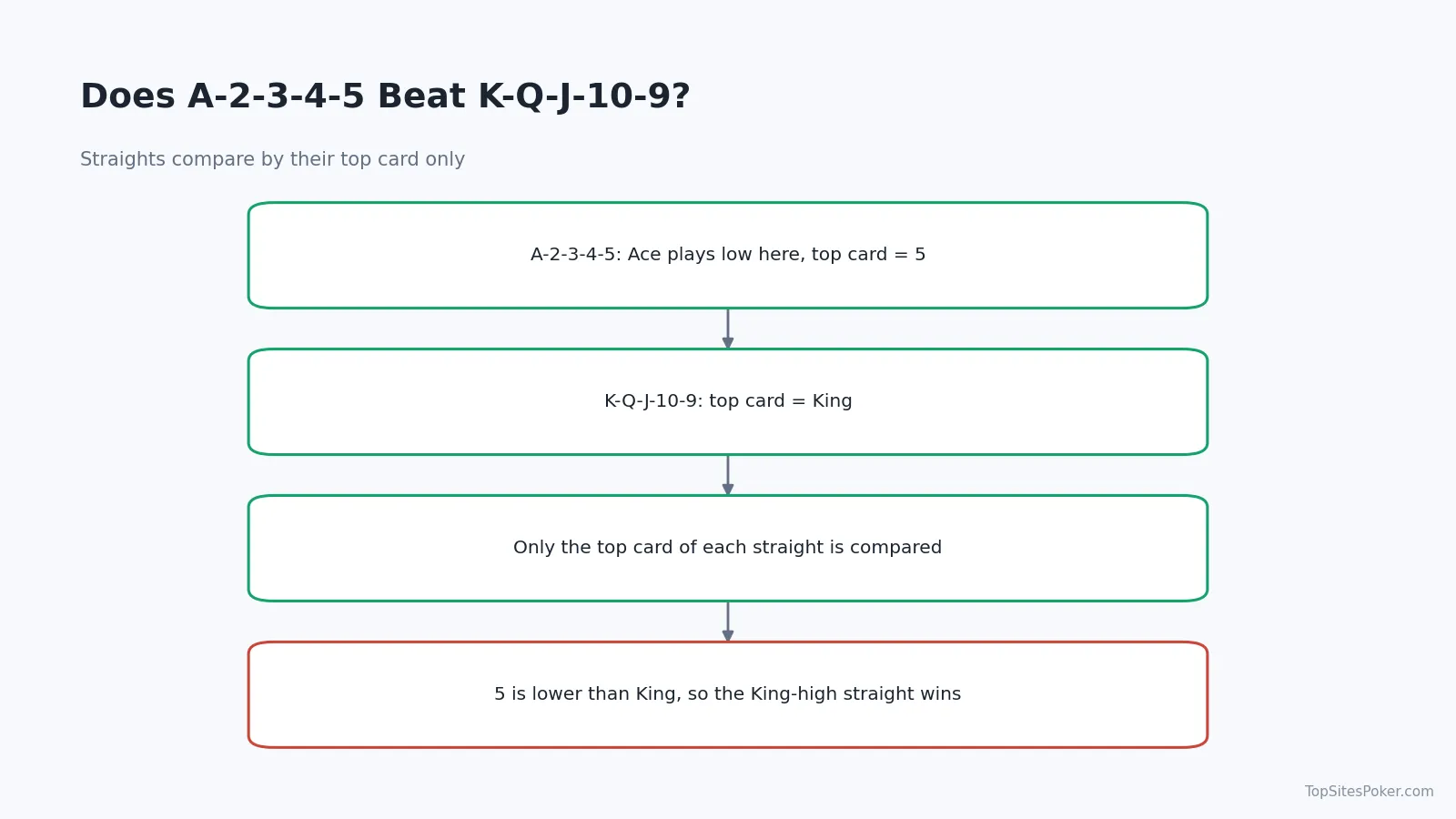
Run the actual numbers through a hand evaluator and this plays out exactly as expected: the wheel’s comparison value is tied to its 5, so it loses to every single one of the other nine straight heights — Six-high through Broadway — every time, with no exceptions and no kicker rescue. A King-high straight beats a wheel not because Kings “outrank” the wheel’s Ace in some general sense (an Ace outranks a King in every other context in poker), but purely because 5 is a lower comparison card than King. Swap the King-high straight for literally any other straight above 6-high and the wheel still loses, for the identical reason.
The ten straights, side by side
Because every straight height is compared by a single top card, and the wheel’s top card (5) is simply the lowest of the ten possible top cards a straight can have, the wheel sits at the very bottom of the straight hierarchy. This is a structural fact of how straights are defined, not a special penalty applied to the wheel — the table below lists exact five-card combination counts for every height, computed by exhaustive enumeration over all 2,598,960 possible five-card poker hands, and every single row (including the wheel’s) lands on precisely the same count:
| Straight (top card) | Five cards | Non-flush combinations | Straight-flush combinations | Share of all 10 heights |
|---|---|---|---|---|
| Wheel — 5 | A-2-3-4-5 | 1,020 | 4 | 10.0% |
| Six-high | 2-3-4-5-6 | 1,020 | 4 | 10.0% |
| Seven-high | 3-4-5-6-7 | 1,020 | 4 | 10.0% |
| Eight-high | 4-5-6-7-8 | 1,020 | 4 | 10.0% |
| Nine-high | 5-6-7-8-9 | 1,020 | 4 | 10.0% |
| Ten-high | 6-7-8-9-10 | 1,020 | 4 | 10.0% |
| Jack-high | 7-8-9-10-J | 1,020 | 4 | 10.0% |
| Queen-high | 8-9-10-J-Q | 1,020 | 4 | 10.0% |
| King-high | 9-10-J-Q-K | 1,020 | 4 | 10.0% |
| Broadway — Ace | 10-J-Q-K-A | 1,020 | 4 | 10.0% |
| Total | all 10 heights | 10,200 | 40 | 100% |
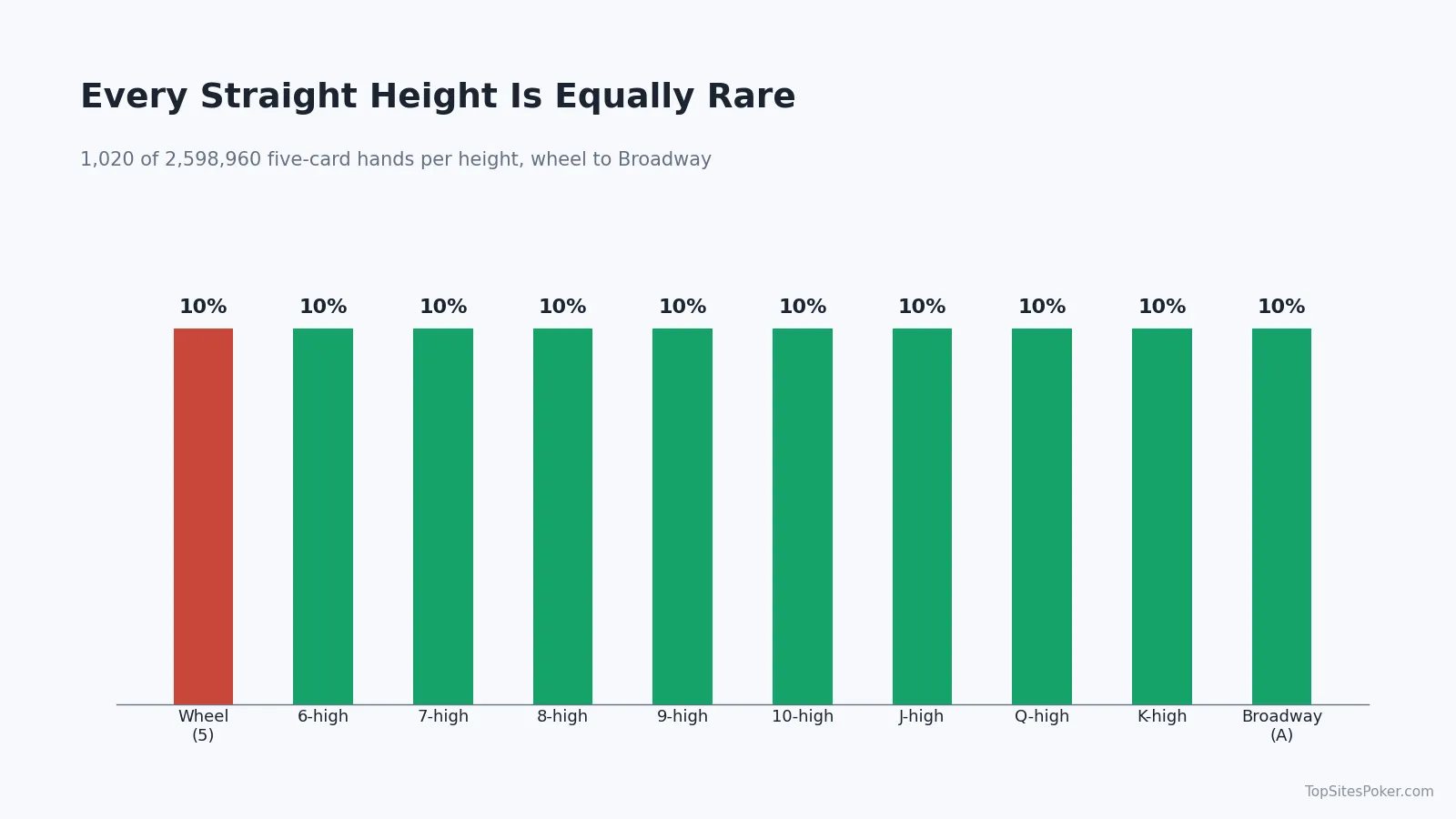
That symmetry isn’t a coincidence of this particular deck — it’s a direct consequence of how a standard straight is built. Every straight height is formed by choosing one card from each of five consecutive ranks, and every rank in a 52-card deck has exactly four cards (one per suit) available for that choice. The count is therefore identical for every height: 4 × 4 × 4 × 4 × 4 = 1,024 total ways to select one card of each of the five relevant ranks. Of those 1,024, exactly 4 combinations happen to be monochromatic — all five cards the same suit, which makes the hand a straight flush instead of a plain straight — leaving 1,020 non-flush straight combinations. That 1,024 = 1,020 + 4 split repeats for every one of the ten heights, wheel included, which is exactly why the “10.0% each” row above never varies.
So to be unambiguous about it: the wheel is not a rare, oddball, or “special case” straight. It is exactly as likely to be dealt or made as Broadway, or any height in between. What makes it the weakest straight is purely the comparison rule (top card only, and its top card is the lowest possible top card a straight can have) — not its frequency.
How Rare Is the Wheel, Really? The Exact Odds
Since frequency and rank are two different things, it’s worth spelling out exactly how often the wheel shows up, using the same exact-enumeration numbers from the table above.
| Event (5-card poker hand) | Combinations | Probability | Odds |
|---|---|---|---|
| Dealt the wheel exactly (non-flush) | 1,020 of 2,598,960 | 0.0392% | 1 in 2,548 |
| Dealt any one specific straight height (non-flush) | 1,020 of 2,598,960 | 0.0392% | 1 in 2,548 |
| Dealt some non-flush straight (any of the 10 heights) | 10,200 of 2,598,960 | 0.3925% | 1 in 254.8 |
| Dealt the steel wheel (A-2-3-4-5, one suit) | 4 of 2,598,960 | 0.000154% | 1 in 649,740 |
Two things worth sitting with. First, a random five-card poker hand is roughly 10 times more likely to contain some straight than one specific straight height, which is just the ordinary math of “1 out of 10 equally likely categories” — nothing wheel-specific there. Second, and more useful at the table: whenever you or an opponent makes a straight at all, there was never anything unusual about that straight happening to be the low end of the ladder. Across every one of the ten heights, the wheel included, you’re looking at a 1-in-2,548 shot from a truly random five-card hand.
The Steel Wheel: A-2-3-4-5, All One Suit
If all five cards of the wheel — Ace, 2, 3, 4, 5 — happen to be the same suit, the hand stops being a plain straight and becomes a straight flush, nicknamed the “steel wheel.” It follows exactly the same logic as the plain wheel: because only the top card of the run (the 5) is compared, the steel wheel is the lowest-ranked straight flush, sitting directly below a 6-high straight flush and worlds below a royal flush (10-J-Q-K-A, all one suit) — even though the steel wheel and the royal both contain an Ace.
Here is the detail that catches even experienced players off guard: because every straight-flush height is built the same way as every plain straight height (one suit, five consecutive ranks, and only 4 possible combinations per height — one starting card in each of the four suits), the steel wheel is exactly as rare as a royal flush. Both come out to precisely 4 of the 2,598,960 possible five-card hands — odds of 1 in 649,740 for either one, computed by the same exhaustive enumeration used throughout this guide.
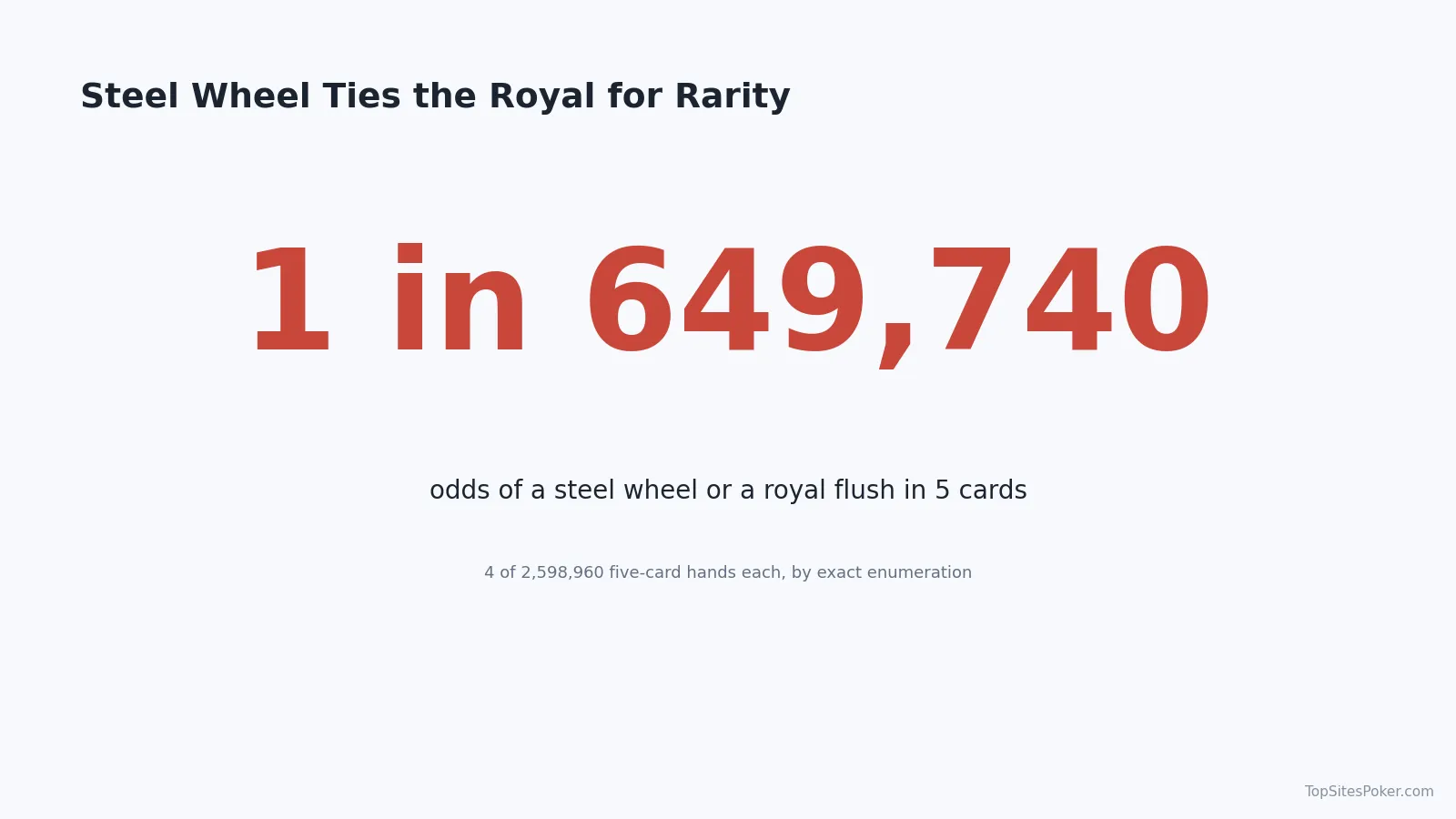
That tends to surprise people because “royal flush” carries a mythic weight in poker culture that “steel wheel” simply doesn’t — but rarity and prestige are different things. The royal flush is famous because it is also the single best possible hand in the entire standard game (nothing beats it, full stop). The steel wheel is equally rare, but it’s ranked at the very bottom of its own hand category — the weakest of the ten straight-flush heights — precisely for the same “top-card-only” comparison reason the plain wheel is the weakest straight. Never confuse the two: a steel wheel is still an extremely strong hand overall (it beats every four of a kind, full house, flush, straight and everything below), but among straight flushes specifically, it is the one that loses to the other nine.
| Hand | Cards | Combinations (of 40 total) | Odds, 5-card hand | Rank among the 10 straight flushes |
|---|---|---|---|---|
| Steel wheel | A-2-3-4-5, one suit | 4 | 1 in 649,740 | Lowest (10th of 10) |
| (any middle height, e.g. 7-high) | 3-4-5-6-7, one suit | 4 | 1 in 649,740 | Middle |
| Royal flush | 10-J-Q-K-A, one suit | 4 | 1 in 649,740 | Highest (1st of 10) |
How Often Does the Wheel Actually Win at Showdown?
Combinatorial rarity is one question; how the wheel performs in a real, multi-player game is another. To measure that, 150,000-trial Monte Carlo simulations were run at three table sizes (2-max, 6-max and 9-max) using a “no-fold” baseline: every seat is dealt two hole cards, all seats see the same random five-card board through to showdown, and the winner is whichever hand is actually best — nobody folds along the way. This baseline is standard for measuring raw showdown composition (it isolates “what wins when everyone sees it through” from real-game folding decisions), and it should always be cited with that caveat, which this article does every time the numbers below are used.
| Table size | Trials | Wheel wins the showdown | Wheel win rate | Any straight wins | Wheel’s share of straight wins |
|---|---|---|---|---|---|
| 2-max (heads-up) | 150,000 | 1,096 | 0.73% | 11,831 (7.89%) | 9.26% |
| 6-max | 150,000 | 2,344 | 1.56% | 24,660 (16.44%) | 9.51% |
| 9-max | 150,000 | 2,809 | 1.87% | 30,025 (20.02%) | 9.36% |
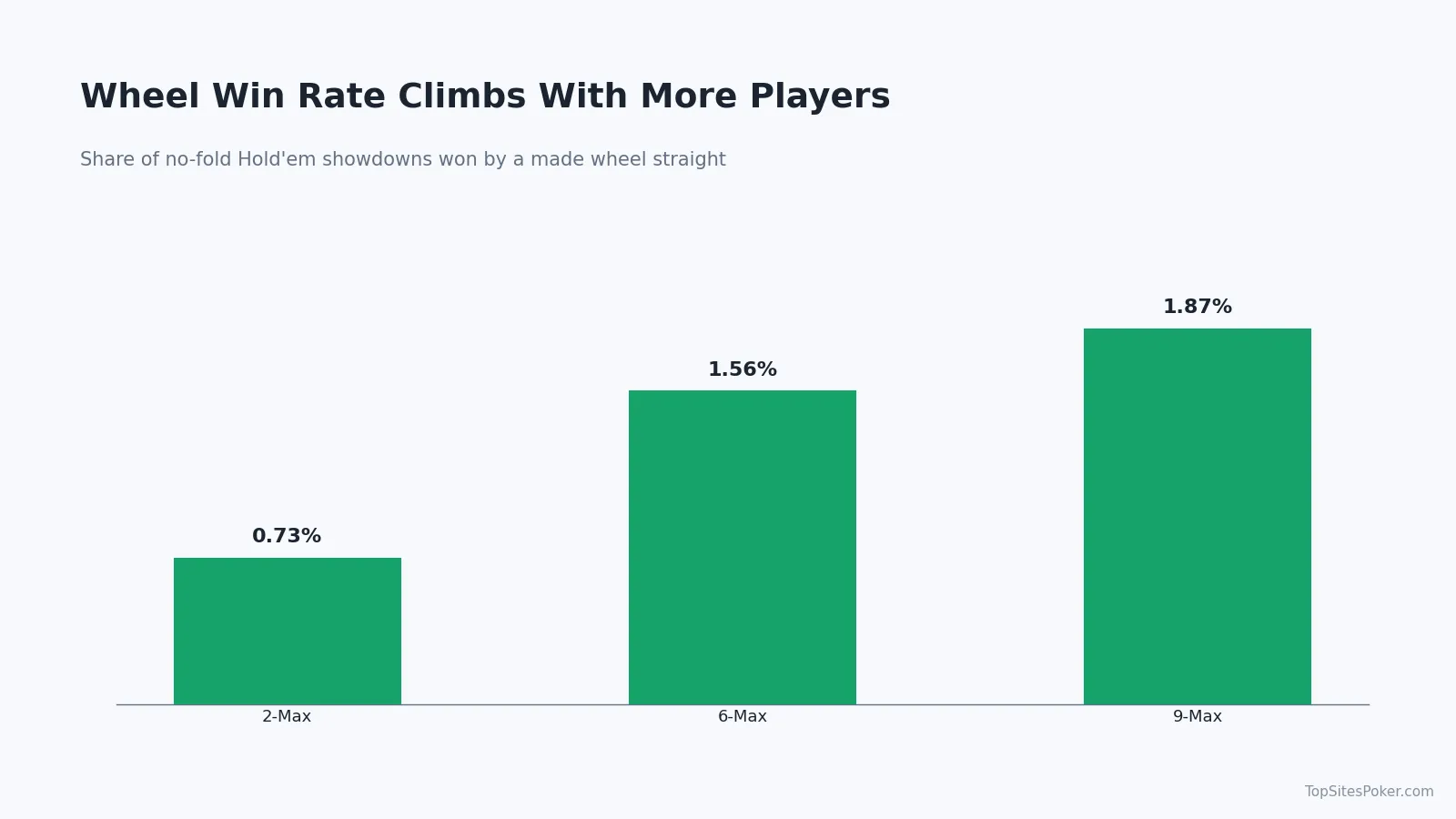
The win rate climbing from 0.73% heads-up to 1.87% nine-handed is not the wheel “getting stronger” as more players join — it is still, in every single trial, the weakest possible straight. What’s rising is the number of hands live to catch a wheel-friendly board in the first place: with nine hole-card pairs in play instead of two, there are simply more chances for somebody’s cards to complete an A-2-3-4-5 that nobody else can beat. More live hands means more total winning hands overall for every category, and the wheel shares in that general lift the same way every other hand type does.
The last column is the more interesting number for understanding the wheel’s actual standing among straights. If the wheel’s real-game strength matched its raw rarity, it would win roughly 10% of all straight-versus-straight and straight-wins-the-pot outcomes (since it’s exactly 1 of 10 equally likely heights). Instead it accounts for only about 9.3%–9.5% of straight wins across all three table sizes — consistently a bit below its “fair share.” That gap is exactly what you’d expect from a hand that is dealt as often as any other height but then loses every single one of the multi-straight showdowns where a higher straight happens to also be live. Being the bottom rung of a ten-rung ladder costs the wheel a small, measurable slice of its otherwise-equal frequency, every time a bigger straight is also in the hand.
Reading a Wheel Sitting on the Board: The “Everybody Plays the Board” Scenario
The single most common way players actually encounter the wheel in Texas Hold’em is not in their own two hole cards — it’s on the community board itself. When the five board cards are exactly A-2-3-4-5 (in any mix of suits that isn’t all one suit), every player at the table can use that entire five-card straight without needing anything from their own hand. This is the “everybody plays the board” scenario, and it comes with a few practical wrinkles worth understanding before it costs you a pot.
Baseline: how often does a board even flash “wheel danger”?
The same 150,000-trial simulations used above also tracked how often the five community cards, on their own, carry at least four of the five wheel ranks (Ace, 2, 3, 4 and 5) — a proxy for “this board is a wheel, or one card away from being one.” Because this measures the board alone, it doesn’t depend on how many players are dealt in, and the three table sizes land within a hair of each other, all close to 1.9%:
| Table size | Trials | Boards with 4+ of A-2-3-4-5 | Rate | Roughly |
|---|---|---|---|---|
| 2-max | 150,000 | 2,814 | 1.876% | 1 in 53.3 boards |
| 6-max | 150,000 | 2,794 | 1.863% | 1 in 53.7 boards |
| 9-max | 150,000 | 2,905 | 1.937% | 1 in 51.6 boards |
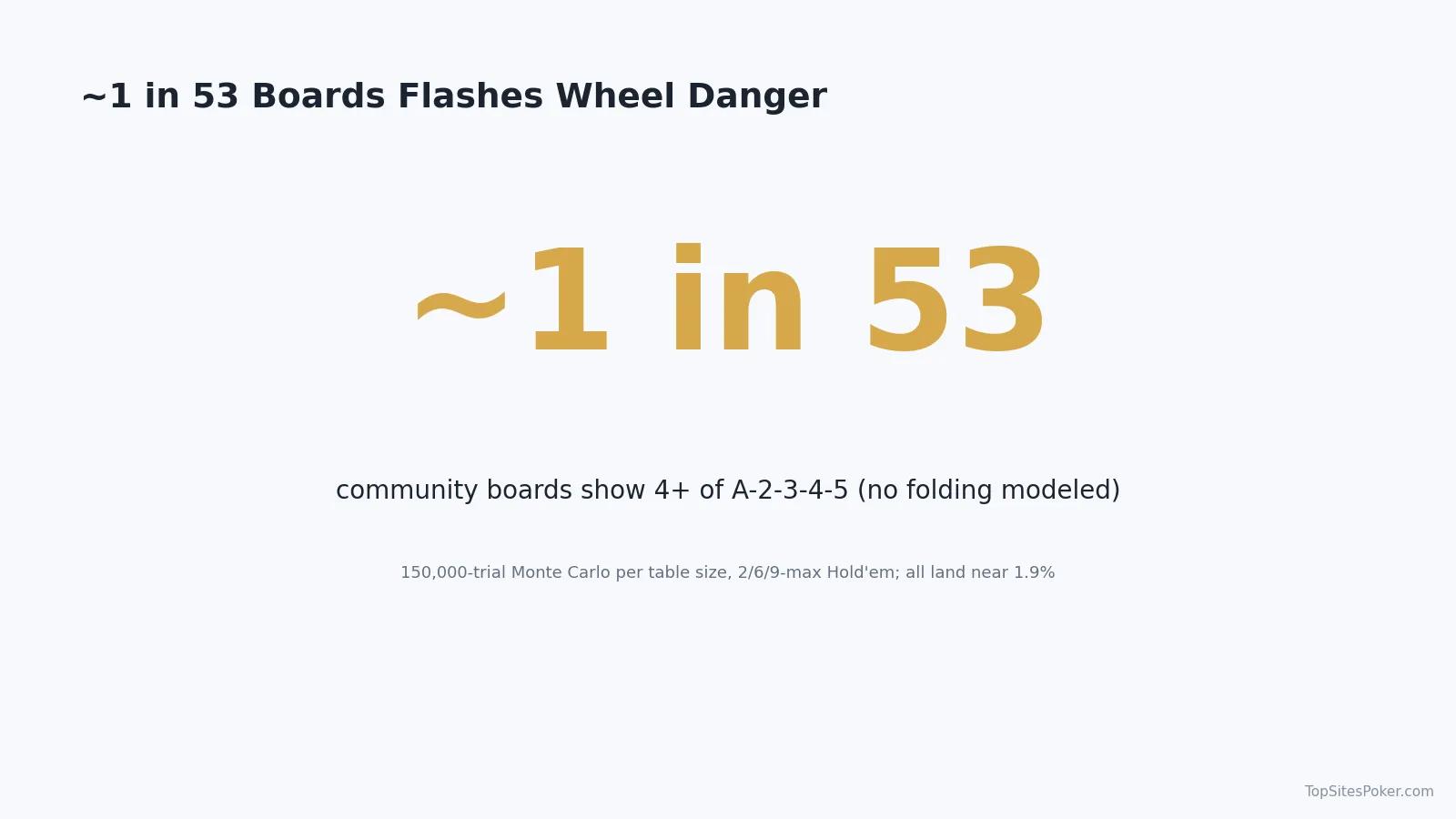
Put plainly: roughly 1 board in every 53 you’ll ever see dealt to a five-card runout flashes some form of wheel danger — either a completed wheel sitting there in full, or a near-miss just one card away. That’s a small but far from negligible slice of hands where reading the board correctly actually matters.
Worked example: the board reads A-2-3-4-5
Say the board runs out A♦-2♣-3♥-4♠-5♦ — a genuine made wheel, no flush possible on this particular mix of suits. Every remaining player automatically has at least a straight, because the board alone already qualifies as one. What happens next depends entirely on what each player’s own two hole cards add to those five community cards, and running the actual holdings through a hand evaluator turns up a few results that aren’t obvious on first glance:
| Hole cards | Best 5-card hand from all 7 cards | Result vs. the board’s own wheel |
|---|---|---|
| K-9 offsuit (no pair, doesn’t connect) | A-2-3-4-5 (the wheel — identical to the board) | Exact tie. This player is simply “playing the board.” |
| Pocket 2-2 | A-2-3-4-5 (the wheel — identical to the board; three deuces would be available but is a weaker hand, so it’s never used) | Exact tie with the board’s straight — three of a kind is always below a straight, so the extra deuce sits unused rather than costing the player anything. |
| Pocket A-A | A-2-3-4-5 (the wheel — identical to the board; three Aces would be available but is a weaker hand, so it’s never used) | Exact tie with the board’s straight — same reason. Trip Aces can’t out-rank a made straight, so the player’s actual best hand is simply the wheel itself. |
| 6-7 offsuit | 3-4-5-6-7, a 7-high straight | Beats the board’s wheel outright — a genuinely higher straight, using the board’s 3, 4, 5 plus the hand’s own 6 and 7. |
Two results there are worth flagging explicitly, because both are exactly the kind of thing that causes real confusion at a real table:
Pairing a wheel card does not automatically beat the wheel. It feels intuitive that pocket Aces sitting behind an A-2-3-4-5 board should be “better” than someone with nothing — after all, three Aces sounds powerful. But three of a kind (hand category 3) is always ranked below any straight (hand category 4) in the standard hierarchy, no matter what the three of a kind’s rank or kickers are. Trip Aces on a wheel board doesn’t upgrade you past the board’s own straight; it leaves you exactly where the board leaves everyone who didn’t improve — tied with (not beating) whoever is only playing the board, and beaten outright by anyone who found a genuine 6-high or better straight.
A wheel on the board is not automatically a chopped pot. The moment you assume “the board plays for everyone” and stop reading further, you can miss a hand that has quietly jumped past the board’s own straight using nothing more exotic than one or two connecting hole cards. A single 6, held by any live player along with almost anything else that extends the run, converts their hand into a straight that beats the community’s wheel outright.
The rules that govern this at the table
A player who is only “playing the board” — holding nothing that improves on the community’s own five cards — is not automatically excused from tabling their hand. Under the current Poker TDA rules (2026 edition), a player must table all their hole cards to win any part of a pot, and that requirement explicitly covers the case where a player is playing the board (TDA Rule 14, and TDA Rule 20 specifically addressing the board-plays situation). Cards speak for themselves at showdown — a player’s own verbal description of their hand does not decide the outcome, and a deliberate miscall (for example, announcing a better hand than you actually hold to induce a fold, or a worse one to disguise a raise) can be penalized under TDA Rule 13.
When several players are all genuinely tied for best hand — say, three players all simply playing the board’s wheel with nothing better — the pot is split evenly among them, and if it doesn’t divide into even whole units, the odd chip in flop-based games like Hold’em goes to the first seat left of the button, under TDA Rule 21 (Stud-style games instead break the tie by highest card by suit; that rule is covered in more depth in this site’s dedicated tie-breaker guide, since the mechanics of splitting and awarding odd chips apply well beyond just wheel-on-board scenarios). One related convention you’ll sometimes hear invoked in exactly this “does everyone need to show?” moment is “show one, show all” — worth flagging explicitly that this is a house rule adopted by many rooms, not a TDA rule, and it governs a different situation (whether a player who voluntarily shows their cards to one opponent must show them to the whole table), not the underlying requirement to table your hand to claim a pot. Since house rules vary by room, always check your specific table’s posted rules rather than assuming a rule you’ve seen elsewhere applies everywhere.
Worked example: the wheel gets made on the turn or river, not dealt whole
The board doesn’t need to already be a complete wheel for these same dynamics to matter. Suppose a player holds 4♣-5♥ and the board runs out A♠-2♦-3♣-9♥-K♣ — no 6 anywhere. That player’s best hand, using their own 4 and 5 alongside the board’s Ace, 2 and 3, is exactly the wheel: a straight, but the weakest possible one, and vulnerable the entire time to any single 6 that might have landed instead of one of those two blank cards (the 9 or the King).
Now change just the river: A♠-2♦-3♣-6♦-K♣. That same player, still holding 4-5, automatically upgrades — their best five-card hand becomes 2-3-4-5-6, a 6-high straight, one full rung above the wheel they’d have had otherwise. This happens without the player doing anything at all; it’s simply a consequence of them privately holding the exact two cards (4 and 5) that let the board’s new 6 extend their run instead of merely tying it. An opponent who separately holds a 6 in that same spot, but without also holding a 4 and a 5, does not make a straight at all from that board — a lone 6 next to A-2-3-6-K is worth exactly one pair, nothing more, because the run from 2 through 6 needs a 4 and a 5 that this particular opponent simply doesn’t have.
The lesson generalizes cleanly: whenever the board is showing a made or near-made wheel, the two cards that matter most for reading who’s actually ahead are 6 and 7 — a live 6 upgrades anyone already holding 4-5 or 3-4 into the run above the wheel, and a live 7 extends it one rung further still, all while the board’s own wheel (or near-wheel) sits there looking, to an inexperienced eye, like the final word on the hand.
Where the Wheel Is Actually the BEST Hand: A-5 (California) Lowball
Everything so far has been about the wheel as the weakest version of a high-poker straight. Flip the game to a genuine lowball variant, and the exact same five cards become the single best hand you can hold.
A-5 lowball (also called California lowball, and the low-hand rule set used in Omaha Hi-Lo and Stud Hi-Lo’s low side, discussed next) works by a simple, deliberately different principle: the goal is the lowest five-card hand, Aces always count low, and — critically — straights and flushes are completely ignored for the purposes of ranking a low hand. A hand is read purely by its five individual card ranks, from highest down to lowest, with the lowest “highest card” winning; pairs still hurt a low hand exactly the way they hurt a high hand (a pair is worse than five unpaired cards), but a run of five consecutive ranks or five cards of one suit carries no penalty at all in this specific rule set.
Because straights simply don’t count against a low hand in A-5 rules, A-2-3-4-5 — the same five cards that make the weakest straight in high poker — becomes the best possible low hand in the entire deck: five genuinely distinct, unpaired, as-low-as-possible ranks, with the Ace playing at its lowest value of all. There is no lower five-card combination available under A-5 rules, which is exactly why the wheel is the nickname players actually reach for in these games; unlike in Hold’em, where “made the wheel” is bittersweet (you have a straight, but the worst kind), in A-5 lowball “made the wheel” is unambiguously the best possible news.
Razz: Why “the Wheel” Isn’t Really a Category There
Razz — seven-card stud played for low — uses ace-to-five low hand rankings much like A-5 lowball, with the Ace always low and pairs hurting a hand. But Razz goes one step further than A-5 lowball: it does not recognize straights or flushes as hand categories at all, not even as something to be ignored the way A-5 lowball ignores them for low purposes. A Razz hand is read purely as five individual card ranks, full stop — there is no straight-vs-non-straight distinction anywhere in the rule set to begin with.
The practical result is that A-2-3-4-5 in Razz is simply the best possible five distinct low cards — the same rock-bottom holding as in A-5 lowball — but it isn’t meaningfully called “the wheel” in Razz the way it is elsewhere, because “the wheel” as a concept only makes sense in a game where straights are a recognized category that this particular one happens to occupy a special (best-low or worst-high) position within. In Razz, there simply is no straight category for A-2-3-4-5 to be the special case of. Players sometimes still use the word informally as a habit carried over from other games, but the underlying rules of Razz don’t treat it as anything structurally different from, say, A-2-3-4-7 (which is a slightly worse low, but not because it “isn’t a straight” — Razz was never checking for straights in the first place).
2-7 Triple Draw: Where the Wheel Is a Trap, Not a Treasure
Deuce-to-Seven Triple Draw flips nearly every one of the wheel’s favorable rules on their head, and it’s worth being explicit about each reversal, since assuming A-5-style rules in a 2-7 game is a genuinely costly beginner mistake:
- Aces always play high in 2-7, never low. There is no “ace plays as a 1” option at all in this variant.
- Straights and flushes count against a low hand in 2-7 — the exact opposite of A-5 lowball’s rule. A hand that happens to form a straight or a flush is actively disqualified from being read as a strong low; it has to be evaluated as if it were a made straight or flush working against you.
- The best possible 2-7 hand is 7-5-4-3-2, unsuited, with no pair, no straight and no ace — not anything resembling A-2-3-4-5.
Put those three facts together and A-2-3-4-5 is, in 2-7 rules, doubly bad: it contains an Ace, which plays high and is one of the very cards a 2-7 player is trying to avoid entirely, and it forms a genuine five-card straight, which counts against the hand rather than for it. So while the label “wheel” travels across game variants as a familiar nickname, the actual holding it describes is not something a 2-7 player is ever trying to make — it’s closer to a hand shape you’re specifically trying to draw away from. If you’re moving between hold’em, A-5 lowball and 2-7 triple draw in the same session, this is the single easiest rule to mix up, and mixing it up is expensive.
A Straight That Can’t Exist: Short Deck (6+) Hold’em
One more variant is worth a specific mention, because it removes the wheel from the game entirely rather than reranking it: Short Deck Hold’em, also called 6+ Hold’em. This variant strips every 2, 3, 4 and 5 out of the deck before play, leaving a 36-card deck that runs 6 through Ace in each suit. Since the wheel is built from exactly the ranks Ace, 2, 3, 4 and 5, and three of those five ranks (2, 3 and 4) simply don’t exist in the box any more, A-2-3-4-5 cannot physically be dealt or made in Short Deck Hold’em at all — not rarely, not weakly, but literally not present in the deck.
What replaces it at the bottom of the straight ladder depends on the specific ruleset in force, and this is exactly the kind of detail that varies by room, so it’s worth checking rather than assuming. Most published Short Deck rulesets keep the Ace’s low-playing option and simply shift the lowest available run down to the new bottom of the deck, making A-6-7-8-9 the lowest straight (with the Ace once again playing as a “1,” the same mechanical trick as the standard wheel, just against a different set of neighboring ranks). A minority of rulesets instead drop the Ace-low option entirely in this variant, in which case the lowest straight would simply be 6-7-8-9-10. Either way, standard Short Deck play typically also reranks flushes below full houses (a separate, unrelated rule change driven by the deck’s different straight and flush frequencies), which is a good reminder that Short Deck is not “regular Hold’em with a shorter deck” so much as its own distinct rule set — confirm the exact straight and hand-ranking rules posted at your specific table or site before assuming anything about low straights carries over.
Cheat Sheet: The Wheel Across Every Major Poker Variant
| Game | Does the Ace ever play low? | Is A-2-3-4-5 a straight here? | What A-2-3-4-5 actually means |
|---|---|---|---|
| Texas Hold’em / Omaha (high) | Yes, only in this one straight | Yes — the weakest of the 10 straight heights | A made straight, but the one everyone else’s straight beats |
| Seven Card Stud (high) | Yes, only in this one straight | Yes — same as Hold’em | Same weakest-straight status |
| Omaha Hi-Lo (8-or-better) | Yes, low always allowed; also the weak straight for high | Yes for high purposes; also usable as a qualifying low | Can be the nut low and a straight for high at once (see next section) |
| Seven Card Stud Hi-Lo | Same as Omaha Hi-Lo | Same dual role | Same scooping potential (see next section) |
| A-5 (California) Lowball | Yes, Ace always plays low | Straights don’t count against a low hand at all | The single best possible hand in the entire game |
| Razz | Yes, Ace always plays low | No straight category exists in this game at all | Just the best possible five distinct low cards — not a meaningful “straight” |
| 2-7 Triple Draw | No — Aces always play high | Yes, and it actively hurts the hand | A trap holding: an Ace (bad, plays high) inside a made straight (bad, disqualifies a strong low) |
| Short Deck (6+) Hold’em | Depends on the ruleset; the 2s, 3s and 4s are removed either way | No — physically impossible, the deck has no 2, 3 or 4 | Not a category at all in this game; check whether the room uses A-6-7-8-9 or 6-7-8-9-10 as the lowest straight instead |
The Scoop: Winning Both Halves of the Pot With the Wheel in Hi-Lo Games
This is the single most famous practical reason serious players go out of their way to talk about the wheel at all: in a split-pot hi-lo game — Omaha Hi-Lo (8-or-better) or Seven Card Stud Hi-Lo — holding the wheel can let one player win the entire pot, both the high half and the low half, in a single hand. Poker players call this a “scoop.”
How the split works
In an 8-or-better hi-lo game, the pot is divided into two halves at showdown. The high half goes to the best conventional high poker hand, exactly as in a regular high-only game. The low half goes to the best qualifying low hand — but only if at least one player actually has one: to qualify at all, a hand needs five cards, each ranked eight or lower, with no pair among them (the Ace counts as the lowest card of all for this purpose). If nobody at the table qualifies for low, the entire pot — both halves — goes to the best high hand instead.
Among all the low hands that can possibly qualify, A-2-3-4-5 is the best one available, full stop — it’s five as-low-as-possible cards, unpaired, all comfortably under the eight-or-better ceiling. That’s the same “best possible low” role the wheel plays in plain A-5 lowball, just now competing for only half the pot instead of all of it.
Where the scoop comes from
The scoop happens because that exact same five-card combination, A-2-3-4-5, doesn’t just qualify as the nut low — under the ordinary high-hand rules running in parallel at the very same table, it’s also a genuine straight. If a player’s best available high hand and best available low hand turn out to be the identical five cards, and no other player at the table beats that straight for high, that one player wins the high half (as a straight) and the low half (as the best possible qualifying low) with the very same holding.
A concrete Omaha Hi-Lo example makes this precise. Omaha hi-lo hands (like all Omaha hands) are built from four hole cards and five community cards, but the final five-card hand — separately for high and separately for low — must use exactly two of the four hole cards plus exactly three of the five board cards; a player can’t simply take their best five cards from all nine freely the way a Hold’em or Stud player can. Suppose a player holds A♦-2♣ among their four hole cards, and the board reads 3♠-4♥-5♦-9♣-K♠. That player’s two hole cards (A, 2) plus three specific board cards (3, 4, 5) combine into A-2-3-4-5 — using exactly the required two-from-hand-plus-three-from-board split. Read as a low hand, that’s the unbeatable nut low. Read as a high hand, it’s also a straight (the wheel) — and if the board’s 9 and King don’t hand anyone else a flush, a full house, or a higher straight, that same five-card wheel takes the entire pot: low half for being the best possible low, high half for simply being the only (or best) straight on the table.
Seven Card Stud Hi-Lo works the same way in spirit but without Omaha’s rigid two-plus-three card-selection rule: a Stud Hi-Lo player freely picks their best five of their own seven cards for the high side, and separately picks their best qualifying five of those same seven cards for the low side (the two selections can differ, or — as in the scoop scenario — be the exact same five cards). A worked Stud Hi-Lo example: a player’s seven cards end up being A♥, 2♠, 3♦, 4♣, 5♥, 9♠ and K♦. Read for low, the best qualifying five are A-2-3-4-5 — the nut low, exactly as in any other ace-to-five low reading. Read for high, that same player scans all seven cards for their best possible five-card poker hand and finds the identical A-2-3-4-5 straight is also their best available high hand (the 9 and King don’t combine into anything better). If no other hand at the table beats that straight for high, this player scoops the entire pot with one seven-card holding doing double duty — the same underlying mechanism as the Omaha example, just without the two-from-hand-plus-three-from-board restriction that Omaha imposes.
The scoop isn’t guaranteed just for holding the wheel
It’s worth being precise here, because this is exactly where overconfidence creeps in: holding the wheel guarantees you the best possible low (nothing beats A-2-3-4-5 as a low hand), but it does not automatically guarantee the high half too. Remember, the wheel is the weakest straight in high poker — if any other player at the table has made two pair, three of a kind, a flush, a full house, or literally any straight one rung higher, that player takes the entire high half, and the wheel-holder settles for a half-scoop: the whole low side, nothing from the high side. The full scoop specifically requires that nobody else’s hand beats the wheel for high — which, given that a straight already beats one pair, two pair and three of a kind outright, is a real and common outcome, but never an automatic one just because you hold the best possible low.
More Worked Examples: Reading the Wheel Correctly
A few additional real-holding scenarios, beyond the board-wheel cases already covered, round out the practical picture.
Example: your own two hole cards make the wheel, with no help from a wheel-friendly board
You hold 2♣-3♦ in Hold’em. The board runs A♥-4♠-5♣-9♦-K♥. Your best five-card hand combines your 2 and 3 with the board’s Ace, 4 and 5, for a made wheel — the weakest straight, but still a straight, and still comfortably ahead of a single pair, two pair, or three of a kind that anyone else might be showing. Unlike the “board is already the wheel” scenario covered earlier, this particular board only contributes two connecting ranks (the 4 and the 5) — so nobody else can complete a bigger straight from these seven cards without also holding your exact 2 and 3, which would only tie you, never beat you. The real risk on a runout like this one is a backdoor flush (the board already shows two hearts) or a bigger hand category entirely — trip Kings, trip 4s or trip 5s from pairing one of the board’s own ranks, or two pair — not a higher straight.
Example: the wheel loses to a full house lurking behind a paired board
Board: 2♠-3♥-4♦-5♣-5♦ (the 5 is paired). A player holding A♣-K♥ makes the wheel using their Ace plus the board’s 2, 3, 4 and one of the two 5s — confirmed directly against the hand evaluator, that player’s best five cards are exactly A-2-3-4-5, a straight, already enough to beat any single pair on the board. But a second player holding pocket 4-4 does better still: their two 4s plus the board’s remaining 4 make three 4s, and the board’s own pair of 5s slots in right behind it for a full house, 4-4-4-5-5 — verified to beat the wheel outright, the same way any full house beats any straight regardless of which one. The general lesson: whenever a wheel-carrying board is also paired, a full house is a live possibility, and the straight should be treated as vulnerable, not safe.
Example: distinguishing “made the wheel” from “drawing to the wheel,” with the real math
Holding 3♦-4♠ with a flop of A♣-2♥-9♠, you don’t yet have the wheel — you have a draw that specifically needs a 5 to complete A-2-3-4-5, since the board doesn’t already carry one. This particular holding only pairs with a 5; nothing else in the deck (a 6, for instance, would leave you with A-2-3-4-6, which still isn’t five truly consecutive ranks) completes a straight here. That makes it a single-card, “gutshot” draw to the wheel specifically, not the two-way, either-end draw a holding like 4-5 would have on a similar board.
With four 5s left in the deck and, on the flop, 47 unseen cards, the standard combinatorial approach gives this draw an 8.51% chance to complete on the very next card (4 divided by 47), and a further 8.70% chance on the river if it misses the turn (4 divided by 46 remaining cards). Combined across both remaining cards, that works out to a 16.47% chance to complete the wheel by the river — close to the quick “outs times 4” shortcut many players use at the table (4 outs × 4 ≈ 16%), which is exactly why that shortcut exists. At typical pot-sized bets, a 16.47% shot needs roughly 5-to-1 pot odds or better to be profitable purely on its own drawing equity — worth remembering given that a completed wheel, once it arrives, is still only the bottom rung of the straight ladder and can itself be outdrawn by anyone holding a live 6.
Common Mistakes With the Ace-Low Straight
| Mistake | Why it’s wrong | Correct read |
|---|---|---|
| Thinking K-A-2-3-4 is a straight (“around the corner”) | There is no wraparound straight in standard poker — verified directly by hand evaluation, which reads K-A-2-3-4 as plain Ace-high, no pair. | Treat it as no pair at all; within these five cards, the only genuine partial straight is A-2-3-4 (missing just the 5) — the King is a disconnected fifth card, not part of any near-straight here. |
| Assuming the wheel is a rare, special hand because it’s “only” the ace-low case | It is exactly as common as every other straight height — 1,020 of 2,598,960 five-card hands each (0.0392%), an equal 10.0% share of all straights, identical to Broadway. | Play it as an ordinary straight in terms of how often it shows up; only its comparison rank (lowest) is special. |
| Assuming a pair on top of a wheel-carrying board (e.g., trip Aces) beats the board’s straight | Three of a kind is always below any straight in the standard hand hierarchy, regardless of rank or kickers. | A made straight on the board only loses to another straight, a flush, a full house, quads or a straight flush — never to three of a kind, two pair or one pair. |
| Assuming a wheel on the board automatically means the pot is chopped among everyone left | Any live 6 (with the right supporting cards) or better upgrades a hand past the mere wheel; the chop only happens if nobody actually improved. | Check specifically for a live 6 or 7 that could extend the run before assuming the board’s straight is the final word. |
| Confusing “ace-high” (the no-pair hand category) with “the Ace playing low in a straight” | These are two unrelated concepts that only share the word “ace” — one is a hand category, the other is a rule about one specific straight. | “Ace-high” never refers to the wheel, and the wheel is never described using the term “ace-high.” |
| Assuming A-5 lowball rules (straights don’t count) apply in 2-7 Triple Draw | 2-7 uses the opposite rule: straights and flushes actively hurt a low hand, and Aces always play high. | In 2-7, treat A-2-3-4-5 as a hand to avoid, not a hand to chase — the best possible 2-7 hand is 7-5-4-3-2, no ace, no straight, no flush. |
| Assuming holding the wheel in Omaha Hi-Lo guarantees the whole pot | The wheel guarantees the best possible low, but the high half still goes to whoever has the best high hand — which could easily beat the wheel’s own weak straight. | Expect a full scoop only when no other hand at the table beats a straight for high; otherwise expect to win only the low half. |
| Calling A-2-3-4-5 “the wheel” in Razz the same way you would in Hold’em or A-5 lowball | Razz doesn’t recognize straights as a category at all, so there’s no “weakest straight” or “best straight” distinction to be the special case of. | In Razz, just think of it as the best possible five distinct low cards, full stop — the “straight” framing doesn’t apply. |
Quick Quiz: Test Your Wheel Knowledge
- 1. In the straight A-2-3-4-5, what card does the hand’s strength get compared by when it faces another straight?
Answer: The 5 — the top card of the run. The Ace, sitting at the bottom, is not the comparison card here. - 2. Is K-A-2-3-4 a valid straight in standard poker?
Answer: No. There is no wraparound straight; this hand evaluates as plain Ace-high, no pair. - 3. Out of 2,598,960 possible five-card poker hands, how many are the non-flush wheel specifically?
Answer: 1,020 — exactly the same count as every other one of the ten straight heights. - 4. True or false: the wheel is rarer than a King-high straight.
Answer: False. Both occur in exactly 1,020 of 2,598,960 five-card hands — precisely equally common. - 5. What is the “steel wheel,” and how rare is it compared to a royal flush?
Answer: The steel wheel is A-2-3-4-5 all in one suit (a straight flush). It’s exactly as rare as a royal flush — 4 of 2,598,960 five-card hands each, or 1 in 649,740. - 6. In which game is A-2-3-4-5 the single best possible hand you can hold?
Answer: A-5 (California) lowball, where straights and flushes don’t count against a low hand. - 7. Does the term “wheel” mean anything special in Razz?
Answer: Not really — Razz doesn’t recognize straights as a category at all, so A-2-3-4-5 is simply the best possible five distinct low cards, not a “weakest straight” or “best straight” in any meaningful sense. - 8. In 2-7 Triple Draw, is A-2-3-4-5 a hand you want to make?
Answer: No. Aces always play high in 2-7, and straights count against a low hand there — A-2-3-4-5 is doubly unwanted, not a target. - 9. In Omaha Hi-Lo, what does it take for a player holding the wheel to “scoop” the entire pot?
Answer: The wheel automatically wins the low half (it’s the best possible qualifying low). To also win the high half — and scoop the whole pot — no other player’s hand can beat that same five cards as a straight for high. - 10. On a board showing a made wheel (A-2-3-4-5), does a player holding pocket Aces automatically beat the board?
Answer: No — the player’s actual best five-card hand is still just the wheel itself. Three of a kind would be a weaker hand than the board’s own straight, so it’s never used; the player ties the board exactly like anyone else who didn’t improve.
Frequently Asked Questions
Can an Ace really be low in poker?
Yes, in exactly one situation: the straight A-2-3-4-5, nicknamed the wheel or the bicycle. There, the Ace plays as the lowest card in the run, effectively standing in for a rank of “1.” It doesn’t play low anywhere else in standard poker.
Can the same hand use the Ace as both high and low at once?
No. A five-card hand’s Ace is either the top of a run (as in Broadway, 10-J-Q-K-A) or the bottom of one (as in the wheel, A-2-3-4-5) — never both in the same hand. There’s no “wraparound” straight that uses the Ace to bridge King and 2.
Is K-A-2-3-4 a straight?
No. Direct hand evaluation confirms this hand scores as Ace-high with no pair — not a straight of any kind. This is one of the most common misconceptions new players have about how the Ace works.
Why is the wheel the lowest straight if it has the highest card in the deck?
Because straights are compared purely by their top card, and the wheel’s top card for that purpose is the 5, not the Ace. The Ace is present in the hand, but it’s occupying the bottom of the run, not the comparison slot.
Is the wheel a rare hand?
No. It’s exactly as common as every other straight height — 1,020 of 2,598,960 five-card poker hands each (0.0392%), an equal 10.0% share of all 10,200 straight combinations, identical to Broadway or any height in between, computed by exhaustive enumeration.
What’s the difference between “the wheel” and “the bicycle”?
Nothing — they’re two names for the exact same hand, A-2-3-4-5. “Wheel” is more common at the table today; “bicycle” (or “bike”) is an older nickname still seen in some lowball literature and some rooms.
What is a “steel wheel”?
A-2-3-4-5, all in one suit — a straight flush instead of a plain straight. It’s the weakest of the ten straight-flush heights, for the same top-card-only comparison reason the plain wheel is the weakest straight, yet it’s exactly as rare as a royal flush: 4 of 2,598,960 five-card hands, or 1 in 649,740.
Does a steel wheel beat a royal flush?
No. A royal flush is the highest straight flush (top card Ace, played high); a steel wheel is the lowest (top card 5). Never confuse the two just because both contain an Ace — a steel wheel loses to every other straight flush height, royal included.
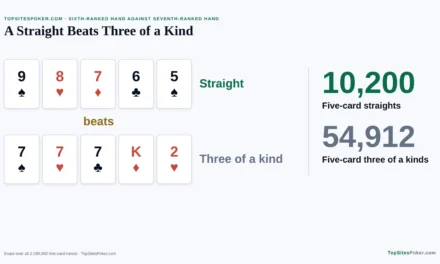
Does the wheel beat three of a kind?
Yes, always. Any straight, including the wheel, outranks three of a kind, two pair and one pair in the standard hand hierarchy, regardless of the three of a kind’s rank. On a board showing a made wheel, a player holding a pocket pair that matches a board rank (like pocket Aces) never actually gets to use those trips — their best five-card hand is still just the wheel itself, tied with the board, because the straight is the better of the two hands available to them.
In Texas Hold’em, if the board shows A-2-3-4-5, does everyone at the table tie?
Only the players who don’t improve on it. Anyone holding hole cards that don’t extend the run (for example, two unconnected high cards) ties the board exactly and simply “plays the board.” But any player holding a live 6 (with the needed supporting cards already on the board) has actually made a 6-high straight, which beats the community’s wheel outright — so it’s not a guaranteed chop just because the board itself is a straight.
If I’m just playing the board, do I still have to show my cards to win?
Yes. Under the current Poker TDA rules, a player must table all hole cards to win any part of a pot, and that requirement explicitly covers playing the board (TDA Rule 14 and TDA Rule 20). Simply announcing that you’re playing the board isn’t sufficient on its own — cards speak, not verbal claims (TDA Rule 13).
Is “show one, show all” a real poker rule?
It’s a widely used house rule at many rooms, not a rule set by the TDA. It governs whether a player who voluntarily shows their hand to one opponent must show it to the whole table — a different question from the requirement to table your hand to claim a pot. Since it’s a house rule, confirm it’s actually in effect at your specific table before relying on it.
Where is the wheel actually the best possible hand in poker?
In A-5 (California) lowball, where the goal is the lowest hand and straights and flushes are ignored for low purposes. A-2-3-4-5 is the lowest possible five unpaired card ranks, making it unbeatable as a low hand in that specific rule set.
Is the wheel a meaningful concept in Razz?
Not really, and this is worth being careful about. Razz doesn’t recognize straights (or flushes) as hand categories at all, so there’s no “weakest straight” or “best straight” for A-2-3-4-5 to be a special case of. It’s simply the best possible five distinct low cards under Razz’s plain ace-to-five ranking, and the word “wheel” is more habit than a meaningful rules category there.
Is the wheel a good hand to make in 2-7 Triple Draw?
No — quite the opposite. In 2-7 rules, Aces always play high (never low) and straights count against a low hand. A-2-3-4-5 is therefore a hand to avoid: it carries an unwanted Ace and forms a disqualifying straight. The best possible 2-7 hand is 7-5-4-3-2, unsuited, with no pair, no ace and no straight.
Can you even make the wheel in Short Deck (6+) Hold’em?
No. Short Deck removes the 2s, 3s and 4s from the deck entirely, and the wheel needs all three of those ranks, so A-2-3-4-5 simply cannot be dealt or made in that variant. Most Short Deck rulesets keep an ace-low option and use A-6-7-8-9 as the lowest straight instead, though a minority of rulesets drop ace-low there too and use 6-7-8-9-10 — check your specific room’s posted rules.
What are the exact odds of completing a gutshot draw to the wheel?
With four 5s left in the deck (the only card that completes a hand like 3-4 into A-2-3-4-5 on a board that already shows an Ace and a 2), the draw is 8.51% to hit on the very next card (4 of 47 unseen) and 8.70% on the following card if it misses once (4 of 46 unseen), for a combined 16.47% chance by the river — close to the everyday “outs times four” shortcut (4 × 4 ≈ 16%) many players use for a quick estimate.
What does it mean to “scoop” a pot with the wheel?
In a hi-lo split-pot game like Omaha Hi-Lo (8-or-better) or Stud Hi-Lo, the wheel is automatically the best possible qualifying low hand. If that same five-card holding also happens to be the best hand at the table for high (which requires nobody else beating it with a bigger straight, a flush, a full house or better), that one player wins both halves of the pot at once — a “scoop.”
Does holding the wheel in Omaha Hi-Lo guarantee I win the whole pot?
No. It guarantees you the low half, since nothing beats A-2-3-4-5 as a qualifying low. The high half still goes to whoever has the best high hand at the table — and since the wheel is the weakest straight, any other made straight, flush, full house or better takes that half instead, leaving the wheel-holder with only half the pot.
How often does the wheel actually win at real showdowns?
In 150,000-trial no-fold Hold’em simulations, the wheel was the outright winning hand 0.73% of the time heads-up, 1.56% six-handed, and 1.87% nine-handed. The rate rises with more players simply because more hands are live to catch a wheel-friendly board, not because the wheel itself gets any stronger.
How often does a board show wheel danger?
Roughly 1.9% of random five-card community boards carry at least four of the five wheel ranks (Ace, 2, 3, 4 and 5) — about 1 board in every 53, consistently across 2-max, 6-max and 9-max simulations, since this measures the board alone and doesn’t depend on how many players are dealt in.
Does a full house beat the wheel?
Yes, always — a full house outranks every straight, the wheel included, with no exceptions. This matters specifically because a wheel-carrying board is often also a paired board (since the wheel already uses five distinct low ranks, a sixth card completing five community cards frequently pairs one of them), and a paired board is exactly the texture where a full house can be lurking behind what looks like a made straight.
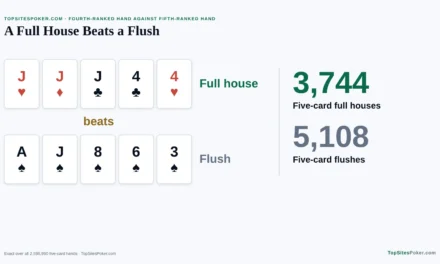
Does the wheel ever beat a flush?
No. In the standard nine-category hand ranking used in Texas Hold’em, Omaha and Seven Card Stud, every flush outranks every straight, the wheel included, regardless of the flush’s own high card. A wheel only wins a showdown against hands ranked at three of a kind or below — one pair, two pair, three of a kind, or nothing at all.
The Bottom Line
The wheel, A-2-3-4-5, is the one and only place a single hand’s Ace plays low instead of high — and it never plays both at once, since a “wraparound” straight through King-Ace-2 simply doesn’t exist in standard poker. That single rule quirk cascades into everything else that makes the wheel interesting: it contains the highest card in the deck yet ranks as the weakest of the ten straights, purely because straights are compared by their top card and the wheel’s top card is a 5, not an Ace. It is not rare — exactly 10.0% of all straights land on this height, identical to every other one — and the same top-card logic makes the steel wheel (its straight-flush version) exactly as uncommon as a royal flush while still ranking dead last among straight flushes. Read a wheel sitting on the community board carefully: a made straight there beats every pair, two pair and three of a kind at the table regardless of rank, but a live 6 or 7 can quietly leapfrog it. And in the games where the rules actually change — A-5 lowball, where it’s the best hand possible; hi-lo split games, where it can scoop an entire pot; Razz, where the whole “straight” framing doesn’t even apply; and 2-7 Triple Draw, where it’s a trap rather than a treasure — knowing exactly which rule set you’re sitting down to is the difference between correctly reading the wheel and costing yourself a pot over it.
About the Author and Legal Notes
Written and fact-checked by the TopSitesPoker.com Editorial Team. Our editorial team verifies poker hand rankings, tie-breaker mechanics and rules citations against the current Tournament Directors Association (TDA) rules and against hand outcomes computed directly by exhaustive enumeration or large-scale simulation, not recalled from memory.
Last updated: September 28, 2026. Next scheduled review: March 28, 2027.
This article is for informational purposes only and is not legal, financial or professional gambling advice. Nothing here guarantees any result at the poker table.
Play only where poker is legal and licensed. In U.S. states that license online poker, players must be 21 or older; in many other jurisdictions the minimum age is 18. Check your local laws before playing.
Poker room and cardroom rules vary and can change. Where this guide differs from the posted rules at your table or site, the posted rules apply. If you find an error, please let us know through our contact page.
TopSitesPoker.com may earn commissions from some of the poker sites we review. These commissions do not influence the rules, odds or rankings we publish.
If gambling is no longer fun, help is available: call, text or chat 1-800-MY-RESET (1-800-697-3738).
All third-party names, brands and trademarks are used for identification purposes only.
© 2026 TopSitesPoker.com. All rights reserved. Original data, tables and infographics on this page may not be reproduced without permission.