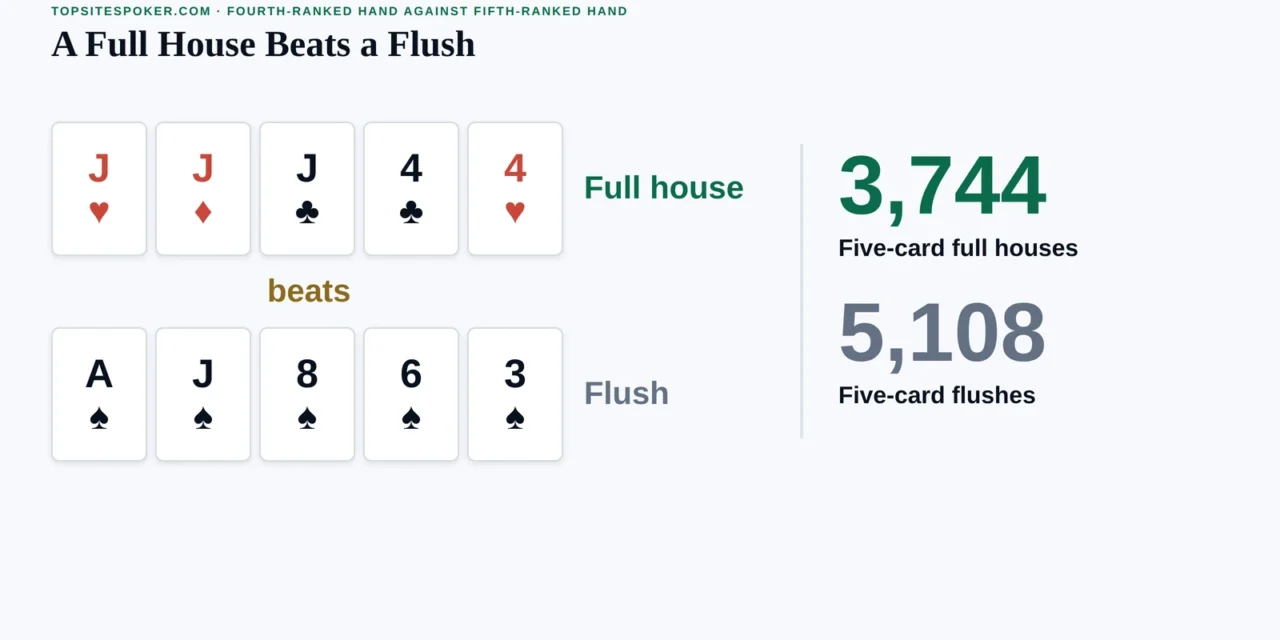
Yes. A full house beats a flush in Texas Hold’em, Omaha, Seven Card Stud and almost every other form of poker. A full house is three cards of one rank plus a pair; a flush is five cards of one suit. The full house ranks higher because it’s rarer: a five-card deal holds 3,744 full houses and 5,108 flushes.
Full house vs flush in brief
- Ranking: full house fourth, flush fifth, from the top.
- Even the lowest full house, 2-2-2-3-3, beats the best flush, A-K-Q-J-9 of one suit.
- In Hold’em, a full house needs a paired board, so on an unpaired board no full house is possible.
- Seven cards can’t hold a flush and a full house at the same time.
- The main exception is Short Deck (6+ Hold’em), where most rules rank a flush above a full house.
| Full house | Flush |
|---|---|
| Three of a kind plus a pair: J♥ J♦ J♣ 4♣ 4♥ | Five cards of the same suit, in any order: A♠ J♠ 8♠ 6♠ 3♠ |
| Fourth-best hand in standard poker | Fifth-best hand in standard poker |
| 3,744 five-card hands (0.144%, about 1 in 694) | 5,108 five-card hands (0.197%, about 1 in 509) |
| Best hand by the Hold’em river 2.60% of the time (1 in 39) | Best hand by the Hold’em river 3.03% of the time (1 in 33) |
| Best: A-A-A-K-K; worst: 2-2-2-3-3 | Best: A-K-Q-J-9 of one suit; worst: 7-5-4-3-2 of one suit |
| Two full houses: compare the three of a kind, then the pair | Two flushes: compare the highest card, then the next, down to the fifth |
| Beats a flush, a straight and everything below | Beats a straight, three of a kind and everything below |
| Loses to four of a kind and a straight flush | Loses to a full house, four of a kind and a straight flush |
| In Short Deck, usually ranks below the flush | In Short Deck, usually ranks above the full house |
Exact counts over all 2,598,960 five-card and 133,784,560 seven-card hands, counting each hand by its best five cards. Calculated by TopSitesPoker.com.
The flush-against-full-house showdown is one of poker’s classic coolers. A flush looks like a monster, and most of the time it is one, but when the board pairs, a full house can be waiting. The short answer never changes in standard poker: full house over flush. This guide explains why, then goes further: how close the two hands are in frequency, why a paired board is the warning sign, how sets and two pair do against flushes and flush draws, how often a flush loses to a full house at tables of every size, and the one popular game where the order is reversed.
Every probability here was calculated by the TopSitesPoker.com editorial team, either exactly, by counting every possible combination of cards, or by large simulations where exact counting isn’t practical. The only exceptions are the video poker frequencies and returns, which come from the Wizard of Odds. Each example was checked with a hand evaluator.
- A full house always beats a flush in standard poker, whatever the ranks: deuces full of threes beats an ace-high flush.
- The two hands are close in frequency: flushes are 1.36 times as common as full houses in five cards, and only 1.17 times as common in seven.
- In Hold’em, a full house is only possible on a paired board. By the river, 43.4% of the boards where a flush is possible are also paired.
- Every pocket pair makes a full house 8.55% of the time by the river; every unpaired hand, suited or not, 2.22%.
- With everyone seeing the river, a flush loses to a full house in about 1 of every 1,262 heads-up deals and 1 of every 125 six-handed deals.
- Short Deck reverses the order: with only 36 cards, flushes become rarer than full houses.
Why a Full House Beats a Flush
Poker hands are ranked by how hard they are to make in a five-card deal: the rarer the hand, the higher it ranks. A full house is rarer than a flush, so it ranks higher. Both counts are easy to check by hand:
- Full houses: choose the rank of the three of a kind (13 ways) and three of its four suits (4 ways), then the rank of the pair (12 ways) and two of its four suits (6 ways): 13 × 4 × 12 × 6 = 3,744 full houses.
- Flushes: choose a suit (4 ways) and five of its 13 ranks (C(13,5) = 1,287 ways), for 5,148 hands. Forty of those are straight flushes, which rank higher, leaving 5,108 flushes.
So a five-card deal holds about 1.36 flushes for every full house. That’s a much closer race than the flush against the straight, where straights are twice as common as flushes, but it’s enough to put the full house one place higher. Nothing about the ranks changes this: the lowest full house, 2-2-2-3-3, beats the highest flush, A-K-Q-J-9 of one suit.
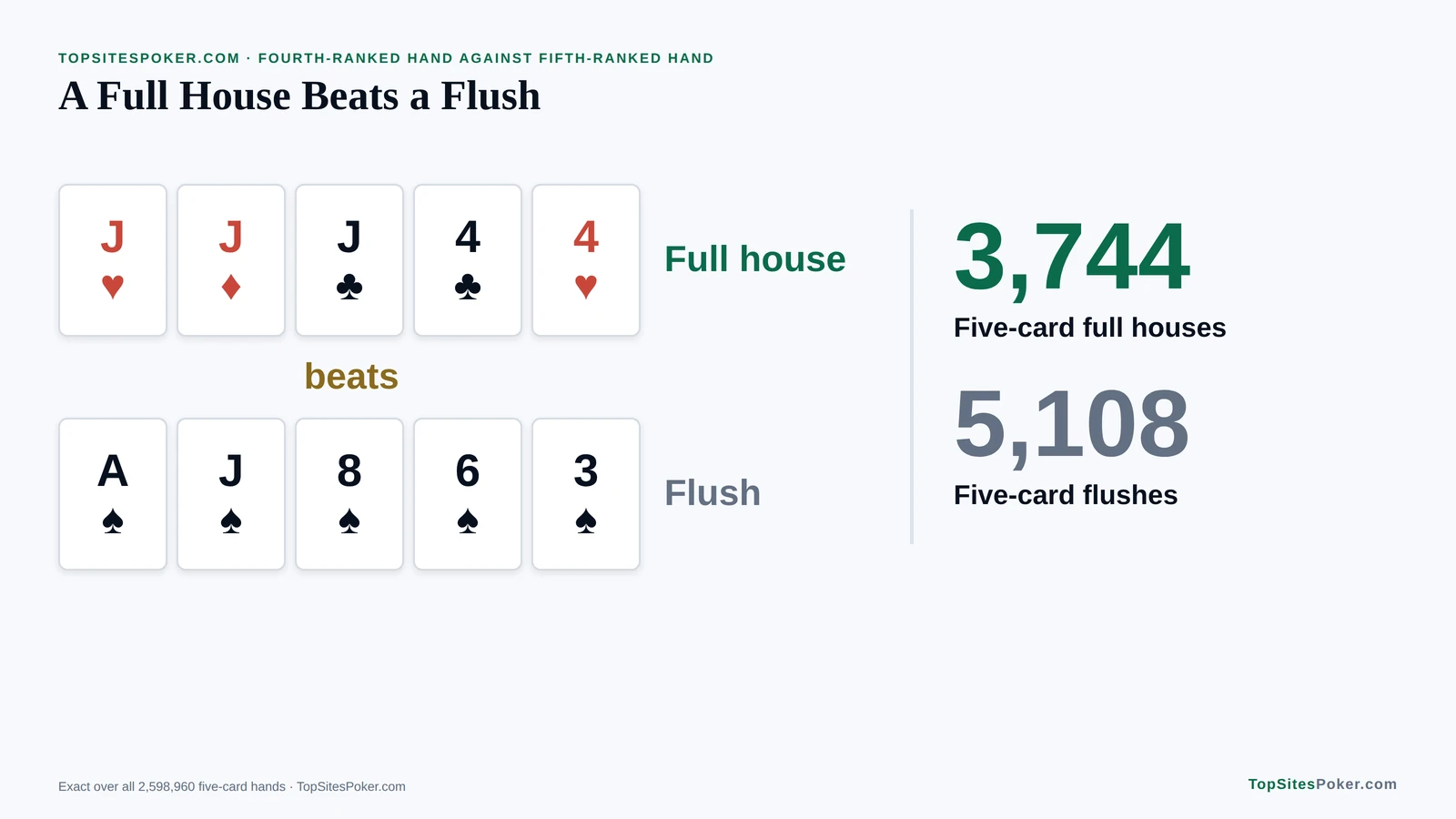
A full house ranks higher because it’s rarer: a five-card deal holds 3,744 full houses and 5,108 flushes.
Does it hold with seven cards?
Hand rankings are based on five-card deals, but in Hold’em and Stud you use the best five of seven cards. The extra cards help full houses more than flushes, so the gap narrows. It never closes:
| Cards seen | Full house as best hand | Flush as best hand | Flushes per full house |
|---|---|---|---|
| 5 (a five-card deal, or the Hold’em flop) | 3,744 of 2,598,960 (0.144%) | 5,108 (0.197%) | 1.36 |
| 6 (the Hold’em turn) | 165,984 of 20,358,520 (0.815%) | 205,792 (1.01%) | 1.24 |
| 7 (the Hold’em river, or Stud’s seventh street) | 3,473,184 of 133,784,560 (2.60%) | 4,047,644 (3.03%) | 1.17 |
Exact counts by TopSitesPoker.com over every possible hand, counting each by its best five cards.
Why do extra cards help the full house more? A full house needs pairs, and every extra card is another chance to pair something you already hold. A flush needs five cards of one suit, and once you have seven different cards there are only so many ways to get five of them into one suit. With five cards, a flush is 36% more common; with seven, only 17% more common.
The same comparison in other games
| Game | Full house | Flush | Which is rarer |
|---|---|---|---|
| Five-card deal | 0.144% | 0.197% | Full house |
| Texas Hold’em or Seven Card Stud, by the river | 2.60% | 3.03% | Full house |
| Omaha, by the river | 6.35% | 6.73% | Full house, just |
| Short Deck, five cards (36-card deck) | 0.458% (1,728 of 376,992) | 0.127% (480) | Flush |
| Short Deck Hold’em, by the river | 7.58% | 2.10% | Flush |
| 9/6 Jacks or Better video poker, final hands with optimal play | 1.15% | 1.10% | Flush, just |
Exact counts by TopSitesPoker.com, except Omaha (TopSitesPoker.com simulations of 200,000,000 hands, which agree with the Wizard of Odds’ exact counts) and video poker (published figures from the Wizard of Odds). Short Deck counts treat A-6-7-8-9 as the lowest straight.
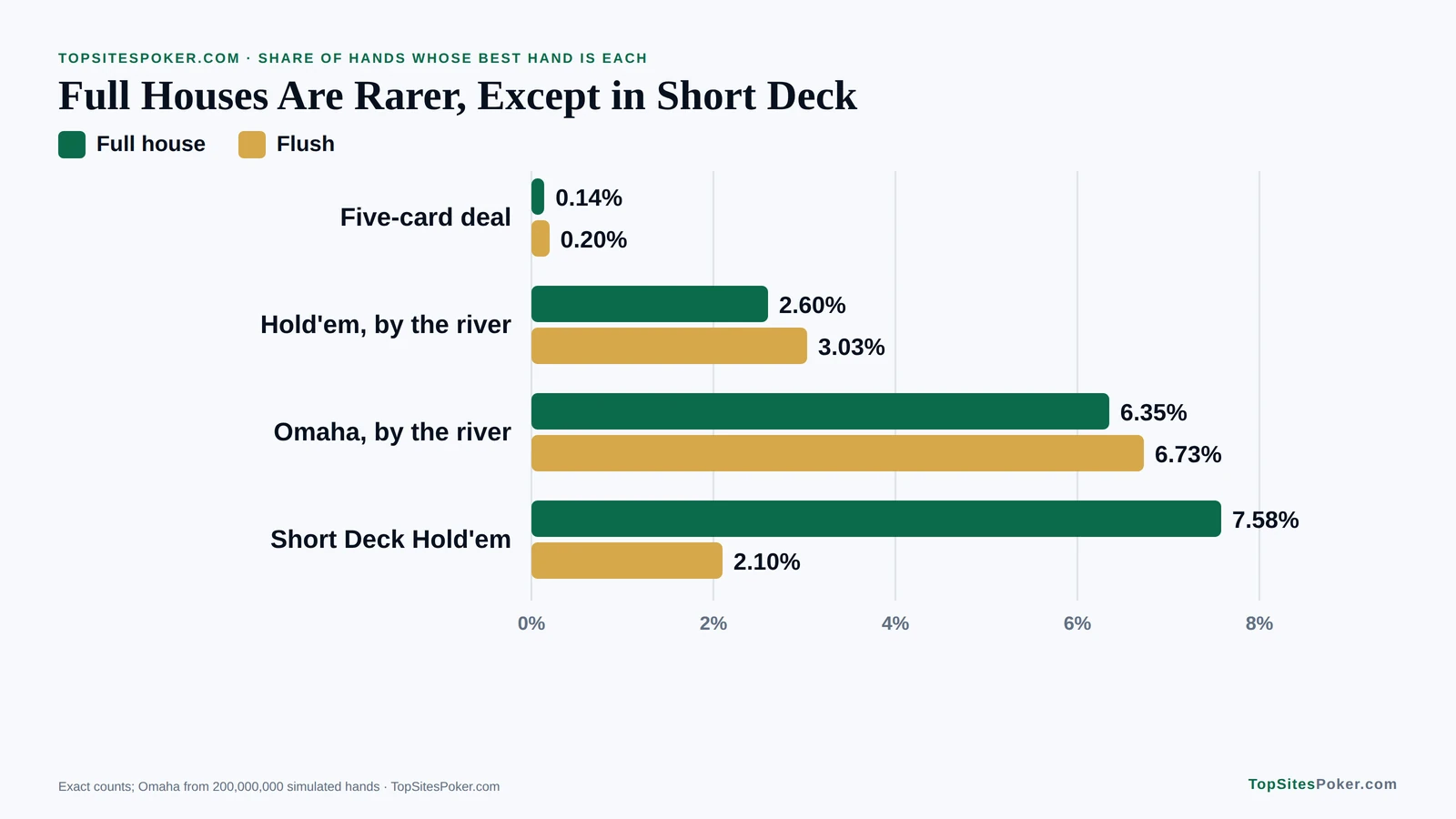
Share of hands whose best hand is a full house or a flush, with every hand played to the end.
Two rows stand out. In Short Deck, removing the 2s through 5s leaves only nine cards per suit, so flushes become much harder to make, while full houses become easier because there are fewer ranks to pair. Flushes end up less than a third as common as full houses, and that’s why most Short Deck rules move the flush above the full house. In video poker, the order also flips, but for a different reason: optimal strategy keeps every pair, two pair and three of a kind it’s dealt, and each of those can fill up to a full house, while many hands that could draw to a flush are played for other draws instead. The pay table still follows the standard ranking, with 9 for 1 for a full house and 6 for 1 for a flush, even though the two come up almost equally often.
Where the Full House and the Flush Sit in the Rankings
Here’s the full order of poker hands. Each hand beats every hand below it and loses to every hand above it; the full house and the flush sit side by side in the upper middle:
| Rank | Hand | Example | Five-card hands | Seven-card hands (best five) |
|---|---|---|---|---|
| 1 | Royal flush | A♠ K♠ Q♠ J♠ 10♠ | 4 | 4,324 |
| 2 | Straight flush | 9♥ 8♥ 7♥ 6♥ 5♥ | 36 | 37,260 |
| 3 | Four of a kind | Q♠ Q♥ Q♦ Q♣ 7♠ | 624 | 224,848 |
| 4 | Full house | J♠ J♥ J♦ 4♣ 4♠ | 3,744 | 3,473,184 |
| 5 | Flush | A♠ J♠ 8♠ 6♠ 3♠ | 5,108 | 4,047,644 |
| 6 | Straight | 9♠ 8♥ 7♦ 6♣ 5♠ | 10,200 | 6,180,020 |
| 7 | Three of a kind | 7♠ 7♥ 7♦ K♣ 2♠ | 54,912 | 6,461,620 |
| 8 | Two pair | K♠ K♥ 8♦ 8♣ A♠ | 123,552 | 31,433,400 |
| 9 | One pair | Q♠ Q♥ A♦ 9♣ 4♠ | 1,098,240 | 58,627,800 |
| 10 | High card | A♠ J♦ 8♣ 6♥ 3♠ | 1,302,540 | 23,294,460 |
Exact over all 2,598,960 five-card and 133,784,560 seven-card hands. Seven-card counts are by the best five cards. Calculated by TopSitesPoker.com.
What beats a full house, and what a flush beats
- Only two kinds of hand beat a full house: four of a kind and a straight flush, including the royal flush. A higher full house also beats a lower one.
- A flush beats a straight, three of a kind, two pair, one pair and high card, plus any lower flush. It loses to a full house and everything above it.
- The neighbors matter too. Above the full house, four of a kind is six times rarer (624 five-card hands). Below the flush, the straight is twice as common (10,200). The full house and the flush are the closest pair of neighbors in the top half of the rankings.
Which Full Houses and Which Flushes Come Up Most
The two hands also differ in how their strength is spread. A full house is named by its three of a kind first, “jacks full of fours” for J-J-J-4-4, and every rank is about equally likely to be the three of a kind. Flushes pile up at the top:
| Top rank | Share of seven-card full houses, by the three of a kind | Share of seven-card flushes, by the top card |
|---|---|---|
| Ace | 7.81% | 39.2% |
| King | 7.79% | 25.9% |
| Queen | 7.77% | 16.3% |
| Jack | 7.75% | 9.6% |
| Ten | 7.73% | 5.2% |
| Nine | 7.71% | 2.6% |
| Eight | 7.69% | 1.0% |
| Seven | 7.67% | 0.3% |
| Six down to two | 7.65% to 7.57% each | None |
Exact over all 3,473,184 seven-card full houses and 4,047,644 seven-card flushes, by the best five cards. In five-card deals, each rank is the three of a kind in exactly 288 full houses, 7.69%. Calculated by TopSitesPoker.com.
There are 156 different full houses by rank (13 choices for the three of a kind times 12 for the pair) and 1,277 different flushes by rank. With seven cards, higher full houses gain a sliver of ground, because when a hand holds two three-of-a-kinds, the higher one is played as the three. But the spread stays almost flat: aces full are only slightly more common than deuces full.
Flushes are the opposite. Four flushes in five are queen high or better, because a flush with a high top card has many more ways to fill in the four cards below it. So when two players both have a flush, they’re usually both high ones, while a full house could be any of the 156 with almost equal chance.
Can You Have a Full House and a Flush at the Same Time?
In Hold’em and Seven Card Stud, no. Seven cards can never hold both a flush and a full house. A flush needs five cards of one suit, and those five are all different ranks. That leaves only two other cards, which can add at most three of a kind or two pair, never three of one rank and a pair of another. So a seven-card hand with a flush never has a full house, and one with a full house never has a flush.
What can happen is that the same board makes both hands possible for different players. On a Hold’em board, that takes a pair and three cards of one suit, like K♠ K♥ 9♠ 5♠ 2♦. One player can hold two spades for a flush while another holds a pair of nines for nines full of kings, or a king with a nine for kings full. By the river, 16.1% of all boards are paired and have three or more cards of one suit.
Omaha is different
In Omaha, each player has four hole cards and must use exactly two of them with exactly three board cards. Different pairs of hole cards can make different hands, so one Omaha hand can hold a flush and a full house as two separate options. Your hand is the better one, the full house:
| Game | Your cards | Board | Options | Your hand |
|---|---|---|---|---|
| Hold’em | A♠ 3♠ | K♠ K♥ 9♠ 5♠ 2♦ | Flush only | Ace-high flush |
| Hold’em | 9♥ 9♦ | K♠ K♥ 9♠ 5♠ 2♦ | Full house only | Nines full of kings |
| Omaha | A♠ Q♠ 9♥ 9♦ | K♠ K♥ 9♠ 5♠ 2♦ | A♠ Q♠ makes a flush; 9♥ 9♦ makes a full house | Nines full of kings |
| Omaha | A♠ 7♠ 6♦ 6♣ | 9♠ 9♥ 6♠ 3♠ 2♣ | A♠ 7♠ makes a flush; 6♦ 6♣ makes a full house | Sixes full of nines |
| Omaha | A♠ Q♠ J♥ 10♦ | K♠ K♥ K♦ 9♠ 5♠ | Flush only: no pair in hand to go with the kings | Ace-high flush |
Every hand checked with a hand evaluator, Omaha hands with exactly two hole cards and three board cards.
The last row is a useful Omaha trap. With three kings on the board, a Hold’em player holding any pocket pair, any nine or any five would have a full house. An Omaha player must use exactly two hole cards and three board cards, so on this board a full house takes a pocket pair, like A♥ A♦ for kings full of aces. A single nine or five only makes two pair, and the last king makes four of a kind.
Comparing Full Houses, Flushes and the Two Against Each Other
Three kinds of showdown come up, and each follows its own rule:
- Full house against flush: the full house always wins in standard poker. No rank or suit can change that.
- Full house against full house: compare the three of a kind first; the higher three wins, whatever the pairs. Only when the threes match, which takes help from the board in Hold’em, does the pair decide. If both match, the pot is split.
- Flush against flush: compare the highest cards; if they match, the second-highest, and so on down to the fifth. Suits never break a tie.
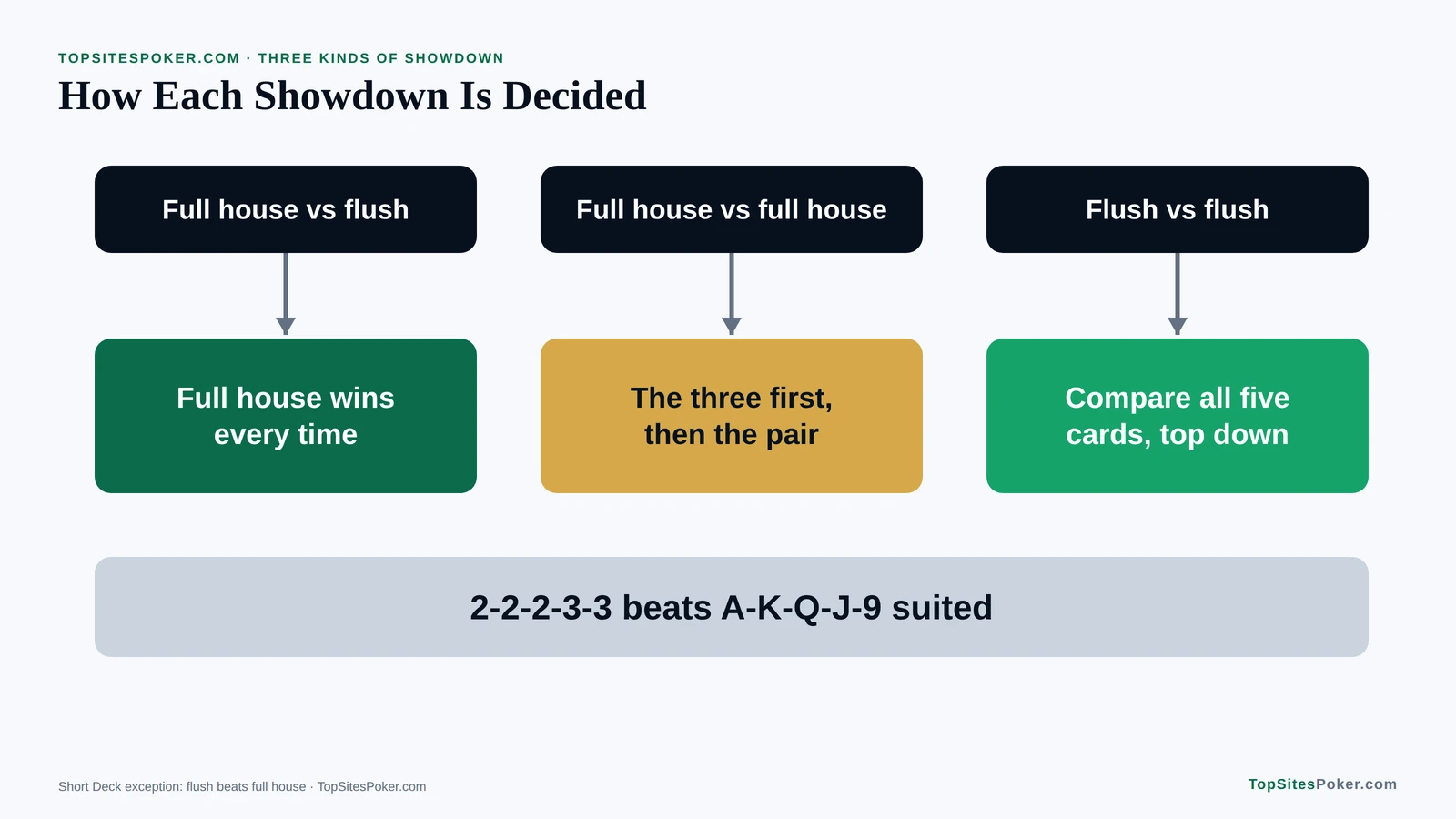
Hand categories are compared first; in Short Deck, the flush ranks above the full house.
| Hand A | Hand B | Winner | Why |
|---|---|---|---|
| 2♠ 2♥ 2♦ 3♣ 3♠ (the lowest full house) | A♥ K♥ Q♥ J♥ 9♥ (the highest flush) | A | Any full house beats any flush |
| 7♠ 7♥ 7♦ 2♣ 2♠ | K♦ J♦ 8♦ 5♦ 4♦ | A | Still full house over flush |
| 3♠ 3♥ 3♦ 4♣ 4♠ | 2♥ 2♦ 2♣ A♠ A♥ | A | Two full houses: the three of a kind decides first |
| K♥ Q♥ 9♥ 6♥ 3♥ | K♣ Q♣ 9♣ 6♣ 2♣ | A | Two flushes: the fifth card, three against two, decides |
| A♠ A♥ A♦ K♣ K♠ (the best full house) | Q♠ Q♥ Q♦ Q♣ 2♠ | B | Four of a kind beats any full house |
| 9♥ 8♥ 7♥ 6♥ 5♥ | A♠ A♣ A♦ K♣ K♠ | A | A straight flush beats any full house |
Every comparison checked with a hand evaluator.
The first row is the one to remember: deuces full of threes beats an ace-high flush. Hand categories are compared first, and ranks only matter between two hands of the same category. The third row catches people too. Threes full of fours beats deuces full of aces, because the three of a kind is compared before the pair.
The Paired Board: When a Full House Becomes Possible
In Hold’em, a full house needs the board to be paired. If the five board cards are all different ranks, two hole cards can make three of a kind or two pair, but never three of one rank and two of another. That makes a paired board the single most important warning sign for a flush. Here’s how often each hand is possible on each street:
| Board | Paired (full house possible) | Three or more of a suit (flush possible) | Both |
|---|---|---|---|
| Flop (3 cards) | 17.2% | 5.2% | 0% |
| Turn (4 cards) | 32.4% | 17.5% | 3.8% |
| River (5 cards) | 49.3% | 37.1% | 16.1% |
Exact over all 22,100 flops, 270,725 turn boards and 2,598,960 river boards. Calculated by TopSitesPoker.com.
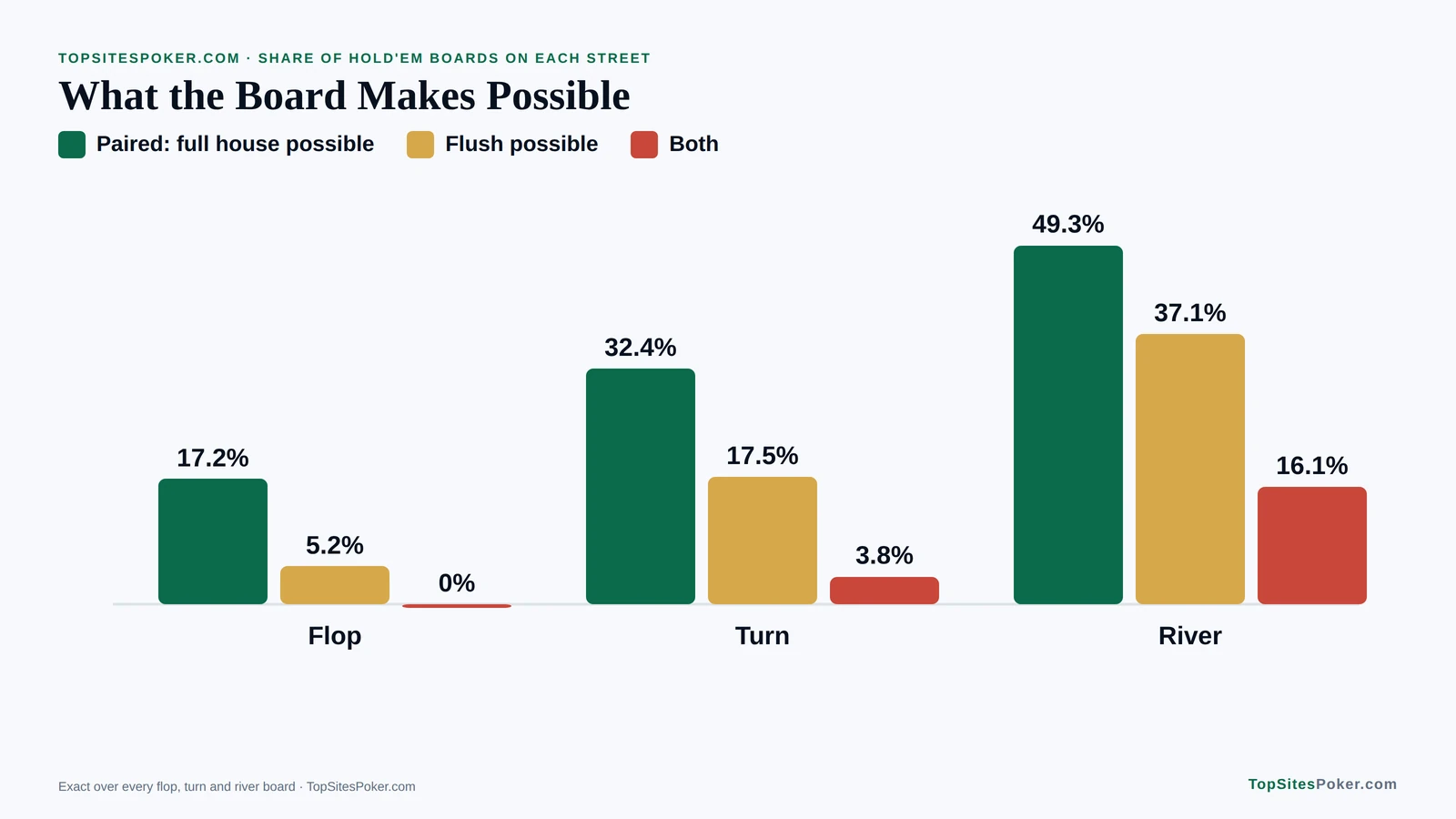
A full house needs a paired board; three cards can’t be paired and all one suit.
Three cards can’t be both paired and all one suit, so on the flop the two hands never threaten each other. By the river, almost half of all boards are paired, and 43.4% of the boards where a flush is possible also make a full house possible. In other words, when you make a flush on the river, there’s a good chance the board has paired along the way.
Where full houses and flushes come from
Here’s how the board’s shape affects each hand, over every combination of two hole cards and five board cards:
| River board | Share of boards | Your best hand is a full house | Your best hand is a flush | Share of all full houses | Share of all flushes |
|---|---|---|---|---|---|
| No pair | 50.7% | 0% | 3.86% | 0% | 64.7% |
| One pair | 42.3% | 2.50% | 2.37% | 40.7% | 33.1% |
| Two pair | 4.75% | 16.6% | 1.03% | 30.3% | 1.6% |
| Three of a kind | 2.11% | 29.1% | 0.77% | 23.7% | 0.5% |
| Full house on the board | 0.14% | 95.7% | 0% | 5.3% | 0% |
Exact over all 2,809,475,760 combinations of two hole cards and five board cards. Boards with four of a kind (0.02%) are left out; every player has four of a kind there. Calculated by TopSitesPoker.com.
Two-thirds of flushes are made on unpaired boards, where no full house is possible. The rest are made on paired boards, and those are the ones at risk. The more the board is paired, the more full houses appear: on a board with one pair, a full house is about as likely as a flush for a random hand, 2.50% against 2.37%; on a board with two pair or three of a kind, full houses are many times more common than flushes.
How many hands beat your flush on a paired board
Here’s how many of the 990 hands an opponent could hold beat the same ace-high flush, and a few lower flushes, as the board pairs:
| Board | Your hand | Your best hand | Hands that beat you |
|---|---|---|---|
| K♠ Q♥ 9♠ 5♠ 2♦ (unpaired) | A♠ 3♠ | Ace-high flush | 0 |
| K♠ K♥ 9♠ 5♠ 2♦ (one pair) | A♠ 3♠ | Ace-high flush | 28 (27 full houses, 1 four of a kind) |
| K♠ K♥ 9♠ 5♠ 2♦ | Q♠ J♠ | King-high flush | 35 (27 full houses, 7 higher flushes, 1 four of a kind) |
| K♠ K♥ 9♠ 5♠ 2♦ | 4♠ 3♠ | King-high flush, low cards | 56 (27 full houses, 28 higher flushes, 1 four of a kind) |
| K♠ K♥ 9♠ 9♦ 5♠ (two pair) | A♠ 3♠ | Ace-high flush | 173 (171 full houses, 2 fours of a kind) |
| K♠ K♥ K♦ 9♠ 5♠ (three of a kind) | A♠ 3♠ | Ace-high flush | 341 (297 full houses, 44 fours of a kind) |
Exact over all 990 possible opponent hands on each board. Calculated by TopSitesPoker.com.
The same ace-high flush goes from unbeatable on an unpaired board, to losing to 28 hands when the board has one pair, 173 when it has two pair and 341, more than a third of all possible hands, when it has three of a kind. With three kings on the board, any pocket pair, any nine, any five and the last king all beat the nut flush.
Which Starting Hands Make Full Houses and Which Make Flushes
Pocket pairs make full houses; suited cards make flushes. Here’s how often some common Hold’em starting hands finish the river with each, counting every possible board:
| Starting hand | Full house by the river | Four of a kind | Flush by the river |
|---|---|---|---|
| A♠ A♦ (pocket aces) | 8.55% | 0.842% | 1.96% |
| 10♠ 10♦ (pocket tens) | 8.55% | 0.842% | 1.95% |
| 2♠ 2♦ (pocket deuces) | 8.55% | 0.842% | 1.96% |
| A♠ K♠ (suited) | 2.22% | 0.126% | 6.53% |
| J♠ 10♠ (suited connectors) | 2.22% | 0.126% | 6.38% |
| K♠ 2♠ (suited, far apart) | 2.22% | 0.126% | 6.57% |
| A♠ K♦ (offsuit) | 2.22% | 0.126% | 1.96% |
| J♠ 10♦ (offsuit connectors) | 2.22% | 0.126% | 1.95% |
| 7♠ 2♦ (offsuit, far apart) | 2.22% | 0.126% | 1.96% |
Exact over all 2,118,760 boards for each starting hand. Each column counts hands whose best hand is that hand; flushes that are also straight flushes are left out of the flush column. Calculated by TopSitesPoker.com.
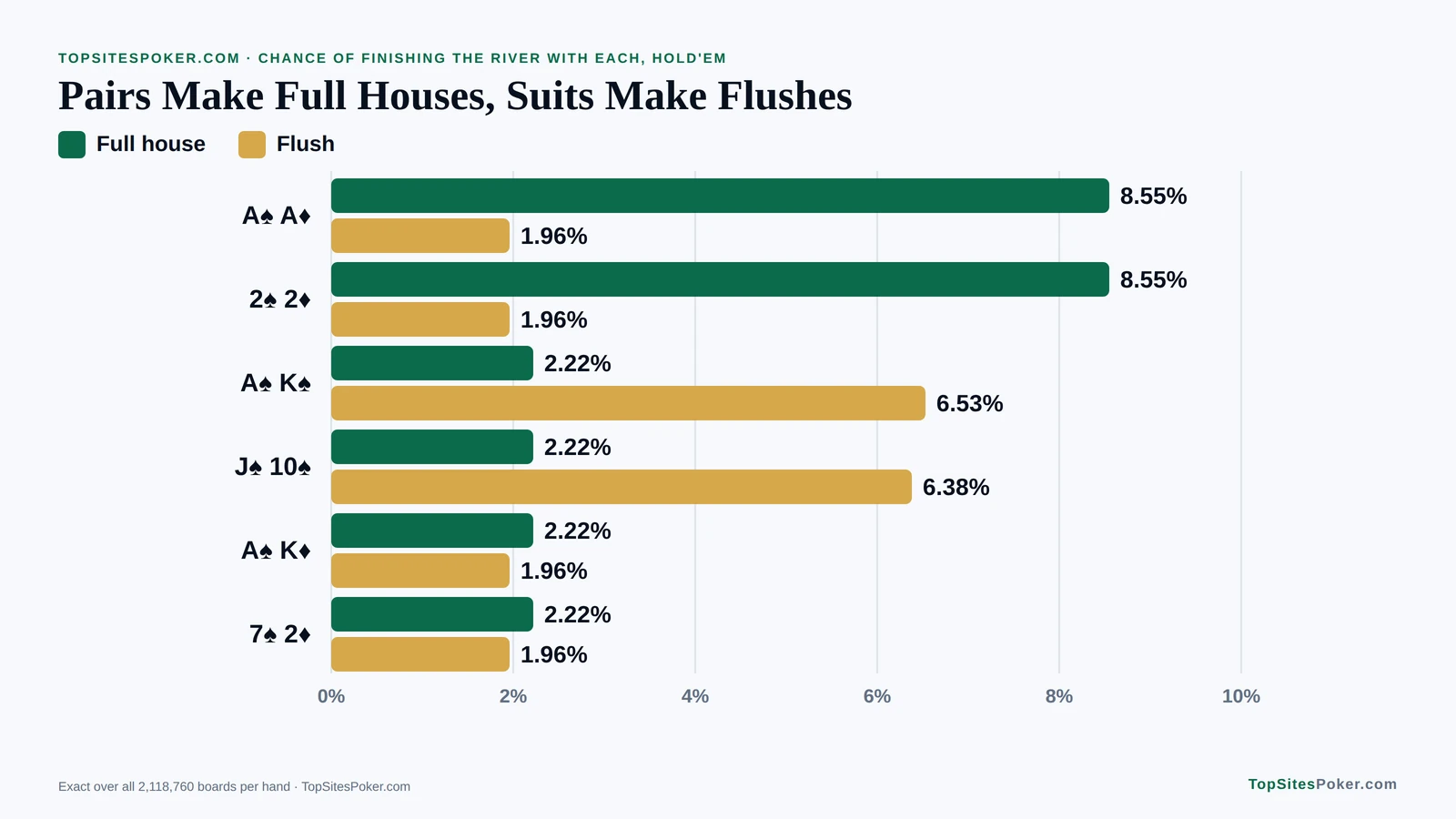
Pocket pairs make full houses and suited cards make flushes; straight flushes aren’t counted as flushes.
The full house column is striking: every pocket pair makes a full house exactly as often, 8.55% of the time, and every unpaired hand exactly 2.22%, whatever the ranks and suits. A full house only cares about how cards pair up, so which ranks you hold makes no difference. Starting with a pair makes a full house almost four times as likely.
Flushes work the same way with suits instead of pairs. Every suited hand makes a flush or a straight flush 6.58% of the time, and every hand with two different suits, pocket pairs included, about 1.97%. The small differences in the flush column come from how many of those flushes are straight flushes.
Put the two columns together and you can see both sides of the cooler. A pocket pair makes a full house 8.55% of the time by the river, more often than a suited hand makes a flush. An unpaired hand still makes a full house 2.22% of the time, always with help from a paired board: for example, one hole card matches the board’s pair for three of a kind while the other pairs another board card. And a pocket pair makes a flush only as often as any other two-suit hand, 1.95% to 1.96%, so a pair is rarely on the flush side of this showdown.
Filling Up vs Drawing to a Flush
Most full-house-over-flush coolers start earlier in the hand: a set or two pair against a flush draw, or against a flush that’s already made. Both sides are drawing to something, and the odds are closer than many players expect.
Outs and odds
| Your hand after the flop | Outs | Flop to river (two cards) | Turn to river (one card) |
|---|---|---|---|
| Set (a pocket pair that hit three of a kind), filling up to a full house or four of a kind | 7 on the turn, 10 on the river | 33.4% | 21.7% |
| Two pair (both hole cards paired), filling up | 4 | 16.7% | 8.7% |
| Flush draw, completing | 9 | 35.0% | 19.6% |
Exact from 47 unseen cards after the flop and 46 after the turn, ignoring the opponent’s cards. The set and two pair figures include every way to finish with a full house or four of a kind, including run-outs that pair the board twice. Calculated by TopSitesPoker.com.
A set fills up almost exactly as often as a flush draw completes, 33.4% against 35.0% from the flop. On the flop, a set has seven outs: three cards for each of the two unpaired board ranks, plus the last card of its own rank for four of a kind. If the turn misses, it adds three more outs, because the turn card is a new rank that can pair on the river. That’s why a set has 10 outs from the turn. Two pair has only four outs, two for each pair, and fills up about half as often.
Set against flush, and flush against set
| Situation | Hands | Board | Equity |
|---|---|---|---|
| Set against a made flush, on the flop | 9♥ 9♦ against A♠ Q♠ | 9♠ 6♠ 2♠ | 34.4% against 65.6% |
| The same, on the turn | 9♥ 9♦ against A♠ Q♠ | 9♠ 6♠ 2♠ K♦ | 22.7% against 77.3% |
| Two pair against a made flush, on the flop | K♥ 9♥ against A♠ Q♠ | K♠ 9♠ 2♠ | 17.5% against 82.5% |
| The same, on the turn | K♥ 9♥ against A♠ Q♠ | K♠ 9♠ 2♠ 5♦ | 9.1% against 90.9% |
| Nut flush draw against a set, on the flop | A♠ Q♠ against 9♥ 9♦ | 9♠ 6♠ 2♥ | 24.6% against 75.4% |
| The same, on the turn | A♠ Q♠ against 9♥ 9♦ | 9♠ 6♠ 2♥ K♦ | 15.9% against 84.1% |
| Flush draw against trips on a paired board, on the flop | A♠ Q♠ against K♦ J♣ | K♠ K♥ 6♠ | 25.1% against 74.9% |
| Made flush against trips, on the turn | A♠ Q♠ against K♦ J♣ | K♠ K♥ 6♠ 2♠ | 77.3% against 22.7% |
| Overpair against a flush draw, on the flop | A♥ A♦ against K♠ Q♠ | J♠ 7♠ 2♥ | 62.2% against 37.8% |
| Full house against a flush draw, on the turn | 9♥ 9♦ against A♠ Q♠ | 9♠ 6♠ 6♥ 2♦ | 100% against 0% |
Exact over every possible turn and river. Equity counts a split pot as half a win. Calculated by TopSitesPoker.com.
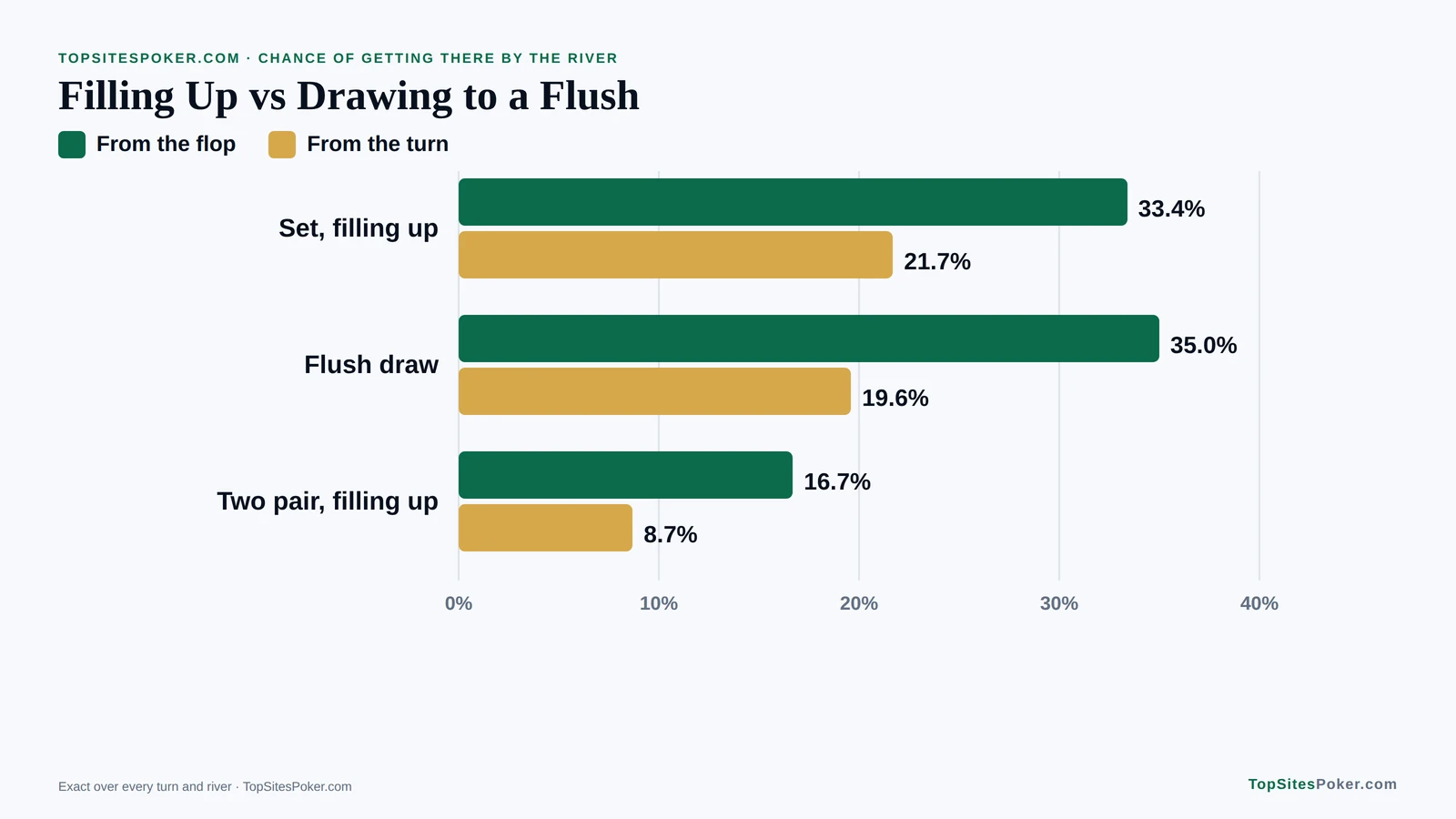
Exact over every turn and river, ignoring the opponent’s cards.
Four lessons come out of these numbers:
- A set is never dead against a flush. Even when the flush is already made on the flop, 9♥ 9♦ wins 34.4% of the time, because any card that pairs the board gives it a full house. On the turn, it still has 10 outs, 22.7%.
- A flush draw against a set is worth much less than 35%. A♠ Q♠ has nine spades to come, but the 2♠ pairs the board and gives the set a full house, and even when a clean spade arrives on the turn, the river can still pair the board. The nut flush draw’s equity falls to 24.6% on the flop and 15.9% on the turn, where the K♠ and 2♠ are no longer good for it.
- Two pair is in much worse shape than a set. With only four outs, K-9 against a made flush has 17.5% on the flop and 9.1% on the turn.
- Once the full house is made, a flush draw is drawing dead unless it has other outs, to four of a kind, a straight flush or a bigger full house. On 9♠ 6♠ 6♥ 2♦, A♠ Q♠ can’t win with any river card.
How Often a Flush Runs Into a Full House
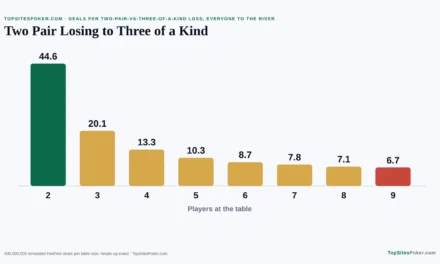
A full house beats a flush every time they meet, but how often do they meet? We simulated 400,000,000 Hold’em deals at every table size from two to nine players, with every player seeing all five board cards:
| Players | Someone has a flush | Someone has a full house | A flush loses to a full house | Winning hand is a full house | Winning hand is a flush |
|---|---|---|---|---|---|
| 2 | 5.3% | 4.8% | 1 deal in 1,262 | 4.7% | 5.2% |
| 3 | 7.3% | 6.7% | 1 in 470 | 6.5% | 7.0% |
| 4 | 9.0% | 8.4% | 1 in 260 | 8.2% | 8.5% |
| 5 | 10.4% | 10.0% | 1 in 171 | 9.6% | 9.7% |
| 6 | 11.8% | 11.5% | 1 in 125 | 10.9% | 10.8% |
| 7 | 13.0% | 12.8% | 1 in 96 | 12.1% | 11.8% |
| 8 | 14.2% | 14.0% | 1 in 78 | 13.2% | 12.7% |
| 9 | 15.3% | 15.2% | 1 in 65 | 14.3% | 13.5% |
TopSitesPoker.com simulation, 400,000,000 deals per table size, every player seeing the river. “A flush loses to a full house” counts deals where the winning hand is a full house and at least one other player has a flush. The winning-hand columns include split pots. The heads-up row can also be counted exactly: 1 deal in 1,262.
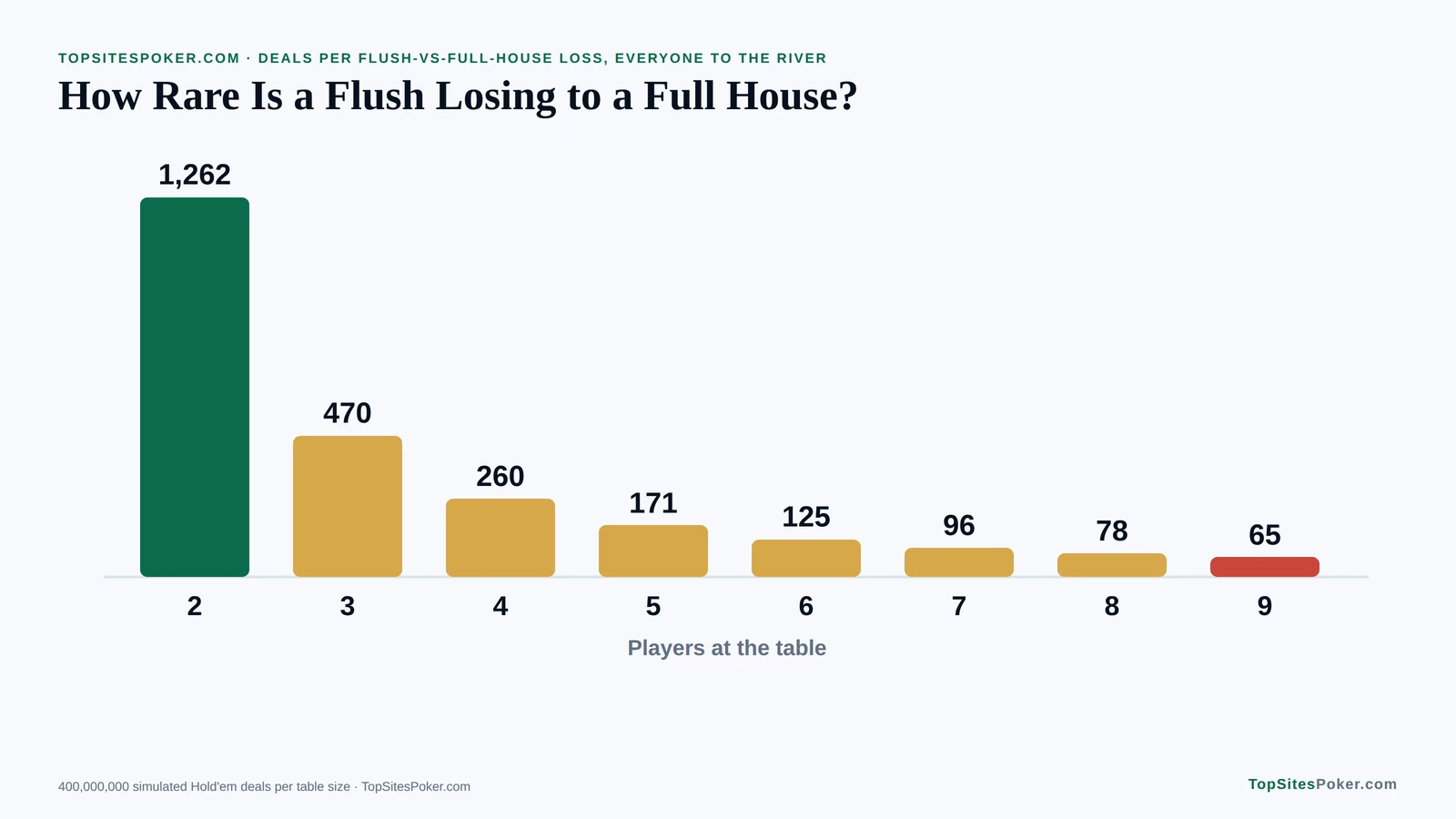
Every player seeing the river; 400,000,000 simulated deals per table size.
Heads-up, a flush loses to a full house only about once in every 1,262 deals. At a full nine-handed table, with everyone seeing the river, it’s about once in 65, almost 20 times as often. Each extra player adds another chance for a flush and another chance for a full house, so the collisions multiply much faster than the players.
Look at the last two columns, too. With five players or fewer, the winning hand is a flush more often than a full house. From six players up, it’s the other way around. Flushes are more common for any one player, but a full house also wins more of the pots it reaches, so at crowded tables it ends up taking more pots than the flush.
What happens to a flush at showdown
| Players | Flush wins | Splits | Loses | Loses to a higher flush | Loses to a full house | Loses to four of a kind or a straight flush |
|---|---|---|---|---|---|---|
| 2 | 85.0% | 3.5% | 11.5% | 9.9% | 1.3% | 0.3% |
| 4 | 69.8% | 1.8% | 28.4% | 23.9% | 3.6% | 0.9% |
| 6 | 59.5% | 0.9% | 39.6% | 32.5% | 5.6% | 1.5% |
| 9 | 49.4% | 0.3% | 50.4% | 39.8% | 8.1% | 2.4% |
Share of all players whose best hand is a flush, in the same simulation. The three loss columns add up to the “Loses” column, apart from rounding. Calculated by TopSitesPoker.com.
Here’s a surprise: a flush’s biggest threat isn’t a full house. It’s another flush. On a board with three or four cards of a suit, several players can hold a flush, and the higher one wins. Heads-up, 9.9% of flushes lose to a higher flush and only 1.3% to a full house. Even nine-handed, the full house accounts for only about one flush loss in six.
What happens to a full house at showdown
| Players | Full house wins | Splits | Loses | Loses to a higher full house | Loses to four of a kind | Wins while a flush is at the table |
|---|---|---|---|---|---|---|
| 2 | 87.0% | 7.2% | 5.8% | 4.5% | 1.3% | 1.5% |
| 4 | 74.4% | 10.1% | 15.5% | 11.4% | 4.0% | 3.6% |
| 6 | 65.1% | 11.8% | 23.0% | 16.3% | 6.7% | 5.0% |
| 9 | 55.3% | 13.0% | 31.7% | 20.9% | 10.7% | 6.2% |
Share of all players whose best hand is a full house, in the same simulation. Losses to a straight flush, 0.1% or less at every table size, are included in “Loses” but not shown separately. Calculated by TopSitesPoker.com.
Full houses split far more often than flushes, 7.2% heads-up and 13.0% nine-handed, because a board with three of a kind or two pair often gives several players the same full house. When a full house loses, it’s usually to a higher full house, with four of a kind next. The last column shows how often a full house beats a flush at the table: heads-up, 1.5% of full houses win against an opponent holding a flush; nine-handed, 6.2% win a pot in which at least one opponent holds a flush.
Heads-up: how the board changes a flush’s risk
For a flush against one opponent holding a random hand, both seeing the river, here’s how often it loses, by the shape of the board:
| River board | Share of flushes | Loses to a full house | Loses to a higher flush | Loses to four of a kind or a straight flush |
|---|---|---|---|---|
| No pair | 64.7% | 0% | 11.2% | 0.3% |
| One pair | 33.1% | 2.6% | 8.1% | 0.3% |
| Two pair | 1.6% | 17.3% | 1.4% | 0.2% |
| Three of a kind | 0.5% | 30.0% | 1.4% | 4.5% |
Exact over every combination of board, two-card flush and opponent hand. On an unpaired board, the last column is straight flushes only. Calculated by TopSitesPoker.com.
Against a single random hand, one pair on the board adds only a small risk, 2.6%. Two pair on the board makes it 17.3%, and three of a kind 30.0%. Real opponents don’t hold random hands, of course: a player who keeps betting into a paired board is far more likely to have filled up than these averages suggest.
All of these figures describe the worst case for big hands, with every player staying to the river. In real games, most players fold before the river, so showdowns are smaller. The patterns hold in any game, though: the more players see the river, and the more the board pairs, the more often a flush runs into a full house.
Full House vs Flush Showdowns: Worked Examples
Here are thirteen Hold’em showdowns where full houses and flushes meet, including a few that trip up experienced players. In each one, both players use their best five of seven cards.
| Board | Player A | Player B | Winner | Why |
|---|---|---|---|---|
| K♠ K♥ 9♠ 5♠ 2♦ | A♠ 3♠: ace-high flush | 9♥ 9♦: nines full of kings | B | Any full house beats any flush |
| K♠ K♥ 9♠ 5♠ 2♦ | A♠ 3♠: ace-high flush | 2♥ 2♣: deuces full of kings | B | Even the smallest full house here wins |
| K♠ K♥ 9♠ 5♠ 2♦ | K♦ Q♣: three kings | Q♠ J♠: king-high flush | B | Three of a kind without a pair is only trips |
| K♠ K♥ 9♠ 5♠ 2♦ | K♦ 9♥: kings full of nines | 5♥ 5♦: fives full of kings | A | Three kings beat three fives |
| K♠ K♥ 9♠ 5♠ 2♦ | 9♥ 9♦: nines full of kings | 5♥ 5♦: fives full of kings | A | Three nines beat three fives |
| K♠ K♥ 9♠ 9♦ 5♠ | A♠ 3♠: ace-high flush | Q♦ 9♥: nines full of kings | B | A two-pair board: one matching card fills up |
| J♥ 8♥ 4♥ 4♣ K♦ | A♥ 2♥: ace-high flush | J♣ 4♦: fours full of jacks | B | The nut flush loses to a small full house |
| 7♣ 7♦ 6♠ 5♠ 4♠ | 8♠ 3♠: flush, with a straight too | 7♥ 6♥: sevens full of sixes | B | A flush and a straight together still lose |
| A♠ A♥ 10♠ 6♠ 2♠ | K♠ Q♦: ace-high flush | 10♥ 10♦: tens full of aces | B | A pocket pair that made a set fills up |
| A♠ A♥ 10♠ 6♠ 2♠ | A♦ K♣: three aces | 10♥ 10♦: tens full of aces | B | Three aces alone lose to any full house |
| 8♠ 8♥ 8♦ A♣ 4♠ | A♥ 2♣: eights full of aces | 4♥ 4♦: eights full of fours | A | Same three eights, so the pair decides |
| Q♠ Q♥ Q♦ 7♣ 7♥ | A♠ K♠: plays the board | 3♦ 2♣: plays the board | Split | The full house on the board is the best either can do |
| Q♠ Q♥ Q♦ 7♣ 7♥ | A♠ K♠: plays the board | Q♣ 2♣: four queens | B | Four of a kind beats a full house |
Every showdown checked with a hand evaluator.
Two rows deserve a closer look. In the eleventh, both players share the board’s three eights, so each takes the best pair available: A♥ 2♣ uses the board’s ace for eights full of aces, while 4♥ 4♦ makes three fours but can only play them as the pair, eights full of fours. When a hand holds two sets of three, the higher three plays as the three of a kind and the lower one as the pair.
In the eighth row, 8♠ 3♠ has both a flush and a straight, 8-7-6-5-4, which looks like a monster on a board with three spades. But the board is paired, and 7♥ 6♥ has sevens full of sixes. That’s the pattern to remember: a paired board plus three of a suit is exactly where a flush is most likely to run into a full house.
How to read a paired board
- Check for a straight flush. Are three cards of one suit within five ranks of each other?
- Check the pairs. A pair on the board makes four of a kind and full houses possible. Two pairs or three of a kind make full houses far more common.
- Count each suit. Three of a suit means a flush is possible for anyone holding two of them; four means a single card of that suit does it.
- Ask what the betting says. An opponent who called on an earlier street and then bets or raises when the board pairs may be telling you they filled up.
Working from the top down, from the strongest possible hand to yours, is how you find the nuts and how you avoid paying off a full house with a flush that was far from the best hand possible.
How to Play a Flush When the Board Pairs
A flush on an unpaired board has only higher flushes and straight flushes to worry about. When the board pairs, full houses and four of a kind join the list. The question is how much that should change your play, and the answer starts with counting.
How often the board pairs after you make a flush
Say you flop the nut flush with A♠ Q♠ on K♠ 9♠ 2♠. No full house is possible yet. What are the chances the board pairs by the river and lets one in?
| When you make the flush | Board pairs by the river | Board stays unpaired |
|---|---|---|
| On the flop (A♠ Q♠ on K♠ 9♠ 2♠) | 40.0% | 60.0% |
| On the turn (the same hand, with the 5♦ on the turn) | 26.1% | 73.9% |
Exact over every turn and river from 47 unseen cards, and every river from 46. Calculated by TopSitesPoker.com.
A board that pairs doesn’t mean you’ve lost, though. Heads-up against a random hand, a flush on a one-pair board loses to a full house only 2.6% of the time. The danger is real when the betting says so, or when the board pairs twice.
Count the hands that beat you
On K♠ K♥ 9♠ 5♠ 2♦, the ace-high flush A♠ 3♠ loses to exactly 28 of the 990 hands an opponent could hold:
| Opponent’s hand | Their hand | Combinations |
|---|---|---|
| K-9 | Kings full of nines | 6 |
| K-5 | Kings full of fives | 6 |
| K-2 | Kings full of deuces | 6 |
| 9-9 | Nines full of kings | 3 |
| 5-5 | Fives full of kings | 3 |
| 2-2 | Deuces full of kings | 3 |
| K♦ K♣ | Four kings | 1 |
| Total | 28 |
Exact over all 990 possible opponent hands. There are only two kings left, so each K-x hand has 2 × 3 = 6 combinations. Calculated by TopSitesPoker.com.
Twenty-eight hands is 2.8% of all possible hands, but these are exactly the hands that bet and raise on a paired board. The count gives you a starting point; the opponent’s actions tell you how far to move from it. A player who called a flop bet on K♠ K♥ 9♠ and then raises big when the 5♠ and 2♦ arrive may well have a full house, or a flush of their own.
Blockers: the cards in your hand change the count
Every card you hold is a card your opponent can’t have. Compare two ace-high flushes on the same board:
- A♠ 3♠ loses to 28 hands: 27 full houses and four kings.
- A♠ 2♠ loses to only 24. Holding the 2♠ leaves two deuces instead of three, so K-2 drops from 6 combinations to 4 and 2-2 from 3 to 1.
The effect is modest, a seventh fewer hands that beat you, but it’s the kind of detail that tips close decisions. A flush that holds a card of the board’s paired rank, or of the other board ranks, blocks some full houses. Here it can’t block the kings, because the only kings left, the K♦ and K♣, aren’t spades.
Set against a flush: the price of drawing to a full house
When you hold a set and the flush comes, you still have outs. The table shows what share of the pot a call needs to win against each bet size, ignoring any money it could win later, compared with the chance of filling up on the river:
| Opponent’s bet | A call needs to win | Set or trips on the turn (10 outs, 22.7%) | Two pair on the turn (4 outs, 9.1%) |
|---|---|---|---|
| 1/4 pot | 16.7% | Profitable call | Short |
| 1/3 pot | 20.0% | Profitable call | Short |
| 1/2 pot | 25.0% | Just short | Well short |
| 2/3 pot | 28.6% | Short | Well short |
| Pot | 33.3% | Short | Well short |
A call needs to win bet ÷ (pot + 2 × bet). Outs from 44 unseen cards, with both players’ hands known. Calculated by TopSitesPoker.com.
A set facing a flush on the turn can call small bets on price alone and is only just short against a half-pot bet. It also has unusually good implied odds: when the board pairs on the river, a player holding a flush often pays off a large bet, because a flush looks so strong. Two pair is in a much weaker position, with only four outs.
How to Play a Full House When a Flush Is Possible
A full house on a board with three cards of a suit is usually a great spot, because flushes are common there and players who hold them rarely fold. The danger comes from above, not below:
| Your hand on K♠ K♥ 9♠ 5♠ 2♦ | Your best hand | Hands that beat you |
|---|---|---|
| K♦ 9♥ | Kings full of nines, the best full house here | 0 (2 ties) |
| K♦ 5♥ | Kings full of fives | 3 |
| K♦ 2♥ | Kings full of deuces | 6 |
| 9♥ 9♦ | Nines full of kings | 15 |
| 5♥ 5♦ | Fives full of kings | 18 |
| 2♥ 2♣ | Deuces full of kings | 21 |
| A♠ 3♠ | Ace-high flush, for comparison | 28 |
Exact over all 990 possible opponent hands. Calculated by TopSitesPoker.com.
A pocket pair that fills up on a paired board, like 9-9 on K-K-9, is sometimes called an underfull: nines full of kings loses to every king that pairs a board card. Here it’s still a strong hand, beaten by only 15 of 990 hands, but those 15 are the hands most likely to raise it. A king with a nine, on the other hand, can’t lose on this board, since no one can hold the two remaining kings once you have one of them.
Full House vs Flush in Other Poker Games
A full house beats a flush in every standard high-hand game except one. What changes from game to game is how often each hand appears, how you make it and, in Short Deck, which one ranks higher.
Omaha
In Omaha, each player gets four hole cards and must use exactly two of them with exactly three board cards. Both hands are much more common than in Hold’em: by the river, 6.35% of Omaha hands finish with a full house and 6.73% with a flush, according to our 200,000,000-hand simulations, about two and a half times the Hold’em rates for full houses and more than twice for flushes. The two hands are also closer in frequency than in Hold’em or Stud.
- A full house still needs a paired board. Three of one rank and two of another, built from two hole cards and three board cards, always need at least a pair among the three board cards used.
- A flush needs three board cards of the suit and two in your hand. One card of the suit is never enough, even with four on the board.
- One hand can hold both options. A♠ Q♠ 9♥ 9♦ on K♠ K♥ 9♠ 5♠ 2♦ has a flush with the spades and a full house with the nines, and plays the full house.
More full houses and more flushes mean many more collisions. In our simulation of 30,000,000 six-handed Omaha deals, with every player seeing the river, a flush lost to a full house once every 16 deals, against once every 125 in Hold’em. Heads-up, a separate 60,000,000-deal simulation put it at once every 135 deals, against 1,262 in Hold’em. Six-handed, an Omaha flush won outright 52.0% of the time, lost to a higher flush 23.9% of the time and lost to a full house 21.6% of the time. So in Omaha, full houses cause almost half of all flush losses, against about one in seven in six-handed Hold’em. The winning hand was a full house in 27.3% of six-handed Omaha deals and a flush in 21.0%.
Short Deck (6+ Hold’em): the big exception
Short Deck removes the 2s through 5s, leaving 36 cards: nine ranks in each of four suits. That changes both hands in opposite directions. With only nine cards per suit, five of one suit becomes hard to find. With only nine ranks, pairs come quickly, and full houses with them.
| Short Deck hand | Five-card hands | By the river, Short Deck Hold’em |
|---|---|---|
| Flush | 480 of 376,992 (0.127%) | 2.10% |
| Full house | 1,728 (0.458%) | 7.58% |
Exact over all 376,992 five-card and 8,347,680 seven-card Short Deck hands. The flush row leaves out straight flushes. Calculated by TopSitesPoker.com.
In a 36-card deck, a full house is 3.6 times as common as a flush in five cards, and still 3.6 times as common by the river of Short Deck Hold’em. Since rarer hands rank higher, standard Short Deck rules put the flush above the full house: in Short Deck, 8♠ 8♥ 8♦ J♣ J♥ loses to A♠ Q♠ 9♠ 7♠ 6♠. This is the one popular game where the answer to “does a full house beat a flush?” is no. Some Short Deck rule sets also change the order of the straight and three of a kind, so always check the posted rankings before you play.
Seven Card Stud
Stud players see seven cards, just like Hold’em players, so the frequencies are the same: a full house is the best hand 2.60% of the time by seventh street and a flush 3.03%. What’s different is that some of every player’s cards are face up. Those up cards are warning signs, not proof: a pair showing on an opponent’s board makes a full house more likely, and three or four cards of one suit showing make a flush more likely, but with three cards hidden, either hand can be there without them. Your own chances depend on your start:
- Three of a kind on third street, “rolled up”, finishes with a full house 32.0% of the time and four of a kind 8.2%, a combined 40.2%, before counting the cards you can see in other players’ hands.
- Two pair after fifth street, with two cards to come, fills up 16.6% of the time and makes four of a kind 0.2%.
Every up card of a rank you need is one fewer out, so count the board before you chase a full house or a flush.
Five Card Draw
Dealt pat, a full house comes 0.144% of the time and a flush 0.197%, the five-card figures. The draws are where the choices come in:
- Two pair, drawing one: 4 of 47 cards make a full house, 8.5%.
- Three of a kind, drawing two: full house 6.1%, four of a kind 4.3%, a combined 10.4%.
- Three of a kind plus a kicker, drawing one: full house 6.4%, four of a kind 2.1%, a combined 8.5%. Keeping a kicker costs you about two points of improvement, although some players do it to disguise the hand.
- Four to a flush, drawing one: 9 of 47, 19.1%.
Lowball and hi-lo games
- Deuce-to-Seven counts pairs, straights and flushes against you, so both hands are terrible low hands. A full house is worse, since it ranks higher.
- Ace-to-Five lowball and Razz ignore straights and flushes but count pairs, so a flush can be a strong low hand, 5-4-3-2-A of one suit is the best possible, while a full house is one of the worst.
- In hi-lo split games like Omaha Hi-Lo and Stud Hi-Lo, the high half uses normal rankings, so a full house beats a flush for high. A flush made of low cards can also be the low hand; the five cards of a full house never can, because they contain pairs, although in Omaha Hi-Lo a player can make a full house for high and a separate low with other hole cards.
Video poker
Video poker pay tables are named after these two hands. In “9/6” Jacks or Better, the 9 is the payout for a full house and the 6 the payout for a flush, per coin bet, and other games use the same kind of label. According to the Wizard of Odds, with optimal play a full house appears in 1.15% of final hands and a flush in 1.10%, and the full-pay 9/6 game returns 99.54%. Cut those two payouts to 8 and 5, the common “8/5” version, and the return falls to 97.30%. When you’re dealt a choice involving these hands, here are the exact values of some common holds:
| Dealt hand | Best hold | Average return per credit | Alternative |
|---|---|---|---|
| 8♠ 8♥ 8♦ K♣ K♥ | The full house | 9.00 | The three eights: 4.31 |
| 9♠ 8♠ 7♠ 6♠ 2♠ | The flush | 6.00 | Four to the straight flush: 3.40 |
| A♠ K♠ Q♠ J♠ 3♠ | Four to the royal flush | 18.43 | The flush: 6.00 |
| K♥ K♣ 7♥ 7♦ 2♥ | Two pair | 2.60 | The kings alone: 1.54 |
| 7♥ 7♦ 7♣ 2♥ 5♥ | The three sevens | 4.30 | Three sevens plus a kicker: 3.85 |
| Q♥ Q♣ 8♥ 5♥ 2♥ | The pair of queens | 1.54 | Four to the flush: 1.19 |
| 9♥ 9♦ K♥ 5♥ 2♥ | Four to the flush | 1.21 | The pair of nines: 0.82 |
Exact over every possible draw, full-pay 9/6 Jacks or Better (pair of jacks or better pays 1, two pair 2, three of a kind 3, straight 4, flush 6, full house 9, four of a kind 25, straight flush 50, royal flush 800 per credit with maximum coins). Calculated by TopSitesPoker.com.
Two of these surprise players. A pat flush of A♠ K♠ Q♠ J♠ 3♠ should be broken to draw for the royal, because the 800-for-1 royal and the other draws are worth three times the sure flush. And two pair, which fills up only 8.5% of the time, is still worth far more than keeping only the higher pair, because two pair already pays 2 for 1.
Full Houses and Flushes at Showdown: Rules and Etiquette
- Cards speak. Your hand is what your cards make, not what you say. If you announce “flush” and turn over a full house, the full house is what’s read [TDA 13]. Deliberately miscalling a hand can be penalized.
- Show both hole cards. Table all your hole cards face up so they can be read [TDA 14]. On a paired board, one card is often the difference between three of a kind and a full house, so let the dealer see both. Even when the full house is entirely on the board, you have to show your cards to get part of the pot [TDA 20].
- Don’t muck too soon. Players with a flush on a paired board sometimes throw it away when they see a bet, and players with an underfull sometimes misread their own hand. Once your cards hit the muck and can’t be identified, they’re dead [TDA 15], so let both hands be read first.
- Suits never break ties. Two identical full houses split the pot, which happens often when the full house is on the board. Two flushes are compared on their five ranks only.
- Odd chips. When a pot is split in a flop game, TDA rules give any odd chip to the first winner to the left of the button [TDA 21]. In Stud, it’s usually awarded by suit to the high card.
The TDA rules apply only in events and rooms that adopt them. Home games and many cardrooms use their own procedures, so check the posted rules where you play.
Common Mistakes With Full Houses and Flushes
| Mistake | Why it costs you | What to do instead |
|---|---|---|
| Thinking a flush beats a full house because it “looks harder to make” | Full houses are rarer: 3,744 five-card hands against 5,108 flushes | Remember: rarer ranks higher, so full house over flush |
| Ignoring a paired board | The nut flush on K♠ K♥ 9♠ 5♠ 2♦ loses to 28 hands; with two pair on the board, to 173 | Count the pairs on the board before you count your flush |
| Calling three of a kind a full house | K-K-K-Q-9 is only trips; a full house needs a pair as well | Check for three of one rank and two of another |
| Comparing two full houses by the pair first | The three of a kind decides first: 3-3-3-4-4 beats 2-2-2-A-A | Compare the threes, then the pairs |
| Overvaluing an underfull | 9-9 on K-K-9 loses to every hand with a king that pairs the board | Respect big bets from players who could hold the top full house |
| Counting a flush draw against a set as 35% | Some flush cards pair the board: 24.6% on the flop in our example, 15.9% on the turn | Subtract the outs that fill up the set |
| Folding a set to a small bet when the flush comes | A set has 10 outs on the turn, 22.7% | Call bets up to about a third of the pot, and more with implied odds |
| Assuming three of a kind on an Omaha board gives everyone a full house | Omaha uses exactly two hole cards and three board cards, so on a board with three of a kind you need a pocket pair | Build every Omaha hand from two hole cards plus three board cards |
| Assuming a full house beats a flush in Short Deck | Standard Short Deck rules rank the flush above the full house | Read the posted hand rankings before you play |
| Keeping a pat flush with four to a royal in video poker | Four to the royal is worth 18.43 per credit, the flush 6.00 | Break the flush and draw for the royal |
Figures from the exact counts and simulations in this guide. Calculated by TopSitesPoker.com.
Most of these come down to the same habit: read the board from the top down. Four of a kind and full houses first, then flushes, then everything else. If the board is paired, your flush is no longer near the top of that list.
Full House vs Flush Quiz
Test yourself. Every answer was checked with a hand evaluator or calculated exactly.
| # | Question | Answer | Why |
|---|---|---|---|
| 1 | Which wins: 2♠ 2♥ 2♦ 3♣ 3♠ or A♥ K♥ Q♥ J♥ 9♥? | The full house | Any full house beats any flush |
| 2 | Board K♠ K♥ 9♠ 5♠ 2♦. A♠ 3♠ against 2♥ 2♣? | 2♥ 2♣ | Deuces full of kings beats the ace-high flush |
| 3 | Which wins: 3-3-3-4-4 or 2-2-2-A-A? | 3-3-3-4-4 | The three of a kind is compared first |
| 4 | How many five-card full houses and flushes are there? | 3,744 and 5,108 | Not counting the 40 straight flushes |
| 5 | Can a Hold’em player hold a flush and a full house at once? | No | Seven cards can’t hold both |
| 6 | Board 8♠ 8♥ 8♦ A♣ 4♠. A♥ 2♣ against 4♥ 4♦? | A♥ 2♣ | Eights full of aces beats eights full of fours |
| 7 | Can anyone have a full house on an unpaired Hold’em board? | No | A full house needs a paired board |
| 8 | How often does a flop set fill up by the river? | 33.4% | Seven outs on the turn, ten on the river |
| 9 | In Short Deck, does a full house beat a flush? | No, under standard rules | Flushes are rarer than full houses with 36 cards |
| 10 | In 9/6 Jacks or Better, what do the 9 and the 6 stand for? | The full house and flush payouts | 9 for 1 and 6 for 1 |
Frequently Asked Questions
Does a full house beat a flush?
Yes, in Texas Hold’em, Omaha, Seven Card Stud, Five Card Draw and every other standard high-hand game. A full house ranks fourth from the top and a flush fifth. The main exception is Short Deck, where standard rules rank the flush higher.
Does a flush ever beat a full house?
Only in Short Deck (6+ Hold’em), where the 36-card deck makes flushes rarer than full houses, and in lowball games, where the lower hand wins: a flush is a better low hand than a full house in Deuce-to-Seven, and Ace-to-Five and Razz ignore flushes altogether while counting pairs against you. In standard poker, the only flush that beats a full house is a straight flush.
Why does a full house beat a flush?
Because it’s rarer. Of the 2,598,960 possible five-card hands, 3,744 are full houses and 5,108 are flushes. Poker ranks rarer hands higher.
Does the lowest full house beat the highest flush?
Yes. Hand categories are compared before ranks, so 2-2-2-3-3 beats A-K-Q-J-9 of one suit.
What beats a full house?
Four of a kind and a straight flush, including the royal flush. A higher full house also beats a lower one.
What does a flush beat?
A straight, three of a kind, two pair, one pair and high card, plus any lower flush.
Can you have a flush and a full house at the same time?
Not in Hold’em or Stud: seven cards can’t hold both, because the five flush cards are all different ranks and the two other cards can’t make three of a kind and a pair. In Omaha, one hand can have both as separate options, and the full house plays.
Which is more common, a full house or a flush?
A flush. In five cards, there are 1.36 flushes for every full house; by the Hold’em river, 1.17. For a player who sees all seven cards, the best hand is a full house 2.60% of the time and a flush 3.03%.
How do you compare two full houses?
By the three of a kind first: the higher three wins, whatever the pairs, so 3-3-3-4-4 beats 2-2-2-A-A. If the threes match, which takes board help in Hold’em, the higher pair wins. If both match, the pot is split.
How do you compare two flushes?
By the highest card, then the second-highest, and so on down to the fifth. If all five ranks match, the pot is split. Suits never break the tie.
Can you make a full house on an unpaired board in Hold’em?
No. With five different ranks on the board, two hole cards can make three of a kind or two pair but never a full house. A paired board is required, which is why it’s the warning sign for anyone holding a flush.
What are my odds of making a full house with a pocket pair?
If you see all five board cards, any pocket pair makes a full house 8.55% of the time and four of a kind 0.84%. Any unpaired hand makes a full house 2.22% of the time. The ranks and suits make no difference.
How often does a set fill up?
A set on the flop finishes with a full house or four of a kind 33.4% of the time by the river, and a set on the turn 21.7% of the time on the river. That’s about as often as a flush draw completes, 35.0% from the flop and 19.6% from the turn.
How often does a flush lose to a full house?
With everyone seeing the river, a flush loses to a full house in about 1 of every 1,262 heads-up deals, 1 in 125 six-handed and 1 in 65 nine-handed. A flush actually loses to a higher flush much more often than to a full house.
What is an underfull?
A full house made with a pocket pair that’s lower than the pair on the board, like 9-9 on K-K-9: nines full of kings. It beats every flush, but it loses to any player holding a king with one of the board’s other ranks, who has kings full.
Does a full house beat a flush in Short Deck?
No, not under standard Short Deck rules. With only 36 cards, there are 480 five-card flushes against 1,728 full houses, so the flush moves above the full house.
Which pays more in video poker, a full house or a flush?
The full house. The name of full-pay 9/6 Jacks or Better comes from these two payouts: 9 for 1 for a full house and 6 for 1 for a flush. According to the Wizard of Odds, both appear in about 1.1% of final hands with optimal play.
What does “full of” mean?
It’s how full houses are named: the rank of the three of a kind, then “full of” the rank of the pair. J-J-J-4-4 is “jacks full of fours,” sometimes shortened to “jacks full.”
Full House vs Flush: Quick-Reference Summary
| Question | Answer |
|---|---|
| Does a full house beat a flush? | Yes, in every standard high-hand game; Short Deck is the main exception |
| Why | It’s rarer: 3,744 five-card full houses against 5,108 flushes |
| Rank | Full house fourth, flush fifth of the ten standard hands |
| Lowest full house against highest flush | 2-2-2-3-3 beats A-K-Q-J-9 suited |
| Both in one hand | Impossible with seven cards; in Omaha, the full house plays |
| Odds by the Hold’em river | Full house 2.60%, flush 3.03%; 1.17 flushes per full house |
| Boards by the river | Paired 49.3%, flush possible 37.1%, both 16.1% |
| Starting hands | Pocket pairs make a full house 8.55% of the time, unpaired hands 2.22%; suited hands a flush or straight flush 6.58% |
| Draws | A flop set fills up 33.4% of the time; two pair 16.7%; a flush draw completes 35.0% |
| Set against a made flush | 34.4% on the flop, 22.7% on the turn |
| How often a flush loses to a full house, everyone to the river | 1 deal in 1,262 heads-up, 1 in 125 six-handed, 1 in 65 nine-handed |
| Comparing two of the same | Full houses: the three first, then the pair. Flushes: card by card, all five count. |
| Short Deck | Flush beats full house: 480 five-card flushes against 1,728 full houses |
| Video poker | The “9/6” in 9/6 Jacks or Better is the full house and flush payouts |
About This Guide
This guide uses the standard poker hand rankings used in casinos, cardrooms and online, and the TDA 2026 rules (version 1.0, September 7, 2026) where showdown procedure is concerned. House rules, especially on Short Deck rankings, lowball, Stud procedures and split pots, vary, and the rules of the room or site where you play always apply.
Every probability except the video poker frequencies and returns was produced by the TopSitesPoker.com editorial team rather than copied from other sources:
- Exact counts: five-, six- and seven-card counts over all 2,598,960, 20,358,520 and 133,784,560 hands; full houses and flushes by rank; board shapes over every flop, turn and river board; hand frequencies by board shape over all 2,809,475,760 combinations of two hole cards and five board cards; starting-hand figures over all 2,118,760 boards for each hand; Short Deck over all 376,992 five-card and 8,347,680 seven-card hands; and every example, equity, beat count, outs figure and Stud or Draw probability over all possible remaining cards.
- Simulations: the Omaha frequencies from 200,000,000 simulated hands, which agree with published exact counts; the Omaha showdown figures from 30,000,000 simulated six-handed and 60,000,000 heads-up deals; and the Hold’em table-size figures from 400,000,000 simulated deals per table size, all with every player seeing the river. The heads-up figures by board shape are exact.
- Video poker: the hold values are exact over every possible draw. The full house and flush frequencies and the 9/6 and 8/5 returns under optimal strategy are published figures from the Wizard of Odds.
- Evaluator checks: every example, comparison, showdown and quiz answer was verified with a hand evaluator, with Omaha hands evaluated using exactly two hole cards and three board cards.
Hold’em, Omaha and Stud figures assume every hand is played to the end. In real games, many players fold before the river, so showdowns are smaller and big hands like full houses and flushes win more often than these worst-case figures suggest.
The Bottom Line
A full house beats a flush in every standard game, because it’s rarer: 3,744 five-card full houses against 5,108 flushes. The gap is small, and with seven cards it narrows further, but the order never changes, so deuces full of threes beats an ace-high flush. The one popular exception is Short Deck, where a 36-card deck makes the flush the rarer hand.
The practical skill is reading the board. In Hold’em, no one can have a full house until the board pairs, and once it does, a flush is no longer close to the nuts: the ace-high flush that beat everything on an unpaired board loses to 28 hands with one pair on the board and 341 with three of a kind. With a flush, slow down when the board pairs and the betting heats up. With a set, remember that you’re never dead against a flush, with 10 outs on the turn. Do that, and when the full-house-over-flush cooler does come, it will cost you less.
About the Author and Legal Notes
Written and fact-checked by the TopSitesPoker.com Editorial Team. Our editors write, test and review every guide on the site. Poker odds in our guides are calculated with exact enumeration or large-scale simulation, never copied, and rules are checked against current Poker Tournament Directors Association (TDA) standards and published cardroom rules.
Last updated: September 24, 2026
Next scheduled review: March 2027
- For information only. This guide is for educational and informational purposes. It isn’t legal, financial or professional gambling advice, and nothing in it guarantees a result at the table.
- Laws and age limits. Gambling laws differ by country, state and province. Play real-money poker only where it’s legal and licensed, and only if you meet the minimum age: 21 in the U.S. states that license online poker, and 18 or older in many other jurisdictions. Check the rules where you live before you play.
- Accuracy. We check every rule, figure and example carefully, but cardroom and site rules differ and can change. Where they differ from this guide, the posted rules of the room or site you play at apply. If you spot an error, please let us know through the site’s contact page.
- Affiliate disclosure. TopSitesPoker.com may earn a commission when readers sign up with poker sites we review. Commissions never influence the rules, odds or rankings we publish, and this guide contains no promotional links.
- Responsible gambling. Poker involves real financial risk. Set a budget, play only with money you can afford to lose, and take a break if the game stops being fun. In the U.S., the national problem gambling helpline is 1-800-MY-RESET (1-800-697-3738), available by phone, text or chat.
- Trademarks. Names of games, events and organizations mentioned on this site are trademarks of their respective owners and are used for identification only.
- Copyright. © 2026 TopSitesPoker.com. All rights reserved. The original data, tables and infographics in this guide may not be reproduced without permission.