Quick answer: A split pot (or “chop”) happens when two or more players hold the exact same best hand at showdown, so the pot is divided equally among them instead of going to one winner. The mechanics get more involved when the pot doesn’t divide evenly (the “odd chip” problem), when a short stack is all-in for less than a full call (side pots), or in hi-lo games where the pot splits between the best high hand and best low hand (with “quartering” when one of those halves is itself tied).
| Scenario | What happens to the chips | Governing rule / concept |
|---|---|---|
| Two or more players tie for the whole pot, stacks divide evenly | Pot is split into equal shares, no leftover chips | Basic even chop |
| Tied players’ shares leave a leftover chip (pot doesn’t divide evenly) | In flop games (Hold’em, Omaha), the extra chip goes to the first seat left of the button among the tied players; in Stud, it goes by high card by suit | TDA Rule 21 |
| A short stack is all-in for less than a full call | A main pot forms (everyone still in the hand is eligible) and one or more side pots form (only the players who covered the extra money are eligible) | TDA Rule 49-A / 49-B |
| Hi-lo split game, one hand qualifies for both best high and best qualifying low | That single player “scoops” the entire pot | Hi-lo split rules (e.g., Omaha Hi-Lo 8-or-better) |
| Hi-lo split game, two or more players tie for just the high half or just the low half | That half of the pot is divided again among the players tied for it — “quartering” (or “tenthing” with more ties) | Hi-lo split rules |
| The community board itself is the best available 5-card hand | Every remaining player ties and shares the pot equally — “the board plays” | TDA Rule 20 |
What “Split Pot” Actually Means (and What This Guide Covers)
A split pot is a purely mechanical outcome: the cards decided that two or more hands are exactly equal in rank, and the chips have to be divided instead of handed to a single winner. A sibling guide on this site, Poker Tie-Breaker Rules (TSP-0027), owns the question of why hands tie — the card-by-card comparison ladder that decides whether two hands with the same category (say, two pair, or a straight) are actually identical in rank once every kicker has been checked. If you want that ladder explained in detail, that’s the place to go.
This guide starts from the moment the “why” question has already been answered — the dealer, or the room’s software, has already determined that a tie exists — and walks through the entirely different, mechanical question of what happens to the chips once that tie is on the table. That turns out to be a bigger topic than most players expect, because a real-money pot almost never divides as cleanly as a textbook example. Five distinct situations create the complexity:
- The basic even chop, when the math works out cleanly.
- The odd chip problem, when it doesn’t divide evenly.
- Side pots, when a short stack was all-in for less than everyone else put in.
- Hi-lo split games, where the pot itself is cut into two halves before anyone even considers a tie.
- The full-table chop, where the community board is simply the best hand anyone can make, and everyone left in the hand shares it.
Each of those gets its own section below, with worked chip counts you can check with a calculator, real simulation data on how often each situation actually comes up, and the current Tournament Directors Association (TDA) rule that governs the procedure where one applies. Rule citations refer to the 2026 edition of the Poker TDA rules, Version 1.0, dated September 7, 2026. TDA rules bind only the events and rooms that have formally adopted them — most large tournaments have, most cardrooms informally follow the spirit of them for cash games, and some private and home games do neither, so always check your room’s or event’s posted procedures before assuming a TDA rule applies verbatim.
It’s also worth being clear about what a chop is not. It isn’t a negotiated agreement between players to split a pot regardless of the cards (some home games allow that informally, but it’s a table decision, not a rule); it isn’t a refund of a bet that was never called; and it isn’t something a player can request just because they think their hand is close. A chop is strictly the mechanical result of two or more tabled hands actually being equal in rank once compared under the rules — nothing about it is negotiable or discretionary once the cards are down.
The Simple Chop: Equal Stacks, Equal Hands
Start with the easy case, because it’s the one every other scenario in this guide is a complication of. Two players play a hand from start to river with no all-in and no uneven stacks involved — they both have plenty of chips behind and both call every bet in full. At showdown, their five-card hands are exactly equal in rank: same category, same primary cards, same kickers, all the way down the comparison ladder.
When that happens, the pot is simply divided into equal shares. There’s no main pot/side pot split to work out (nobody was short), and if the total divides evenly by the number of tied players, there’s no leftover chip to award either. Two players, an $860 pot, and a dead-even tie: $860 ÷ 2 = $430 each. Nothing more to it.
The two complications that turn this simple case into the rest of this article are (1) what happens when that division doesn’t come out to a whole number, and (2) what happens when the stacks weren’t equal to begin with. Those are sections two and three below. A third and fourth complication — hi-lo split games, and the specific case where the board itself is the best hand — get their own sections further down.
How Often You’ll Actually See a Chop
Before getting into the mechanics, it’s worth knowing how often you’ll actually need them. We ran a 150,000-trial Monte Carlo simulation of Texas Hold’em showdowns at three table sizes — heads-up (2 players), 6-max, and full-ring (9 players) — using an exact 7-card hand evaluator. Every trial deals a complete random board and lets every seat see it through to the river; nobody folds. That’s an important and deliberate simplification: this measures how often ties occur by raw hand-rank frequency among hands that reach a full board, not how often real folding decisions let a chop actually happen at a real table (folding removes plenty of would-be ties before they ever reach showdown). Treat the numbers below as a “no-fold baseline,” useful for comparing table sizes against each other, not as literal in-game frequencies.
| Table size | Exact-tie rate (no-fold baseline) | Roughly translates to |
|---|---|---|
| Heads-up (2 players) | 4.14% | about 1 in 24 hands that reach a full board |
| 6-max | 7.22% | about 1 in 14 hands |
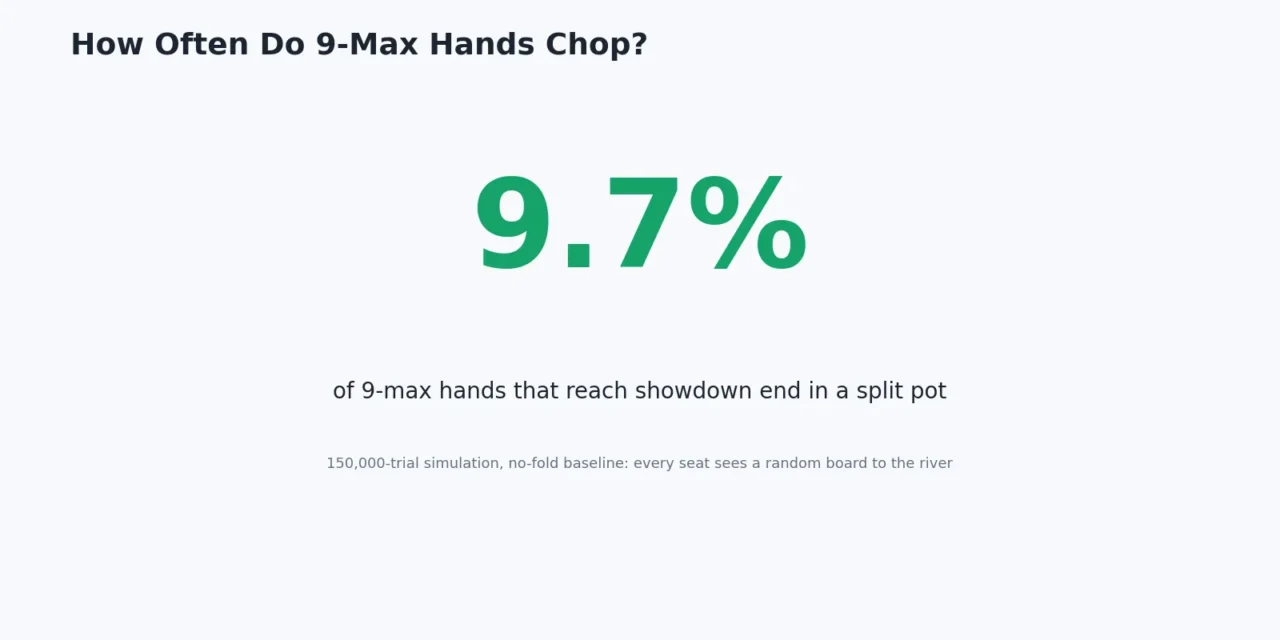
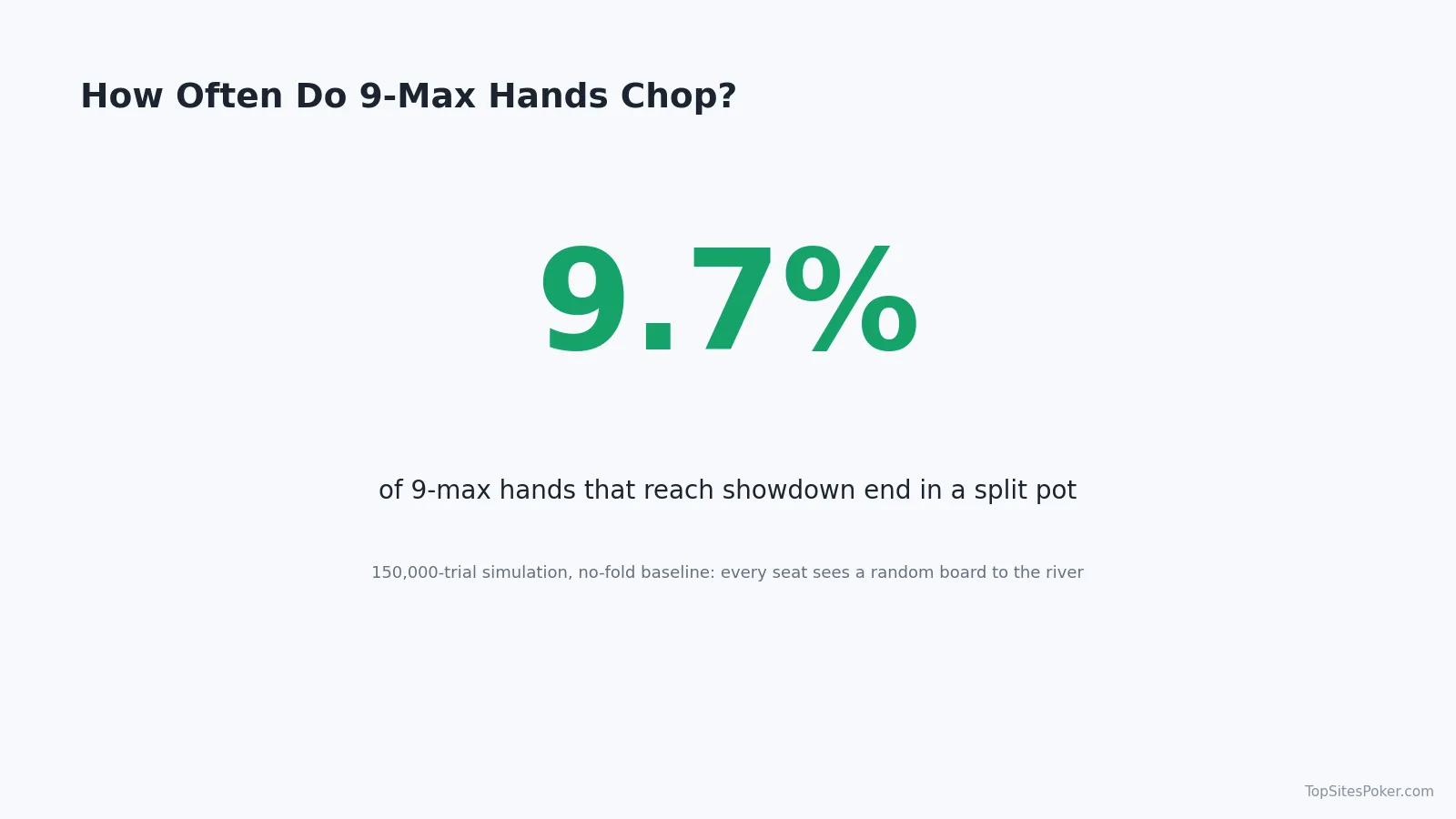
| 9-max (full ring) | 9.70% | about 1 in 10 hands |
The pattern makes intuitive sense once you think about it: every extra player at the table is another chance for someone’s hand to land on the exact same rank as the current best hand, so the tie rate climbs steadily with table size. At a full 9-max table under this no-fold baseline, roughly one hand in ten that reaches the river ends in some kind of chop — which is exactly why every serious poker room and tournament staff needs a clean, memorized procedure for splitting a pot, rather than treating it as some kind of rare edge case.
The Odd Chip Problem: TDA Rule 21 in Action
A chop only comes out clean when the pot divides evenly by the number of tied players. Real pots are built out of blinds, antes, and betting increments that rarely land on a number that divides neatly by two, let alone three or nine. Whenever the division leaves a remainder, that remainder — the “odd chip” — has to go to exactly one of the tied players, and the rulebook has to say which one, or the dealer would be making an arbitrary call every time it happens.
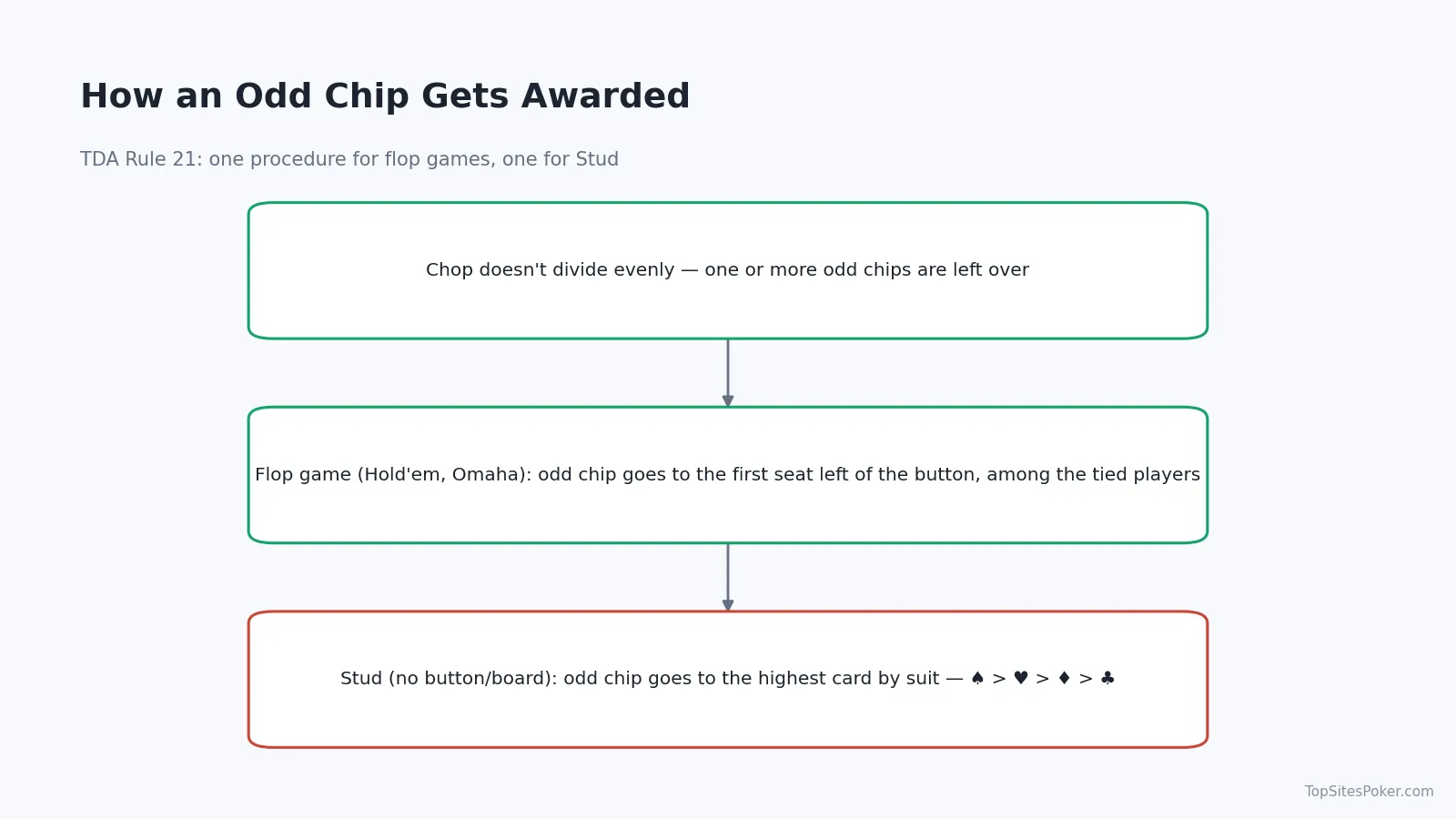
TDA Rule 21 splits the answer into two completely different procedures depending on the game:
- Flop games (Texas Hold’em, Omaha, and other community-board games): the odd chip (or chips, if there’s more than one and more than two winners) goes to the first seat left of the button, counting only among the players who are actually tied. Seating position, not the cards, breaks the tie for the leftover chip.
- Stud games (no community board, no fixed button position driving the action the same way): the odd chip goes by high card by suit. Since the tied hands are already equal in rank (that’s why they tied), the deciding factor is the suit of the highest card in each tied hand, using the standard suit ranking: spades, then hearts, then diamonds, then clubs.
Worked example: the odd chip in a flop game
Three players are tied for the entire pot at the river in a 9-handed Hold’em tournament hand: the players in Seat 2, Seat 7, and Seat 9. The total pot is $301. The button is on Seat 5.
$301 ÷ 3 = $100 with $1 left over. Each tied player gets a base share of $100 (3 × $100 = $300), and there’s exactly one $1 chip that has to go somewhere.
To find who gets it, walk clockwise around the table starting from the seat immediately after the button (Seat 6) and stop at the first seat that belongs to one of the three tied players: Seat 6 (not tied) → Seat 7 (tied — stop here). Seat 7 is first left of the button among the tied players, so Seat 7 receives the extra chip.
| Seat | Tied for the pot? | Base share | Odd chip? | Total received |
|---|---|---|---|---|
| Seat 2 | Yes | $100 | No | $100 |
| Seat 7 (first left of button among tied players) | Yes | $100 | Yes (+$1) | $101 |
| Seat 9 | Yes | $100 | No | $100 |
$100 + $101 + $100 = $301, matching the pot exactly.
Worked example: the odd chip in Stud
In 7-card Stud, there’s no community board and no button driving position the same way, so the tiebreaker for the odd chip switches to high card by suit. Two players are tied for a $151 pot with an identical two pair — Jacks and Fours — and an Ace kicker:
- Player 1’s best five cards: J♠ J♥ 4♣ 4♠ A♠ (two pair, Jacks and Fours, Ace kicker).
- Player 2’s best five cards: J♦ J♣ 4♥ 4♦ A♥ (two pair, Jacks and Fours, Ace kicker).
Both hands are exactly equal by rank — same pairs, same kicker rank. The single highest card in each hand is the Ace kicker, so the tiebreaker compares the two Aces by suit: A♠ (Player 1) outranks A♥ (Player 2) under the spades-hearts-diamonds-clubs order, so Player 1 receives the odd chip.
$151 ÷ 2 = $75 with $1 left over. Player 1 gets $76 (base $75 plus the odd chip), Player 2 gets $75. $76 + $75 = $151.
| Procedure | Applies to | Tiebreaker for the odd chip | Rule |
|---|---|---|---|
| First seat left of the button | Flop games (Hold’em, Omaha, and similar community-board games) | Seating position relative to the button, among tied players only | TDA Rule 21 |
| High card by suit | Stud games (no fixed community board) | Suit of the highest card in each tied hand: spades > hearts > diamonds > clubs | TDA Rule 21 |
If a chop involves more than two players and leaves more than one leftover chip (say, a three-way tie leaves two chips over), the same logic just repeats: award the first chip to the first qualifying seat (or highest suited card in Stud), then move to the next seat (or next-highest card) for the second chip, and so on, until every leftover chip is placed.
Side Pots: Where the Confusion Really Starts
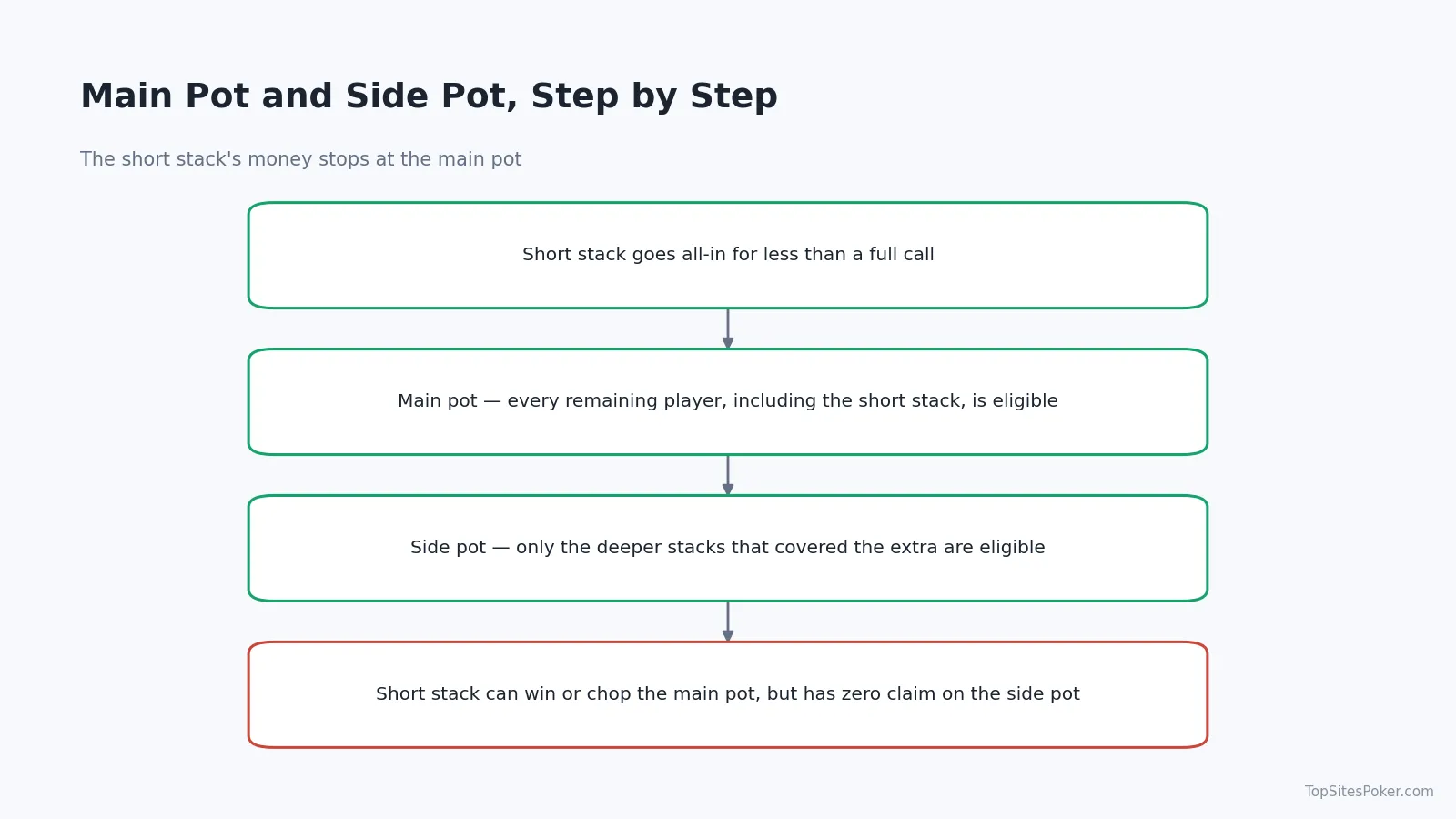
Everything above assumes every player at showdown put the same amount of money into the pot. That’s not always true. Whenever a player goes all-in for less than a full call — they simply don’t have enough chips left to match the current bet — the table has to split the pot itself into layers, because that short-stacked player never had a chance to win any money beyond what they were able to put in.
This is, by a wide margin, the single most confusing mechanic in this entire guide for new players, and it’s worth being precise about the vocabulary before working through the numbers:
- Main pot: built from the amount every remaining player — including the short stack — has contributed. Every remaining player, no matter how deep their stack, is eligible to win or split the main pot.
- Side pot: built from the additional amount contributed only by the players who could afford to put in more than the short stack. Only those deeper-stacked players are eligible to win or split the side pot. The short stack has zero claim on it — not because of anything about their hand, but purely because they never contributed to it.
If more than one player is short in the same hand, at different amounts, the table can end up with a main pot and two or more layered side pots, each one eligible only to the players whose stacks reached that layer. The rule that creates this situation in the first place — a short all-in for less than a full bet or raise, including one built up over more than one street (a “cumulative” short all-in) — is TDA Rule 49-A, with a 50% threshold that governs whether a short all-in even counts as a legal raise in limit games under TDA Rule 49-B.
Worked Example: A 3-Handed Side Pot
Three players get to showdown: Player A (the short stack), Player B, and Player C. Over the course of the hand, A ends up all-in for a total of $200. B and C both call the rest of the way and each end up having put in $500 total.
Building the pots:
- Main pot: everyone is matched up to A’s $200, so $200 × 3 players = $600. A, B, and C are all eligible.
- Side pot: B and C each put in $300 more than A ($500 − $200 = $300 each), so $300 × 2 players = $600. Only B and C are eligible; A has no claim on it.
Total pot: $600 + $600 = $1,200, matching the $200 + $500 + $500 = $1,200 actually contributed.
The showdown: the board is Q♦-4♣-4♦-9♠-2♥. A holds Q♠-6♣ and C holds Q♣-5♥ — both make the exact same hand, two pair, Queens and Fours, with a 9 kicker (the board supplies the 9, so both kickers are forced to match). B holds J♣-J♥, making a weaker two pair — Jacks and Fours, with a Queen kicker — which loses to both A and C.
| Player | Hand | Contributed | Main pot (all 3 eligible) | Side pot (B & C only) | Total received | Net result |
|---|---|---|---|---|---|---|
| A (short stack) | Two pair, Queens and Fours, 9 kicker | $200 | Ties with C, wins $300 | Not eligible — $0 | $300 | +$100 |
| B | Two pair, Jacks and Fours, Queen kicker | $500 | Loses to A & C — $0 | Loses to C — $0 | $0 | −$500 |
| C | Two pair, Queens and Fours, 9 kicker | $500 | Ties with A, wins $300 | Wins outright — $600 | $900 | +$400 |
This is the exact pattern that trips new players up: A chopped the main pot fair and square, tied with C for the best hand among all three players — and then had absolutely nothing to say about the $600 side pot, which C took outright because C’s hand also beat B’s. A’s shorter stack didn’t cost A anything in the pot A was actually eligible for; it simply meant A was never eligible for the second layer. Check the arithmetic: $300 + $0 + $900 = $1,200, matching the total pot exactly.
Worked Example: A 4-Handed Side Pot With Two Layers
Four players get to showdown with four different stack depths, which builds a main pot and two side pots stacked on top of each other. Player D goes all-in for $100 total. Player E goes all-in for $300 total. Players F and G both call the rest of the way and each end up having put in $600 total.
Building the pots:
- Main pot: everyone matched up to D’s $100, so $100 × 4 players = $400. D, E, F, and G are all eligible.
- Side pot 1: E, F, and G each put in $200 more than D ($300 − $100 = $200 each), so $200 × 3 players = $600. D is not eligible; E, F, and G are.
- Side pot 2: F and G each put in $300 more than E ($600 − $300 = $300 each), so $300 × 2 players = $600. Only F and G are eligible.
Total pot: $400 + $600 + $600 = $1,600, matching $100 + $300 + $600 + $600 = $1,600 contributed.
The showdown: the board is 10♦-9♣-8♠-7♥-2♣. D holds J♠-3♦ and E holds J♥-4♦ — both complete the exact same straight, Jack-high (J-10-9-8-7), because a straight’s rank depends only on its top card, so their different second hole cards (3♦ vs. 4♦) make no difference at all. F holds 2♠-10♠ and G holds 2♥-10♥ — both make the exact same two pair, Tens and Twos, with a 9 kicker. The straight beats the two pair, so D and E both beat F and G outright.
| Player | Hand | Contributed | Main pot (all 4 eligible) | Side pot 1 (E, F, G only) | Side pot 2 (F & G only) | Total received | Net result |
|---|---|---|---|---|---|---|---|
| D (short stack) | Straight, Jack-high | $100 | Ties with E, wins $200 | Not eligible | Not eligible | $200 | +$100 |
| E | Straight, Jack-high | $300 | Ties with D, wins $200 | Wins outright — $600 | Not eligible | $800 | +$500 |
| F | Two pair, Tens and Twos, 9 kicker | $600 | Loses — $0 | Loses to E — $0 | Ties with G, wins $300 | $300 | −$300 |
| G | Two pair, Tens and Twos, 9 kicker | $600 | Loses — $0 | Loses to E — $0 | Ties with F, wins $300 | $300 | −$300 |
This example packs in every variation on the theme at once: the short stack (D) chops the main pot with a deeper stack (E) and has zero claim on either side pot; the middle layer (side pot 1) is won outright by the deeper stack (E) whose hand beats the two remaining players; and the deepest layer (side pot 2) is itself a chop between the two deepest stacks (F and G), who tie each other exactly. Check the arithmetic: $200 + $800 + $300 + $300 = $1,600, matching the total pot exactly, and every player’s net result sums to zero (+$100, +$500, −$300, −$300).
How Dealers Actually Build and Award These Pots
At a live table, the dealer builds side pots in real time, not retroactively at showdown — as soon as a short all-in happens and the remaining players keep betting past it, the dealer physically separates the action into a capped pot (frozen at the short stack’s contribution level) and a new, open pot for anything beyond that. By the time the hand reaches showdown, the pots are already sitting there as separate stacks of chips; nobody has to reconstruct the math from memory.
Showdown procedure itself — who has to show their cards first, and how “cards speak” resolves any dispute about hand values — is its own topic, covered in detail in a sibling guide on this site, Poker Showdown Procedure (TSP-0029). The two rules most relevant to split pots specifically: TDA Rule 14 requires a player to table all of their hole cards, face up, to win any part of a pot — you can’t win half a chopped pot by showing three cards and mucking the rest, and that requirement applies even when the winning hand is made entirely from the community cards under TDA Rule 20 (the “playing the board” scenario covered later in this guide). TDA Rule 13 establishes that cards speak for themselves once tabled — the hand’s actual value controls the pot award regardless of what a player says out loud about it, and a deliberate miscall of one’s own hand can draw a penalty.
One convention you’ll hear at almost every cardroom — “show one, show all” — is not a TDA rule. It’s a widely adopted house rule that says if a player voluntarily shows their hand to just one other player at the table (often to another player who already mucked), the dealer or floor can require it be shown to everyone. It exists to stop one player from getting an informational edge over the rest of the table, and it has nothing to do with how a chop itself is calculated — but because it comes up constantly around showdown, it’s worth knowing that it varies by room and isn’t part of the TDA framework, so check your room’s or event’s posted rules rather than assuming it applies everywhere.
How Big Can a Chop Get? Multiway Ties
Every worked example so far has used two or three tied players. Using the same 150,000-trial, no-fold Hold’em simulation from earlier, we can break down exactly how large a chop tends to get at a 9-max table. Out of 14,556 total chops recorded in that simulation:
| Chop size | Count | Share of all chops | Share of all 150,000 hands |
|---|---|---|---|
| 2-way | 12,283 | 84.4% | 8.19% |
| 3-way | 1,920 | 13.2% | 1.28% |
| 4-way | 147 | 1.0% | 0.098% |
| 9-way (the entire table, “the board plays”) | 206 | 1.4% | 0.137% |
(12,283 + 1,920 + 147 + 206 = 14,556, matching the total chop count exactly.) The overwhelming majority of chops — better than four out of five — are the simple two-way case. But that last row is a genuinely striking number: 206 times out of 150,000 no-fold trials, every single player remaining in the hand tied for the exact same best hand, because the community board itself was that hand. That’s covered in full in its own section below.
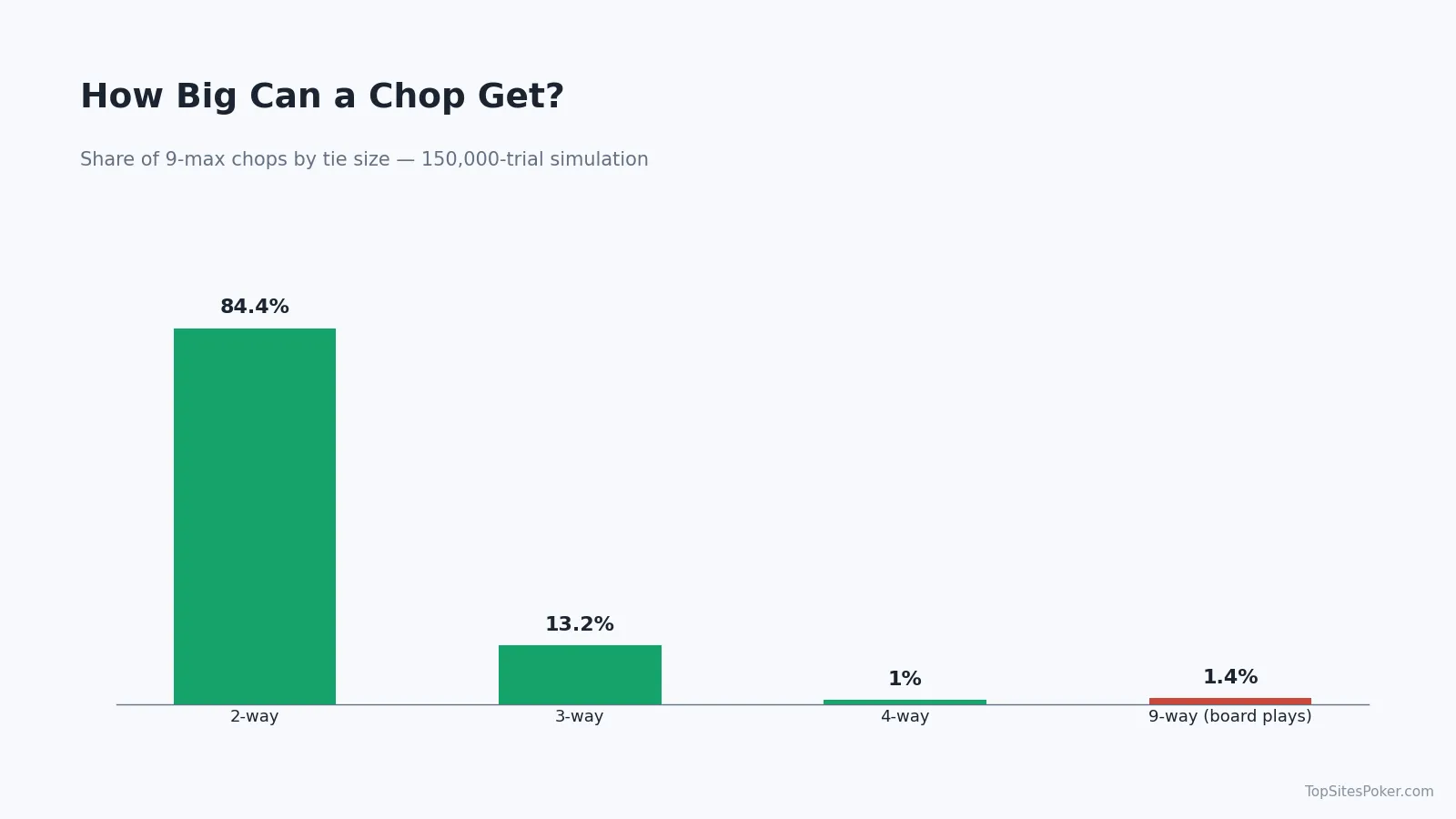
Table size changes this mix too. At a 6-max table in the same simulation, chops break down as 9,569 two-way (88.4% of chops), 813 three-way (7.5%), 30 four-way (0.3%), and 412 full six-way (3.8%) — out of 10,824 total chops. Notice that a full-table chop is actually a larger share of all chops at 6-max (3.8%) than four-way chops are, even though four is a smaller number than six — a full-table “board plays” chop simply doesn’t require every seat’s hand to independently line up with every other seat’s, only that nobody at the table happens to hold cards that beat the board’s own best five, which becomes more likely, not less, once you’re only asking it of six hands instead of nine.
How often does a chop actually need an odd chip?
Real poker pots are built from blinds, antes, and bet sizes, not from numbers chosen to divide evenly by however many players end up tied. As an illustrative (not simulated) way to estimate how often a real chop runs into the odd-chip problem from the earlier section, assume a pot’s total is effectively random relative to the number of players splitting it — in other words, for an N-way chop, there’s roughly a 1-in-N chance the total happens to be an exact multiple of N (no odd chip needed) and an (N−1)-in-N chance it isn’t (an odd chip is needed). Applying that assumption to the real 9-max chop-size distribution above:
| Chop size (N) | Share of all chops | P(needs an odd chip) = 1 − 1/N | Contribution to the weighted average |
|---|---|---|---|
| 2-way | 84.38% | 1 − 1/2 = 50.00% | 0.8438 × 0.5000 = 0.4219 |
| 3-way | 13.19% | 1 − 1/3 = 66.67% | 0.1319 × 0.6667 = 0.0879 |
| 4-way | 1.01% | 1 − 1/4 = 75.00% | 0.0101 × 0.7500 = 0.0076 |
| 9-way | 1.42% | 1 − 1/9 = 88.89% | 0.0142 × 0.8889 = 0.0126 |
Add the contributions: 0.4219 + 0.0879 + 0.0076 + 0.0126 = 0.5300. Under this simplifying assumption, a chop needs some kind of odd-chip award roughly 53% of the time at a 9-max table — which is exactly why TDA Rule 21 isn’t a rarely-invoked footnote. It’s closer to a coin flip whether any given chop needs it, and dealers apply it constantly. This is a deliberately illustrative estimate built from the real simulated chop-size distribution above, not a separately simulated statistic — a genuinely exact answer would require also modeling every room’s specific blind, ante, and bet-sizing structure, which varies too much to generalize.
Hi-Lo Split Games: Scoops, Splits, and Quartering
Everything above assumes the pot is contested for a single thing: the best high hand. Hi-lo split games — Omaha Hi-Lo 8-or-better and Seven Card Stud Hi-Lo 8-or-better are the two most common — divide the pot itself in half before any of the tying rules above even come into play. Half the pot goes to whoever has the best qualifying high hand (using the same category rankings as any other poker game); the other half goes to whoever has the best qualifying low hand, defined in an 8-or-better game as the lowest five distinct cards ranked eight or below, with straights and flushes ignored for low purposes.
Three outcomes are possible, and the vocabulary matters because it comes up in every hi-lo hand you’ll ever play:
- Scoop: a single player holds both the best qualifying high hand and the best qualifying low hand. That player takes the entire pot — both halves — with nobody else getting anything.
- Clean split: one player has the best high hand, a different player has the best low hand, and neither half has a tie within it. Each player takes exactly half the pot.
- Quartering: one player wins a half of the pot outright, but two players tie for the other half. Each of those two tied players gets only half of that half — a quarter of the total pot — despite having “the winning low hand” (or high hand). This is the single most common source of “why did I only get a quarter of that pot” confusion in hi-lo games.
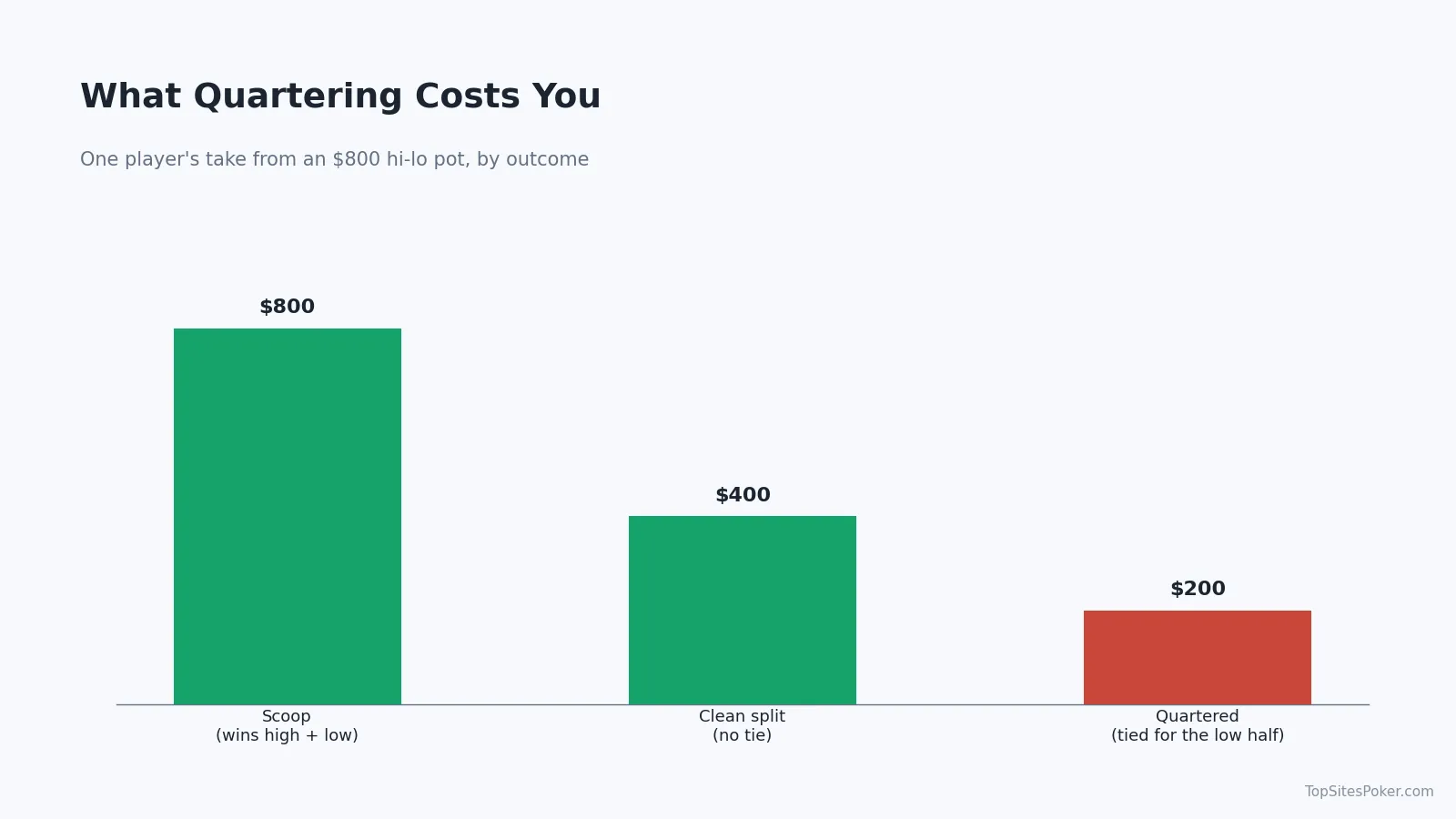
Worked example, using an $800 pot: suppose the best high hand is held outright by one player (no tie for high), so that player wins the high half, $400. Two different players tie exactly for the best qualifying low hand — say both hold the identical 7-5-4-3-2 low. The low half, $400, now has to be split again between those two players: $400 ÷ 2 = $200 each.
| Outcome | Who gets what | Amount per player |
|---|---|---|
| Scoop | One player wins both halves outright | $800 to that one player |
| Clean split (no tie) | One player wins high, a different player wins low, neither tied | $400 to the high winner, $400 to the low winner |
| Quartered (two players tie for the low half) | High winner takes their full half; the two low-tied players split the low half again | $400 to the high winner, $200 each to the two low-tied players |
Check the quartered row’s arithmetic: $400 + $200 + $200 = $800, matching the pot exactly — the high winner’s share doesn’t change just because the low half happened to tie.
Two more worked examples: no qualifying low, and a three-way low tie
Two more real-number scenarios round out the hi-lo picture. First, a $650 Omaha Hi-Lo pot where the board simply never allows a qualifying low — none of the five community cards, combined with anyone’s hole cards, can produce five distinct ranks of 8 or below. When that happens, the low half of the pot is never carved out in the first place: the entire $650 goes to whoever has the best high hand, exactly as if the game were being played as a standard high-only pot. There’s no “unclaimed” low money sitting anywhere waiting for a ruling — it simply never gets split off.
Second, a $900 pot where the best high hand is won outright by one player, but three different players tie exactly for the best qualifying low. The high half, $450, goes entirely to the high winner. The low half, also $450, now has to be divided three ways: $450 ÷ 3 = $150 each. Check it against the general (1/2) ÷ N rule from above with N = 3: $900 ÷ 6 = $150 — the same answer, confirming the pattern holds. ($450 [high] + $150 + $150 + $150 [three-way low] = $900, matching the pot.) Notice this example was deliberately chosen so $450 divides evenly by 3; if it hadn’t (say a $920 pot, with a $460 low half divided three ways), the odd-chip procedure from earlier in this guide would apply inside that one half of the pot, exactly as if that half were its own miniature chop — which is exactly what it is.
The pattern generalizes past two-way ties. If three players tied for the low half of that same $800 pot instead of two, each would get their quarter-of-the-pot half divided three ways: $400 ÷ 3 ≈ $133.33 each (and, notice, that’s a division that doesn’t come out even — so the odd-chip procedure from earlier in this guide applies here too, inside the low half specifically). If five players somehow tied for that half — vanishingly rare, but it illustrates the pattern — each would receive only $400 ÷ 5 = $80, or exactly one-tenth of the total $800 pot. Players sometimes call that outcome “tenthing” by analogy with quartering: the general rule is that a tied half divided N ways gives each of those N players (1/2) ÷ N of the whole pot — a quarter each with N=2, a tenth each with N=5, and so on. It’s also entirely possible for a hand to have no qualifying low at all (nobody made an 8-or-better) — in that case, the entire pot, both halves, goes to the best high hand, exactly as if it weren’t a hi-lo game in the first place.
Everybody Plays the Board: The Full-Table Chop
The most dramatic version of a chop happens when the community board itself, on its own, is a better five-card hand than any player at the table can make by combining it with their two hole cards — or at least ties whatever the best combination anyone actually holds turns out to be. When that happens, every player still in the hand effectively “plays the board,” meaning their best five-card hand is identical to the board’s own best five cards, and the pot chops among every remaining player at once. TDA Rule 20 covers this scenario directly, and TDA Rule 14’s requirement to table all hole cards to win any part of the pot still applies — a player can’t decline to show simply because their hole cards didn’t end up mattering.
The cleanest possible illustration is a board that happens to run out as a royal flush: A♦-K♦-Q♦-J♦-10♦. Nothing beats a royal flush, so it makes no difference at all what any of the nine players are holding in their hand — every single one of them ties for the exact same best possible five-card hand, because none of their hole cards can improve on what’s already sitting on the board. If nine players go to showdown and split a $900 pot in that spot: $900 ÷ 9 = $100 each, evenly, with no odd chip required at all — a rare case where the arithmetic actually comes out clean specifically because it involves every seat at once.
In the earlier 150,000-trial simulation, exactly this kind of full-table chop at a 9-max table happened 206 times — 0.137% of all 150,000 no-fold trials, or 1.4% of every chop that occurred. That figure lines up with a second statistic tracked in the same simulation, the rate at which the winning hand simply equals the board’s own best five cards (“board plays”) at a 9-max table, which also came out to 206 occurrences out of 150,000 — exactly the same number, which makes sense: any time the board plays for the winner, it plays identically for every other player still in the hand too, since they’re all comparing against the same five community cards.
Split Pots in Other Poker Variants
Everything above uses Texas Hold’em for its worked examples, since it’s the most widely played game, but the same five mechanics — even chops, odd chips, side pots, hi-lo splits, and board-plays chops — apply across essentially every poker variant, sometimes with a different odd-chip procedure attached. It’s worth walking through the main variants specifically, because which procedure applies depends on the structural shape of the game, not on which hand happens to be better.
- Short Deck Hold’em (also called 6+ Hold’em): still a community-board, button-driven game, so it falls squarely into the “flop games” bucket of TDA Rule 21 — the odd chip goes to the first seat left of the button among tied players, exactly as in standard Hold’em or Omaha. Short Deck’s smaller 36-card deck (no cards below a 6) changes some hand-category rankings in most rulesets — many rooms rank a flush above a full house, for instance — but none of that changes how a tie, once it exists, actually gets divided.
- Seven Card Stud, Stud Hi-Lo, and Razz (Stud-family games): no community board and no button-driven betting order the way flop games have it, so these fall into the “Stud” bucket of TDA Rule 21 — the odd chip goes by high card by suit, exactly as in the worked Stud example earlier in this guide. Stud Hi-Lo additionally layers the scoop/split/quartering mechanics from the hi-lo section above on top of that same odd-chip procedure.
- Deuce-to-Seven Triple Draw and Badugi (draw games): these use a dealer button and a fixed blind structure just like Hold’em, even though there’s no community board at all. Because TDA Rule 21’s text is framed specifically around “board games” for the button-position procedure, and these games have a button but no board, most rooms extend the same button-position logic to them anyway, on the reasoning that the position logic doesn’t actually depend on the presence of community cards — but this is exactly the kind of case where a room’s own posted procedure should settle it rather than assuming.
- Mixed games (H.O.R.S.E., 8-Game, and similar rotations): the specific game being dealt at that moment determines the procedure, not the tournament or table as a whole. A Hold’em or Omaha hand within the rotation uses the button-position procedure; a Razz or Stud hand within the very same tournament, minutes later, switches to high card by suit. Dealers in mixed-game rooms have to track this switch constantly.
Rake and Split Pots: Which Comes First?
One detail that’s easy to overlook when checking a chop’s arithmetic against a real cash-game pot: the house’s rake is typically taken out of the total pot before it’s divided among the winners, not after. Most cardrooms rake a small percentage of the pot on a sliding scale with a cap — the exact schedule varies enormously by room and stake level, so no single number applies everywhere — and that rake is usually pulled by the dealer as the hand is still being played, well before showdown, not calculated retroactively once a chop is determined. So a real-money pot that players see on the table at showdown, ready to be split, is already the post-rake amount; none of the worked chip totals in this guide need a separate rake deduction on top, because they represent the amount that’s actually left to divide.
Tournament poker works differently in a way that matters here: there’s no per-hand rake taken out of chips in play at all. The house’s cut in a tournament comes from a separate fee charged at registration (the buy-in typically breaks down into a prize-pool portion and a house-fee portion, decided before the tournament even starts), so every chip that ends up in a pot at the table — including every worked example in this guide — is genuinely, fully in play for whoever wins or splits it. That’s part of why tournament chip counts and cash-game dollar amounts, while they look similar on paper, aren’t directly interchangeable: a tournament chip’s value is really its share of the total prize pool, not a fixed dollar figure, and that value doesn’t shrink hand by hand the way a cash pot does after rake.
Side Pot vs. “Insurance”: Don’t Confuse Them
Some higher-stakes cardrooms and online sites offer a separate product, often called “insurance,” to a player who is all-in and at risk before the remaining community cards are dealt. It lets that player pay a fee, calculated from their current equity in the hand, to lock in a guaranteed partial payout regardless of how the board runs out — essentially a side bet on their own hand’s outcome. It’s worth flagging explicitly here because the name and the situation (a player who is all-in) invite confusion with side pots, but the two concepts have nothing to do with each other mechanically. A side pot is built from other players’ chips and is a mandatory, rules-based consequence of an uneven all-in; insurance, where it’s offered at all, is an optional financial product a room may sell to a player on top of the hand that’s actually being played, funded by a third party (often the room itself or another player willing to take the other side of the bet), and it doesn’t change how the actual pot — main or side — gets awarded once the hand is over. Most rooms don’t offer it at all, and where it exists it’s governed by the specific room’s own posted terms, not by any TDA rule.
Antes and the Main Pot
Blinds and antes deserve a specific mention here because of how they interact with the main pot/side pot split. Every player at the table who’s still active posts the same ante (in a traditional structure) or has the same big-blind-ante charged against their stack (in the increasingly common “big blind ante” format, where only the big blind posts an amount covering every player’s ante obligation for that hand). Either way, ante money is contributed by everyone before any all-in complications from later streets even come into play, so it always lands in the main pot — there’s no such thing as an “ante side pot,” because by definition every player who’s dealt in has already matched that specific piece of the action.
There’s one wrinkle worth knowing: a player can be too short-stacked to post their own full ante or blind. When that happens, they simply post whatever they have — even if it’s less than the full amount — and they’re still considered active for whatever portion of the pot that reduced contribution buys them. That’s technically its own miniature version of the short-all-in situation from earlier in this guide, just triggered by a forced bet instead of a voluntary call, and it can create a wafer-thin side pot layer before a single card is even dealt if that player is then eliminated or folds before contributing anything further.
Avoiding Odd Chips Before They Happen: Chip Denominations
Because the odd-chip procedure in TDA Rule 21 exists specifically to resolve pots that don’t divide evenly, many rooms and tournament directors try to reduce how often it comes up in the first place, simply by choosing chip denominations and blind/ante structures that divide cleanly by common numbers of players. A blind structure built entirely around denominations of 25 (25/50/100/…) divides evenly by two, four, five, or ten tied players far more often than one that mixes in odd increments like 15s or 75s, and a tournament’s smallest denomination chip in play at any given moment sets the floor for how fine a split can even be made — if the smallest chip on the table is a 100-denomination chip, an odd-chip situation can be triggered by a pot total that would divide evenly if measured down to the nearest 25. Chip races (removing smaller-denomination chips from play as blinds increase, TDA Rule 26-A, run from Seat 1 with a single chip drawn at random and no player getting raced out of the tournament) exist for a related but distinct reason — keeping stack sizes manageable to count and bet — and as a side effect they also tend to make odd-chip splits somewhat less frequent later in a tournament, once the smallest denominations have already been raced away.
When It’s Not a Split Pot: Uncalled Bets and Walkovers
It’s worth being precise about the boundary of this topic, because one very common situation looks superficially similar to a chop but isn’t one at all: if every other player folds and only one player remains in the hand, that player wins the entire pot immediately and uncontested — there’s no showdown, no hand comparison, and nothing to divide. If that last remaining player had a bet out that nobody called, the uncalled portion of that bet is simply returned to them; it was never really part of the pot the other players were contesting. Neither of those situations is a split pot in any sense — they’re the ordinary, non-tied outcome that the vast majority of poker hands actually end in. A genuine chop requires an actual showdown between two or more players whose hands, once tabled and compared under TDA Rule 13’s cards-speak standard, come out exactly equal.
Common Mistakes With Split Pots
- Assuming a short stack automatically loses claim to everything. A short stack that ties for the best hand still wins (or splits) the full main pot; it’s only excluded from side pots it never contributed to, not from the pot it was actually eligible for.
- Assuming the side pot and main pot must go to the same player. They’re evaluated completely independently. It’s entirely normal for one player to win the main pot and a different player to win a side pot in the same hand, as the worked examples above show.
- Forgetting that “playing the board” still requires tabling all hole cards. Under TDA Rule 14, even a player whose hand is entirely made from the community cards must still show their hole cards face up to claim any part of the pot.
- Mixing up “quartered” with “won a quarter of the hand’s action.” Quartering specifically refers to winning only a quarter of the total pot after tying for one already-split half in a hi-lo game — it has a precise meaning, not a loose one.
- Treating “show one, show all” as a TDA rule. It’s a house rule that varies by room; some cardrooms don’t enforce it at all.
- Assuming the odd chip always goes to the player closest to the dealer. In flop games it goes by position relative to the button among tied players specifically — not to whoever happens to be sitting nearest the dealer’s tray.
- Assuming a chop is rare. At a 9-max table under a no-fold baseline, roughly one hand in ten that reaches a full board ends in some kind of split; it isn’t a corner case.
- Confusing “insurance” (an optional side product some rooms sell) with a side pot (a mandatory, rules-based structure). They share a superficial connection — both involve a player who is all-in — but nothing else.
- Assuming an ante can end up stuck in a side pot. Every active player contributes the same ante before later-street all-ins even develop, so ante money is always part of the main pot, never a side pot.
- Forgetting that a straight has no kicker at all. Two hands can tie for the exact same straight with completely different second (or third, or fourth) hole cards, because a straight’s rank depends only on its single highest card — nothing else in the hand matters for comparison purposes.
Quick Quiz: Test Yourself
- Two players tie for a $500 pot, no all-in involved. How is it split?
A) $500 to whichever player is closer to the button
B) $250 each
C) The dealer decides
D) It can’t be split, a fresh card is drawn
Answer: B. With equal stacks and an even division, it’s a straightforward $250-each chop. - Three players tie for a $301 pot in a Hold’em hand. Who gets the extra $1 chip?
A) The player with the best kicker
B) The player in the biggest blind
C) The first seat left of the button among the three tied players
D) It’s split into three equal fractional chips
Answer: C. TDA Rule 21 sends the odd chip by position relative to the button in flop games. - Same situation, but it’s 7-card Stud instead of Hold’em. Who gets the odd chip?
A) Still the first seat left of the button
B) Whoever posted the bring-in
C) The highest card by suit among the tied hands
D) It’s carried over to the next hand’s pot
Answer: C. Stud uses high card by suit instead of seating position, per TDA Rule 21. - A short stack goes all-in for $200 while two other players each put in $500. What’s the side pot’s total?
A) $1,200
B) $600
C) $300
D) $0, there’s no side pot with only one short stack
Answer: B. Each deeper stack contributed $300 beyond the short stack’s $200, so 2 × $300 = $600. - In that same hand, can the short stack win any part of the $600 side pot?
A) Yes, if their hand is best overall
B) No, they never contributed to it
C) Only if they ask the floor
D) Yes, but only half of it
Answer: B. Eligibility for a side pot is based purely on contribution, not hand strength. - In an Omaha Hi-Lo 8-or-better pot, one player has both the best high hand and the best qualifying low hand. What happens?
A) The pot is void
B) That player scoops the entire pot
C) The pot splits between that player and the second-best low hand
D) Only the high half is awarded
Answer: B. A single player holding both best hands takes the whole pot — a scoop. - Two players tie for the low half of a hi-lo pot, while a third player wins the high half outright. What’s this outcome called?
A) Tenthing
B) Scooping
C) Quartering
D) A walkover
Answer: C. Each of the two low-tied players gets a quarter of the total pot — quartering. - The community board itself runs out as a royal flush. What happens to the pot among the remaining players?
A) It’s void and re-dealt
B) Whoever has a diamond in their hand wins
C) Every remaining player ties and splits it evenly
D) The dealer must break the tie by suit
Answer: C. Nothing beats a royal flush, so every remaining player plays the board and ties. - Is “show one, show all” a TDA rule?
A) Yes, it’s TDA Rule 21
B) Yes, it’s a Recommended Procedure
C) No, it’s a house rule that varies by room
D) It only applies in Stud
Answer: C. It’s a common house convention, not part of the TDA rulebook. - At a 9-max table in the 150,000-trial simulation used in this guide, roughly what share of all hands that reach the river end in some kind of split?
A) About 1%
B) About 5%
C) About 10%
D) About 25%
Answer: C. The simulated exact-tie rate at 9-max was 9.70%, or roughly 1 in 10, under a no-fold baseline.
Frequently Asked Questions
What exactly is a split pot in poker?
It’s a pot that gets divided among two or more players instead of awarded to a single winner, because their hands at showdown are exactly equal in rank once every card in the comparison ladder has been checked. Any leftover chip that the division doesn’t account for, and any layered side pots from earlier all-ins, get resolved by the specific rules covered throughout this guide.
What’s the difference between a split pot and a side pot?
A split pot describes what happens when two or more hands tie — the pot (or a pot) is divided between them. A side pot is a completely separate concept: it’s a layer of the total money on the table that only certain players (the ones who contributed to it) are eligible to win at all, created whenever a short stack goes all-in for less than a full call. A single hand can involve both at once, as the worked 3-handed and 4-handed examples above show.
Who decides how a pot is chopped at the table?
The dealer applies the room’s or event’s posted rules — typically the TDA framework for tournaments, or house rules for cash games — mechanically, without discretion. If there’s a genuine dispute about hand values or procedure, the floor supervisor is called to make the final ruling, not the dealer personally.
Does the odd chip ever go to more than one player?
No — a single odd chip goes to exactly one player under TDA Rule 21. If the division leaves more than one leftover chip (for example, a $302 pot split three ways leaves two chips over), each leftover chip is awarded one at a time, moving to the next qualifying seat (or next-highest suited card in Stud) for each additional chip.
Is the odd-chip rule the same in cash games and tournaments?
TDA Rule 21 is written for tournament play, but the overwhelming majority of cardrooms apply the identical logic — button position in flop games, high card by suit in Stud — to their cash games as a matter of house policy, since it’s simple, consistent, and doesn’t depend on chip denomination. Always check your specific room’s posted procedures rather than assuming.
Can a short stack lose the main pot but still be part of a side pot?
No — eligibility only ever grows with stack depth, never the reverse. A player is eligible for every pot layer up to the amount they contributed and no further; they can’t somehow be excluded from the main pot (which they did contribute to) while being included in a side pot (which they didn’t).
What happens if three or more players are all-in for three different amounts in the same hand?
The table builds a main pot plus one side pot for every distinct all-in amount above the shortest stack, layered from shortest to deepest. The 4-handed worked example in this guide (with a main pot and two side pots) shows exactly this pattern with real chip numbers.
Does “playing the board” mean the player did nothing?
It means their two hole cards didn’t end up improving their hand beyond what the five community cards already made on their own — the player still has to have gotten to showdown honestly, and under TDA Rule 14 they still must table their hole cards face up to claim any part of the pot, exactly like a player whose hole cards mattered a great deal.
How common is it for the entire table to chop a pot at once?
In the 150,000-trial, no-fold Hold’em simulation used throughout this guide, a full 9-way chop at a 9-max table happened 206 times — about 1.4% of all chops, or 0.137% of every hand simulated. It’s rare, but it isn’t zero, and it happens specifically because of a board that’s simply too strong for any hole cards to improve on.
What’s the difference between quartering and tenthing?
Both describe the same underlying mechanic — a tied half of a hi-lo pot being divided further among the players who tied for it — at different tie sizes. Two players tying for a half produces a quarter of the whole pot each (quartering); five players tying for a half produces a tenth of the whole pot each (tenthing). The general pattern is (1/2) ÷ N of the total pot per tied player, for an N-way tie on that half.
Do all poker rooms play hi-lo games with an 8-or-better qualifier?
The 8-or-better qualifier (Omaha Hi-Lo 8-or-better, Stud Hi-Lo 8-or-better) is by far the most widely spread structure, but some hi-lo variants use no qualifier at all for the low hand (meaning the low half is always awarded to somebody, even a fairly high “low” hand), or use a different low-hand ranking system entirely. Check the specific game’s posted rules before assuming the 8-or-better standard applies.
If nobody qualifies for low in a hi-lo game, who gets the low half of the pot?
Nobody — the entire pot, both halves, goes to the best qualifying high hand, exactly as if the game weren’t a hi-lo split at all. The low half only gets carved out of the pot when at least one player actually has a qualifying low hand.
Is “show one, show all” enforced everywhere?
No. It’s a house rule, not a TDA rule, and enforcement varies by room and by event. Some cardrooms enforce it strictly at every table; others leave it to dealer discretion or don’t apply it at all. Always check your specific room’s posted rules.
Can insurance change how a side pot is calculated?
No. Where a room offers insurance as an optional product to an all-in player, it’s a separate financial arrangement layered on top of the hand, funded outside the actual pot. It has no effect on how the main pot or any side pot is built or awarded once the hand plays out.
What rule requires a player to show their cards to win part of a split pot?
TDA Rule 14 requires a player to table all of their hole cards, face up, to win any part of a pot — including a split — and this applies even when the winning hand is made entirely from the community board under TDA Rule 20.
Does a straight ever get an advantage in a tie because of its kicker?
No — a straight’s rank is determined only by its highest card; it has no kicker at all. Two different players can hold entirely different second hole cards and still tie exactly for the same straight, exactly as shown in the 4-handed side pot example in this guide, where two players’ straights tied despite different hole cards.
Where can I read more about why hands tie in the first place, rather than what happens to the chips?
That’s the specific focus of this site’s companion guide, Poker Tie-Breaker Rules (TSP-0027), which walks through the full card-by-card comparison ladder that determines whether two hands of the same category are actually identical in rank.
Does an ante ever end up sitting in a side pot?
No. Ante money — whether posted individually by every player or charged as a single big-blind ante — is contributed by every active player before any all-in complications from later betting rounds develop, so it’s always part of the main pot. The one exception worth knowing: a player too short-stacked to post their full ante posts whatever they have, which can create its own miniature short-all-in situation before a single card is dealt.
Is a “kill pot” the same thing as a split pot?
No, and the similar-sounding name is coincidental. A kill pot (or “killer button”) is a home-game and some cardroom convention where winning a hand over a certain size, or winning two hands in a row, forces that player to post a larger forced bet on the very next hand, raising the stakes for everyone temporarily. It has nothing to do with dividing a pot among tied hands — it’s purely about the size of the next hand’s forced bets, and where it’s used at all, it’s entirely a house rule with no TDA equivalent.
Does the rake get taken before or after a pot is chopped?
In a cash game, before — the house’s rake is normally pulled from the total pot as the hand is being played, so the amount actually sitting on the table at showdown, ready to be split, is already the post-rake figure. In a tournament, there’s no per-hand rake at all, so every chip in the pot is fully in play for the chop, with the house’s fee already accounted for separately at the buy-in stage.
Is a chip race the same thing as an odd-chip award?
No, even though both involve a single chip being singled out for special treatment. A chip race, run under TDA Rule 26-A, happens between hands, when a room is removing a small denomination of chip from play entirely (usually as blinds increase past the point where that denomination still matters) — it starts from Seat 1, moves one chip at a time, and guarantees no player is eliminated by the process itself. An odd-chip award, under TDA Rule 21, happens at the showdown of a specific hand, when a pot being split among tied players doesn’t divide evenly. They can even interact indirectly — a room that races away its smallest chips earlier in a tournament will tend to see fewer odd-chip situations later, simply because the smallest unit left in play is now larger and divides into more pot totals cleanly — but the two procedures themselves are unrelated.
Can a floor supervisor change how a chop was already calculated?
Yes, if a genuine error is found — a miscounted pot, a misapplied odd-chip procedure, or a hand that was misread before the pot was awarded. Once chips have actually been paid out and the next hand has started, most rooms are far more reluctant to unwind a payout, so a player who believes a chop was calculated incorrectly should raise it with the dealer or call for the floor immediately, before the action moves on, rather than after the fact.
The Bottom Line
A split pot is never really one problem — it’s whichever combination of five distinct mechanics happens to apply to the specific hand in front of you. The basic even chop is simple arithmetic. The odd-chip problem has exactly two procedures, one for flop games (button position among tied players) and one for Stud (high card by suit), both under TDA Rule 21. Side pots require tracking eligibility layer by layer, strictly by how much each player contributed, completely independent of how strong any player’s hand turns out to be. Hi-lo games split the pot in two before any tying question is even asked, with quartering (and its rarer cousins, like tenthing) as the specific outcome when one of those two halves is itself tied. And in the rarest and most dramatic case, the community board itself can simply be the best hand at the table, chopping the entire pot among everyone still in the hand at once.
None of these mechanics depend on luck or table talk once the cards are already tabled — they’re entirely mechanical, entirely computable in advance, and every dealer and floor supervisor applies them the same way every single time. Knowing them in advance means you’ll never be confused, or worse, misinformed by another player at the table, about where your chips actually went.
About the Author and Legal Notes
Written and fact-checked by the TopSitesPoker.com Editorial Team. Our editorial team verifies poker hand rankings, tie-breaker mechanics and rules citations against the current Tournament Directors Association (TDA) rules and against hand outcomes computed directly by exhaustive enumeration or large-scale simulation, not recalled from memory.
Last updated: September 28, 2026. Next scheduled review: March 28, 2027.
This article is for informational purposes only and is not legal, financial or professional gambling advice. Nothing here guarantees any result at the poker table.
Play only where poker is legal and licensed. In U.S. states that license online poker, players must be 21 or older; in many other jurisdictions the minimum age is 18. Check your local laws before playing.
Poker room and cardroom rules vary and can change. Where this guide differs from the posted rules at your table or site, the posted rules apply. If you find an error, please let us know through our contact page.
TopSitesPoker.com may earn commissions from some of the poker sites we review. These commissions do not influence the rules, odds or rankings we publish.
If gambling is no longer fun, help is available: call, text or chat 1-800-MY-RESET (1-800-697-3738).
All third-party names, brands and trademarks are used for identification purposes only.
© 2026 TopSitesPoker.com. All rights reserved. Original data, tables and infographics on this page may not be reproduced without permission.