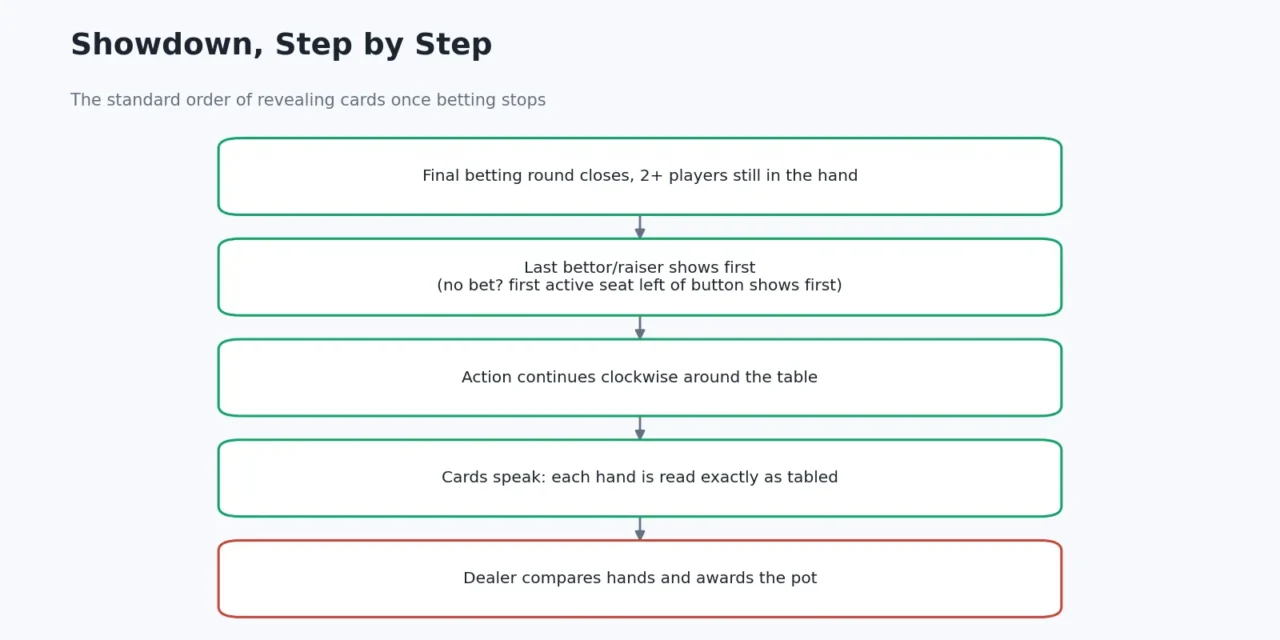
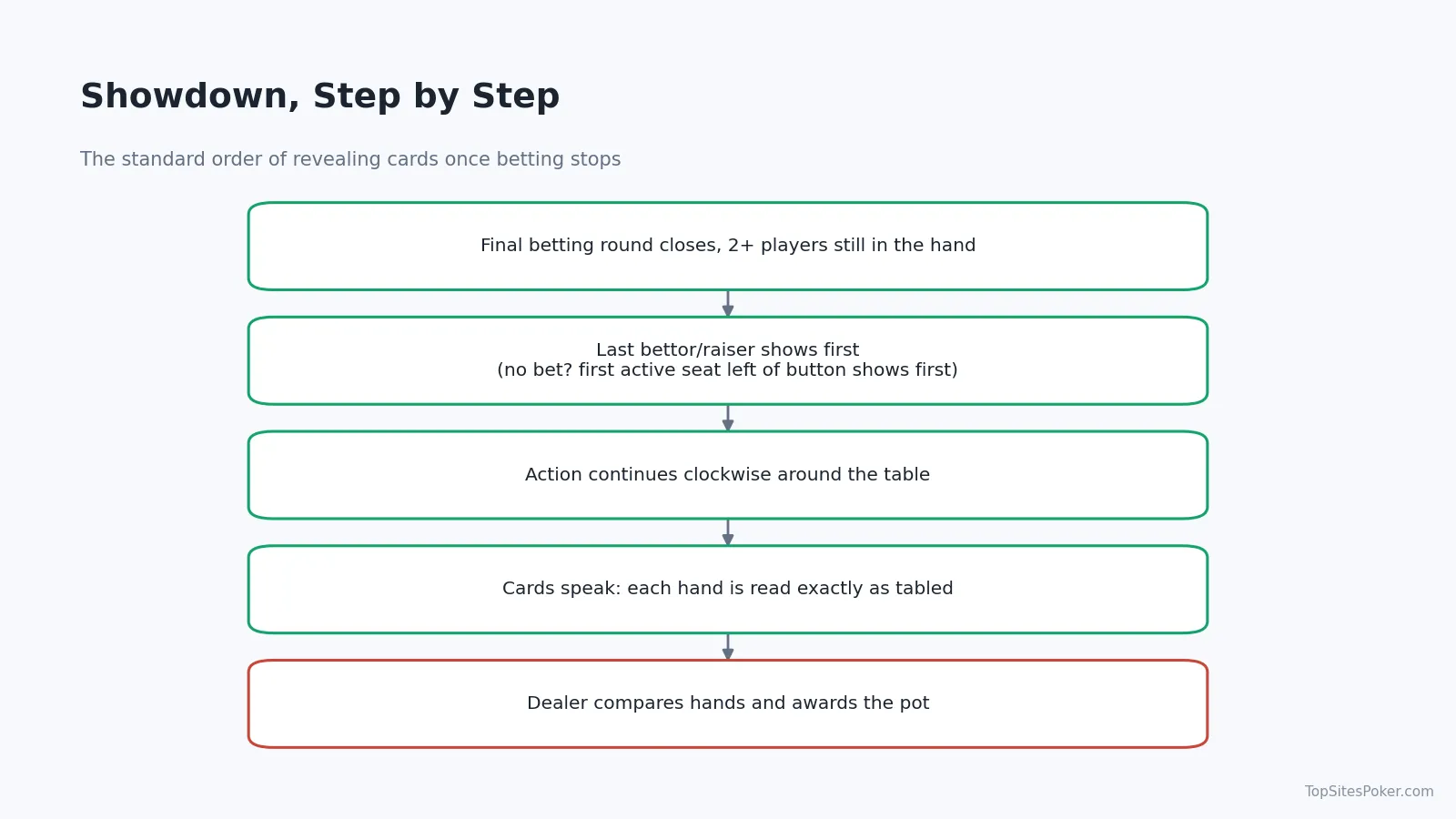
Quick answer: A poker showdown happens once the final betting round closes with two or more players still live. The last player to bet or raise on that round shows their cards first; if nobody bet, the first active player left of the button shows first, and action then continues clockwise. Cards speak — a hand is read exactly as tabled, not by what a player claims out loud — and a hand must be fully tabled, face-up, to win any part of the pot.
| Situation | Who shows / acts first | Why |
|---|---|---|
| A bet or raise was made on the final betting round | The last player to bet or raise | They made the final aggressive action, so standard procedure has the aggressor show first |
| No bet on the final round (everyone checked it through) | The first active player left of the button | The same seating order that already governs betting carries into the showdown |
| All betting stopped because every remaining player is all-in | Varies by room — often cards up once no more action is possible | Many rooms turn cards up as soon as no further betting can occur, but this is a house option, not a universal rule (see the section below) |
| Only one player is still live when betting closes | No showdown occurs at all | An unchallenged hand wins the pot without being required to show it |
Everything below walks through that procedure in full: when a showdown is triggered, exactly who has to show and in what order, what “cards speak” really means, when a player has to table their whole hand to win, when mucking is allowed and when it costs you the pot, the “show one, show all” convention (and why it is not a TDA rule), how a dealer handles irregularities, and how the all-in “cards up” moment you see on televised final tables differs from the procedure at a standard cardroom table. Two closely related questions get their own dedicated treatment elsewhere on this site and are only touched on briefly here: the card-by-card comparison ladder that decides which hand actually wins once two hands are both tabled, and what happens to the chips once a tie between two or more hands is confirmed. This guide owns the procedure itself — the sequence of events between the last bet and the pot landing in front of a winner.
When Does a Showdown Actually Happen?
A showdown is not automatic just because a hand goes to the river. It is triggered by one specific condition: the final betting round for that hand closes with more than one player still active. “Active” means still in the hand — they have not folded and their chips (or a portion of them, in a side-pot situation) are still live in that pot. If every other player folds at any point before the last card is dealt or the last bet is called, the hand ends immediately with no showdown at all. The last player standing takes the pot, and by long-standing convention they are not required to show their cards, because nobody called their final bet — there is nothing to compare it against.
That single rule — showdown requires a closed betting round and two or more live players — covers every game and format, but it plays out in three slightly different shapes depending on how the hand got there:
- A normal river showdown. The last card is dealt, a betting round happens on it, and it closes with a bet-and-call, a check-through, or a raise that gets called. Two or more players are still live, so the hand goes to showdown the moment that action stops.
- An all-in showdown before the river. If two or more players are all-in (or one is all-in and the rest have checked or called with no more betting possible) before all the community cards are out, the dealer deals the remaining cards with no further betting, and the showdown happens the instant the last card lands and there is nothing left to act on.
- A showdown forced by a single all-in caller. If one player is all-in and every other live player has either called or checked (nobody left with a decision that could still change the pot), the hand runs out the board and goes to showdown even though technically “betting” stopped earlier than the final card.
Two practical wrinkles are worth flagging up front, because both come up constantly at the table and both feed directly into the rest of this guide:
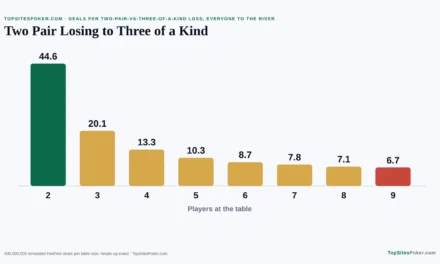
First, a showdown can involve more than two hands. Cash games and multi-way tournament pots regularly reach the river with three, four, or more players still live. The dealer’s job in that situation is not a single comparison — it is comparing every tabled hand against every other one to find the single best hand (or the tied best hands). Later in this guide, real simulation data shows exactly how often a showdown has to resolve three, four, or even nine hands at once instead of the two-hand comparison most players picture.
Second, “showdown” and “who wins” are two different questions. This guide is about the procedure — the order cards get shown in, the rule that makes cards speak for themselves, the requirement to table your whole hand, and what happens if you muck instead. The separate question of exactly which hand outranks another once both are face-up — the full card-rank comparison ladder used to settle close calls — is covered start to finish in this site’s dedicated guide to comparing two poker hands card by card. If you already know your hand is behind or ahead and just want the showdown mechanics, keep reading; if you need the tiebreaker math for a specific matchup, that companion piece is the one to reach for.
Who Shows First? The Standard Order of Revealing Cards
Once a showdown is triggered, cards do not get shown randomly, and they are not shown all at once by mutual agreement. There is a standard order, and it exists for a fairness reason: the player who has to show first is, by definition, giving up information before anyone else does. The order is designed so that obligation falls on the player who was already the aggressor — the one who chose to bet or raise, and therefore chose to put themselves in that position — rather than on a player who was simply calling along.
The order works like this:
- If there was a bet or a raise on the final betting round, the last player to bet or raise shows first. This is true even if two or three players called that final bet — the caller does not have to show before the bettor. The player who made the last aggressive action tables their hand first.
- If there was no bet on the final round — everyone checked it through — the first active player left of the button shows first. This mirrors the normal order of action at the table: the player in that seat would have been first to act if anyone had wanted to bet, so they are first to show when nobody did.
- After the first hand is shown, action continues clockwise around the table, with each remaining live player showing (or mucking, if they know they cannot win) in seating order until every live hand has either been tabled or conceded face-down.
A dealer does not need a player to ask for this order to be followed — house dealers in live cardrooms are trained to call for the appropriate player to show first, and most experienced players simply turn their cards up in the right order out of habit. In practice, plenty of players who know they have a big hand will flip immediately regardless of the formal order, and nothing in the rules stops a player from showing early if they choose to. The order matters most when someone is unsure whether to show, wants to see another hand before deciding, or when a dispute arises about who legitimately has to show — at that point, the dealer enforces the sequence above.
One detail trips up newer players constantly: the order of showing has nothing to do with who wins. Showing first is not a penalty and mucking later is not an advantage. A player who is required to show first can still have the best hand at the table; the order only determines the sequence cards get tabled in, not the outcome. The outcome is decided entirely by the actual cards, which is exactly what the next section covers.
A related question that comes up in bigger multi-way pots: does the standard order change when the hand has produced one or more side pots because a player went all-in for less than a full call? It does not. The same rule applies — last bettor or raiser on the final round shows first, or first active player left of the button if there was no final-round bet, then clockwise from there — and the dealer simply resolves the side pot(s) and the main pot separately, comparing only the hands that are actually eligible for each specific pot. A short-stacked player who is only eligible for the main pot, for example, is never compared against a side pot they never contributed to; but the showing order among the hands that are live for a given pot follows the exact same sequence covered above.
Cards Speak: Why What You Say Doesn’t Matter (TDA Rule 13)
“Cards speak” is one of the oldest and most important principles in poker procedure, and it is codified directly in the current rulebook: TDA Rule 13 establishes that a hand is read by its actual cards as tabled, regardless of what a player says or claims about it out loud, and that a deliberate miscall may be penalized. In plain terms: your mouth does not determine your hand. Your cards do.
This matters more than it might sound like at first. Players get tired, players get excited, players misread their own hands under pressure — nobody is immune to announcing the wrong hand at the table, especially after a long session or a big multi-way pot with several community cards to account for. Cards speak exists specifically so that an honest mistake in what a player says never costs them (or costs their opponent) the pot they are actually entitled to. The dealer, and ultimately the room’s cards, are the final word — not the player’s declaration.
Here is a worked example that shows exactly how this plays out at the table.
| Seat | Tabled hand | What the player said | What the cards actually make |
|---|---|---|---|
| Player A | Q♦ Q♣ 7♥ 7♠ 3♦ | “Flush!” | Two pair, queens and sevens (no flush — the suits are mixed) |
| Player B | 9♣ 9♦ 9♥ 4♠ 2♣ | “Just two pair, I think” | Three of a kind, nines |
Player A tables their cards and, in the moment, calls out “Flush!” — maybe out of habit, maybe simply misreading their own five cards after a long multi-way hand. But there is no flush on the table; the suits do not match. Player B, meanwhile, undersells their own hand, muttering “just two pair” when they are actually looking at three nines. Under Rule 13, none of that spoken commentary matters. The dealer reads the tabled cards exactly as they lie: Player A has two pair (queens and sevens), Player B has three of a kind (nines), and three of a kind beats two pair on the actual ranking ladder — full stop. Player B wins the pot, exactly as they would have if both players had stayed silent and let the dealer read the cards cold.
The rule cuts both ways, and that symmetry is the whole point. Player A’s mistaken “Flush!” call does not turn their two pair into a flush, and it does not create a false impression that gets baked into the ruling. Equally, Player B’s understatement does not cost them the hand they actually made. Cards speak protects both an honest overstatement and an honest understatement from mattering — the dealer’s read of the physical cards is the only thing that counts.
Rule 13 also addresses the darker version of this scenario: a deliberate miscall, where a player knowingly announces a false hand — most commonly to try to induce another player still deciding whether to show, muck, or even (in a game with more than two live hands) reconsider a call they have not yet made, into acting on bad information. Because the cards themselves always control the actual ruling, a deliberate miscall cannot change who wins the pot. But it is not a harmless bit of table talk either — a deliberate miscall is exactly the kind of angle-shooting behavior tournament directors are authorized to penalize under Rule 13, separately from the (unaffected) outcome of the hand itself. In practice this means a player can win the ruling on their cards and still walk away with a penalty for how they announced them, if a floor determines the miscall was intentional rather than an honest mistake.
The Tabling Requirement: Show It All to Win It All (TDA Rule 14 and Rule 20)
TDA Rule 14 sets the second half of the showdown foundation: a player must show all of their hole cards, face-up, on the table, in order to claim any part of the pot. Not most of the hand. Not “the good card.” All of it. A player who tables only one card of a two-card hand, or flashes a card and pulls it back before the dealer can confirm it, has not satisfied the tabling requirement — and a hand that is not fully tabled cannot win, even in the scenario where it would genuinely have been the best hand at the table if it had been shown properly.
This sounds like a technicality until you picture the situation it is actually protecting against. Imagine a player who wants to see an opponent’s hand before deciding whether it is even worth revealing their own — showing one card, watching for a reaction, and only producing the second card if it looks safe to do so. Rule 14 closes that door entirely. Tabling is all-or-nothing: both hole cards, face-up, or the hand does not count as shown for the purpose of winning the pot.
TDA Rule 20 extends this same principle to a specific and easily misunderstood situation: playing the board. When the five community cards themselves form a strong hand — say, a made straight or a strong two pair sitting right there on the board — a player’s own two hole cards might not improve on it at all. In that case the player’s actual best hand really is just “the board’s five cards.” Rule 20 makes clear that a player in this position still has to table both of their hole cards face-up to claim any part of the pot with that board hand. It is not enough to gesture at the board and say “I play the board” — the tabling requirement in Rule 14 applies exactly the same way, whether the winning five cards came entirely from the board, entirely from a player’s own hole cards, or some mix of the two.
The simulation data behind this article shows exactly how often this scenario actually decides a real pot. “Playing the board” means the winner’s best five-card hand is identical to the community cards’ own best five-card hand — their hole cards contributed nothing at all to the winning combination.
| Table size | Share of showdowns where the winning hand is exactly the board’s own hand |
|---|---|
| 2-max | 1.56% (2,345 of 150,000 simulated no-fold showdowns) |
| 6-max | 0.27% (412 of 150,000) |
| 9-max | 0.14% (206 of 150,000) |
Method note: these figures come from a 150,000-trial Monte Carlo simulation per table size, using the “no-fold” baseline — every seat is dealt in and every hand runs to a random five-card board with nobody folding. That baseline describes what actually gets tabled at showdown, not how often real-money hands reach showdown after folding (most hands in a real game never get there at all). The rate falls sharply as the table gets bigger because with more hole cards live against the same single board, it becomes far less likely that nobody at the table happened to pair, straighten, or otherwise improve on what the board already shows — someone almost always beats the board outright once there are nine hands competing against it instead of two.
Even at its highest rate here — heads-up, where it happens a little over 1.5% of the time — playing the board is a genuine minority outcome. But it is common enough that every serious player will run into it, and Rule 20 removes any ambiguity about what to do: table both hole cards, exactly as if they had improved the hand, and let the dealer confirm the board is in fact the best available five cards.
| Rule | What it covers | Binding? |
|---|---|---|
| TDA Rule 13 | Cards speak: a hand is read by the cards actually tabled, not by what a player says. Deliberate miscalls may be penalized. | TDA rule — binds any room or event that adopts the TDA rulebook |
| TDA Rule 14 | A player must show all hole cards face-up on the table to claim any part of the pot. | TDA rule |
| TDA Rule 20 | The Rule 14 tabling requirement applies in full even when a player is simply playing the board. | TDA rule |
| “Show one, show all” | If a player shows their cards to anyone at the table, they must show everyone at the table. | House rule only — not a TDA rule. Adopted, or not, entirely at each room’s discretion. |
That last row deserves its own full treatment, because it is the single most common point of confusion at the showdown table — and it is the subject of the next two sections.
Mucking: Conceding Without Showing Your Cards
Not every player at a showdown has to table their hand. A player who knows they cannot win the pot may muck — turn their cards face-down and slide them to the dealer without showing them to anyone — instead of tabling. This is completely normal and happens constantly: if you are the third or fourth player to act in the showdown sequence and the two hands already shown clearly beat anything you could possibly have, there is no obligation to show your losing hand to the table before conceding it.
The core trade-off is simple and absolute: mucking forfeits any claim to the pot, even if the mucked hand was secretly the best hand at the table. Once a hand goes into the muck face-down, it is dead for the purposes of that pot. It does not matter whether the player folding it “actually” had the winner — a hand that is never tabled cannot be awarded any part of the pot, full stop, because Rule 14’s tabling requirement was never satisfied. This is the flip side of the tabling rule discussed above: tabling protects a hand’s right to win, and mucking waives that right, deliberately or not.
This creates a real, well-known risk that experienced players are careful about: mucking a winner by mistake. It happens more often than beginners expect, usually in one of these situations:
- Misreading your own hand under pressure. A player glances at a scary board, assumes they are beaten, and mucks a hand that was actually good — often a two pair or a straight they didn’t notice they still had after focusing on an opponent’s flush-looking board.
- Reacting to another player’s confident bet or declaration. Strong, fast action from an opponent can talk a player out of a hand that would have won — which is exactly the kind of situation Rule 13’s protection against relying on what a player says does not extend to, because mucking based on a bluffed declaration is still a voluntary choice to concede, not a misapplication of the cards-speak rule.
- Rushing because the dealer is already moving to kill the hand. In a busy cardroom, a dealer may begin sweeping cards toward the muck quickly once it looks like a player is folding; a player who hesitates and lets their cards get mixed into the discard pile has, in almost every ruleset, lost any ability to reclaim them once they are irretrievably mixed in with other dead cards.
Because a mucked hand generally cannot be un-mucked once it is genuinely dead and mixed with other cards, the practical responsibility sits with the player: protect your hand, and do not release it to the dealer until you are certain you want to concede. This is standard advice repeated at nearly every cardroom in the world for good reason — it is one of the few showdown mistakes that is completely irreversible once it happens.
There is one situation where mucking is essentially risk-free: a heads-up final pot, where only two hands remain and one of them is the pot’s only other claimant. If you know for certain you are beaten in a genuine two-way showdown with no other live hands anywhere in that pot, mucking costs you nothing you were not already going to lose, and it saves you from showing a hand you might prefer to keep private (particularly relevant in a cash game that continues after this hand, discussed next). The risk described above belongs almost entirely to situations where a player is uncertain whether they actually have the best hand and mucks anyway rather than tabling to find out for sure.
“Show One, Show All”: A House Rule, Not a TDA Rule
Walk into almost any live cardroom and you will likely see a small placard somewhere near the table, or hear a floor person mention, a rule along these lines: if you show your cards to even one other person at the table — a friend, a dealer, another player — during or after a hand, you must show your cards to the entire table if anyone asks. This is the “show one, show all” convention, and it is worth stating as plainly as possible: this is a house rule, not a TDA rule. It does not appear in the TDA rulebook’s showdown procedures (Rules 13, 14, and 20 above are the actual TDA framework), and no tournament or cash game is required to run it. It is adopted, or not, entirely at each individual room’s discretion, and enforcement style varies from room to room where it is posted at all.
The reasoning behind the rule is straightforward once you see the scenario it targets. Picture a multi-way pot where a player wins with a well-timed bluff, mucks their cards face-down as they are entitled to, but then privately flashes the winning bluff to a friend seated one seat over — purely to brag, or purely to signal something. Every other player still active at the table, and every opponent who will play against that same person later in the session or the tournament, is now at an informational disadvantage: one person at the table knows exactly how that player plays a big bluff, and nobody else does. “Show one, show all” exists specifically to prevent a player from selectively controlling who gets to see a revealing hand and who does not, which would otherwise let them manipulate how different opponents perceive their play going forward.
Two things make this rule situational rather than universal, which is exactly why so many rooms leave it optional rather than baked into the core rulebook:
- It is largely moot once a pot is the final heads-up pot of a tournament with no more play to follow. If the hand in question ends the tournament outright, there is no “future perception” left to manipulate — the game is over. The informational-advantage concern the rule exists to prevent simply does not apply in that specific case, which is exactly why hedged language (“most rooms,” “check the posted rules”) is appropriate here rather than a flat universal statement.
- It matters a great deal in every other setting: multi-way pots with other players still live in the same hand, or any cash game and any tournament table that will keep dealing more hands afterward. In both of those cases, other players’ future decisions can genuinely be affected by who knows what about how a given opponent plays, which is exactly the asymmetry the rule is designed to close.
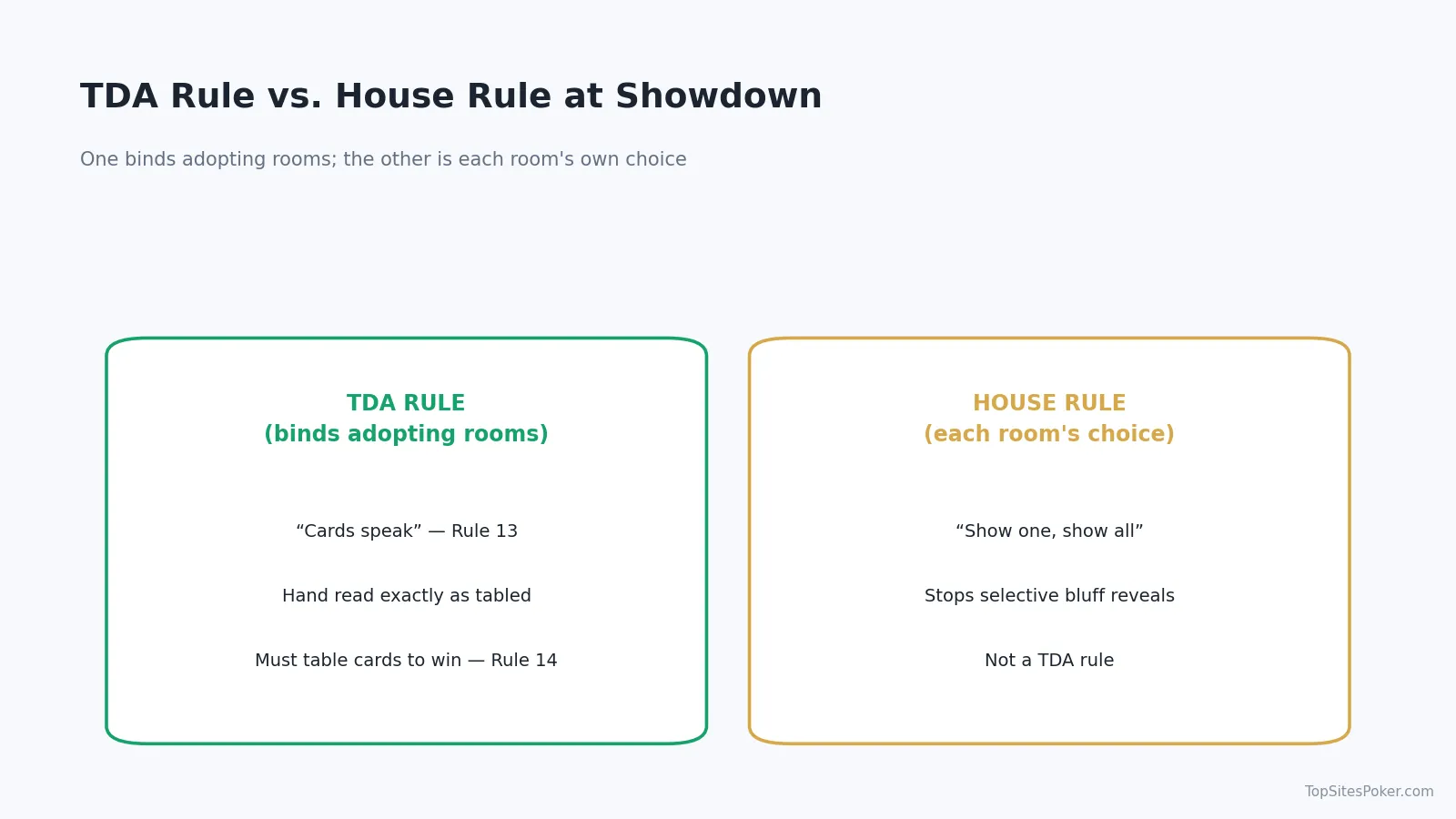
Because this is a house rule, its exact wording and enforcement differ from room to room. Some cardrooms apply it only when a player specifically requests to see a mucked hand and the room’s dealer or floor staff decide to enforce the reveal; others post it as a standing, automatically-enforced rule at every table; some online sites simply do not implement any version of it at all, since there is no “friend leaning over your shoulder” scenario to guard against in a fully digital format where every remaining player already sees the same screen. The one constant across all of this variation: it is never a TDA rule, so a reader who wants to know whether it applies at a specific table should check that room’s own posted rules rather than assuming it works the same way everywhere.
What Actually Gets Tabled and Wins at Showdown
Knowing the procedure — who shows, in what order, and what “cards speak” and tabling actually require — only tells you how a showdown is conducted. It does not tell you what a real showdown typically looks like once you are sitting there watching hands get turned over. That is a question you can answer directly with simulation, because it depends entirely on how many players see a random board together, not on any strategic decision.
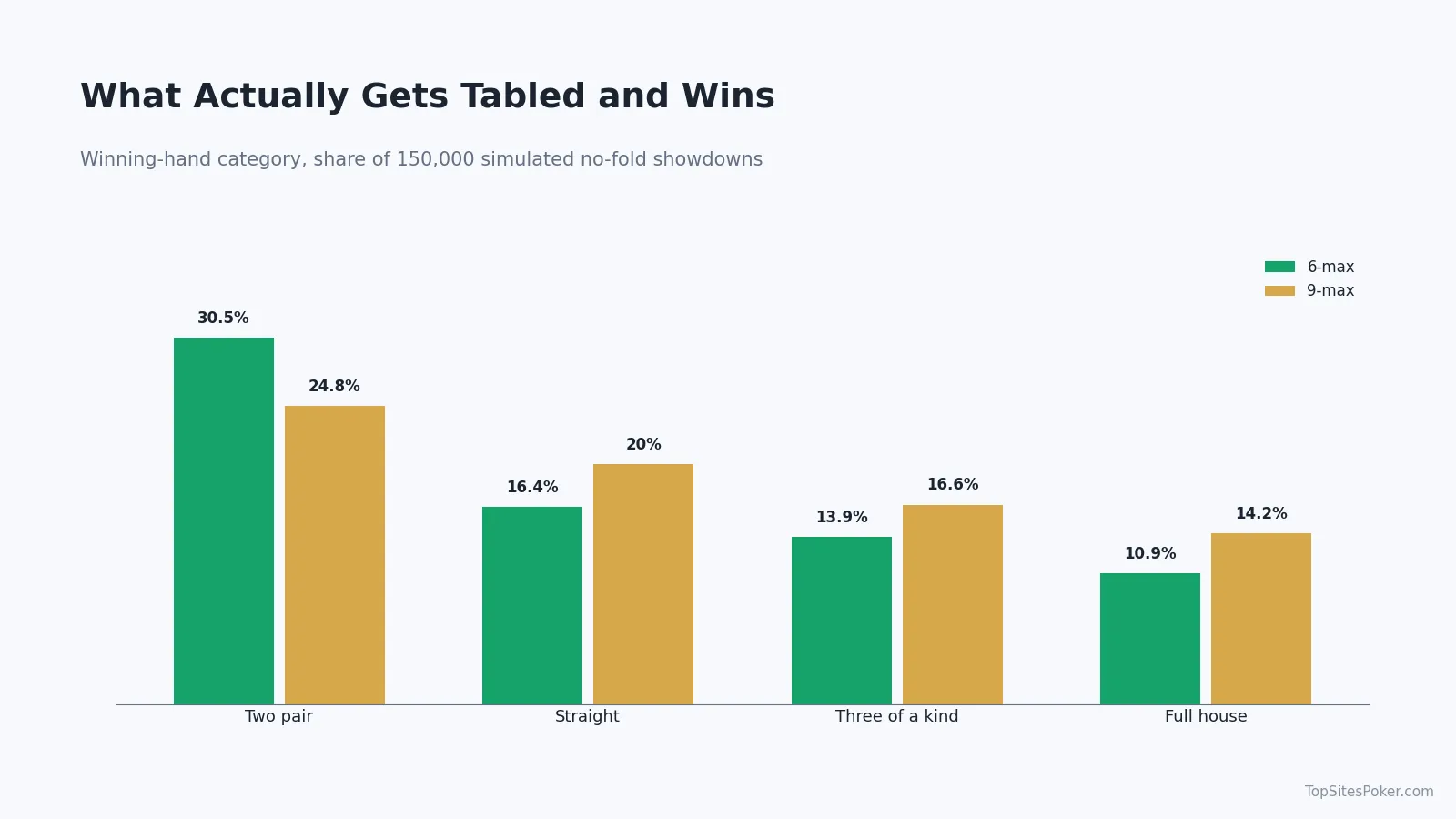
The numbers below come from a 150,000-trial Monte Carlo simulation of Texas Hold’em showdowns at three table sizes — 2-max, 6-max, and 9-max — using the no-fold baseline: every seat at the table is dealt two hole cards, every seat sees the full five-card board, and nobody folds at any point. This baseline is the right tool for answering “what typically gets tabled and wins,” because it isolates the raw card math from all the folding decisions that, in a real game, thin out how many hands actually reach a real-money showdown. It is not a claim about how often real hands make it to showdown in the first place — most hands never do, because most players fold before the river. It is a clean measurement of hand composition among hands that do reach the table together.
| Winning hand category | 2-max (heads-up) | 6-max | 9-max |
|---|---|---|---|
| One pair | 37.1% | 16.2% | 9.5% |
| Two pair | 31.6% | 30.5% | 24.8% |
| Straight | 7.9% | 16.4% | 20.0% |
| Three of a kind | 7.2% | 13.9% | 16.6% |
| High card | 6.0% | 0.05% | 0.0% |
| Flush | 5.2% | 10.8% | 13.3% |
| Full house | 4.7% | 10.9% | 14.2% |
| Four of a kind | 0.3% | 0.9% | 1.3% |
| Straight flush | 0.06% | 0.16% | 0.25% |
Method note: 150,000-trial Monte Carlo simulation per table size, no-fold baseline (every seat sees a random board through to showdown; this measures what gets tabled, not how often real hands reach showdown). Columns sum to 100% at each table size (rounding may shift the last digit).
The pattern in this table is the single most useful thing to internalize about multi-way showdowns: the more live hands are competing for the same board, the stronger the average winning hand has to be. Heads-up, one pair is the most common winner by a wide margin (37.1%), because there is only one opponent’s hand to beat and a single made pair is frequently enough. By six players, two pair has overtaken one pair as the most common winner (30.5% vs. 16.2%), because with five competing hands instead of one, a bare pair is far less likely to survive as the best hand at the table. By nine players, straights and full houses have both grown substantially (20.0% and 14.2%, respectively, versus 7.9% and 4.7% heads-up), and two pair — while still the single most common category — has fallen to under a quarter of showdowns, because with eight opponents’ hands in the mix, something stronger than two pair is very often sitting at the table.
Notice also that “high card” (no pair at all) essentially disappears once the table gets full — it wins 6.0% of heads-up showdowns in this simulation but only 0.05% of the time at six-handed (82 of 150,000) and effectively never at nine-handed (0 occurrences in this particular 150,000-trial run, meaning it is on the order of well under one in 150,000 in a full nine-handed no-fold showdown). That is intuitive once you picture it: for a completely unpaired hand to be the best hand at the table, every other live hand also has to have missed pairing anything on a shared five-card board — a coincidence that gets exponentially less likely every time you add another live hand to the comparison.
None of this changes the procedure covered earlier in this guide — the order of showing, the cards-speak rule, and the tabling requirement work identically whether the winning hand is a bare pair or a full house. What this data changes is your expectations of what you are likely to actually see turned face-up on a given night, depending on how full the table is.
When the Dealer Has to Compare More Than Two Hands at Once
Most players picture a showdown as a clean two-hand comparison: your cards against one opponent’s cards, best hand wins. That picture is accurate a majority of the time, but it understates how often a real dealer’s job is genuinely harder than that — comparing three, four, or even every hand at a full table simultaneously to find not just a single winner, but potentially a group of tied winners.
The same 150,000-trial no-fold simulation used above also recorded every exact tie — every showdown where two or more tabled hands finished with the literal same best five-card ranking, down to every tiebreak card. At every table size, ties happen; the interesting question is how often those ties involve more than two hands at once.
| Table size | Total exact ties | 2 hands tied | 3 hands tied | 4 hands tied | Full table tied | Share that is 3+ hands |
|---|---|---|---|---|---|---|
| 2-max | 6,211 | 6,211 | 0 | 0 | 0 | 0.0% |
| 6-max | 10,824 | 9,569 | 813 | 30 | 412 (all 6) | 11.6% |
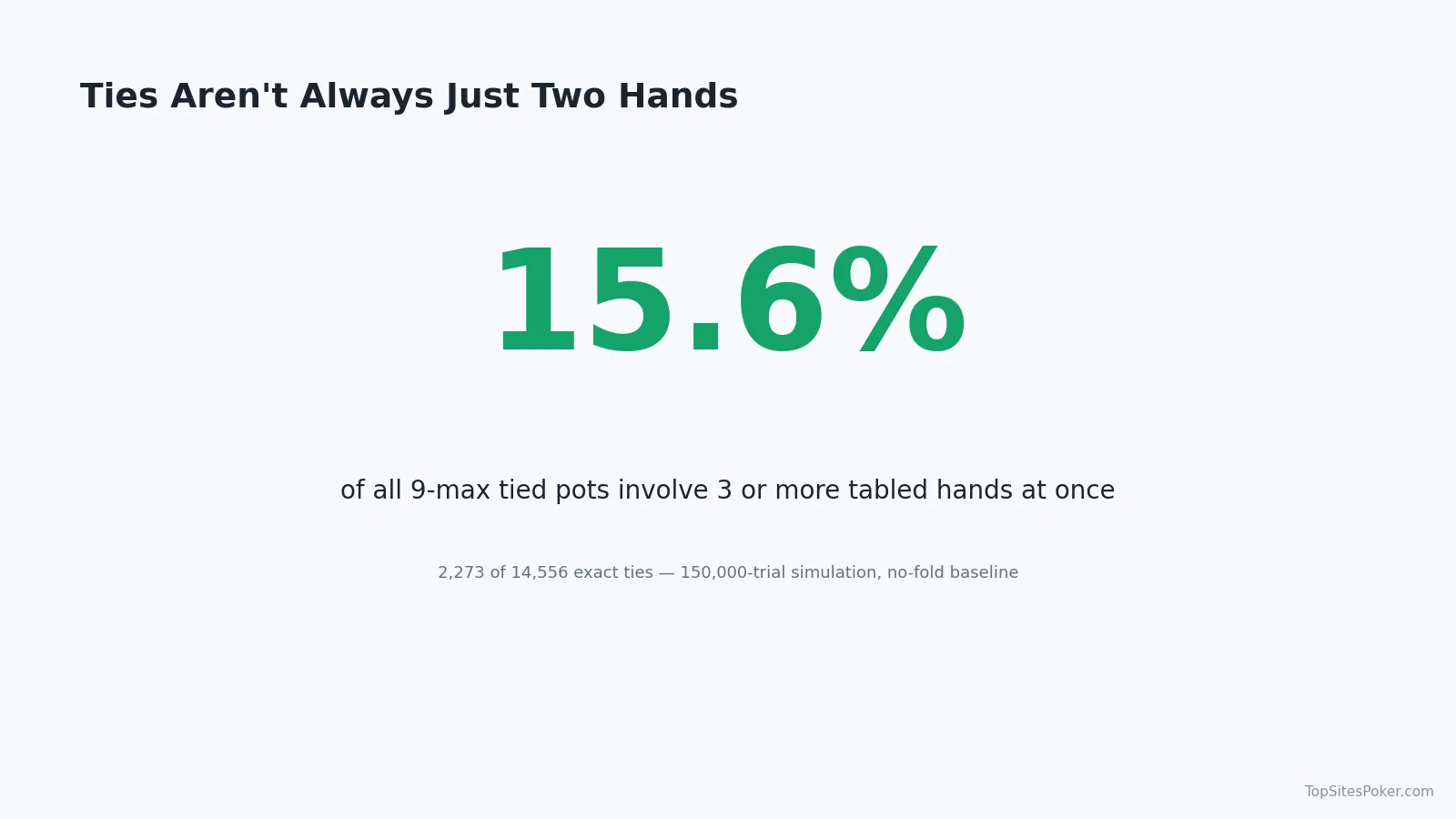
| 9-max | 14,556 | 12,283 | 1,920 | 147 | 206 (all 9) | 15.6% |
Method note: same 150,000-trial Monte Carlo simulation, no-fold baseline, per table size. “3+ hands” combines every tie bucket where three or more tabled hands finished with the exact same best five-card ranking. At 2-max, every tie is necessarily a 2-way tie, since there are only two hands at the table.
At a heads-up table, this question has an obvious answer — with only two players, every tie is automatically a two-way tie; there is no other option. But once a third, fourth, or ninth hand is added to the mix, real multi-way ties start showing up, and they are not rare. At a full nine-handed table, roughly 15.6% of all exact ties involve three or more tied hands at once — meaning the dealer is not comparing two hands and calling it, but genuinely sorting a small group of hands that all finished dead level, then splitting the pot among all of them. Six-handed tables see a very similar pattern at a slightly lower rate, with 11.6% of ties involving three or more hands.
The most extreme case in this data set is genuinely rare but not impossible: at nine-handed tables, 206 of the 150,000 simulated showdowns produced a tie among every single one of the nine tabled hands — the entire table finishing dead level. That specific outcome only happens when the community board itself is so strong (for example, a made straight or flush sitting entirely on the board) that no combination of hole cards can improve on it for anyone, so every player at the table ends up simply playing the board, tied with each other by definition. It is a vivid, if unusual, illustration of Rule 20’s tabling requirement from earlier in this guide — every one of those nine players still has to table both of their hole cards to claim their share of the pot, even though none of those hole cards changed anything about the final hand.
It is also worth noting how the overall tie rate itself climbs with table size, independent of how multiway those ties get:
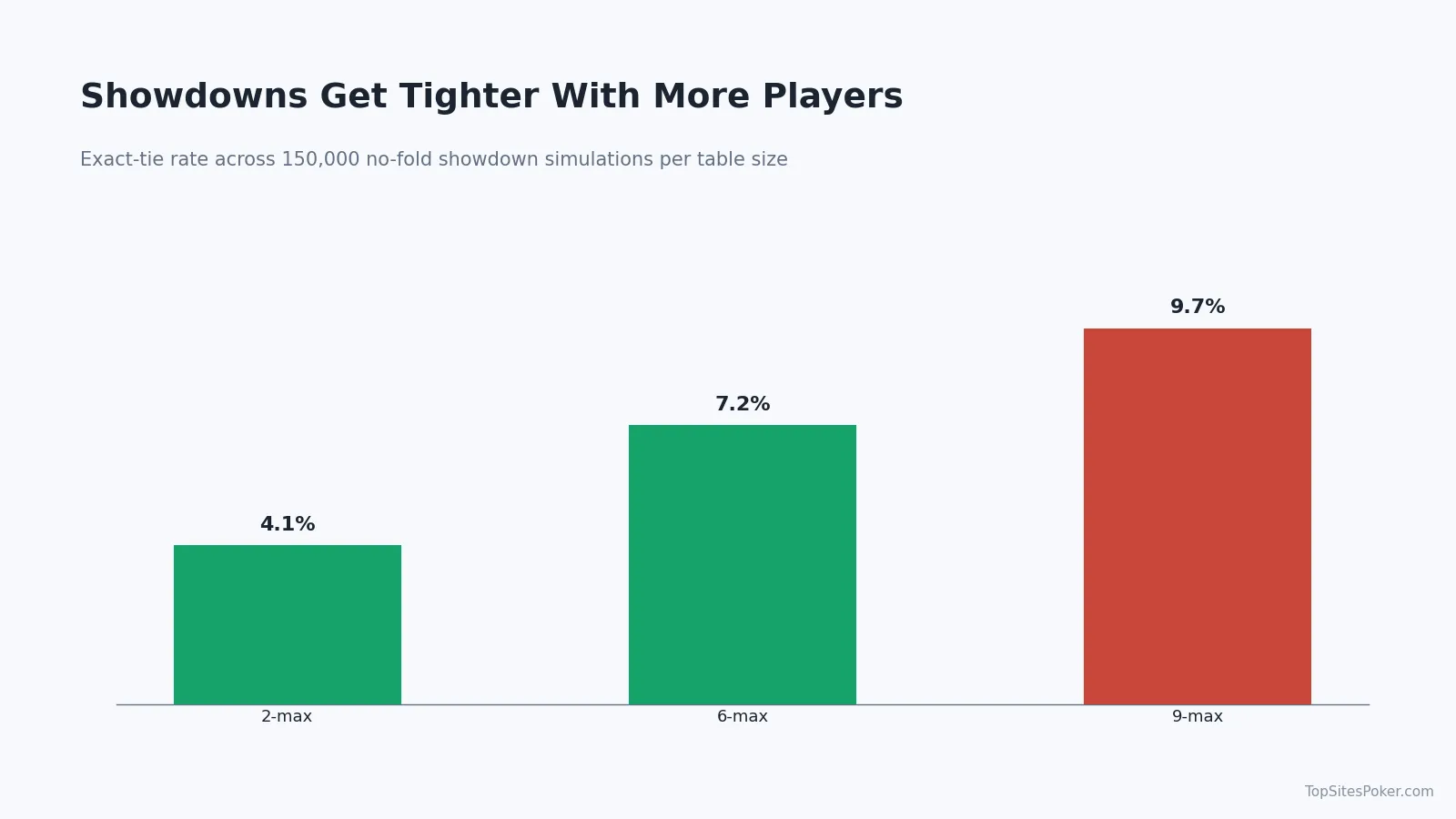
Heads-up showdowns tie exactly 4.1% of the time in this simulation (6,211 of 150,000); at six-handed, that climbs to 7.2% (10,824 of 150,000); at nine-handed, it reaches 9.7% (14,556 of 150,000). More live hands at the table means more chances for two or more of them to happen to land on the same final ranking — and, as the table above shows, an increasing share of those ties are not simple two-way splits but genuine multi-hand comparisons. Exactly what happens to the chips once a tie like this is confirmed — how an odd chip gets distributed, how side pots factor in, how a chop actually gets counted out — is its own detailed topic, covered fully in this site’s companion guide to what happens to the pot once a tie is confirmed. The procedural point that belongs here is simpler: the dealer’s read-and-compare step at showdown is very often a genuinely multi-hand operation, not the two-hand comparison most players assume by default.
Irregularities at Showdown: Exposed Cards, Early Shows, and the Dealer’s Role
Showdown procedure is straightforward in the ordinary case, but real tables regularly produce edge cases: cards flashed early, hands shown out of the expected order, two or more players tabling at nearly the same instant, and the recurring question of who has the final say when something looks ambiguous. Here is how each of those is typically handled.
Exposed cards before showdown. A card accidentally flashed mid-hand — a hole card that slips and is briefly visible to the table before the hand is even over — is a different situation from anything discussed above, because it happens before betting has finished rather than at the tabling stage. The closest procedural analogy in the rulebook is TDA Recommended Procedure 5, which governs a card exposed prematurely during the deal itself: the burn card stays where it is, the prematurely exposed card is reshuffled back into the stub, and the hand is redealt from that point without burning an additional card. That specific procedure is about dealing mechanics, not about the showdown itself, but it reflects the same underlying principle that runs through this entire guide: an accidental exposure does not get treated as a deliberate reveal, and the room has a defined way to neutralize it rather than improvising case by case. Separately, TDA Rule 15 establishes that a face-down discard is not automatically ruled dead if it remains 100% identifiable — relevant if a mucked or discarded card needs to be sorted out from a dispute after the fact, since it means a clearly-identifiable card is not simply lost to ambiguity.
A card shown before it is technically that player’s turn to show. Nothing in the tabling rules stops a player from turning their cards up early — Rule 14 requires that a hand be shown to claim the pot, but it does not forbid a player from showing ahead of the formal order described earlier in this guide. In practice, this happens constantly and harmlessly: an excited player at an all-in confrontation flips immediately rather than waiting to be asked. Where it becomes a genuine irregularity is when an early show is used tactically — for example, showing a strong hand specifically to influence how another player, who has not yet acted on whether to show or muck their own hand, responds. A floor is generally the authority for sorting out whether an early show crossed from harmless enthusiasm into an attempt to manipulate another player’s decision, and the standard response is procedural rather than punitive in most cases: the dealer re-establishes the correct order for any remaining hands and proceeds normally, since — per Rule 13 — nothing about the order cards were shown in changes what the cards themselves say once everything is on the table.
String or simultaneous tabling. At a busy all-in confrontation with several players, it is common for two or more hands to hit the table at almost the same moment, with genuine excitement making the literal sequence hard for anyone (including the dealer) to pin down precisely. This does not create a procedural problem, because the actual order cards physically land in has no bearing on the outcome — the dealer still reads and compares every tabled hand the same way regardless of which one technically touched the felt a half-second earlier. The formal “who shows first” order exists to manage the sequence of a normal showdown cleanly, not to create an advantage tied to timing; a dealer facing simultaneous tabling simply proceeds to read all of the hands and determine the actual best hand (or hands, in a tie) exactly as they would with any other showdown.
The dealer’s role in reading and announcing hands. Throughout this guide, one point keeps recurring for good reason: the dealer, not the players, is the final word on what a tabled hand actually is. Dealers are trained to read every hand at showdown correctly regardless of what any player calls out, per Rule 13, and to confirm that every hand claiming a share of the pot has actually satisfied the Rule 14 tabling requirement before that share is paid. If a dealer misreads a hand or miscounts a comparison, the standard remedy is for players or the floor to catch and correct it — but, consistent with the mucking risks discussed earlier, that correction generally has to happen before the pot is pushed and cards are swept into the muck. Once chips have moved and cards are dead, most rooms treat the hand as closed. This is exactly why experienced players make a habit of double-checking the board and their own hand before agreeing that a dealer’s call is correct, rather than assuming any error will simply get fixed after the fact.
All-In “Cards Up”: Televised Final Tables vs. Standard Cardroom Procedure
Anyone who has watched a televised or streamed poker final table has seen the moment: two players get all their chips in, and the instant the last call locks the action, both hands flip face-up on the felt — even though there might still be a turn and a river left to deal. It is one of the most recognizable images in poker broadcasting, because it is exactly what makes the remaining cards feel like genuine drama for an audience that can now see both hands and the exact odds each is fighting for.
It is important to be precise about what that moment actually represents, because it is easy to assume it reflects a universal rule when it does not. Turning cards face-up immediately once an all-in is settled, before the remaining board cards are dealt, is itself usually a house option adopted for broadcast purposes — not a universal procedural rule that every cardroom follows. Televised final tables show cards early specifically because it serves the audience: viewers get to watch the exact percentages update in real time on a graphic overlay as each subsequent card is dealt, which only works if both hands are already known.
Standard live cardroom procedure is more varied, and the honest answer is that it depends heavily on the room:
- Some cardrooms do turn cards up immediately once all betting is genuinely finished — meaning every remaining live player is either all-in or has no further decision to make — as a matter of house policy, often to keep the game moving and to prevent any appearance of collusion or soft-play on the remaining streets.
- Other cardrooms keep all cards face-down until the final board card has been dealt, and only then follow the standard showdown order covered earlier in this guide (last bettor/raiser first, or first active player left of the button if there was no final-round bet). In this style of room, the dramatic “cards up on the flop” moment familiar from television simply does not happen — hands stay hidden until the whole board is out.
- A meaningful distinction inside this question is whether every remaining player is actually all-in. If even one live player still has a real decision left to make on a later street, most rooms will not show any cards early, specifically because doing so would hand that undecided player information they should not have before they act — the same fairness logic that governs the ordinary showdown order applies here with extra force, since an early reveal in that scenario could distort a decision that has not been made yet.
Because this genuinely varies by room, floor, and format, the only reliable guidance is to check the posted rules at whatever table you are actually playing. A player who assumes their local cardroom works like a televised final table — cards up the instant an all-in is called — may be in for a surprise if that room in fact holds every hand face-down until the last card falls and works through the standard show-in-order procedure from there. Neither approach is more “correct” in a rules sense; both are legitimate house options sitting on top of the same underlying TDA framework covered throughout this guide.
Worked Examples: Full Showdowns From Start to Finish
The individual rules above are easiest to apply once you have seen them work together in a complete hand. Here are four full walk-throughs, each illustrating a different part of the procedure.
Example 1: Standard river showdown, bettor shows first
Three players see the river in a cash game. On the river, Player A bets, Player B calls, and Player C — who was already planning to fold to any bet — folds. That leaves two live hands. Because Player A made the last bet on the final round, Player A shows first, tabling K♠ Q♣ for top pair on a board of K♣ 9♦ 7♥ 4♠ 2♣. Player B, who called with A♦ Q♦, has missed everything and is looking at ace-high with no pair. Player A’s pair of kings beats Player B’s unpaired hand, so Player A wins without Player B ever needing to table (though Player B is welcome to show if they choose to).
Example 2: No bet on the river, first active player left of the button shows first
Two players check the river through in position order: the small blind checks first, the big blind checks second, ending the betting round with no bet made. Because nobody bet on the final round, the first active player left of the button shows first — in a two-player hand, that is simply whichever of the two blinds is seated first in clockwise order after the button. Say the small blind is first active left of the button in this hand: the small blind tables their hand first (Q♥ J♥ for a made straight on a board of 10♦ 9♣ 8♠ 8♥ 3♣), and the big blind then tables second (9♦ 4♣ for two pair, nines and eights, using the board’s own pair of eights). The straight beats the two pair.
Example 3: Multi-way pot, mucking correctly
Four players reach the river. The last aggressor tables A♣ A♦ for a set of aces improved to a full house on a paired board. Action continues clockwise: the next player, holding only a weak pair that is obviously beaten by the full house already shown, mucks face-down without showing — there is no requirement to reveal a hand that plainly cannot win once a better hand is already on the table. The third player also mucks for the same reason. The fourth player, out of habit, tables anyway, showing a busted flush draw that missed the board entirely — perfectly legal, since showing a beaten hand is always optional and never mandatory in either direction. The full house wins the entire pot, and two of the four original hands (the two mucked ones) are never seen by anyone at the table, which is completely normal and correct procedure.
Example 4: Playing the board, full tabling required
Two players reach the river on a board of Q♥ J♥ 10♥ 9♠ 8♣ — a queen-high straight sitting entirely on the community cards. Neither player’s hole cards improve on that straight in any way (neither has a heart-flush draw or a pair that could make a stronger hand). Both hands, in effect, are just “the board.” Per Rule 20, both players still have to table both of their hole cards face-up — showing, say, 4♠ 2♣ and 7♦ 3♣ respectively — even though those cards do not change either hand’s final value at all. Once both are properly tabled, the dealer confirms both hands are exactly equal (the board’s own straight, with no kicker difference possible since neither hand’s hole cards factor into the five-card hand at all), and the pot is split evenly between the two players.
Common Mistakes at Showdown
Most showdown disputes and lost pots trace back to one of a small handful of avoidable mistakes. Watching for these is far more useful in practice than memorizing rule numbers.
- Mucking before you are certain you’re beaten. The single most costly and most irreversible mistake covered in this guide. If there is any doubt at all about whether your hand is good, table it. A mucked hand cannot be un-mucked once it is genuinely dead, no matter how good it secretly was.
- Assuming your spoken description of your hand controls the outcome. Whether you overstate or understate what you have out loud, Rule 13 means only the actual tabled cards matter. Announcing the wrong hand by mistake will not cost you a hand you actually made, but it also will not win you a hand you did not.
- Trying to claim a pot without tabling both hole cards. Whether the hand is entirely hole-card-based, partly board-based, or purely playing the board, Rule 14 (and Rule 20 for the board-only case) requires every hole card to be shown, face-up, to claim any part of the pot. A hand that is not fully tabled cannot win, however strong it actually is.
- Assuming “show one, show all” is a universal rule. It is a house rule, not a TDA rule, and it does not apply at every table or every site. Do not assume a room enforces it — or that a room does not — without checking the posted rules.
- Assuming cards go up automatically on every all-in. Whether cards flip face-up the moment an all-in is settled, before the rest of the board is dealt, is itself usually a house policy rather than a universal procedure. It is common on televised final tables and at some cardrooms, but far from guaranteed everywhere.
- Forgetting that a showdown can involve more than two hands. In a genuine multi-way pot, especially at a fuller table, the dealer is very often comparing three or more tabled hands at once rather than a simple head-to-head — real simulation data above puts that at roughly 15.6% of all ties at a nine-handed table. Treat every multi-way pot as a real possibility for a genuine multi-hand tie, not just a two-hand race.
- Relying on informal table talk instead of the posted rules. Because house rules vary meaningfully from room to room on several of the points in this guide — “show one, show all” and the all-in cards-up convention especially — the only reliable source is that specific room’s own posted procedures, not what a neighboring table or a different site happens to do.
Quick Glossary of Showdown Terms
- Showdown: the point at which two or more remaining players reveal their hands to determine who wins the pot, triggered once the final betting round closes with more than one player still active.
- Table (a hand): to place all of a hand’s hole cards face-up on the table, the only way to claim any part of the pot under TDA Rule 14.
- Cards speak: the TDA Rule 13 principle that a hand is scored by the actual cards as tabled, never by what a player says about it.
- Muck (verb): to concede a hand by turning it face-down without tabling it, forfeiting any claim to the pot for that hand.
- The muck (noun): the pile of dead, face-down cards — folded hands, mucked showdown hands, and burn cards — that a dealer collects during a hand.
- Playing the board: a situation where a player’s best five-card hand is identical to the community board’s own best five cards, with their hole cards contributing nothing; still subject to the full tabling requirement under TDA Rule 20.
- Show one, show all: a house rule (not a TDA rule) requiring a player who reveals their cards to anyone at the table to reveal them to everyone, if asked.
- Cards up: a house convention, most familiar from televised final tables, of turning all remaining cards face-up immediately once an all-in confrontation is settled and no further betting is possible, before the rest of the board is dealt.
Showdown Procedure Quiz
- A showdown requires a closed final betting round with how many players still active?
Two or more. If only one player remains live, the hand ends without a showdown and that player is not required to show. - On the river, Player X bets and Player Y calls. Who shows first?
Player X, the last player to bet or raise on the final round. - On the river, everyone checks it through. Who shows first?
The first active player left of the button. - True or false: a player’s verbal description of their hand determines how it is scored.
False. Under TDA Rule 13, cards speak — the hand is read exactly as tabled, regardless of what the player says. - What is required to claim any part of the pot, per TDA Rule 14?
All hole cards must be shown face-up on the table. - Does the Rule 14 tabling requirement still apply when a player is only playing the board?
Yes — per TDA Rule 20, both hole cards must still be tabled even if they do not improve on the board’s own best hand. - A player mucks a hand face-down that later turns out it would have won. What happens?
Nothing can be done — mucking forfeits any claim to the pot, even for a hand that was secretly the best hand at the table. - Is “show one, show all” a TDA rule?
No. It is a house rule adopted at some rooms’ discretion, not part of the TDA rulebook. - Is turning cards face-up immediately on every all-in, before the rest of the board is dealt, a universal rule?
No — it is usually a house option, common on televised final tables and at some cardrooms, but not universal live cardroom procedure. - At a nine-handed table, roughly what share of exact ties involve three or more hands at once, per the simulation in this guide?
About 15.6% (2,273 of 14,556 exact ties in the 150,000-trial simulation).
Frequently Asked Questions
What exactly triggers a poker showdown?
The final betting round for the hand closing with two or more players still active (not folded). If everyone but one player folds at any point, there is no showdown — the last player standing takes the pot uncontested.
Does a player who wins without a showdown have to show their cards?
No. If every other player folds before a showdown is reached, the winning hand was never called, so by standard convention there is nothing to compare it to and the player is not required to reveal it.
Who has to show their cards first at showdown?
The last player to bet or raise on the final betting round. If nobody bet on that round, the first active player left of the button shows first, and action then continues clockwise.
Does the order players show their cards in affect who wins?
No. The order only determines the sequence hands are tabled in. The winner is decided entirely by the actual cards, exactly as covered by the cards-speak principle in TDA Rule 13.
What does “cards speak” actually mean?
It means a hand is read strictly by its actual tabled cards, not by what a player says or claims about it. TDA Rule 13 establishes this directly, and also allows a deliberate (not honest-mistake) miscall to be penalized separately from the hand’s outcome.
Can a dealer overrule what a player calls their own hand?
Yes — in fact the dealer’s read is the one that counts. A player’s spoken claim about their hand has no bearing on the ruling; the dealer (or the room, on review) reads the tabled cards directly.
What is the tabling requirement?
Under TDA Rule 14, a player must show all of their hole cards, face-up, on the table to claim any part of the pot. A hand that is not fully tabled cannot win any share of that pot, even if it was actually the best hand.
Do I have to show my hole cards if I’m just playing the board?
Yes. TDA Rule 20 makes clear the Rule 14 tabling requirement applies even when your hole cards do not improve on the community board’s own best five-card hand. You still have to table both cards face-up to claim any part of the pot.
What does it mean to muck a hand?
Mucking means conceding a hand by turning it face-down and sliding it to the dealer instead of showing it. A player who cannot win, or does not want to show, may muck instead of tabling.
If I muck a hand that was actually the winner, can I get the pot back?
No, in virtually every ruleset. Mucking forfeits any claim to the pot regardless of what the mucked hand actually was, and once cards are genuinely dead and mixed with other discards, the ruling generally cannot be reversed. This is why players are advised to protect their hand and avoid mucking until they are certain.
Is “show one, show all” a rule I can rely on at every table?
No. It is a house rule, not a TDA rule, so whether it applies depends entirely on the specific room or site’s own posted policy. Always check the local rules rather than assuming.
Why do some rooms use “show one, show all” at all?
To prevent a player from selectively showing their cards — for example, a winning bluff — to only some people at the table (or to a friend watching), which would give those specific people an information advantage over everyone else who might play against that player later in the same session or event.
Does “show one, show all” matter in a final heads-up pot that ends the tournament?
Generally it becomes moot at that point, since there is no further play left for the informational asymmetry to affect. It matters most in multi-way pots with other players still live, or in a cash game or tournament table that will keep dealing more hands afterward.
Do all-in hands automatically get turned face-up before the rest of the board is dealt?
Not universally. Turning cards up immediately once an all-in is settled, before remaining cards are dealt, is common on televised or streamed final tables and is a house option at some live cardrooms — but plenty of rooms keep all cards face-down until the final board card falls and then follow the standard show-in-order procedure.
Can a showdown involve more than two hands at once?
Yes, regularly, in any multi-way pot. Simulation data in this guide shows that at a nine-handed table, roughly 15.6% of all exact ties involve three or more tabled hands rather than just two.
What happens if two or more tabled hands are exactly equal?
The pot is split between (or among, if more than two) the tied hands. The exact chip mechanics of carrying that out — odd chips, side pots, and how a multi-way chop actually gets counted — are a separate topic from the showdown procedure covered in this guide.
How do I know which hand actually wins if two hands are close?
That depends on the specific card-by-card tiebreaker ladder for the hand types involved (comparing pair ranks, then kickers, in a fixed order) — a rules-of-comparison question that goes beyond showdown procedure itself, which only governs how and when hands get tabled.
Does online poker follow the same showdown order as a live table?
The underlying principles are the same — cards speak, and a hand must be shown to win — but the mechanical order of “who shows first” matters less online, since most software reveals every remaining hand simultaneously on screen once betting closes rather than requiring a manual show-in-sequence. A player can typically still choose to muck without showing if they know they are beaten, mirroring live-table mucking.
What happens if a player who is required to show simply refuses?
In a live cardroom, the floor can be called to rule on it, and most rooms treat a refusal to show when required as functionally equivalent to mucking — the hand is dead for the purposes of that pot, since Rule 14’s tabling requirement was never satisfied. It is not a way to “hide” a winning hand and still collect the pot.
What happens if a card gets accidentally exposed before the hand even reaches showdown?
That is a dealing-time irregularity rather than a showdown-time one. The closest procedural guidance is TDA Recommended Procedure 5 for a card exposed prematurely during the deal (the card is reshuffled into the stub and the deal continues without an extra burn), and TDA Rule 15 for a face-down discard that remains 100% identifiable and so is not automatically ruled dead.
What happens if two players table their hands at almost the same instant?
Nothing procedurally significant. The dealer reads and compares all tabled hands the same way regardless of the exact physical order or timing they hit the table, since the actual outcome depends entirely on the cards, not on who tabled first.
Can a player be penalized for lying about their hand at showdown?
The hand’s outcome cannot be changed by a false claim, since cards speak under Rule 13 regardless. However, a deliberate (rather than honest) miscall is something a tournament director can penalize separately, apart from the (unaffected) result of the hand itself.
Is it ever correct to show your hand even if you know you’re beaten?
There is no requirement to do so, and it is entirely optional. Some players choose to show a losing hand anyway for table-image reasons; others prefer to muck any hand they know cannot win. Neither choice affects the pot’s outcome, since a beaten hand loses whether it is shown or mucked.
Does the dealer always get the reading right, and what if they don’t?
Dealers are trained to read tabled hands correctly and generally do, but mistakes can happen. Corrections are far more reliably made before the pot is actually pushed and cards are swept into the muck; once chips have moved and cards are genuinely dead, most rooms treat the hand as closed.
Where can I find the exact rule numbers this guide cites?
All of the TDA rule numbers referenced here (Rule 13, Rule 14, Rule 15, Rule 20, and Recommended Procedure 5) are drawn from the current Poker TDA rules (2026 edition, Version 1.0, dated September 7, 2026). These rules only bind events and rooms that formally adopt the TDA rulebook, so always confirm against your specific room’s posted rules where anything might differ.
The Bottom Line
A poker showdown is a defined sequence, not a free-for-all: it happens only when the final betting round closes with two or more players still active, it proceeds in a specific order (last bettor or raiser first, or first active player left of the button if nobody bet, then clockwise from there), and it is governed throughout by two unshakeable principles — cards speak exactly as tabled (TDA Rule 13), and a hand must be fully tabled, face-up, to win any part of the pot, even when it is simply playing the board (TDA Rule 14 and Rule 20). Mucking is always an option for a hand that cannot win, but it is an irreversible one: a mucked hand forfeits its claim to the pot even if it was secretly the best hand at the table. “Show one, show all” and the all-in cards-up convention seen on televised final tables are both genuinely useful conventions many rooms choose to run — but neither is a TDA rule, and both vary by house, so the posted rules at your specific table are always the final word. Real simulation data shows this procedure is not always a simple two-hand comparison, either: at a full table, a meaningful share of ties — about 15.6% at nine-handed — involve three or more tabled hands at once, and the mix of hands that typically wins shifts noticeably toward straights, flushes, and full houses as more live hands compete for the same board. Know the order, know what cards speak actually protects, and never muck a hand you are not certain has lost.
About the Author and Legal Notes
Written and fact-checked by the TopSitesPoker.com Editorial Team. Our editorial team verifies poker hand rankings, tie-breaker mechanics and rules citations against the current Tournament Directors Association (TDA) rules and against hand outcomes computed directly by exhaustive enumeration or large-scale simulation, not recalled from memory.
Last updated: September 28, 2026. Next scheduled review: March 28, 2027.
This article is for informational purposes only and is not legal, financial or professional gambling advice. Nothing here guarantees any result at the poker table.
Play only where poker is legal and licensed. In U.S. states that license online poker, players must be 21 or older; in many other jurisdictions the minimum age is 18. Check your local laws before playing.
Poker room and cardroom rules vary and can change. Where this guide differs from the posted rules at your table or site, the posted rules apply. If you find an error, please let us know through our contact page.
TopSitesPoker.com may earn commissions from some of the poker sites we review. These commissions do not influence the rules, odds or rankings we publish.
If gambling is no longer fun, help is available: call, text or chat 1-800-MY-RESET (1-800-697-3738).
All third-party names, brands and trademarks are used for identification purposes only.
© 2026 TopSitesPoker.com. All rights reserved. Original data, tables and infographics on this page may not be reproduced without permission.