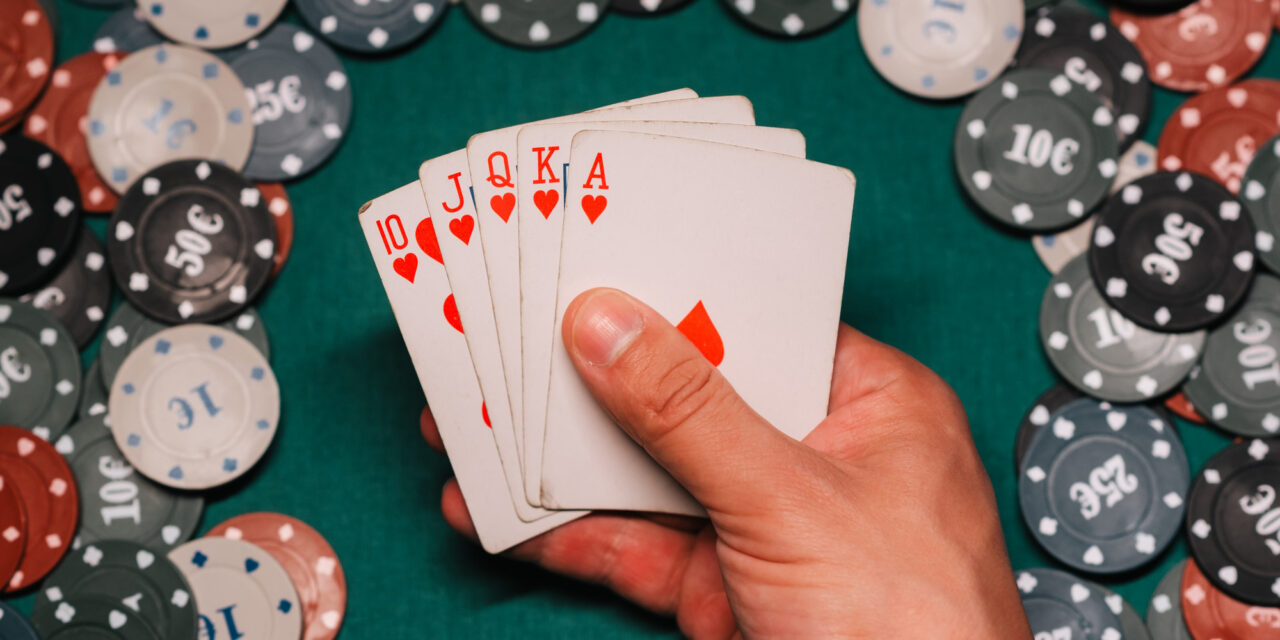
A poker hands cheat sheet is a one-page list of the ten poker hands from best to worst: royal flush, straight flush, four of a kind, full house, flush, straight, three of a kind, two pair, one pair and high card. Any hand beats every hand below it, and ties are broken by comparing the five cards in order.
The cheat sheet in brief
- Only your best five cards count, in every standard form of poker.
- A higher-ranked hand always wins; the actual cards matter only when two hands have the same rank.
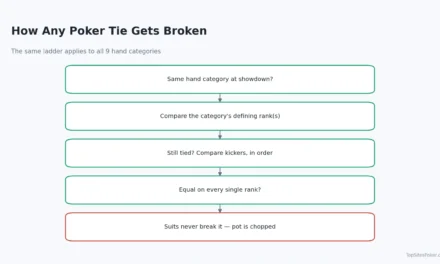
- Kickers break ties inside a rank. Suits never do.
- A flush beats a straight, and a full house beats a flush.
- The ace can be high (A-K-Q-J-10) or low (5-4-3-2-A), but a straight can’t wrap around.
- In Texas Hold’em, you can use two, one or none of your hole cards.
Every poker player needs the same small set of facts at hand: which hand beats which, how to break a tie, what the board makes possible, how often you’ll hit a draw and what price makes a call worthwhile. Most of them fit on a single page. This guide is that page, expanded so each part is explained, backed by numbers and tested with examples.
It’s organized as a set of cheat sheets you can use on their own. The first four cover the hand rankings, how to read them, how ties are broken and quick what-beats-what answers, followed by memory tricks. The next group covers reading the board and finding the best possible hand, the nuts. Then come the numbers that turn rankings into decisions: starting hands, preflop matchups, outs, pot odds and how often common hands appear. The last part covers other poker games, hand nicknames, practice drills, the most common mistakes and whether you’re allowed to use a cheat sheet while you play.
Every probability in this guide was calculated by the TopSitesPoker.com editorial team, most of them exactly, by counting every possible deal, and the few simulated figures are labeled as such. Texas Hold’em is used for the examples because it’s the game most people play, but the hand rankings are the same in every standard high-hand game.
Key takeaways
- There are only ten hand ranks to learn, and they’re ordered by rarity: the rarer the hand, the higher it ranks.
- In Hold’em, the best possible hand on a finished board is never a full house. It’s four of a kind or better on 55% of boards, because a paired board always makes four of a kind possible.
- A flush draw has 9 outs: 35.0% to hit by the river from the flop, 19.6% from the turn. The rule of 4 and 2 gets you within a point or two for most draws.
- Against a half-pot bet, a call needs to win 25% of the time; against a pot-sized bet, 33.3%.
- Poker TDA tournament rules, which many live events follow, don’t allow charts at the table, so the goal of a cheat sheet is to learn it well enough that you no longer need it.
Cheat Sheet 1: Poker Hand Rankings From Best to Worst
This is the table to learn first. Read it from the top: every hand beats every hand below it, whatever the individual cards are. The “remember it as” column gives a short description you can recall at the table, and the last column shows how often you’ll finish with each hand in Texas Hold’em when you see all seven cards.
| Rank | Hand | Example | Remember it as | Chance by the river (7 cards) |
|---|---|---|---|---|
| 1 | Royal flush | A♠ K♠ Q♠ J♠ 10♠ | The top straight, all one suit | 1 in 30,940 |
| 2 | Straight flush | 9♥ 8♥ 7♥ 6♥ 5♥ | Five in a row, all one suit | 1 in 3,591 |
| 3 | Four of a kind | J♣ J♦ J♥ J♠ 4♦ | All four cards of one rank | 1 in 595 |
| 4 | Full house | 10♠ 10♥ 10♦ 6♣ 6♠ | Three of a kind plus a pair | 1 in 38.5 |
| 5 | Flush | K♦ Q♦ 9♦ 5♦ 3♦ | Five of one suit, any order | 1 in 33 |
| 6 | Straight | 8♠ 7♣ 6♥ 5♦ 4♠ | Five in a row, mixed suits | 1 in 21.6 |
| 7 | Three of a kind | 5♥ 5♣ 5♠ K♦ 9♣ | Three cards of one rank | 1 in 20.7 |
| 8 | Two pair | Q♠ Q♥ 7♦ 7♣ A♠ | Two different pairs | 1 in 4.3 |
| 9 | One pair | A♥ A♦ 10♣ 8♠ 2♥ | Two cards of one rank | 1 in 2.3 |
| 10 | High card | K♣ J♦ 8♥ 5♠ 3♣ | Nothing else; highest card plays | 1 in 5.7 |
Chances are exact over all 133,784,560 seven-card combinations: the best five-card hand from seven cards, as in Hold’em when all five board cards are dealt. “Straight flush” excludes the royal flush. Calculated by TopSitesPoker.com.
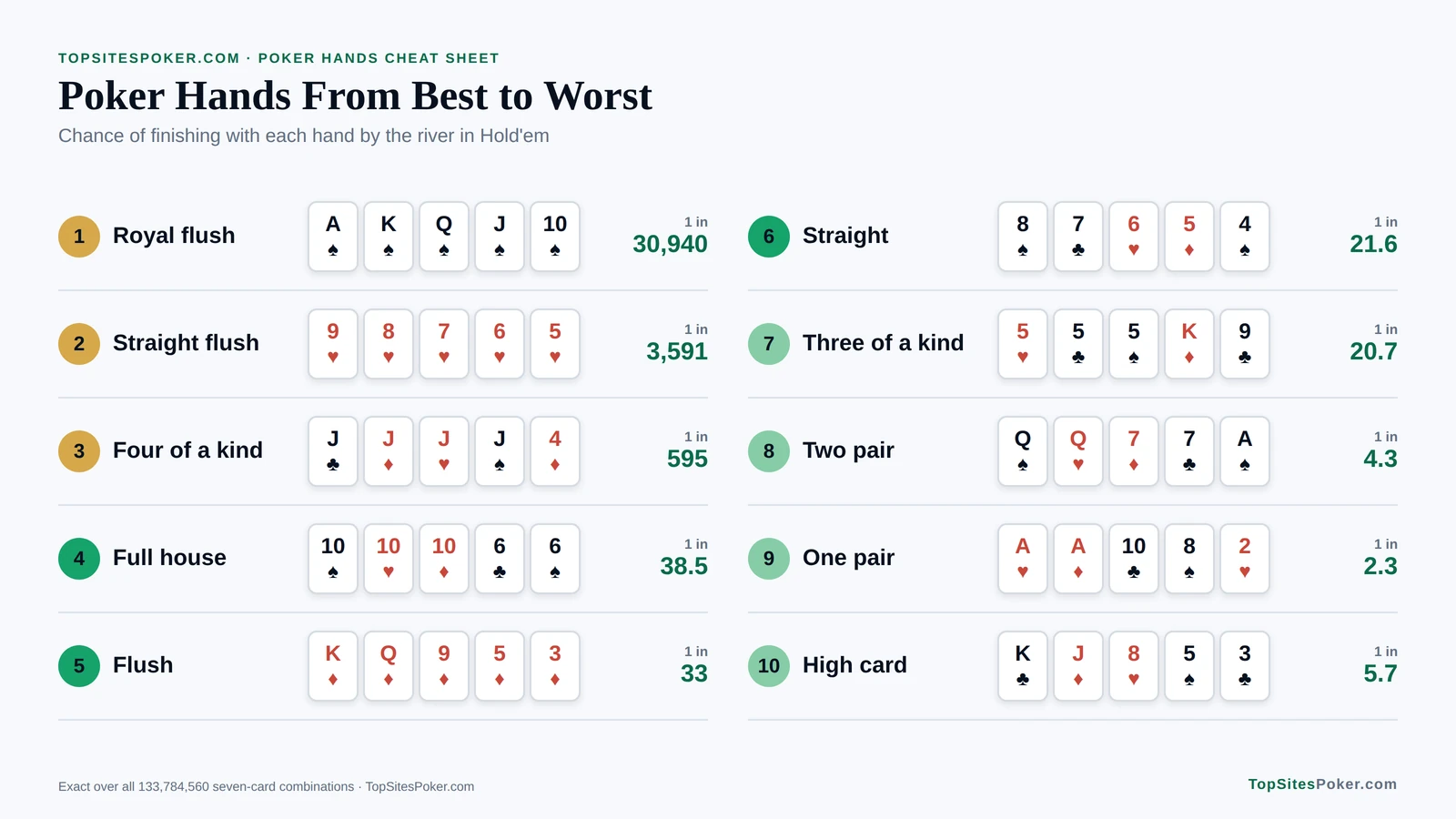
Any hand beats every hand below it; the odds show how often you’ll finish with each hand by the river.
Three facts that make the table easy to remember
- Rarer ranks higher. The order comes from five-card poker, where there are 4 ways to make a royal flush, 36 other straight flushes, 624 four of a kinds, 3,744 full houses, 5,108 flushes, 10,200 straights, 54,912 three of a kinds, 123,552 two pairs, 1,098,240 one pairs and 1,302,540 hands with no pair. Each rank is rarer than the one below it.
- The top two are the same hand type. A royal flush is simply the highest possible straight flush. Some charts list nine hands instead of ten for that reason.
- The middle is where people get confused. The pairs of ranks players mix up most are flush vs straight, full house vs flush, and three of a kind vs two pair. In each case, the hand listed higher on the chart wins.
Why the seven-card column looks odd
The ranking was set for five-card hands, and with seven cards two things change. First, you’re more likely to finish with one pair (43.8%) or two pair (23.5%) than with no pair at all (17.4%), because extra cards make pairs likely. Second, three of a kind (4.83%) is only slightly more common than a straight (4.62%). The ranking still holds, because above one pair each hand remains rarer than the one below it, but the gaps are much smaller than the five-card numbers suggest. You don’t need to memorize these figures. The useful takeaway is that by the river, a single pair is a very ordinary hand.
How to use this cheat sheet at showdown
- Find your best five cards from the seven available (your two hole cards and the five on the board).
- Name the rank of that five-card hand using the table.
- Do the same for your opponent.
- If the ranks are different, the higher rank wins. If they’re the same, go to the tie-breaker cheat sheet below.
That four-step routine covers every showdown in standard poker. The rest of this page is about doing it faster and using it to make better decisions before the showdown ever arrives.
Cheat Sheet 2: Five Rules That Settle Every Showdown
The ranking table tells you what beats what. These five rules tell you how to apply it, and together they settle every showdown in standard high-hand poker.
- Only five cards count. Your hand is the best five-card combination you can make. In Hold’em you choose from seven cards; in Seven Card Stud, from your own seven; in Omaha, from nine, under a special rule covered later. A sixth or seventh card never plays, even to break a tie.
- Rank first, cards second. Compare the two hands’ ranks. The higher rank wins, full stop. The lowest full house (2-2-2-3-3) beats the highest flush (A-K-Q-J-9 of one suit), and the lowest straight (5-4-3-2-A) beats the best three of a kind (A-A-A-K-Q).
- Inside a rank, compare the cards in order. Start with the cards that make the hand (the pair, the three of a kind, the highest card of the straight), then move to the leftover cards, the kickers, from highest to lowest. The first difference decides the pot.
- Suits never break ties. Spades aren’t higher than hearts at showdown. Two hands with the same five ranks split the pot. Suits matter only for procedures such as drawing for the button or the bring-in in stud games, never for who wins.
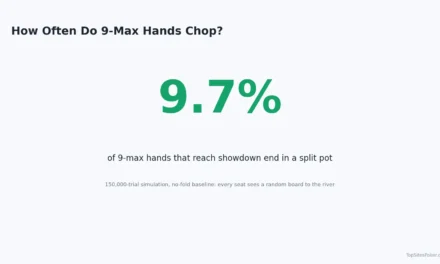
- The board can be your hand. In Hold’em, if the five community cards are your best five, you “play the board,” and so does everyone else who can’t beat it. Those players split the pot.
Rules about the ace and straights
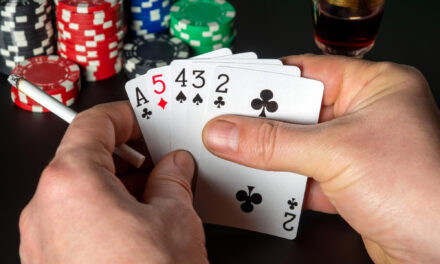
- The ace is the highest card, and it can also be the lowest card in a straight: 5-4-3-2-A, called the wheel, is a five-high straight, the lowest straight there is.
- The ace can’t be in the middle. Q-K-A-2-3 is not a straight; it’s ace-high, or whatever pair the cards make.
- A straight is ranked by its highest card, so 6-5-4-3-2 beats 5-4-3-2-A, and A-K-Q-J-10 (Broadway) is the highest straight.
- In a flush, the ace is always high: A-9-5-3-2 of one suit is an ace-high flush. The one exception is A-5-4-3-2 of one suit, which is in a row and so counts as a five-high straight flush, sometimes called a steel wheel.
Hands that are “counterfeited”
Because only five cards count, the board can make your hole cards worthless. This is called being counterfeited. If you hold 5-5 and the board comes A-A-K-K-Q, your best five cards are A-A-K-K-Q, the same as everyone else’s, so your pair of fives never plays. If you hold 9-8 and flop two pair on 9-8-4, a turn and river of K-K leave your best five as K-K-9-9-8: any opponent with a king now has three of a kind, and any opponent with a 9 and a better kicker than your 8 beats you too. And if you hold 4-3 and flop a straight on 5-6-7, a turn and river of 8-9 put a nine-high straight on the board: your 4 and 3 no longer play, the best you can do is split with every player who can’t beat the board, and anyone holding a 10 beats you. Always look at what the board makes on its own before you count your hand.
Cheat Sheet 3: Tie-Breakers and Kickers
When two players have the same rank, the pot goes to the better version of that hand. The table below is the complete tie-breaking system for standard poker. It looks long, but it follows one idea: compare the most important cards first, then work down through the rest of the five cards until something is different.
| Hand | Compare first | Then | Kickers that can play | Example of a tie broken |
|---|---|---|---|---|
| Straight flush | Highest card of the straight | Nothing else | None | 9-high straight flush beats 8-high |
| Four of a kind | Rank of the four | The fifth card | 1 | On a board of 7-7-7-7-3, Q beats J |
| Full house | Rank of the three | Rank of the pair | None | K-K-K-2-2 beats Q-Q-Q-A-A |
| Flush | Highest card | Each next card, down to the fifth | All five cards count | A-J-9-6-3 beats A-J-9-5-4 |
| Straight | Highest card of the straight | Nothing else | None | 7-high beats 6-high; the wheel is lowest |
| Three of a kind | Rank of the three | Higher kicker, then the lower kicker | 2 | 7-7-7-A-4 beats 7-7-7-K-Q |
| Two pair | Higher pair | Lower pair, then the kicker | 1 | Q-Q-8-8-A beats Q-Q-8-8-K |
| One pair | Rank of the pair | Three kickers, in order | 3 | K-K-Q-9-4 beats K-K-J-10-9 |
| High card | Highest card | Each next card, down to the fifth | All five cards count | A-Q-8-6-2 beats A-Q-8-5-4 |
A short way to remember the kicker column: the fewer cards the main hand uses, the more kickers there are. One pair uses two cards and has three kickers; three of a kind uses three and has two; two pair and four of a kind use four and have one; straights, flushes and full houses use all five and have none left over. Flushes and high-card hands are the exceptions in wording only, because every card in them is compared in turn.
Tie-breakers in real Hold’em hands
Here are common showdowns where the ranks match and the tie-breaker decides. Each one was checked with a hand evaluator.
| Board | Player 1 | Player 2 | Result | Why |
|---|---|---|---|---|
| A♥ 7♣ 7♠ 2♦ 9♥ | A♠ K♦ | A♣ Q♥ | Player 1 wins | Both have aces and sevens; the king kicker beats the queen |
| A♦ K♥ Q♣ J♠ 2♦ | A♥ 9♣ | A♠ 8♦ | Split pot | Both play A-A-K-Q-J; the 9 and 8 are sixth cards and don’t count |
| 7♥ 7♣ 7♦ 7♠ 3♣ | J♦ 4♦ | Q♠ 5♠ | Player 2 wins | Four sevens each; the queen kicker beats the jack |
| K♦ K♥ 6♣ 6♦ 3♠ | K♠ 3♥ | K♣ 2♣ | Split pot | Both have kings full of sixes; the 3 doesn’t improve a full house |
| Q♠ Q♦ Q♣ J♠ J♦ | A♥ K♥ | 2♣ 3♦ | Split pot | The board is a full house, and no hole card can improve it |
| A♥ J♥ 10♥ 4♥ 2♠ | K♣ Q♣ | 2♥ 3♦ | Player 2 wins | K-Q makes a straight, but the 2♥ makes a heart flush, which ranks higher |
The second and fourth rows are the ones that start arguments. A player with A-9 often expects to beat A-8, but when the board supplies K-Q-J, both hands are A-A-K-Q-J and the 9 never becomes part of the hand. And a player with K-3 on a board with 3♠ may think the 3 gives them a better full house, but kings full of sixes already uses the best available pair. When you think a kicker should play, count the cards: if the five best cards are already on the table without it, it doesn’t.
Cheat Sheet 4: What Beats What, Quick Answers
Most questions at a home game are some version of “does this beat that?” This lookup table answers the ones that come up most. The rule behind every answer is the same: a higher-ranked hand wins, and only equal ranks are compared card by card.
| Question | Answer | Why |
|---|---|---|
| Does a flush beat a straight? | Yes | Flush is rank 5, straight is rank 6 |
| Does a full house beat a flush? | Yes | Full house is rank 4 |
| Does a straight beat three of a kind? | Yes | Even 5-4-3-2-A beats A-A-A |
| Does three of a kind beat two pair? | Yes | 2-2-2 beats A-A-K-K |
| Does two pair beat one pair? | Yes | 3-3-2-2 beats A-A |
| Does a pair of 2s beat ace-high? | Yes | Any pair beats any high-card hand |
| Does four of a kind beat a full house? | Yes | Four of a kind is rank 3 |
| Does a straight flush beat four of a kind? | Yes | Straight flush is rank 2 |
| Does a royal flush beat a straight flush? | Yes | It’s the highest straight flush |
| Aces full of 2s vs kings full of queens? | Aces full | The three of a kind is compared first |
| Ace-high flush vs king-high flush? | Ace-high | Flushes are compared by their highest card first |
| Queen-high straight vs jack-high straight? | Queen-high | Straights are compared by their top card only |
| A-A-K-K-2 vs A-A-Q-Q-J? | A-A-K-K | The lower pair decides before the kicker |
| K-K-J-8-3 vs K-K-J-8-2? | K-K-J-8-3 | The last kicker decides |
| Spade flush vs heart flush, same ranks? | Split pot | Suits never break ties |
| Does a five-card “wraparound” Q-K-A-2-3 count? | No | A straight can’t wrap around the ace |
The four comparisons that cause most arguments
- Straight vs flush. The flush wins. Five cards of one suit are rarer than five in a row: 5,108 flushes against 10,200 straights in five-card poker.
- Flush vs full house. The full house wins, 3,744 ways against 5,108. Short Deck poker is the one common game that reverses this, because removing the low cards makes flushes rarer there.
- Two pair vs three of a kind. Three of a kind wins, even 2-2-2 against A-A-K-K. It feels wrong to newcomers because two pair uses more high cards, but rank beats card size.
- A big pair vs a small two pair. Two pair wins. A-A-K-Q-J loses to 3-3-2-2-4. Pocket aces are the best starting hand, not a guaranteed winner.
Memory Tricks: Learn the Rankings in Ten Minutes
You’ll stop needing a cheat sheet for the rankings surprisingly quickly if you learn them as a pattern instead of a list. These are the tricks that work best for new players.
1. Split the list into two families
Six of the ten hands are about matching ranks: one pair, two pair, three of a kind, full house and four of a kind, plus high card for when nothing matches. They climb in an obvious order: two matching cards, two sets of two, three, three plus two, four. The other four are about patterns: a straight (five in a row), a flush (five of a suit), a straight flush (both at once) and the royal flush, which is simply the highest straight flush. Learn the matching family first, then slot the patterns in: the straight and flush sit between three of a kind and the full house, and the straight flush sits at the very top.
2. Use a sentence for the full order
The ten hands from the top are Royal flush, Straight flush, Four of a kind, Full house, Flush, Straight, Three of a kind, Two pair, Pair and High card. One sentence that follows the first letters: “Royal Sailors Find Full Fishing Ships Through The Pacific Harbor.” The middle of it, “Find Full Fishing Ships,” is the part people get wrong, and it keeps four of a kind, full house, flush and straight in the right order.
3. Remember one rule for the confusing middle
If you forget whether a straight beats a flush, ask which is harder to make. Five cards of one suit are harder to collect than five cards in a row, so the flush is higher. A full house needs a three of a kind and a pair at the same time, which is harder still. The rule “harder to make ranks higher” works for every pair of hands on the list when you count five-card hands, which is how the ranking was set.
4. Say the hand out loud in a standard way
Dealers announce hands in a fixed format, and copying it trains you to read hands correctly: “two pair, kings and sevens,” “three nines,” “queen-high flush,” “jack-high straight,” “sixes full of twos.” Saying the full name forces you to identify the rank and the cards that matter for a tie-breaker, which is exactly what you need at showdown.
5. Practice with a real deck for five minutes
Deal seven cards face up, as if they were two hole cards and a five-card board, and name the best five-card hand in under ten seconds. Then deal a second set of two hole cards and decide who wins. Twenty deals is enough for most people to stop hesitating over the order. The practice drills later on this page give you fourteen hands to start with, with answers.
Cheat Sheet 5: What the Board Makes Possible
In Texas Hold’em, everyone shares the board, so the five community cards decide which hands are even possible. Before you count your own hand, three quick checks tell you what an opponent could have:
- Is the board paired? If two board cards share a rank, full houses and four of a kind are possible. If not, neither is.
- Are three or more board cards the same suit? If so, a flush is possible. With only two of a suit on a finished board, nobody can have a flush.
- Do three board cards fit inside a five-rank span? For example 9-7-6, or A-3-5. If so, a straight is possible. If no three cards fit, nobody can have a straight.
How often do those features appear? We counted every possible flop, turn and river board:
| Board feature | Hands it makes possible | On the flop | By the turn | By the river |
|---|---|---|---|---|
| At least one pair on the board | Full house, four of a kind | 17.2% | 32.4% | 49.3% |
| Three or more cards of one suit | Flush | 5.2% | 17.5% | 37.1% |
| Three different ranks within a five-rank span | Straight | 18.5% | 47.7% | 74.7% |
| None of the three | Best possible hand is three of a kind | 60.3% | 21.3% | 1.8% |
| Three of a kind on the board | Full house for anyone with a pocket pair or a card matching another board card; four of a kind for the last card of that rank | 0.24% | 0.93% | 2.3% |
| Four or more cards of one suit | A flush for anyone holding one card of that suit | — | 1.1% | 4.5% |
Exact counts over all 22,100 flops, 270,725 four-card boards and 2,598,960 five-card boards. Calculated by TopSitesPoker.com.
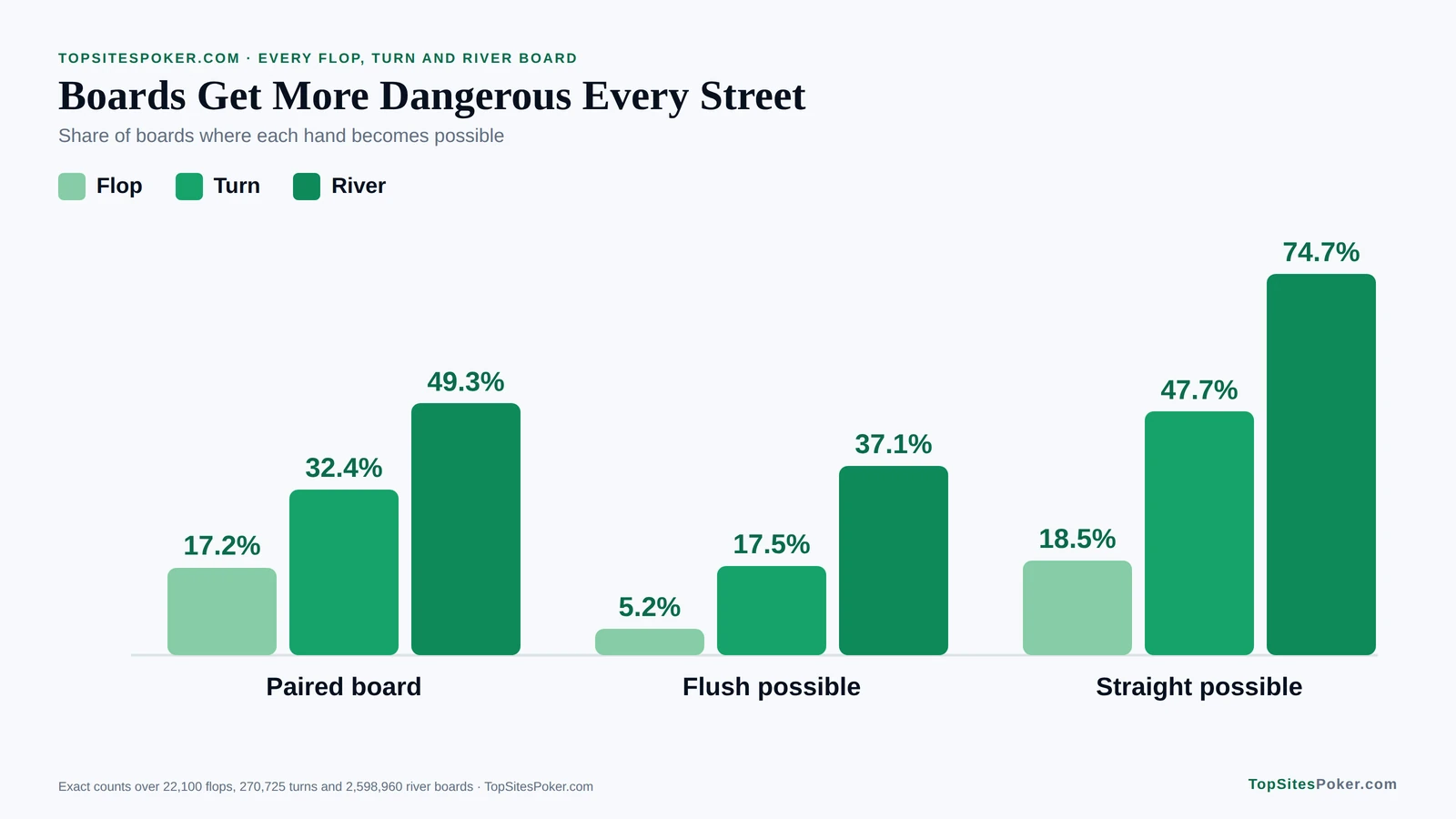
By the river, about half of all boards are paired and three in four allow a straight.
The lesson in the numbers is that boards get more dangerous every street. On the flop, six boards in ten allow no straight, no flush and no full house. By the river, that’s down to fewer than two in a hundred. A straight is possible on three river boards in four, and a full house on about half of them. A hand that was strong on a quiet flop can easily be second-best by the river, simply because the board has made stronger hands possible.
Flop suits at a glance
Players describe a flop by its suits because it tells you how likely flushes are later:
- Rainbow (three different suits): 39.8% of flops. No flush is possible unless the turn and river both bring the same suit as one of the flop cards.
- Two-tone (two of one suit): 55.1% of flops. A flush draw is possible for anyone holding two cards of that suit.
- Monotone (all three the same suit): 5.2% of flops. A flush is already possible, and anyone with one card of the suit has a draw.
Dry and wet boards
A dry board has unconnected ranks and mixed suits, such as K♠ 8♦ 3♣. Few strong hands are possible, so the best hand on the flop tends to stay the best. A wet board has connected ranks or matching suits, such as J♥ 10♥ 8♣, where straights, flushes and many draws are possible and the lead changes often. The three checks above are a fast way to tell which one you’re looking at.
Cheat Sheet 6: Finding the Nuts in Five Seconds
The nuts is the best possible hand on a given board: the hand nobody can beat. Knowing it tells you how close your own hand is to the top and which hands you need to fear. Because the board’s features decide what’s possible, you can find the nuts on any Hold’em board with five questions, asked in this order:
- Can anyone make a straight flush? You need three cards of one suit within a five-rank span. If yes, the nuts is the highest straight flush those cards allow.
- Is the board paired? If yes, the nuts is the highest four of a kind possible, made with the missing cards of a rank that’s paired (or tripled) on the board.
- Are three or more cards the same suit? If yes, the nuts is the best flush, made with the highest cards of that suit that aren’t on the board. That usually means holding the ace; with exactly three suited cards on the board you need two cards of the suit, so the ace plus the next-highest missing card is best.
- Do three ranks fit inside a five-rank span? If yes, the nuts is the highest straight you can make.
- None of the above? The nuts is three of a kind: a pocket pair matching the board’s highest card.
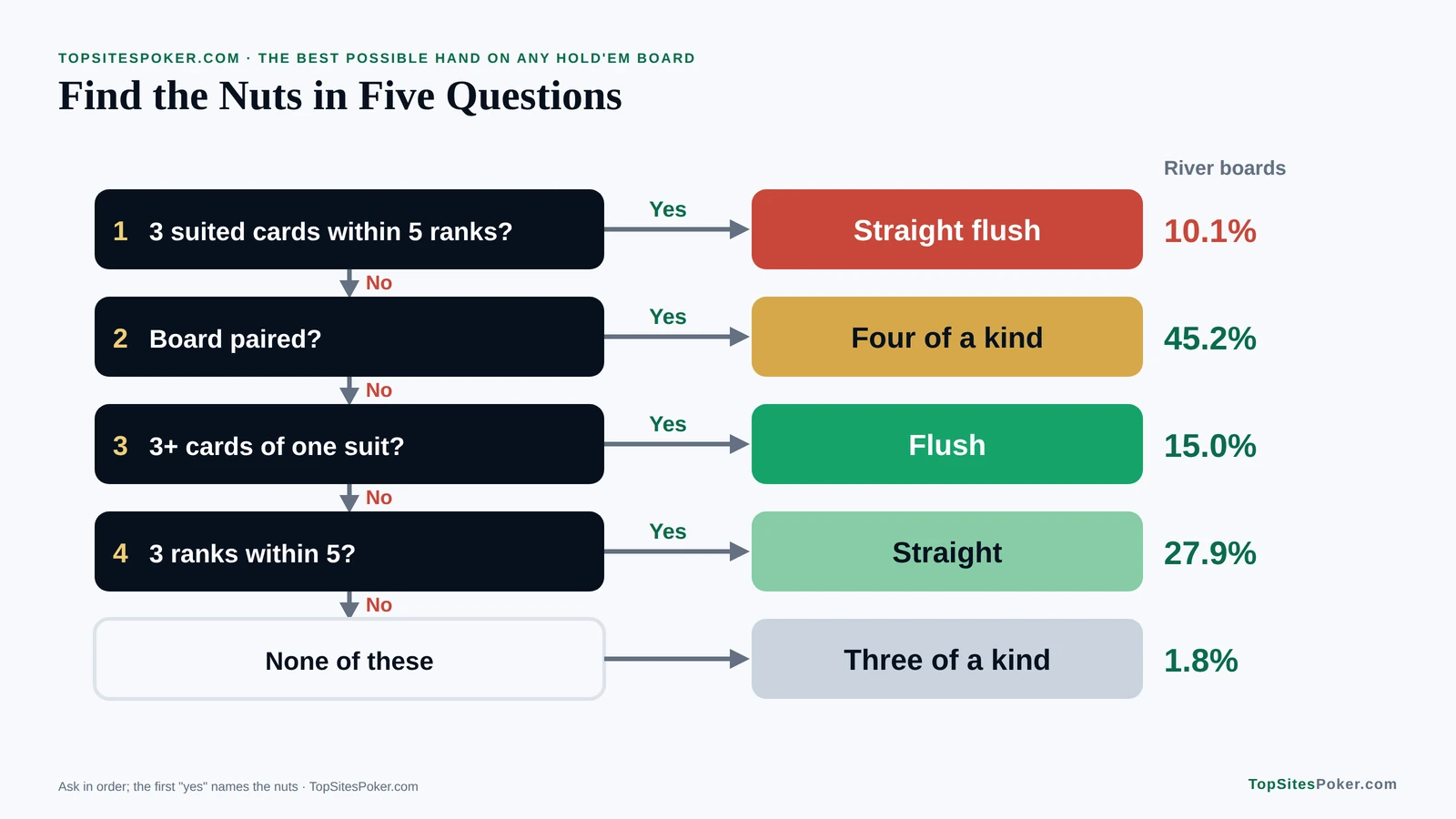
Ask the questions in order; the first yes names the nuts.
What the nuts usually is
Running every possible board through those five questions gives a surprising picture. We counted every flop, turn and river board:
| The nuts is | On the flop | On the turn | On the river |
|---|---|---|---|
| Straight flush (including royal) | 1.2% | 4.3% | 10.1% |
| Four of a kind | 17.2% | 31.5% | 45.2% |
| Flush | 4.0% | 10.3% | 15.0% |
| Straight | 17.4% | 32.6% | 27.9% |
| Three of a kind | 60.3% | 21.3% | 1.8% |
| Full house, two pair or less | 0% | 0% | 0% |
Exact counts over all 22,100 flops, 270,725 turns and 2,598,960 river boards. Calculated by TopSitesPoker.com.
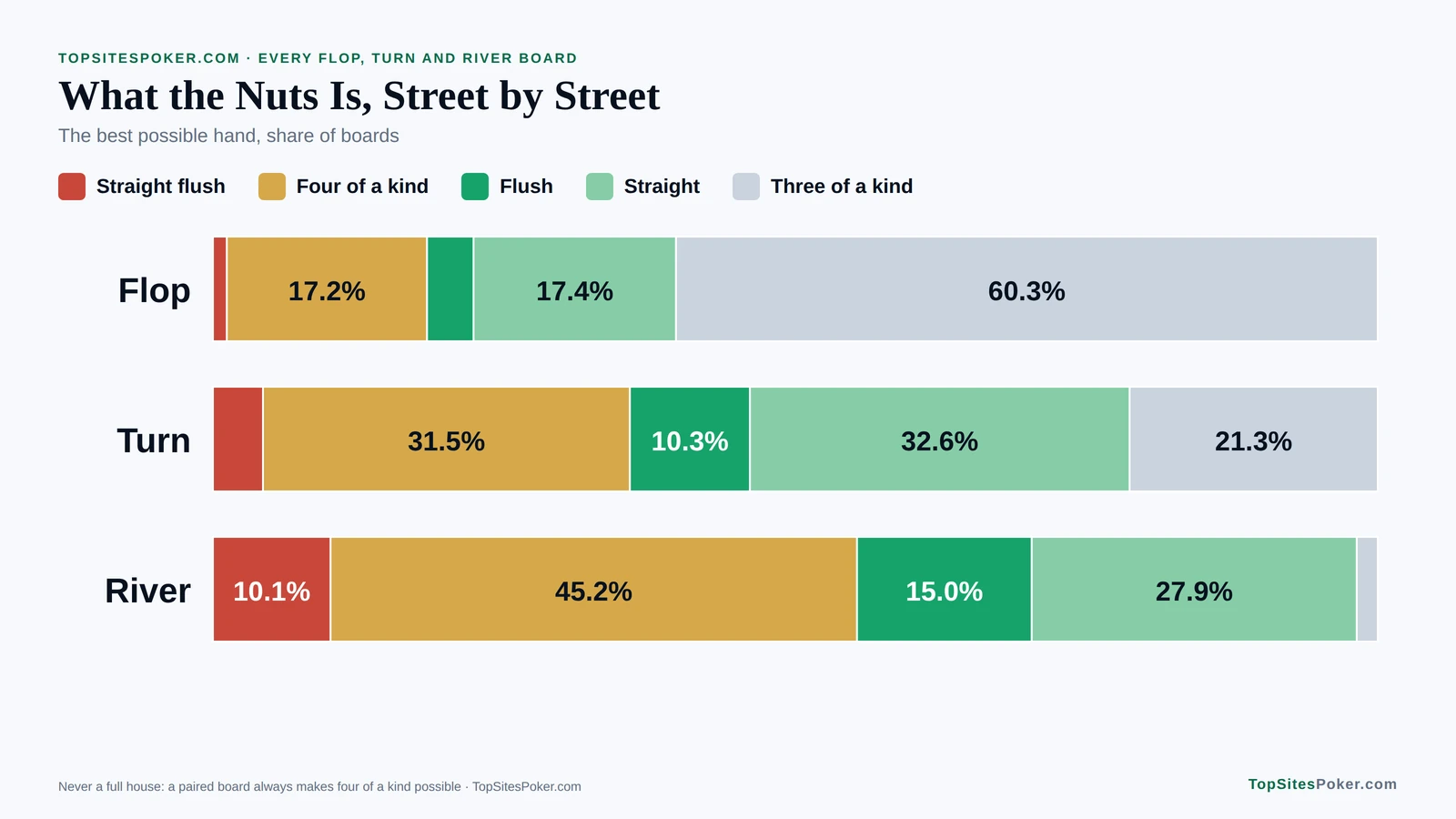
The nuts is never a full house, because a paired board always allows four of a kind.
Two facts stand out. First, the nuts in Hold’em is never a full house. A full house needs a paired board, and any paired board also makes four of a kind possible, so four of a kind (or a straight flush) is always the true nuts. Second, by the river the absolute nuts is four of a kind or better on 55% of boards. Those hands are so rare in practice that experienced players also talk about the “effective nuts”: the best hand an opponent could realistically hold. On a board of Q♠ J♠ 5♦ 5♣ 2♠, the absolute nuts is four fives, which needs exactly 5♥ 5♠. Pocket queens make queens full of fives, which loses only to that single combination, so in practice queens full is the hand to fear most. Even the ace-high spade flush, which looks strong, loses to every full house on this board.
The nuts on ten real boards
| Board | The nuts | Hole cards needed | Combinations |
|---|---|---|---|
| K♠ 8♦ 3♣ | Three kings | K-K | 3 |
| J♥ 10♥ 4♣ | Three jacks | J-J (no straight or flush is possible yet) | 3 |
| J♥ 10♥ 4♣ 9♠ | King-high straight | K-Q | 16 |
| 9♣ 9♦ 4♠ | Four nines | 9♥ 9♠ | 1 |
| A♥ K♥ 7♥ 2♣ | Ace-high flush | Q♥ J♥ (the ace is already on the board) | 1 |
| Q♠ J♠ 5♦ 5♣ 2♠ | Four fives | 5♥ 5♠ | 1 |
| 8♥ 7♥ 6♥ | Ten-high straight flush | 10♥ 9♥ | 1 |
| A♠ K♠ Q♠ 2♦ 2♣ | Royal flush | J♠ 10♠ | 1 |
| 6♣ 7♦ 8♠ 9♥ K♣ | Jack-high straight | J-10 | 16 |
| K♠ 8♦ 3♣ 2♥ 7♠ | Three kings | K-K | 3 |
Each board was checked against every possible two-card holding (1,176 on a flop, 1,128 on a turn, 1,081 on a river) with a hand evaluator.
The ace-high flush example shows a common trap. When the ace of the flush suit is on the board, the nut flush is made by the highest cards of that suit still missing. Here the ace and king of hearts are both on the board, so the best flush needs the queen and jack. Always check which high cards of the suit are already out before you assume your flush is the best one.
Cheat Sheet 7: Starting Hands at a Glance
Made-hand rankings tell you who wins at showdown. Before the flop, you need a different cheat sheet: which two-card hands are worth playing at all. There are 1,326 possible starting hands in Hold’em, which reduce to 169 types once you ignore the specific suits. A simple four-tier grouping covers everything a beginner needs:
| Tier | Hands | Combinations | How often you’re dealt one | Win rate against one random hand |
|---|---|---|---|---|
| 1. Premium | A-A, K-K, Q-Q, A-K | 34 | 2.6% (1 in 39) | 65% to 85% |
| 2. Strong | J-J, 10-10, A-Q, A-J suited, K-Q suited | 36 | 2.7% (1 in 37) | 63% to 77% |
| 3. Good | 9-9 to 7-7, A-10 suited, K-J suited, Q-J suited, J-10 suited, A-J offsuit, K-Q offsuit | 58 | 4.4% (1 in 23) | 57% to 72% |
| 4. Speculative | 6-6 to 2-2, A-9 suited to A-2 suited, 10-9 suited to 5-4 suited, K-10 suited, Q-10 suited | 94 | 7.1% (1 in 14) | 41% to 63% |
| Everything else | All other hands | 1,104 | 83.3% | 32% to 63%; most below 55% |
Combinations and frequencies are exact. Win rates are all-in to the river against one random hand, from TopSitesPoker.com simulations of 200,000 deals per starting hand. The tiers are a common beginner grouping, not a fixed rule.
The top three tiers together are 128 combinations, just under 10% of all hands, or about one deal in ten. That’s a sensible range to play at a full table when you’re starting out, adding more hands from the later positions as you gain experience. Notice that the win rates overlap: some speculative hands win less often against one random hand than hands in the last row, such as A-10 offsuit at 62.6%. Heads-up win rate isn’t the whole story. Suited connectors and small pairs make straights, flushes and sets that win big pots, while hands like A-10 or K-J offsuit more often make a second-best pair. The speculative tier is for situations where you can see a flop cheaply, because these hands win mainly when they flop something strong: a set, a straight or a flush.
How often you’re dealt the hands people ask about
| Starting hand | Combinations | Chance per deal | About once every |
|---|---|---|---|
| Any pocket pair | 78 | 5.9% | 17 hands |
| Pocket aces (or any specific pair) | 6 | 0.45% | 221 hands |
| A-K (suited or offsuit) | 16 | 1.2% | 83 hands |
| A-K suited | 4 | 0.30% | 332 hands |
| Any two suited cards | 312 | 23.5% | 4.25 hands |
| At least one ace | 198 | 14.9% | 6.7 hands |
| J-J or better, or A-K | 40 | 3.0% | 33 hands |
Exact counts out of 1,326 possible two-card starting hands.
Hands that look better than they are
- Any ace with a small kicker, offsuit. A-7 offsuit is ahead of a random hand, but when you make a pair of aces against a player who called or raised, they often hold a better ace. That’s called being dominated, and it costs more money than it wins.
- Two face cards offsuit, such as K-J or Q-J. They look strong and do fine heads-up, but against raises they’re often dominated by A-K, A-Q, A-J or K-Q.
- Any two suited cards. Being suited adds only a few percentage points of equity. You flop a flush just 0.84% of the time and a flush draw 10.9% of the time, so 9-3 suited is still a weak hand.
- Small pairs against lots of action. Pocket 2s to 6s win mostly by flopping a set, which happens 11.8% of the time. They’re worth a small call to try, not a big one.
Cheat Sheet 8: Preflop Matchups
When two players are all-in before the flop, the result depends on a handful of recurring matchup types. You don’t need exact numbers at the table, just the shape of each one. The equities below were calculated exactly, by dealing out every one of the 1,712,304 possible five-card boards for each pair of hands, with split pots counted as half a win.
| Matchup type | Example | Favorite’s equity | Rule of thumb |
|---|---|---|---|
| Higher pair vs lower pair | Q♠ Q♥ vs 8♣ 8♦ | 80.2% | About 4 to 1 |
| Pair vs two lower cards | Q♠ Q♥ vs 9♣ 8♦ | 82.2% | About 4 to 1 or better |
| Pair vs a hand holding the same rank | A♠ A♥ vs A♣ K♦ | 92.6% | About 12 to 1 |
| Pair vs one higher and one lower card | 9♠ 9♥ vs A♣ 5♦ | 69.3% | About 7 to 3 |
| Domination: shared high card | A♠ K♥ vs A♣ Q♦ | 74.0% | About 3 to 1 |
| Domination: shared low card | A♠ K♥ vs K♣ Q♦ | 74.2% | About 3 to 1 |
| Two high cards vs two lower cards | A♠ K♥ vs 8♣ 7♦ | 61.9% | About 3 to 2 |
| Ace with a small kicker vs two face cards | A♣ 7♥ vs K♠ Q♦ | 57.5% | Small edge to the ace |
| Pair vs two overcards | 8♠ 8♥ vs A♣ K♦ | 55.6% | A “coin flip,” slightly favoring the pair |
| Small pair vs two connected overcards | J♠ 10♥ vs 2♣ 2♦ | 51.2% (J-10) | Even, or slightly worse for the pair |
| Identical hands | A♠ K♥ vs A♦ K♣ | 50% (95.7% of boards split) | A split pot |
Exact all-in equities for the specific suits shown. Other suit combinations move each figure by a few points. Calculated by TopSitesPoker.com.
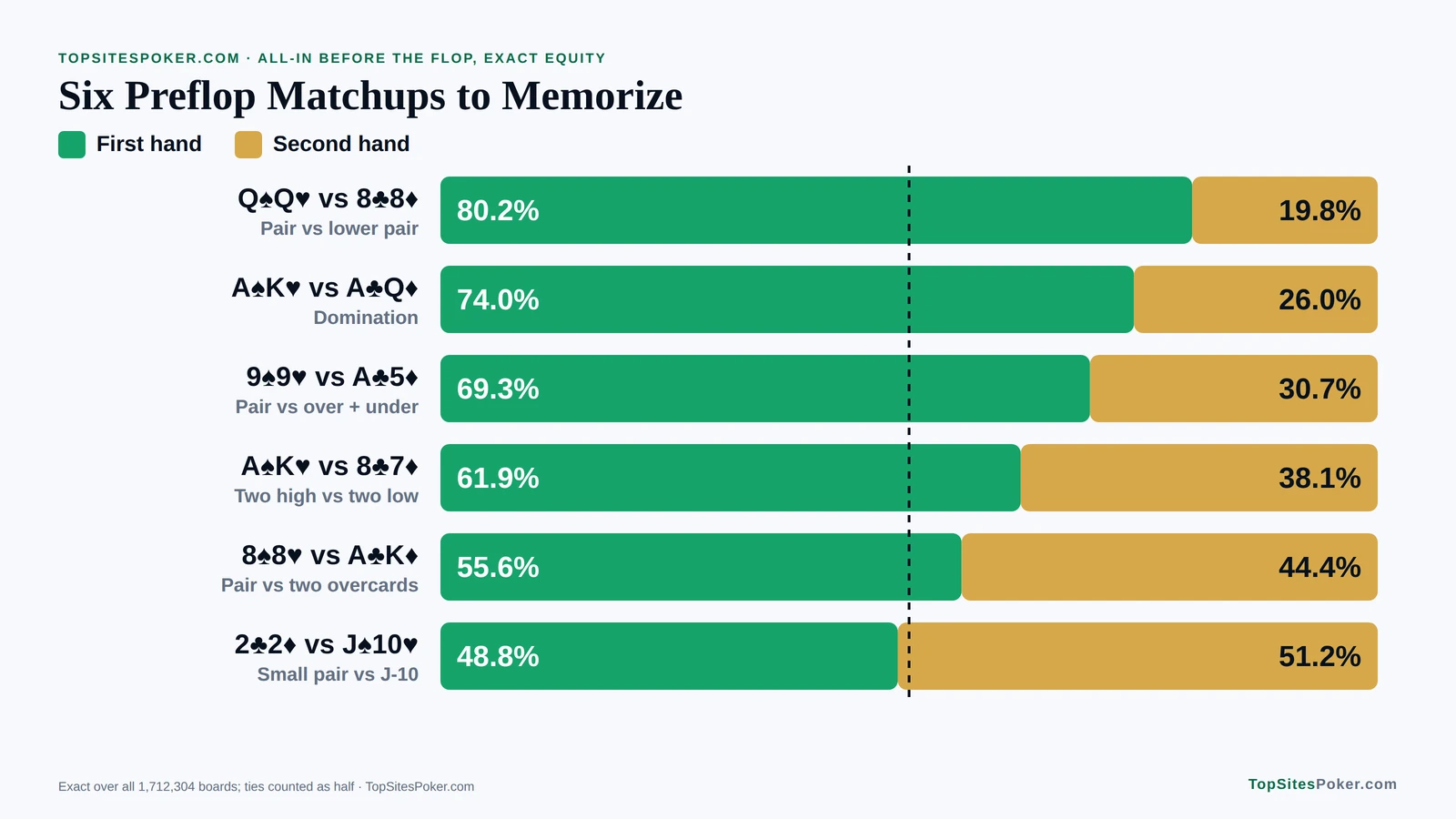
A pair against a lower pair is about 4 to 1; a pair against two overcards is close to a coin flip.
Five patterns to remember
- A pair against a lower pair is about 80/20. The underdog needs to hit one of two cards to make a set, and even that doesn’t always win.
- A pair against two overcards is roughly a coin flip. That’s where the phrase “flip” comes from. The pair is usually a small favorite, around 55%, but against two connected overcards, especially suited ones, the edge shrinks further, and a very small pair can even be a slight underdog: 2-2 has only 48.8% equity against J-10 offsuit.
- Domination is about 3 to 1. When two hands share a card, the one with the higher second card usually has around 70% to 75% of the equity (less when both second cards are small and close together, because many boards split). That’s why A-K is so strong against A-Q and K-Q, and why weak aces are dangerous to play.
- Two high cards against two lower cards is only about 60/40. A-K is a favorite over 8-7, but not a big one, because the lower cards can make pairs, two pair, straights and flushes.
- Even a strong-looking hand can be the underdog. K♥ Q♥ has only 46.3% equity against A♣ 7♦, because the single ace outranks both of its cards.
Cheat Sheet 9: Outs and Drawing Odds
An out is a card still in the deck that would improve your hand to one you expect to win. Once you know your outs, this cheat sheet tells you how often you’ll hit. From the flop you have two cards to come; from the turn, one. The unseen cards are the 47 you can’t see on the flop (52 minus your two and the three on the board), or 46 on the turn.
The draws you’ll meet most often
| Draw | Example | Outs | Flop to river | Turn to river |
|---|---|---|---|---|
| Flush draw plus open-ended straight draw | 9♥ 8♥ on 10♥ 7♥ 2♠ | 15 | 54.1% | 32.6% |
| Flush draw plus gutshot | 9♥ 8♥ on J♥ 7♥ 2♠ | 12 | 45.0% | 26.1% |
| Flush draw | A♥ 7♥ on K♥ 9♥ 2♣ | 9 | 35.0% | 19.6% |
| Open-ended straight draw | 9♠ 8♦ on 10♣ 7♥ 2♠ | 8 | 31.5% | 17.4% |
| Double gutshot | 9♠ 7♦ on J♣ 8♥ 5♠ | 8 | 31.5% | 17.4% |
| Two overcards, to make a pair | A♠ K♦ on 9♣ 6♥ 2♠ | 6 | 24.1% | 13.0% |
| Gutshot (inside straight draw) | 9♠ 8♦ on J♣ 7♥ 2♠ | 4 | 16.5% | 8.7% |
| Two pair to a full house | K♠ 9♦ on K♣ 9♥ 4♠ | 4 | 16.5% | 8.7% |
| Pocket pair to a set | 5♠ 5♦ on K♣ 9♥ 2♠ | 2 | 8.4% | 4.3% |
| Set to a full house or better | 7♠ 7♥ on 7♣ K♦ 2♠ | 7 on the turn, 10 on the river | 33.4% | 21.7% |
Exact chances of hitting one of the listed outs, from 47 unseen cards on the flop and 46 on the turn; runner-runner draws aren’t included except for the set. For the set, the outs grow from 7 to 10 on the river when the turn is a blank, because any card that pairs the new turn card also makes a full house. Calculated by TopSitesPoker.com.
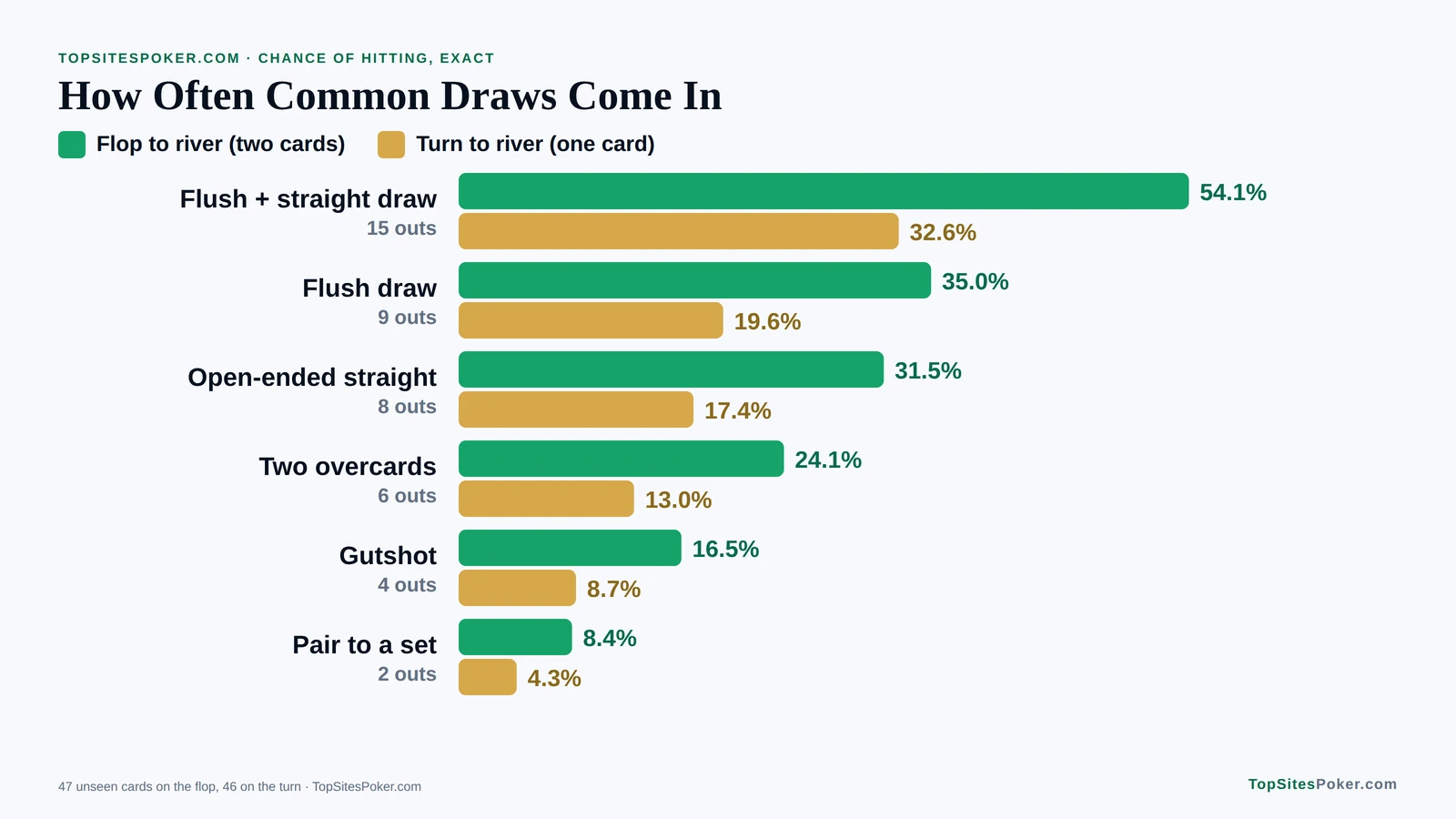
Seeing two more cards instead of one nearly doubles your chance of hitting.
Every number of outs
| Outs | One card to come | Two cards to come (flop to river) | Rule of 2 / rule of 4 | Odds against, one card |
|---|---|---|---|---|
| 1 | 2.2% | 4.3% | 2% / 4% | 45 to 1 |
| 2 | 4.3% | 8.4% | 4% / 8% | 22 to 1 |
| 3 | 6.5% | 12.5% | 6% / 12% | 14.3 to 1 |
| 4 | 8.7% | 16.5% | 8% / 16% | 10.5 to 1 |
| 5 | 10.9% | 20.4% | 10% / 20% | 8.2 to 1 |
| 6 | 13.0% | 24.1% | 12% / 24% | 6.7 to 1 |
| 7 | 15.2% | 27.8% | 14% / 28% | 5.6 to 1 |
| 8 | 17.4% | 31.5% | 16% / 32% | 4.8 to 1 |
| 9 | 19.6% | 35.0% | 18% / 36% | 4.1 to 1 |
| 10 | 21.7% | 38.4% | 20% / 40% | 3.6 to 1 |
| 11 | 23.9% | 41.7% | 22% / 44% | 3.2 to 1 |
| 12 | 26.1% | 45.0% | 24% / 48% | 2.8 to 1 |
| 13 | 28.3% | 48.1% | 26% / 52% | 2.5 to 1 |
| 14 | 30.4% | 51.2% | 28% / 56% | 2.3 to 1 |
| 15 | 32.6% | 54.1% | 30% / 60% | 2.1 to 1 |
| 16 | 34.8% | 57.0% | 32% / 64% | 1.9 to 1 |
| 17 | 37.0% | 59.8% | 34% / 68% | 1.7 to 1 |
| 18 | 39.1% | 62.4% | 36% / 72% | 1.6 to 1 |
| 19 | 41.3% | 65.0% | 38% / 76% | 1.4 to 1 |
| 20 | 43.5% | 67.5% | 40% / 80% | 1.3 to 1 |
One card to come = outs ÷ 46 (turn to river). Two cards to come = 1 − (misses ÷ 47) × (misses ÷ 46), from the flop when you’ll see both the turn and river. Exact, calculated by TopSitesPoker.com.
The shortcut most players use is the rule of 2 and 4: multiply your outs by 2 for one card to come, or by 4 for two cards. The rule of 4 is within about a point of the exact figure up to 9 outs, while the rule of 2 slightly understates your chances, by up to about 2.5 points for the draws in the table above. Above 9 outs, the rule of 4 starts to overstate your chances: 60% against the real 54.1% at 15 outs, and 80% against 67.5% at 20. A common fix: above 8 outs, multiply by 4 and then subtract the number of outs above 8. For 15 outs that gives 60 − 7 = 53%, close to the true 54.1%.
One caution applies to the rule of 4. It assumes you’ll see both the turn and the river for the price of one call. If an opponent is likely to bet again on the turn, use the one-card figure for each decision.
Counting outs correctly
- Don’t count a card twice. With a flush draw and an open-ended straight draw, two of the straight cards are also flush cards, so the total is 9 + 6 = 15, not 17.
- Discount outs that give someone else a better hand. If you’re drawing to a straight on a flop with two hearts, the heart cards that complete your straight also give any flush draw a flush.
- Overcards aren’t clean outs. Pairing an ace or king on the turn gives you top pair, which is often, but not always, the best hand.
- Watch the board pairing. If your opponent may already have two pair or a set, a card that pairs the board can give them a full house even while it completes your straight or flush.
Cheat Sheet 10: Pot Odds by Bet Size
Outs tell you how often you’ll hit. Pot odds tell you how often you need to hit for a call to pay. When an opponent bets, compare the price of calling with the size of the pot you’d win. The table below does the arithmetic for the bet sizes you’ll see most, and adds the bettor’s side: how often a bluff of that size has to work to break even.
| Opponent bets | Pot odds you’re offered | Your call must win at least | Outs you need with one card to come | A bluff this size must work |
|---|---|---|---|---|
| 1/4 of the pot | 5 to 1 | 16.7% | 8 (17.4%) | 20.0% |
| 1/3 of the pot | 4 to 1 | 20.0% | 10 (21.7%) | 25.0% |
| 1/2 of the pot | 3 to 1 | 25.0% | 12 (26.1%) | 33.3% |
| 2/3 of the pot | 2.5 to 1 | 28.6% | 14 (30.4%) | 40.0% |
| 3/4 of the pot | 2.33 to 1 | 30.0% | 14 (30.4%) | 42.9% |
| The full pot | 2 to 1 | 33.3% | 16 (34.8%) | 50.0% |
| 1.5 times the pot | 1.67 to 1 | 37.5% | 18 (39.1%) | 60.0% |
| 2 times the pot | 1.5 to 1 | 40.0% | 19 (41.3%) | 66.7% |
Required equity = bet ÷ (pot + bet + your call). Bluff break-even = bet ÷ (pot + bet). Outs are for the turn with 46 unseen cards and no further betting. Calculated by TopSitesPoker.com.
Putting outs and pot odds together
The decision is a simple comparison: if your chance of hitting is higher than the percentage in the “must win” column, calling makes money in the long run; if it’s lower, calling loses money unless you expect to win extra later.
- Flush draw on the turn, facing a half-pot bet. You need 25%, and 9 outs give you 19.6%. On pot odds alone, it’s a fold.
- The same flush draw facing a quarter-pot bet. You need 16.7%, and you have 19.6%. Call.
- Gutshot on the turn, facing a third of the pot. You need 20%, and 4 outs give you 8.7%. Fold, unless you expect to win a lot more on the river when you hit.
- Flush draw plus open-ended straight draw, facing a pot-sized bet on the turn. You need 33.3%, and 15 outs give you 32.6%. Close to break-even; any extra money you’d win when you hit makes it a call.
That last point is called implied odds: the extra chips you expect to win on later streets when you make your hand. They’re why players sometimes call with slightly less than the required equity, especially with draws that are hard to see, such as a gutshot. They’re also easy to overestimate. A good habit for beginners is to count implied odds only when the opponent has plenty of chips left and is likely to pay you off.
The bettor’s side
The last column works in reverse. If you bet half the pot as a bluff, it only has to make your opponent fold one time in three to break even. A pot-sized bluff has to work half the time. That’s why smaller bluffs are cheaper to run, and why a call against a large bet needs more equity than a call against a small one.
Cheat Sheet 11: How Often Things Happen
Good decisions start with realistic expectations. Many new players overestimate how often the flop will help them, and underestimate how often an opponent’s hand improves by the river. These are the frequencies worth knowing, all counted exactly.
On the flop
| You hold | The flop gives you | Chance | About |
|---|---|---|---|
| Two unpaired cards (such as A-K) | At least a pair with one of your cards | 32.4% | 1 flop in 3 |
| Two unpaired cards | Two pair using both your cards | 2.0% | 1 in 50 |
| Two unpaired cards | Three of a kind with one of your cards | 1.3% | 1 in 74 |
| A pocket pair | A set or better (a third card of your rank) | 11.8% | 1 in 8.5 |
| Pocket jacks | At least one overcard (queen, king or ace) | 57.0% | More often than not |
| Two suited cards | A flush | 0.84% | 1 in 119 |
| Two suited cards | A flush draw (exactly two of your suit) | 10.9% | 1 in 9 |
| Two suited cards | A backdoor flush draw (exactly one of your suit) | 41.6% | 2 in 5 |
| Connected cards (such as 9-8 or J-10) | A straight | 1.3% | 1 in 77 |
| Connected cards | An 8-out straight draw (open-ended or double gutshot) | 9.7% | 1 in 10 |
| Connected cards | A gutshot straight draw | 16.8% | 1 in 6 |
Exact counts over all 19,600 possible flops for each starting hand. Calculated by TopSitesPoker.com.
The first row is the most important one. Two unpaired cards miss the flop about two times in three. That’s true for A-K as much as for 7-2, which is why a continuation bet often wins and why an unpaired hand that misses should usually be ready to give up.
By the river
| You hold | By the river you’ll have | Chance |
|---|---|---|
| Two unpaired cards | At least a pair with one of your hole cards | 48.7% |
| A pocket pair | A set or better | 19.2% |
| Two suited cards | A flush in your suit | 6.4% |
| Any two cards | At least a pair (including pairs on the board) | 82.6% |
| Any two cards | Two pair or better | 38.8% |
| Any two cards | A straight or better | 10.4% |
Exact. The last three rows are from all 133,784,560 seven-card combinations.
Two numbers in this table explain a lot about Hold’em. Pocket pairs make a set by the river only about one time in five, so small pairs are hands you hope improve, not hands you rely on. And more than a third of the time, any two cards end up with two pair or better by the river once the board is counted. That’s why one pair, even a big one, loses more often than new players expect in hands that go all the way to showdown.
Cheat Sheet 12: Other Poker Games on One Page
The ten-hand ranking applies to almost every high-hand poker game, but some games change which cards you may use, Short Deck puts the flush above the full house, and lowball games turn the ranking upside down. This table is the quick reference for the games you’re most likely to meet after Hold’em.
| Game | Ranking used | Key rule to remember | Best possible hand |
|---|---|---|---|
| Texas Hold’em | Standard high | Best five of seven; use two, one or none of your hole cards | Royal flush |
| Omaha (PLO) | Standard high | Exactly two of your four hole cards plus exactly three board cards | Royal flush |
| Omaha Hi-Lo (8 or better) | High half plus low half | Low needs five different ranks, 8 or lower; the two-plus-three rule applies to each half | High: royal flush. Low: 5-4-3-2-A |
| Seven Card Stud | Standard high | Best five of your own seven cards; no community cards | Royal flush |
| Razz | Ace-to-five low | Lowest hand wins; aces are low; straights and flushes don’t count | 5-4-3-2-A |
| 2-7 Lowball (Triple Draw or Single Draw) | Deuce-to-seven low | Lowest hand wins; aces are high; straights and flushes count against you | 7-5-4-3-2, not all one suit |
| Short Deck (6+ Hold’em) | Modified high | 36-card deck without 2s to 5s; a flush beats a full house; A-6-7-8-9 is the lowest straight | Royal flush |
| Five Card Draw | Standard high | Your own five cards after one draw | Royal flush |
Short Deck rules vary on one point: some rooms rank three of a kind above a straight, others below. Check the house rules.
The Omaha rule that catches Hold’em players
In Omaha you must use exactly two hole cards, so a board with four cards of one suit doesn’t give you a flush unless you hold two cards of that suit yourself. Holding A♥ K♣ 7♠ 2♦ on a board with four hearts, you have no flush at all, even with the ace of hearts. The same rule means a board with four cards to a straight doesn’t give you the straight unless two of your own cards complete it.
Low hands in one minute
Low hands are compared from the highest card down, just like high hands, except that the lower card wins at each step. In ace-to-five games such as Razz and the low half of Omaha Hi-Lo, 7-5-3-2-A beats 7-6-3-2-A because the second card, 5, is lower than 6. In deuce-to-seven games, aces count high, straights and flushes count as high hands, and the best hand is 7-5-4-3-2 of mixed suits, so 6-5-4-3-2 is a straight, which makes it a very poor low hand: it loses to any hand ranked below a straight, even a pair. If you’re unsure which low system a game uses, ask before the cards are dealt.
Cheat Sheet 13: Starting-Hand Nicknames
Players often talk in nicknames, and hearing “I had cowboys” or “Big Slick” makes more sense once you know the common ones. None of them affect the rules; they’re just shorthand.
| Hand | Common nickname | Hand | Common nickname |
|---|---|---|---|
| A-A | Pocket rockets, bullets | A-K | Big Slick |
| K-K | Cowboys | K-Q | Royal couple, marriage (when suited) |
| Q-Q | Ladies | K-9 | Canine |
| J-J | Hooks, fishhooks | J-5 | Motown |
| 10-10 | Dimes | 10-2 | Doyle Brunson |
| 8-8 | Snowmen | 7-2 offsuit | The hammer |
| 7-7 | Hockey sticks | 5-5 | Speed limit |
| 3-3 | Crabs | 2-2 | Ducks |
Two of these come with stories worth knowing. 10-2 is named after Doyle Brunson, who won the World Series of Poker Main Event with that hand in both 1976 and 1977. And 7-2 offsuit is widely called the worst starting hand in Hold’em. Against several opponents it is among the very weakest hands, but heads-up against one random hand, 3-2 offsuit is lower: in our simulations, 7-2 offsuit wins 34.6% of the time and 3-2 offsuit 32.4%.
Practice Drills: Read the Best Five Cards
The fastest way to make the cheat sheet stick is to use it. For each hand below, find the best five-card hand from the two hole cards and the five-card board, then check the answer. Every answer was verified with a hand evaluator. Aim for under ten seconds per hand.
1. Hole cards A♠ K♦; board A♥ 7♣ 7♠ 2♦ 9♥.
Answer: two pair, aces and sevens, with a king kicker: A-A-7-7-K.
2. Hole cards 8♥ 8♣; board K♥ 8♦ 5♠ 5♣ K♣.
Answer: full house, eights full of kings: 8-8-8-K-K. Your three eights combine with the board’s pair of kings; the board’s fives don’t play, because a full house uses only the best pair available.
3. Hole cards Q♥ J♥; board 10♥ 9♥ 2♣ 8♥ A♠.
Answer: a queen-high straight flush: Q♥ J♥ 10♥ 9♥ 8♥.
4. Hole cards A♣ 4♦; board 5♥ 3♠ 2♣ K♦ 9♥.
Answer: a five-high straight, the wheel: 5-4-3-2-A.
5. Hole cards K♣ Q♣; board A♥ J♥ 10♥ 4♥ 2♠.
Answer: an ace-high straight, A-K-Q-J-10. Careful, though: the board has four hearts, so any single heart makes a flush that beats you.
6. Hole cards 9♠ 9♦; board 9♣ 4♥ 4♠ 4♦ K♣.
Answer: a full house, nines full of fours: 9-9-9-4-4. It’s higher than fours full of nines, because the three of a kind is compared first.
7. Hole cards A♦ 2♦; board K♦ 9♦ 5♦ Q♣ 7♠.
Answer: an ace-high flush: A♦ K♦ 9♦ 5♦ 2♦. Because you hold the ace of diamonds, nobody else can have an ace-high flush, and with no pair and no straight flush possible on this board, no hand can beat you.
8. Hole cards 7♣ 6♣; board 8♦ 9♠ 10♣ J♥ 2♥.
Answer: a jack-high straight: J-10-9-8-7. Your 6 doesn’t play, and anyone holding a queen has a higher straight.
9. Hole cards A♥ K♥; board Q♠ Q♦ Q♣ J♠ J♦.
Answer: queens full of jacks, all from the board: Q-Q-Q-J-J. Your ace and king don’t play, because a full house has no kicker, so you split with anyone who can’t beat the board. Several hands can: pocket aces or kings make queens full of aces or kings, any hand with the last queen makes four queens, and J♣ J♥ makes four jacks.
10. Hole cards J♣ J♠; board 10♠ 9♠ 8♠ 7♠ 2♦.
Answer: a jack-high straight flush: J♠ 10♠ 9♠ 8♠ 7♠. Only the J♠ matters; the J♣ doesn’t play.
11. Hole cards K♠ 3♥; board K♦ K♥ 6♣ 6♦ 3♠.
Answer: kings full of sixes: K-K-K-6-6. The pair of threes is lower than the sixes, so it doesn’t play.
12. Hole cards 5♣ 5♦; board A♣ A♦ K♣ K♦ Q♥.
Answer: two pair, aces and kings with a queen kicker: A-A-K-K-Q, all from the board. Your fives are counterfeited.
13. Hole cards 10♦ 9♦; board J♦ Q♦ 2♠ 3♥ K♦.
Answer: a king-high straight flush: K♦ Q♦ J♦ 10♦ 9♦. Only A♦ with 10♦ could have beaten it, and you hold the 10♦.
14. Hole cards A♠ Q♠; board K♠ J♠ 4♠ 4♦ 4♣.
Answer: an ace-high flush: A♠ K♠ Q♠ J♠ 4♠. It looks enormous, but with three 4s on the board, any pocket pair or any card matching the K or J makes a full house, and the last 4 makes four of a kind.
Five head-to-head showdowns
| Board | Player 1 | Player 2 | Winner |
|---|---|---|---|
| J♣ 8♣ 4♣ 9♦ 10♥ | A♣ 2♣ | K♣ Q♥ | Player 1: ace-high flush beats a king-high straight |
| 8♣ 7♦ 4♠ K♠ 2♥ | 6♥ 5♥ | 9♠ 3♦ | Player 1: eight-high straight beats king high card |
| 7♥ 7♣ 7♦ 7♠ 3♣ | J♦ 4♦ | Q♠ 5♠ | Player 2: the queen kicker plays with four sevens |
| A♦ K♥ Q♣ J♠ 2♦ | A♥ 9♣ | A♠ 8♦ | Split: both play A-A-K-Q-J |
| K♦ K♥ 6♣ 6♦ 3♠ | K♠ 3♥ | K♣ 2♣ | Split: both have kings full of sixes |
If you got all nineteen right, you’ve learned the part of the cheat sheet that matters most at showdown. If one caught you out, it was probably a kicker that didn’t play or a board that counterfeited your hand, the two most common reading errors.
Common Mistakes With Poker Hands
Most misread hands come from the same short list of errors. None of them are about strategy; they’re about reading the cards correctly. This table is the checklist to run through when a showdown doesn’t look the way you expected.
| Mistake | What actually happens | Fix |
|---|---|---|
| Counting six or seven cards | Only the best five cards play; extra cards never break ties | Name your exact five cards before you compare |
| Thinking a straight beats a flush | The flush wins; it’s harder to make | Remember “harder to make ranks higher” |
| Thinking two pair beats three of a kind | Three of a kind wins, even 2-2-2 against A-A-K-K | Compare ranks first, card sizes second |
| Expecting suits to break a tie | Identical ranks split the pot | Suits never decide the winner at showdown |
| Expecting a kicker to play in a full house or straight | Those hands use all five cards; there’s no kicker | Check whether the hand already has five cards |
| Expecting a kicker to play when the board supplies it | A-9 and A-8 split on A-K-Q-J-2 | See which five cards are already on the table |
| Missing a four-flush on the board | Any single card of that suit makes a flush | Count suits on the board before counting your hand |
| Missing a paired board | Full houses and four of a kind become possible | Ask “is the board paired?” every street |
| Treating the wheel as ace-high | 5-4-3-2-A is the lowest straight | A straight is named by its top card; in the wheel that’s the 5 |
| Counting a wraparound straight | Q-K-A-2-3 isn’t a straight | The ace can start or end a straight, never sit in the middle |
| Using one hole card in Omaha | You must use exactly two hole cards and three board cards | Build Omaha hands from pairs of hole cards |
| Mucking a hand that plays the board | You needed to table your cards to claim a share | Table your hand and let the dealer read it |
The last row matters in live games. If the board is your best hand, you still have to turn your cards face up to share the pot. Throwing them away because you “can’t win” gives your share to the other players. Cards speak at showdown, but only if they’re on the table.
Can You Use a Cheat Sheet While You Play?
It depends on where you’re playing, and the answer is tightening everywhere. The safe approach is to treat a cheat sheet as study material: learn it away from the table, then play from memory.
| Where you play | Can you look at a cheat sheet during a hand? | What to do instead |
|---|---|---|
| Live tournaments | No, at events that use the Poker TDA rules. Under the 2026 edition, betting apps, charts and other poker strategy tools may not be used at the table, and phones may not rest on the table | Learn the rankings beforehand; review your notes during breaks, away from the table |
| Live cash games | Set by each cardroom. Many restrict phones and devices at the table, and consulting any reference during a hand is widely frowned on | Ask the floor about the room’s policy before you sit down |
| Online poker sites | Real-time assistance software is banned by major sites. Rules on static charts vary: some sites allow only very basic starting-hand charts, and others prohibit them | Read the site’s list of permitted and prohibited tools, which most major sites publish |
| Home games | Whatever the players agree | A printed hand-ranking card on the table is common and helpful when beginners are playing |
| Free and play-money games | The site’s rules on assistance software still apply, but some sites ban referring to charts of any kind during play, even printed ones, so check before using a sheet beside you | A good place to practice with the cheat sheet beside you until you no longer need it |
Policies change. Always check the current rules of the room, event or site where you play.
There’s a practical reason to go without it, too. Looking something up during a hand slows the game and tells observant opponents that you’re unsure. Players who have to check whether a flush beats a straight also tend to miss the more important information on the board, such as a pair that makes a full house possible. The goal of every cheat sheet on this page is to become unnecessary.
What you can always do is ask the dealer to read the hands at showdown. Reading tabled hands and awarding the pot is the dealer’s job, and at a live table nobody expects a new player to call out the winner.
The One-Page Version to Print
If you want a single sheet for study or for a home game, this is the condensed version of everything above.
Poker hands, best to worst: royal flush, straight flush, four of a kind, full house, flush, straight, three of a kind, two pair, one pair, high card.
Showdown rules: best five cards only. Higher rank wins. Same rank: compare the main cards, then kickers, highest first. Suits never break ties. The ace is high or low in a straight, never in the middle.
Kickers: one pair 3, three of a kind 2, two pair 1, four of a kind 1, straights, flushes and full houses none (a flush compares all five cards).
Board check: paired board = full house possible. Three of a suit = flush possible. Three ranks within five = straight possible. The nuts is never a full house.
Outs: flush draw 9, open-ended straight draw 8, gutshot 4, two overcards 6. Multiply by 2 for one card to come, by 4 for two.
Pot odds: a half-pot bet needs 25% to call; a pot-sized bet needs 33.3%.
Preflop: pair vs lower pair about 80/20; pair vs two overcards about 55/45; dominated hand about 26/74.
A seven-day plan to stop needing it
- Day 1: learn the ten ranks with the sentence “Royal Sailors Find Full Fishing Ships Through The Pacific Harbor,” and write them out from memory three times.
- Day 2: learn the tie-breakers. Deal two five-card hands of the same rank and decide the winner, twenty times.
- Day 3: practice reading seven cards. Deal two hole cards and a five-card board, and name the best five cards in under ten seconds.
- Day 4: practice the three board checks on fifty random flops: paired, suited, connected.
- Day 5: memorize the four draws (9, 8, 6 and 4 outs) and the rule of 2 and 4.
- Day 6: learn two pot-odds numbers, 25% against half the pot and 33% against the full pot, and compare them with your draws.
- Day 7: play a free or very low-stakes session without the sheet, and check any hand you weren’t sure about afterward.
Frequently Asked Questions
What is the order of poker hands from best to worst?
Royal flush, straight flush, four of a kind, full house, flush, straight, three of a kind, two pair, one pair and high card. Any hand beats every hand below it on the list.
What is the best hand in poker?
A royal flush: A-K-Q-J-10 of the same suit. There are only four of them among 2,598,960 five-card hands, so you’d expect one in five-card poker once every 649,740 hands. In Hold’em, with seven cards to choose from, you’ll finish with one about once every 30,940 hands that go to the river.
Does a flush beat a straight?
Yes. A flush (five cards of one suit) ranks above a straight (five cards in a row). It’s harder to make: in five-card poker there are 5,108 flushes and 10,200 straights.
What beats a full house?
Four of a kind, a straight flush and a royal flush. A higher full house also beats a lower one: the three of a kind is compared first, so aces full of twos beats kings full of queens.
What is a kicker?
A kicker is a card that isn’t part of your main hand but still counts among your best five cards, so it can break a tie. With A-K on a board of A-9-7-4-2, you have a pair of aces with a king kicker, and you beat A-Q. Straights, flushes and full houses have no kickers, because all five cards are part of the hand.
Do suits matter in poker?
Not for deciding who wins. No suit ranks higher than another at showdown, and two hands with the same ranks split the pot. Suits matter only for making flushes and for a few procedures, such as drawing for the dealer button or deciding the bring-in in stud games.
Can the ace be low?
Yes, in a straight. 5-4-3-2-A, the wheel, is the lowest straight. The ace can also be high, in A-K-Q-J-10, but it can’t be in the middle of a straight such as Q-K-A-2-3. In every other hand the ace is the highest card, and in ace-to-five lowball games it counts as the lowest card.
What is the worst hand in poker?
The lowest possible five-card hand is 7-5-4-3-2 with mixed suits: no pair, no straight, no flush and the lowest high card possible. Among Hold’em starting hands, 7-2 offsuit has the reputation of being the worst, but against a single random hand, 3-2 offsuit wins slightly less often.
How many different poker hands are there?
There are 2,598,960 possible five-card hands, which fall into 7,462 distinct strengths once hands that differ only by suit are treated as equal. In Hold’em there are 1,326 possible two-card starting hands, or 169 types when you ignore the specific suits.
What does “the nuts” mean?
The best possible hand on the current board. In Hold’em it’s always three of a kind, a straight, a flush, four of a kind or a straight flush, never a full house, because any board that allows a full house also allows four of a kind.
What happens if two players have exactly the same hand?
They split the pot equally. If the chips can’t be divided evenly, the odd chip goes to a player named by the room’s rules, usually the first winning player to the left of the dealer button in games like Hold’em.
What is the rule of 2 and 4?
A shortcut for drawing odds: multiply your outs by 4 on the flop to estimate your chance of hitting by the river, or by 2 for one card to come. A flush draw with 9 outs gives 36% and 18%, close to the exact 35.0% and 19.6%. The rule of 4 overstates big draws, so subtract the number of outs above 8 when you have more than 8.
Is a flush with an ace always the best flush?
No. An ace-high flush beats every flush without an ace, but two ace-high flushes are compared card by card, and a straight flush, four of a kind or full house beats any flush. On a paired board, an ace-high flush can lose to a full house.
Should I memorize starting-hand percentages?
Not in detail. It’s enough to know the tiers (premium, strong, good and speculative), that you’ll get a premium hand about once every 39 deals, and that most unpaired hands miss the flop two times in three. Those three facts will shape your decisions more than any single number.
Poker Hands Cheat Sheet: Quick-Reference Summary
| Topic | What to remember |
|---|---|
| Hand order | Royal flush, straight flush, four of a kind, full house, flush, straight, three of a kind, two pair, one pair, high card |
| Basic rule | Best five cards only; higher rank always wins |
| Ties | Compare main cards, then kickers, highest first; suits never count; identical hands split |
| Kickers | Pair 3, three of a kind 2, two pair 1, four of a kind 1; straights, flushes and full houses none |
| The ace | High or low in a straight (A-K-Q-J-10 or 5-4-3-2-A); never in the middle |
| Board checks | Paired: full house possible (49% of river boards). Three suited: flush possible (37%). Three within five ranks: straight possible (75%) |
| The nuts | Never a full house; four of a kind or better on 55% of river boards |
| Starting hands | Premium (A-A, K-K, Q-Q, A-K) about 1 deal in 39; top three tiers about 1 in 10 |
| Preflop matchups | Pair vs lower pair about 80/20; pair vs two overcards about 55/45; domination about 74/26 |
| Draws | Flush draw 9 outs: 35.0% flop to river, 19.6% turn to river. Open-ended 8 outs: 31.5% and 17.4% |
| Pot odds | Half-pot bet: need 25%. Pot-sized bet: need 33.3% |
| Flop reality | Unpaired hands miss the flop about two times in three; pocket pairs flop a set 11.8% of the time |
| At the table | Charts aren’t allowed at the table under TDA tournament rules; learn the sheet, then play without it |
About This Guide
This cheat sheet uses the standard poker hand rankings used in casinos, cardrooms and online, with differences for Omaha, lowball and Short Deck noted where they apply. Rules on using charts at the table reflect the Poker Tournament Directors Association (TDA) rules, 2026 edition, and general practice; the rules of the room or site where you play always apply.
Every figure was calculated by the TopSitesPoker.com editorial team rather than copied from other sources:
- Exact counts: hand frequencies over all 2,598,960 five-card and 133,784,560 seven-card combinations; board features and the nuts over all 22,100 flops, 270,725 turns and 2,598,960 river boards; flop and river frequencies for each type of starting hand; outs and pot-odds tables; and the preflop matchups, each over all 1,712,304 possible boards.
- Simulations: the starting-hand win rates against one random hand come from 200,000 simulated deals per starting hand.
- Evaluator checks: every drill, tie-breaker example and nuts example was checked with a hand evaluator against all possible opposing holdings.
The starting-hand tiers and pot-odds guidance are simplified guidelines for new players, not a complete strategy.
The Bottom Line
A poker hands cheat sheet comes down to a few ideas you can learn in an evening. There are ten hands, ordered from rarest to most common. Only the best five cards count. A higher rank always wins, and within a rank the cards are compared from the top down, with suits never breaking a tie. Around that core sit the numbers that turn rankings into good decisions: what the board makes possible, how often your draws come in, and what price a call needs.
Keep the one-page version handy while you learn, use the drills to test yourself, and aim to reach the point where you never need to look. By then you’ll be reading boards, counting outs and spotting the nuts without thinking about it, which is exactly what the cheat sheet is for.
About the Author and Legal Notes
Written and fact-checked by the TopSitesPoker.com Editorial Team. Our editors write, test and review every guide on the site. Poker odds in our guides are calculated with exact enumeration or large-scale simulation, never copied, and rules are checked against current Poker Tournament Directors Association (TDA) standards and published cardroom rules.
Last updated: September 23, 2026
- For information only. This guide is for educational and informational purposes. It isn’t legal, financial or professional gambling advice, and nothing in it guarantees a result at the table.
- Laws and age limits. Gambling laws differ by country, state and province. Play real-money poker only where it’s legal and licensed, and only if you meet the minimum age: 21 in the U.S. states that license online poker, and 18 or older in many other jurisdictions. Check the rules where you live before you play.
- Accuracy. We check every rule, figure and example carefully, but cardroom and site rules differ and can change. Where they differ from this guide, the posted rules of the room or site you play at apply. If you spot an error, please let us know through the site’s contact page.
- Affiliate disclosure. TopSitesPoker.com may earn a commission when readers sign up with poker sites we review. Commissions never influence the rules, odds or rankings we publish, and this guide contains no promotional links.
- Responsible gambling. Poker involves real financial risk. Set a budget, play only with money you can afford to lose, and take a break if the game stops being fun. In the U.S., the national problem gambling helpline is 1-800-MY-RESET (1-800-697-3738), available by phone, text or chat.
- Trademarks. Names of games, events and organizations mentioned in this guide, such as the World Series of Poker and the Poker Tournament Directors Association (TDA), are trademarks of their respective owners and are used for identification only. TopSitesPoker.com isn’t affiliated with or endorsed by them.
- Copyright. © 2026 TopSitesPoker.com. All rights reserved. The original data, tables and infographics in this guide may not be reproduced without permission.