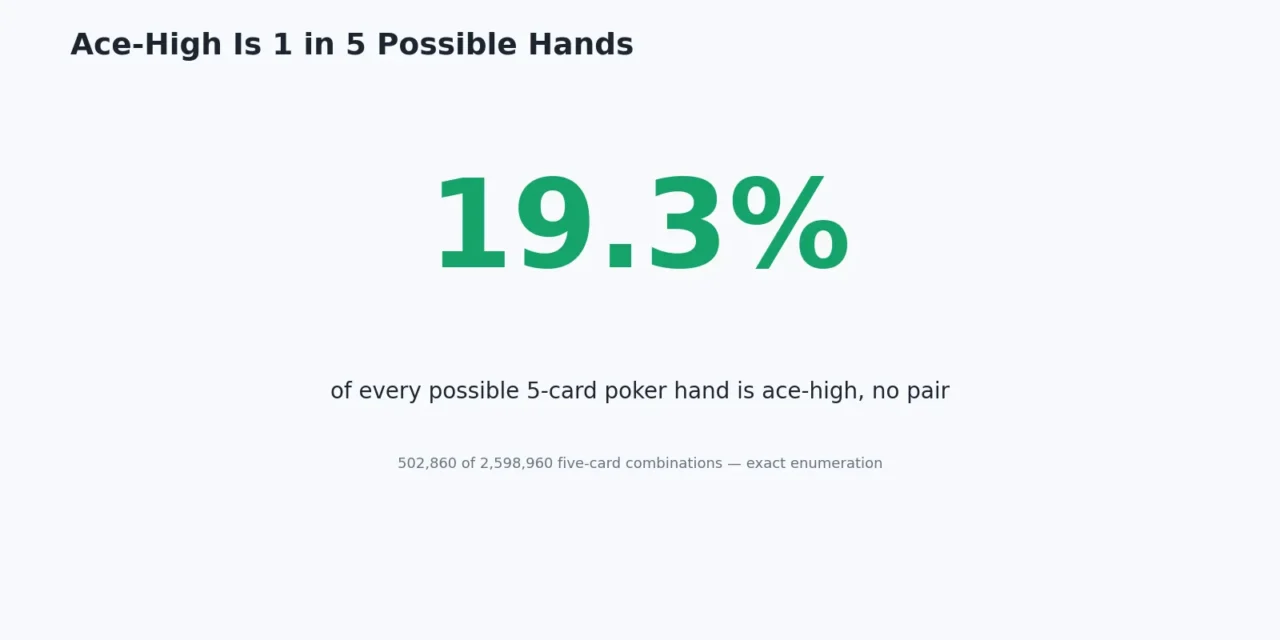
Ace-high means your best five-card poker hand has no pair, no two pair, no straight and no flush — it’s just five unmatched cards with an Ace on top. It is the most common single case of “high card,” making up 19.3% of all 2,598,960 possible five-card hands (502,860 hands, computed by exhaustive enumeration). It is not the same thing as an Ace-high straight (Broadway, A-K-Q-J-10), which is a completely different and vastly stronger hand. When two ace-high hands meet, the pot is decided by comparing kickers one at a time — 2nd card, then 3rd, then 4th, then 5th — until one side is higher or the five cards match exactly and the pot chops.
| Question | Quick answer |
|---|---|
| Is ace-high a made hand? | Yes — it’s the lowest hand-ranking category, “high card,” with an Ace as the top card. It has no pair, straight, or flush. |
| Does ace-high beat an Ace-high straight? | No. An Ace-high straight (Broadway) is a straight, a completely different and far stronger category. It beats every ace-high (no-pair) hand automatically. |
| How common is ace-high in 5-card poker? | 19.3% of all 5-card hands (502,860 of 2,598,960) — computed by exact enumeration. |
| How common is it in real 7-card Hold’em? | Only 9.6% of the time is a player’s best 7-card hand ace-high (150,000-trial simulation) — about half the 5-card rate. |
| How often does ace-high actually win a showdown? | 4.11% heads-up, 0.052% six-handed, and 0% in 150,000 nine-handed no-fold simulations. |
| What beats ace-high? | Any pair, two pair, three of a kind, straight, flush, full house, four of a kind, or straight flush — every other hand category beats it. |
| How is an ace-high tie broken? | Compare the 2nd-highest card, then 3rd, 4th, and 5th, in order, until one side is higher or all five cards match (chop). |
Ace-High vs. an Ace-High Straight: The Confusion to Clear Up First
“Ace-high” is one of the most misused terms in poker, and it’s worth getting straight (pun intended) before anything else, because the two things it can mean are not remotely close in strength.
Ace-high (the subject of this article) is a “high card” hand — the weakest hand-ranking category in poker. It means: no pair, no two pair, no three of a kind, no straight, no flush, no full house, no four of a kind, no straight flush. Just five cards of different ranks and mixed suits, and the highest of those five cards happens to be an Ace. A hand like A♠ J♥ 8♦ 6♣ 3♠ is ace-high. So is A♣ K♦ Q♠ J♥ 9♣ — that one is the strongest possible ace-high hand (more on that below), but it is still, categorically, “just” high card.
An Ace-high straight — almost always called Broadway in casual conversation, and formally A-K-Q-J-10 — is a straight. Straights are an entirely different, far stronger hand category that sits above three of a kind and below a flush. The phrase “Ace-high straight” is doing real descriptive work: it’s telling you which of the ten possible straights this is (the one topping out at the Ace), the same way “king-high straight” (K-Q-J-10-9) or “seven-high straight” (7-6-5-4-3) name the other nine. The word “straight” is not optional color commentary — drop it and “Ace-high” reverts to meaning the no-pair hand this article is about.
The confusion is understandable because English lets “ace-high” modify almost any hand that happens to be topped by an Ace: an ace-high flush (A♠ J♠ 8♠ 6♠ 3♠) is a flush; an ace-high straight is a straight; but “ace-high” by itself, with no hand-category word attached, is universally understood at the table and in the rules to mean the no-pair category specifically — the same way “two pair” or “trips” names a category on its own. TopSitesPoker.com’s companion piece on the wheel (the A-2-3-4-5 straight, where the Ace plays low) is a good example of the opposite trap: that hand is never called “ace-high” at all, because the Ace there is playing as the bottom of the straight, not the top card of a no-pair hand.
| Feature | Ace-high (this article) | Ace-high straight (“Broadway”) |
|---|---|---|
| Hand category | High card (weakest ranking category) | Straight (5th-strongest category) |
| Cards | 5 unmatched ranks, mixed suits, top card = Ace | A-K-Q-J-10 exactly, mixed suits |
| 5-card hands of this type | 502,860 | 1,020 (non-flush) + 4 (as a royal flush, a separate top category) |
| Share of all 5-card hands | 19.3% | 0.039% (1,020 of 2,598,960) |
| What beats it | Every other category: any pair, two pair, trips, straight, flush, full house, quads, straight flush | Only a flush or better; no other straight beats it (it’s the top straight) |
| How ties are broken | Compare kickers one at a time (2nd, 3rd, 4th, 5th card) | Never ties on rank alone at showdown among players holding the straight itself — every A-K-Q-J-10 is equal in rank; a shared-board Broadway simply chops (suits never break a poker tie) |
One more wrinkle worth flagging early: if the board itself deals out A-K-Q-J-10 in Texas Hold’em, everyone at the table is “playing the board” for a straight — and under Tournament Directors Association rules, every player must table all their hole cards to claim any part of that pot (TDA Rule 14), including when the winning hand is made entirely from community cards (TDA Rule 20). Nobody in that spot is “ace-high” in the sense this article covers; they’re all holding (at minimum) an Ace-high straight, and the pot chops among everyone still in the hand unless somebody’s hole cards improve on it.
How Common Is Ace-High, Really? The Exact Math
Start from the full 5-card deck. There are exactly 2,598,960 different 5-card hands you can be dealt from a standard 52-card deck (that’s “52 choose 5”). Exhaustive enumeration over every one of those hands — not sampling, not estimating, literally checking all 2,598,960 — sorts them into the nine familiar categories:
| Category | 5-card hands | % of all hands |
|---|---|---|
| High card (all forms) | 1,302,540 | 50.12% |
| — of which: ace-high specifically | 502,860 | 19.35% |
| One pair | 1,098,240 | 42.26% |
| Two pair | 123,552 | 4.75% |
| Three of a kind | 54,912 | 2.11% |
| Straight | 10,200 | 0.39% |
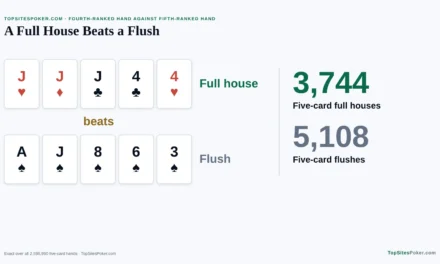
| Flush | 5,108 | 0.20% |
| Full house | 3,744 | 0.14% |
| Four of a kind | 624 | 0.024% |
| Straight flush (incl. royal) | 40 | 0.0015% |
Two numbers stand out. First, high card is the single most common category in poker — just over half of all random 5-card deals land there, which is exactly why TopSitesPoker.com’s companion piece, “High Card in Poker,” treats the whole category as a deep dive on its own. Second, within that huge high-card bucket, ace-high alone accounts for 502,860 hands — 38.6% of every high-card hand there is (502,860 / 1,302,540). No other single top card comes close: because an Ace can pair with any of the other 12 ranks as a kicker set, while a king-high hand can only use kickers below a king, and so on down the ladder, ace-high hands outnumber every other “X-high” bucket combined more than they trail behind it. Put differently: if you know someone has a no-pair hand and nothing else, the single most likely top card, by a wide margin, is an Ace.
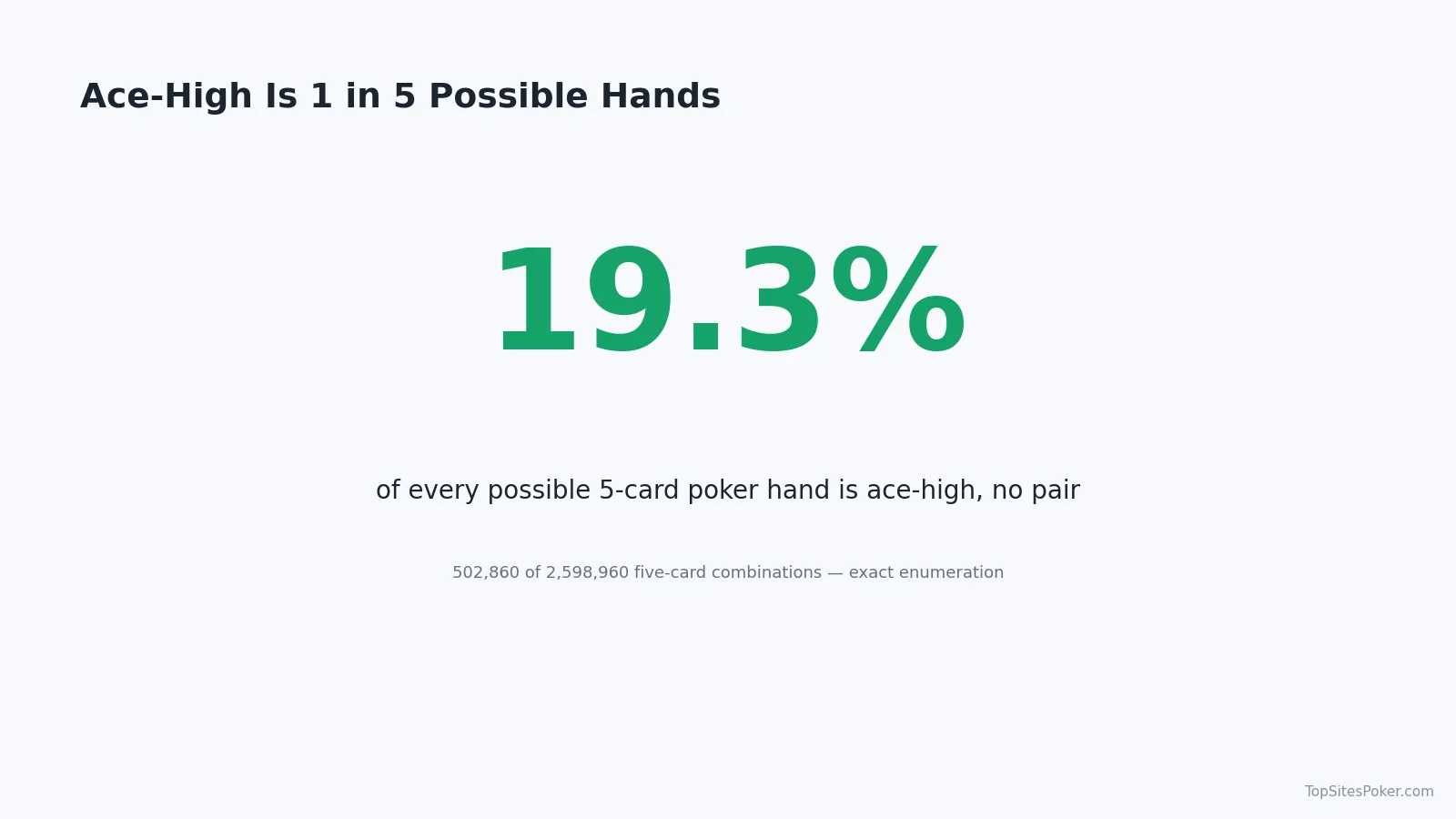
Where does that 19.3% (502,860) figure actually come from, arithmetically? It breaks into two independent counts multiplied together:
- Rank patterns: with the Ace fixed as the top card, you need to choose 4 more ranks from the 12 ranks below it (2 through King) to fill out the hand: that’s “12 choose 4” = 495 possible rank combinations. But 2 of those 495 combinations actually form a straight together with the Ace — the set {King, Queen, Jack, 10} makes Broadway (A-K-Q-J-10), and the set {5, 4, 3, 2} makes the wheel (A-2-3-4-5, where the Ace plays low). Both of those get reclassified as straights, not high card, so they’re excluded: 495 − 2 = 493 valid ace-high rank patterns.
- Suit patterns: for any five cards with five different ranks, there are 45 = 1,024 ways to assign suits, but 4 of those assignments put all five cards in the same suit (a flush, not high card), leaving 1,020 non-flush suit patterns per rank combination.
Multiply them: 493 × 1,020 = 502,860, exactly matching the enumerated total. This is a useful pattern to internalize, because it’s the same logic (choose the kickers, subtract the straight-forming sets, multiply by non-flush suit patterns) used to count every other “X-high” bucket in poker, and it’s how TSP-0002’s full 7,462-hand ranking ladder assigns exact rank counts to every high-card position.
Ace-High Compared to Every Other Hand Category
Raw hand counts are easier to appreciate side by side. Using the same exact-enumeration totals, here is how many 5-card hands of every other category exist for every single ace-high hand:
| Category | 5-card hands | Relative to ace-high (502,860 hands) |
|---|---|---|
| One pair | 1,098,240 | 2.18 one-pair hands exist for every 1 ace-high hand |
| Ace-high (reference point) | 502,860 | — |
| Two pair | 123,552 | Ace-high is 4.1x more common |
| Three of a kind | 54,912 | Ace-high is 9.2x more common |
| Straight | 10,200 | Ace-high is 49.3x more common |
| Flush | 5,108 | Ace-high is 98.4x more common |
| Full house | 3,744 | Ace-high is 134.3x more common |
| Four of a kind | 624 | Ace-high is 805.9x more common |
| Straight flush (incl. royal) | 40 | Ace-high is 12,571.5x more common |
Only one category, one pair, is more common than ace-high as a static 5-card deal — everything else in poker is rarer, in some cases dramatically so. That’s the source of the paradox this article keeps returning to: ace-high sits just one notch below one pair in raw frequency, yet it loses to one pair (and to everything rarer than one pair) every single time. Frequency and strength are entirely different axes, and ace-high is the clearest illustration in the whole game of how far apart they can be — common enough to show up constantly, weak enough to almost never survive contact with a made hand.
From 19.3% on Paper to 9.6% in Real Hold’em
19.3% sounds like a lot — “ace-high, no pair” is nearly a 1-in-5 outcome for a random 5-card hand. But almost nobody plays 5-card stud with a single static hand anymore. In Texas Hold’em, you get 2 hole cards and choose your best 5 from those plus the 5-card board — 7 cards total, with the freedom to pick whichever 5 make the strongest hand. That extra flexibility changes the math substantially.
A 150,000-trial simulation of a single random player’s own best hand from a random 7-card Hold’em deal (2 hole cards + a random 5-card board, no folding) found that a player’s best hand is high card only 17.3% of the time (down from 50.1% at 5 cards) — and of that 17.3%, the overwhelming majority is ace-high specifically: ace-high shows up as a player’s actual best 7-card Hold’em hand only 9.6% of the time (14,419 of 150,000 trials).
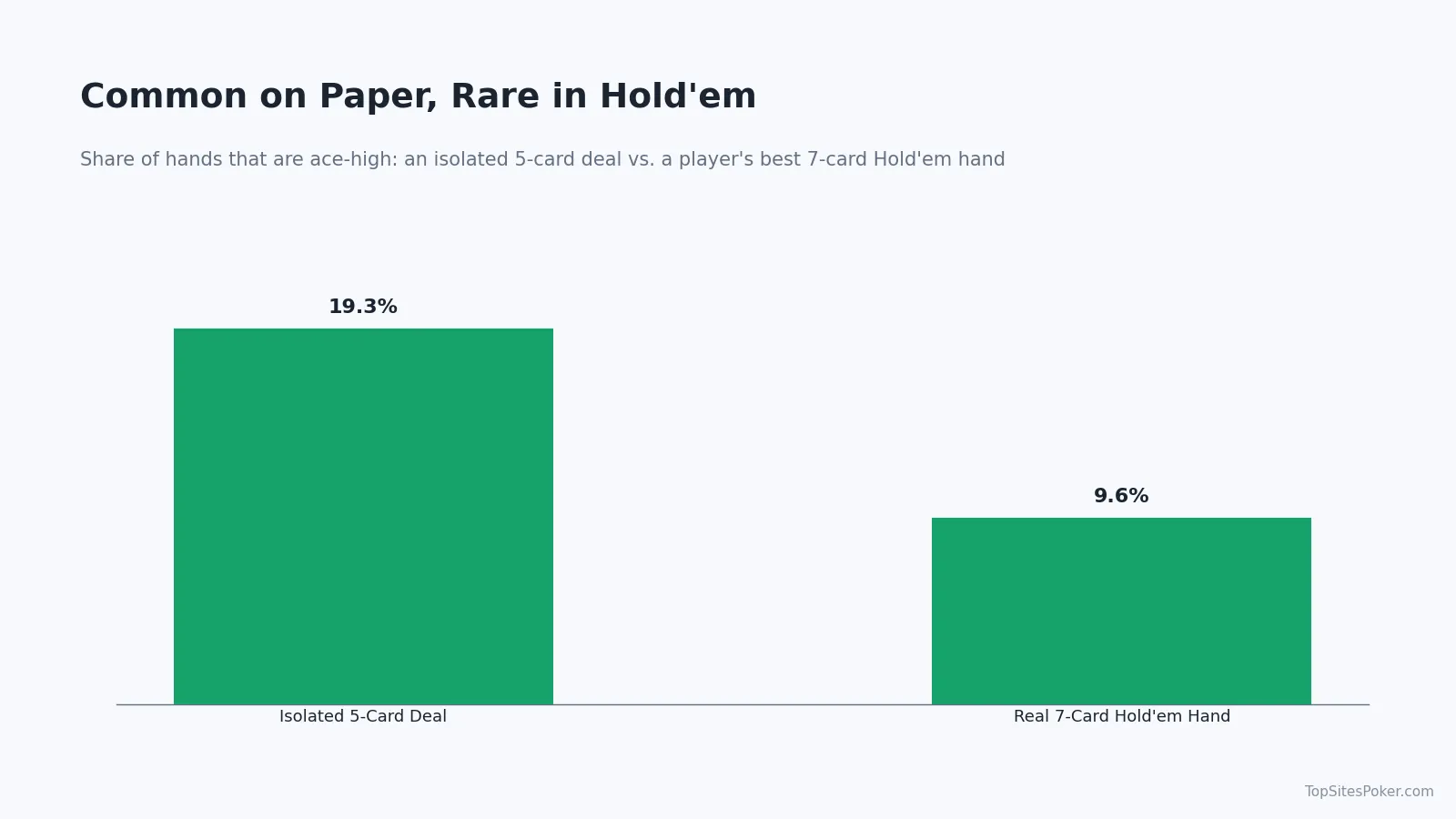
Why does having two extra cards to choose from cut the ace-high rate roughly in half? Two forces are both pushing in the same direction:
- More cards means more chances to pair up. With 7 cards instead of 5, the odds that at least two of them share a rank rise sharply — and any pair, however small, immediately promotes your hand out of “high card” and into “one pair” or better. One pair is the single most common category at 7 cards (43.9% in this same simulation), and most of what would have stayed high card at 5 cards gets absorbed into it.
- More cards also means more chances to complete a straight or flush. A wider net of 7 cards to draw 5 from makes straights (4.6%) and flushes (3.1%) meaningfully more common than they were at 5 cards, siphoning off more of what would have been “no pair” hands.
The practical takeaway: don’t reason about your real showdown chances using the 5-card figure. 19.3% describes an isolated 5-card deal — a useful number for understanding the shape of the deck, and exactly the kind of number the site’s ranking-ladder reference (TSP-0002) and general high-card article (TSP-0017) use for that purpose. But if you’re at a Hold’em table wondering how often you or an opponent actually ends up holding “just” ace-high once the river is out, the more relevant figure is 9.6% — and, as the next section shows, the gap between “having” ace-high and winning with it is even larger still.
Why So Many Hands Qualify But So Few Ace-High Hands Actually Win
Here’s the paradox this article exists to resolve: ace-high is common enough that it’s a player’s best hand nearly 1 time in 10 in real Hold’em deals — yet experienced players will tell you that showing down a genuine no-pair ace-high hand and winning with it feels like a small miracle. Both things are true, and the reason is simple: having ace-high says nothing about what your opponents have, and the moment there’s more than one live hand at showdown, someone else’s pair (even a lowly pair of deuces) beats every ace-high hand in existence.
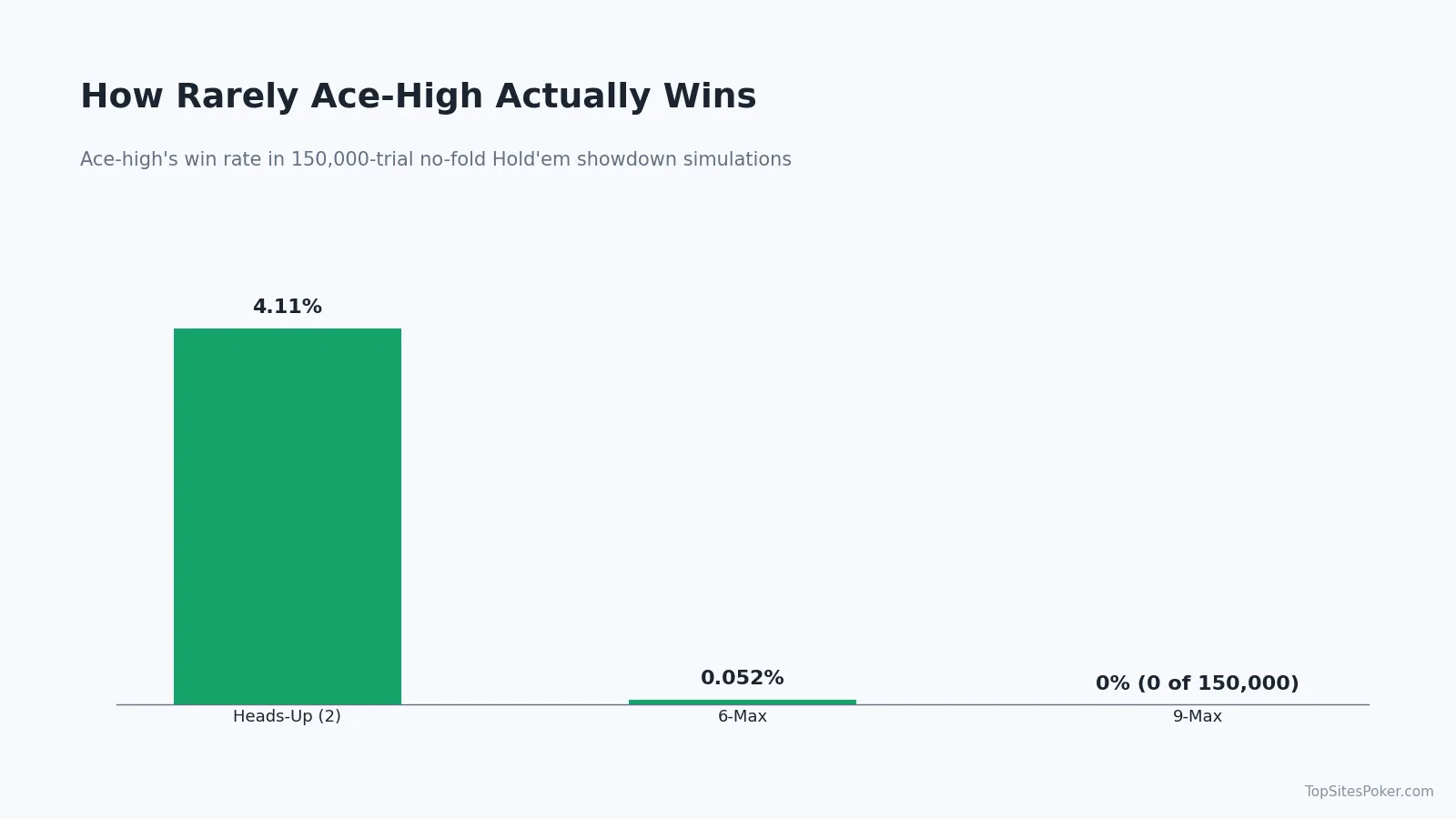
A 150,000-trial no-fold Hold’em simulation makes this concrete. In this simulation, every seat at the table is dealt in and sees the full run to a 5-card board with nobody folding — a deliberate baseline that strips out betting and folding decisions entirely, so the numbers measure pure hand-strength frequency: “if every seat always saw every showdown, how often would the best hand at the table actually be ace-high?” The answer collapses fast as more players are dealt in:
| Table size | Ace-high win rate | Trials where ace-high won |
|---|---|---|
| Heads-up (2 players) | 4.11% | 6,165 of 150,000 |
| 6-max (6 players) | 0.052% | 78 of 150,000 |
| 9-max (9 players) | 0.0% | 0 of 150,000 |
That last row is not a rounding artifact — it’s the literal simulation result. Ace-high never won a single one of 150,000 simulated nine-handed showdowns. With eight opponents also seeing every board to the river with no folding, the chance that all eight of them also whiff into a worse-than-ace-high hand (or a lower ace-high) is so small it didn’t occur even once in 150,000 tries.
Compare this to the win rates for other hand categories in the same simulations (drawn from the winner-category breakdown in the same 150,000-trial runs): heads-up, one pair alone wins 37.1% of showdowns and two pair wins 31.6%; by 9-max, two pair wins 24.8% and a straight wins 20.0% of showdowns, while high card of any kind (ace-high included) accounts for effectively none of the winning hands. The gap between “ace-high is 9.6% of my own best hand” and “ace-high wins the pot” is the gap between one hand’s strength in isolation and that hand’s strength relative to however many opponents are also live — and that gap only widens as more players see the river.
There’s a mechanical reason this baseline matters for reading these numbers correctly, too: this simulation deliberately never folds anybody. In real games, players with genuinely weak holdings fold long before showdown, which changes who’s actually left to compare hands against — real showdown pools skew toward stronger holdings than a random no-fold sample. That means these numbers are, if anything, an overestimate of how often ace-high wins against a realistic range of hands that chose to stay in a pot to the end. The takeaway holds either way: the more players who see a showdown, the closer ace-high’s win rate gets to zero, and by a full table it’s already there.
What Happens When You Actually Hold Ace-High? Conditional Heads-Up Equity
The 4.11% figure above answers a specific question: “across every possible heads-up showdown, how often is the winning hand ace-high?” That’s different from the question a player actually facing a decision needs answered: “given that I already know my own hand is ace-high, how often do I beat one random opponent?” The first number is diluted by every showdown where nobody at the table ends up with ace-high at all (the large majority of deals). The second isolates only the deals where you specifically got there.
To answer that directly, a fresh 1,700,000-trial heads-up Hold’em simulation dealt two random hole-card hands and a random board each time, kept only the trials where the first player’s best 7-card hand was ace-high, and then compared that player’s hand against the second player’s best 7-card hand from the same board. That produced 164,934 qualifying ace-high trials — a 9.70% qualifying rate, consistent with the 9.6% single-player ace-high rate reported earlier, which is a useful internal cross-check that the two independent simulations agree.
| Outcome (given you hold ace-high, heads-up) | Rate | Count (of 164,934 qualifying trials) |
|---|---|---|
| You win | 19.67% | 32,439 |
| You tie (chop) | 2.69% | 4,436 |
| You lose | 77.64% | 128,059 |
So: if you already know your hand is ace-high heads-up against one random opponent, you’re still an underdog — losing roughly 3 times out of every 4 — but you’re a considerably less hopeless underdog than the unconditional 4.11% figure might suggest at first glance, because that number was diluted by all the showdowns where ace-high wasn’t even in contention. Notice the two numbers aren’t contradictory; they’re answering different questions. The unconditional figure (4.11%) tells you how often ace-high is the winning hand across all heads-up showdowns. The conditional figure (19.67%) tells you your actual equity once you already know you’re holding it. Against a real, single opponent who has also stayed in the hand to the river — rather than a purely random hand — your real equity would typically be lower still, since a range of hands that chose to call or bet down to showdown skews stronger than a uniformly random hand.
The Full Ace-High Tie-Break Mechanic, Step by Step
When two (or more) players table ace-high hands against each other — no pair, top card Ace, for both — the pot is decided the same way every high-card comparison is decided: card by card, from the top down, stopping at the first point of difference.
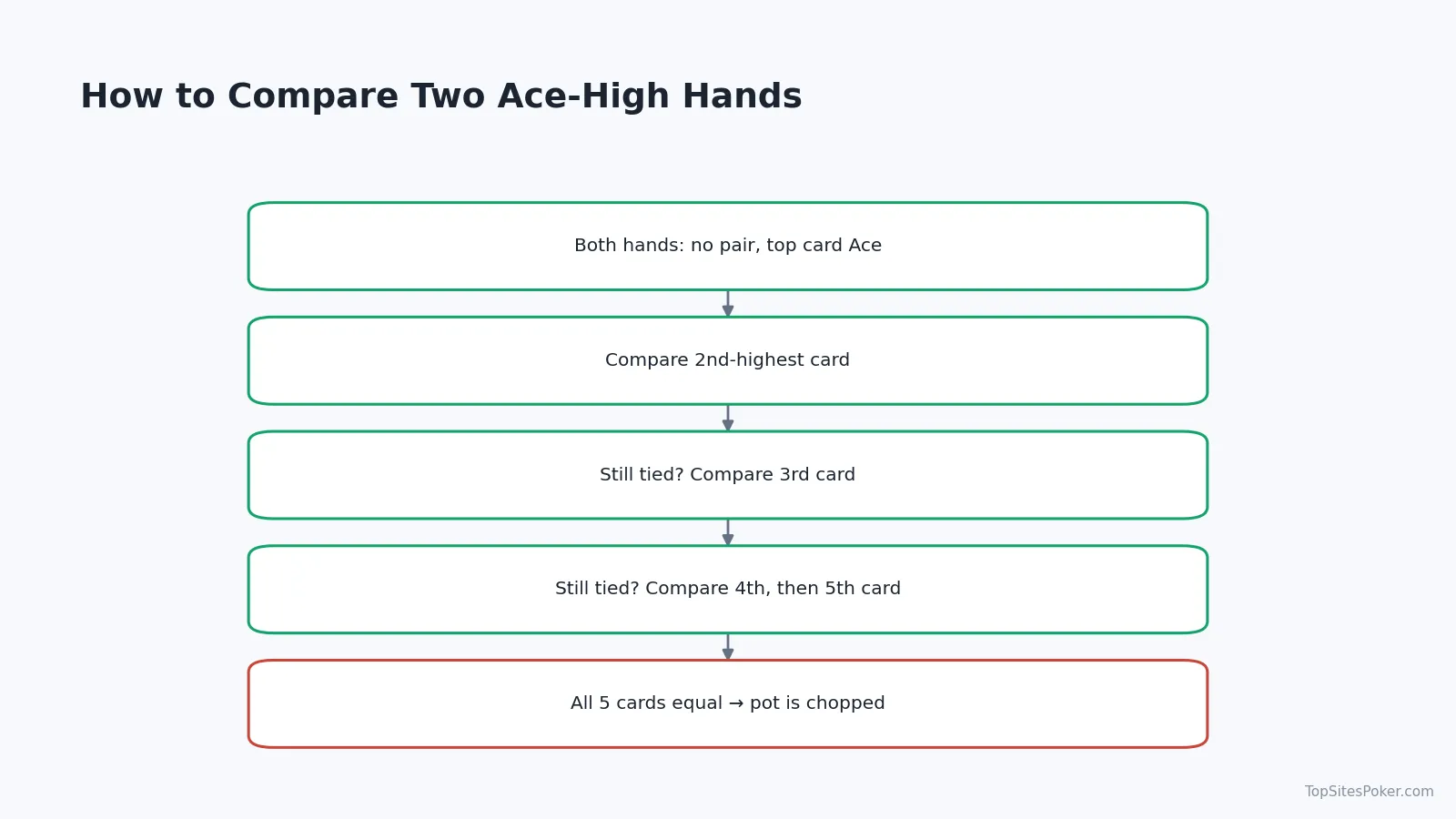
Written out as an explicit procedure:
- Confirm both hands are ace-high. No pair, no straight, no flush, top card an Ace, for both hands. (If either hand actually has a pair, a straight, a flush, or anything else, this whole procedure doesn’t apply — that hand simply wins outright, or you’re comparing within a different category altogether.)
- The top card (the Ace) is a guaranteed tie and never breaks anything — both hands have one, by definition, so move immediately to the next card.
- Compare the 2nd-highest card in each hand (each player’s best kicker). Higher card wins the pot outright. If equal, continue.
- Compare the 3rd-highest card. Higher card wins. If equal, continue.
- Compare the 4th-highest card. Higher card wins. If equal, continue.
- Compare the 5th-highest (lowest) card. Higher card wins.
- If all five cards match exactly between the two hands, it’s a genuine tie and the pot is chopped (split) between them. Suits never enter into it — poker hand rank never depends on suit.
The mechanical rule behind this (“cards speak”) is worth naming explicitly: at showdown, a hand is read for what it actually is, and any player’s own verbal claim about their hand doesn’t change that — a deliberately false call of one’s own hand can be penalized under the rules (TDA Rule 13). This is why dealers and floor staff read hands directly off the tabled cards rather than taking a player’s word for it, and it’s also why every player who wants any share of the pot must actually table all of their hole cards, per TDA Rule 14, rather than describing their hand and mucking.
How often does each step actually end up being the one that decides the pot? This isn’t a guess — it comes from a 400,000-sample analysis that took random pairs of the 502,860 real ace-high hands, found the first card position where they differed, and tallied the result:
| Decided at… | Share of ace-high vs. ace-high matchups | Sample count (of 400,000) |
|---|---|---|
| 2nd card | 78.1% | 312,289 |
| 3rd card | 17.5% | 70,012 |
| 4th card | 3.6% | 14,243 |
| 5th card | 0.7% | 2,648 |
| Exact chop (all 5 cards equal) | 0.2% | 808 |
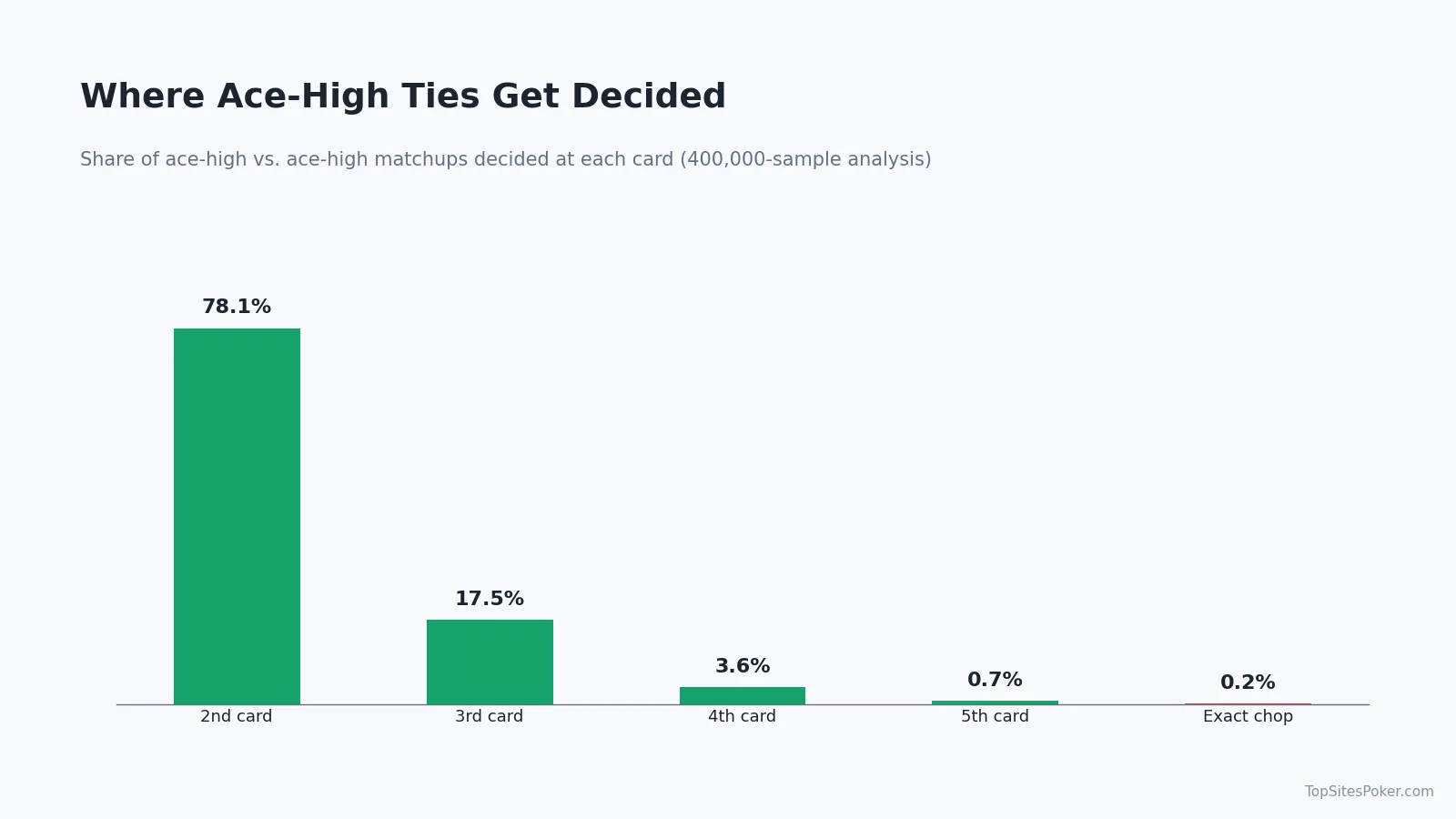
The lesson from this distribution: your 2nd card (your best kicker) is doing almost all of the work. Nearly four out of every five ace-high-vs-ace-high collisions never even get to the 3rd card — they’re already decided by whoever has the better second-highest card. That’s the single most important practical fact in this whole article: when you’re assessing an ace-high hand, glance at your best kicker first, because it settles the overwhelming majority of collisions by itself. The 3rd card matters a lot less (17.5%), the 4th card is a minor factor (3.6%), and by the time you’re down to the 5th card mattering (0.7%) or an exact five-card chop (0.2%), you’re in genuinely rare territory — a dead-even ace-high chop happens only about 1 time in 500 ace-high collisions.
Ace-High Hands by Kicker Strength
Not all ace-high hands are created equal, and the 2nd card is where almost all of that inequality lives. An exact enumeration of the 502,860 ace-high hands, sorted by 2nd-highest card, shows just how top-heavy the distribution is:
| 2nd card (best kicker) | Ace-high hands with this kicker | % of all ace-high hands |
|---|---|---|
| King | 167,280 | 33.27% |
| Queen | 122,400 | 24.34% |
| Jack | 85,680 | 17.04% |
| Ten | 57,120 | 11.36% |
| Nine | 35,700 | 7.10% |
| Eight | 20,400 | 4.06% |
| Seven | 10,200 | 2.03% |
| Six | 4,080 | 0.81% |
Three things jump out of that table. First, a full third of all ace-high hands (33.27%) have a King as their 2nd card — “Ace-King high” is by far the single largest slice of the ace-high universe, because a King can pair with the widest range of remaining lower kickers without accidentally forming a straight or a pair. Second, the top four kicker ranks (King, Queen, Jack, Ten) together account for 86.0% of every ace-high hand there is (432,480 of 502,860) — the vast majority of real-world ace-high hands have a “big” kicker, not a small one. Third, and easy to miss: the 2nd card can never be lower than a Six. A 2nd card of Five would require the remaining four cards to come from {5, 4, 3, 2} — but that specific set, combined with the Ace, is exactly the wheel straight (A-2-3-4-5), so it gets reclassified as a straight rather than staying high card. That single exclusion is why “ace-high” hands bottom out at a 6 kicker, never a 5.
Following that logic all the way to the bottom: the single weakest possible ace-high hand, ranked strictly by the tie-break rule above, is A-6-4-3-2 (any suits, not a flush) — not A-6-5-4-3, which might look weaker at a glance. Both have a 6 kicker, so the comparison falls to the 3rd card: A-6-5-4-3’s 3rd card is a 5, while A-6-4-3-2’s 3rd card is a 4. Since 4 is lower than 5, A-6-4-3-2 loses that showdown, making it the genuine bottom of the ace-high ladder. At the opposite extreme, the strongest possible ace-high hand is A-K-Q-J-9 — not A-K-Q-J-10, because that specific five-card set is Broadway, a straight, and gets promoted out of the high-card category entirely (the same exclusion rule as the wheel, just at the top of the ladder instead of the bottom).
Board Texture: When Is Ace-High Even Possible?
There’s a deterministic rule — not a frequency, a certainty — that’s easy to overlook when you’re reading a Hold’em board: ace-high (or any high-card hand) can only be somebody’s final best hand if the 5-card community board itself is not already a made hand of one pair or better. The reasoning is mechanical. Your best 7-card hand is always the strongest 5-card combination available from your 2 hole cards plus the 5 board cards. If the board contains a pair — say it runs out A-A-9-5-2 — then both members of that pair are sitting face-up for everyone to use, and every single player at the table can always assemble a valid one-pair hand from the board’s pair plus their own three highest remaining cards. Since one pair categorically beats high card no matter what the kickers are, the true best hand for every player at that table is guaranteed to be at least a pair the moment the board itself pairs — nobody, regardless of their hole cards, can end up with a high-card (or ace-high) final hand on a paired board.
The same logic extends further: if the board itself completes a straight (five running ranks, such as 9-8-7-6-5) or the board itself is a monotone flush (all five board cards the same suit — rare, but it happens), every player automatically has access to at least that straight or that flush, since all five of the relevant cards are already face-up on the board for anyone to use. So the full condition for ace-high to even be possible as someone’s final hand is: the board’s own five cards must have five different ranks, must not themselves form a straight, and must not themselves be a single-suit flush. Only on a board that clears all three of those bars does “high card” — and, most often, ace-high specifically — become an available outcome for anyone at the table.
Even on a board that clears those bars, most players will still improve past high card via their own hole cards — pairing a board card, making two pair, hitting a straight or flush using both hole cards, and so on. That’s the second half of the story from the “From 19.3% on Paper to 9.6% in Real Hold’em” section above: it’s not just that ace-high requires a cooperative (unpaired, non-straight, non-flush) board — it also requires that your own two hole cards specifically failed to connect with that board in any of the usual ways. Both conditions have to hold at once, which is exactly why the real 7-card rate (9.6%) comes in well under the raw 5-card rate (19.3%).
Worked Examples: Reading Real Ace-High Showdowns
Seeing the tie-break rule applied to actual holdings makes it far more intuitive than the abstract procedure alone. Here are several worked showdowns, using the rule from the previous section every time.
| Player A’s hand | Player B’s hand | Decided at | Result |
|---|---|---|---|
| A♠ K♥ 9♦ 6♣ 4♠ | A♦ Q♣ J♠ 8♥ 5♦ | 2nd card | A wins — King beats Queen |
| A♣ K♦ J♠ 7♥ 3♣ | A♠ K♥ 10♦ 8♣ 2♠ | 3rd card | A wins — both have King kicker, but A’s Jack beats B’s Ten |
| A♦ K♣ J♥ 8♠ 4♦ | A♥ K♠ J♦ 6♣ 2♥ | 4th card | A wins — both share Ace-King-Jack, but A’s 8 beats B’s 6 |
| A♠ K♦ Q♣ J♥ 9♠ | A♥ K♣ Q♦ J♠ 6♥ | 5th card | A wins — matched through the 4th card, A’s 9 beats B’s 6 on the final card |
| A♣ K♥ Q♠ 10♦ 7♣ | A♦ K♠ Q♥ 10♣ 7♦ | Exact chop | All five ranks match (A-K-Q-10-7 for both) — pot splits evenly. Suits are irrelevant. |
Two things worth flagging from that table. In the third row, both players share the exact same top three cards (Ace, King, Jack) — a genuinely common pattern once you understand that 33.27% of all ace-high hands have a King kicker and 17.04% have a Jack as their next card, so “both players have Ace-King-Jack” is far from a freak coincidence. In the last row, the chop isn’t a hedge or a rare curiosity — it’s exactly the kind of result the 400,000-sample analysis says happens about 0.2% of the time two ace-high hands collide, which at a busy table over thousands of hands will absolutely happen sooner or later.
One more worked scenario that trips up newer players: a three-way ace-high pot.
Three-way example: Player A shows A♠ K♥ Q♦ 8♣ 5♠. Player B shows A♦ K♣ J♠ 9♥ 4♦. Player C shows A♥ Q♠ J♦ 10♣ 7♥. Player C’s top card is an Ace, tied with A and B — but C’s 2nd card is a Queen, while A’s is a King and B’s is a King. Since King beats Queen, C is already eliminated at the 2nd-card comparison, regardless of anything else in C’s hand. That leaves A and B, both with a King kicker — so it moves to the 3rd card: A has a Queen, B has a Jack. Queen beats Jack, so Player A wins the entire pot, and neither B’s nor C’s remaining cards ever mattered.
A full Hold’em hand, start to finish: Hero raises preflop holding A♠ K♦. Both players see a heads-up flop of Q♣ 9♦ 5♥ — no pair, no flush draw for either player yet, and the board itself is still “raw” in the sense described above. The turn brings the 3♠, and the river brings the 2♣. The final board reads Q♣ 9♦ 5♥ 3♠ 2♣ — five different ranks, no pair, no straight, no flush possible on the board itself, so a high-card hand is still on the table as an outcome. Hero’s best five cards from A♠ K♦ + the board are A♠-K♦-Q♣-9♦-5♥ (the board’s 3♠ and 2♣ are both lower than Hero’s 5♥, so they don’t make the final five). That’s ace-high with a King kicker — one of the stronger ace-high hands, since King kickers make up 33.27% of the entire ace-high universe. Whether Hero wins depends entirely on what the opponent is holding: any pair at all — even a lone pair of deuces made by pairing the river’s 2♣ — beats Hero’s ace-high outright, no matter how good Hero’s kickers look on paper.
Ace-High as a Bluff-Catcher and Showdown-Value Hand
Given how rarely ace-high wins once more than one or two players are live (the previous section’s 4.11% / 0.052% / 0% figures), why do experienced players still talk about “calling with ace-high” as if it’s a real decision rather than an automatic fold? The answer is that ace-high’s practical value in real play isn’t about being the best hand most of the time — it’s about being just good enough to beat a bluff.
A bluff-catcher is any hand that can’t beat a legitimate value bet but can beat a bluff — a hand whose entire job is to call, not to bet or raise for value. Ace-high is the textbook example. It beats exactly one thing at showdown: a worse high-card hand or a missed draw with nothing at all (including a lower ace-high, or a king-high hand, and so on down the ladder). It loses to literally everything else — any pair, any two pair, any made straight or flush. That makes it a hand you can only profitably continue with when you have a specific read that your opponent’s final bet is more likely to represent “nothing” than “something,” typically on a scary-looking river where a made hand would be expected to bet for value and a busted draw might try to bet as a bluff instead.
Because ace-high beats a bluff 100% of the time and loses to a value bet 100% of the time (there’s no in-between outcome once you simplify an opponent’s river range into just those two buckets), the calling decision reduces to a break-even comparison: how often does the bet in front of you need to be a bluff for calling to make sense, given the size of that bet relative to the pot? The standard pot-odds formula for a simple bluff-catch — required bluff frequency = bet ÷ (pot before the bet + 2 × bet) — gives a clean reference table for common bet sizes:
| Opponent’s river bet size | Bluff frequency needed to break even calling with ace-high |
|---|---|
| 33% of the pot | 19.9% |
| 50% of the pot | 25.0% |
| 75% of the pot | 30.0% |
| 100% of the pot (pot-sized bet) | 33.3% |
| 150% of the pot (overbet) | 37.5% |
Reading that table: the smaller an opponent’s bet relative to the pot, the less often they need to be bluffing for your ace-high call to break even — a 33%-pot bet only needs to be a bluff about 1 time in 5 for calling to be correct, while a large 150%-pot overbet needs to be a bluff more than 1 time in 3. This is a general break-even framework applied specifically to ace-high’s role as a bluff-catcher, not a simulated win-rate claim — it tells you the threshold to compare your actual read against, not a guaranteed outcome.
A worked example: the pot is $100 heading into the river, and your opponent bets $50 — exactly the 50%-pot row in the table above, with a break-even bluff frequency of 25.0%. You’re holding A♠ K♦ 9♣ 6♥ 3♠, an Ace-King-high hand, one of the stronger ace-high holdings (King kickers make up 33.27% of the whole ace-high universe). If, based on how the hand played out — the betting pattern, the specific board texture, and what you know about this particular opponent — you believe they’d show up with a genuine bluff here at least 25% of the time, calling is the break-even-or-better play. If you think they’re bluffing this exact spot closer to 10-15% of the time, folding is clearly correct, even with a relatively strong ace-high hand. Notice that the strength of your specific ace-high hand (Ace-King versus, say, Ace-Six) doesn’t change the break-even math at all — it only matters for how confident you can be that you’re actually beating whatever your opponent’s bluffing range contains, since a stronger kicker beats more of an opponent’s potential holdings if they turn out not to be bluffing but showing down a weaker made hand instead.
A few practical guardrails worth internalizing:
- Ace-high is a calling hand, essentially never a betting hand, once opponents are still in the pot. Betting or raising with a hand this weak, against players who haven’t shown weakness, invites a call or raise from literally any pair — and the showdown math above shows just how often “any pair” is exactly what’s out there.
- Position and bet-sizing patterns matter more than your own hand strength here. Because ace-high can only ever beat air, the entire decision of whether to call hinges on how likely you think the specific bet in front of you is to be a bluff — which is a read on the opponent and the betting line, not a property of your own cards.
- The kicker-strength table above (King down to Six) is a useful tiebreak against yourself, too. If you’re weighing whether to call a river bet with ace-high, an Ace-King-high hand (33.27% of the ace-high universe, and roughly as strong as ace-high gets) is a materially better bluff-catcher than an Ace-Six-high hand, because it also beats any weaker ace-high hand your opponent might be bluffing with, not just non-Ace high cards.
- Multiway pots make ace-high calls dramatically worse, not just modestly worse. The jump from a 4.11% win rate heads-up to a 0.052% win rate six-handed (roughly an 80-fold drop) is the numeric version of the well-known poker adage that showdown-value hands lose most of their value once more than one opponent needs to be beaten — which is exactly the situation ace-high is worst suited for.
- Holding an Ace yourself has a small blocker effect worth factoring into a bluff-catch read. There are normally 6 possible two-card combinations that make pocket Aces (choosing 2 of the deck’s 4 Aces). The moment you hold one Ace yourself, only 3 Aces remain in the other 50 unseen cards, which cuts the number of remaining pocket-Ace combinations available to your opponent from 6 down to 3 — it doesn’t rule pocket Aces out, but it does make them half as likely as they’d otherwise be. The same logic very slightly reduces the chance an opponent is sitting on a big Ace-high hand of their own, or on a Broadway straight, since one of the four Aces in the deck is already accounted for in your own hand.
None of this is a chart or a strategy tool you’re meant to consult mid-hand — and it’s worth noting explicitly that TDA rules prohibit exactly that: electronic devices, wearable technology and AI assistance are banned at the table, and printed charts or strategy tools are likewise not permitted for use during play (TDA Rule 5). The frameworks in this section are meant to shape how you think about ace-high decisions away from the table, not something to consult live.
Ace-High in Lowball and Hi-Lo Variants
Everything above describes standard “high” poker — the family that includes Texas Hold’em, Omaha, and standard 7-card Stud, where the best high hand wins and an Ace is always the top-ranked card. Several other poker variants flip that logic, and “ace-high” behaves very differently — sometimes it barely exists as a concept, and sometimes it’s actively bad. This section covers the two lowball forms the brief calls out specifically; other stud and split-pot variants (Razz, Omaha Hi-Lo) are mentioned only briefly, since their full treatment belongs elsewhere.
| Game / rule set | How the Ace plays | What “ace-high” means there |
|---|---|---|
| Standard high poker (Hold’em, Omaha, standard Stud) | Always high (rank 14) — can also play low only for a wheel-type straight | A no-pair hand topped by an Ace — the most common single high-card top card, as covered throughout this article |
| A-5 lowball (e.g. California/Ace-to-Five lowball, and Razz’s ranking logic) | Always low (counts as the lowest card, rank 1) | Effectively impossible as a “made hand” descriptor — since the Ace is the lowest card, it can never be the highest card in a genuine 5-distinct-card low hand. Having an Ace is excellent news, not bad news. |
| 2-7 lowball (Deuce-to-Seven, single or triple draw) | Always high only (no low Ace at all) | A real and generally unwelcome outcome — since straights and flushes count against you and the Ace is strictly high, an “ace-high” no-pair hand is one of the worst possible holdings in the game |
A-5 lowball (the ranking system used in games like California lowball and in Razz, 7-card stud played for the lowest hand) treats the Ace as the best possible low card — it always plays as rank 1, never as a high card. In these games you’re trying to make the lowest unpaired, non-straight, non-flush five-card hand, and the best hand of all is A-2-3-4-5 (called “the wheel” or “the bicycle” in this context too, though the term is doing a very different job than it does in standard-straight talk about the same five ranks). Because the Ace is always your lowest, most valuable card here, it is structurally impossible for an Ace to be the highest card in a genuine A-5 low hand — if a hand contains an Ace, something else in the hand has to be higher, by definition, unless every other card is also somehow lower, which can’t happen with five distinct ranks and only one Ace in the mix below rank 2. Practically: in A-5 lowball, “ace-high” isn’t really a phrase players use to describe a made hand at all, and holding an Ace is close to the best news you can get, not a warning sign the way this article’s whole premise treats “just ace-high” in standard poker.
2-7 lowball (Deuce-to-Seven, played single draw or triple draw) flips the standard-poker logic in the opposite direction from A-5: the Ace counts only as a high card (rank 14, exactly as in standard high poker) — there is no low Ace option at all — and, critically, straights and flushes actively count against you rather than helping. The best possible hand in 2-7 lowball is 7-5-4-3-2 (no pair, no straight, no flush, and as low as the ranks can go without accidentally forming a straight) — a hand nicknamed simply “the seven” or “number one” in this variant. Since the Ace is always high in 2-7, holding one is close to the worst thing that can happen to your low hand: an ace-high, no-pair holding in 2-7 lowball is a real, describable hand (unlike in A-5), and it’s one of the weakest hands you can show down, essentially the mirror image of how “ace-high” functions as a modest asset in standard high poker. Hedge appropriately here: exact 2-7 lowball frequency tables are outside the scope this article was built to cover — the point worth taking away is simply that having an Ace is good in standard high poker and in A-5 lowball, but bad in 2-7 lowball, and “ace-high” specifically only really exists as a describable (and unwelcome) hand type in the last of those three.
Razz (7-card stud played for the lowest hand, using A-5 ranking logic) and Omaha Hi-Lo (8-or-better) both use the same A-5-style low-hand ranking described above for their low side, so the same logic applies to their low hands: an Ace is a premium low card, not a high card, and “ace-high” as this article defines it doesn’t meaningfully describe a made Razz or Omaha Hi-Lo low hand. Omaha Hi-Lo’s high side, by contrast, works exactly like standard Hold’em high hands — so a player can absolutely hold a standard ace-high (no-pair) hand for the high half of an Omaha Hi-Lo pot, subject to everything covered earlier in this article.
Common Mistakes with Ace-High
Most misunderstandings about ace-high cluster around a handful of recurring errors. Watching for these will save you both at the table and when reading strategy content elsewhere.
- Confusing “ace-high” with “Ace-high straight.” This is the single most common mix-up, and it’s exactly what the opening section of this article was built to head off. If someone says “I had ace-high and won,” ask (or read carefully) whether they mean the no-pair hand or shorthand for Broadway — the two are worlds apart in strength and in how often they show up (19.3% vs. 0.039% of 5-card hands).
- Assuming ace-high is strong because “Ace” sounds strong. An Ace is the highest-ranked single card in the deck, but “ace-high” as a hand category is still the weakest possible category in poker. The presence of an Ace tells you almost nothing about whether your hand will hold up — the showdown simulations above show it winning 0% of the time nine-handed.
- Treating all ace-high hands as equally strong. As the kicker-strength table showed, an Ace-King-high hand (33.27% of the ace-high universe) is meaningfully better than an Ace-Six-high hand (0.81%), because the 2nd card decides 78.1% of ace-high collisions by itself. Lumping every ace-high hand together ignores the single biggest driver of who wins those showdowns.
- Betting or raising with ace-high against action. Because ace-high can only beat a missed hand, betting it into a player who is still in the pot and not folding invites a call or raise from any pair at all — the worst possible spot for a hand this weak to be building the pot in.
- Forgetting that any pair — even the lowest possible pair — beats every ace-high hand. A pair of deuces beats A-K-Q-J-9, the single best possible ace-high hand there is. There’s no such thing as an ace-high hand that’s “too strong” to lose to a pair; category always trumps rank within high card.
- Assuming the Ace itself decides ace-high-vs-ace-high ties. It can’t — both hands have one, always. The entire tie-break lives in the 2nd through 5th cards, and forgetting that leads to misreading who actually wins a shown-down pot.
- Using the same “ace is good” assumption across every poker variant. As the variants section covered, an Ace is excellent in standard high poker and in A-5 lowball, but a real liability in 2-7 lowball. Carrying one game’s intuition into another game with a different ranking system is an easy way to misjudge a hand.
- Overvaluing “at least I have an Ace” as a fallback plan preflop. Holding any Ace preflop doesn’t guarantee you’ll end up with an ace-high hand, let alone a winning one — plenty of Ace-containing starting hands end up pairing, missing entirely, or losing to a made hand by the river regardless of the Ace in the hole.
- Ignoring what the board itself is doing before assuming anyone is ace-high. As the board-texture section above lays out, a paired board guarantees every player at least a pair, a board straight guarantees everyone at least that straight, and a monotone board guarantees everyone at least that flush — in any of those cases, “ace-high” simply isn’t an available outcome for anybody, no matter what hole cards are in play.
Ace-High and the Rules of Showdown
A handful of Tournament Directors Association rules govern exactly how an ace-high showdown plays out procedurally, and they’re worth knowing precisely because ace-high hands are so often “close” comparisons decided by a single kicker card — the kind of situation where sloppy procedure actually matters.
- Cards speak, and deliberate miscalls can be penalized (TDA Rule 13). If you table A-K-Q-J-9 believing you have “just ace-high” and someone else tables what turns out to be a lower kicker set, your hand is read for exactly what it is — a hand doesn’t need to be correctly announced to win, but deliberately misrepresenting your own hand’s strength to induce a fold or a bad call can draw a penalty.
- Every player must table all their hole cards to win any part of the pot (TDA Rule 14), including when the winning hand is made entirely from the board (TDA Rule 20). This matters more than it might seem for ace-high specifically: because ace-high hands are so often close, mucking early on a misread of your own kicker strength can cost you a pot you actually would have won.
- Face-down discards aren’t automatically dead if they’re 100% identifiable (TDA Rule 15). In draw-based games where a card gets discarded face-down by mistake, this rule can matter for reconstructing exactly which cards make up a contested ace-high (or any) hand.
- Premature cards (a card exposed or dealt out of sequence) are handled by a specific procedure, not by scrapping the deal (TDA Recommended Procedure 5). A prematurely exposed card is generally kept out of play, reshuffled into the stub, and the hand redealt without an extra burn card. This matters more for ace-high hands than it might seem: because so many ace-high-vs-ace-high showdowns are decided by a single kicker card (78.1% of them at the 2nd card alone, per the analysis above), a procedural error in exactly which card lands where can change who actually wins a close pot — which is precisely why the rule exists.
- TDA Rule 21 splits an odd chip in a chopped pot differently by game type: in board games (Hold’em, Omaha) it goes to the first seat left of the button, while in Stud games ties such as the bring-in go by high card ranked by suit — spades, hearts, diamonds, clubs. Either way, this is a procedural tie-break for chip mechanics, not a hand-ranking rule — it never decides which hand wins a showdown, including an ace-high one. Hand rank is always settled by rank comparison first (exactly as described earlier in this article), and suit only ever enters the picture for these narrow procedural purposes.
- “Show one, show all” is a house rule, not a TDA rule. Many rooms require that if a player voluntarily shows their hand to one opponent (or the rail) after a hand is over, they must show it to everyone who asks — but this is a house policy adopted by individual rooms, not a Tournament Directors Association rule. Since ace-high hands at showdown are often genuinely close, this rule (where it’s adopted) can matter for how much information gets revealed about borderline calls. Check your room’s posted rules, since adoption varies.
As with every rules citation in this piece, remember that TDA rules bind only the events and rooms that have formally adopted them — most organized tournaments do, but many cash games and home games run on their own house rules instead, which can differ in exactly these procedural details even when the underlying hand-ranking math (which never changes) stays the same.
Glossary: Ace-High Terms Worth Knowing
| Term | What it means |
|---|---|
| Ace-high | A no-pair, no-straight, no-flush five-card hand whose highest card is an Ace. The specific subject of this article, and the most common single version of the “high card” category. |
| High card (no pair) | The umbrella hand category ace-high belongs to — any hand with five different ranks, mixed suits, and no straight. Ace-high, king-high, queen-high, and so on down to seven-high are all versions of it. |
| Kicker | Any card in your hand that isn’t part of the hand’s core (in a no-pair hand, every card besides the top one functions as a kicker). Kickers are what settle ace-high-vs-ace-high ties. |
| Broadway | The common nickname for the Ace-high straight, A-K-Q-J-10 — a straight, not a high-card hand, despite also being “topped” by an Ace. |
| The wheel | The nickname for the A-2-3-4-5 straight, where the Ace plays as the lowest card rather than the highest. It’s never described as “ace-high” for that reason. |
| Chop (split pot) | What happens when two or more hands are exactly equal in rank at showdown — including two identical ace-high hands, card for card. The pot divides evenly; suits are never used to break the tie. |
| Bluff-catcher | A hand too weak to bet for value but strong enough to beat a bluff — ace-high’s main practical role once betting is over and a decision to call or fold remains. |
| The nuts | The best possible hand given the exact cards on the board. On a sufficiently dry, unpaired, non-straight, non-flush board where nobody connects, the nuts can be as low as ace-high. |
| Showdown | The point in a hand, after all betting is complete, where remaining players table their hole cards and the pot is awarded based on hand rank — governed procedurally by rules such as TDA Rule 13 and Rule 14. |
Quick Quiz: Test Your Ace-High Knowledge
- Which of these is a true ace-high hand? (a) A-K-Q-J-10 mixed suits (b) A♠ K♠ Q♠ J♠ 9♠ (c) A♦ J♣ 8♠ 6♥ 3♦ (d) A-A-K-K-Q — Answer: (c). Option (a) is Broadway, a straight. Option (b) is a royal flush. Option (d) has two pairs.
- What percentage of all 2,598,960 five-card hands are ace-high? Answer: 19.3% (502,860 hands), by exact enumeration.
- True or false: an Ace-high straight beats an ace-high (no-pair) hand automatically, regardless of kickers. Answer: True. Straight is a higher hand category than high card; kickers never come into it.
- Two players table ace-high hands with the same 2nd, 3rd, and 4th cards. What decides the pot? Answer: the 5th (lowest) card — and if that also matches, the pot chops.
- In a 400,000-sample analysis of ace-high-vs-ace-high matchups, what share was decided by the 2nd card alone? Answer: 78.1%.
- What is the single most common 2nd-card (kicker) rank among all ace-high hands? Answer: King (33.27% of all ace-high hands).
- Why can an ace-high hand’s 2nd card never be a 5? Answer: because only three ranks exist below a 5 (namely 4, 3, and 2), so a hand with 2nd card 5 has no choice of kickers at all — it must use exactly {5, 4, 3, 2}. Combined with the Ace, that’s precisely A-2-3-4-5, the wheel straight, which is reclassified as a straight rather than staying high card.
- According to 150,000-trial no-fold simulations, how often did ace-high win a nine-handed Hold’em showdown? Answer: 0% — 0 wins in 150,000 trials.
- In 2-7 lowball, is an ace-high (no-pair) hand generally good or bad? Answer: bad — the Ace only plays high in 2-7 lowball, so an ace-high hand is one of the weakest possible low hands.
- What’s the strongest possible ace-high hand? Answer: A-K-Q-J-9 (A-K-Q-J-10 would be Broadway, a straight, so 9 is the highest kicker that keeps the hand in the high-card category).
Frequently Asked Questions
What does “ace-high” mean in poker?
It means your best five-card hand has no pair, no two pair, no straight, and no flush — and the highest of your five cards is an Ace. It’s the most common single version of the “high card” hand category, the weakest ranking category in poker.
Is ace-high the same as an Ace-high straight?
No. An Ace-high straight (commonly called Broadway, A-K-Q-J-10) is a straight — a completely different, far stronger hand category. “Ace-high” without the word “straight” attached means the no-pair hand this article covers.
Does ace-high beat a pair?
No, never. Every pair beats every ace-high hand, no matter how strong the ace-high hand’s kickers are. The single best possible ace-high hand, A-K-Q-J-9, still loses to the single worst possible pair, a pair of deuces with no kicker help.
How rare is ace-high really?
As an isolated 5-card deal, it’s not rare at all — 19.3% of all hands (502,860 of 2,598,960), computed by exact enumeration. In real 7-card Texas Hold’em, it’s rarer: a player’s best hand is ace-high about 9.6% of the time, per a 150,000-trial simulation. Winning with it is far rarer still — 4.11% heads-up, 0.052% six-handed, and 0% across 150,000 nine-handed simulated showdowns.
How do you break a tie between two ace-high hands?
Compare the 2nd-highest card in each hand; higher wins. If that’s tied, compare the 3rd card, then the 4th, then the 5th, in order, stopping at the first difference. If all five cards match exactly, the pot is split.
Which card matters most when comparing two ace-high hands?
The 2nd-highest card (your best kicker). A 400,000-sample analysis found that 78.1% of all ace-high-vs-ace-high matchups are decided right there, without ever needing to look at the 3rd, 4th, or 5th card.
Can two players both have ace-high and tie exactly?
Yes — it’s rare but real. The same analysis found an exact five-card tie (a genuine chop) in about 0.2% of sampled ace-high-vs-ace-high matchups.
What’s the best possible ace-high hand?
A-K-Q-J-9 (any non-flush suit combination). A-K-Q-J-10 would be Broadway, a straight, so it’s excluded from the high-card category entirely — 9 is the highest kicker that keeps the hand as “just” ace-high.
What’s the worst possible ace-high hand?
A-6-4-3-2 (any non-flush suit combination) — not A-6-5-4-3, which loses to it on the 3rd card (a 4 versus a 5). The 2nd card can’t go any lower than a 6, because a 2nd card of 5 would require the set {5,4,3,2}, which combined with the Ace forms the wheel straight instead.
Why can’t an ace-high hand have a 2nd card lower than a 6?
Because the only rank set that would produce a 2nd card of 5 is exactly {5, 4, 3, 2} — and that set, together with the Ace, forms the A-2-3-4-5 wheel straight rather than a high-card hand. It gets reclassified out of the ace-high category entirely.
Is ace-high a good hand to bluff-catch with?
It can be, situationally — ace-high beats a missed draw or a weaker high-card hand, which makes it a workable “bluff-catcher” when you specifically read your opponent’s final bet as more likely to be a bluff than a value bet. It’s a calling hand, not a betting hand, and its value depends entirely on that read rather than on the strength of the ace-high hand itself.
Should I ever bet or raise with just ace-high?
Generally no, once an opponent is showing continued interest in the pot. Since ace-high only beats hands with nothing at all, betting it into live action invites a call or raise from literally any pair — and the showdown data above shows how common it is for someone at the table to have exactly that.
How does ace-high work in A-5 lowball?
Very differently. In A-5 lowball (used in California lowball and in Razz’s low-hand ranking), the Ace always plays as the lowest card, so it can never be the highest card in a made low hand — “ace-high” isn’t really a phrase that describes a genuine A-5 low hand. Holding an Ace there is excellent news, the opposite of how this article treats “just ace-high” in standard poker.
How does ace-high work in 2-7 lowball?
The Ace only plays high in 2-7 lowball (there’s no low-Ace option), and straights and flushes count against you. That makes a genuine ace-high, no-pair hand a real and generally weak holding in 2-7 — closer to the mirror image of how “ace-high” functions in standard high poker.
Does the ace-high win rate change with more players at the table?
Yes, dramatically. In 150,000-trial no-fold simulations, ace-high won 4.11% of heads-up showdowns, 0.052% of six-handed showdowns, and 0% (0 of 150,000) of nine-handed showdowns. More live hands means more chances someone holds at least a pair, which always beats ace-high.
Is an ace-high flush the same thing as ace-high (no pair)?
No — an “ace-high flush” is a flush (a much stronger hand category) whose top card happens to be an Ace. The bare term “ace-high,” without a hand-category word attached, refers specifically to the no-pair category this article covers.
Does suit ever decide an ace-high tie?
No. Poker hand rank never depends on suit — an ace-high tie is settled entirely by comparing ranks, card by card, as described above. Suit only matters procedurally in specific, narrow situations (such as certain Stud-game tie-breaking procedures under TDA Rule 21), never for deciding which hand is actually stronger.
Does holding an Ace block my opponent from having a better ace-high hand?
Only slightly. Holding one of the deck’s four Aces yourself cuts the number of possible pocket-Ace combinations available to a single opponent in half (from 6 combinations down to 3), and it removes one of the four routes to any Ace-containing hand for anyone else. It’s a real but modest effect, not something that meaningfully changes the win-rate figures above on its own.
Can ace-high ever be the best possible hand on a given board (the “nuts”)?
Yes, on a sufficiently dry board. If the community board itself has five different ranks, doesn’t form a straight, and isn’t a single-suit flush, and nobody’s hole cards connect with it or with each other, the strongest hand anyone can show down really can be ace-high — the “nuts” simply means the best hand that board allows, and on a dead enough board, that ceiling can be as low as high card.
Does the same tie-break method used for ace-high apply to every other no-pair hand?
Yes. The identical card-by-card kicker procedure — compare the 2nd-highest card, then the 3rd, 4th, and 5th, stopping at the first difference — applies to king-high, queen-high, and every other “X-high” hand all the way down to seven-high (the lowest possible high-card top card). Ace-high is simply the highest-ranked and by far the most common example of that broader mechanic. A full breakdown of how tie-breaks work across every hand category, not just high card, is its own topic beyond this article’s scope.
The Bottom Line
Ace-high is simultaneously one of the most common hands in poker and one of the least likely to actually win once real opponents are in the pot with you. As an isolated 5-card deal, it’s a genuine 1-in-5 outcome (19.3%, 502,860 of 2,598,960 hands by exact enumeration) and the largest single slice of the entire high-card category (38.6% of every high-card hand). In real 7-card Hold’em, that rate roughly halves to 9.6% as extra cards give you more chances to pair up or complete a straight or flush. And once you’re comparing your ace-high hand against a table full of opponents rather than against the deck in the abstract, its win rate falls off a cliff — 4.11% heads-up, 0.052% six-handed, and a flat 0% across 150,000 nine-handed no-fold simulations.
The single most actionable fact in this entire piece is the kicker-decision breakdown: 78.1% of all ace-high-vs-ace-high showdowns are decided by the 2nd card alone, so learning to read your own best kicker at a glance (King-high kickers make up 33.27% of the ace-high universe, all the way down to the rare Six-kicker hands at 0.81%) tells you almost everything you need to know about how your ace-high hand stacks up against another one. And whatever you do, keep the two meanings of “ace-high” separate in your head for good: the no-pair hand this article is about, and the entirely different, vastly stronger Ace-high straight (Broadway) — confusing the two is the single most common mistake this topic produces.
About the Author and Legal Notes
Written and fact-checked by the TopSitesPoker.com Editorial Team. Our editorial team verifies poker hand rankings, tie-breaker mechanics and rules citations against the current Tournament Directors Association (TDA) rules and against hand outcomes computed directly by exhaustive enumeration or large-scale simulation, not recalled from memory.
Last updated: September 28, 2026. Next scheduled review: March 28, 2027.
This article is for informational purposes only and is not legal, financial or professional gambling advice. Nothing here guarantees any result at the poker table.
Play only where poker is legal and licensed. In U.S. states that license online poker, players must be 21 or older; in many other jurisdictions the minimum age is 18. Check your local laws before playing.
Poker room and cardroom rules vary and can change. Where this guide differs from the posted rules at your table or site, the posted rules apply. If you find an error, please let us know through our contact page.
TopSitesPoker.com may earn commissions from some of the poker sites we review. These commissions do not influence the rules, odds or rankings we publish.
If gambling is no longer fun, help is available: call, text or chat 1-800-MY-RESET (1-800-697-3738).
All third-party names, brands and trademarks are used for identification purposes only.
© 2026 TopSitesPoker.com. All rights reserved. Original data, tables and infographics on this page may not be reproduced without permission.