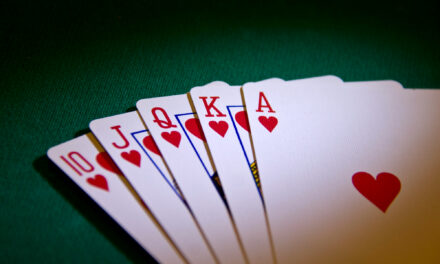
The best poker hand is a royal flush (A-K-Q-J-10 of one suit), followed by a straight flush and four of a kind. Before the flop in Texas Hold’em, the best starting hand is pocket aces, which wins about 85% of the time against one random hand, followed by pocket kings, pocket queens and ace-king. Best Poker Hands…
In brief
- Best made hands: royal flush, straight flush, four of a kind, full house, flush.
- Best starting hands: AA, KK, QQ, AK suited, JJ, AK offsuit.
- Best hand on a given board: “the nuts”, which changes with every card dealt.
- Pocket aces are a favorite, not a lock: they win about 56% of the time against four random hands.
- Hand strength is relative: a strong starting hand can become a weak made hand after the flop.
“What’s the best hand in poker?” has three correct answers, and players get into trouble when they mix them up. The best made hand is the strongest five-card combination at showdown, and the answer never changes: a royal flush. The best starting hand is the strongest pair of hole cards you can be dealt in Texas Hold’em, and the answer is pocket aces. The best hand right now, on the specific board in front of you, is called the nuts, and it can change with every card the dealer turns over.
This guide covers all three. It ranks the made hands and shows how often you’ll actually hold each one by the river. It ranks the strongest starting hands with win rates from our own simulations, shows how those win rates collapse when more players see the flop, and explains how to work out the nuts on any board. Every percentage in this article comes either from exact combinatorics or from TopSitesPoker.com simulations of at least 150,000 deals per hand, and each figure was checked against published reference values.
Key takeaways
- With seven cards to choose from, you’ll finish with one pair or better about 83% of the time. A flush or better happens only about 6% of the time.
- Pocket aces are dealt once every 221 hands on average. Any pocket pair comes once every 17 hands.
- Heads-up, pocket aces win about 85% against a random hand and about 82% against pocket kings. Against four opponents, they win about 56%.
- Suitedness adds about two percentage points of equity. Being dominated (sharing a card with a better hand, such as AQ against AK) costs far more.
- The nuts can move from a set to a straight flush in a single card. Re-check the board every street.
“Best” Means Three Different Things in Poker
Before any rankings, it helps to separate the three questions, because each one uses different information:
- Best made hand. This is about the final five cards at showdown. It depends only on the fixed hand-ranking order: royal flush at the top, high card at the bottom. It’s the same in every standard form of high-hand poker.
- Best starting hand. This is about your two hole cards before any community cards appear. It’s a question of probability: which two cards are most likely to end up as the best hand, and which are easiest to play well.
- Best hand on this board. This is the nuts: the strongest hand anyone could hold given the community cards dealt so far. A flush can be the nuts on one board and a losing hand on the next.
A useful way to think about it: starting-hand strength is a forecast, made-hand rankings are the scoring rules, and the nuts are the ceiling on the current board. Good decisions use all three.
The Best Made Hands, Ranked
A made hand is the best five-card combination you can form. In Texas Hold’em, you choose any five from your two hole cards and the five community cards: both hole cards, one, or none. The table below ranks every made hand and adds a column most ranking charts leave out: how often you actually finish with that hand when you see all seven cards.
| Rank | Hand | Example | Chance with 7 cards | Roughly 1 in |
|---|---|---|---|---|
| 1 | Royal flush | A♥ K♥ Q♥ J♥ 10♥ | 0.0032% | 30,940 |
| 2 | Straight flush | 8♣ 7♣ 6♣ 5♣ 4♣ | 0.028% | 3,590 |
| 3 | Four of a kind | 9♠ 9♥ 9♦ 9♣ K♠ | 0.17% | 595 |
| 4 | Full house | Q♠ Q♦ Q♣ 5♥ 5♠ | 2.60% | 38.5 |
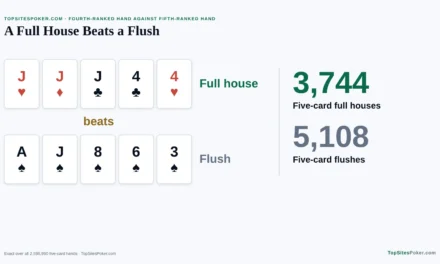
| 5 | Flush | A♦ J♦ 8♦ 6♦ 2♦ | 3.03% | 33 |
| 6 | Straight | 10♠ 9♥ 8♦ 7♣ 6♠ | 4.62% | 21.6 |
| 7 | Three of a kind | 7♥ 7♣ 7♦ A♠ 3♥ | 4.83% | 20.7 |
| 8 | Two pair | K♣ K♦ 4♠ 4♥ J♣ | 23.5% | 4.3 |
| 9 | One pair | J♠ J♦ A♣ 8♥ 3♠ | 43.8% | 2.3 |
| 10 | High card | A♠ Q♦ 9♣ 6♥ 4♠ | 17.4% | 5.7 |
Frequencies are exact values for the best five-card hand from seven random cards (133,784,560 possible combinations). They describe what you finish with if you see the river, not what you’re dealt.
Two things in that table surprise most new players. First, you finish with two pair more often than with no pair at all (23.5% against 17.4%). Seven cards give you a lot of chances to pair something. Second, the jump from “two pair” to “three of a kind or better” is enormous: everything from trips upward adds up to only about 15% of seven-card hands. That gap explains a basic truth of Hold’em: most pots are decided between one-pair and two-pair hands, and the difference between a good kicker and a bad one matters far more often than the difference between a flush and a full house.
Why the rankings are in this order
The ranking follows probability. The rarer a hand is, the higher it ranks. That’s why a flush beats a straight even though both use five cards, and why a full house beats a flush. With seven cards, straights (4.62%) are actually slightly less common than three of a kind (4.83%), yet trips still rank below a straight. The traditional ranking comes from five-card poker, where a straight is more than five times rarer than three of a kind (0.39% against 2.11% of five-card deals), and the order has never been changed for seven-card games. Short Deck poker is the one widespread exception: with the 2s through 5s removed, a flush becomes rarer than a full house, so the flush ranks higher.
Kickers and ties: when the same hand isn’t equal
Two players often make the same type of hand, and then the individual cards decide the pot. Only five cards ever count. When the hand type matches, compare the cards that make the hand first, then the remaining cards (the kickers) from highest to lowest. If all five cards match in rank, the pot is split. Suits never break a tie. These Hold’em examples show the situations that come up most:
| Board | Player A | Player B | Result | Why |
|---|---|---|---|---|
| Q♠ 8♦ 5♣ 3♥ 2♠ | Q♦ J♣ | Q♥ 10♦ | A wins | Same pair of queens; A’s jack kicker beats B’s ten |
| J♥ J♣ 7♦ 4♠ 2♥ | A♠ 3♦ | K♠ Q♦ | A wins | Both play the board’s jacks; A’s ace outkicks B’s king |
| A♠ K♦ 9♣ 9♥ 4♠ | A♦ 7♣ | A♣ Q♦ | Split | Both make aces and nines with the board’s king as kicker; neither 7 nor Q plays |
| 8♣ 8♦ 8♥ K♠ 5♦ | A♣ 2♦ | Q♠ Q♥ | B wins | A has trips with an ace kicker, but B’s pocket pair makes a full house |
| A♥ 9♥ 6♥ 3♣ 2♥ | K♥ 4♠ | Q♥ J♥ | A wins | Both have ace-high flushes; A’s second card (king) beats B’s (queen) |
| 9♦ 8♣ 7♠ 2♥ K♦ | J♥ 10♣ | 10♦ 6♠ | A wins | Jack-high straight beats ten-high straight |
| 5♠ 6♦ 7♣ 8♥ 9♠ | A♠ K♠ | 2♣ 2♦ | Split | The board is a straight; neither player can improve it |
The third row is the one to remember. A kicker only helps if it’s one of your best five cards. When the board already supplies a higher kicker, your “better” kicker doesn’t play, and hands that looked different split the pot.
The Nuts: The Best Possible Hand on This Board
A royal flush is the best hand in poker, but it’s almost never available. What matters at the table is the best hand possible given the community cards, called the nuts. If you hold the nuts on the river, you can’t lose the pot (at worst you split it with someone holding the same hand). Knowing what the nuts are also tells you how worried to be about your own hand: holding a flush when a full house is possible is different from holding a flush when it’s the best hand available.
You can find the nuts on any Hold’em board with the same short check, done in order. The first “yes” gives you the answer:
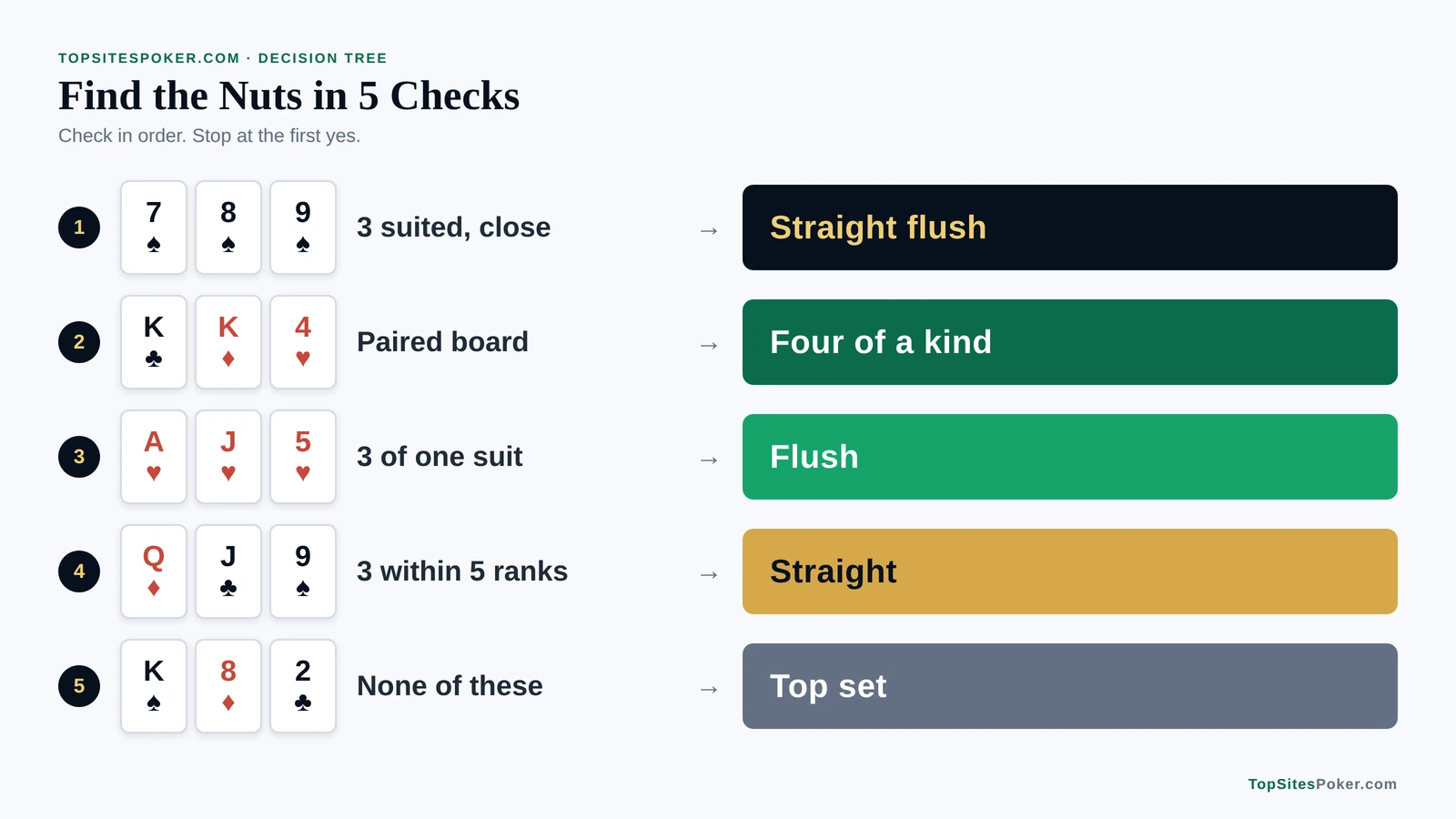
The order matters. A straight flush beats four of a kind, so you check for it first. For straights and straight flushes, remember that the ace also counts low, so 5-4-3-2-A is possible. A-4-3 on the board fits a five-rank window. A paired board makes four of a kind possible, and quads beat a flush, so the paired-board check comes before the flush check. If none of the four conditions apply, no straight, flush, full house or better is possible, and the nuts are three of a kind using the highest card on the board.
How the nuts change street by street
The nuts aren’t fixed for the whole hand. Each new card can create hands that weren’t possible before. Follow this board:
- Flop 9♠ 8♠ 2♦. No three suited cards, no pair, and no three cards within five ranks (9 and 8 are close, but the 2 is far away). The nuts are three nines: a pocket pair of nines making top set.
- Turn 7♠. Now there are three spades within five ranks (7♠ 8♠ 9♠). A straight flush is possible, and the nuts jump straight to J♠ 10♠, which makes a jack-high straight flush. Set of nines, the nuts one card ago, is now well behind the best possible hand.
- River 7♦. The board pairs, so four of a kind becomes possible (pocket sevens), but the straight flush still beats it. The nuts remain J♠ 10♠.
In practice, nobody holds the nuts that often, and you don’t need the nuts to bet. But knowing what the nuts are lets you judge whether your hand is near the top of what’s possible or several steps below it, which is the heart of relative hand strength.
Absolute and relative hand strength
A hand’s absolute strength is its place in the ranking table. Its relative strength is how it compares with what your opponents could have on this board. A flush is absolutely strong, but on a paired board with lots of betting, it can be relatively weak. One pair of aces is absolutely weak (one pair is the second-lowest hand), but on a dry board like A♣ 7♦ 2♠ with no straight or flush possibilities, top pair with a strong kicker is often the best hand at the table.
New players tend to judge hands by absolute strength (“I have a flush!”) while experienced players judge them relatively (“a flush on a paired board facing a raise”). Getting into the habit of asking “what could beat me, and is my opponent likely to have it?” is the single biggest step from knowing the rankings to playing hands well.
What the nuts usually are: board statistics
Running every possible board through the check above gives a clear picture of how the best possible hand shifts as cards are dealt. We applied the nuts check to all 22,100 possible flops, all 270,725 possible turn boards and all 2,598,960 possible five-card river boards:
| The nuts are… | On the flop | On the turn | On the river |
|---|---|---|---|
| A straight flush | 1.2% | 4.3% | 10.1% |
| Four of a kind | 17.2% | 31.5% | 45.2% |
| A flush | 4.0% | 10.3% | 15.0% |
| A straight | 17.4% | 32.6% | 27.9% |
| Three of a kind (top set) | 60.3% | 21.3% | 1.8% |
Exact counts over every possible board, calculated by TopSitesPoker.com. “Four of a kind” includes every paired board where no straight flush is possible.
The numbers explain a lot about how hands play out. On the flop, top set is the best possible hand about 60% of the time, so a set is usually at or near the top of what’s possible. By the river, a set is the nuts on fewer than 2% of boards: on about 98% of river boards, a straight or better is possible. That doesn’t mean someone has it. It means that as the board fills in, the gap between your hand and the best possible hand grows, and the betting has to tell you how likely it is that an opponent has closed it.
The same pattern shows why paired boards feel so awkward. On nearly half of all river boards (45.2%), the board is paired and four of a kind is the nuts. On those boards, full houses are possible too, and a flush or straight is no longer close to the top.
Flop textures: how often each type of flop appears
Players describe flops by “texture”: how many suits are showing, and whether the board is paired. Texture decides which draws are possible and how much your made hand is threatened. These are the exact frequencies for a random flop:
| Flop type | Example | How often | What it means for hand strength |
|---|---|---|---|
| Rainbow (three different suits) | K♠ 8♦ 3♣ | 39.8% | No flush possible yet. Made hands such as top pair are safer. |
| Two-tone (two cards of one suit) | K♥ 8♥ 3♣ | 55.1% | Flush draws are possible. Bet sizes often grow to charge them. |
| Monotone (three cards of one suit) | K♥ 8♥ 3♥ | 5.2% | A flush is already possible. One-pair hands lose a lot of value. |
| Paired | 9♠ 9♦ 4♣ | 16.9% | Full houses and quads are possible. Fewer hands connect, so bluffs work more often. |
| Three of a kind | 7♠ 7♦ 7♥ | 0.24% | Anyone holding the fourth 7 has quads. Pocket pairs make full houses. |
Suit and pairing are separate properties, so the rows overlap: a paired flop is either rainbow or two-tone, for example. The practical point is that nearly two flops in three (two-tone plus monotone, 60.2%) carry at least two cards of one suit, so flush draws are part of most hands you’ll play.
A Five-Step Process for Judging Your Hand
Rankings, the nuts and board texture come together in one routine you can run on every street. It takes a few seconds once it becomes habit, and it replaces the beginner’s question (“Is my hand good?”) with a more useful one (“How good is my hand here?”).
- Name your hand exactly. Not “a pair” but “top pair, queen kicker” or “second pair” or “a flush draw with two overcards.” Precision matters, because every later step compares your hand against specific alternatives.
- Find the nuts. Run the nuts check from the decision tree above. Now you know the ceiling.
- List the realistic hands that beat you. Between your hand and the nuts there’s a ladder of better hands. On K♥ 9♥ 4♣ with K-Q, you lose to K-K, 9-9, 4-4 (sets), K-9, K-4 and 9-4 (two pair) and A-K (better kicker). Write the list in your head.
- Ask whether your opponent would play those hands this way. A player who just called before the flop is less likely to hold A-K or K-K, which most players raise. A player who suddenly raises big on the turn is more likely to hold one of the hands on your list. This step is where hand strength becomes hand reading.
- If you’re behind, count your outs. A hand that’s losing now can still be worth continuing with if enough cards improve it and the price is right. Count the cards that give you a winning hand, and compare your chances with the size of the bet you have to call.
Beginners usually stop after step one. Players who go all the way through step five on every important decision make far fewer big mistakes with strong-looking hands like overpairs and top pair, which is where most losing players lose the most money.
The Best Starting Hands in Texas Hold’em
In Texas Hold’em you’re dealt two hole cards, and those two cards are the only thing you know before the flop. There are 1,326 possible two-card combinations, but many are equivalent: A♠ K♠ plays exactly like A♥ K♥ before the flop. Grouping equivalent hands leaves 169 distinct starting hands: 13 pocket pairs, 78 suited hands and 78 offsuit hands.
How often each type comes up depends on how many ways it can be dealt:
- A specific pocket pair (such as AA) can be dealt 6 ways, so you get it once every 221 hands on average.
- A specific suited hand (such as AK suited) can be dealt 4 ways: once every 331.5 hands.
- A specific offsuit hand (such as AK offsuit) can be dealt 12 ways: once every 110.5 hands.
- Any pocket pair comes once every 17 hands, and any two suited cards about 23.5% of the time.
That means ace-king (suited or not) is dealt more than twice as often as pocket aces, and four times as often as any single suited hand. It’s one reason AK is such an important hand to play well: you’ll hold it about once every 83 deals.
Top 15 starting hands
There’s no single official ranking of starting hands, because a hand’s value depends on position, stack sizes and opponents. The ranking below is a widely used beginner order. It weighs raw win rate together with how easy the hand is to play after the flop. The equity column shows how often each hand wins (ties counted as half a win) against one random hand if all five board cards are dealt, from our simulations of 300,000 deals per hand.
| Rank | Hand | Type | Ways to be dealt | Dealt about once every | Equity vs one random hand |
|---|---|---|---|---|---|
| 1 | A-A | Pocket pair | 6 | 221 hands | 85.3% |
| 2 | K-K | Pocket pair | 6 | 221 hands | 82.4% |
| 3 | Q-Q | Pocket pair | 6 | 221 hands | 79.9% |
| 4 | A-K suited | Suited | 4 | 332 hands | 67.1% |
| 5 | J-J | Pocket pair | 6 | 221 hands | 77.5% |
| 6 | A-K offsuit | Offsuit | 12 | 111 hands | 65.3% |
| 7 | A-Q suited | Suited | 4 | 332 hands | 66.3% |
| 8 | 10-10 | Pocket pair | 6 | 221 hands | 75.0% |
| 9 | A-J suited | Suited | 4 | 332 hands | 65.5% |
| 10 | K-Q suited | Suited | 4 | 332 hands | 63.4% |
| 11 | A-Q offsuit | Offsuit | 12 | 111 hands | 64.5% |
| 12 | 9-9 | Pocket pair | 6 | 221 hands | 72.0% |
| 13 | A-10 suited | Suited | 4 | 332 hands | 64.7% |
| 14 | K-J suited | Suited | 4 | 332 hands | 62.5% |
| 15 | Q-J suited | Suited | 4 | 332 hands | 60.4% |
Notice that the ranking isn’t sorted by equity. Pocket nines (72.0%) beat ace-king suited (67.1%) heads-up against a random hand, yet AK is ranked far higher. There are three reasons:
- AK makes the best version of the hands it makes. When AK pairs, it’s usually top pair with the best possible kicker. Pocket nines see at least one overcard (a 10 or higher) on about 79% of flops, and then they’re often a weak pair.
- AK blocks the best hands. Holding an ace and a king makes it less likely that anyone else holds AA, KK or AK.
- Heads-up equity against a random hand isn’t the real test. Hands that get raised and re-raised face strong ranges, not random ones. AK does well against the hands that stay in a big pot. Middle pairs often don’t.
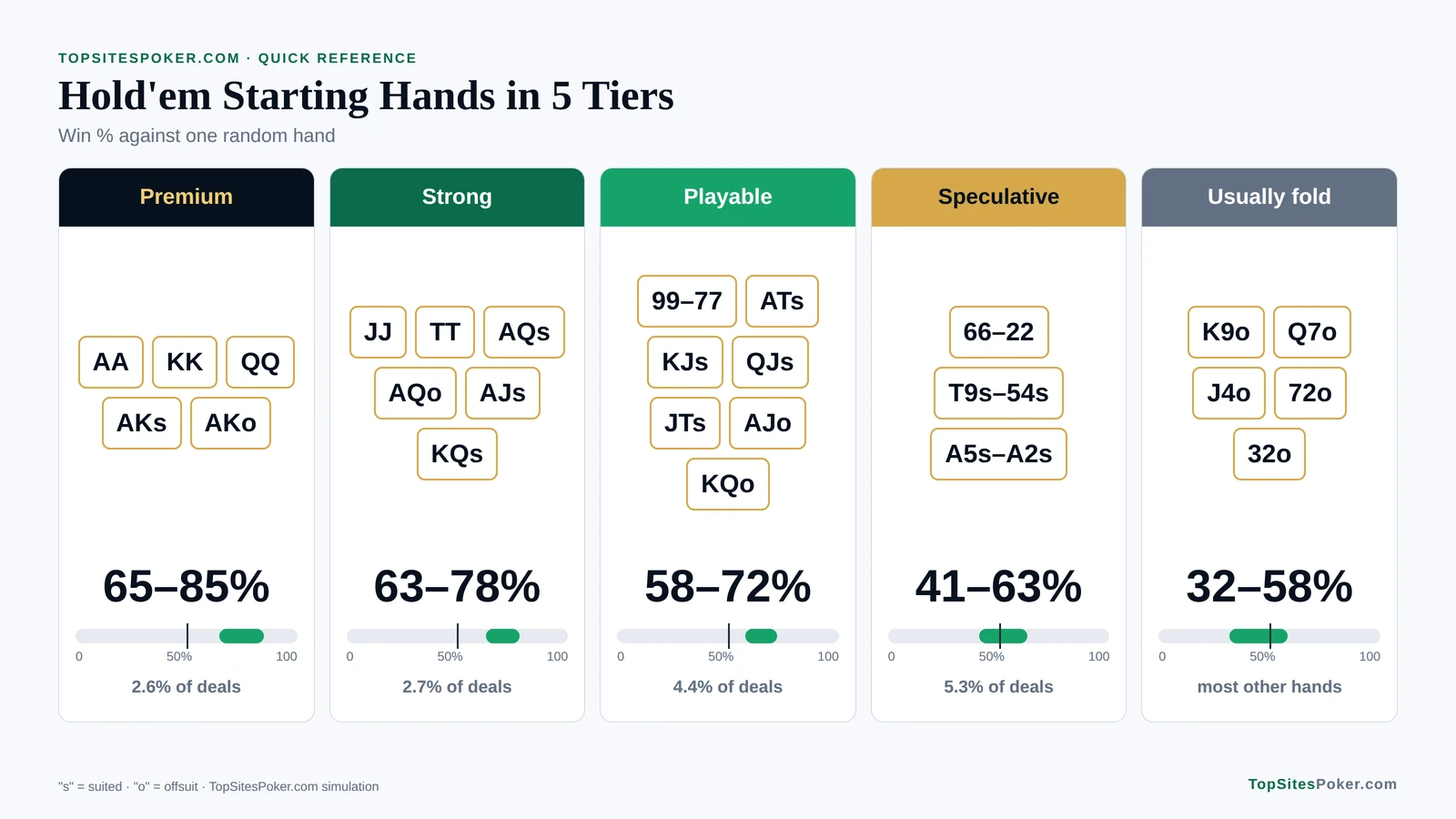
A five-tier starting-hand framework with equity ranges from our simulations. Tiers are a beginner guide. Real ranges widen in late position and tighten in early position.
What makes a starting hand strong
Every strong starting hand has some combination of four features:
- A pair. Pocket pairs start as made hands. Even 2-2 is a slight favorite (about 50.4%) against a random hand heads-up. And a pocket pair makes three of a kind or better on the flop about 12% of the time, a strong and well-disguised hand.
- High cards. High cards make high pairs, and high pairs win at showdown. They also serve as strong kickers.
- Suitedness. Two cards of the same suit can make a flush. It helps less than most beginners think: AK suited wins 67.1% against a random hand and AK offsuit 65.3%, a gap of under two percentage points. Suited cards flop a flush only 0.84% of the time and make one by the river about 6.4% of the time.
- Connectedness. Cards close in rank (such as J-10 or 7-6) can make straights. J-10 flops a straight about 1.3% of the time, rarely, but straights and flushes are the hands that win big pots from strong one-pair hands.
The best hands combine several features (AK suited has high cards, suitedness and connectedness). The worst hands have none: 7-2 offsuit is low, unsuited and too far apart to make a straight, and wins only about 34.5% of the time against a random hand. The single worst hand by that measure is 3-2 offsuit, at about 32.4%.
The hidden weakness: domination
The biggest danger for a starting hand isn’t low cards. It’s being dominated, meaning your hand shares a card with a better hand. A-Q against A-K is the classic example. If an ace comes, both players pair aces and the king kicker wins. A-Q can only win by catching a queen without a king, or by getting lucky with a straight or flush. The result is that A-Q wins only about 26% of the time against A-K, much worse than against a random hand.
That’s why offsuit hands like K-9, Q-7 or A-7 are poor starting hands in most situations, even though they contain a high card. They win a fair share against random hands (K-9 offsuit wins about 57.8%), but the hands that call a raise or bet into you are exactly the hands that dominate them: K-Q, K-J, A-K, A-Q. You’ll win small pots when you’re ahead and lose big ones when you’re dominated.
How position changes which hands are “best”
The same two cards can be a clear raise from one seat and a clear fold from another. The reason is simple arithmetic about who is left to act behind you. At a nine-handed table, the first player to act before the flop (under the gun) still has eight opponents waiting, so the chance that one of them holds a better hand is much higher than for the player on the button, who faces only the two blinds.
A quick calculation shows how big the difference is. Suppose you hold K-K. The only better starting hand is A-A, and with your two kings removed from the deck, each opponent holds A-A about 0.49% of the time (6 of the 1,225 possible hands). Only one player can hold both remaining aces at once, so the chances simply add up: facing eight opponents, someone has aces about 3.9% of the time. Facing two, it’s about 1%. For a weaker hand like A-J, the number of better hands (A-A, K-K, Q-Q, J-J, A-K, A-Q and others) is much larger, so its chance of running into a better hand grows much faster with every extra player behind you.
That’s why starting-hand charts are always position-based. From early position, most players stick to the top two or three tiers. From the cutoff and the button, the playable range widens to include more suited connectors, suited aces and broadway hands, because fewer players remain to wake up with something better, and you’ll act last on every street after the flop. The best hands in the table above stay the best from any seat. What changes is how far down the list you can go.
A beginner opening chart by position
The chart below gives simple, deliberately tight ranges for opening the pot with a raise when everyone before you has folded, at a full-ring (eight- or nine-handed) no-limit table. It’s a starting point for learning, not a solver output. Experienced players open wider, especially from the cutoff and button. The combination counts show exactly how selective each range is.
| Your position | Open-raise with | Hand types | Combinations | Share of all deals |
|---|---|---|---|---|
| Early (under the gun, UTG+1) | 7-7+, A-J suited+, K-Q suited, A-Q offsuit+ | 14 | 88 | 6.6% |
| Middle (middle position, hijack) | 5-5+, A-10 suited+, K-J suited+, Q-J suited, J-10 suited, A-J offsuit+, K-Q offsuit | 22 | 140 | 10.6% |
| Cutoff | 2-2+, any suited ace, K-9 suited+, Q-9 suited+, J-9 suited+, 10-9 suited, 9-8 suited, 8-7 suited, A-10 offsuit+, K-J offsuit+, Q-J offsuit | 44 | 258 | 19.5% |
| Button | 2-2+, any suited ace, K-5 suited+, Q-8 suited+, J-8 suited+, 10-8 suited+, 9-7 suited+, 8-6 suited+, 7-5 suited+, 6-5 suited, 5-4 suited, A-7 offsuit+, K-9 offsuit+, Q-9 offsuit+, J-9 offsuit+, 10-9 offsuit | 67 | 430 | 32.4% |
“7-7+” means 7-7 and every higher pair. “A-J suited+” means A-J, A-Q and A-K suited. Combination counts were calculated from each range. Blinds play differently and aren’t shown.
Two things stand out. First, the early-position range is mostly the top two tiers from the chart above: big pairs, big aces and K-Q suited. Second, the button range is about five times as wide as the early range (430 combinations against 88), which reflects the positional advantage described above. The button acts last on every street after the flop, and only the two blinds can wake up with a better hand before the flop. That’s also why the button range includes a few offsuit hands, such as K-9 and A-7, that are folds almost everywhere else: with only two players left to act, the risk of running into a dominating hand is small.
How many hands should you play?
If you follow the chart above at a nine-handed table, you’ll open roughly 6–7% of hands from the two earliest seats, about 11% from the middle, about 20% from the cutoff and about a third of hands from the button. Adding occasional calls and blind defense, a disciplined beginner ends up voluntarily playing somewhere around 15–20% of all hands dealt. At a six-handed table, where every seat is effectively later, that number rises.
A useful self-check is to count. Over your next 100 hands, note how many times you put money in the pot voluntarily (not counting forced blinds). If it’s 40 or 50, you’re playing far too many hands, and most of the extra ones are dominated offsuit hands and weak aces, exactly the hands in the bottom tier of the chart.
Why Pocket Aces Still Lose
Pocket aces are the best starting hand, but they’re a favorite, not a guarantee. Every extra opponent who sees the flop adds another hand that might outdraw you. The table below shows how often each hand wins as the number of opponents grows, assuming everyone sees all five board cards. The last row shows each player’s “fair share”, what an average hand would win.
| Hand | vs 1 opponent | vs 2 opponents | vs 4 opponents | vs 8 opponents |
|---|---|---|---|---|
| A-A | 85.3% | 73.5% | 56.0% | 34.5% |
| K-K | 82.4% | 68.8% | 49.9% | 29.1% |
| Q-Q | 79.9% | 64.8% | 44.7% | 25.0% |
| J-J | 77.5% | 61.0% | 40.2% | 21.8% |
| 10-10 | 75.0% | 57.4% | 36.2% | 19.1% |
| A-K suited | 67.1% | 50.8% | 35.4% | 22.4% |
| A-K offsuit | 65.3% | 48.2% | 32.3% | 19.0% |
| J-10 suited | 57.6% | 41.8% | 28.8% | 18.2% |
| 7-6 suited | 45.3% | 32.0% | 20.6% | 13.3% |
| 2-2 | 50.4% | 30.7% | 17.6% | 12.5% |
| Fair share | 50.0% | 33.3% | 20.0% | 11.1% |
TopSitesPoker.com simulation against random hands, 150,000 deals per cell (300,000 for the one-opponent column). Ties are counted as fractional wins.
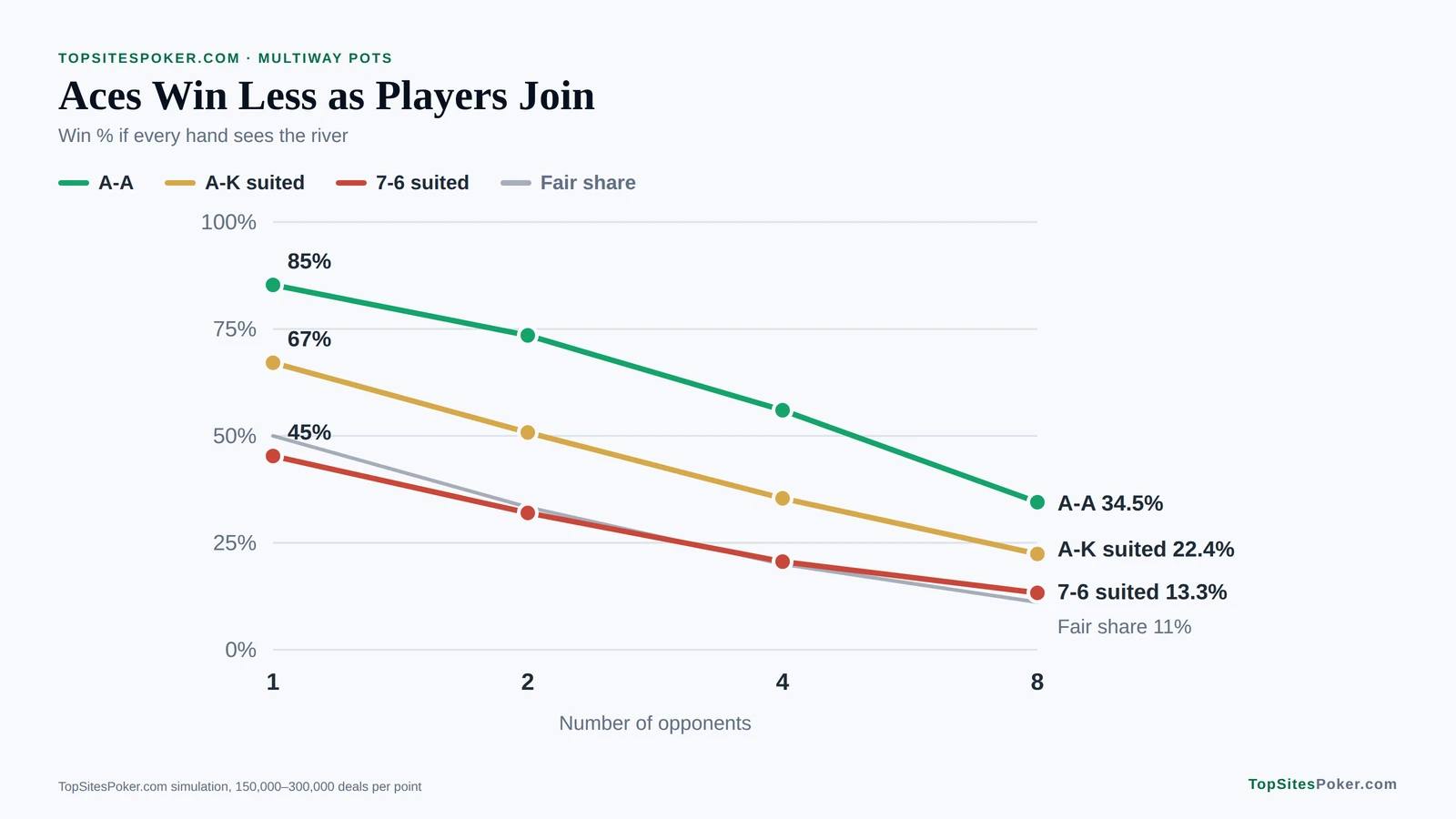
Pocket aces lose the most ground as players join. 7-6 suited ends above its fair share.
Three lessons come out of these numbers:
- Big pairs want fewer opponents. Pocket aces go from winning 85% of the time to 56% against four players. You still win far more than your fair share, but you’ll lose almost half the time. That’s why strong players raise with big pairs before the flop: raising charges the weaker hands to continue and thins the field.
- Pairs lose value fastest. Pocket jacks win more than ace-king against one opponent (77.5% against 65–67%), but against eight opponents ace-king suited edges ahead (22.4% against 21.8%). Medium pairs rarely improve and face more overcards, and more opponents means more chances that someone pairs one.
- Speculative hands hold up in crowded pots. 7-6 suited loses to a random hand heads-up (45.3%), yet against eight opponents it wins 13.3%, above its 11.1% fair share, because when it makes a straight or flush, it often wins a big multiway pot. That’s the reason suited connectors and small pairs are called speculative: they need a big pot to pay off.
Overcards: how often your pocket pair gets outflopped
Pocket pairs lose value as more opponents join for another reason too: overcards. An overcard is any flop card higher than your pair. It gives anyone holding that rank a bigger pair. Here’s how often at least one overcard lands on the flop for each pocket pair, calculated exactly from all 19,600 possible flops:
| Your pair | Overcards left in the deck | At least one overcard on the flop | Flop has no overcard |
|---|---|---|---|
| K-K | 4 (the aces) | 22.6% | 77.4% |
| Q-Q | 8 | 41.4% | 58.6% |
| J-J | 12 | 57.0% | 43.0% |
| 10-10 | 16 | 69.5% | 30.5% |
| 9-9 | 20 | 79.3% | 20.7% |
| 8-8 | 24 | 86.7% | 13.3% |
| 7-7 | 28 | 92.1% | 7.9% |
| 6-6 | 32 | 95.8% | 4.2% |
| 5-5 | 36 | 98.1% | 1.9% |
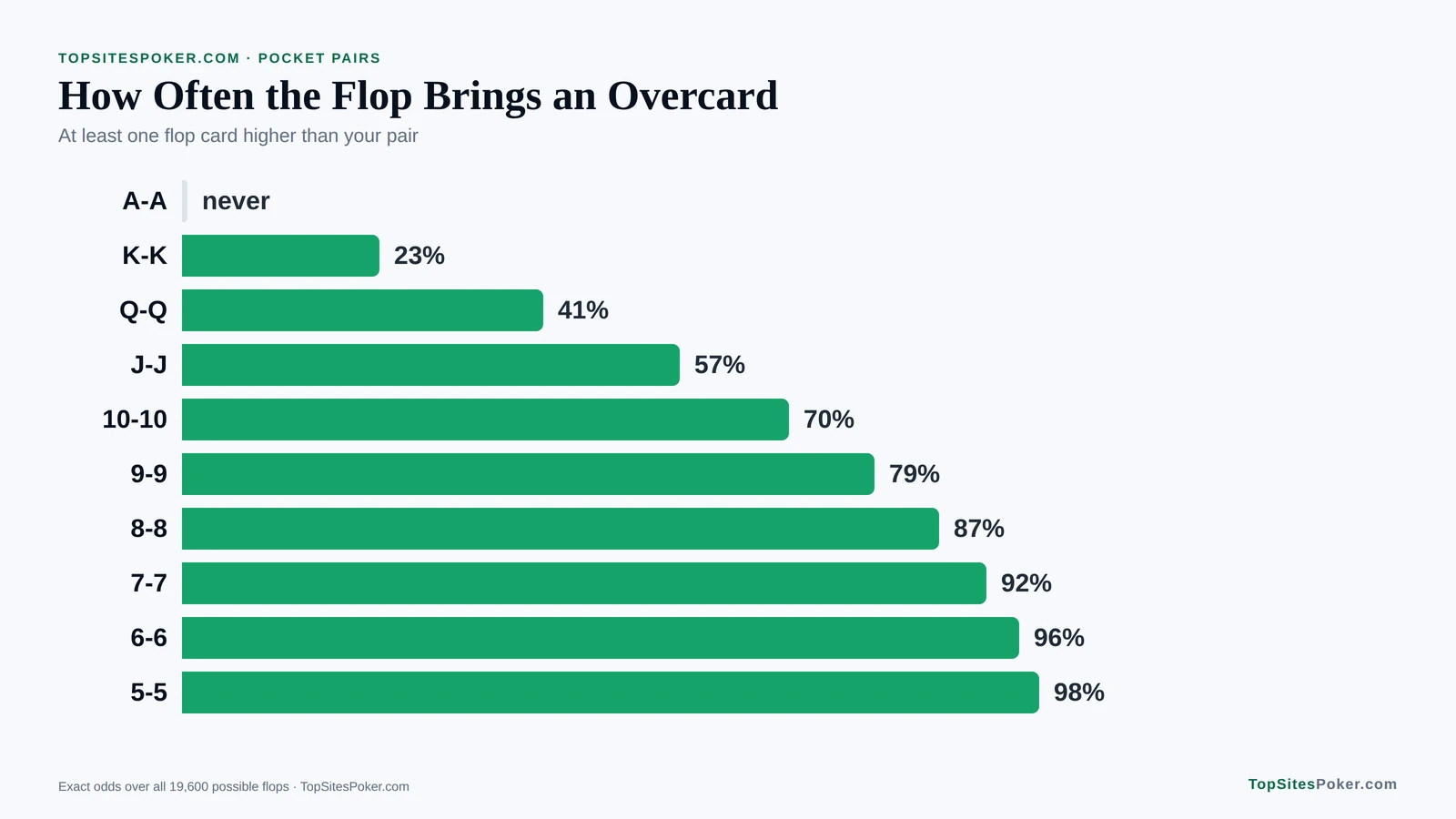
The lower your pair, the more often the flop puts a higher card on the board.
Pocket aces never face an overcard, and that’s a big part of why they’re the best starting hand. Pocket kings see an ace on the flop a little less than one time in four. From pocket jacks down, the flop brings an overcard more often than not. An overcard doesn’t mean you’re beaten, but against several opponents, someone often holds a card that pairs it. That’s why medium pairs are often played for their chance to make a set rather than as strong one-pair hands.
The same arithmetic works for unpaired hands. Ace-king fails to pair either card on the flop 67.6% of the time. Even the strongest unpaired starting hand is left with just ace-high about two times in three once the flop is dealt.
Classic Preflop Matchups
When two players get all their chips in before the flop, the result depends on a handful of recurring matchup types. Knowing roughly where you stand in each one helps you understand why some all-ins are big favorites and others are close to coin flips.
| Matchup | Type | Favorite wins | Underdog wins |
|---|---|---|---|
| A-A vs K-K | Higher pair vs lower pair | 82.0% | 18.0% |
| 8-8 vs 7-7 | Higher pair vs lower pair | 81.8% | 18.2% |
| A-A vs A-K suited | Pair dominates a shared card | 87.8% | 12.2% |
| K-K vs A-K offsuit | Pair vs one overcard | 69.9% | 30.1% |
| A-A vs 7-6 suited | Pair vs two lower cards | 77.5% | 22.5% |
| A-K offsuit vs A-Q offsuit | Domination (shared ace) | 74.4% | 25.6% |
| A-K offsuit vs K-Q offsuit | Domination (shared king) | 74.8% | 25.2% |
| 10-10 vs A-5 suited | Pair vs one overcard | 67.0% | 33.0% |
| Q-Q vs A-K offsuit | Pair vs two overcards | 56.8% | 43.2% |
| Q-Q vs A-K suited | Pair vs two suited overcards | 54.0% | 46.0% |
| 2-2 vs A-K offsuit | Small pair vs two overcards | 52.6% | 47.4% |
| A-K offsuit vs 7-6 suited | Two high cards vs two lower cards | 58.3% | 41.7% |
All-in before the flop, all five board cards dealt. Averaged over suit combinations in a TopSitesPoker.com simulation of 400,000 boards per matchup. Split pots are counted as half a win for each player.
The pattern is easy to remember. A higher pair against a lower pair is about 4-to-1. A pair against two overcards is close to a coin flip, which is why players call these situations “flips.” Domination, where both hands share a card, is roughly 3-to-1. Suitedness nudges each number by a few points, but it doesn’t change the basic shape.
Playing the Best Starting Hands Well
Being dealt a premium hand is only half the job. Premium hands win the most money when they’re played to build a pot while they’re ahead and to lose as little as possible on the occasions they’re not. These are the core habits for the three hands you’ll face most often.
Pocket aces and kings: raise, and keep raising
With A-A or K-K, the priority before the flop is getting money in and reducing the field. The multiway table above shows why: aces win 85% against one opponent but only 56% against four. So:
- Raise when you’re first in. Limping (just calling the big blind) with aces invites several players to see a cheap flop, which is exactly the situation where aces lose most often.
- Re-raise when someone has already raised. Players who raise have stronger ranges, and you’re ahead of nearly all of them. The re-raise builds the pot and usually leaves you heads-up.
- With kings, don’t fear aces before the flop. As the position section showed, even at a nine-handed table, someone holds aces only about 3.9% of the time when you have kings. Folding kings before the flop is almost always a mistake at typical stakes.
After the flop, big pairs play best on dry boards (for example K♠ 7♦ 2♣ when you hold aces), where few draws exist and your opponent’s one-pair hands will often pay you. They need more caution on coordinated boards (such as J♥ 10♥ 9♠) and when a single opponent suddenly shows strength on the turn or river. An overpair is still one pair. It’s the best one pair, but by the river on a wet board, it’s often not the best hand.
Ace-king: strong, but not a made hand
Ace-king wins its big pots in two ways: all-in before the flop against smaller pairs and weaker aces, and by making top pair with the best kicker. It needs a different approach from a pocket pair:
- Before the flop, raise and re-raise with it much like a big pair. It dominates A-Q, A-J, K-Q and K-J, which are exactly the hands that tend to call.
- After a miss (67.6% of flops), you have ace-high. Against one opponent, a single bet often wins the pot anyway, because your opponent has usually missed too. Against several opponents, or after a call and further action, ace-high rarely wins at showdown, so be ready to give up.
- After a hit, top pair with the best kicker is a strong hand on most boards and a good one to bet for value. It’s still one pair, though, so treat big raises on later streets with respect.
Pocket queens and jacks: strong, but vulnerable
Q-Q and J-J win more than any unpaired hand against a random opponent, but they face overcards on 41% and 57% of flops respectively. Before the flop, raise them. Against a large re-raise from a tight player, whose range is concentrated in A-A, K-K and A-K, their edge shrinks: queens are only about 57% against ace-king and around 18% against a bigger pair. After the flop, an ace or king in front of you doesn’t mean you must fold, but it does mean your hand has moved from “probably best” to “needs a closer look”. Run the five-step process.
How Often Your Starting Hand Improves
Starting-hand strength is really a question of what the hand can become. These are the key improvement odds, calculated exactly from every possible flop and board:
| Starting hand | What you’re hoping for | On the flop | By the river |
|---|---|---|---|
| Any pocket pair | Three of a kind or better | 12.0% (about 1 in 8.3) | 19.2% (at least one more card of your rank) |
| Two unpaired cards (such as A-K) | Pair at least one of your cards | 32.4% (about 1 in 3.1) | 48.7% |
| Two suited cards | A made flush | 0.84% (about 1 in 119) | 6.4% (about 1 in 16) |
| Two suited cards | A flush draw (two more of your suit) | 10.9% (about 1 in 9) | — |
| Connected cards (J-10 to 5-4) | A made straight | 1.3% (about 1 in 76) | — |
The practical takeaway: two unpaired cards miss the flop about two times out of three. If you raise with A-K and the flop comes 9-6-2, you haven’t done anything wrong, and you still have ace-high, but you also don’t have a made hand yet. Pocket pairs hit a set only about once every eight flops, so calling large bets with small pairs purely to hit a set only works when the pot you’ll win is large enough to pay for all the times you miss.
Best Hands in Other Poker Games
The hand rankings stay the same across most high-hand games, but the best starting hands change completely:
- Omaha: you get four hole cards and must use exactly two. The best starting hand is A-A-K-K double-suited (two aces and two kings in two suits, such as A♠ K♠ A♥ K♥), because it combines two premium pairs with two nut-flush draws, and every pair of its cards works together. Starting hands in Omaha run much closer in equity than in Hold’em, so pre-flop edges are smaller.
- Short Deck (6+): played with a 36-card deck. A flush beats a full house because flushes are rarer with fewer cards per suit. Some rule sets also rank three of a kind above a straight, so check the rules of the game you’re joining. Pocket aces are still the best starting hand, but connected hands gain value because straights are more common.
- Seven Card Stud: there are no community cards, and each player gets three cards to start (two down, one up). The best possible start is “rolled-up” trips, three of a kind in your first three cards, with three aces the strongest. Any rolled-up trips come only once every 425 deals (52 of the 22,100 possible three-card starts). Below that, big pairs, especially when their rank isn’t showing on other players’ upcards, and three cards to a flush or straight are the traditional strong starts. Because other players’ upcards are visible, a Stud hand’s value depends heavily on whether the cards you need are already out.
- Five-card draw: each player gets five private cards and can exchange some once. Going in, a pat hand (a straight or better dealt from the start) is the strongest, and a pair of jacks or better is the traditional minimum to open the betting in the classic “jacks or better” version.
- Lowball games: the goal is the lowest hand. In games like Razz (A-5 lowball), the best possible hand is 5-4-3-2-A, and straights and flushes don’t count against you. In 2-7 Triple Draw, aces are high and straights and flushes count, so the best hand is 7-5-4-3-2 in mixed suits.
How Stack Size and Table Size Change the Best Hands
The starting-hand rankings above assume a standard no-limit game with deep stacks and a full table. Change either condition and the order of the middle hands shifts noticeably, even though the very top stays the same.
Deep stacks favor hands that make big hands
When you and your opponent both have 100 big blinds or more, speculative hands such as small pairs and suited connectors gain value. The reason is implied odds: the money you can win on later streets when you hit. A pair of fives flops a set only about 12% of the time, so calling a raise with it loses money if you only ever win the pot as it stands. But when a set wins an opponent’s whole stack a meaningful share of the time, those rare hits pay for all the misses. Deep stacks make that possible.
Hands that make one pair and not much else, such as K-10 offsuit or Q-J offsuit, go the other way. With deep stacks, big pots tend to be won by two pair or better, and a strong one-pair hand is often second-best by the river.
Short stacks favor high cards
With a short stack (roughly 20 big blinds or fewer, common late in tournaments), there’s little money left to win after the flop, so implied odds largely disappear. Starting hands are judged more on raw equity, because the chips often go in before the flop or on the flop. High-card hands such as A-9, K-J and even A-5 offsuit gain value, because they win a solid share of all-in confrontations. Suited connectors lose most of theirs: 7-6 suited wins only about 45% against a random hand heads-up, and with no room to win extra chips when it hits, it has little going for it.
This is why tournament players with short stacks move all-in with hands like A-8 or K-Q offsuit that they might just call or fold with deep stacks, and why they fold small suited connectors they’d happily play in a deep cash game.
Short-handed and heads-up tables favor high cards too
With fewer players at the table, the blinds come around faster, you have to play more hands, and your opponents’ ranges are wider. Against a single random hand, many hands that are clear folds at a full table become favorites. From our simulations, K-9 offsuit wins about 57.8% of the time against a random hand, Q-7 offsuit about 51.8%, and any pocket pair, even 2-2, is a slight favorite. Weaker hands, such as J-4 offsuit (about 46.2%) and even 7-6 suited (about 45.3%), are underdogs to a random hand heads-up.
That’s why heads-up players raise a very wide range from the button, often most of their hands, and why they value any ace and any king much more highly than full-ring players do. The ranking of the very best hands doesn’t change, but the line between playable and unplayable moves a long way down the list.
What Hand Usually Wins at Showdown?
How good does a hand need to be to win? It depends heavily on how many players are in the pot. To show the effect, we dealt 200,000 random deals at each table size and let every hand run to the river without folding, then recorded the type of the winning hand. Real games are different, because players fold weak hands, but the baseline shows how quickly the winning standard rises with more opponents:
| Winning hand | 2 players | 6 players | 9 players |
|---|---|---|---|
| High card | 5.8% | under 0.1% | under 0.1% |
| One pair | 37.1% | 16.1% | 9.4% |
| Two pair | 31.6% | 30.5% | 24.6% |
| Three of a kind | 7.1% | 13.9% | 16.6% |
| Straight | 8.1% | 16.6% | 20.1% |
| Flush | 5.2% | 10.8% | 13.4% |
| Full house | 4.6% | 10.9% | 14.3% |
| Four of a kind or better | 0.4% | 1.1% | 1.5% |
TopSitesPoker.com simulation, 200,000 deals per column, every hand dealt to the river. Columns may not total exactly 100% because of rounding.
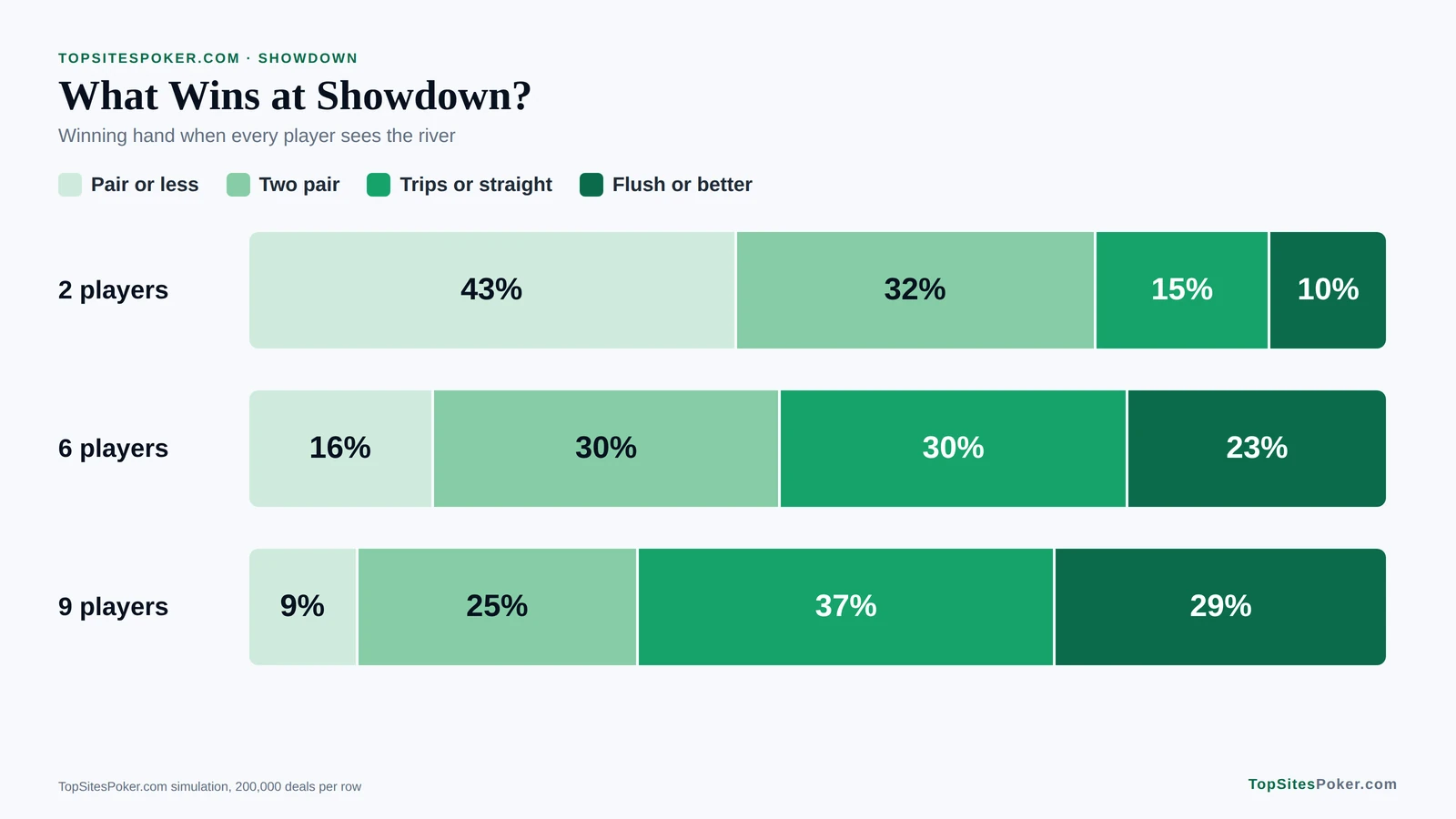
The more players reach the river, the stronger the hand it takes to win.
Heads-up, one pair or two pair wins about 69% of the time. At a full nine-handed table where everyone saw the river, the winning hand is three of a kind or better almost two times in three (about 66%). That’s the numerical version of the multiway lesson from earlier: the more players who see the flop, the less your one-pair hand is worth, and the more your hand’s ability to make straights, flushes and sets matters.
It also explains why the same hand can be played so differently in different spots. Top pair with a good kicker is a strong hand heads-up and often a weak one in a five-way pot. The hand hasn’t changed. The number of opponents who could beat it has.
How Rare the Best Hands Really Are
New players often underestimate how long they’ll wait for premium hands, and that impatience leads to playing weak ones. The arithmetic is worth seeing once:
- Pocket aces: dealt once every 221 hands on average. Over 100 hands, there’s a 63.5% chance you won’t see them at all. Over 300 hands, there’s still a 25.7% chance.
- Any premium hand (A-A, K-K, Q-Q or A-K, suited or offsuit): 34 of the 1,326 possible hands, or about 2.6%. You can expect about 2.6 of them per 100 hands, and there’s a 7.4% chance of going 100 hands without a single one.
- Pocket aces twice in a row: about 1 in 48,841.
In real time, the gap is even more noticeable. A live table deals roughly 30 hands per hour, so you’ll see pocket aces about once every seven and a half hours on average, and any premium hand about once every 80 minutes. Online, at around 80 hands per hour at a single table, aces come roughly every 2.8 hours. Knowing this makes it easier to fold the hundreds of mediocre hands in between without feeling you’re “missing out”. The waiting is part of the game, and the players who wait well are the ones whose premium hands get paid.
Myths About the Best Poker Hands
A handful of beliefs about strong hands are repeated at home games and low-stakes tables everywhere. Each one contains a grain of truth, which is why it survives, but the numbers tell a more useful story.
Myth: “Slow-play your aces to trap people”
Occasionally just calling with aces works, and it makes a great story when it does. As a habit, it costs money. Every extra opponent you let in cheaply cuts your winning chances: 85% against one player, 73.5% against two, 56% against four. Raising builds a pot while you’re a big favorite and keeps the field small. Save slow-playing for rare spots against specific opponents who are very likely to bet for you.
Myth: “When an ace flops, your kings are dead”
Not against a random hand. With K♠ K♥ on an A♦ 7♣ 2♠ flop, a random opponent holds an ace only about 12.5% of the time, and your kings still win about 79.7% of the time against a random hand (calculated exactly over every possible opponent hand, turn and river). The danger is real only because opponents who called a pre-flop raise hold aces far more often than a random hand does. The ace makes you more cautious. It doesn’t make you fold automatically.
Myth: “Any suited hand is worth playing”
Suitedness adds roughly two percentage points of equity (A-K suited 67.1% against A-K offsuit 65.3%, and the same gap for A-Q, A-J and K-Q). A suited hand makes a flush by the river only about 6.4% of the time, and when a weak suited hand does make a flush, it’s often not the best flush. Suitedness improves hands that are already playable. It doesn’t rescue hands that aren’t.
Myth: “A flush is almost always good”
A flush beats most hands, but the board decides how close it is to the top. On about half of all river boards (49.3%), the board is paired, which makes full houses and quads possible. On a paired board with heavy betting, a flush (especially a low one) is often behind. And with three cards of one suit on the board, a small flush can easily lose to a bigger one.
Myth: “The best starting hands win most of the pots”
Premium hands make up only about 2.6% of all deals. Most pots are won by ordinary hands (middle pairs, suited connectors that hit, top pair with a decent kicker) played well. Winning players separate themselves less by how they play aces, which nearly everyone plays reasonably, than by how they handle the medium-strength hands in the other 97% of deals, including folding many of them.
Common Mistakes About Hand Strength
Most of the money beginners lose doesn’t come from misreading the rankings. It comes from misjudging how strong a hand is in context. These are the mistakes that show up most often:
| Mistake | Why it costs you | Better approach |
|---|---|---|
| Playing any hand with an ace | Weak aces (A-7 offsuit and below) are often dominated by better aces and win small pots or lose big ones | Play suited small aces selectively; fold weak offsuit aces to raises |
| Playing any two suited cards | Suitedness adds only about two percentage points, and you make a flush by the river only about 6% of the time | Treat suitedness as a bonus on an already playable hand, not a reason to play |
| Treating pocket aces as unbeatable | Against four opponents they win only about 56% of the time | Raise before the flop to reduce the number of opponents |
| Falling in love with a big pair on a scary board | K-K on an A-high board, or any overpair on a four-straight board, is often behind | Re-check what beats you on every street, especially when facing heavy betting |
| Ignoring the kicker | Top pair with a weak kicker often loses to the same pair with a better kicker | Value hands like A-K and A-Q over A-9 and K-8 for exactly this reason |
| Forgetting that the board plays | A better kicker or second pair in your hand may not count if the board supplies better cards | Always build your best five cards, not your best two |
| Calling big bets with small pairs to “set mine” | You flop a set only about 12% of the time, so most calls lose | Only chase a set when the pot you can win is many times the price of calling |
| Confusing the best starting hand with the best hand now | Pre-flop strength is a forecast; after the flop, only your made hand and your draws matter | Re-rate your hand after every card using the nuts check |
Worked Examples
Example 1: Kings meet an ace
You hold K♠ K♥, the second-best starting hand, and raise before the flop. One player calls. The flop comes A♦ 7♣ 2♠. Nothing about your hand has changed, but its relative strength has dropped sharply. Your opponent called a raise, and hands that call raises often contain an ace (A-K, A-Q, A-J, A-10 suited). You beat almost every hand without an ace (only 7-7, 2-2 and 7-2 also beat you), and you lose to every hand with one. If your opponent bets heavily, the kings are often the second-best hand. The lesson: starting-hand rank tells you how you began, not where you stand.
Example 2: A draw worth more than a pair
You hold 7♥ 6♥ in a four-way pot. The flop comes 8♥ 5♣ 2♥. You have no pair, just seven-high. But you have an open-ended straight draw (any 4 or 9 gives you a straight) and a flush draw (any heart gives you a flush). Count your outs: nine hearts, plus three non-heart 4s and three non-heart 9s, for 15 cards. If you see both the turn and river, you complete at least one draw about 54% of the time (one minus the chance of missing twice: 1 − 32/47 × 31/46). On this flop, your “seven-high” is often a favorite over a single pair. The lesson: drawing hands can be stronger than they look, which is exactly why suited connectors gain value in multiway pots.
Example 3: When your kicker doesn’t play
You hold A♣ Q♦ and your opponent holds A♥ 8♠. The board runs out A♠ K♦ 9♣ 9♥ 4♠. You both have two pair, aces and nines. Your best five cards are A-A-9-9-K, and so are your opponent’s: the king on the board is a higher kicker than either your queen or their eight. The pot is split. If the last board card had been a 3 instead of a 4, the result would be the same, because the king would still play. If the board had no king, your queen would have won. The lesson: always build the best five cards from all seven, and check whether the board already gives everyone the same kicker.
Example 4: A set against a flush draw
You hold 8♠ 8♣ and your opponent holds A♥ Q♥. The flop is K♥ 8♥ 3♦. You’ve flopped a set of eights, an excellent hand. Your opponent has the nut flush draw: any of the nine remaining hearts gives them an ace-high flush. If all the chips go in on the flop, you win 74.4% of the time, calculated exactly over all 990 possible turn and river combinations. That’s well short of a sure thing, but it isn’t as bad as the nine outs suggest either, because your set has its own redraw: if the board pairs on the turn or river, you make a full house, which beats a flush.
If the turn is the 2♣ and the money goes in then, your edge grows to 84.1%. Your opponent now has one card to hit, and two of the nine hearts (3♥ and 2♥) would pair the board and give you a full house, so only seven cards win for them (7 of 44, about 15.9%). The lesson: even the second-best hand on the flop can have real equity, and “I had a set” isn’t the end of the calculation. Your set is a strong favorite, not a lock.
Example 5: Counterfeited
You hold 6♥ 5♥ and your opponent holds A♦ 6♦. The flop is 6♣ 5♠ 2♦. You have two pair, sixes and fives, against their top pair with an ace kicker, and you’re a 78.7% favorite to win by the river. The turn is the J♥ and the river is the J♠, so the final board is 6♣ 5♠ 2♦ J♥ J♠. Your best five cards are now J-J-6-6-5: two pair, jacks and sixes, with a five kicker. Your opponent’s best five are J-J-6-6-A: the same two pair with an ace kicker. They win.
Your fives were counterfeited: the board’s pair of jacks pushed your lower pair out of your best five cards, and your hand fell back to the same level as your opponent’s, where their ace kicker decides it. Counterfeiting mostly hurts small two-pair hands and low straights. The lesson: a hand that’s strong on the flop can lose its strength without the board ever looking scary, just by pairing above you.
Glossary: Hand-Strength Terms
| Term | Meaning |
|---|---|
| The nuts | The best possible hand given the current board. “Second nuts” is the second-best possible hand. |
| Premium hand | One of the strongest starting hands, usually A-A, K-K, Q-Q and A-K (sometimes J-J too). |
| Kicker | A card that isn’t part of your pair, two pair, trips or quads but is one of your best five cards. It breaks ties between equal hand types. |
| Domination | When your starting hand shares a card with a better hand, such as A-Q against A-K. The dominated hand wins only about one time in four. |
| Overpair | A pocket pair higher than every card on the board, such as Q-Q on a J-7-3 flop. |
| Top pair | A pair made with the highest card on the board, such as A-K on a K-9-4 flop. |
| Set | Three of a kind made with a pocket pair plus one matching board card. Harder for opponents to see coming than trips. |
| Trips | Three of a kind made with one hole card plus a pair on the board. |
| Draw | A hand that needs one or more cards to become a strong made hand, such as a flush draw or straight draw. |
| Outs | The unseen cards that improve your hand to the likely winner. |
| Counterfeited | When a board card makes your hand no better than an opponent’s by duplicating or overriding the cards that made yours strong. |
| Drawing dead | Having no cards left in the deck that can make you the winner. |
| Coin flip | An all-in close to 50/50, most often a pocket pair against two higher unpaired cards. |
| Suited connectors | Two consecutive cards of the same suit, such as 8♥ 7♥. Speculative hands that can make straights and flushes. |
| Broadway cards | Tens through aces, the cards that make up the highest straight (A-K-Q-J-10). |
| Speculative hand | A starting hand that rarely wins as it stands but can make a big hand, such as a small pair or suited connectors. |
Frequently Asked Questions
What is the best hand in poker?
A royal flush: A-K-Q-J-10 all of the same suit. It can’t be beaten, only tied, and in Hold’em a tie is only possible when the royal flush is entirely on the board. You’ll make one with seven cards only about once every 30,940 hands.
What is the best starting hand in Texas Hold’em?
Pocket aces (A-A). They win about 85% of the time against one random hand and about 82% against pocket kings, the second-best starting hand. You’re dealt them once every 221 hands on average.
What are the top 5 starting hands in Hold’em?
By the common beginner ranking: pocket aces, pocket kings, pocket queens, ace-king suited and pocket jacks. Ace-king offsuit is usually listed next. Rankings differ slightly between sources, because a hand’s value depends on position, stack sizes and opponents, not just raw equity.
Is ace-king better than pocket queens?
Not in an all-in before the flop: pocket queens win about 57% of the time against ace-king offsuit and about 54% against ace-king suited. But ace-king is easier to play in many situations, blocks pocket aces and kings, and is dealt more than twice as often, which is why the two are often ranked close together.
What is the worst starting hand in poker?
It depends on how many opponents you face. Against one random hand, 3-2 offsuit is the weakest, winning about 32.4% of the time, while 7-2 offsuit wins about 34.5%. At a full table the order flips: against eight opponents, 7-2 offsuit wins only about 5.3% of the time and 3-2 offsuit about 6.1%, because 3-2 can still make a wheel straight (A-2-3-4-5) while a 7 and a 2 are too far apart to make a straight together. That’s why 7-2 offsuit is usually called the worst hand in poker.
Does a flush beat a straight?
Yes. A flush beats a straight, and a full house beats a flush. The one widely played exception to the standard order is Short Deck poker, where a flush also beats a full house.
How often do pocket aces win?
About 85% of the time against one random hand, 73.5% against two, 56% against four and about 34.5% against eight, assuming everyone sees all five board cards. That’s why players raise with aces before the flop: fewer opponents means a much higher chance of winning.
What does “the nuts” mean?
The nuts are the best possible hand given the community cards on the board at that moment. To find them, check in order whether a straight flush is possible, whether the board is paired, whether three cards of one suit are showing, and whether three cards fall within five ranks of each other. If none apply, the nuts are three of a kind with the board’s highest card.
Are suited hands much better than offsuit hands?
Only slightly. Suitedness adds roughly two percentage points of equity against a random hand. Two suited cards flop a flush draw about 10.9% of the time and make a flush by the river about 6.4% of the time. It’s a useful bonus, not a reason to play an otherwise weak hand.
How often will I get pocket aces?
Once every 221 hands on average. Over 100 hands there’s roughly a 36.5% chance you’ll see them at least once. At a live table dealing about 30 hands an hour, that works out to about once every seven and a half hours.
What’s the difference between a set and trips?
Both are three of a kind. A set uses a pocket pair plus one matching card on the board, for example 8-8 on an 8-K-3 flop. Trips use one hole card plus a pair on the board, for example K-8 on an 8-8-3 flop. Sets are stronger in practice because they’re well hidden. When the board is paired, opponents know trips are possible, and a player with the same trips and a better kicker can beat you.
Should I always play pocket pairs?
No. Big pairs (roughly 10-10 and above) are strong in any position. Small and medium pairs are speculative: they flop a set only about 12% of the time, so they’re best played from later positions or when you can see a flop cheaply, with deep stacks behind so a set can win a big pot. In early position at a full table, many beginners do best folding the smallest pairs.
Is ace-king a made hand?
No. Before the flop, ace-king is just ace-high. It misses the flop, meaning it doesn’t pair either card, about 67.6% of the time. Its strength comes from how often it makes top pair with the best kicker, and from how well it does in all-in confrontations against smaller pairs and weaker aces.
What’s the best hand in Omaha?
For starting hands, A-A-K-K double-suited, meaning the two aces and two kings are split across two suits (such as A♠ K♠ A♥ K♥). The made-hand rankings are the same as in Hold’em, but you must use exactly two of your four hole cards and exactly three board cards, so a flush or straight always needs two of your own cards.
About This Guide
Made-hand frequencies are exact values for the best five-card hand from seven cards, drawn from all 133,784,560 possible seven-card combinations. Flop and river improvement odds, overcard frequencies, flop textures and the “what are the nuts” statistics were calculated exactly, by enumerating every possible flop, turn and river board. The set-against-flush-draw, counterfeit and kings-on-an-ace-flop examples were also calculated exactly over every remaining card combination, using an open-source hand evaluator. The showdown table comes from 200,000 simulated deals per table size, and the position chart’s combination counts were computed directly from each range. Starting-hand equities come from TopSitesPoker.com Monte Carlo simulations: 300,000 deals per hand heads-up, 150,000 per hand for multiway figures and 400,000 boards per head-to-head matchup, with ties counted as fractional wins. All results were cross-checked against published reference equities and agree within a few tenths of a percentage point. Figures are rounded, and simulated equities can differ by about ±0.2 points between runs. This guide is reviewed every 6 to 12 months.
Poker involves real financial risk, and no starting hand guarantees a win. Play only with money you can afford to lose, and set limits before you sit down. If gambling stops being fun or starts causing problems, support is available: in the U.S., the national problem gambling helpline is 1-800-MY-RESET (1-800-697-3738), available by phone, text or chat.
The Bottom Line
The best poker hand is a royal flush, the best starting hand is pocket aces, and the best hand on any board is the nuts, and each answer serves a different decision. Use starting-hand strength to decide which hands to play, the hand rankings to score what you’ve made, and the nuts check to judge where your hand stands on every street. The numbers behind them all point the same way: strong starting hands win more often, but none wins often enough to play on autopilot. Good players keep re-rating their hand as the board changes.