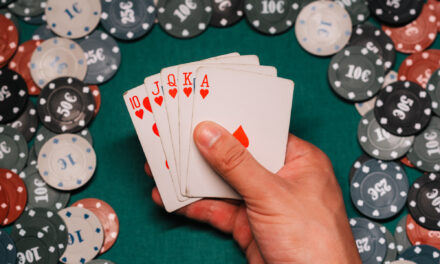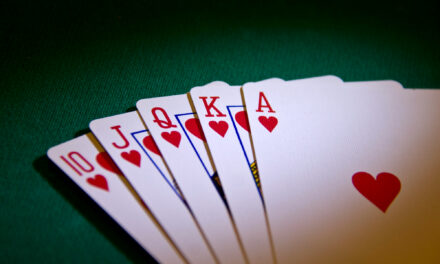
Poker hand rankings are the fixed order that decides which five-card hand wins: royal flush, straight flush, four of a kind, full house, flush, straight, three of a kind, two pair, one pair and high card. The rarer the hand, the higher it ranks. Within the same rank, the higher cards win.
The rankings in brief
- There are ten hand ranks and 7,462 distinct hand strengths in total.
- Every hand of a higher rank beats every hand of a lower rank.
- Inside a rank, compare the cards that make the hand, then the kickers.
- Suits never rank. Identical hands in different suits split the pot.
- Low games, hi-lo games and Short Deck use modified rankings.
Every poker player learns the ten hand ranks in their first hour at the table. Far fewer know the ranking system in full: how a queen-high flush compares with a king-high one, why the wheel is the lowest straight, where a pair of aces actually sits among all possible hands, how the 169 starting hands in Texas Hold’em rank against each other, and why lowball and Short Deck players use different lists altogether. This guide covers the whole system.
It starts with the official ranking and the logic behind it, then goes rank by rank through how hands are ordered inside each category, which is where most real pots are decided. After that come the numbers: where every type of hand sits among all 2,598,960 possible five-card hands, the full ranking of all 169 Hold’em starting hands from our own simulations, and the ranking systems used in lowball, hi-lo and Short Deck games. Every figure was either counted exactly over every possible hand or simulated over tens of thousands to a million deals, and the guide says which.
Key takeaways
- Half of all five-card hands are “high card.” The lowest pair, 2-2-5-4-3, already beats 50.1% of all possible five-card hands, and the weakest pair of aces beats 89.1%.
- Straights have only 10 distinct strengths and flushes have 1,277, which is why straights tie often and flushes almost never do.
- With seven cards, 39% of all flushes are ace-high, and the ace-high straight is the most common straight.
- Pocket aces top the ranking of the 169 Hold’em starting hands, winning 85.2% heads-up; 3-2 offsuit is last at 32.4%.
- Short Deck rule sets disagree about three of a kind versus a straight, and the odds show why the question is debatable: the answer flips between five-card and seven-card counts.
The Official Poker Hand Ranking
This is the ranking used in every standard high-hand poker game: Texas Hold’em, Omaha, Seven Card Stud, five-card draw and almost every home game. Any hand beats every hand below it on the list, regardless of the individual cards.
| Rank | Hand | What it is | Highest possible | Lowest possible | Distinct strengths |
|---|---|---|---|---|---|
| 1 | Royal flush | A-K-Q-J-10 of one suit | — | — | 1 |
| 2 | Straight flush | Five in sequence, one suit | K-Q-J-10-9 suited | 5-4-3-2-A suited | 9 |
| 3 | Four of a kind | Four cards of one rank | A-A-A-A-K | 2-2-2-2-3 | 156 |
| 4 | Full house | Three of a kind plus a pair | A-A-A-K-K | 2-2-2-3-3 | 156 |
| 5 | Flush | Five of one suit, not in sequence | A-K-Q-J-9 suited | 7-5-4-3-2 suited | 1,277 |
| 6 | Straight | Five in sequence, mixed suits | A-K-Q-J-10 | 5-4-3-2-A | 10 |
| 7 | Three of a kind | Three cards of one rank | A-A-A-K-Q | 2-2-2-4-3 | 858 |
| 8 | Two pair | Two different pairs | A-A-K-K-Q | 3-3-2-2-4 | 858 |
| 9 | One pair | Two cards of one rank | A-A-K-Q-J | 2-2-5-4-3 | 2,860 |
| 10 | High card | None of the above | A-K-Q-J-9 mixed suits | 7-5-4-3-2 mixed suits | 1,277 |
Distinct strengths counted by TopSitesPoker.com with a full enumeration of all 2,598,960 five-card hands. Together they make 7,462 steps from the royal flush to 7-5-4-3-2.
The rule behind the order
The ranking follows one principle: the fewer ways a hand can be made in five cards, the higher it ranks. There are 4 royal flushes, 36 other straight flushes, 624 four-of-a-kind hands, 3,744 full houses, 5,108 flushes, 10,200 straights, 54,912 three-of-a-kind hands, 123,552 two-pair hands, 1,098,240 one-pair hands and 1,302,540 high-card hands. Read that list and the ranking is simply the order from rarest to most common.
Two consequences of that principle surprise many players. First, a flush ranks above a straight because five cards of one suit are about twice as hard to get as five in a row. Second, the full house ranks above the flush even though both feel like “big” hands: with five cards, a flush is roughly 1.4 times as common as a full house. The order isn’t tradition or taste. It’s arithmetic.
Three rules that sit on top of the order
- Only five cards count. Whatever game you play, your hand is the best five cards available to you. A sixth card never counts, not even to break a tie.
- Suits have no rank. A spade flush and a heart flush with the same five ranks are equal. Suits only matter in a few procedural situations, such as drawing for the dealer button, and never decide who wins a pot.
- The ace plays high, except in one place. The ace is the highest card in every hand except the five-high straight and straight flush (5-4-3-2-A), where it plays as a one. It can’t be high and low at once, so Q-K-A-2-3 isn’t a straight.
Every Rank in Detail: What Makes One Hand Higher Than Another
Knowing that a flush beats a straight settles the easy showdowns. The hard ones happen inside a single rank: two flushes, two straights, two pairs of kings. This section goes through the ten ranks one at a time and explains how hands are ordered within each one, how many versions exist, what they’re called, and where the edge cases hide.
1. Royal flush: the single top hand
A royal flush is A-K-Q-J-10 of one suit. There are exactly four, one per suit, and they’re all equal: a royal flush in spades doesn’t beat one in hearts. Formally, the royal flush is the highest straight flush rather than a separate rank, and some rulebooks list it that way. Most players and most charts give it its own line because it’s the one hand that can never lose.
There’s no internal ordering to learn. The only question a royal flush raises at the table is whether it’s shared: in Hold’em, two players can both have a royal flush only when all five of its cards are on the board, in which case every remaining player splits the pot.
2. Straight flush: nine steps, ordered by the top card
A straight flush is five cards in sequence, all of one suit. Below the royal flush there are nine distinct straight flushes, from K-Q-J-10-9 (king-high) down to 5-4-3-2-A (five-high), each possible in four suits, for 36 in total.
- Ordering: by the highest card only. A nine-high straight flush beats an eight-high one. Because every card in a straight flush is part of the hand, there are no kickers.
- The lowest one: 5-4-3-2-A of one suit, the “steel wheel.” The ace plays as a one here, so this is the bottom of the category, not the top.
- Naming: by the top card: “a queen-high straight flush,” “a steel wheel.”
- Ties: two straight flushes with the same top card split the pot. In Hold’em, that can only happen when the board supplies enough of the hand for both players.
3. Four of a kind: 13 ranks, then the kicker
Four of a kind (quads) is four cards of one rank plus a fifth card, the kicker. There are 13 possible ranks for the four and 12 possible ranks for the kicker, giving 156 distinct strengths and 624 five-card hands.
- Ordering: by the rank of the four first. Four aces beat four kings, whatever the kickers. Only when two players have the same four of a kind does the kicker decide.
- When the kicker matters: in Hold’em, only when all four cards are on the board. Then everyone has the same quads, and the highest fifth card, from a player’s hand or the board, wins. If the board’s fifth card is the highest possible kicker, every remaining player splits.
- Highest and lowest: A-A-A-A-K at the top, 2-2-2-2-3 at the bottom. The lowest four of a kind still beats every full house.
- Naming: “quad nines,” “four jacks.”
4. Full house: the three of a kind comes first
A full house is three cards of one rank plus two of another. With 13 ranks for the three and 12 for the pair, there are 156 distinct full houses and 3,744 five-card hands.
- Ordering: by the three of a kind first, then by the pair. Kings full of twos (K-K-K-2-2) beats queens full of aces (Q-Q-Q-A-A). This single rule settles more full-house disputes than any other.
- Naming: “[three] full of [pair].” J-J-J-4-4 is “jacks full of fours” or “jacks full.” Players also call a full house a “boat.”
- Highest and lowest: aces full of kings (A-A-A-K-K) at the top, twos full of threes (2-2-2-3-3) at the bottom.
- When the pair decides: only when two players share the same three of a kind. In Hold’em, that means the board supplies at least two of the three cards. On a board of K-K-K-7-2, a player holding 7-x has kings full of sevens, a player holding a pocket pair of nines has kings full of nines, and the nines win.
- Hidden trap: with seven cards, you can hold two sets of three (for example, 8-8-8 and 5-5-5). Your best full house uses the higher three and a pair from the lower three: eights full of fives.
5. Flush: all five cards count, in order
A flush is any five cards of one suit that aren’t in sequence. Flushes have 1,277 distinct strengths, as many as high-card hands and more than any other rank except one pair. Each is possible in four suits, for 5,108 hands.
- Ordering: compare the highest cards; if they’re equal, compare the second-highest, and so on through all five. A-J-9-6-3 beats A-J-9-5-4 on the fourth card.
- Highest and lowest: A-K-Q-J-9 of one suit at the top (A-K-Q-J-10 would be a royal flush). 7-5-4-3-2 of one suit at the bottom (6-5-4-3-2 would be a straight flush).
- Ace-high flushes dominate: 493 of the 1,277 flush rank patterns include an ace, about 38.6%. In seven-card games the share is almost the same: across all 133,784,560 seven-card combinations, 39.2% of all flushes are ace-high, 25.9% king-high and 16.3% queen-high. Fewer than one flush in five (18.7%) is jack-high or lower.
- The nut flush: the best possible flush on a given board contains the highest card of the suit that isn’t on the board. When the ace of the suit is showing, the king becomes the nut-flush card.
- Ties: rare, because all five ranks have to match. In Hold’em, they happen mostly when four or five flush cards are on the board.
6. Straight: ten steps, the ace at both ends
A straight is five cards in sequence in at least two suits. There are only ten distinct straights, from 5-4-3-2-A (the wheel) to A-K-Q-J-10 (Broadway), and each can be made 1,020 ways in five cards, for 10,200 in total.
- Ordering: by the top card only. A jack-high straight beats a ten-high straight. There are no kickers.
- The ace: it’s the top card of Broadway and the bottom card of the wheel. The wheel’s top card is the five, so it’s the lowest straight. Q-K-A-2-3 and K-A-2-3-4 aren’t straights at all.
- Which straights you’ll actually see: across all 133,784,560 seven-card combinations, the ace-high straight is the most common, at 12.1% of all straights, while each of the other nine makes up exactly the same share, 9.8%. Broadway gets a boost because it can’t be extended. When seven cards contain six in a row, such as 8-9-10-J-Q-K, the higher straight is the one that counts, so every other straight loses some hands to the straight one step above it. Nothing sits above Broadway, so it loses none.
- Ties: common, because there are so few distinct straights. In Hold’em, showdowns won with a straight end in a split more often than those won with any other hand from one pair up, because the board so often supplies most of the sequence.
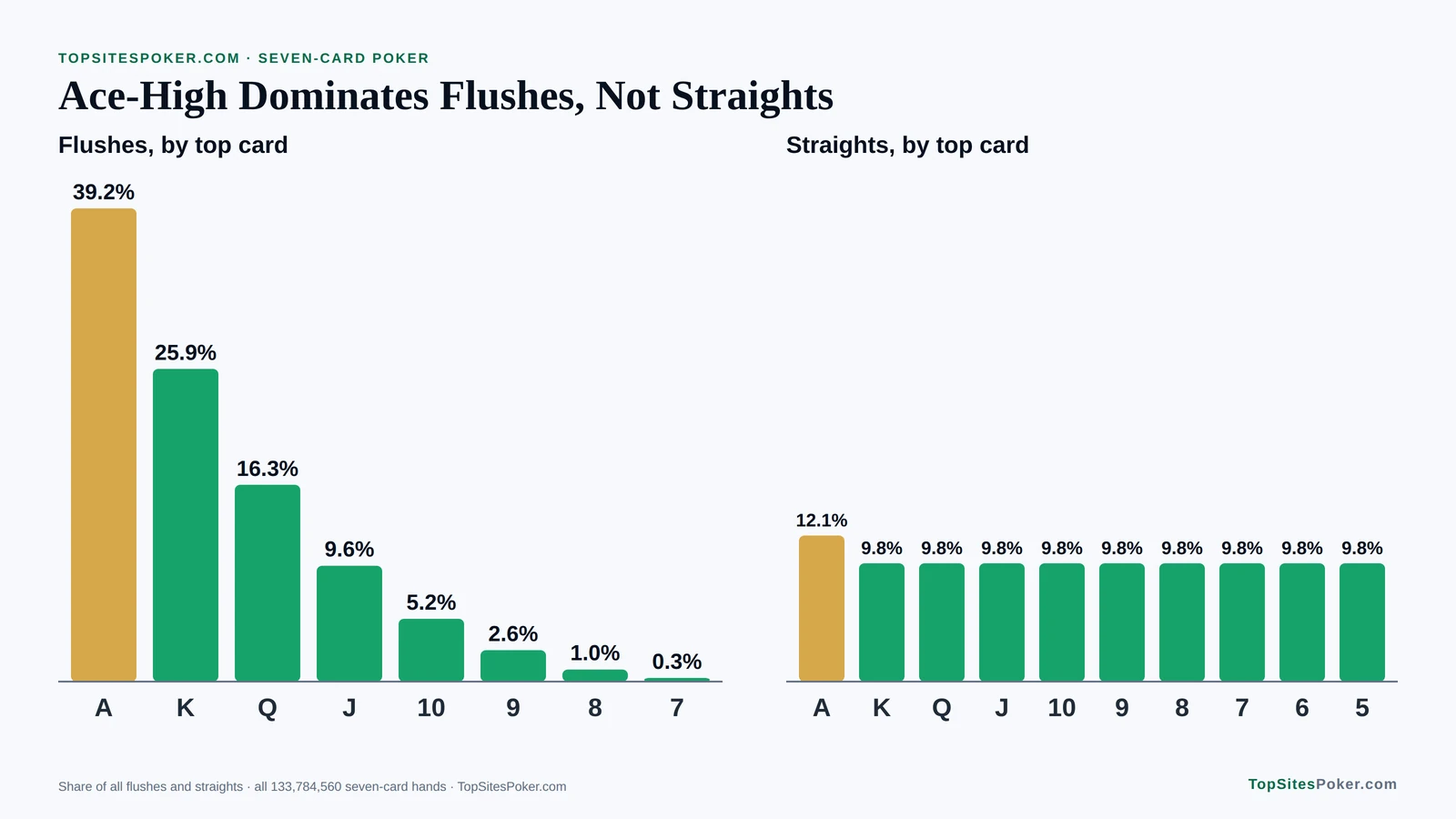
Across all seven-card hands, ace-high flushes make up 39.2% of all flushes, but straights are spread almost evenly.
7. Three of a kind: the three, then two kickers
Three of a kind is three cards of one rank plus two unrelated cards. There are 858 distinct strengths (13 ranks for the three, times 66 combinations of two different kicker ranks) and 54,912 five-card hands.
- Ordering: by the rank of the three, then the higher kicker, then the lower kicker. 7-7-7-A-4 beats 7-7-7-K-Q.
- Highest and lowest: A-A-A-K-Q at the top, 2-2-2-4-3 at the bottom.
- Set or trips: Hold’em players distinguish a set (a pocket pair plus one matching board card) from trips (one hole card plus a pair on the board). They rank identically. The difference is practical: with trips, other players can hold the same three of a kind, so the kickers often decide the pot.
- Where it sits: the weakest possible three of a kind beats 97.1% of all five-card hands.
8. Two pair: top pair, bottom pair, kicker
Two pair is two cards of one rank, two of another and one unrelated card. There are 858 distinct strengths (78 combinations of two pair ranks, times 11 kickers) and 123,552 five-card hands.
- Ordering: by the higher pair, then the lower pair, then the kicker. Aces and threes (A-A-3-3-x) beats kings and queens (K-K-Q-Q-x), because the higher pair is compared first.
- Naming: by both pairs, higher first (“jacks and fours”) or by the top pair (“jacks up”).
- Highest and lowest: A-A-K-K-Q at the top, 3-3-2-2-4 at the bottom.
- “Aces up” is common: 132 of the 858 two-pair strengths have aces as the higher pair, about 15%.
- Three pairs in seven cards: only the two highest pairs count. The fifth card is the highest remaining card, which may come from the third pair.
9. One pair: the most varied rank of all
One pair is two cards of one rank plus three unrelated cards. It has more distinct strengths than any other rank: 2,860 (13 ranks times 220 combinations of three kicker ranks), and 1,098,240 five-card hands.
- Ordering: by the rank of the pair, then the three kickers from highest to lowest. K-K-Q-9-4 beats K-K-J-10-9 on the first kicker.
- Highest and lowest: A-A-K-Q-J at the top, 2-2-5-4-3 at the bottom.
- Where pairs sit: the lowest possible pair beats 50.1% of all five-card hands, because every high-card hand is below it. The weakest pair of aces (A-A-4-3-2) beats 89.1%, and the best possible pair (A-A-K-Q-J) beats 92.4%.
- Why kickers matter here most: one pair is the most common final hand in Hold’em, and most of its 2,860 versions differ only in their kickers. A large share of real pots between two one-pair hands is decided by the first or second kicker.
10. High card: five cards, compared one by one
A high-card hand has no pair, no straight and no flush. It has 1,277 distinct strengths, the same rank patterns as flushes but in mixed suits, and it’s the most common five-card hand: 1,302,540 of the 2,598,960 possible deals.
- Ordering: highest card first, then the next, through all five. A-Q-8-6-2 beats A-Q-8-5-4.
- Highest and lowest: A-K-Q-J-9 at the top, 7-5-4-3-2 at the bottom. The latter is the worst possible hand in high poker.
- Where they sit: the best queen-high hand beats about 17.8% of five-card hands, and the best king-high hand about 30.7%. Ace-high hands cover a huge range, from 30.8% for A-6-4-3-2 to 50.1% for A-K-Q-J-9, because about 19% of all five-card deals are ace-high.
- In Hold’em: high card is the final hand only about 17% of the time, but when two players both miss, ace-high often wins the pot.
The 7,462-Step Ladder: Every Hand Has a Number
Put the ten ranks and all their internal ordering together, and you get a single ladder with 7,462 rungs. Every possible five-card poker hand sits on exactly one rung, and any two hands on the same rung are equal. Rung 1 is the royal flush. Rung 7,462 is 7-5-4-3-2 in mixed suits. Many poker hand evaluators are built on this 7,462-class ladder, numbered in one direction or the other, and knowing its shape explains a lot about how the ranking works.
We built the ladder by evaluating all 2,598,960 five-card hands and sorting the distinct results. These are the positions of the landmark hands:
| Rung | Hand | What it is | Five-card hands that beat it |
|---|---|---|---|
| 1 | A-K-Q-J-10 suited | Royal flush | 0 |
| 2 | K-Q-J-10-9 suited | Best non-royal straight flush | 4 |
| 10 | 5-4-3-2-A suited | Lowest straight flush (steel wheel) | 36 |
| 11 | A-A-A-A-K | Best four of a kind | 40 |
| 166 | 2-2-2-2-3 | Lowest four of a kind | 660 |
| 167 | A-A-A-K-K | Best full house | 664 |
| 322 | 2-2-2-3-3 | Lowest full house | 4,384 |
| 323 | A-K-Q-J-9 suited | Best flush | 4,408 |
| 815 | A-6-4-3-2 suited | Lowest ace-high flush | 6,376 |
| 816 | K-Q-J-10-8 suited | Best king-high flush | 6,380 |
| 1,599 | 7-5-4-3-2 suited | Lowest flush | 9,512 |
| 1,600 | A-K-Q-J-10 | Best straight (Broadway) | 9,516 |
| 1,609 | 5-4-3-2-A | Lowest straight (the wheel) | 18,696 |
| 1,610 | A-A-A-K-Q | Best three of a kind | 19,716 |
| 2,467 | 2-2-2-4-3 | Lowest three of a kind | 74,564 |
| 2,468 | A-A-K-K-Q | Best two pair | 74,628 |
| 3,325 | 3-3-2-2-4 | Lowest two pair | 198,036 |
| 3,326 | A-A-K-Q-J | Best one pair | 198,180 |
| 3,545 | A-A-4-3-2 | Lowest pair of aces | 282,276 |
| 4,205 | J-J-4-3-2 | Lowest pair of jacks | 535,716 |
| 6,185 | 2-2-5-4-3 | Lowest one pair | 1,296,036 |
| 6,186 | A-K-Q-J-9 | Best high-card hand | 1,296,420 |
| 6,678 | A-6-4-3-2 | Lowest ace-high hand | 1,798,260 |
| 7,462 | 7-5-4-3-2 | Worst possible hand | 2,597,940 |
Rungs and counts from a full enumeration of all 2,598,960 five-card hands by TopSitesPoker.com. “Five-card hands that beat it” counts every hand on a higher rung, including all suit combinations.
Why the ladder looks lopsided
The ladder has two ways of being “big”: the number of rungs a rank takes up, and the number of actual hands standing on those rungs. The two don’t match at all.
- Flushes take up 17.1% of the ladder but only 0.2% of all hands. There are 1,277 different flushes, the same number as high-card hands, because a flush is just a high-card pattern in one suit. But each flush pattern can only be made 4 ways, so flushes are rare.
- High-card hands also take up 17.1% of the ladder, but 50.1% of all hands. Each high-card pattern can be made 1,020 ways in mixed suits, so the bottom 1,277 rungs are the most crowded part of the ladder by far.
- Straights take up just 10 rungs. Only the royal flush (1 rung) and the other straight flushes (9 rungs) take up fewer. That’s why two straights so often tie.
- One pair takes up the most rungs of all: 2,860, or 38.3% of the ladder, and 42.3% of all hands.
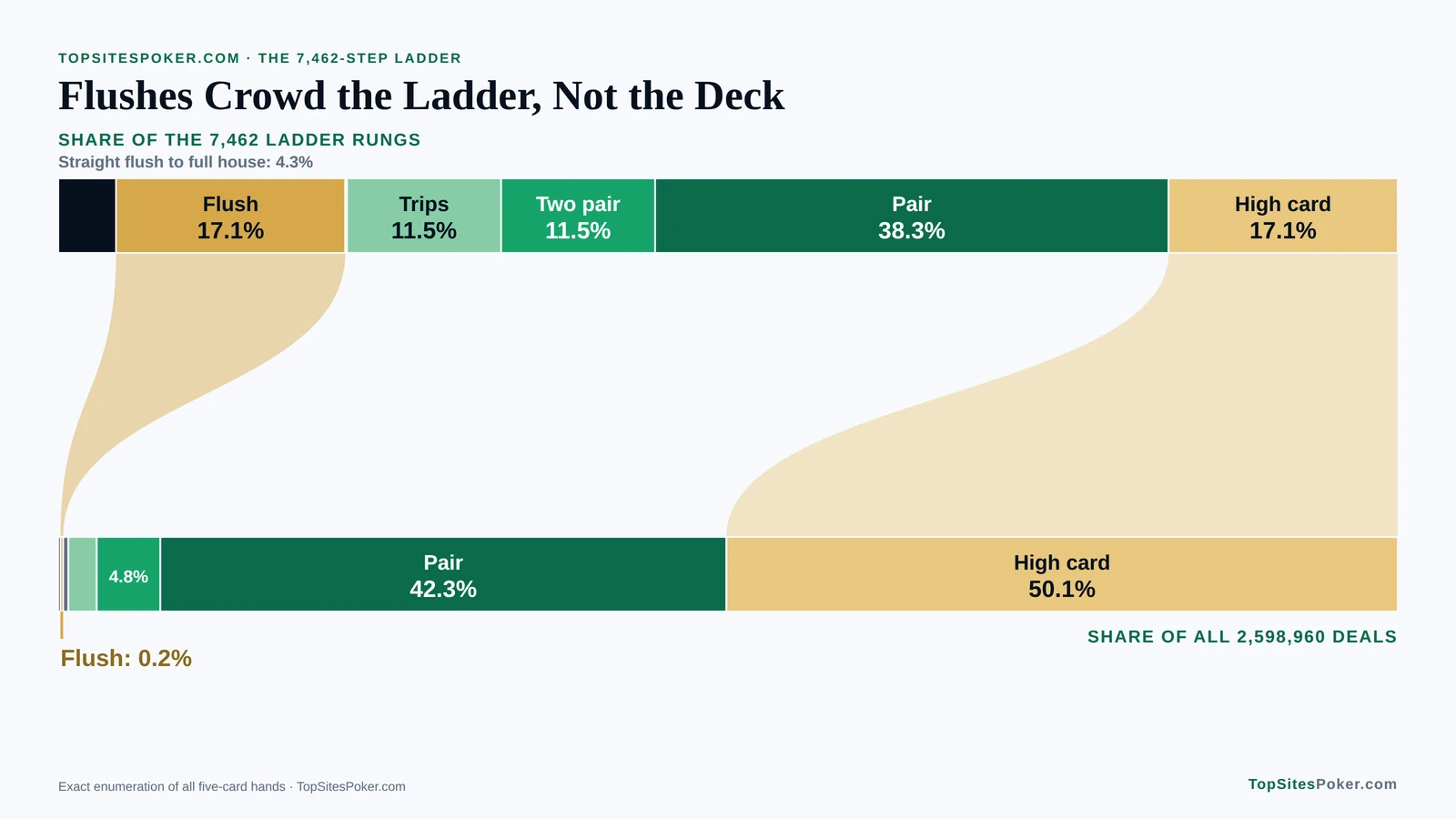
Flushes fill 17.1% of the ladder’s rungs but only 0.2% of real deals. High-card hands are the reverse.
The middle rung of the ladder, number 3,731, is K-K-8-7-6, a pair of kings. That tells you something counterintuitive: measured by distinct strengths, half of all possible hand types are better than a pair of kings. Measured by how often hands actually occur, a pair of kings with those kickers beats about 86% of five-card deals. The ladder is crowded at the bottom and sparse at the top, which is exactly what “rarer hands rank higher” means.
Seven cards use only part of the ladder
In Hold’em and Seven Card Stud, your hand is the best five of seven cards. That changes which rungs you can land on. We checked every one of the 133,784,560 possible seven-card combinations: only 4,824 of the 7,462 rungs can ever be the best hand. The other 2,638 can’t, because the two extra cards would always improve them.
- Weak high-card hands disappear. With seven cards and no pair, straight or flush, you hold seven different ranks. The lowest possible set is 2, 3, 4, 5, 7, 8, 9 (a 6 would complete a straight), so the worst possible seven-card hand is 9-8-7-5-4, not 7-5-4-3-2. All the high-card rungs below it are unreachable, and so are some above it, such as 9-8-7-6-2.
- Hands with very low kickers disappear too. A-A-A-K-3 can never be your best five from seven, for example. The two cards you don’t use would have to be lower than the 3 without pairing anything, and only one rank (the 2) is available. The same logic removes hundreds of one-pair, two-pair and three-of-a-kind rungs with low kickers.
- Everything from the straight up is still reachable. All the unreachable rungs are high-card, one-pair, two-pair and three-of-a-kind hands.
There’s a practical point hidden in this. In any seven-card hand that uses kickers (high card, one pair, two pair, three of a kind or four of a kind), the two cards you don’t use can never be higher than your lowest kicker. So when you work out your best five, you can always build it from the top down: take the cards that make the rank, then add the highest remaining cards until you have five.
Where Your Hand Ranks Among All Poker Hands
The ranking chart tells you the order of the ten ranks. It doesn’t tell you how strong a hand is in absolute terms: what share of all possible hands it beats. That depends on how many hands sit below it, and it changes a lot depending on whether you’re comparing against five-card hands (as in five-card draw) or against the best five of seven cards (as in Hold’em and Stud).
We calculated both. The five-card column is exact: each hand’s position among all 2,598,960 five-card hands. The seven-card column is exact too: it compares the same hand with the best five cards of every one of the 133,784,560 possible seven-card combinations.
| Hand | Example | Beats this share of five-card hands | Beats this share of seven-card hands |
|---|---|---|---|
| Worst possible hand | 7-5-4-3-2 (mixed suits) | 0% | 0% |
| Best high-card hand | A-K-Q-J-9 (mixed suits) | 50.1% | 17.2% |
| Lowest pair | 2-2-5-4-3 | 50.1% | 17.4% |
| Pair of eights, best kickers | 8-8-A-K-Q | 72.9% | 40.8% |
| Lowest pair of jacks | J-J-4-3-2 | 79.4% | 47.6% |
| Lowest pair of aces | A-A-4-3-2 | 89.1% | 57.8% |
| Best possible pair | A-A-K-Q-J | 92.4% | 61.1% |
| Lowest two pair | 3-3-2-2-4 | 92.4% | 61.2% |
| Best two pair | A-A-K-K-Q | 97.1% | 84.6% |
| Lowest three of a kind | 2-2-2-4-3 | 97.1% | 84.7% |
| Best three of a kind | A-A-A-K-Q | 99.2% | 89.5% |
| Lowest straight (the wheel) | 5-4-3-2-A | 99.2% | 89.6% |
| Highest straight (Broadway) | A-K-Q-J-10 | 99.6% | 93.6% |
| Lowest flush | 7-5-4-3-2 suited | 99.6% | 94.2% |
| Best flush | A-K-Q-J-9 suited | 99.8% | 97.2% |
| Lowest full house | 2-2-2-3-3 | 99.8% | 97.2% |
| Lowest four of a kind | 2-2-2-2-3 | 99.97% | 99.8% |
Five-card column: exact rank among all 2,598,960 hands. Seven-card column: share of all 133,784,560 seven-card combinations whose best five cards rank lower. Both calculated by TopSitesPoker.com. “Beats” means strictly better; ties aren’t counted.
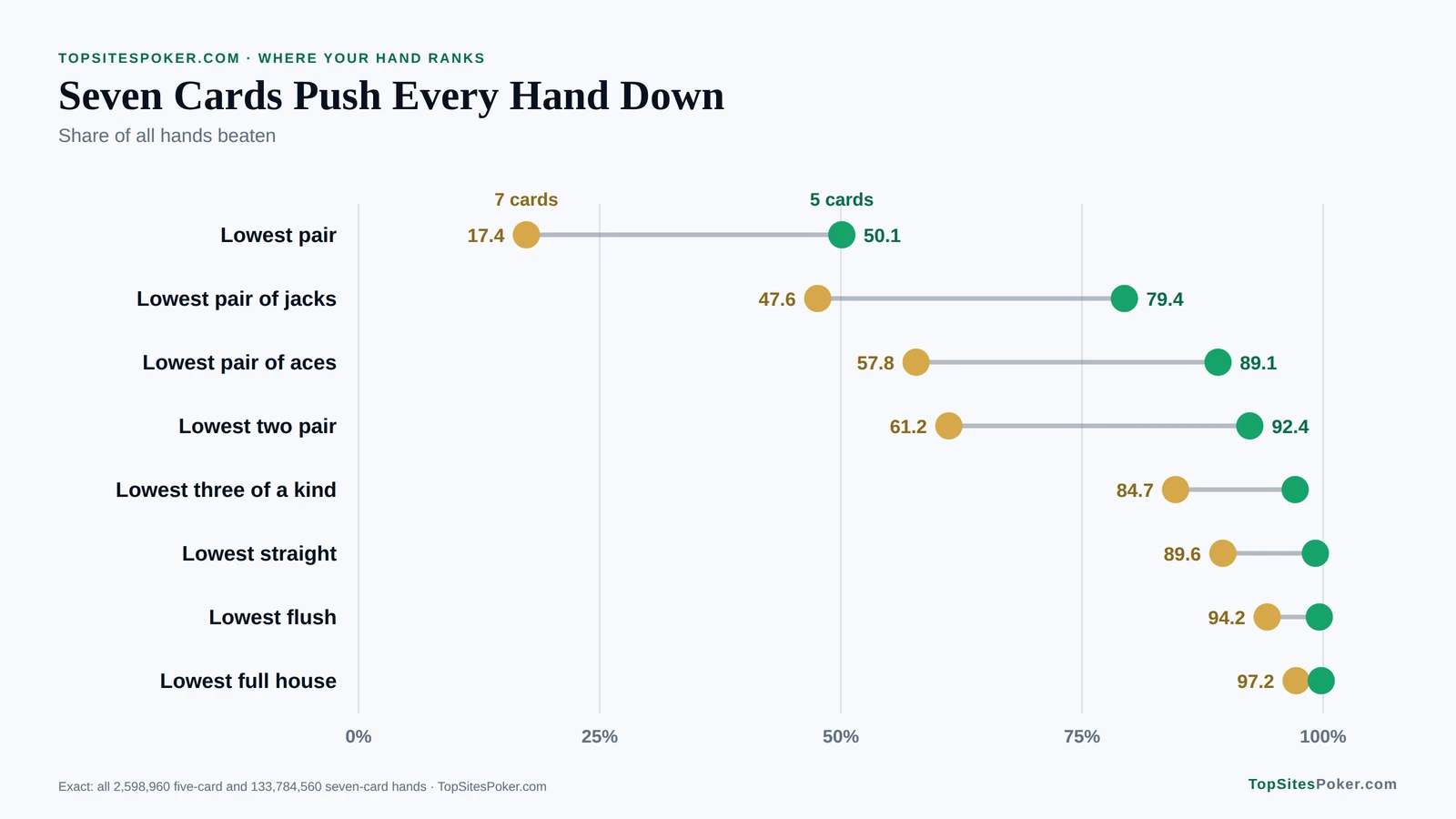
Every hand beats a much smaller share of hands when players have seven cards to choose from.
The two columns tell very different stories:
- In five-card poker, any pair is a decent hand. The lowest pair beats half of all hands, and a pair of aces beats nearly nine in ten. It helps explain why many five-card draw games require jacks or better to open: a pair of jacks is already stronger than about 79% of what anyone else can be dealt.
- In seven-card games, one pair is ordinary. A pair of aces with weak kickers beats only 57.8% of seven-card hands, because seven cards so often make two pair or better. The best possible pair beats just 61.1%.
- The jumps between ranks matter more than the steps within them. Going from the best pair (61.1% in seven cards) to the weakest two pair (61.2%) barely changes anything. Going from the best two pair (84.6%) to the weakest trips (84.7%) is the same. But moving from a pair of eights (40.8%) to a pair of aces (57.8%) is a big jump within a single rank.
- Big hands are big in both games. Any flush beats at least 94% of seven-card hands, and any full house at least 97%.
For Hold’em players, a rough conversion is worth memorizing. Measured against all seven-card hands, a pair of jacks or better with a good kicker sits at roughly the 50th to 61st percentile, two pair at roughly the 61st to 85th, and three of a kind or better above the 85th. These percentiles compare your hand with independent random hands, not with opponents who share your board, and real opponents fold weak hands and continue with strong ones, so treat them as a guide to raw strength, not as win rates.
Every pair, from weakest to strongest
One pair is the hand you’ll hold most often, so it’s worth knowing how the thirteen pair ranks spread across the whole range. Each pair rank covers the same number of five-card hands, so each takes up an equal slice of about 3.3 percentage points of the five-card range, and a roughly equal slice of 3.3 to 3.4 points of the seven-card range. The weakest version of each pair has the three lowest possible kickers, and the strongest has the three highest.
| Pair | Weakest version | Strongest version | Beats (five-card hands) | Beats (seven-card hands) |
|---|---|---|---|---|
| Aces | A-A-4-3-2 | A-A-K-Q-J | 89.1% to 92.4% | 57.8% to 61.1% |
| Kings | K-K-4-3-2 | K-K-A-Q-J | 85.9% to 89.1% | 54.4% to 57.7% |
| Queens | Q-Q-4-3-2 | Q-Q-A-K-J | 82.6% to 85.9% | 51.0% to 54.3% |
| Jacks | J-J-4-3-2 | J-J-A-K-Q | 79.4% to 82.6% | 47.6% to 50.9% |
| Tens | 10-10-4-3-2 | 10-10-A-K-Q | 76.1% to 79.4% | 44.3% to 47.5% |
| Nines | 9-9-4-3-2 | 9-9-A-K-Q | 72.9% to 76.1% | 41.0% to 44.1% |
| Eights | 8-8-4-3-2 | 8-8-A-K-Q | 69.6% to 72.9% | 37.6% to 40.8% |
| Sevens | 7-7-4-3-2 | 7-7-A-K-Q | 66.4% to 69.6% | 34.3% to 37.5% |
| Sixes | 6-6-4-3-2 | 6-6-A-K-Q | 63.1% to 66.4% | 30.9% to 34.1% |
| Fives | 5-5-4-3-2 | 5-5-A-K-Q | 59.9% to 63.1% | 27.6% to 30.8% |
| Fours | 4-4-5-3-2 | 4-4-A-K-Q | 56.6% to 59.9% | 24.2% to 27.4% |
| Threes | 3-3-5-4-2 | 3-3-A-K-Q | 53.4% to 56.6% | 20.8% to 24.1% |
| Twos | 2-2-5-4-3 | 2-2-A-K-Q | 50.1% to 53.4% | 17.4% to 20.7% |
Exact figures over all 2,598,960 five-card hands and all 133,784,560 seven-card combinations, calculated by TopSitesPoker.com.
Two details in the table are easy to miss. The weakest pair of fours is 4-4-5-3-2, not 4-4-3-2-something lower, because the kickers can’t include another four and the lowest three other ranks are 5, 3 and 2. And the strongest pair of aces uses K-Q-J as kickers, not A-K-Q, for the same reason. Kings and queens work the same way: their best kickers skip their own rank.
In seven-card games, the dividing line sits in the middle of the pairs. A pair of jacks is the pair that crosses the 50% mark: its weakest version beats 47.6% of seven-card hands and its strongest beats 50.9%. Anything from queens up beats more than half of all seven-card hands, and anything from tens down beats less than half.
What a “typical” hand looks like
Another way to read the same data is to ask what hand sits at a given position. If you lined up every possible hand from worst to best, these are the hands you’d find at each milestone:
| Milestone | Five-card hand at that point | Seven-card hand at that point |
|---|---|---|
| Weakest 10% | Queen-high (Q-7-5-4-3) | Ace-high (A-Q-9-6-5) |
| Weakest 25% | King-high (K-J-9-8-7) | Pair of fours (4-4-Q-10-9) |
| The middle (50%) | Ace-high (A-K-Q-J-6) | Pair of jacks (J-J-A-10-8) |
| Top 25% | Pair of nines (9-9-K-10-5) | Queens and threes (Q-Q-3-3-A) |
| Top 10% | Pair of aces (A-A-10-5-2) | The wheel (5-4-3-2-A) |
| Top 5% | Jacks and nines (J-J-9-9-2) | Queen-high flush (Q-10-9-5-3) |
| Top 1% | Three kings (K-K-K-10-7) | Jacks full of twos (J-J-J-2-2) |
Each hand is the one at which the cumulative share of all hands, counted from the worst, reaches the milestone. Exact enumeration by TopSitesPoker.com.
The gap between the columns is the whole story of five-card versus seven-card poker. The median five-card hand doesn’t even have a pair. The median seven-card hand is a pair of jacks. To be in the top 10% you need a pair of aces with five cards, but a straight with seven. And a full house, which feels like a monster in any game, isn’t automatically in the top 1% of seven-card hands: the lowest full houses sit in the top 3%, and the top 1% only starts at jacks full of twos.
Flop, turn, river: which table applies in Hold’em
In Texas Hold’em, the number of cards you can use grows street by street. On the flop you have exactly five cards (two in your hand and three on the board), so the five-card percentiles apply. On the turn you have six, and on the river seven. The same hand drops sharply in relative strength as the cards come, because every extra card gives every other hand more ways to improve too:
| Hand | Beats on the flop (5 cards) | Beats on the turn (6 cards) | Beats on the river (7 cards) |
|---|---|---|---|
| Best ace-high, A-K-Q-J-9 | 50.1% | 32.3% | 17.2% |
| Lowest pair, 2-2-5-4-3 | 50.1% | 32.5% | 17.4% |
| Pair of eights, 8-8-A-K-Q | 72.9% | 58.1% | 40.8% |
| Lowest pair of jacks, J-J-4-3-2 | 79.4% | 65.5% | 47.6% |
| Best pair, A-A-K-Q-J | 92.4% | 80.2% | 61.1% |
| Lowest two pair, 3-3-2-2-4 | 92.4% | 80.3% | 61.2% |
| Aces up, A-A-7-7-K | 96.8% | 91.7% | 82.6% |
| Lowest three of a kind, 2-2-2-4-3 | 97.1% | 92.7% | 84.7% |
| Lowest straight, 5-4-3-2-A | 99.2% | 96.3% | 89.6% |
| Lowest flush, 7-5-4-3-2 | 99.6% | 98.1% | 94.2% |
| Lowest full house, 2-2-2-3-3 | 99.8% | 99.1% | 97.2% |
Exact percentiles over all 2,598,960 five-card, 20,358,520 six-card and 133,784,560 seven-card combinations, calculated by TopSitesPoker.com. These compare your hand with all possible hands of the same size, not with hands that share your board.
Read across any row and the lesson is the same: a hand that’s strong on the flop is only medium by the river if it doesn’t improve. The best possible one pair beats 92.4% of five-card hands on the flop, but only 61.1% of seven-card hands at the river. Real opponents share your board, so their hands aren’t random, but the direction holds: the more cards to come, the more your made hand’s relative strength will fall unless it improves.
Five-card draw: the logic of “jacks or better”
Five-card draw is played with exactly five cards, so the five-card column is the one that matters. The weakest pair of jacks, J-J-4-3-2, beats 79.4% of five-card hands, which means about one hand in five is jacks or better. That makes it a natural minimum: strong enough to be ahead of most hands, common enough that someone can usually open. We simulated 600,000 deals to see how often at least one player at the table is dealt jacks or better:
| Players at the table | At least one player dealt jacks or better |
|---|---|
| 1 (your own hand) | 20.6% (exact) |
| 2 | 37.2% |
| 4 | 60.9% |
| 6 | 76.1% |
| 8 | 85.6% |
Single-hand figure: exact share of five-card hands ranking at or above J-J-4-3-2. Table figures: 600,000 simulated deals. Calculated by TopSitesPoker.com.
At a typical six-player table, someone can open about three deals in four. The same threshold appears in video poker’s classic Jacks or Better game, where a pair of jacks is the lowest paying hand.
The Complete Tie-Breaking Reference
Most arguments about poker hands aren’t about which rank is higher. They’re about ties: two flushes, two straights, two players with the same pair. The rules are simple and universal, but they’re easy to misapply in the moment. This reference covers every case.
The master rule
Compare the two hands’ ranks first. If they’re the same, compare the cards that define the rank, in order of importance. If those are equal, compare the remaining cards (the kickers) from highest to lowest. If all five cards are equal in rank, the pot is split. Suits are never used.
Rank by rank: what’s compared, in what order
| Rank | Compared 1st | Compared 2nd | Compared 3rd and later | Cards that can be kickers |
|---|---|---|---|---|
| Straight flush | Top card | — | — | 0 |
| Four of a kind | Rank of the four | Kicker | — | 1 |
| Full house | Rank of the three | Rank of the pair | — | 0 |
| Flush | Highest card | Second card | Third, fourth, fifth card | All five compared |
| Straight | Top card | — | — | 0 |
| Three of a kind | Rank of the three | Higher kicker | Lower kicker | 2 |
| Two pair | Higher pair | Lower pair | Kicker | 1 |
| One pair | Rank of the pair | First kicker | Second, third kicker | 3 |
| High card | Highest card | Second card | Third, fourth, fifth card | All five compared |
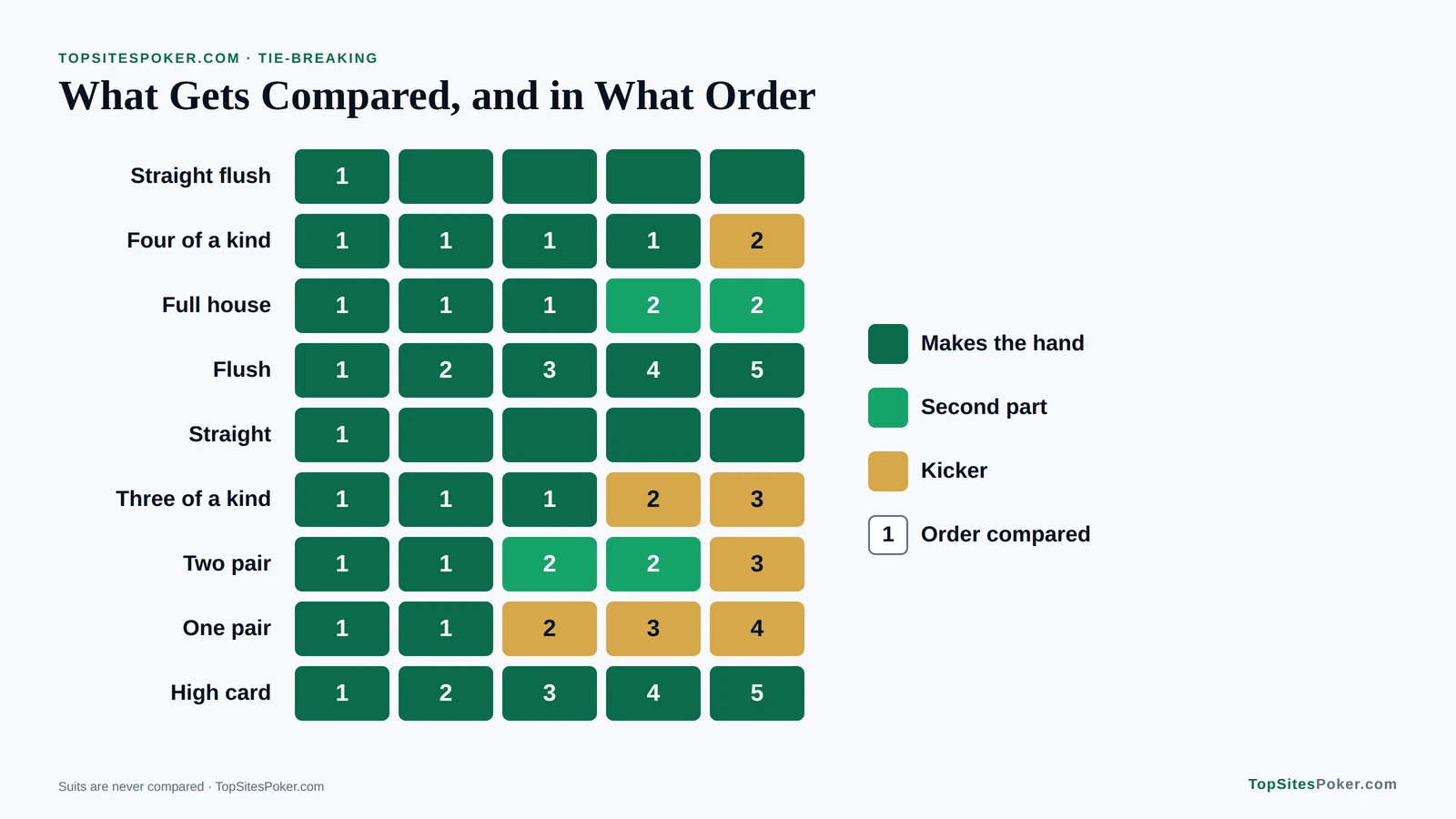
Compare slot 1 first, and move to the next number only if everything before it is equal.
Kickers only count if they’re in your best five
This is the rule behind most Hold’em disputes. A kicker is part of your hand only if it’s one of your best five cards, and in Hold’em the board often provides a better one than either player’s hand.
Example: the board is A♠ K♦ 9♣ 9♥ 4♠. Player A holds A♦ 7♣; Player B holds A♣ Q♦. Both have aces and nines. The fifth card for both is the board’s king, which is higher than either player’s other card, so both hands are A-A-9-9-K and the pot is split. Player B’s queen never plays.
Another example: the board is Q♣ Q♦ 8♠ 8♥ 5♣. Player A holds A♠ 3♦; Player B holds K♠ 4♥. Both have queens and eights. Player A’s ace is higher than the board’s five, so A’s hand is Q-Q-8-8-A. Player B’s hand is Q-Q-8-8-K. Player A wins.
Counterfeiting: when the board replaces your cards
A hand is “counterfeited” when a board card makes one of your hole cards irrelevant. It most often happens to small two-pair hands. If you hold 6-5 on a 6-5-2 board, you have two pair. If the turn and river are both jacks, your best hand becomes J-J-6-6-5, and anyone holding a six with a better kicker than your five has J-J-6-6 with a better fifth card and beats you. Your fives were counterfeited by the board’s pair of jacks.
The same thing happens with low straights and in lowball games, where pairing a low card can ruin a hand. The practical rule: re-rank your hand after every card, because the board can change your best five even when your hole cards stay the same.
Split pots and odd chips
When two or more hands are exactly equal, the pot is divided equally among them. Chips that can’t be divided evenly go by house rule. The widely used standard in flop games like Hold’em gives the odd chip to the first tied player to the left of the button. In stud games, it usually goes to the tied player with the highest card by suit, one of the few places suits have any role at all.
Ties in hi-lo games: quartering
In split-pot hi-lo games, the pot is divided between the best high hand and the best qualifying low hand, and ties work the same way inside each half. That creates a situation unique to split games: quartering. If one player wins the high half outright and two players tie for low, the low half is split between them, so each tied low player receives a quarter of the pot.
Example: in an Omaha Hi-Lo pot of $120, Player A wins the high half ($60) and ties Player B for the best low. Player A also takes half of the low half ($30), for $90 in total. Player B takes the other $30, a quarter of the pot. If Player B put in a third of the money in a three-way pot, being quartered can mean losing money even with a “winning” hand. That’s why experienced hi-lo players are wary of holding a common low without a way to win the high half too.
Edge cases that come up at the table
- Everyone plays the board. If the five community cards form the best possible hand for every remaining player, the pot is split among all of them.
- Two sets in seven cards. With 8-8-8 and 5-5-5 among your seven cards, your hand is eights full of fives. You can’t use both sets.
- Straight and flush together. Seven cards can contain a straight and a flush that aren’t a straight flush. Your hand is the flush, because it ranks higher.
- A six-card straight. With 4-5-6-7-8-9 among your cards, your straight is 9-8-7-6-5. The four doesn’t count.
- Four of a kind on the board. Everyone has the same quads. The highest fifth card in play, from any hand or the board, decides the pot.
- Suited versus offsuit. Whether your hole cards are suited has no effect at showdown unless you actually make a flush.
Tie-breaking in low games
Low games use the same card-by-card idea, turned upside down: compare from the highest card down, and the lower card wins at the first difference.
- A-5 low (Razz, hi-lo games): 7-5-3-2-A beats 7-5-4-2-A. The sevens and fives are equal, and the 3 is lower than the 4. The ace counts as the lowest card. Any unpaired hand beats any paired hand; between two paired hands, the lower pair wins.
- 2-7 low: the same comparison, but the ace is high and straights and flushes count against you. 8-6-4-3-2 beats 8-6-5-3-2 on the third card. A hand like 8-7-6-5-4 isn’t an eight-low at all. It’s a straight, which in 2-7 is worse than every unpaired low and even worse than a pair.
- Badugi: first count the cards in each player’s usable hand; more cards always win. Between hands with the same number of cards, compare the highest cards, and the lower one wins.
- Hi-lo ties: each half is decided separately. Two players can split the high half, and three can share the low half. The odd chip in the total pot goes to the high half.
Suits never break a tie in low games either. Two identical lows split the low half, exactly as identical high hands split a high pot.
How Often Each Tie-Breaker Decides the Pot
The tie-breaking rules above aren’t rare technicalities. To measure how often they actually decide a pot, we dealt 1,000,000 random heads-up Texas Hold’em hands to the river and sorted every showdown by what separated the winner from the loser:
- Rank: the two hands were different ranks, such as a flush against a straight.
- Defining cards: same rank, decided by the cards that make it, such as a pair of kings against a pair of queens, or a jack-high straight against a ten-high straight. For flushes and high-card hands, this means the top card.
- Kickers: same rank and same defining cards, decided by a kicker. For flushes and high-card hands, this means the second to fifth cards.
- Split: all five cards equal in rank.
We ran the same test for six-handed Hold’em (winner against the second-best hand) and six-handed Omaha.
| What decided the showdown | Hold’em, heads-up | Hold’em, six players | Omaha, six players |
|---|---|---|---|
| Different ranks | 61.6% | 54.3% | 61.4% |
| Same rank, defining cards | 17.6% | 30.5% | 27.2% |
| Same rank, kickers | 16.7% | 8.0% | 5.3% |
| Split pot | 4.0% | 7.3% | 6.1% |
Simulated by TopSitesPoker.com: 1,000,000 heads-up Hold’em deals, 300,000 six-player Hold’em deals and 120,000 six-player Omaha deals, with random hands and no folding. In six-player games, the winner is compared with the second-best hand.
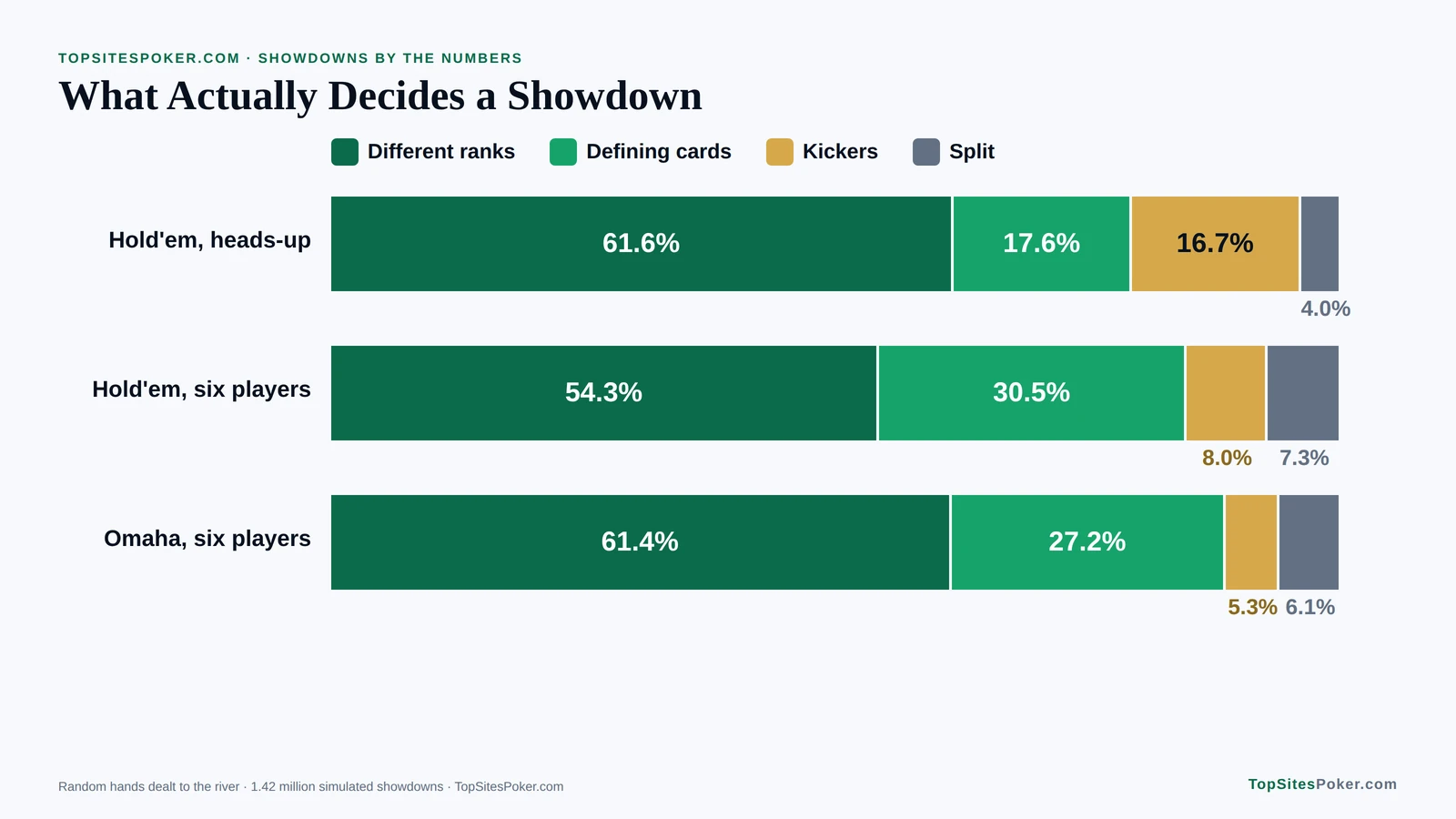
More than a third of heads-up showdowns are decided inside a single rank.
Three findings stand out:
- More than a third of heads-up showdowns are decided inside a single rank. Only 61.6% are settled by the rank alone. Another 17.6% come down to which pair, which straight or which flush is higher, and 16.7%, about one showdown in six, is decided by a kicker.
- With more players, kickers matter less and the rank’s own cards matter more. Six-handed, the best two hands at the table are often the same rank, but they rarely share the same pair or the same three of a kind, so the defining cards decide 30.5% of pots and kickers only 8.0%.
- Split pots are common. About one heads-up showdown in 25 ends in a split, and in about 37% of those splits, both players are simply playing the board.
The tie-breakers that matter for each winning hand
Breaking the heads-up results down by the winning hand shows where each tie-breaking rule does its work:
| Winning hand | Beat a lower rank | Won on defining cards | Won on kickers | Split |
|---|---|---|---|---|
| High card | — | 34.5% | 58.4% | 7.1% |
| One pair | 44.4% | 25.1% | 26.8% | 3.7% |
| Two pair | 71.8% | 17.5% | 6.8% | 3.9% |
| Three of a kind | 86.3% | 0.1% | 11.2% | 2.3% |
| Straight | 88.8% | 4.2% | — | 7.0% |
| Flush | 86.8% | 3.9% | 7.4% | 2.0% |
| Full house | 91.1% | 4.9% | — | 3.9% |
Heads-up Hold’em, 1,000,000 simulated deals to the river, random hands. Rows show how the pot was decided when the winning hand (or the split hand) was of that rank. Straights and full houses have no kickers. Rows may not add to exactly 100% because of rounding.
A few rows deserve a comment:
- One pair is where kickers live. When a one-pair hand wins a heads-up showdown, more than a quarter of the time it’s beating the same pair with a better kicker. That’s why kicker strength is such a big part of Hold’em starting-hand selection: A-K and A-5 both make a pair of aces, but only one of them wins the kicker battle.
- Three of a kind is almost never beaten by a higher three of a kind. Two players rarely hold three of a kind in different ranks on the same board (0.1% of trips wins). But when both players have the same trips, which happens when the board is paired, the kickers decide 11.2% of trips pots.
- Straights split more often than any other made hand. 7.0% of the showdowns won or split with a straight end in a split, more than for any other hand from one pair up, because there are only ten straights and the board often supplies most of them.
- Flushes are decided below the top card more often than by it. When two flushes meet, they usually share the board’s highest flush card, so the second, third or even fourth card decides.
These are random hands that all reach the river, so real games look a little different: players fold weak hands, and the hands that go to showdown are stronger and more often close. If anything, that makes tie-breakers matter even more in practice.
Which hands split the pot
Split pots happened in 4.0% of our heads-up showdowns. This is how those splits break down by the tied hand, as a share of all heads-up showdowns:
| Tied hand | Share of all heads-up showdowns | Share of all split pots |
|---|---|---|
| One pair | 1.37% | 34.0% |
| Two pair | 1.23% | 30.3% |
| Straight | 0.56% | 13.9% |
| High card | 0.42% | 10.4% |
| Full house | 0.18% | 4.6% |
| Three of a kind | 0.17% | 4.2% |
| Flush | 0.10% | 2.6% |
| Four of a kind or straight flush | under 0.01% | 0.2% |
1,000,000 simulated heads-up Hold’em deals to the river, random hands. Calculated by TopSitesPoker.com.
One pair and two pair produce almost two-thirds of all split pots, usually because the board supplies both the pairs and the kickers. Straights produce 13.9% of splits even though fewer than one final hand in twenty is a straight, which is the “ten distinct straights” effect again: when two players both have a straight, they often have the same one.
Does your kicker actually play?
A kicker only counts if it makes it into your best five, and in Hold’em the board often pushes it out. To measure how often, we took hands of the form A-x, dealt 400,000 random boards for each second card, and looked only at the showdowns where the final hand was exactly one pair of aces. Then we checked whether the second card was part of the best five:
| Your hand | Your kicker plays when you finish with one pair of aces |
|---|---|
| A-K, A-Q, A-J, A-10 | 100% |
| A-9 | 91.6% |
| A-8 | 80.8% |
| A-7 | 65.2% |
| A-6 | 47.0% |
| A-5 | 26.4% |
| A-4 | 8.8% |
| A-3, A-2 | 0% |
400,000 simulated boards per hand, offsuit, counting only boards where the final hand was exactly one pair of aces. Calculated by TopSitesPoker.com.
The pattern follows directly from the ranking rules. With exactly one pair, the board supplies four other cards, and your kicker plays only if no more than two of them are higher than it. A ten or better always plays: for three board cards to beat a ten, they’d have to be king, queen and jack, and together with your ace and ten, that’s a straight, not a pair. A deuce or trey never plays: for it to make the best five, the board would need two cards below it without pairing, and there aren’t enough low ranks to do that. So when two players both end up with a pair of aces, A-2 and A-3 are always relying on the board’s cards, and the player with a ten or better as a kicker never is.
Eleven Showdowns Decided Inside the Rank
These Texas Hold’em showdowns all have one thing in common: both players hold the same rank, so the ranking chart alone can’t settle them. Each one shows a different tie-breaking rule at work. Every result was checked with a hand evaluator.
1. Two flushes: one card beats two
Board: A♥ 9♥ 6♥ 3♣ 2♥. Player A: K♥ 4♦. Player B: Q♥ J♥.
Both players have an ace-high flush. Player A’s best five are A♥ K♥ 9♥ 6♥ 2♥; Player B’s are A♥ Q♥ J♥ 9♥ 6♥. The aces tie, and the second card decides: king beats queen. Player A wins with a single heart against Player B’s two. When four flush cards are on the board, the highest single card of the suit is often enough.
2. Two straights: only the top card counts
Board: 9♣ 8♦ 7♠ 6♥ K♣. Player A: 10♦ 2♠. Player B: 10♥ J♣.
Player A has 10-9-8-7-6. Player B has J-10-9-8-7. Both are straights, and Player B’s top card is higher. Player B wins. Player A’s single ten completes a straight, but anyone holding jack-ten completes a higher one. When the board shows four cards in a row, a straight made with one of your cards can be beaten by a player whose cards extend the run further up.
3. Two full houses: a set that loses
Board: 7♠ 7♦ 7♣ K♥ 4♠. Player A: K♣ 2♦. Player B: 4♥ 4♦.
Player B made three fours, but with three sevens on the board, the best full house available is sevens full of fours (7-7-7-4-4). Player A has sevens full of kings (7-7-7-K-K). The three of a kind is the same for both, so the pair decides. Player A wins. When the board has three of a kind, everyone’s full house uses those three cards, and the higher pair wins.
4. Two pair: a pocket pair beats an ace kicker
Board: K♠ K♦ 8♣ 8♥ Q♠. Player A: A♣ 3♦. Player B: J♥ J♦.
Player A has K-K-8-8-A: the board’s two pair with an ace kicker. Player B has three pairs, kings, jacks and eights, and plays the top two: K-K-J-J-Q. The higher pair is equal, the lower pair decides, and jacks beat eights before the kicker is ever reached. Player B wins.
5. Trips: the first kicker
Board: 9♠ 9♦ 5♣ 3♥ 2♠. Player A: 9♣ K♦. Player B: 9♥ Q♣.
Both have three nines. Player A’s hand is 9-9-9-K-5 and Player B’s is 9-9-9-Q-5. Player A wins on the first kicker. This is the typical trips pot: the same three of a kind, decided by the side card each player holds.
6. Trips: when the board’s card is a kicker
Board: the same, 9♠ 9♦ 5♣ 3♥ 2♠. Player A: 9♣ 4♦. Player B: 9♥ 6♣.
Now both kickers are small. Player A’s best five are 9-9-9-5-4, using the board’s five as the first kicker. Player B’s are 9-9-9-6-5. The six beats the five. Player B wins. A small kicker can still matter when it’s higher than the board’s cards.
7. One pair: the second kicker
Board: A♦ 10♣ 7♠ 4♥ 2♣. Player A: A♠ 9♦. Player B: A♥ 8♠.
Both have a pair of aces. The board’s ten is the first kicker for both, so the second kicker decides: Player A has A-A-10-9-7 and Player B has A-A-10-8-7. Player A wins with the nine.
8. High card: kickers that don’t play
Board: K♠ J♦ 8♣ 5♥ 2♠. Player A: A♦ 3♥. Player B: A♣ 4♦.
Both players have A-K-J-8-5. Their second cards, the three and the four, are lower than every board card they’d replace, so neither plays. Split pot. Player B’s “higher kicker” is irrelevant because it isn’t in B’s best five.
9. Four of a kind on the board
Board: Q♠ Q♦ Q♣ Q♥ 6♠. Player A: 7♣ 2♦. Player B: A♠ 5♦.
Everyone has four queens, so only the fifth card matters. Player A’s best is Q-Q-Q-Q-7, Player B’s is Q-Q-Q-Q-A. Player B wins. If the board’s fifth card had been an ace, every remaining player would have split.
10. Two straight flushes
Board: 8♥ 7♥ 6♥ 5♥ K♣. Player A: 9♥ 2♣. Player B: 4♥ 3♦.
Both players have a straight flush. Player A’s runs to the nine (9-8-7-6-5), Player B’s only to the eight (8-7-6-5-4). Player A wins. Straight flushes follow the straight rule: top card only.
11. Five flush cards on the board
Board: A♠ J♠ 8♠ 6♠ 3♠. Player A: K♦ Q♦. Player B: 2♠ 7♥. Player C: 9♠ 4♣.
Every player has a flush. Player A has no spade and plays the board: A-J-8-6-3. Player B’s 2♠ is lower than every board spade, so B also plays the board. Player C’s 9♠ replaces the board’s 3♠, making A-J-9-8-6, which beats the board flush on the third card. Player C wins. With five suited cards on the board, a single spade only helps if it’s higher than the lowest board spade, and the higher it is, the better.
What the examples teach
- Always build both hands in full, five cards each, before comparing.
- Compare the cards that make the rank before any kicker.
- A card in your hand only matters if it makes it into your best five.
- When the board makes most of the hand, look for the one card that improves it.
Suits: The Only Places They Rank
At showdown, suits never matter. A royal flush in spades is exactly equal to a royal flush in hearts, and two identical flushes in different suits split the pot. Standard cardroom rulebooks state it plainly: suits never break a tie for winning a pot.
Yet many players have heard that “spades are the highest suit,” and it’s true in a limited sense. Poker does have a traditional suit order, and it’s used for a handful of procedures that need a tie-breaker when there’s no pot at stake. From highest to lowest, the order is:
♠ Spades > ♥ Hearts > ♦ Diamonds > ♣ Clubs
An easy way to remember it: in English, it’s reverse alphabetical order. Clubs, diamonds, hearts, spades runs from lowest to highest.
Where the suit order is used
| Situation | Does suit matter? | What usually happens |
|---|---|---|
| Deciding who wins a pot | Never | Equal hands split the pot, whatever their suits |
| Ranking two flushes | Never | Flushes are compared by rank, card by card; identical ranks split |
| Drawing for the dealer button | Yes | The highest card wins in most games; if two players draw the same rank, the higher suit wins |
| Seven Card Stud bring-in | Yes | The lowest upcard brings it in; between equal ranks, the lowest suit does, so the 2♣ is the “lowest” card |
| Razz bring-in | Yes | The highest upcard brings it in (aces are low); ties are broken by suit |
| First to act on later stud streets | Sometimes | The best exposed hand acts first; for identical exposed hands, tournament rules use the high card by suit, while some cash-game rulebooks use position |
| Odd chip in a stud split pot | Yes | Under the 2026 TDA rules, it goes to the player with the high card by suit in their five-card winning hand |
| Odd chip in a Hold’em or Omaha split pot | No | It goes to the first tied player to the left of the button |
The stud rules in detail
Stud games are where suits come up most, because players’ cards are dealt face up and there’s no button to decide who acts first.
- Third street: in Seven Card Stud, the player with the lowest upcard must make the forced bring-in bet. If two players show the same rank, the suit decides, so a player showing 2♣ brings it in ahead of a player showing 2♦.
- Fourth street onward: the player with the best exposed hand acts first. Only pairs, two pair, trips, quads and high cards count for this. A player showing four spades or 5-6-7-8 doesn’t act first because of a possible flush or straight, since incomplete hands don’t count.
- Identical exposed hands: if two players show exactly the same ranks, such as K-7 each, the current TDA procedures break the tie by the high card by suit. Some cash-game rulebooks use position instead, giving the action to the player who was dealt cards first. Check which one your room uses.
- Razz: everything is reversed. The highest upcard makes the bring-in, with the ace counting as low, so a king is the highest card. On later streets, the lowest exposed hand acts first.
Odd chips: the one place suits touch the money
When a pot can’t be split evenly, somebody has to get the extra chip. In flop games such as Hold’em and Omaha, the current TDA rules give it to the first tied player to the left of the button, so suits play no part. In stud and razz, where there’s no button, the TDA rules give the odd chip to the player holding the high card by suit in their five-card winning hand. In a hi-lo split between a high hand and a low hand, the odd chip goes to the high side. Some older house rules give the odd chip in low stud games to the lowest card by suit instead, so it’s worth checking in a room you don’t know.
Notice that none of these procedures changes who wins. The suit only decides who gets one leftover chip, who posts a forced bet or who acts first. That’s the consistent principle: suits are a procedural tie-breaker, never part of a hand’s value.
Why suits don’t rank at showdown
The reason is fairness. Every suit has exactly the same thirteen ranks, so no suit is harder to collect than another. The poker ranking is built on how hard a hand is to make, and a spade flush is exactly as hard to make as a heart flush. Ranking one above the other would reward luck with no basis in the odds.
Some other card games that borrow poker hands, such as Big Two, do rank suits, each in its own order. That’s one source of the confusion. If you play a game where suits break showdown ties, you’re playing that game’s rules, not poker’s.
Texas Hold’em Starting Hand Rankings: All 169 Hands
“Poker hand rankings” has a second meaning for Hold’em players: the ranking of the two-card starting hands. There are 1,326 ways to be dealt two cards, but only 169 distinct starting hands: 13 pocket pairs, 78 suited combinations and 78 offsuit combinations. This section ranks all 169 of them.
How we ranked them
A starting hand’s strength isn’t fixed. It depends on position, stack sizes and opponents, and no single list captures all of that. What can be measured objectively is how often each hand wins when all five community cards are dealt with no folding, its equity. We simulated 200,000 deals for every one of the 169 hands against one random opponent, and 60,000 deals against four random opponents, counting split pots as fractional wins. The table ranks the hands by their heads-up result and shows their rank against four opponents alongside it. Hands within about half a percentage point of each other can swap places between simulation runs, so treat neighboring ranks as ties.
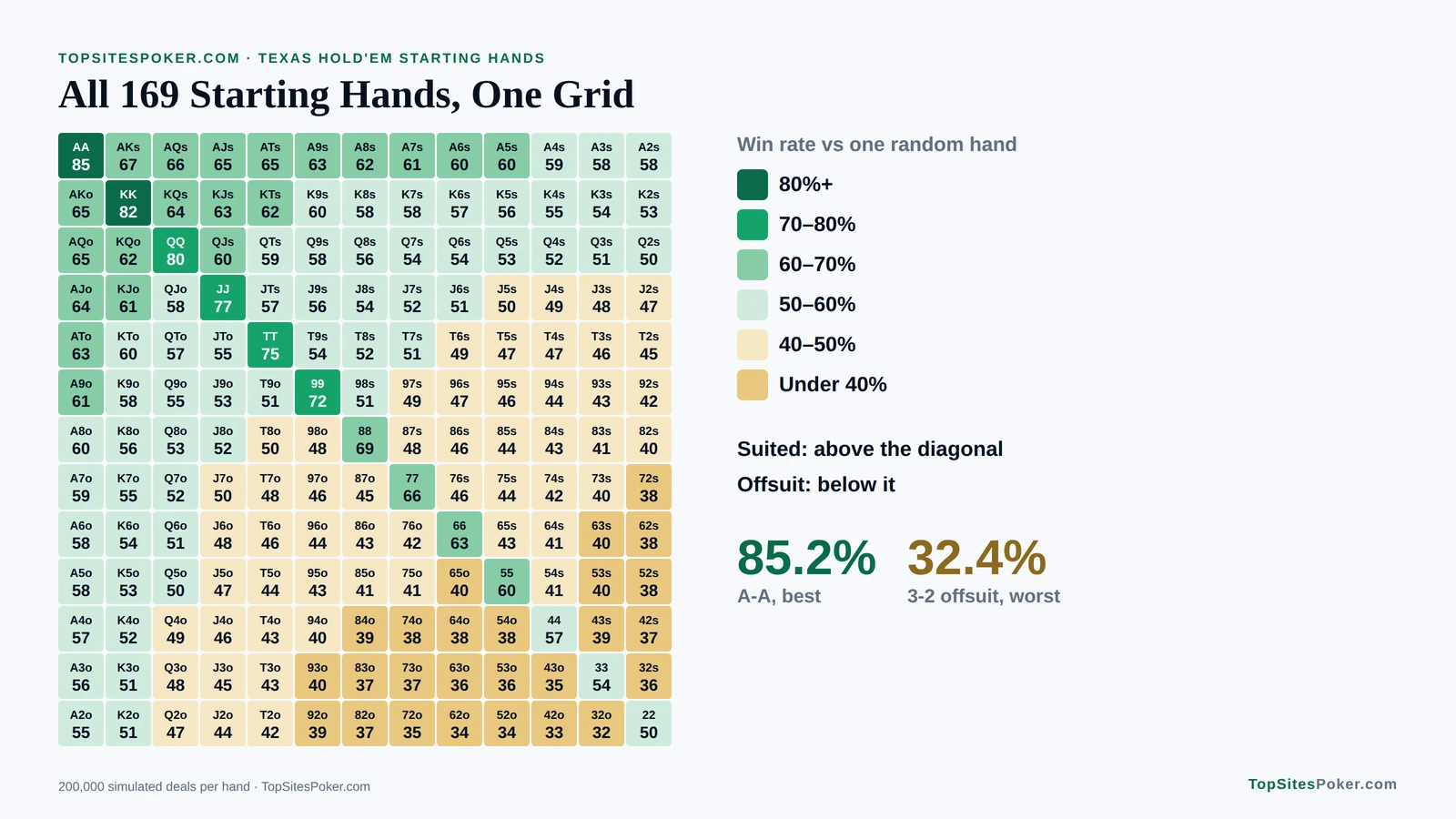
Suited hands sit above the diagonal, offsuit hands below it, and pairs on it. T stands for ten.
The full ranking
| Rank (heads-up) | Starting hand | Wins vs 1 random hand | Rank vs 4 opponents | Wins vs 4 random hands |
|---|---|---|---|---|
| 1 | A-A | 85.2% | 1 | 55.8% |
| 2 | K-K | 82.4% | 2 | 50.0% |
| 3 | Q-Q | 79.8% | 3 | 44.6% |
| 4 | J-J | 77.4% | 4 | 40.6% |
| 5 | 10-10 | 75.1% | 5 | 36.3% |
| 6 | 9-9 | 71.9% | 9 | 32.8% |
| 7 | 8-8 | 69.4% | 19 | 29.3% |
| 8 | A-K suited | 67.0% | 6 | 35.4% |
| 9 | 7-7 | 66.2% | 27 | 26.8% |
| 10 | A-Q suited | 66.1% | 7 | 33.5% |
| 11 | A-J suited | 65.3% | 11 | 32.3% |
| 12 | A-K offsuit | 65.3% | 10 | 32.5% |
| 13 | A-10 suited | 64.7% | 12 | 31.0% |
| 14 | A-Q offsuit | 64.6% | 14 | 30.5% |
| 15 | A-J offsuit | 63.6% | 20 | 28.8% |
| 16 | K-Q suited | 63.5% | 8 | 32.9% |
| 17 | 6-6 | 63.1% | 41 | 24.8% |
| 18 | A-9 suited | 62.8% | 22 | 27.9% |
| 19 | A-10 offsuit | 62.6% | 23 | 27.7% |
| 20 | K-J suited | 62.6% | 13 | 30.8% |
| 21 | A-8 suited | 62.0% | 26 | 27.3% |
| 22 | K-10 suited | 61.9% | 16 | 29.7% |
| 23 | K-Q offsuit | 61.5% | 18 | 29.3% |
| 24 | A-7 suited | 61.0% | 29 | 26.6% |
| 25 | A-9 offsuit | 60.8% | 43 | 24.4% |
| 26 | K-J offsuit | 60.5% | 24 | 27.6% |
| 27 | Q-J suited | 60.5% | 15 | 30.2% |
| 28 | 5-5 | 60.3% | 57 | 22.5% |
| 29 | A-6 suited | 60.1% | 35 | 25.6% |
| 30 | A-5 suited | 60.0% | 32 | 26.1% |
| 31 | K-9 suited | 59.9% | 25 | 27.4% |
| 32 | K-10 offsuit | 59.6% | 31 | 26.2% |
| 33 | A-8 offsuit | 59.6% | 50 | 23.3% |
| 34 | Q-10 suited | 59.4% | 17 | 29.4% |
| 35 | A-4 suited | 59.2% | 37 | 25.4% |
| 36 | A-7 offsuit | 58.8% | 56 | 22.5% |
| 37 | K-8 suited | 58.5% | 39 | 25.0% |
| 38 | Q-J offsuit | 58.2% | 28 | 26.8% |
| 39 | A-3 suited | 58.1% | 40 | 25.0% |
| 40 | K-9 offsuit | 57.7% | 48 | 23.6% |
| 41 | A-5 offsuit | 57.7% | 62 | 22.1% |
| 42 | K-7 suited | 57.6% | 42 | 24.5% |
| 43 | A-6 offsuit | 57.5% | 70 | 21.3% |
| 44 | Q-9 suited | 57.5% | 30 | 26.5% |
| 45 | A-2 suited | 57.5% | 45 | 24.1% |
| 46 | J-10 suited | 57.4% | 21 | 28.7% |
| 47 | Q-10 offsuit | 57.2% | 36 | 25.6% |
| 48 | 4-4 | 56.9% | 75 | 20.7% |
| 49 | A-4 offsuit | 56.8% | 71 | 21.2% |
| 50 | K-6 suited | 56.7% | 51 | 23.2% |
| 51 | K-8 offsuit | 56.1% | 68 | 21.4% |
| 52 | Q-8 suited | 55.9% | 44 | 24.2% |
| 53 | K-5 suited | 55.9% | 52 | 23.1% |
| 54 | A-3 offsuit | 55.7% | 76 | 20.6% |
| 55 | J-9 suited | 55.7% | 34 | 26.0% |
| 56 | Q-9 offsuit | 55.3% | 53 | 22.8% |
| 57 | J-10 offsuit | 55.3% | 38 | 25.2% |
| 58 | K-7 offsuit | 55.2% | 79 | 20.4% |
| 59 | A-2 offsuit | 55.0% | 88 | 19.8% |
| 60 | K-4 suited | 54.7% | 55 | 22.6% |
| 61 | K-6 offsuit | 54.4% | 89 | 19.8% |
| 62 | K-3 suited | 54.2% | 66 | 21.7% |
| 63 | Q-7 suited | 54.2% | 54 | 22.7% |
| 64 | 10-9 suited | 54.1% | 33 | 26.1% |
| 65 | J-8 suited | 53.9% | 47 | 23.9% |
| 66 | 3-3 | 53.8% | 93 | 19.1% |
| 67 | Q-6 suited | 53.7% | 63 | 22.1% |
| 68 | Q-8 offsuit | 53.5% | 73 | 20.9% |
| 69 | K-2 suited | 53.3% | 67 | 21.4% |
| 70 | J-9 offsuit | 53.3% | 59 | 22.4% |
| 71 | K-5 offsuit | 53.3% | 98 | 18.7% |
| 72 | Q-5 suited | 52.8% | 69 | 21.4% |
| 73 | 10-8 suited | 52.3% | 46 | 24.1% |
| 74 | J-7 suited | 52.2% | 61 | 22.2% |
| 75 | K-4 offsuit | 52.2% | 103 | 18.4% |
| 76 | Q-7 offsuit | 51.8% | 105 | 18.3% |
| 77 | Q-4 suited | 51.8% | 72 | 21.0% |
| 78 | J-8 offsuit | 51.5% | 77 | 20.5% |
| 79 | 10-9 offsuit | 51.5% | 58 | 22.5% |
| 80 | K-3 offsuit | 51.4% | 112 | 17.7% |
| 81 | Q-3 suited | 51.1% | 81 | 20.4% |
| 82 | Q-6 offsuit | 51.0% | 111 | 17.8% |
| 83 | 9-8 suited | 50.8% | 49 | 23.4% |
| 84 | J-6 suited | 50.7% | 80 | 20.4% |
| 85 | 10-7 suited | 50.7% | 60 | 22.3% |
| 86 | K-2 offsuit | 50.6% | 120 | 17.0% |
| 87 | 2-2 | 50.3% | 114 | 17.6% |
| 88 | Q-2 suited | 50.1% | 87 | 19.8% |
| 89 | Q-5 offsuit | 50.0% | 117 | 17.4% |
| 90 | J-5 suited | 50.0% | 90 | 19.8% |
| 91 | 10-8 offsuit | 49.8% | 82 | 20.2% |
| 92 | J-7 offsuit | 49.7% | 107 | 18.2% |
| 93 | 9-7 suited | 49.3% | 65 | 21.9% |
| 94 | J-4 suited | 49.2% | 91 | 19.3% |
| 95 | Q-4 offsuit | 49.1% | 128 | 16.4% |
| 96 | 10-6 suited | 49.0% | 84 | 20.1% |
| 97 | J-3 suited | 48.3% | 96 | 18.9% |
| 98 | Q-3 offsuit | 48.3% | 133 | 16.1% |
| 99 | 9-8 offsuit | 48.2% | 86 | 19.9% |
| 100 | 10-7 offsuit | 47.9% | 102 | 18.5% |
| 101 | 8-7 suited | 47.8% | 64 | 22.0% |
| 102 | J-6 offsuit | 47.7% | 126 | 16.6% |
| 103 | J-2 suited | 47.4% | 101 | 18.5% |
| 104 | 9-6 suited | 47.3% | 83 | 20.1% |
| 105 | Q-2 offsuit | 47.3% | 136 | 15.7% |
| 106 | 10-5 suited | 47.2% | 99 | 18.7% |
| 107 | J-5 offsuit | 47.1% | 138 | 15.6% |
| 108 | 10-4 suited | 46.6% | 106 | 18.3% |
| 109 | J-4 offsuit | 46.4% | 143 | 15.2% |
| 110 | 8-6 suited | 46.2% | 74 | 20.8% |
| 111 | 9-7 offsuit | 46.2% | 108 | 18.2% |
| 112 | 10-6 offsuit | 45.9% | 130 | 16.4% |
| 113 | 10-3 suited | 45.8% | 110 | 17.8% |
| 114 | 7-6 suited | 45.6% | 78 | 20.4% |
| 115 | 9-5 suited | 45.6% | 97 | 18.9% |
| 116 | J-3 offsuit | 45.2% | 147 | 14.9% |
| 117 | 10-2 suited | 44.9% | 115 | 17.5% |
| 118 | 8-7 offsuit | 44.9% | 100 | 18.6% |
| 119 | 9-6 offsuit | 44.4% | 127 | 16.5% |
| 120 | 8-5 suited | 44.4% | 95 | 19.0% |
| 121 | 10-5 offsuit | 44.4% | 146 | 14.9% |
| 122 | J-2 offsuit | 44.3% | 151 | 14.2% |
| 123 | 9-4 suited | 43.9% | 118 | 17.2% |
| 124 | 7-5 suited | 43.7% | 92 | 19.3% |
| 125 | 9-3 suited | 43.5% | 121 | 17.0% |
| 126 | 10-4 offsuit | 43.4% | 150 | 14.5% |
| 127 | 8-6 offsuit | 43.3% | 124 | 16.9% |
| 128 | 6-5 suited | 43.1% | 85 | 19.9% |
| 129 | 9-5 offsuit | 42.7% | 148 | 14.8% |
| 130 | 8-4 suited | 42.5% | 113 | 17.6% |
| 131 | 10-3 offsuit | 42.5% | 152 | 13.9% |
| 132 | 9-2 suited | 42.5% | 129 | 16.4% |
| 133 | 7-6 offsuit | 42.1% | 119 | 17.1% |
| 134 | 7-4 suited | 41.7% | 109 | 17.8% |
| 135 | 10-2 offsuit | 41.6% | 156 | 13.3% |
| 136 | 8-5 offsuit | 41.5% | 145 | 15.0% |
| 137 | 5-4 suited | 41.4% | 94 | 19.0% |
| 138 | 6-4 suited | 41.3% | 104 | 18.3% |
| 139 | 8-3 suited | 41.0% | 132 | 16.1% |
| 140 | 7-5 offsuit | 40.5% | 140 | 15.5% |
| 141 | 9-4 offsuit | 40.5% | 157 | 13.2% |
| 142 | 8-2 suited | 40.4% | 135 | 15.8% |
| 143 | 7-3 suited | 40.1% | 125 | 16.6% |
| 144 | 9-3 offsuit | 39.9% | 160 | 12.6% |
| 145 | 6-5 offsuit | 39.9% | 134 | 16.0% |
| 146 | 5-3 suited | 39.8% | 116 | 17.5% |
| 147 | 6-3 suited | 39.5% | 123 | 16.9% |
| 148 | 8-4 offsuit | 39.4% | 154 | 13.6% |
| 149 | 9-2 offsuit | 38.9% | 162 | 12.3% |
| 150 | 4-3 suited | 38.8% | 122 | 16.9% |
| 151 | 7-4 offsuit | 38.5% | 153 | 13.7% |
| 152 | 7-2 suited | 38.4% | 142 | 15.2% |
| 153 | 5-4 offsuit | 38.2% | 141 | 15.2% |
| 154 | 5-2 suited | 38.0% | 131 | 16.3% |
| 155 | 6-4 offsuit | 37.9% | 149 | 14.5% |
| 156 | 6-2 suited | 37.8% | 137 | 15.6% |
| 157 | 8-3 offsuit | 37.3% | 164 | 11.9% |
| 158 | 8-2 offsuit | 36.9% | 166 | 11.3% |
| 159 | 4-2 suited | 36.8% | 139 | 15.5% |
| 160 | 7-3 offsuit | 36.5% | 161 | 12.5% |
| 161 | 5-3 offsuit | 36.3% | 155 | 13.4% |
| 162 | 6-3 offsuit | 36.0% | 159 | 12.8% |
| 163 | 3-2 suited | 35.9% | 144 | 15.1% |
| 164 | 4-3 offsuit | 34.9% | 158 | 12.9% |
| 165 | 7-2 offsuit | 34.5% | 168 | 11.0% |
| 166 | 6-2 offsuit | 34.2% | 167 | 11.1% |
| 167 | 5-2 offsuit | 34.2% | 163 | 12.0% |
| 168 | 4-2 offsuit | 33.2% | 165 | 11.5% |
| 169 | 3-2 offsuit | 32.4% | 169 | 10.9% |
TopSitesPoker.com simulation: 200,000 deals per hand against one random hand and 60,000 deals per hand against four random hands, all five board cards dealt, ties counted as fractional wins.
What the ranking shows
- Pocket pairs dominate the top. The top seven hands heads-up are all pairs, from A-A (85.2%) down to 8-8 (69.4%). A-K suited is the best unpaired hand, in eighth place at 67.0%.
- Suitedness is worth about three points. Across all 78 suited hands, the suited version wins on average 2.8 percentage points more often than the offsuit version heads-up, ranging from 1.5 to 3.9 points. Against four opponents, the average gap grows to 3.9 points, because flushes win bigger multiway pots.
- 89 of the 169 hands are favorites against one random hand. More than half of all starting hands win more than 50% of the time heads-up, which is why heads-up players raise such a wide range.
- The worst hand is 3-2 offsuit, not 7-2. Heads-up, 3-2 offsuit ranks last at 32.4%, and 7-2 offsuit is 165th at 34.5%. 7-2 offsuit got its reputation because it’s the lowest unpaired, unsuited hand whose cards are too far apart to make a straight together. Against four opponents it ranks 168th, with only 3-2 offsuit below it.
- More opponents reward connected, suited hands. Against four opponents, suited connectors climb the most: 6-5 suited rises from 128th to 85th, 8-7 suited from 101st to 64th and 10-9 suited from 64th to 33rd. The biggest fallers are weak offsuit hands with one high card, such as K-3 offsuit (80th to 112th) and Q-3 offsuit (98th to 133rd), plus small pairs like 5-5 (28th to 57th), which rarely win an unimproved showdown against several players.
Keep in mind what this ranking measures. Equity against random hands that never fold is a clean, repeatable yardstick, but real opponents fold weak hands and continue with strong ones, and position lets you play weaker hands profitably. Use the ranking to understand the raw strength of each hand, and adjust for position and opponents when you play.
Starting hands by group
| Group | Hands | Heads-up win rate range |
|---|---|---|
| Premium pairs | A-A, K-K, Q-Q, J-J | 77–85% |
| Medium pairs | 10-10 through 7-7 | 66–75% |
| Big suited aces and broadway | A-K, A-Q, A-J, A-10, K-Q, K-J suited | 63–67% |
| Big offsuit aces and broadway | A-K, A-Q, A-J, K-Q offsuit | 61–65% |
| Small pairs | 6-6 through 2-2 | 50–63% |
| Suited connectors | 10-9 suited through 5-4 suited | 41–54% |
| Weakest offsuit hands | 7-2, 6-2, 5-2, 4-2 and 3-2 offsuit | 32–35% |
Why a ranking isn’t a pecking order
A ranked list suggests that every hand beats every hand below it. Starting hands don’t work that way. The ranking measures each hand against a random opponent, but when two specific hands meet, the result depends on how their cards interact: shared cards, straight and flush chances, and who holds the higher pair.
The clearest proof is a three-way cycle. We calculated these matchups exactly, over every possible five-card board:
| Matchup | Winner | Winner’s equity | Ranks in our 169 list |
|---|---|---|---|
| A♣ K♦ against J♠ 10♠ | A-K offsuit | 58.8% | 12th against 46th |
| J♠ 10♠ against 2♥ 2♦ | J-10 suited | 54.0% | 46th against 87th |
| 2♥ 2♦ against A♣ K♦ | 2-2 | 52.7% | 87th against 12th |
Exact equity over all 1,712,304 possible boards for each matchup, with split pots counted as half a win. Calculated by TopSitesPoker.com.
A-K beats J-10 suited, J-10 suited beats a pair of twos, and the pair of twos beats A-K. It’s rock-paper-scissors with poker hands. The reasons are simple once you see them: A-K has two overcards to J-10 but no pair; J-10 suited has two overcards to the twos plus straight and flush chances; and the twos start as a pair against A-K’s two unpaired cards, a small favorite before any card is dealt.
This is why experienced players think in terms of ranges, not single hands, and why a starting-hand ranking is a guide to general strength rather than a prediction of any single matchup.
Other Ranking Systems: Low, Hi-Lo, Short Deck and More
The standard ranking is for “high” games, where the best hand wins. Several popular games use a different ranking, either because the lowest hand wins or because the deck is different. The logic is always the same, though: the ranking reflects how hard each hand is to make under that game’s rules.
A-5 low: the most common low ranking
A-5 low (also called “ace-to-five”) is used in Razz, California lowball and the low half of hi-lo games such as Omaha Hi-Lo and Seven Card Stud Hi-Lo. The rules:
- The ace is always the lowest card.
- Straights and flushes don’t count. 5-4-3-2-A is a perfect low even if it’s all one suit.
- Pairs are bad. Any hand with a pair loses to any hand without one.
- Hands are compared from the highest card down, and the lower card wins at the first difference.
The best possible hand is 5-4-3-2-A (the wheel). A low hand is named by its highest card: 5-4-3-2-A is a “five low,” 7-5-4-3-2 a “seven low.” The number of distinct no-pair lows grows quickly as the top card rises: there’s only 1 possible five-low, 5 six-lows, 15 seven-lows and 35 eight-lows.
| A-5 rank | Hand | Name |
|---|---|---|
| 1 | 5-4-3-2-A | Five low (the wheel) |
| 2 | 6-4-3-2-A | Six-four low |
| 3 | 6-5-3-2-A | Six-five low |
| 4 | 6-5-4-2-A | Six-five low |
| 5 | 6-5-4-3-A | Six-five low |
| 6 | 6-5-4-3-2 | Six-five low |
| 7 | 7-4-3-2-A | Seven-four low |
| 8 | 7-5-3-2-A | Seven-five low |
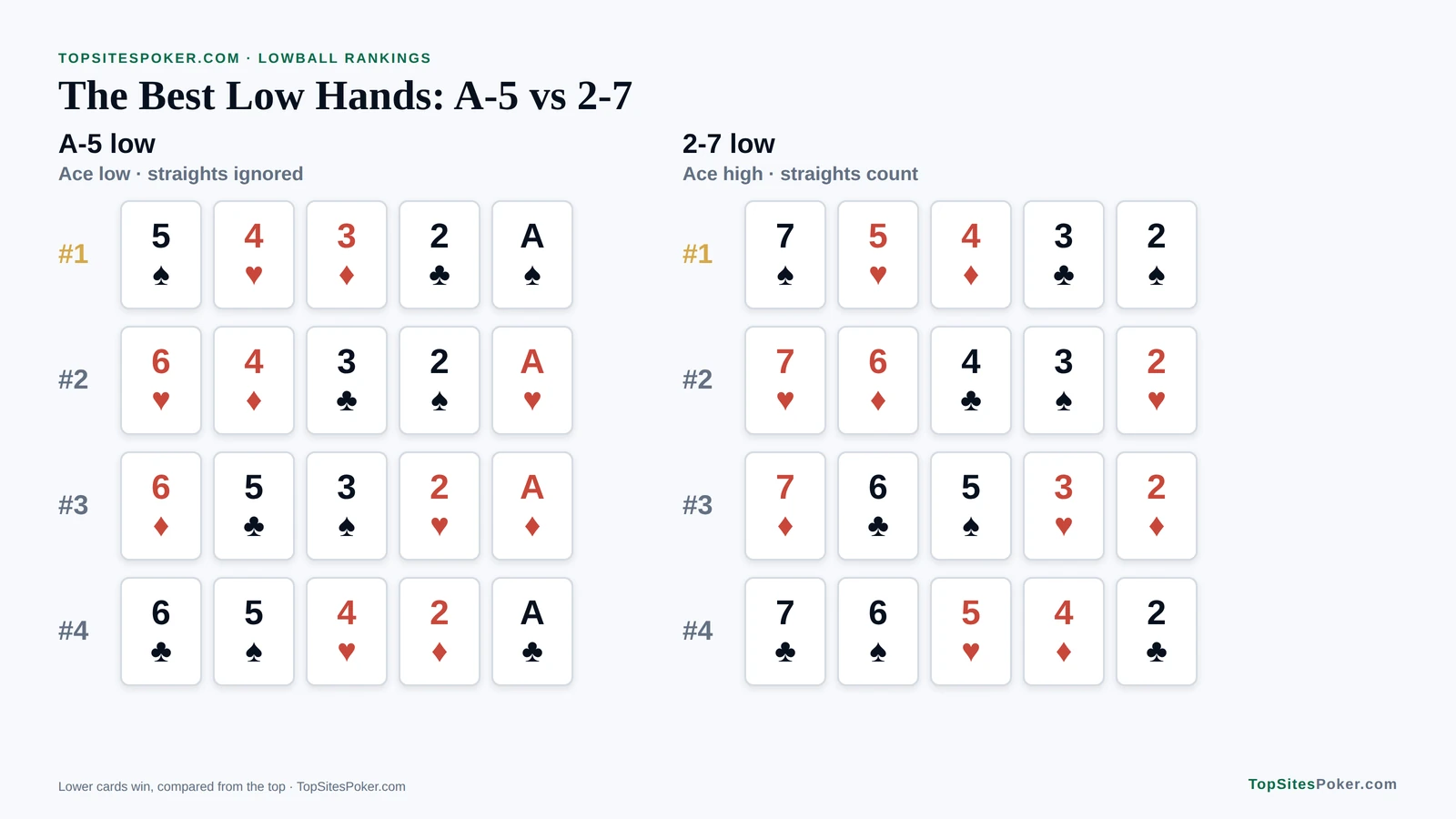
The same low cards rank very differently once the ace plays high and straights count.
The 8-or-better qualifier in hi-lo games
In most hi-lo games, a hand can only win the low half if it qualifies: five different ranks, all 8 or lower (with the ace low). That leaves exactly 56 distinct qualifying lows, from 5-4-3-2-A down to 8-7-6-5-4. If no hand qualifies, the high hand wins the whole pot.
How often a low qualifies depends on how many cards you have to choose from:
- Five cards: only 2.2% of five-card deals contain five different ranks from A to 8.
- Seven cards: 18.3% of seven-card hands contain a qualifying low, counted exactly over all 133,784,560 combinations. The best low is a wheel 0.6% of the time, a six-low 2.4%, a seven-low 5.6% and an eight-low 9.8%.
In Omaha Hi-Lo, where you must use exactly two of your four hole cards and three board cards, a low is only possible when at least three different low cards (8 or below) appear on the board. That’s why Omaha Hi-Lo players value hands like A-2 so highly: on most boards that allow a low, they make the best possible one, unless an ace or a deuce on the board counterfeits them.
How often does the low half exist at all? Exactly 60.1% of all five-card boards contain three or more different low ranks, so about four boards in ten give the whole pot to the high hand. In our simulation of 200,000 six-player Omaha Hi-Lo deals with everyone seeing the river, a single random hand made a qualifying low about 35% of the time, and at least one player had a low in almost every pot where the board allowed one. In 15.6% of the pots with a low, two or more players tied for the best low and split the low half, which is how players get quartered.
Razz: how low hands actually finish
Razz is Seven Card Stud played for low only, with A-5 rankings and no qualifier: the lowest hand always wins, even if it’s king-high. Because there’s no qualifier, the full distribution of final hands matters. Counting all 133,784,560 seven-card combinations exactly, this is how often each best low occurs:
| Best low (seven cards) | How often | This low or better |
|---|---|---|
| Five-low (the wheel) | 0.6% | 0.6% |
| Six-low | 2.4% | 2.9% |
| Seven-low | 5.6% | 8.5% |
| Eight-low | 9.8% | 18.3% |
| Nine-low | 14.3% | 32.7% |
| Ten-low | 17.7% | 50.4% |
| Jack-low | 18.6% | 68.9% |
| Queen-low | 16.0% | 85.0% |
| King-low | 10.4% | 95.4% |
| Paired hand (fewer than five different ranks) | 4.6% | 100% |
Exact counts over all seven-card combinations, ace low, calculated by TopSitesPoker.com. Cumulative figures are computed from unrounded counts.
The median Razz hand is roughly a ten-low: half of all seven-card hands make a ten-low or better. A nine-low is already better than two-thirds of random hands, and a seven-low is in the best 9%.
2-7 low: the “purist” ranking
2-7 low (deuce-to-seven, or Kansas City lowball) is used in 2-7 Triple Draw and 2-7 Single Draw. It ranks low hands as the worst possible high hands:
- The ace is always high, so A-5-4-3-2 is just an ace-high hand, and a bad low.
- Straights and flushes count against you. 6-5-4-3-2 is a straight, not a good low.
- Pairs are bad, as in A-5.
The best possible hand is 7-5-4-3-2 in mixed suits (the “number one”). There are only four distinct seven-low hands in 2-7: 7-5-4-3-2, 7-6-4-3-2, 7-6-5-3-2 and 7-6-5-4-2. The fifth combination, 7-6-5-4-3, is a straight. After the sevens come the eight-lows, starting with 8-5-4-3-2.
Short Deck: why the rankings change
Short Deck (Six Plus Hold’em) removes the 2s through 5s and plays with 36 cards. With fewer cards in each suit, the rarity of several hands changes, and the rankings follow. We counted all 376,992 possible five-card Short Deck hands and all 8,347,680 seven-card Short Deck hands exactly:
| Hand | Short Deck, 5 cards (exact count) | Short Deck, 5 cards (share) | Short Deck, 7 cards (exact share) |
|---|---|---|---|
| Straight flush | 24 | 0.006% | 0.13% |
| Four of a kind | 288 | 0.08% | 0.53% |
| Flush | 480 | 0.13% | 2.1% |
| Full house | 1,728 | 0.46% | 7.6% |
| Straight | 6,120 | 1.6% | 14.0% |
| Three of a kind | 16,128 | 4.3% | 7.3% |
| Two pair | 36,288 | 9.6% | 37.8% |
| One pair | 193,536 | 51.3% | 27.8% |
| High card | 122,400 | 32.5% | 2.8% |
Calculated by TopSitesPoker.com with a custom Short Deck evaluator, counting A-6-7-8-9 as the lowest straight. Seven-card shares use the standard order, so a hand containing both a straight and three of a kind counts as a straight.
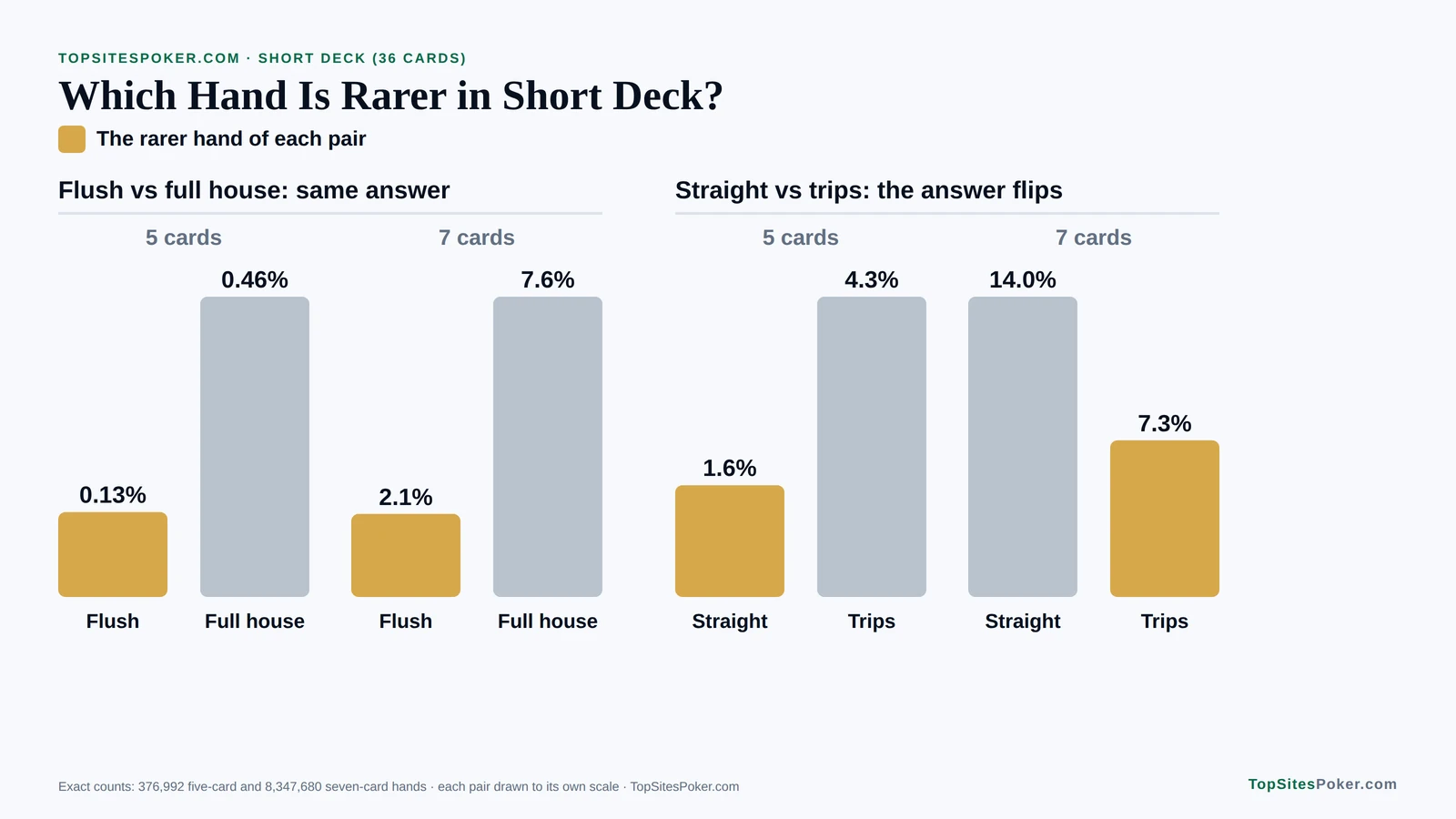
The flush beats the full house in Short Deck under every count. Trips versus straight depends on how you count.
Two facts explain the Short Deck rules:
- A flush is rarer than a full house in both five-card and seven-card Short Deck (480 flushes against 1,728 full houses in five cards). So every Short Deck rule set ranks the flush above the full house.
- Three of a kind versus a straight depends on how you count. In five cards, a straight is rarer (6,120 against 16,128), which supports the standard order. In seven cards, as the game is actually played, three of a kind is rarer (7.3% against 14.0%), which supports ranking trips above straights. That stays true even under the alternative order, where hands holding both count as trips: 7.6% against 13.7%. That’s one reason Short Deck rule sets disagree on this point, and why you should always check which version a game uses.
The ace also plays low in Short Deck straights, but the lowest possible straight is A-6-7-8-9, because the 2 through 5 are gone.
Three Card Poker
The casino game Three Card Poker ranks three-card hands, and the change in card count reshapes the order. Out of 22,100 possible three-card hands, there are 48 straight flushes, 52 three-of-a-kinds, 720 straights, 1,096 flushes and 3,744 pairs. A straight is rarer than a flush with three cards, and three of a kind is rarer than a straight, so the Three Card Poker order is: straight flush, three of a kind, straight, flush, pair, high card.
Badugi
Badugi is a four-card draw lowball game with its own ranking. The best hand is four cards of four different suits and four different ranks, with the ace low: A-2-3-4 in four suits is the best possible hand. A hand with a pair or with two cards of the same suit is only partly usable: you count only the largest group of cards with different suits and different ranks. Any four-card “badugi” beats any three-card hand, any three-card hand beats any two-card hand, and so on. Among hands with the same number of cards, the one with the lower highest card wins, then the next card down, just as in A-5 low.
That rule makes a real badugi surprisingly rare. Counting all 270,725 possible four-card hands exactly:
- 6.3% are four-card badugis (17,160 hands).
- 57.0% are three-card hands.
- 35.6% are two-card hands.
- 1.1% are one-card hands, such as four cards of the same suit or four of a kind.
It’s the clearest example of how a new rule (suits must differ) produces an entirely new ranking.
Wild-card games
When jokers or other wild cards are in play, a new hand becomes possible: five of a kind. Most house rules rank it above the royal flush, since it can’t be made without a wild card. Wild cards also raise questions the standard ranking doesn’t answer, such as whether a natural hand beats an identical hand made with a wild card. Groups that play with wild cards should agree on those rules before dealing.
Which ranking each game uses
Mixed-game players switch between ranking systems every few hands, and the switch is where mistakes happen. This table lists the ranking and the card rule for each common game:
| Game | Ranking used | How the hand is formed |
|---|---|---|
| Texas Hold’em | Standard high | Best five of your two hole cards and five board cards, in any combination |
| Pot-Limit Omaha | Standard high | Exactly two of your four hole cards plus exactly three board cards |
| Omaha Hi-Lo (8 or better) | Standard high, plus A-5 low with an 8 qualifier | Exactly two hole cards and three board cards for each half; you may use different cards for high and low |
| Big O (five-card Omaha Hi-Lo) | Standard high, plus A-5 low with an 8 qualifier | Five hole cards, still exactly two plus three board cards |
| Seven Card Stud | Standard high | Best five of your seven cards |
| Stud Hi-Lo (8 or better) | Standard high, plus A-5 low with an 8 qualifier | Best five of seven for each half, chosen separately |
| Razz | A-5 low, no qualifier | Best five of seven; the lowest hand wins the whole pot |
| Five Card Draw | Standard high | Your five cards after the draw |
| 2-7 Triple Draw and Single Draw | 2-7 low | Your five cards after the draws; straights, flushes and pairs count against you |
| A-5 Triple Draw | A-5 low | Your five cards after the draws |
| Badugi | Badugi ranking | Four cards; different suits and different ranks, ace low |
| Short Deck (Six Plus) | Modified high: flush above full house; trips versus straight varies | Best five of seven from a 36-card deck |
A HORSE player, for example, uses three systems in one session: the standard high ranking in Hold’em and Stud, A-5 low with an eight qualifier in Omaha Hi-Lo and Stud Hi-Lo, and A-5 low without a qualifier in Razz. Eight-game mixes add 2-7 Triple Draw, where the ace is high and straights count against you, the opposite of the A-5 rules a few hands earlier.
Seven Card Stud: ranking your first three cards
Stud players get no community cards, so their starting-hand ranking is built from the first three cards: two face down and one face up. The categories follow the hand ranking directly, but the order is set by what each start can become. Counting all 22,100 possible three-card starts exactly:
| Three-card start | Example | Hands | How often dealt |
|---|---|---|---|
| Three of a kind (“rolled up”) | 8-8-8 | 52 | 0.24% |
| Three to a straight flush | 9♠ 10♠ J♠ | 48 | 0.22% |
| One pair | Q-Q-5 | 3,744 | 16.9% |
| Three to a flush | A♥ 9♥ 4♥ | 1,096 | 5.0% |
| Three to a straight | 7♣ 8♦ 9♠ | 720 | 3.3% |
| None of these | K-9-3 in mixed suits | 16,440 | 74.4% |
Exact counts over all 22,100 three-card combinations; A-2-3 and Q-K-A count as three in a row. Calculated by TopSitesPoker.com.
Rolled-up trips are the best start, dealt about once in 425 hands. Big pairs come next, with their strength depending on the kicker and on whether their matching cards are visible in other players’ upcards. That last point is unique to stud: because so many cards are face up, a start’s real value depends on how many of the cards it needs are still “live.” Three hearts are a weak start if four other hearts are showing around the table.
Games where you rank several hands at once
A few games ask you to build more than one hand from the same cards, and they add a rule of their own: your hands must be in ranking order.
- Chinese poker gives each player 13 cards to split into a five-card back hand, a five-card middle hand and a three-card front hand. The back hand must rank at least as high as the middle, and the middle at least as high as the front. A player who breaks that order has “fouled” and loses the hand. The three-card front hand only counts high cards, pairs and three of a kind, so straights and flushes don’t exist there.
- Open-Face Chinese poker uses the same three rows and the same fouling rule, but players place their cards face up a few at a time, committing to each row before they see the rest. Bonus payments for strong hands in each row vary by house.
- Pai Gow poker, the casino game, splits seven cards into a five-card hand and a two-card hand, and the five-card hand must outrank the two-card hand.
Chinese poker and Open-Face Chinese poker use the standard ranking for each individual hand. Pai Gow poker adds its own twists: it’s played with a joker, and in many casinos A-2-3-4-5 counts as the second-highest straight. In all three, the extra skill is in the split: making the strongest set of hands that still respects the order.
Non-standard hands in home games
Home games have invented dozens of hands that casinos don’t recognize. None of them appear in standard rules, and where they rank depends entirely on the house, but these are the ones you’re most likely to meet:
| Hand | What it is | Where it usually ranks, if used |
|---|---|---|
| Five of a kind | Five cards of one rank, only possible with wild cards | Usually above a royal flush |
| Skip straight (Dutch or kangaroo straight) | Every second rank, such as 3-5-7-9-J | Set by house rule |
| Round-the-corner straight | A straight that wraps through the ace, such as Q-K-A-2-3 | Set by house rule; not a straight in standard poker |
| Big and little dog, big and little cat (tiger) | No-pair hands in a fixed range, such as ace-high with a nine as the lowest card (big dog) | Usually between a straight and a flush |
| Blaze | Five picture cards (jacks, queens and kings) | Set by house rule |
| Four-flush or four-straight (bobtail) | Four cards of a flush or straight | Set by house rule; worthless in standard poker |
If your game uses any of these, write down where they rank before the first deal. Adding a hand to the ranking also changes the odds of the other hands, since some deals now count as the new hand instead, and that can produce odd situations that the standard ranking was designed to avoid.
If Probability Set the Order: The Seven-Card Paradox
The ranking was designed around five-card hands, where it matches the odds perfectly: every rank is rarer than the one below it. But most poker today is played with seven cards, in Texas Hold’em and Seven Card Stud. So what happens if you rank the hands by how often they actually occur in a seven-card game?
We counted all 133,784,560 possible seven-card combinations exactly and recorded the best five-card hand in each:
| Hand | Five-card hands | Five-card share | Seven-card hands | Seven-card share |
|---|---|---|---|---|
| Straight flush (incl. royal) | 40 | 0.0015% | 41,584 | 0.031% |
| Four of a kind | 624 | 0.024% | 224,848 | 0.17% |
| Full house | 3,744 | 0.14% | 3,473,184 | 2.60% |
| Flush | 5,108 | 0.20% | 4,047,644 | 3.03% |
| Straight | 10,200 | 0.39% | 6,180,020 | 4.62% |
| Three of a kind | 54,912 | 2.11% | 6,461,620 | 4.83% |
| Two pair | 123,552 | 4.75% | 31,433,400 | 23.50% |
| One pair | 1,098,240 | 42.26% | 58,627,800 | 43.82% |
| High card | 1,302,540 | 50.12% | 23,294,460 | 17.41% |
| Total | 2,598,960 | 100% | 133,784,560 | 100% |
Exact counts over every possible five-card and seven-card combination, calculated by TopSitesPoker.com. Seven-card counts classify each combination by its best five-card hand.
From the straight flush down to three of a kind, the order holds: each hand is still rarer than the one below it. Two things change, though:
- High card becomes rarer than two pair and one pair. With seven cards, you avoid pairing any of them only 17.4% of the time. By pure rarity, high card would rank above two pair (23.5%) and one pair (43.8%), making it the seventh-best hand.
- Three of a kind and the straight nearly tie. In seven cards, three of a kind (4.83%) is only about 5% more common than a straight (4.62%). The straight is still rarer, so the standard order survives, but only just.
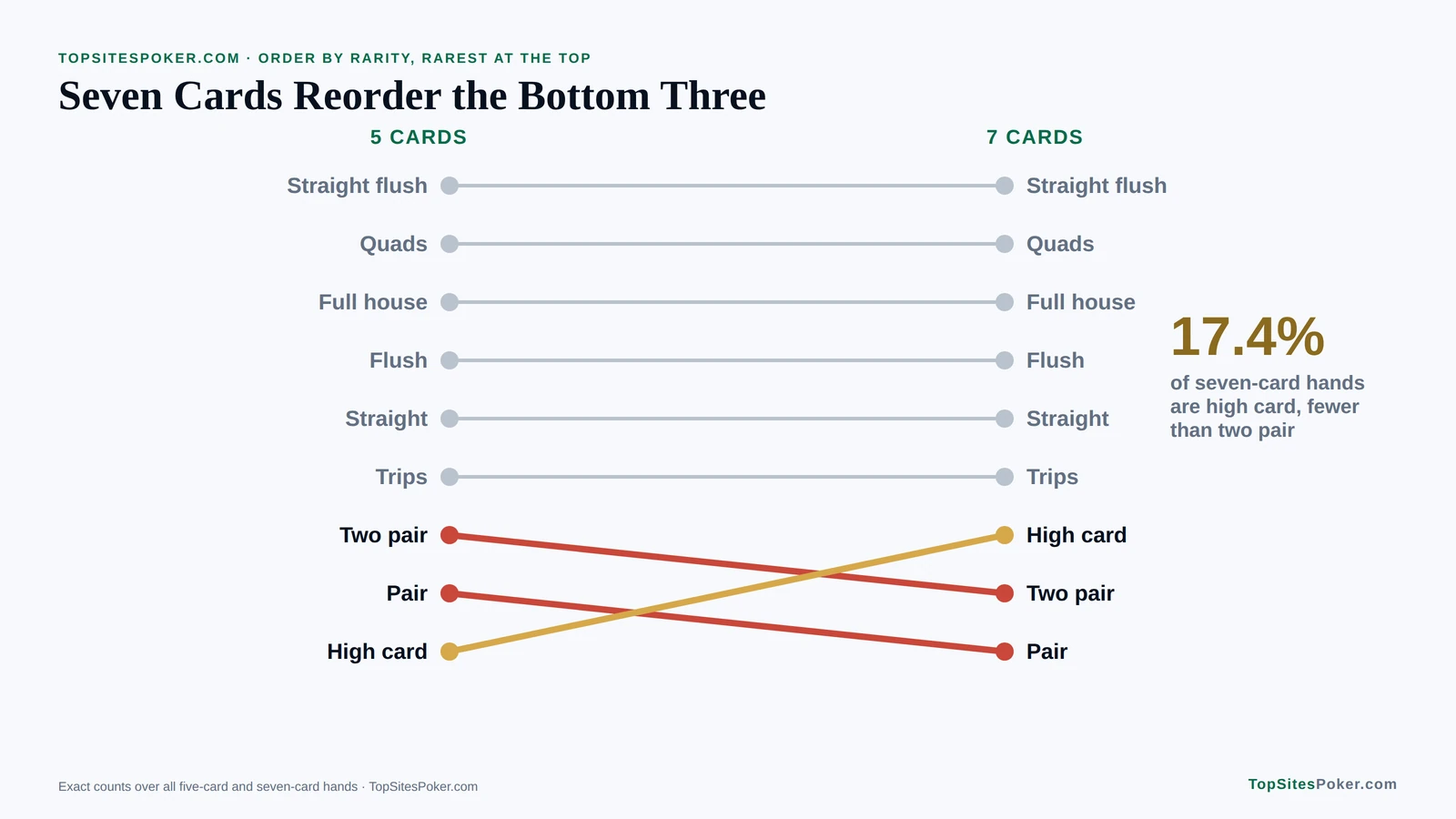
The top six hands keep their order in seven-card poker. The bottom three reorder.
Why nobody re-ranks high card
If high card really ranked above one pair, a strange thing would happen. About 95% of all seven-card hands contain at least five different ranks. A player holding a pair and five other cards could simply choose five unpaired cards and declare “high card” instead. Almost everyone could make the “rare” hand, so it would stop being rare. The new ranking would destroy the very rarity that justified it.
This is a real mathematical problem, not just a thought experiment. It’s the same trap that appears in games with wild cards. In 1996, mathematicians Steve Gadbois (in Mathematics Magazine) and John Emert and Dale Umbach (in Chance) showed that once players can choose how to use a wild card, no ranking can be fully consistent with frequency. Whichever of two hands, such as two pair and three of a kind, is given the higher rank becomes the one players choose to make, and so becomes the more common one.
The standard ranking avoids the problem by being fixed and simple: it’s based on five-card odds, it never changes with the number of cards, and your hand is always the best five cards under that one order. The fact that it no longer matches seven-card odds perfectly is the price of a ranking that can’t be gamed.
Every format has its own “natural” order
The seven-card case isn’t unique. Change the number of cards or the deck, and the order by rarity changes too. Using the exact counts and simulations in this guide, this is how the hands would line up, rarest first, if each format ranked hands purely by how often they occur:
| Format | Order by rarity (rarest first) | Differs from the standard order? |
|---|---|---|
| Five cards, 52-card deck | Straight flush, quads, full house, flush, straight, trips, two pair, pair, high card | No: this is the standard ranking |
| Seven cards, 52-card deck (Hold’em, Stud) | Straight flush, quads, full house, flush, straight, trips, high card, two pair, pair | High card moves up two places |
| Omaha (exactly two plus three) | Straight flush, quads, high card, full house, flush, trips, straight, pair, two pair | Several changes; high card is rarer than a full house |
| Five cards, Short Deck | Straight flush, quads, flush, full house, straight, trips, two pair, high card, pair | Flush above full house; high card above pair |
| Seven cards, Short Deck | Straight flush, quads, flush, high card, trips, full house, straight, pair, two pair | Many changes |
| Three cards (Three Card Poker) | Straight flush, trips, straight, flush, pair, high card | Trips and straight both above flush |
Bold marks hands that are out of their standard order. Seven-card Short Deck counts use the standard order to decide hands that contain both a straight and three of a kind. Calculated by TopSitesPoker.com.
Only two of these formats actually changed their official ranking to follow the odds: Short Deck, which moves the flush above the full house (and in some rule sets, trips above the straight), and Three Card Poker, which has its own order. Every other game keeps the standard five-card ranking and accepts that it’s slightly out of step with its own odds. The reasons are consistency and the paradox above: a ranking that players can game by choosing which cards to use is worse than one that’s slightly “wrong” but fixed.
What this means for Hold’em players
- Two pair is far more common than its rank suggests. In seven-card games, 23.5% of final hands are exactly two pair, very often with one of the pairs on the board. Treat “two pair” as a medium-strength hand unless both of your hole cards are involved.
- Three of a kind and straights arrive about equally often. Neither is a rare event in a seven-card game: together they account for about 9.5% of final hands.
- Missing everything is unusual. Ending with no pair at all happens in fewer than one seven-card hand in five. When it happens to both players, the high-card tie-breaking rules decide the pot, and in our simulation the winner was more often decided by a lower card than by the top card.
Same Ranking, More Cards: How Omaha Changes What Wins
Omaha uses exactly the same hand ranking as Texas Hold’em. What changes is how many cards you can choose from: four hole cards instead of two, which gives you six possible two-card combinations to pair with the ten possible three-card combinations from the board, 60 five-card hands in all. The rule that you must use exactly two hole cards and exactly three board cards stays the same in every standard form of Omaha.
More choices mean stronger hands. We simulated 600,000 single Omaha hands to the river and compared them with the exact seven-card figures for Hold’em:
| Final hand | Hold’em (exact) | Omaha (simulated) |
|---|---|---|
| Straight flush | 0.03% | 0.09% |
| Four of a kind | 0.17% | 0.48% |
| Full house | 2.60% | 6.36% |
| Flush | 3.03% | 6.73% |
| Straight | 4.62% | 11.30% |
| Three of a kind | 4.83% | 8.73% |
| Two pair | 23.50% | 36.91% |
| One pair | 43.82% | 26.44% |
| High card | 17.41% | 2.96% |
Hold’em: exact count over all 133,784,560 seven-card combinations. Omaha: 600,000 simulated hands, best of all 60 legal two-plus-three combinations. Both by TopSitesPoker.com.
Three differences stand out:
- A straight is more common than three of a kind in Omaha. In Hold’em, the two are almost equally common. In Omaha, a straight (11.3%) is almost 30% more common than three of a kind (8.7%), because four hole cards cover so many more sequences. If Omaha had its own ranking based on its own odds, three of a kind would rank above the straight, just as it does in some Short Deck rule sets.
- Missing completely is rare. Only about 3% of Omaha hands end with no pair at all, against 17.4% in Hold’em. By pure frequency, a no-pair Omaha hand would be rarer than a full house.
- Two pair is the most common final hand. More than a third of Omaha hands end as two pair, against less than a quarter in Hold’em.
What wins a six-player showdown
The individual hands are stronger, and the winning hands are stronger still. We dealt 400,000 six-player showdowns in each game, with every player going to the river, and recorded the winning hand:
| Winning hand | Hold’em, six players | Omaha, six players |
|---|---|---|
| Straight flush | 0.2% | 0.5% |
| Four of a kind | 0.9% | 2.9% |
| Full house | 10.9% | 27.2% |
| Flush | 10.8% | 21.0% |
| Straight | 16.6% | 26.6% |
| Three of a kind | 13.9% | 11.2% |
| Two pair | 30.5% | 10.3% |
| One pair | 16.2% | 0.2% |
| High card | 0.05% | under 0.01% |
400,000 simulated six-player showdowns per game, random hands, no folding. Calculated by TopSitesPoker.com.
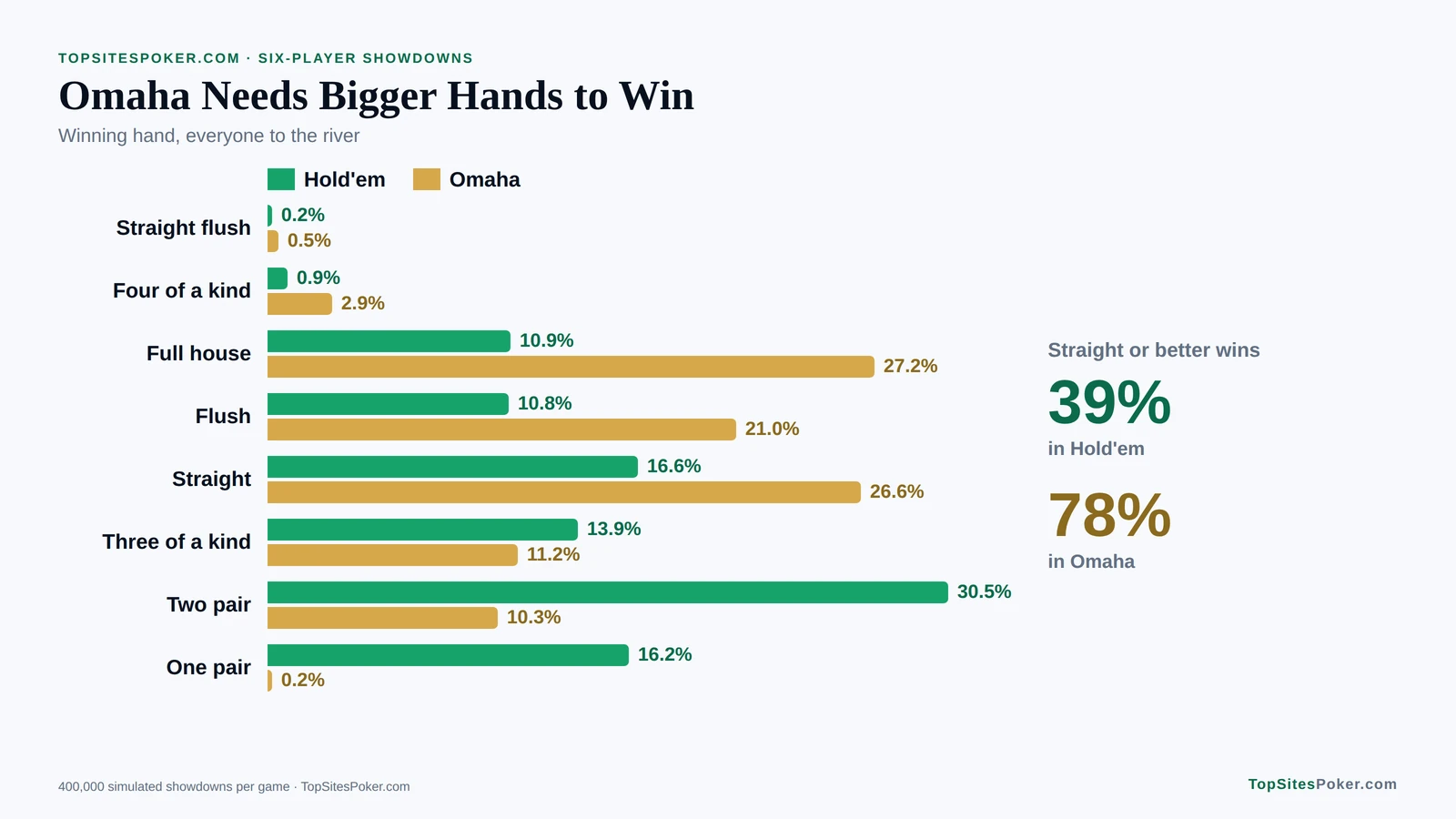
With four hole cards, the typical winning hand moves up two to four ranks.
In six-handed Hold’em, a straight or better wins 39% of showdowns. In six-handed Omaha, it wins 78%. A full house is the single most common winning hand in Omaha, and one pair almost never wins when six players see the river. That’s the real reason Omaha players talk about “the nuts” so much more than Hold’em players: the ranking hasn’t changed, but the part of it that wins pots has moved up by two to four ranks.
These are random hands with no folding, so they overstate how often weak hands reach a showdown. The direction of the effect is the point: the same ranking produces much stronger winners when each player has more cards to choose from.
Omaha starting hands: no simple 169-hand list
Hold’em has 169 distinct starting hands, few enough to rank in a single table. Omaha has far more. Counting every four-card hand and treating hands that differ only by which suits they use as the same, there are 16,432 distinct Omaha starting hands. Nobody memorizes a list that long, so Omaha players rank hands by type instead. We simulated 40,000 deals for each of these typical hands against one random Omaha hand:
| Starting hand | Type | Wins vs 1 random hand |
|---|---|---|
| A♠ A♥ K♠ K♥ | Aces and kings, double-suited | 71% |
| A♠ A♥ J♠ 10♥ | Aces with connected cards, double-suited | 71% |
| K♠ K♥ Q♠ Q♥ | Two high pairs, double-suited | 68% |
| A♠ A♥ K♦ Q♣ | Aces with high cards, four suits | 64% |
| A♠ A♥ 7♦ 2♣ | Aces with unrelated low cards, four suits | 61% |
| K♠ Q♥ J♠ 10♥ | High rundown, double-suited | 60% |
| A♠ A♥ A♦ 2♣ | Three aces | 57% |
| J♠ 10♠ 9♥ 8♥ | Middle rundown, double-suited | 56% |
| 9♠ 8♥ 7♠ 6♥ | Lower rundown, double-suited | 51% |
| A♠ K♦ 7♣ 2♥ | Unrelated cards, four suits | 47% |
| 7♣ 5♦ 3♥ 2♠ | Low, gapped, four suits | 35% |
| 2♠ 2♥ 2♦ 2♣ | Four of a kind | 10% |
40,000 simulated deals per hand against one random four-card hand, all five board cards dealt, split pots counted as half a win. Figures rounded to the nearest point; the top two hands are within the simulation’s margin of error of each other. Calculated by TopSitesPoker.com.
The exactly-two rule explains the whole ranking. Every card in an Omaha hand should be able to work with the others: two suits give two flush chances, connected ranks give many straights, and a pair of aces gives the best pair. Duplicated cards are wasted. Three aces rank below a pair of aces with two unrelated cards, because you can only ever use two of the aces. Four deuces are the worst hand on the list by far: your hole cards can only ever contribute a pair of deuces, with no chance of a set, a straight or a flush.
Remember that equity against a random hand is only one measure. In real Omaha games, hands that make the nuts, such as high rundowns and suited aces, gain value in multiway pots, and hands that make second-best straights and flushes lose value.
Reading an Omaha hand against the ranking
The ranking is the same, but the exactly-two rule changes which hands you can claim. Three checks catch nearly every misread:
- Flushes need two of your cards in the suit. With four hearts on the board and one heart in your hand, you don’t have a flush.
- Straights need two of your cards in the sequence. On a board of 5-6-7-8-K, a hand with a single 9 isn’t a straight. You need two hole cards that fit with three board cards, such as 9-10 (with 6-7-8) or 4-3 (with 5-6-7).
- A paired board doesn’t make a full house easy. Holding 7-7 on a board of K-K-2-5-9 gives you two pair, kings and sevens, not a full house. You’d need a seven on the board, as in K-K-7-5-2, to make sevens full of kings.
How to Master the Full Ranking System
Learning the ten ranks takes minutes. Knowing the whole system well enough to read any showdown instantly, in any game, takes a bit more structure. The approach below works in five layers, each building on the last. Most players stop after the first layer. The ones who read hands fastest and argue least have usually worked through all five.
Layer 1: The ten ranks as three families
Instead of memorizing ten items in a row, group them by what they’re made of:
- Matching hands are built from cards of the same rank: four of a kind, full house, three of a kind, two pair and one pair. Within this family, the bigger the largest group of matching cards, the higher the hand. When the largest groups are the same size, a second group wins: a full house beats three of a kind, and two pair beats one pair.
- Pattern hands are built from sequence or suit: straight flush, flush and straight. Within this family, both patterns together beat suit alone, which beats sequence alone.
- High card is the leftover: no match, no pattern.
Then learn where the two families interleave. The straight flush tops everything. Four of a kind and the full house come next. The flush and straight sit in the middle. Three of a kind, two pair and one pair come after them. That gives the full order: pattern, match, match, pattern, pattern, match, match, match, nothing.
Layer 2: The inside-the-rank rule
Every tie-break in high poker follows one sentence: compare the cards that make the hand, then the kickers, from the top down. What changes from rank to rank is only how many kickers there are, and that’s easy to work out. Take five and subtract the cards that make the rank:
- Four of a kind uses four cards, so it has one kicker.
- Three of a kind uses three, so it has two kickers.
- Two pair uses four, so one kicker.
- One pair uses two, so three kickers.
- Straights, flushes and full houses use all five cards, so they have none. Flushes and high-card hands are compared card by card instead.
Layer 3: A few anchor numbers
You don’t need the full percentile tables. Four anchors are enough to judge any hand’s absolute strength:
- In five-card games, any pair is above average. The lowest pair beats 50.1% of all five-card hands.
- In seven-card games, a pair of jacks is average. The median seven-card hand is J-J-A-10-8.
- In seven-card games, a straight puts you in the top 10%. Even the wheel beats 89.6% of seven-card hands.
- A full house puts you in the top 3%. The lowest full house beats 97.2% of seven-card hands.
Layer 4: The starting-hand ranking in blocks
Nobody memorizes all 169 starting hands in order, and nobody needs to. Learn them as blocks instead: the big and medium pairs together with the best ace-king and ace-queen combinations at the top, then the other big aces and suited broadway cards, then the small pairs and offsuit broadway cards, and so on down to the unconnected offsuit hands. The heat map earlier in this guide is built for this: the strongest hands are all clustered in the top-left corner and along the diagonal of pairs.
Layer 5: The three switches for other games
Every alternative ranking system differs from the standard one in the answers to three questions. Ask them whenever you sit down at an unfamiliar game:
- Does the high hand or the low hand win?
- Is the ace high, low, or both?
- Do straights and flushes count?
Standard high poker: high wins, ace both (high except in the wheel), straights and flushes count. A-5 low: low wins, ace low, straights and flushes don’t count. 2-7 low: low wins, ace high, straights and flushes count against you. Short Deck adds a fourth question: where does the flush sit relative to the full house?
Drills that build the full system
- The sort drill. Deal five separate five-card hands face up and put them in order from best to worst. Many deals will be pairs and high-card hands, so this trains the kicker rules more than the rank order, which is exactly the point.
- The percentile guess. Deal seven cards, name the best five, and guess what share of seven-card hands it beats, using the anchors in Layer 3. Check yourself against the tables in this guide.
- The kicker count. For any made hand, say out loud how many kickers it has and what they are. It sounds too simple, but it’s the fastest way to stop counting a kicker that doesn’t play.
- The switch drill. Deal a five-card hand and rank it three ways: as a high hand, as an A-5 low and as a 2-7 low. A hand like 6-5-4-3-2 is a straight, a good A-5 low and a terrible 2-7 low, which is the kind of switch that costs mixed-game players pots.
Ranking Quiz: 20 Questions, Easy to Expert
These questions test the whole system, not just the ten ranks. Unless a question says otherwise, standard high-hand rules apply. Every hand comparison was checked with a hand evaluator.
- Which flush wins: A-J-9-6-3 or A-J-9-5-4?
A-J-9-6-3. The first three cards are equal, and the fourth card decides: 6 beats 5. - Which full house wins: K-K-K-2-2 or Q-Q-Q-A-A?
K-K-K-2-2. The three of a kind is compared first, and kings beat queens. The pair only matters when the threes are equal. - Which wins: 7-7-7-A-4 or 7-7-7-K-Q?
7-7-7-A-4. The trips are equal, so the first kicker decides, and the ace beats the king. - Which wins: A-A-3-3-2 or K-K-Q-Q-J?
A-A-3-3-2. The higher pair is compared first. - How many distinct hand strengths are there in five-card poker?
7,462, from the royal flush on rung 1 to 7-5-4-3-2 on rung 7,462. - What’s the lowest straight flush?
5-4-3-2-A of one suit, the steel wheel. The ace plays low, so its top card is the five. - How many different straights exist, ignoring suits?
Ten, from the wheel (5-high) to Broadway (ace-high). - The board is J♠ J♦ 6♣ 6♥ K♠. Player A holds A♥ 2♣; Player B holds Q♦ Q♣. Who wins?
Player B. B has three pairs (queens, jacks and sixes) and plays the best two: Q-Q-J-J-K. Player A has J-J-6-6-A. Queens up beats jacks up; A’s ace kicker never comes into it. - The board is 9♠ 9♥ 9♦ 9♣ 3♠. Player A holds K♣ 2♦; Player B holds Q♦ J♥. Who wins?
Player A. Both have four nines, so the fifth card decides: A’s king beats B’s queen. - Which beats more five-card hands: the best high-card hand or the lowest pair?
The lowest pair, just barely: 2-2-5-4-3 beats 50.12% of five-card hands, and A-K-Q-J-9 beats 50.08%. - In a seven-card game, what’s the weakest possible final hand?
9-8-7-5-4 in mixed suits. Seven cards with no pair means seven different ranks, and seven different ranks without a straight always include a nine or higher. - In a Hold’em split pot, who gets the odd chip?
The first tied player to the left of the button. Suits play no part. - In Seven Card Stud, one player shows 2♦ and another shows 2♣. Who brings it in?
The 2♣. Clubs are the lowest suit for procedures like the bring-in. - In 2-7 lowball, is 6-5-4-3-2 a good hand?
No. Straights count against you in 2-7, so it’s a six-high straight, a strong high hand and a very poor low one. - What’s the best possible hand in 2-7 lowball?
7-5-4-3-2 in at least two suits. - In A-5 low, which wins: 6-4-3-2-A or 6-5-3-2-A?
6-4-3-2-A. Both are six-lows, so the next card decides, and the lower one (4) wins. - Does 8-7-6-5-4 qualify for the low half in an 8-or-better game?
Yes. Straights don’t count against an A-5 low, and all five cards are 8 or lower. It’s the weakest qualifying low of all 56. - In Short Deck, which wins: a flush or a full house?
The flush. With 36 cards, flushes are rarer than full houses, so every Short Deck rule set ranks the flush higher. - Which ranks higher among the 169 Hold’em starting hands: K-Q suited or 6-6?
It depends on the opponents. Against one random hand they’re almost tied (63.5% against 63.1%, ranks 16 and 17). Against four random hands, K-Q suited is far stronger: 8th against 41st. - In Omaha, you hold Q♥ Q♣ 9♦ 4♣ and the board is Q♠ Q♦ 8♥ 8♣ 2♠. What’s your hand?
Four queens. You use exactly two hole cards (Q♥ Q♣) and exactly three board cards (Q♠ Q♦ 8♥ or 8♣).
If you got 17 or more right, you know the ranking system better than most regular players. If questions 14 to 18 caught you out, spend some time with the A-5, 2-7 and Short Deck sections before your next mixed game.
Ranking Errors That Cost Pots
Once players know the ten ranks, their mistakes move to the finer parts of the system: the order inside a rank, the difference between hand rankings and starting-hand rankings, and the switch between games. These are the errors we see most often from players who already “know the rankings”:
| Mistake | What it looks like | The correct rule |
|---|---|---|
| Comparing flushes by the top card only | “We both have ace-high flushes, so it’s a split” | Flushes are compared card by card through all five; a split needs all five ranks to match |
| Judging a pair without its kickers | “I have jacks” treated as one fixed strength | A pair of jacks ranges from 47.6% to 50.9% of seven-card hands, depending on the kickers |
| Overrating two pair in seven-card games | Treating any two pair as a monster | 23.5% of seven-card hands end as two pair, often with one pair on the board |
| Confusing hand rankings with starting-hand rankings | “K-Q suited ranks above 6-6, so it beats it” | Starting-hand rankings measure equity before the flop; at showdown, only the final five cards count |
| Calling 7-2 offsuit the worst starting hand in every case | Assuming nothing ranks below it | Against one random hand, 3-2 offsuit is lower; in our ranking, 7-2 offsuit is 165th of 169 |
| Overvaluing suited cards | Playing any two suited cards | Being suited adds 2.8 percentage points on average heads-up; it doesn’t turn a weak hand into a strong one |
| Using A-5 rules in a 2-7 game | Drawing to A-2-3-4-5 in deuce-to-seven | In 2-7, the ace is high and straights count, so A-5-4-3-2 is just ace-high |
| Claiming a low with a pair | “8-6-4-2-2 is an eight-low” | A qualifying low needs five different ranks, all 8 or lower |
| Carrying Short Deck rules into Hold’em | Thinking a flush beats a full house | In standard poker, any full house beats any flush |
| Assuming one Short Deck order | “Trips always beat a straight in Short Deck” | Rule sets differ; check before you play |
| Expecting suits to settle a tie | Claiming the odd chip with the spade flush | In flop games such as Hold’em and Omaha, the odd chip goes to the first tied player left of the button |
| Counting a four-card hand | “Four to a flush beats a pair” | Four-flushes and four-straights have no value in standard poker |
The two that cost the most
Comparing flushes by the top card only is expensive because it happens in big pots. When a four-flush sits on the board, several players often hold a flush, and they frequently share the board’s top card. The pot then goes to whoever has the higher second, third or even fourth card. In our heads-up simulation, flushes that beat other flushes were decided below the top card about twice as often as by it. Players who assume a split and check the river give away value, and players who call assuming a split lose the whole pot.
Overrating two pair is expensive because it feels strong. In five-card poker, two pair beats more than 92% of hands. In seven-card games, it’s the second most common final hand, and the weakest two pair beats only 61.2% of seven-card hands, barely more than the best one pair. On a paired board, “two pair” often means one pair of your own plus the board’s pair, which every other player also has. Before putting a lot of money in with two pair, ask how many of its four cards came from your hand.
Two more that confuse good players
Confusing the two meanings of “hand rankings.” The phrase is used for two different things: the ranking of finished five-card hands, which decides every showdown, and the ranking of two-card starting hands, which estimates how often each one will win. The first is a fixed rule. The second is a set of probabilities that shifts with the number of opponents. K-Q suited ranks above pocket sixes on most starting-hand lists, but if the board runs out and the sixes make a set, they win. Nothing about a starting hand’s rank survives to the showdown except the cards themselves.
Switching ranking systems mid-session. Mixed games rotate between high, A-5 low and 2-7 low, and the most common errors come in the first few hands after a switch. A wheel is the best possible hand in Razz and a weak ace-high hand in 2-7 Triple Draw. A player coming from an A-5 game, where 6-5-4-3-2 is a strong low, can easily keep drawing to it in 2-7, where it’s a straight and counts against them. Before the first hand of each new game, run through the three questions: does high or low win, where does the ace play, and do straights and flushes count?
A quick self-check before any big showdown decision
- What’s my exact five-card hand, including kickers?
- Which of those cards are on the board and available to everyone?
- If someone has the same rank, which card decides it, and is mine good enough?
- Am I sure which ranking this game uses?
Ranking Terms Used in This Guide
- Rank
- One of the ten hand categories, from royal flush to high card. Every hand of a higher rank beats every hand of a lower rank.
- Rung
- A position on the ladder of 7,462 distinct hand strengths. Hands on the same rung are exactly equal and split the pot.
- Defining cards
- The cards that make a hand its rank: the pair in one pair, the three cards in three of a kind, all five cards in a straight. They’re compared before any kicker.
- Kicker
- A card in your best five that isn’t part of the rank itself. Kickers break ties between hands with the same defining cards, and only count if they’re in your best five.
- Percentile
- The share of all possible hands of the same size that a given hand beats. A hand at the 90th percentile beats 90% of them.
- Equity
- The share of the pot a hand is expected to win from the current point, counting split pots as partial wins. Starting-hand rankings are built on equity.
- Counterfeit
- When a board card makes one of your hole cards useless, usually by pairing the board above your lower pair or by completing a better version of your low hand.
- Playing the board
- When your best five cards are the five community cards, so your hole cards don’t improve your hand.
- Qualifier
- The minimum a hand must reach to win part of the pot. In hi-lo games, a low must be five different ranks, all 8 or lower.
- Scoop
- To win both halves of a hi-lo pot.
- Quartered
- Receiving a quarter of a hi-lo pot by tying for one half.
- Bring-in
- The forced opening bet in stud games, made by the lowest upcard in Seven Card Stud and the highest in Razz.
- Wheel
- 5-4-3-2-A. The lowest straight in high poker and the best hand in A-5 low.
- Broadway
- A-K-Q-J-10 in mixed suits, the highest straight.
- Steel wheel
- 5-4-3-2-A of one suit, the lowest straight flush.
- Number one
- 7-5-4-3-2 in mixed suits, the best hand in 2-7 lowball.
- Badugi
- A four-card hand with four different suits and four different ranks, the best type of hand in the game of the same name.
- Rolled up
- Three of a kind in the first three cards of a stud game.
Frequently Asked Questions
How many poker hand rankings are there?
There are ten hand ranks: royal flush, straight flush, four of a kind, full house, flush, straight, three of a kind, two pair, one pair and high card. Some rulebooks count nine, treating the royal flush as the highest straight flush. Inside those ranks there are 7,462 distinct hand strengths, from the royal flush down to 7-5-4-3-2 in mixed suits.
Is the royal flush a separate rank?
Technically, no. A royal flush is simply the ace-high straight flush, the highest hand in the straight-flush category. Most charts list it separately because it’s the only hand that can never be beaten, and because players treat it as a category of its own. Either way, the order of hands is identical.
Which suit is highest in poker?
No suit is higher at showdown. Identical hands in different suits split the pot. For procedures such as drawing for the button or deciding the stud bring-in, cardrooms use the traditional order: spades, hearts, diamonds, clubs, from highest to lowest.
How are two flushes compared?
Card by card, from the top. Compare the highest cards; if they’re equal, compare the second-highest, and so on through all five. A-Q-7-5-3 beats A-Q-7-4-3 on the fourth card. Only when all five ranks match is the pot split.
How are two straights compared?
By the top card only. A queen-high straight beats a jack-high straight. Straights have no kickers, so two straights with the same top card always split the pot. The wheel (5-4-3-2-A) is the lowest straight, because the ace plays as a one.
Do kickers count in a full house or a straight?
No. Straights, flushes and full houses use all five cards, so there’s nothing left to be a kicker. Full houses are compared by the three of a kind, then by the pair. Kickers only exist in four of a kind, three of a kind, two pair, one pair and high-card hands.
What happens with three pair in Texas Hold’em?
You play the two highest pairs and the highest remaining card as your kicker. With K-K, 8-8 and 4-4 among your seven cards plus a queen, your hand is K-K-8-8-Q. If there’s no card higher than the fours outside the pairs, one of the fours becomes the kicker. You can never use all three pairs.
What is the median hand in Texas Hold’em?
Across all 133,784,560 possible seven-card combinations, the middle hand is a pair of jacks, J-J-A-10-8 to be exact. Half of all seven-card hands are weaker and half are stronger. In five-card poker, the middle hand is only ace-high.
What is the worst possible final hand in Texas Hold’em?
9-8-7-5-4 in mixed suits. With seven cards, you can’t end up with 7-5-4-3-2, the worst five-card hand, because the two extra cards always improve it. Seven different ranks without a straight must include at least a nine.
What are the best and worst starting hands in Texas Hold’em?
Pocket aces are the best: in our simulation, they win 85.2% of the time against one random hand and 55.8% against four. By heads-up equity, the worst is 3-2 offsuit at 32.4%. 7-2 offsuit is traditionally called the worst hand because it’s the lowest unpaired, unsuited hand whose two cards can’t be part of the same straight. In our simulations, it ranks 165th of 169 against one opponent and 168th against four.
Do starting-hand rankings change with the number of players?
Yes, a lot. Pairs and high cards do best against one opponent, while suited and connected hands gain value against several, because they can make straights and flushes that win bigger pots. In our simulations, 8-7 suited rises from 101st heads-up to 64th against four opponents, and pocket fives fall from 28th to 57th.
What ranking is used in Omaha Hi-Lo?
Two rankings at once. The high half uses the standard ranking, and the low half uses A-5 low with an eight-or-better qualifier: five different ranks, all 8 or lower, with the ace low and straights and flushes ignored. You must use exactly two hole cards and three board cards for each half, but they can be different cards for high and low.
What’s the difference between A-5 and 2-7 lowball?
In A-5 low, the ace is always low and straights and flushes don’t count, so 5-4-3-2-A is the best hand. In 2-7 low, the ace is always high and straights and flushes count against you, so the best hand is 7-5-4-3-2 in mixed suits. The same five cards can be the best hand in one system and a poor one in the other.
Why does a flush beat a full house in Short Deck?
Because with only 36 cards, flushes are rarer. Each suit has nine cards instead of thirteen, which makes five of one suit much harder to collect. Counting all 376,992 five-card Short Deck hands, there are 480 flushes and 1,728 full houses. Seven-card odds point the same way, so every Short Deck rule set ranks the flush above the full house.
Does three of a kind beat a straight in Short Deck?
It depends on the rule set. In five-card Short Deck odds, the straight is rarer, which supports the standard order. In seven-card odds, as the game is played, three of a kind is rarer. Some rule sets rank trips above straights and others keep the standard order, so always check before you play.
What hand ranking is used in Three Card Poker?
With only three cards, the order changes: straight flush, three of a kind, straight, flush, pair, high card. A straight ranks above a flush because, out of 22,100 possible three-card hands, there are 720 straights and 1,096 flushes.
How often is a Hold’em pot decided by a kicker?
More often than most players expect. In our simulation of 1,000,000 heads-up hands dealt to the river, about one showdown in six (16.7%) was decided by a kicker, and another 4.0% ended in a split. When one pair won a heads-up showdown, more than a quarter of the time it was beating the same pair on a kicker.
Is five of a kind a real poker hand?
Only in games with wild cards. With a standard 52-card deck, there are only four cards of each rank, so five of a kind is impossible. In wild-card games, most house rules rank it above the royal flush, but that’s a house decision, not a universal rule.
Why is the worst hand 7-5-4-3-2 and not 6-5-4-3-2?
Because 6-5-4-3-2 is a straight. The lowest five different ranks that don’t form a straight are 7, 5, 4, 3 and 2, in at least two suits. That’s the bottom rung of the 7,462-step ladder, and every other five-card hand beats it.
How much better than average is a pair of aces?
In five-card poker, the weakest pair of aces (A-A-4-3-2) beats 89.1% of all hands, and the best (A-A-K-Q-J) beats 92.4%. In seven-card poker, the same hands beat 57.8% and 61.1%. A pair of aces is a strong five-card hand but only an above-average seven-card hand, which is why pocket aces can lose when they don’t improve.
Can two players have the same four of a kind?
In Texas Hold’em, only when all four cards of the rank are on the board. Then everyone has the same quads, and the highest fifth card decides the pot, whether it comes from a player’s hand or the board. In games without community cards, such as Seven Card Stud, it’s impossible, because each card exists only once.
Do the hand rankings change in tournaments?
No. Tournaments and cash games use the same ranking, and the same “cards speak” principle: your hand is whatever your cards make, whatever you say about it. What tournaments standardize are the procedures around the ranking, such as how the odd chip is awarded, which the Poker TDA rules set out for most major events.
What’s the difference between a hand’s rank and its equity?
Rank is fixed: it’s where a finished five-card hand sits on the ladder. Equity is a probability: the share of the pot a hand is expected to win from the current point, given the cards still to come and the opponents’ possible hands. A flush draw has no rank yet, but it has equity. A pair of aces has a fixed rank at showdown, but its equity before the flop depends on how many opponents it faces.
Poker Hand Rankings: The Complete Reference Table
Everything in this guide in one table: the order, the rungs each rank occupies on the 7,462-step ladder, how often each rank occurs with five and seven cards, and how ties are broken.
| Rank | Hand | Rungs | Five-card share | Seven-card share | Ties broken by |
|---|---|---|---|---|---|
| 1–2 | Royal flush and straight flush | 1–10 | 0.0015% | 0.031% | Top card |
| 3 | Four of a kind | 11–166 | 0.024% | 0.17% | Rank of the four, then kicker |
| 4 | Full house | 167–322 | 0.14% | 2.60% | The three, then the pair |
| 5 | Flush | 323–1,599 | 0.20% | 3.03% | All five cards, from the top |
| 6 | Straight | 1,600–1,609 | 0.39% | 4.62% | Top card |
| 7 | Three of a kind | 1,610–2,467 | 2.11% | 4.83% | The three, then two kickers |
| 8 | Two pair | 2,468–3,325 | 4.75% | 23.50% | High pair, low pair, kicker |
| 9 | One pair | 3,326–6,185 | 42.26% | 43.82% | The pair, then three kickers |
| 10 | High card | 6,186–7,462 | 50.12% | 17.41% | All five cards, from the top |
All figures are exact counts over every possible five-card and seven-card combination, calculated by TopSitesPoker.com.
About This Guide
Every number in this guide was calculated by the TopSitesPoker.com editorial team rather than copied from other sources. We used an open-source poker hand evaluator and our own scripts:
- Exact counts: all 2,598,960 five-card hands and all 133,784,560 seven-card combinations were evaluated one by one. The ladder positions, percentiles, hand frequencies and top-card shares come from these full enumerations.
- Simulations: starting-hand equities (200,000 deals per hand heads-up and 60,000 against four opponents), the tie-breaker study (1,000,000 heads-up and 300,000 six-player Hold’em deals, plus 120,000 six-player Omaha deals), the Omaha comparisons (600,000 single hands and 400,000 six-player showdowns per game), Omaha Hi-Lo low frequencies (200,000 six-player deals), Omaha starting hands (40,000 deals each), the kicker study (400,000 boards per hand) and the jacks-or-better table (600,000 deals). Simulated figures carry a small margin of error, typically well under half a percentage point. The three-hand starting-hand cycle was calculated exactly over every possible board.
- Short Deck, lowball and Badugi: Short Deck hands (all 376,992 five-card and 8,347,680 seven-card combinations) were counted exactly with our own evaluator for a 36-card deck, with A-6-7-8-9 as the lowest straight. A-5 low, Razz and Badugi frequencies are also exact counts.
- Rules: tie-breaking, odd-chip and stud procedures follow the 2026 Poker TDA rules and standard cardroom rulebooks. Where rooms differ, the guide says so.
Starting-hand equities measure how often a hand wins against random cards with no folding. They’re a useful, objective ranking, but they aren’t a complete strategy: position, stack sizes and opponents’ tendencies all change which hands are worth playing.
The Bottom Line
The poker hand ranking is ten ranks long, but it’s really a 7,462-step ladder built on one principle: rarer hands rank higher. Most showdowns aren’t decided by the ten ranks at all. More than a third of heads-up showdowns come down to which pair, which flush or which kicker is higher, so the inside-the-rank rules matter as much as the order of ranks.
Know where your hand sits, not just what it’s called. In a seven-card game, a pair of jacks is an average hand, a straight puts you in the top 10%, and two pair is far more common than its rank suggests. Know the starting-hand ranking in blocks, and remember that it shifts with the number of opponents. And before you play any game other than standard high poker, ask the three questions: does high or low win, where does the ace play, and do straights and flushes count? With those answers, you can rank any hand in any game.
About the Author and Legal Notes
Written and fact-checked by the TopSitesPoker.com Editorial Team. Our editors write, test and review every guide on the site. Poker odds in our guides are calculated with exact enumeration or large-scale simulation, never copied, and rules are checked against current Poker Tournament Directors Association (TDA) standards and published cardroom rules.
Last updated: September 23, 2026
- For information only. This guide is for educational and informational purposes. It isn’t legal, financial or professional gambling advice, and nothing in it guarantees a result at the table.
- Laws and age limits. Gambling laws differ by country, state and province. Play real-money poker only where it’s legal and licensed, and only if you meet the minimum age: 21 in the U.S. states that license online poker, and 18 or older in many other jurisdictions. Check the rules where you live before you play.
- Accuracy. We check every rule, figure and example carefully, but cardroom and site rules differ and can change. Where they differ from this guide, the posted rules of the room or site you play at apply. If you spot an error, please let us know through the site’s contact page.
- Affiliate disclosure. TopSitesPoker.com may earn a commission when readers sign up with poker sites we review. Commissions never influence the rules, odds or rankings we publish, and this guide contains no promotional links.
- Responsible gambling. Poker involves real financial risk. Set a budget, play only with money you can afford to lose, and take a break if the game stops being fun. In the U.S., the national problem gambling helpline is 1-800-MY-RESET (1-800-697-3738), available by phone, text or chat.
- Trademarks. Names of games, events and organizations mentioned in this guide, such as the Poker Tournament Directors Association (TDA), are trademarks of their respective owners and are used for identification only. TopSitesPoker.com isn’t affiliated with or endorsed by them.
- Copyright. © 2026 TopSitesPoker.com. All rights reserved. The original data, tables and infographics in this guide may not be reproduced without permission.